
quête:the soft
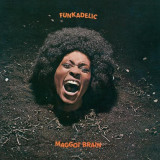
- A1: Maggot Brain
- A2: Can You Get To That
- A3: Hit It & Quit It
- A4: You & Your Folks, Me & My Folks
- B1: Super Stupid
- B2: Back In Our Minds
- B3: Wars Of Armageddon
- C1: Maggot Brain Live 1971
- D1: Maggot Brain Bmg Dub
7
également disponible
Deluxe edition[39,71 €]
1971 and Black America was luxuriating in the soft soul
of the O’Jays, the Temptations had just left behind their
flirtation with psychedelia, James Brown was
explaining Soul Power, Sly & the Family Stone were
having a Family Affair, and Marvin Gaye was asking
‘What’s Going On’.
• In their own inimitable way, Funkadelic were laying
down their own statement about the ecology of the
planet in the opening of lead and title track ‘Maggot
Brain’, turning it into an elegy for the Earth in the
ensuing heart-wrenching extended Eddie Hazel guitar
solo – one of the most radical records of the period.
• The album also spawned two Top 50 singles with the
usual Funkadelic wry observational humour of ‘You
And Your Folks, Me And My Folks’ and ‘Can You Get To
That’. And just in case you think things have
normalised, the set closes with nine minutes of the
chaotic sound collage ‘Wars Of Armageddon’.
• This 50th anniversary edition includes a second 12”
with two versions of the title track. Side A features the
live version from Meadowbrook from the same year that
the studio album came out. Jump forward 46 years to
the “Reworked by Detroiters” release and side B has
the BMG Dub, showing the enduring quality of one of
the great guitar records of all time.
• This issue is mastered from fresh transfers of the tape.
• Facsimile gatefold sleeve.
• 180gram black vinyl

- 1: Margaret Murie 02 46
- 2: Crux 04 07
- 3: Nameless 0 6
- 4: Eidetic 01 36
- 5: Thursday Night 03 09
- 6: Halve 03 12
- 7: Osco Drug 01 19
- 8: Lillian Isola 02 3
- 9: Safn 01 10
- 10: Maple Seed 02 21
- 11: Viridiana 03 29
- 12: Tet 01 51
- 13: God Innocent Controller 01 36
- 14: The Void 03 17
- 15: Alces 01 06
- 16: Pastel Dust 03 30
- 17: Where To 04 02
17
également disponible
Dark Green Vinyl[24,33 €]
American singer-songwriter, poet, and photographer Thomas Meluch, known musically as Benoît Pioulard, returns with his most structured and vocal release to date. Titled »Eidetic,« a word denoting the ability to recall mental images with extraordinarily rich precision, the album presents unprecedented clarity and vitality for Benoît Pioulard. To access its thematic ground, Meluch looked inward with an affinity towards the people he loves during a period marked by his move from Seattle to Brooklyn in 2019. The resulting work engages with the universe's unflinching mortality and, as he says, »the ways it has modified and improved my relationships, especially with family.« Embodied by the creek, leaves, and ferns of the cover photography — taken in Michigan’s Burchfield Park, where he and his dad used to hike and »muse on existence« — the music glistens and unfurls with the flow of life he’s come to know. »Eidetic« is the culmination of Meluch's craft both as a producer and writer. An evocative sonic vocabulary meets deft lyrical introspection, articulated with the nuance, vulnerability, and confidence of a longtime artist hitting a stride.
Meluch has continually refined, redefined, and adjusted the focus of his gentle pop project over the last 20 years. Recorded primarily with guitar, tapes, and voice — and spanning labels with albums for Kranky, Morr Music, Beacon Sound, and Past Inside the Present — his catalog flows seamlessly between ambient improvisation and pop composition. Much like the analog photos that often accompany his releases, songs can feel dreamily softened and distant, and others beautifully vivid and detailed. 2021 full-length »Bloodless« found Meluch deep in droning decay, expressive yet wordless. With »Eidetic,« he swings back to sharpened forms. Lush banks of treated guitar and synth brush against hushed percussion; there is mist in the distance, but everything up close is intricately constructed and radiant. Meluch's voice is notably forward in the mix — a warm and calming tenor, a harmonic coo more than a whisper — ever-observant and actively processing.
To record much of the album, Meluch filled a cabin in rural Maine with his usual setup of simple percussion, a couple of Fender electrics, and a parlor guitar made by his friend who does bespoke luthier work. The modest utility is what he knows best, and here he pushes the output to its most pristine potential.
»Eidetic« opens in a swirl of familiar haze; »Margaret Murie« eases listeners in, as lush and verdant as the landscapes conserved by its famed namesake. With the setting established, Meluch, the narrator, enters the foreground with »Crux,« a tender piece written about finding new motivations in a new city. »We covet this rare green hue / Here at the farthest point from home,« he sings above a reassuring pattern of strums and percussion. Meluch's prose shines on the swiftly-moving »Nameless,« inspired by the neurological effects that came with the antiquated practice of manufacturing mercury mirrors; »folks would slowly go insane while looking into their own reflections every day,« he adds. The idea informs a series of surreal abstractions before everything drops out in the final minute, and we are left free-floating in eerie nothingness.
Across the album, labyrinthine lyrical ponderings scatter with dazzling imagery, artfully blurring scenes from world history with Meluch's more personal, present-day. The propulsive and earnest »Thursday Night« catches his mind overly active and too stoned, riffing on black holes and songwriting itself. »Halve« references the splitting of the atom, what he considers »the beginning of man's downfall,« and the unrealized initiative proposed by the US government that would have created 'nuclear refuges' in its national parks. Meluch's loved ones weave throughout; »Tet« holds his father's experience in Vietnam and its lasting effects. »Lillian Isola« touches on his maternal grandmother's spinal curvature, and »Pastel Dust« navigates the wake of his cat, who died on New Year's Eve 2020.
At first blush, Meluch's atmospheric and melodic sensibilities resonate purely in their own right. Upon closer meditation, his ability to render stories — many of which surround human tragedy, misfortune, and understanding — through the prism of his poetry makes »Eidetic« even more rewarding.

- 1: Margaret Murie 02 46
- 2: Crux 04 07
- 3: Nameless 0 6
- 4: Eidetic 01 36
- 5: Thursday Night 03 09
- 6: Halve 03 12
- 7: Osco Drug 01 19
- 8: Lillian Isola 02 3
- 9: Safn 01 10
- 10: Maple Seed 02 21
- 11: Viridiana 03 29
- 12: Tet 01 51
- 13: God Innocent Controller 01 36
- 14: The Void 03 17
- 15: Alces 01 06
- 16: Pastel Dust 03 30
- 17: Where To 04 02
17
également disponible
Black Vinyl[24,33 €]
Dark Green Vinyl
American singer-songwriter, poet, and photographer Thomas Meluch, known musically as Benoît Pioulard, returns with his most structured and vocal release to date. Titled »Eidetic,« a word denoting the ability to recall mental images with extraordinarily rich precision, the album presents unprecedented clarity and vitality for Benoît Pioulard. To access its thematic ground, Meluch looked inward with an affinity towards the people he loves during a period marked by his move from Seattle to Brooklyn in 2019. The resulting work engages with the universe's unflinching mortality and, as he says, »the ways it has modified and improved my relationships, especially with family.« Embodied by the creek, leaves, and ferns of the cover photography — taken in Michigan’s Burchfield Park, where he and his dad used to hike and »muse on existence« — the music glistens and unfurls with the flow of life he’s come to know. »Eidetic« is the culmination of Meluch's craft both as a producer and writer. An evocative sonic vocabulary meets deft lyrical introspection, articulated with the nuance, vulnerability, and confidence of a longtime artist hitting a stride.
Meluch has continually refined, redefined, and adjusted the focus of his gentle pop project over the last 20 years. Recorded primarily with guitar, tapes, and voice — and spanning labels with albums for Kranky, Morr Music, Beacon Sound, and Past Inside the Present — his catalog flows seamlessly between ambient improvisation and pop composition. Much like the analog photos that often accompany his releases, songs can feel dreamily softened and distant, and others beautifully vivid and detailed. 2021 full-length »Bloodless« found Meluch deep in droning decay, expressive yet wordless. With »Eidetic,« he swings back to sharpened forms. Lush banks of treated guitar and synth brush against hushed percussion; there is mist in the distance, but everything up close is intricately constructed and radiant. Meluch's voice is notably forward in the mix — a warm and calming tenor, a harmonic coo more than a whisper — ever-observant and actively processing.
To record much of the album, Meluch filled a cabin in rural Maine with his usual setup of simple percussion, a couple of Fender electrics, and a parlor guitar made by his friend who does bespoke luthier work. The modest utility is what he knows best, and here he pushes the output to its most pristine potential.
»Eidetic« opens in a swirl of familiar haze; »Margaret Murie« eases listeners in, as lush and verdant as the landscapes conserved by its famed namesake. With the setting established, Meluch, the narrator, enters the foreground with »Crux,« a tender piece written about finding new motivations in a new city. »We covet this rare green hue / Here at the farthest point from home,« he sings above a reassuring pattern of strums and percussion. Meluch's prose shines on the swiftly-moving »Nameless,« inspired by the neurological effects that came with the antiquated practice of manufacturing mercury mirrors; »folks would slowly go insane while looking into their own reflections every day,« he adds. The idea informs a series of surreal abstractions before everything drops out in the final minute, and we are left free-floating in eerie nothingness.
Across the album, labyrinthine lyrical ponderings scatter with dazzling imagery, artfully blurring scenes from world history with Meluch's more personal, present-day. The propulsive and earnest »Thursday Night« catches his mind overly active and too stoned, riffing on black holes and songwriting itself. »Halve« references the splitting of the atom, what he considers »the beginning of man's downfall,« and the unrealized initiative proposed by the US government that would have created 'nuclear refuges' in its national parks. Meluch's loved ones weave throughout; »Tet« holds his father's experience in Vietnam and its lasting effects. »Lillian Isola« touches on his maternal grandmother's spinal curvature, and »Pastel Dust« navigates the wake of his cat, who died on New Year's Eve 2020.
At first blush, Meluch's atmospheric and melodic sensibilities resonate purely in their own right. Upon closer meditation, his ability to render stories — many of which surround human tragedy, misfortune, and understanding — through the prism of his poetry makes »Eidetic« even more rewarding.

Following well-received collaborative outings for us as 1/2 of the SF dynamo duo Moniker whose classic “Billy D” anthem and respective Patrice Scott remix graced the early catalog, followed by the galactic
flex Straylight EP with Cali brethren Dave Aju on velvet vocoder vox b/w a stellar Kai Alcé remix on the Another offshoot imprint, and of course his indelible contributions to the arrangements/derangement of the wondrous KAMM LP Cookie Policies, Kenneth Scott is essentially an extended family household name for our camp and so we’re beyond proud to present his initial solo release for the Circus Company label proper. Schooled as always in the deepest of electronic music roots and classiest of track traditions, the three pieces that form the Light Blooming EP puzzle display all the prized synth wizardry and production ingenuity we’ve come to expect from the Berlin-based veteran.
“Firesound” kicks us off in fine form, with a glistening array of pads and tight arpeggios that give way to a soulful funk strut that any fan of Detroit-style electro flavors will enjoy to the fullest. We then move to
the stylized 4/4 pulse of the aptly-titled “Lost Sonar”, an extended live set for Lost Sonar Collective skillfully condensed and finessed into a smooth-as-silk true deep house cut, where warm synth tones set the sound bed while shards of sharper percussion and angular textures flash and fizz throughout, creating an ultra-fresh contrasting feel while a rock-solid groove grinds us along faithfully. Scott then finally closes out the set with the powerful and titular “Light Blooming” which begins with a similar rising pad intro before unleashing fierce and raw overdriven drum programming, teasing us out to the two minute mark when the mighty sub bass line and multi-layered arps drop in to devastating effect, bubbling and building to a bold harmonic apex, before eventually bringing us down softly and somehow with ease
after such a glorious rise.
Filled with early-Warp feels and futurist sci-fi hopes in equal measure, the Light Blooming EP is three tracks of pure funk precision and expressive musical class from the man Kenneth Scott

- 1: Jamaica Girls - Rock The Beat
- 1: 2 Denroy Morgan - High On Your Love
- 1: 3 The Jiving Juniors - Sugar Dandy
- 1: 4 Chico Booth & The Upsetters - The Shimmy
- 1: 5 Lloyd Williams - Funky Beat
- 1: 6 Tommy Mccook & The Supersonics - Work Your Soul
- 1: 7 Owen Gray - Something To Remind Me
- 1: 8 Stranger & Patsy - Give Me The Right
- 1: 9 Vernon Vermont - Too Late
- 1: 0 Jimmy James - Come To Me Softly
- 1: Pat Kelly - Try To Remember
- 1: 2 Ronald Russell - Rhythm Hips
- 2: 1 Denroy Morgan - Happy Feeling
- 2: Marcia Griffiths - Everything I Own
- 2: 3 Norma Lee - Hurt
- 2: 4 The Downbeats - Thinkin' Of You
- 2: 5 Laris Mclennon - Turn Me Loose
- 2: 6 Jimmy James & The Vagabonds - Hey Girl
- 2: 7 Adiche - Chuka-Ja (Get Ready)
- 2: 8 Norma Lee - Rolling On
- 2: 9 Phyllis Dillon - Humpty Dumpty
- 2: 10 Hoagy Benson - Kangaroo
- 2: 11 Sugar Simone - Take It Easy
- 2: 1 Maynell Wilson - Motown Feeling
24
Rare Groove Collection Explore the fusion of world music with soul, funk and disco through the Rare Groove Collection. With this new volume, discover unique groove tracks straight from Jamaica! Fully remastered original versions Jamaican Rare Groove From the beginning of the 60s to the end of the 80s, Jamaica had a worldwide influence with ska, rocksteady, dub and reggae, but the small Caribbean island did not escape the global trends of funk, soul and disco. This mix of influences has given birth to unique groove songs, highlighted by this Jamaican Rare Groove. Double vinyl Jamaican Rare Groove From the beginning of the 60s to the end of the 80s, Jamaica had a worldwide influence with ska, rocksteady, dub and reggae, but the small Caribbean island did not escape the global trends of funk, soul and disco. This mix of influences has given birth to unique groove songs, highlighted by this Jamaican Rare Groove.

10
Innemuseum is the debut album by Danish composer, singer and multi-instrumentalist Cisser Mæhl. The 10 fragile compositions for vocals, sparse electronics and a myriad of instrumentation illuminate a hushed charm unlike few other Sonic Pieces releases to date.
The album sparked off while Cisser was working in a mountain lodge in mid Norway during summer 2019. On her spare time she would find herself recording mountains, rivers, stones, plants and animals in the beautiful scenery. After moving to Oslo shortly after, she rented a studio to further work on her own music, songs and sound processing. Through some friends she met Norwegian artist Jenny Hval who became an inspiration as she started taking solo classes with her. Jenny then pushed to contact producer Lasse Marhaug to work together. This became the last piece of the puzzle for Innemuseum to come to fruition as Lasse ended up putting the final touches on the album. When Cisser returned to Copenhagen after 7 months in Oslo, the album was finished. The title “Innemuseum” refers to both the dark months in Oslo and the retraction towards the inner self. An inner museum - music from within, both as a person and as in physical places.
This is undeniably a very personal record that sounds like the musical embodiment of Cisser herself. She sings in Danish in a close-miked way like she's sitting right next to you, all while gentle rhythms and soft strings together create a sort of bright, minimal chamber music with hints of pop sensibility. It almost feels like a Scandinavian reflection of Colleen's work in her more quiet, vocal periods. A music box of weightless compositions for the conscious mind.

9
également disponible
Cassette[14,50 €]
Dauw welcomes back Jogging House to the label for the first release of the year 2023. His new album Face is a synthbathed meditation on decay and acceptance and shows the typical Jogging House sound in which warm soundscapes are mingled with soft and playful melodies.
Boris Potschubay is a German musician based in Frankfurt am Main. Besides his own music, Potschubay curates his own label, Seil Records which forms a home for Hainbach, KMRU among others. Jogging House debuted in 2011 and brought us more than a dozen releases in the meantime. Listening to all the records chronologically one after the other, demonstrates us how Potschubay is experimenting a wide range of sound sources and creates a variety of atmospheres but stays true to its own individuality.

9
également disponible
Clear Vinyl[25,59 €]
Dauw welcomes back Jogging House to the label for the first release of the year 2023. His new album Face is a synthbathed meditation on decay and acceptance and shows the typical Jogging House sound in which warm soundscapes are mingled with soft and playful melodies.
Boris Potschubay is a German musician based in Frankfurt am Main. Besides his own music, Potschubay curates his own label, Seil Records which forms a home for Hainbach, KMRU among others. Jogging House debuted in 2011 and brought us more than a dozen releases in the meantime. Listening to all the records chronologically one after the other, demonstrates us how Potschubay is experimenting a wide range of sound sources and creates a variety of atmospheres but stays true to its own individuality.

blue marbled vinyl
It was only a matter of time before Bristol's most exciting purveyor of fast-not-hard atmospheric jungle landed on Time Is Now. Artificial Red - otherwise known as George Young - specialises in the genre's softer side, with each release immersing its listener in transcendental worlds that seem at once mechanical and organic. Grit EP is jungle with colour - watercolour - each track stained with shades of orange, yellow, blue and green. Whilst some feature raw percussive techniques to give them a raucous, club-focused edge, others incorporate soulful female vocals and keep things minimal. Whatever your taste, Grit EP might just be thing you didn't know you were looking for.

12
Anne's 7th Opus in 13 Years, Containing 6 Fantastic Covers and 6 of Her Own Songs, Recorded in One of the Most Prestigious Studios in Montreal with Her Original Blue Mind Team
Fresh from the success of her single "Killing Me Softly" from her previous album Keys to My Heart, Anne Bisson, singer-songwriter and jazz pianist, decided to perform and record more standards from the American jazz songbook, as well as new arrangements of classic songs that were so much a part of her teenage years.
Be My Lover, Anne's seventh album is, therefore, a savoury feast of original compositions and classic songs in her own bold new arrangements for acoustic trio. While still in the 'Smooth Jazz' genre, the presence of a Fender Rhodes, the legendary '70s keyboard, along with an electric bass, impart the album with quite a unique tone.
After over 18 months of musical experimentation and other creative endeavours, Anne once again brought together master drummer Paul Brochu (Gino Vanelli, Michel Legrand, UZEB) and proficient bassist Jean-Bertrand Carbou from France, for a series of informal sessions to explore the songs that were being considered for this seventh release.
These two musicians have been valuable collaborators for several years now. Paul has been featured on many of Anne's albums, notably Blue Mind, which made a huge splash when it appeared, with over 35,000 hard copies sold, while Jean-Bertrand's playing has also graced several of her albums.
Since 2009, the three have performed at several important venues, including Le Festival International de Jazz de Montréal, as well as other festivals in the United States and Mexico.
What holds them together is an evident complicity which is present from the very first notes. Their musical contributions are precise and deeply heart-felt. Their virtuoso playing greatly enhances these songs without turning them into mere technical exercises.
With precision playing, subtlety and attention to detail, as well as being recorded in impeccable High Definition, these songs will definitely please Anne's audiophile fans, while also appealing to a wider audience.
All About Ultimate High Quality CD (UHQCD)
Many years have passed since the birth of the Audio Compact Disc (CD) back in 1982. By use of High-Quality materials and a totally different manufacturing method, the definitive version of audiophile audio CD was born. Playable on any CD player, the Ultimate High Quality CD greatly surpasses all previous CDs before it!
The Ultimate High Quality CD (UHQCD):
UHQCD is a radical change to the CD manufacturing process itself. The conventional wisdom about CD manufacturing, which had remained largely unchanged across the world for over 30 years, has been exhaustively questioned. Through this effort, the ultimate in quality was attained - a level of quality that is certainly impossible to achieve with existing CD discs.
The Ultimate High Quality CD was developed through an effort to improve audio quality by simply upgrading the materials used in ordinary CDs to higher quality materials. For the substrate a high-transparency and high-fluidity polycarbonate (a type of plastic) of the type used for LCD panels was used, while for the reflective layer, low-cost, common aluminium was replaced with a unique and expensive alloy of high-reflectivity.
Differences in manufacturing methods:
Conventional CDs are produced using the technique of injection moulding to form "pits" of data on polycarbonate material. Metal plate on which "pits" representing audio source data are formed is used as a die. This is called the "stamper." Polycarbonate is melted at high temperature and poured into the die to duplicate the pit patterns on the stamper.
This method is efficient because it enables high-speed production, but it does not enable totally accurate or complete duplication of the pits on the stamper. As a melted plastic, polycarbonate is inevitably viscous, so it cannot penetrate completely into every land and groove of the tiny pits of the stamper.
The Ultimate High Quality CD photopolymer is used instead of polycarbonate to replicate the pits of the stamper. In their normal state, photopolymers are liquids, but one of their characteristic properties is that they harden when exposed to light of certain wavelengths. The advantage of this property, perfect replication of very finely detailed pits was achieved. Photopolymers in the liquid state are able to penetrate into the tiniest corners of pits on the stamper so that the pattern of the pits is reproduced to an extremely high level of accuracy. The Ultimate High Quality CD reproduces audio with greater precision and at a level that is impossible to achieve using conventional CD production technology!

7
West Midlands five piece MACHIAVELLIAN ART follow up their self released and self titled cassette only album with their first release proper, ‘Indoctrination Sounds’ released February 24th via Riot Season Records, with an eye popping promo video to go with it.
A Maximalist blowout of Sax-honking Noise Rock, Doom Metal, Hardcore Punk, and Shoegaze, with Industrial Noise, Howls, Paranoid Rambles, and pure Disdain for oneself and the rest of you layered on top.
Indoctrination Sounds was conceived in various practice spaces in Digbeth throughout 2020 and 2021 and recorded at Ian Boult's Stuck On A Name Studios in Nottingham in the Summer of 2021, despite the best efforts of a global pandemic. Will Killingsworth mastered the record at Dead Air Studios.
Serotonin Problem opens the record with a huge sludge bass riff before the rest of the band pile in on top to create an all-encompassing and oppressive low mood that continues for the rest of the album. Next, we spiral down into the more open and atmospheric post punk of Faceless Voices - the collective bad feelings of a nation in decline reach boiling point. Indoctrination Sounds, for which the record is named, is a hardcore punk song regarding the clear and easily understood ways that humanity in the Western World is indoctrinated into the death-cult of capitalism under fear of violence, soaked in misinformation and conspiracy. Revolution is a call to action as guitars shift and glide uncertainly around, in a menacing inversion of shoegaze's dreamy safety. Side A is finished - a brief respite.
Side B opens with the more introspective Let Down, as the band play out a pounding homage to Iggy and the Stooges with Fenriz taking a turn on the drums. The drum intro to We're Not Gonna Take It gives way to a Rusted Shut bassline as the band turns their disdainful gaze to the violent pornography that is the 24-hour news cycle and reality TV in Watch Them Crawl. The album closes with Digbeth B5, an improvised piece on the gentrification of Digbeth. During the pandemic one of the band's practice spaces was turned into an overpriced ping pong bar for yuppies. As our culture is softened and cleaned up to make profit, so are our communities and cities.
Machiavellian Art are : Amy Murphy - Bass Guitar Benjamin Thomas - Vocals and Saxophone Joe Parkes - Guitar and Noise John Andrews - Guitar and Vocals Sam Hunt – Drums

- A1: Time Again
- A2: Wildest Dreams
- A3: One Step Closer
- B1: Roundabout
- B2: Without You
- C1: Cutting It Fine
- C2: Intersection Blues
- C3: Fanfare For The Common Man
- D1: The Smile Has Left Your Eyes
- D2: Don't Cry
- D3: In The Court Of The Crimson King
- D4: Here Comes The Feeling
- E1: Video Killed The Radio Star
- E2: The Heat Goes On
- E3: Only Time Will Tell
- F1: Sole Survivor
- F2: Ride Easy
- F3: Heat Of The Moment
18
Die englische Rockband ASIA, die 1981 in London
gegründet wurde, verkaufte mehrfach Platin und gilt
weltweit als Superstars. "Heat Of The Moment", eine
riesige Soft-Rock-Hymne mit anhaltendem, weltweitem
Radioerfolg, ist ihr bestes und bekanntestes Stück, das in
über einem Dutzend Ländern die Top 40 erreichte. Diese
mitreißende Live-Show mit 18 Titeln von der Welttournee
zum 25-jährigen Jubiläum von Asia im Jahr 2007 zeigt die
neu formierte Originalbesetzung mit Sänger/Bassist John
Wetton von King Crimson, Gitarrist Steve Howe und
Keyboarder Geoff Downes von Yes und Schlagzeuger
Carl Palmer von Emerson, Lake & Palmer. Das Album
wurde am 8. März 2007 in der "Shinjuku Kosei Nenkin
Hall" in Tokio, Japan, aufgenommen und erscheint
erstmals auf Vinyl.
Das Booklet dieser neuen 3LP-Veröffentlichung enthält
seltene Fotos und Anmerkungen des bekannten
Asia-Autors Dave Gallant mit Originalzitaten der
Bandmitglieder. Das Cover-Artwork stammt von dem
legendären Designer Roger Dean, der alle Original-Cover
der Asia-Alben entworfen hat. "Fantasia" ist eine
beeindruckende Erinnerung an das majestätische
Vermächtnis dieser unglaublichen Band und an den
künstlerischen Werdegang der vier Originalmitglieder von
Asia. Dieses wegweisende Konzert ist ein unverzichtbares
Set

12
LEMON YELLOW VINYL
As mui zyu, Hong Kong British artist Eva Liu navigates the tricky territory of ever-changing identity, merging fantasy and folklore to create a stage for self-acceptance and deliverance. On her debut full-length Rotten Bun for an Eggless Century, Liu utilizes chopped-up sound- scapes, delicate industrial ambience and sweet pop melodies to introduce a character--a guide--who can be stretched across worlds to offer the catharsis of patience, perseverance and understanding. This isn't a character formed from a desire to escape or flee the real world, but rather a way to submerge even deeper into ourselves. Rotten Bun for an Eggless Century is a reflection of everyone, and everything, that made us who we are. On her 2021 a wonderful thing vomits, Liu was praised for her seamless integration of darkened, often ominous instrumentation and pillowy-soft vocals. As the front person of UK indie-rock trio Dama Scout, Liu effortlessly navigates a disorientating genre-bending sonic landscape with a playful, gentle dexterity. Now, with the help of Dama Scout bandmate Luciano Rossi as co-producer, Liu's first solo full-length builds upon these previous worlds to form a blossoming, more upbeat patchwork of lo-fi percussion, poignant lyricism and oddly alluring arrangements. The writing process of Rotten Bun for an Eggless Century prompted Liu to explore more of her Hong Kong heritage, allowing a space for acceptance and celebration. "I am Chinese and I am owning it," she explains. "Before, I would resent it. I tried doing things that would make me like less Chinese somehow." As the album began to take shape, Liu read the traditional Chinese folklore writings of Pu Songling and joined local East and Southeast Asian groups. It opened a portal into a new self, where Liu could blend her love of video games and film scores with traditional Chinese instruments.

12
Often credited as the “Mother of Hip-hop”, Sylvia Robinson was a seminal blues-turned-soul singer, producer, and writer who released a slew of sultry and sensually charged records in the 1970s as a solo act and in the duo Mickey & Sylvia. Pillow Talk remains her most intoxicating work; a steamy bedroom funk record featuring her illustrious breathy, intimate vocals embedded with silky acoustic guitars, lush orchestral strings, piloted by a series of soft, subtle, and seductive clubby rhythms that still sounds fresh and entrancing today.

The latest from Steve O'Sullivan and Mosaic's archive raiding series sees the first ever airing for an unreleased extended mix of the soft and soul-drenched 'Composure', plus two choice selections on the slip, the sleek sub-bass powered 'She Don't Do Chicks' and a dub mix of the equally streamlined 'Bumper Car'. If the A-side is a luxurious period piece of sorts - it could be related to Underground Resistance's 'Galaxy 2 Galaxy' for instance - then two on the other side could have been made yesterday they're so relevant and playable, coasting along with the kind of subtly jacking framework and dubby basslines that G Man made his own. All lovingly remastered at The Exchnage too.

8
Analogue Attic presents Bush Bash, the second album from Carla Oliver's solo ambient project, Badskin.
The album consists of 8 textural meditations, composed with layers of evolving pads and acoustic instrumentation.
Analogue Attic fans will recognise Badskin from appearances on Albrecht La'Brooy and Alex Albrecht records, or from her masterful live performances at their events.
Naarm/Melbourne underground rock enthusiasts will recognise her from bands such as Soda Eaves or Michael Beach.

- A1: Branislave Zivkovic - Morning Light (2:30)
- A2: B Zivkovic - Sundown (2:44)
- A3: B Zivkovic - Pastoral Walk 1 (0:45)
- A4: B Zivkovic - Pastoral Walk 2 (1:31)
- A5: B Zivkovic - Pastoral Walk 3 (2:11)
- A6: B Zivkovic - In The Garden 1 (1:25)
- A7: B Zivkovic - In The Garden 2 (1:35)
- A8: B Zivkovic - Soft Thoughts 1 (0:47)
- A9: B Zivkovic - Soft Thoughts 2 (0:36)
- A10: B Zivkovic - Soft Thoughts 3 (0:43)
- A11: B Zivkovic - Soft Thoughts 4 (0:38)
- A12: Andre Tschaskowski - Grief (1:20)
- A13: A Tschaskowski - Personal Mood 1 (1:45)
- A14: A Tschaskowski - Personal Mood 2 (1:10)
- B1: A Tschaskowski - Woodland Mood (1:40)
- B2: A Tschaskowski - Reminiscence (3:20)
- B3: A Tschaskowski - Sentimental View 1 (1:30)
- B4: A Tschaskowski - Sentimental View 2 (1:47)
- B5: A Tschaskowski - Sentimental View 3 (1:10)
- B6: A Tschaskowski - Sentimental View 4 (0:40)
- B7: A Tschaskowski - Moonset 1 (4:46)
- B8: A Tschaskowski - Moonset 2 (1:43)
- B9: A Tschaskowski - Emotional Tension 1 (0:33)
- B10: A Tschaskowski - Emotional Tension 2 (0:56)
24
Emotionally, crafted by Brainislave Zivkovic and Andre Tschaskowski in 1986 for Coloursound, is arguably the most beautiful library album ever produced. A start-to-finish masterpiece of powerfully melodic music for reflection and introspection. It is, indeed, deeply emotional.
Branislave Zivkovic handles the majority of Side A. Opener "Morning Light" evokes exactly that feeling, with a gorgeous and plaintive acoustic guitar solo combining with alto flute to stunning effect. Its immediate counterpoint, "Sundown", in no less arresting but brings with it an after-dark drama of almost Lynchian proportions, again drawing upon guitar and flute but with a slightly more melancholic, even sinister edge, also calling to mind Ry Cooder's score for Paris, Texas. It truly captivates when the strings arrive. Remarkable.
The reflective cello solo with swelling strings at the heart of "Pastoral Walk 1" ensure this track is aptly titled, with parts 2 and 3 adding more agitation - via keys and percussive elements - to great effect. "In The Garden 1" presents an elegiac cello solo whilst its second part elevates the romance. The four-part "Soft Thoughts" suite invites further introspection via reflective alto flute and guitar. Fans of The Durutti Column will need to seek this.
Andre Tschaskowski enters proceedings with three tracks at the end of the Side A. All of them aces in the pack. "Grief", whilst sorrowful, uplifts in its second half through beautiful keys. Equally hopeful are the two-part "Personal Mood" sketches, both dreamy exercises in optimistic ambience.
Tschaskowski controls the entirety of Side B. "Woodland Mood", with its pastoral flute and cor anglais and "Reminiscence", with its classical, emotional strings, both beguile. The piano and strings-heavy "Sentimental View" suite is one of the most beautiful, atmospheric things you will ever hear, particularly its second part. "Moonset 1" with it's wonderful Joe Pass-esque guitar is tense yet easy, the beauty elevated further with the introduction of strings and horns. The more restrained "Moonset 2" is pared back to its divine, sweeping essence and should surely have been sampled by now. To close out an album of almost impossible refinement, the brief 2-part "Emotional Tension" salvo brings both increased stress before resolving itself and the LP with a piano motif and atmosphere of serenity. Blessed relief.
As David Hollander, in Unusual Sounds: The Hidden History of Library Music, states, Coloursound was "founded in 1979 by composer, music lawyer, and vibraphonist Gunter Greffenius. A Munich-based library with a reputation for releasing innovative and ambitious music, it catered largely to the market for experimental sounds, its first release was 1980’s Biomechanoid, an abstract synthesizer excursion by Joel Vandroogenbroeck, of the pioneering kosmische band Brainticket. The record — complete with imposing, anonymous title and unearthly H.R. Giger cover art — set the tone for the label’s progressive leanings. The label’s catalogue stands as a tribute to the unfettered creative license that libraries were able to provide to forward-thinking musicians who, frustrated by the whims and constraints of the commercial scene, found complete freedom in the world of production music."
As with all our library music re-issues, the audio for Emotionally comes from the original analogue tapes and has been remastered for vinyl by Be With regular Simon Francis. Richard Robinson has brought the original Coloursound sleeve back to life in all its metallic silver glory.

Golf Trip is the new solo project of Gautier de Bosredon, former member of the Camel Power Club that he co-founded in 2013. The tracks he co-produced and co-wrote have now accumulated over 50 million listens on streaming platforms and the project is now touring all over Europe to present them.
Resulting from a writing that was done since his departure from the group, the music of Golf Trip is goovy and solar. The will to make a record which is soft and positive was the thread of all its realization. Long sessions allow the elaboration of a musical framework based on straight rhythmics, funky guitars and soft synthesizers.
A quiet fleet on board which the listener embarks for 6 tracks whose arrangements and mixing were realized by the Norwegian Olefonken (aka Hubbabubbaklubb).

11
Pink Vinyl
Canadian producer Dylan Khotin-Foote has kept his Khotin alias going for the better part of a decade; the impressionistic electronic project shifts with the movements in his life. Sometimes it leads, like when the club-friendly grooves of 2014's Hello World immersed him in the heart of Vancouver's underground dance scene, and sometimes it follows, like 2018's Beautiful You, a downtempo salve for DJ fatigue His melodic sensibility and playful ear for atmosphere remain the rippling core of the project's fingerprint; whether beat-driven or ambient, a foggy smear or a dusted and pristine print, a Khotin track has a distinct and instantly recognizable swirl. During and after the 2020 release of Finds You Well, his second LP on Ghostly International, Khotin-Foote settled back into a slower vibe in his hometown of Ed- monton. Even before the pandemic, his pivots to softer production, and away from DJing, left him with fewer opportunities in Vancouver and club bookings overall, and as a self-identifying introvert, he was fine with that. But the change of pace did open space for Khotin-Foote to grapple with concepts of adulthood and career. At his lowest, he almost walked off this musical path altogether; instead, he doubled down on the craft _ the tone, pacing, and dynamism of new material _ arriving at a definitive full-length. With Release Spirit, Khotin releases himself from the pressure of expectation, fusing and refining everything we know about his music. The warmth and familiarity of Khotin's dreamy, dulcet style meet new ideas and frameworks, a natural progression, a modest revelation; Khotin confirms it is okay to move slowly and he's never sounded better doing it. The album title borrows from the "release spirit" mechanic in the video game World of Warcraft. When players die, they are prompted to release their spirit and return as ghosts to find their corpses and come back to life. Khotin sees it as a worthy metaphor for the impending change his return home presented and the resulting process of purging artistic expectations to find his creative self again. On this go- around, he is freer, more playful, and more intentional within his palette of warped synth, breakbeats, and piano sounds _ including the classic Casio SK-1 presets he's used since the start _ mingling with wistful samples, field recordings, and other abstract snippets. For the first time, he enlisted Nik Kozub to do the mix and assist with sequencing. Khotin-Foote has long worked with the Edmonton-based musician and engineer in the mastering phase, as well as their days co-running the label Normals Welcome, and this time was able to involve his ears earlier given their newfound proximity. "I think it's my best sounding record to date." We begin on "HV Road" or Happy Valley Road, where Khotin-Foote spent time during a family vacation in British Columbia's Okanagan Lake. His plans to record crickets at night are quickly foiled by his younger siblings; the cute exchange orients the listener to a core memory of sorts, setting the tone of universally understood warmth and wonder that has defined some of Khotin's most transportive tracks. Hazy percussion takes hold, and we are swept further into the wisp of "Lovely," a grooving, melodic standout built on the interplay between the beat and human voice-like hums. Khotin knows this zone well; equally suited for a reverie or a club warm-up. The bubbling atmosphere and absurdity of "3 pz" offer a cosmic/comic interlude and also speak to reflections on his family's move to Canada two generations ago, and the audio tutorials they used to learn English. "I can only imagine my grandpar- ents repeating some of the bizarre phrases." "Fountain, Growth" finds Khotin in collaboration with Montreal's Tess Roby (Dawn to Dawn) for the project's first-ever vocal track. Roby's soft cadence echoes atop spiraling air pockets of rhythmic production, lending a breezy, almost shoegaze pop feel. Throughout the single and the album, wind gusts between the compositional layers, akin to the roaming spirits of its namesake, curving around the birdsong of "Life Mask" and seamlessly reaching "Unlimited <3." The latter bumps in slow motion; disembodied whirrs from his Casio collide with 808 drums and sub-bass for a vibe that teeters on trap and instrumental hip-hop. Release Spirit rests in a dream sequence. Oscillating synth lines dance around the heartbeat of "Techno Creep," a hyperactive REM state before the digitized ambient sprawl of "My Same Size." In the final pass, Khotin imagines transcontinental travel from the glow of his screen. He recorded "Sound Gathering Trip" to soundtrack a genre of YouTube videos he's taken to that follows train routes through Europe and Japan. The scene is serene and moving; piano keys warble as static-filled sound design shimmers off the rails, from cityscapes to the countryside, an introspective ride through a world beyond his bedroom. It doubles as an apt parting image for Khotin's project as a whole: dreaming big but happiest when riffing on the details, shaping environments from the inside out. Over the last decade, he has stretched from his core in Edmonton, leaving a trace in Vancouver and beyond; but when all signs point home, he loops back to see it all from a different vantage, revitalized, refined, and free.
