The Great Alternative Boom of the early ’90s had begun to wither on corporate FM barely halfway through the decade, but the ever-changing underground had almost entirely regenerated after two major-label thrifting trips. In the ever-in-flux city of Boston, Karate positioned themselves as a crucial tendril in a sprawling nationwide community. They did so largely by refusing to stick to any single formula from the myriad of styles at their root—slowcore, post-hardcore, and jazz. As if to make a point, Karate’s lineup went through its own shift too. In the lead up to 1997’s In Place of Real Insight, Eamonn Vitt took up the guitar, and Karate compatriot Jeff Goddard entered the fold to become the band’s bassist. Armed with two guitarists, the band got significantly louder, and they smeared punk fury all over their second LP.
Search:themselves
The Great Alternative Boom of the early ’90s had begun to wither on corporate FM barely halfway through the decade, but the ever-changing underground had almost entirely regenerated after two major-label thrifting trips. In the ever-in-flux city of Boston, Karate positioned themselves as a crucial tendril in a sprawling nationwide community. They did so largely by refusing to stick to any single formula from the myriad of styles at their root—slowcore, post-hardcore, and jazz. As if to make a point, Karate’s lineup went through its own shift too. In the lead up to 1997’s In Place of Real Insight, Eamonn Vitt took up the guitar, and Karate compatriot Jeff Goddard entered the fold to become the band’s bassist. Armed with two guitarists, the band got significantly louder, and they smeared punk fury all over their second LP.
- A1: Jean-Pierre Djeukam - Africa Iyo
- A2: Joseph Kamga - Sie Tcheu
- A3: Los Camaroes - Ma Wde Wa
- A4: Los Camaroes - Esele Mulema Moam
- B1: Ndenga Andre Destin Et Les Golden Sounds - Yondja
- B2: Damas Swing Orchestra - Odylife
- B3: Charles Lembe Et Son Orchestra - Quiero Wapatcha
- B4: Louis Wasson Et L'orchestre Kandem Irenee - Song Of Love
- C1: Tsanga Dieudonne - Les Souffrances
- C2: Pierre Didy Tchakounte Et Les Tulipes Noires - Monde Moderne
- C3: Willie Songue Et Les Showmen - Moni Ngan
- C4: Mballa Bony - Mezik Me Mema
- D1: Johnny Black Et Les Jokers - Mayi Bo Ya?
- D2: Pierre Didy Tchakounte - Ma Fou Fou
- D3: Lucas Tala - Woman Be Fire
- D4: Ndenga Andre Destin Et Les Golden Sounds - Ngamba
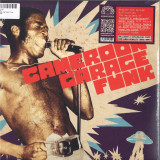
We are extremely proud to announce our 32nd compilation from the Analog Africa regular serie, "Cameroon Garage Funk", highlighting Yaounde's 1970's underground music scene. The quest to assemble the puzzle-pieces of what seemed to be a long lost underground scene took us to Camroon, Benin and further on to Togo and it was in the cities of Cotonou, Lome? and Sotouboua that we managed to lay our hands on most of the songs presented in this compilation. Since there were no local labels, no producers, and almost nothing in way of infrastructure in Cameroon at that time, the artists had to be everything: musician, producer, executive producer, arranger, financier, promoter and sometimes even distributor. The sixteen tracks on Cameroon Garage Funk pulse with raw inspiration and sweat DYI mood uniting the featured diverse musicians around their willingness to do everything themselves in order to take a chance in the music scene.
Power punks, Hot Milk, have announced their second EP, ‘I JUST WANNA KNOW WHAT HAPPENS WHEN I’M DEAD” via Music For Nations.
It follows the success of the band’s first EP, 2019’s ‘Are You Feeling Alive?’, a fizzy collection of gutsy emo-pop which established them as one of the most exciting new bands in the UK. Their 2019 was a whirlwind year that saw them tour with Foo Fighters, Deaf Havana and You Me At Six, as well as playing some of the UK’s biggest festival stages.
The band were formed in 2018 by vocalist and guitarist duo, Han Mee and Jim Shaw, two friends who met working behind the scenes in the Manchester music scene. Yet they yearned to be in a band themselves. “We got to the point where we were why not? What else have you got to lose?” says Jim. “We thought, we can go for this or we can get to 60 and know we didn’t do right by ourselves.”
Debut EP, ‘Are You Feeling Alive?’, which was penned during a drunken songwriting session, was an effervescent refusal to settle for second best in life. “We’ve both realised that life you don’t get another face,” Han continues. “You get one face and then you’re done, and you will never exist ever again.”
That sense of not letting life slip through your fingers is at the core of Hot Milk’s punk-indebted ethos. And having taken a leap of faith to grasp their platform, the band, completed by bassist Tom Paton and drummer Harry Deller, aren’t about to let it go to waste. “Art is about your interpretation of your own experience,” adds Jim. “The first EP was written five years ago. We’ve grown up and realised who we are and what the world is like right now.”
‘I JUST WANNA KNOW WHAT HAPPENS WHEN I’M DEAD’, which was produced by Jim Shaw, is another vivacious call to arms, rammed with sharp hooks and huge, catchy choruses, to encourage everyone, everywhere, to follow their dreams. But elsewhere, the lyrics are more personal, with the band bottling the anxieties and frustrations of their everyday lives. ‘Woozy’ openly tackles depression, ‘Good Life’ takes on societal corruption and the distribution of wealth, while elsewhere the band address the pursuit of happiness in a modern world.
“These songs are honest,” says Han. “I have nothing to hide. Everyone’s on antidepressants these days. It’s the world we live in, it makes people sad. Capitalism. Is it broken? 100 per cent. I’m angry that the fact that we’re sold a world that actually doesn’t make your inner peace happy. Humans need love and community and a lot of the time, there is no love and the community has dissolved.”
“The anger resides in us at the unfairness of the world,” adds Jim. “Online communities are all about flexing and battling your peers to look or sound a certain way that is better than everyone else. It’s constant and it’s dangerous. You’re teaching kids that to be content, you have to be best. It’s a question again. Are you really living?”
“We’re angry, both politically and existentially in terms of the system we now live in. But also, we’re angry at the fact that we’re sad quite a lot,” continues Han. “But we’re trying to not just sit there and take it. We’re trying to fix it, by building a family through this band.”
Walk into any Hot Milk show and you will feel that sense of community. Through their honest lyrics and inclusive approach, the band say their aim is to create an “aggressively space safe” where fans are empowered to be themselves, “authentically and unapologetically”, as well as opening up a dialogue for people to talk. That will become clear later this year when the band get their chance to air the new material. This summer, they will return to Reading and Leeds Festivals, this time to play the main stage, as well as embarking on a headline UK tour in September. And believe, when the times comes to finally get back into those sweaty pits, these new songs will provide the perfect, life-affirming soundtrack.
“Life is fragile,” says Jim. “You can’t take things with you, but you can make the best memories. That’s the most important thing in life. Your currency is your memory.” “What you can take with you is something that absolutely makes the blood pump round your veins and gives you goosebumps,” agrees Han. “That’s what this band is to us. It’s our passion. That’s what this EP is about.”
Spirits Having Fun records are ones made from and for shows and spaces—arrangements rooted in a deeply collaborative process, that come to life through intuitive and locked-in live improvisation. Following their 2019 debut Auto-Portrait, Two finds the New York and Chicago based four-piece continuing to challenge ideas of what a rock band can be, pulling apart their musical experiences and reimagining them as kinetic compositions, equally studied but palpably organic.
Two is constructed around gut feelings and strong grooves, elastic rhythms and playful pacing. Its twelve songs expand, contract, and make sharp turns between melodies under singer-guitarist Katie McShane’s meditative lyrics. “Broken Cloud,” which was also released last year on a compilation in support of Chicago Community Jail Support, offers a glimpse into her reflections on the natural world: "A city grew out of the ground / to a mountain it's only a blur."
True to its name, the internal logic of the band is also just a lot of fun, built on trust and deep-rooted musical relationships. Before there was Spirits Having Fun, McShane, bassist Jesse Heasly, guitarist-vocalist Andrew Clinkman, and drummer Phil Sudderberg had performed together in various arrangements over the years. McShane, Heasly and Clinkman met in a specific corner of the Boston underground in 2013, a time when a scene had coalesced around students from local music conservatories frequently collaborating with punk bands and noise artists, exchanging ideas and warping musical worldviews. Heasly and Clinkman played together in Cowboy Band, making mutant, free jazz-inspired takes on old country tunes. When Clinkman moved to Chicago, Heasly and McShane played in experimental groups like EKP and Listening Woman; in Chicago, Clinkman met Sudderberg playing in projects like jazz scene fixture Ken Vandermark’s high-powered band Marker.
Spirits first came together as an attempt at a long-distance collaboration among friends in 2016, driven by the simple feeling of missing each other; they’d meet up for marathon weekends here and there to practice, playing small loops through dive bars and art spaces around the Midwest—just enough for McShane and Heasly to afford plane tickets back home. Being split between Chicago and New York forced the project into a deliberate pace. “We tried to take it slow and let it be what it was,” said McShane. That sense of patience unexpectedly prepared them for March of 2020, when their planned tours and the release of Two were indefinitely delayed.
Two was mostly recorded in the summer of 2019 with the help of omnipresent Chicago engineer Dave Vettraino and DPCD’s Alec Watson, whose contributions on organ, synths, and piano are laced throughout the record. The album reflects a synthesis of solitary and communal songwriting processes—each song drawing on fragments written by individuals, which McShane threaded together and shaped through her distinct compositional lens, making the songs whole before returning to them to the band to mature collectively. When composing, McShane writes first on the keyboard before adapting parts for guitars played by herself and Clinkman. Their dueling approaches to guitar are complementary: McShane, being a newer guitarist, brings a freshness to the project (“I'm just discovering the whole time,” she says) while Clinkman has been playing since childhood.
“There's a lot more collaboration on this record,” says Clinkman, “in terms of all of us letting stuff bloom a little bit more.” The record’s first single, “Hold The Phone” is a good example of this process—it started with a playful intro riff from Clinkman, a melody and bridge added by McShane, a wobbly outro groove added by Heasly, which Sudderberg brought to life. Another single, the dynamic “See a Sky,” written primarily by Heasly, underscores the rhythm section chemistry at play across the record, the song ebbing and flowing around Heasly and Sudderberg’s eclectic percussive palettes.
“Entropy Transfer Partners” is the only song on the record with lyrics by Clinkman, and the album’s most politically direct—a call for solidarity in the face of systemic failures, an acknowledgment of the shared material devastation caused by our country’s ongoing healthcare and housing crises: “These are not things we're experiencing individually. We struggle through them collectively. And we could actually declare, all of us, that it doesn't have to be this way, and fight and organize to ameliorate some of those conditions.” (“We won't work to create the shit you monetize, to run our lives,” they sing.)
From front to back, Two is an absorbing listen simply for its impressive range. But as the members explain themselves, the complexity of the record is about more than its intricate riffs, or how often they count out an odd time signature, but how they reject the notion of boxing the songs in, letting the melodies take on lives of their own. “Making music that feels alive is important to us,” says Clinkman. “Music feels most powerful to me when it deepens our sensation of feeling alive and connected to other humans. It’s so easy to feel worn down and isolated; that your life’s value is fixed to your productivity at your job, or the things that you have or don’t have. Making music that feels joyful and fun seems like one effective antidote to that feeling.”
Deluxe Edition[33,57 €]
Portuguese experimental trio 10 000 Russos are gearing up for the release of their fifth album ‘Superinertia’, which is due out September 10th on Fuzz Club Records. Following on from 2019’s ‘Kompromat’ LP and tour dates around the UK, Europe and Mexico in support, the Porto-based band describe ‘Superinertia’ as a record addressing the “state of inertia that humans live in the West nowadays. It isn’t a record about the past or future. It’s about now.” For all that ‘Superinertia’ might take aim at a world without motion, however, the same cannot be said of 10 000 Russos themselves.
On the one hand, since their 2013 debut LP and the three that have followed on Fuzz Club since (2015’s self-titled, 2017’s ‘Distress Distress’ and ‘Kompromat’), 10 000 Russos’ music has always been about as kinetic as it gets: a truly unrelenting and motorik sonic force. On the other hand, ‘Superinertia’ also sees the band itself move into whole new musical territories – aided especially by the recent addition of synth player Nils Meisel to the line-up (who replaces former bassist André Couto.)
“The synths really opened up the sound of the band and gave more routes for the music to journey down. The most important thing on this album was to not repeat ourselves. A new arc in our sound is coming to life”, drummer and vocalist João Pimenta explains. On said arc, the Russos sound is expanded to include moments that invoke Ry Cooder’s ‘Paris, Texas’ soundtrack (‘Mexicali/Calexico’), dancey outbursts that transport you to the 90s Summer of Love (‘Super Inertia’), the closest thing Russos have ever done to a pop song (‘A House Full of Garbage’) and even a touch of banjo (albeit one that sounds like a country band on amphetamines playing over a feedback-blasted Stooges beat.)
“10 000 Russos are bizarre and excellent in equal measure.” - The Quietus
“Songs drip with heavy echo, relentless beats and bass and a sense of charging into the ultimate infinite.” - Bandcamp Daily
“Something unholy has indeed been summoned out of the ground, and it is a power trio from the Iberian Peninsula.” - Clash Magazine
Blue vinyl[26,43 €]
Portuguese experimental trio 10 000 Russos are gearing up for the release of their fifth album ‘Superinertia’, which is due out September 10th on Fuzz Club Records. Following on from 2019’s ‘Kompromat’ LP and tour dates around the UK, Europe and Mexico in support, the Porto-based band describe ‘Superinertia’ as a record addressing the “state of inertia that humans live in the West nowadays. It isn’t a record about the past or future. It’s about now.” For all that ‘Superinertia’ might take aim at a world without motion, however, the same cannot be said of 10 000 Russos themselves.
On the one hand, since their 2013 debut LP and the three that have followed on Fuzz Club since (2015’s self-titled, 2017’s ‘Distress Distress’ and ‘Kompromat’), 10 000 Russos’ music has always been about as kinetic as it gets: a truly unrelenting and motorik sonic force. On the other hand, ‘Superinertia’ also sees the band itself move into whole new musical territories – aided especially by the recent addition of synth player Nils Meisel to the line-up (who replaces former bassist André Couto.)
“The synths really opened up the sound of the band and gave more routes for the music to journey down. The most important thing on this album was to not repeat ourselves. A new arc in our sound is coming to life”, drummer and vocalist João Pimenta explains. On said arc, the Russos sound is expanded to include moments that invoke Ry Cooder’s ‘Paris, Texas’ soundtrack (‘Mexicali/Calexico’), dancey outbursts that transport you to the 90s Summer of Love (‘Super Inertia’), the closest thing Russos have ever done to a pop song (‘A House Full of Garbage’) and even a touch of banjo (albeit one that sounds like a country band on amphetamines playing over a feedback-blasted Stooges beat.)
“10 000 Russos are bizarre and excellent in equal measure.” - The Quietus
“Songs drip with heavy echo, relentless beats and bass and a sense of charging into the ultimate infinite.” - Bandcamp Daily
“Something unholy has indeed been summoned out of the ground, and it is a power trio from the Iberian Peninsula.” - Clash Magazine
The edition that marks the start of the brand-new Comets Coming could not be more suitable: it is that Rodrigo Brandão, like his grandfather Herman Poole Blount, dust of stars that the world knows as Sun Ra, may have his feet on the Earth, but he has definitely a sidereal head.
Brandão arrived recently to Portugal, but already left a strong mark in the most adventurous Lisbon scene, having performed several concerts in which his language has been wrapped in the exploratory sounds of musicians such as Rodrigo Amado, João Valinho, and Hernâni Faustino. The agitator, poet and spoken word artist, brought a vast experience that over the years saw him collaborate with artists as distinct as the members of Metá Metá or Prince Paul (that one!) on BROOKZILL!.
This work, however, came in his luggage, across the ocean, on the rediscovery trip that brought him from Brazil to Lisbon. OUTROS ESPAÇO was recorded in São Paulo in late 2019 with a luxury crew: Tulipa Ruiz and Juçara Marçal added to the microphone, Thiago França played flute and alto & tenor saxophones, Guilherme Granado dealt with the synthesizers and effects, Marcos Gerez measured the overall pulse with his electric bass, Thomas Rohrer played soprano and 'rabeca' (fiddle), and Paulo Santos dealt with the percussion. In addition to the base band, OUTROS ESPAÇO also features some members of Sun Ra Arkestra's current incarnation. Respectively: Danny Thompson (RIP) on baritone and bongo, Elson Nascimento on 'surdo' (tom drum), Knoel Scott on tenor and soprano, with the giant Marshall Allen in a prominent role leading the collective towards the unknown, while playing the alto sax and synthesizer.
In OUTROS ESPAÇO, Brandão reaches for words from different origins, from contrasting times and cultures, all with magnetic resonance imaging: what is not from his furrow comes to him from Candomblé (“Quando Os Orixás Desfilam Sobre A Cracolândia”), from his readings of Sun Ra (“Eu Sou 1 Instrumento” is an adaptation of the poem I Am An Instrument), or from the school's playgrounds (“Jamais Nos Esqueceremos”). And in these words there are teeth and nails ingrained in injustice (“Quantos Coltrane...?, “Todo o Dia Tem +”) and kaleidoscopic delusions that result from the speed of light (“Sol da Meia Noite”).
The crew that travels through these OUTROS ESPAÇO (PT for "Other Spaces") has freedom as the main fuel, jazz as a measure of their reach, and all swings in the world as maps, so they can lose themselves at the end of the cosmos. There is urgency and reflection, craziness and precision, surprise and well-known ancestral raw material, that makes us vibrate inwardly with the same trembling as the comets that are coming.
The visionary and veteran Scotty Hard was responsible for making everything sound like the music of the spheres, dealing with the mixing from his INGUASONIC SOUND studio in Brooklyn, NY.
And lastly, in January, Rob Mazurek, another frequent ally of Brandão, another notorious space traveler, offered a poem that frames this project. Among other things, he writes:
Make this place sing
Make this place thunder
Make this place shake
It couldn't be in any other way.
"Ultra, The 12 Singles", a collector's edition deluxe box set, contains eight 12" vinyl discs presenting four singles - "Barrel of a Gun", "It's No Good", "Home", and "Useless" with key B sides, mixes and live recordings contemporaneous to Depeche Mode's ninth studio album, Ultra, originally released April 14th 1997. Three of the 12" vinyl discs in Ultra The 12" Singles are comprised of tracks first released on CD singles throughout 1997. Each of these new 12" discs features artwork reflecting the original CD single releases, now expanded to 12" vinyl for the first time. Audiophile quality 12" vinyl, with audio mastered from the original tapes. The artwork for the exterior box sets draws on iconography inspired by the original releases, while the vinyl sleeves themselves feature the original single artwork. Very limited. Stock will be allocated.
This year Music On Vinyl in cooperation with Sony Music and Alex Callier are releasing 4 Hooverphonic remix Eps. Each EP represents a Hooverphonic album; A New Stereophonic Sound Spectacular, Blue Wonder Power Milk, The Magnificent Tree and Presents Jackie Cane. Alex Callier selected the best remixes of their songs for each remix EP. All 4 remix EP’s are scheduled for release in 2021 and are cut on 45 RPM and pressed on 180 gram audiophile vinyl.
Hooverphonic are a Belgian band that formed in October 1995. Though originally categorized as a trip hop group, they quickly expanded their sound to the point where they could no longer be described as a lone genre, but rather encompass alternative, electronica, electropop, rock, and a mixture of others. The band originally called themselves Hoover, but later changed their name to Hooverphonic after discovering other groups were already using the Hoover name and to avoid any legal issues with the vacuum cleaner company.
Since their formation, Hooverphonic’s lineup consisted of bassist Alex Callier, guitarist Raymond Geerts, and various lead singers. Geike Arnaert (1997–2008, 2020-present) has recently re-joined the band. Hooverphonic represented Belgium in the Eurovision Song Contest 2021.
The band achieved international recognition through the inclusion of the Stereophonic track “2Wicky” on the 2000 individually numbered copies of Blue Wonder Power Milk remixes are available on on solid blue vinyl.
In the Company of Serpents traffic in sonic catharsis. Their music inhabits the strange fringes between sludge metal and sprawling spaghetti western scores, constantly striving for visceral power and raw intensity, contrasted with eerie, spare instrumental passages. Founded in Denver, Colorado in 2011 the band quickly managed to establish a name for themselves. Several releases followed in the years to come and In the Company of Serpents managed to impress the masses on stage as well. Late 2019/early 2020 the band started to work on their album ‘Lux’. It turned out to be one of the most impressive Doom/Sludge Metal albums ever recorded. The band self-released the album in limited edition during 2020 but soon afterwards Petrichor noticed their supreme musical qualities and decided to offer the band a chance to release the album worldwide. A deal was made, hands were shaken and you now all have to face the impending doom before you. The music of In the Company of Serpents is so intense it mimics the gravitational pull of a black hole.
Time and troubles seem to melt away during the fifteen enrapturing minutes of “Idle Moments,” the opening track of Grant Green’s sublime 1963 album of the same name. As the piece unhurriedly unfurls all the unique colours of the ensemble present themselves with Green’s soulful guitar joined by Duke Pearson’s elegant piano, Bobby Hutcherson’s crystalline vibraphone, Bob Cranshaw’s reassuring upright bass, Al Harewood’s subtle drums, and Joe Henderson’s magnificent tenor saxophone. The pace quickens for the rest of this tremendous set including the nimble Green original “Jean de Fleur,” a bluesy take on John Lewis’ MJQ standard “Django,” and a driving performance of Pearson’s original “Nomad.” This Blue Note Classic Vinyl Edition is all-analog, mastered by Kevin Gray from the original master tapes, and pressed on 180g vinyl at Optimal.
Mannequin Records is elated to present for the first time on vinyl the reissue of Giovanotti Mondani Meccanici’s first video soundtrack, originally released in 1984 as an audiotape in less than one hundred copies. Giovanotti Mondani Meccanici (literally Mundane Mechanical Youth) or GMM was one of the most unclassifiable audiovisual experiences to emerge from Italy in the 1980s. Maurizio Dami a.k.a. Alexander Robotnick, a pivotal member of GMM, was responsible for the group’s music output.
Founded in 1984 by Antonio Glessi and Andrea Zingoni in Florence, GMM was an art collective whose production represents the quintessential expression of postmodern transmedia hybridity. GMM pioneered the genre of computer comics, created video installations, developed “multiple identity” performances, and was involved in fashion, media, and music productions, and later on produced cyberdelic environments, artificial reality projects, and proto-memes.
Alexander Robotnick’s first contribution to GMM was this soundtrack for the group’s eponymous first video, the animated version of a computer comics they coincidentally published on legendary Frigidaire magazine. Restored by Dami and reissued here for the first time by Mannequin Records, the composition was also split into two “suites” and released as an audiotape distributed by Materiali Sonori, also responsible for other releases by both Robotnick and GMM.
Determining in this work is Dami’s adoption of the alphaSyntauri, also known as the first affordable digital synth (priced less than $2000 when it was released in 1980), which was playable through its own software, “alphaPlus,” on the Apple II computer. The same computer was used by Glessi to “draw” the 3-bit strips scripted by Zingoni recounting the joyrides of the Giovanotti Mondani Meccanici, three merciless cyborgs in black suit and sunglasses dividing their time between nightclubs, rapes and murders.
As Robotnick, Dami developed an innovative formula of Italo disco that was attractive to the dance floor yet at the same time highlighted the expressive properties of the instruments he used, notably Roland drum machines and Korg synthesizers. For the soundtrack of GMM’s videos and installations, he left aside the danceable synth rhythmics in favor of ambient sounds that produced rarefied atmospheres, psychological tensions, and enhanced states of consciousness.
Dami’s scores for GMM’s artworks could be associated with Italian avant-garde music of the 1970s and 1980s, ranging from composers who adopted electronics flirting with pop and songwriting to minimalist musicians exploring seriality and drones, including Franco Battiato, Roberto Cacciapaglia, Francesco Messina, and Riccardo Sinigaglia. Analogies could also be traced with the playful and humanizing approach to personal computers that characterizes the music output of Marcello Giombini and Doris Norton.
The futuristic escapism of minimal synth and ambient music’s psychological nature is infiltrated by drifting harmonics typical of new age, as if in search of a spiritual dimension of technology. Characteristic of the postmodern ethos of GMM Suite, in line with the humanizing approach to technology that is at the base of GMM’s computer comics, is the melancholic take at speculative dystopias in which human beings would find themselves increasingly trapped into identity crises: a true cyborg’s melodrama.
‘Headsoup’ is a new compilation that deepens the legend of mysterious Swedish psych collective Goat even further. Collecting rarities from across band’s celebrated career, including standalone singles, B-sides, digital edits and two enormous brand new tracks, it’s a globetrotting acid trip of a record that’s even bigger in its scope than their acclaimed studio LPs.From the incendiary heavy psych of their earliest work, like debut B-side ‘The Sun And Moon’, to the serene ‘Requiem’-era alternate take ‘Union Of Mind And Soul’, to the simmering menace of their latest material, it’s a record as multifaceted as Goat themselves, packed with detours in every conceivable direction.Taking in jazz-flute solos, pounding Afrobeat rhythms, ferocious desert blues, drifting Ethio-jazz, this is, as the name of Goat’s first album made clear, ‘World Music’ in its most complete form, a sound unrestrained by genre boundaries. Yet the band are anything but lazy appropriators. They approach their forebears with upmost reverence, articulating a celebratory cultural cross-pollination.And what about these two new tracks? ‘Fill My Mouth’ is a scuzzy psychedelic funk knockout, the sleaziest thing the band have ever recorded. ‘Queen Of The Underground’, meanwhile, is truly herculean, a swaggering psychedelic powerhouse of the very highest order.Sometimes dark and heavy, at others joyous and beautiful, like Goat themselves ‘Headsoup’ is mysterious, and constantly shapeshifting, difficult to properly pin down but constantly enthralling. Almost a decade since they first emerged from the depths of Scandinavia, there is still no other band on earth that sounds quite like them.
Black Truffle is pleased to announce Parampara Festival 13.3.1992, a stunning performance by Amelia Cuni captured live in Berlin almost thirty years ago. Milanese by birth and resident in Berlin for many years, Cuni lived in India for over a decade, studying the classical vocal style of dhrupad under masters of the form. Though perhaps known to many listeners primarily through her performances of the vocal music of John Cage and collaborations with Werner Durand and Terry Riley, she is recognised internationally as one of the great contemporary proponents of traditional dhrupad singing. These recordings document her performance at the 1992 Parampara Festival at the Haus der Kulturen der Welt, a landmark event celebrating the global spread of Indian classical music, bringing together Indian teachers with their international students.
Accompanied by Gianni Ricchizzi on vichitra vina (a plucked zither played with a glass ball slide) and her own tanpura, Cuni stretches out for a languorous side-long performance of the late night Raag Bageshri, the limpid tones of her vocal improvisations illuminating the droning strings like flashes of the moon revealed by rushing clouds. Initially working patiently through a series of subtle dialogues between Cuni’s melodic extemporisations and phrases in response from Richizzi’s vichitra vina, the performance builds to a series of strikingly beautiful, virtuosic held notes from Cuni at the beginning of its second half, before picking up some brisker rhythmic articulation on the way to its conclusion.
On Devino Amor, Cuni presents her own composition, a setting of mystical texts by the 13th century Franciscan friar Jacopone da Todi, elaborated through various traditional raags. Like the words used for most dhrupad compositions, the text Cuni has selected from da Todi praises divine love, thus linking her otherwise unorthodox use of Italian text to the dhrupad tradition. The result is a performance of a yearning intensity that communicates across any language barrier. On the final performance, Cuni and Ricchizzi are joined by Helmut Waibl on the two-headed pakhawaj drum for a piece using a 14 beat rhythmic pattern that sets in motion a cycle of tension and release, metrical dissolution and resolution, possessing a subtle grandeur.
Illustrated with archival images of the performance and accompanied by new liner notes from Peter Pannke and Lars-Christian Koch, Parampara Festival 13.3.1992 invites listeners to lose themselves in Amelia Cuni’s unique approach to ancient tradition.
New York City 4-piece deliver a modern blues rock masterclass on their feisty debut album.
“A timeless classic rock sound that revels in lean riffs and raw emotion.” – Afropunk
In an age where artistic merit is awarded to those who shout the loudest, Dakota Jones pride themselves on an unwavering ability to leave a lasting impression. Spearheaded by Tristan Carter-Jones fierce and unashamedly uncensored songwriting, the band’s fast-growing reputation as formidable live act has stamped Dakota Jones with the hell-hath-no-fury power of Chaka Khan, the wild spontaneity of Janis Joplin, and the honey-dripping sensuality of Marvin Gaye. Their debut album’s message of proud black heritage and triumphant queerness manifests itself in Carter-Jones’ ability to challenge norms of adulthood and femininity as she takes a deep dive into some of life’s most visceral emotions.
Tristan Carter-Jones: “I’m a black, queer woman expressing myself through love and music. Some folks still find that to be a transgressive act in and of itself. I work to fight that idea. I write a lot about my
Continued over…
sexuality and the ways in which I express it. Songs about sex and love bounce back and forth between songs about heartache, hangovers and self-medication, and the pleasure and pain of truly finding yourself. I don’t think we get to hear these things from a woman’s mouth as often as we should.”
Serving as an instant tone setter, the album opens with the line "Stretch marks from growing pains" with Carter-Jones lamenting the woes of adjusting to adulthood on lead single ‘Did It To Myself’ - her husky and commanding vocal instantly asserting its place in the spotlight. The atmosphere soon turns steamy on the flirtatious title track ‘Blacklight,’ whilst fantasising over a modern-day Bonnie & Clyde love affair the funk-laden ‘We Playin Bad Games’ packs a punch with its tale of free spirits entwined in a haze of late-night revelry.
Elsewhere, stories of caustic heartache twist the knife into wounded blues guitar riffs on ‘Like That’ and ‘Black Magic (That Power)’, in which Carter-Jones’s stoical voice never once faulters as she mourns the memories of a previous flame. Personal prayer ‘Lord Please’ recites empowered words of reassurance, and solidarity in the face of injustice erupts into a rallying cry for change on the classic sounding ‘Noise’ – written as a reaction to the 2016 US election. “I woke up after the election feeling pure panic and fear in my body,” remembers Tristan. “I wanted people in a place of privilege to stand up for what I was feeling, stand up for injustice, stand up for all of the things we need to change as a country. I wanted their rage, and I wanted their noise.”
Finally, the band’s tender tropes of togetherness eventually boil into gritty, guitar-slung balladry on hidden bonus track, ‘California,’ where, knees buckling under the weight of past trials and tribulations, Carter-Jones sets out on one final journey of self-discovery, hastily pulling out from reality and leaving only a dust cloud in her wake.
Production comes courtesy of the Grammy-winning John Wooler, ex Virgin Records A+R and founder of the Blues label Pointblank who has worked with everyone from John Lee Hooker and John Hammond to Isaac Hayes and Van Morrison. The album also features a wealth of hugely talented and accomplished musicians, including backing vocalist Kudisan Kai, former backing vocalist for the likes of Elton John, Chaka Khan, Anita Baker, Natalie Cole, Beck, Sting, Mary J. Blige and Jill Scott. Also present; Grammy winning keyboardist Jon Gilutin, who has spent years working with some of the industry’s most respected and iconic artists including Linda Ronstadt, James Taylor, Lady Gaga, Willie Nelson, Aretha Franklin, Diana Ross, Jackson Browne, Celine Dion, Bonnie Rait and Carole King. You’ll also hear the talents of acclaimed guitarist Michael Toles. Most well-known for being a part of the Stax Records group The Bar Kays, and for his contributions on famous records by Issac Hayes, Al Green, BB King, Johnny Taylor, Rufus Thomas, Albert King to name just a few.
Dakota Jones are a rising funk, soul and blues rock band from Brooklyn, New York City. Comprising of Tristan Carter-Jones (vocals), Scott Kramp (bass) Steve Ross (drums), and acclaimed musician Randy Jacobs (guitar) - former member of Was(Not Was) who has recorded for Seal, Bonnie Raitt, Tears for Fears, Elton John and many others. Though Carter-Jones and Ross first met in 1999 whilst at primary school, the band formed years later following a series of home jam sessions in 2016. The band’s collective alias originates from Carter-Jones’s middle name, ‘Dakota’. Dakota Jones have since released a string of acclaimed singles and EPs as well as received international attention for their track, ‘Have Mercy’ after it featured on Netflix’s 2019 film, Always Be My Maybe starring Ali Wong and Randall Park – and now after years of hard work and determination, the band are finally set to reveal their long awaited debut album. “We’d been regularly releasing EPs, waiting for our chance to come, and wondering what that would look like,” says Carter-Jones. “We didn’t realise until we started making this record that we needed to stop waiting for some break to come along, and just do it ourselves, independently.”
“Black Light really dives into a place of funk soul and everything that comes with it. There’s joy and dancing, sleek guitar licks and funky bass slaps. There’s pain and longing, and there’s the feeling of relief when you come out of that place and find your joy and purpose again. Black Light is my story.”
An Aural & Visual Cinematic Live Experience
“Everything from the stage to the sound to the visuals were killer... a
beautiful two-hour venture. TesseracT should be very proud of themselves
for delivering such an immense quality of work for their fans during these
unfortunate times” - Metal Insider
Following on from 2018’s critically acclaimed studio album, Sonder, the band,
in the midst of a global pandemic decided to come together to present P O R T
A L S - a cinematic live experience like no other. The band took livestreams to a
new level by interspersing a conceptual storyline with their live performances
that featured a colossal and highly spectacular arena-style light show.
TesseracT are a band that sit outside the bounds of any genre specificity, pioneers of the ever-evolving rock and metal scene, with an unstoppable force of
off-kilter riffs, soaring melodies and disorientating atmospherics.
They put all of this into the December 2020 event that featured the band
performing songs spanning their entire catalogue. Highlights included “Nocturne” off their 2010 debut EP, Concealing Fate and continued with “Eden”
(One, 2011), “Of Matter” (Altered State, 2013), “Tourniquet” (Polaris, 2015),
and “King” (Sonder, 2018), with the whole performance capturing 14 songs
over 2+ hours.
Bass player Amos Williams explains more about the event and the concept
behind it: “P O R T A L S is a celebration of our love of performing. Each act is a
still from an ever-evolving musical personality. Each song is the conversations
you have with old friends when you meet up for the first time in ages and you
pick up exactly where you left off.”
Along with the release of the livestream event, the band will be playing their
first live shows in almost two years this November and December supporting
Trivium in the UK and Europe, as well as returning to North American shores
in 2022.
“The quality of the audio and visuals provide testament to TesseracT’s statement that the performance represents their biggest production to date” - Prog
/ Louder Sound
Responding to a comment that the foreground of his Western photographs
feels like a stage set, the photographer and auteur Wim Wenders suggests,
‘that impression is basic to the American West and everything people have
built there has a highly theatrical air.
This animates Places of Consequence, the second album and first solo LP
from Cameron Knowler, which deploys guitar and banjo as cinematic tools to
soundtrack and investigate the region.
‘Despite the fact that the lightheartedness of youth lifts and the problematic
components of the West reveal themselves over time,’ Knowler says, ‘there are
still ways of harnessing the space to richly creative ends.’
Single ‘Puerto Suelo,’ which features acoustic and electric guitars playing in unison and a small orchestra of kitchen utensils, shows Knowler’s knack for gorgeous melodies, and nods to LA session wizards like Blake Mills or Sam Gendel.
Places of Consequence is testament to making the effort, and a document of
Knowler’s clear talent.
Canadian collective The Hello Darlins, dubbed “the Broken Social Scene of
Americana”, release their first full-length LP Go By Feel on June 11, 2021.
With over 500,000 combined Spotify streams for their initial three singles, it’s
safe to say there’s a lot of anticipation for their debut album. The buzz began
building almost immediately after the Calgary, Alberta-based Americana collective debuted on the scene in early 2020, with American Songwriter calling the
group “the product of a talented pool of session musicians craving more,” while
Americana UK stated, “It’s great to see a band put together by the talented
folks who would usually be ‘behind the scenes.’”
So, who exactly are The Hello Darlins? The seeds of the band took root in 2016
when vocalist/producer Candace Lacina crossed paths again with keyboardist/
producer Mike Little after first meeting at a recording studio years earlier. Once
reconnected, they soon found themselves making music together in between
their work with other artists, an impressive list that ranges from Shania Twain
to Charlie Major, The Road Hammers to George Canyon as well as the late B.B.
King.
In short order, the couple began inviting others within their circle to participate, including Murray Pulver (Crash Test Dummies), Clay- ton Bellamy (The
Road Hammers), Matt Andersen, Dave and Joey Landreth (aka The Bros. Landreth), Russell Broom (Jann Arden), and ace fiddler Shane Guse.
On Go By Feel, this incredible collection of talent has forged a hybrid of country,
gospel and blues like no other, from the heart-wrenching ballads “Aberdeen”
and “Prayer For A Sparrow” to the classic country-rocker “Mountain Time” and
the album’s soulful title track.
Making music influenced by times of joy and sorrow is natural for Candace and
Mike, as both come from families with long musical traditions within Canada.
It all adds up to The Hello Darlins preferring to add “North” to the Americana
genre, a more than symbolic gesture that’s in line with a musical vision that will
continue to evolve as soon as the band gets a chance to play live with a lineup that could potentially consist of anywhere between five to nine players on
stage.
Until then, audiences will now be able to fully savour the tunes, musicianship
and production of Go By Feel, proof positive that teamwork ultimately leads to
exceptional results.
Raised on a healthy diet of The All-American
Rejects and All Time Low, Australian-born With
Confidence have made quite a name for
themselves in the world of pop punk with over 125
million streams across their first two albums and
multiple headline tours throughout the US, UK,
Australia and Europe.
For their upcoming self-titled album, the band will
be shedding a bit of their adolescent “get out of my
hometown” skin, opting in for a more adult, altpopinspired sound that draws influences from
everything from The 1975 to The Strokes.
The new album will be a follow up to the band’s
sophomore entry, ‘Love & Loathing’, which
debuted at #3 on the Independent Record Label
Chart and #4 on the LP Vinyl Albums Chart, selling
over 7,500 copies in the first week.
For fans of Neck Deep, State Champs,
Waterparks.
LP pressed on ‘Bone’ coloured vinyl.