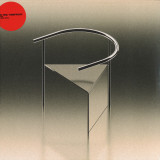
Sacramento, CA duo Blank Gloss’s third album, Cornered, is an exquisite statement of pop ambient starkness, an album that oscillates between lush beauty and spare melancholy. It follows from their 2021 debut for Kompakt, Melt, an album that saw Morgan Fox (piano, synths) and Patrick Hills (guitar) aligned, loosely, with the cosmic pastorale of the ‘ambient Americana’ movement. Cornered feels like a significant step forward, though – by peeling back the layers of their music, they’ve revealed both its restful core and its solemn gravitas. It is unendingly lovely, but with something disquieting at its centre.
Cornered was recorded quickly, over two days in December 2020. There’s nothing rushed or haphazard about the album, though; everything has its place, with each sonic element contributing profoundly to these nine miniature dioramas. It signals change, quietly but perceptibly, through the way the duo sculpts their material, building out of loose improvisations that morphed into songs. While there was no plan in mind when Blank Gloss settled into the studio, Fox recalls that “right away we realised that things were sounding and feeling a bit different than any of the sessions we had previously.”
That difference can be heard in the increased amount of space Blank Gloss gift to their sound sources. Some of the most moving moments on Cornered come when Fox and Hills strip everything back – see, for example, “Crossing”, which sets pensive piano across a shyly humming drone and quiet arcs of guitar, recalling the driftworks of Roger Eno. Curiously, the album’s distinctive shape and mood develops, at least in part, from a change in instrumentation, with Hills using a MIDI pick-up on his guitar. “This resulted in making things happen a lot quicker,” Fox says. “It also helped create what I think is a bit more sombre, dark feeling to some of the songs.”
Elsewhere, on songs like “Salt”, the piano tussles with flecks of guitar, single tones sent out to mingle with the stars, like Morricone at 16 RPM, while Cornered’s centrepiece, the eleven-minute “No Appetite”, lets long arcs of electronic texture breathe and sigh, tangling together in a cat’s cradle of bliss. Throughout, it feels as though the music is blossoming as you hear it, like watching time-lapse footage of flora in bloom. But perhaps the most seductive thing about Cornered is the sense you get, listening, that the music was something unexpected, a visitation. “It almost felt like we weren’t dictating where the music went and how it sounded,” Fox agrees. “We were just there in a room together in December and these sounds were happening, and we were lucky enough to be recording the process.”
Cornered, das dritte Album des kalifornischen Duos Blank Gloss aus Sacramento, ist ein exquisites Statement von pop ambienter Krassheit, ein Album, das zwischen üppiger Schönheit und sparsamer Melancholie oszilliert. Es folgt ihrem 2021er Debüt für Kompakt, Melt, einem Album, auf dem sich Morgan Fox (Klavier, Synthesizer) und Patrick Hills (Gitarre) locker an der kosmischen Pastorale der „Ambient Americana“-Bewegung ausrichteten. Cornered fühlt sich jedoch wie ein bedeutender Schritt nach vorne an – indem sie die Schichten ihrer Musik abschälen, haben sie sowohl ihren ruhigen Kern als auch ihre feierliche Schwere offenbart. Es ist unendlich schön, aber mit etwas Beunruhigendem in seiner Mitte.
Cornered wurde relativ schnell aufgenommen, über zwei Tage im Dezember 2020. Es klingt jedoch nichts überstürzt oder willkürlich an diesem Album; alles hat seinen Platz, wobei jedes Klangelement einen wesentlichen Beitrag zu diesen neun Miniaturdioramen leistet. Es signalisiert Veränderung, leise, aber wahrnehmbar, durch die Art und Weise, wie das Duo sein Material formt und aus losen Improvisationen aufbaut, die sich in Songs verwandeln. Als Blank Gloss sich im Studio niederließen, gab es zwar keinen Plan, aber Fox erinnert sich: „Uns war sofort klar, dass sich die Dinge etwas anders anhörten und anfühlten als bei allen vorherigen Sessions.“
Dieser Unterschied ist in der größeren Menge an Raum zu hören, die Blank Gloss ihren Klangquellen bietet. Einige der bewegendsten Momente auf Cornered kommen, wenn Fox und Hills alles zurücknehmen – siehe zum Beispiel „Crossing“, wo ein nachdenkliches Klavier über einen schüchtern summenden Drone und leise Gitarrenloops setzt und an die Driftworks von Roger Eno erinnert. Seltsamerweise entwickelt sich die unverwechselbare Form und Stimmung des Albums zumindest teilweise aus einer Änderung der Instrumentierung, bei der Hills einen MIDI-Tonabnehmer an seiner Gitarre verwendet. „Dies führte dazu, dass die Dinge viel schneller abliefen“, sagt Fox. „Es hat auch dazu beigetragen, einigen der Songs ein etwas düstereres, dunkleres Gefühl zu verleihen.“ An anderer Stelle, bei Songs wie „Salt“, spielt das Klavier mit Gitarrenfetzen, einzelne Töne werden ausgesandt, um sich mit den Sternen zu vermischen, wie Morricone bei 16 U/min, während Cornereds Herzstück, das elfminütige „No Appetite“, lange Bögen schlägt, elektronische Texturen atmet und seufzt, um sich in einem Katzenkörbchen der Glückseligkeit zu verheddern. Während des Hörens fühlt es sich an, als ob die Musik blüht, als würde man sich Zeitrafferaufnahmen von blühenden Pflanzen ansehen. Aber das Verführerischste an Cornered ist vielleicht das Gefühl, das man beim Zuhören bekommt, dass die Musik etwas Unerwartetes war, eine Heimsuchung. „Es fühlte sich fast so an, als hätten WIR nicht diktiert, wohin die Musik geht und wie sie klingt“, stimmt Fox zu. „Wir waren just im Dezember zusammen in einem Raum, als diese Geräusche passierten, und wir hatten das Glück, dass die Aufnahme mitlief.”
Suche:third mind
- 1: Bewitched (Are You Leaving Soon)
- 2: Tonkachi
- 3: Heartbeat
- 4: Scandal Night
- 5: Shirakechimauze
- 6: Tropical Love
- 7: Business Man Pt. 1
- 8: Ah! Soka
- 9: Suiyoubi Madeni Shinitaino
- 10: Kowloon Daily
- 11: Tropical Exposition (Who Done It? Version)
- 12: Boy Meets Girl
- 13: Love Sick
- 14: Cosmic Love
- 15: Pub Casablanca
- 16: Untotooku
Pink Vinyl[67,19 €]
- The third chapter in the acclaimed Pacific Breeze series! - Artwork by renowned illustrator Hiroshi Nagai - Compiled by Yosuke Kitazawa and Mark "Frosty" McNeill (dublab) - Newly remastered audio - 2xLP housed in a deluxe wide spine jacket with full color inner sleeves and custom die-cut OBI - Extensive artist bios by Yosuke Kitazawa // Light in the Attic's Pacific Breeze series has supplied the world's growing legions of Japanese music fans with an expertly curated selection of the most sought-after City Pop recordings-the mesmerizing and nebulous genre of Japanese bubble-era music of the '70s-'80s that encompasses AOR, R&B, jazz fusion, funk, boogie and disco. These familiar sounds are spun through the unique lens of optimistic, cosmopolitan fantasy colored by Japan's affluence at the time. Much of the music has previously been nearly impossible to acquire outside of Japan and continues to captivate listeners with its unique blend of groove-laden escapism, even birthing wholly new genres such as Vaporwave. Pacific Breeze 3: Japanese City Pop, AOR & Boogie 1975-1987 marks the latest chapter in the famed series and features holy grails plus under-the-radar rarities. The collection bursts at the seams to reveal some of the greatest Japanese tracks ever laid to tape, pushing towards the edge of City Pop to reveal glimmers of the next waves of styles to spring forth from the country's creative minds. The appearance of Pizzicato Five hint at the emergence of Shibuya-kei while the influence of hip hop and electro as an emerging global trend are also evident here through the prevalence of heavier programmed drum beats on tracks such as "Heartbeat" by Miho Fujiwara. This volume of Pacific Breeze, like its predecessors, is a female-forward offering with many tracks being voiced by women who would become household names in Japan as actresses and pop idols. Their songs here subvert the norm and brim with an innovative spirit that shatters gender roles in favor of sonic transcendence. Techno-pop classics from Susan, Miharu Koshi and Chiemi Manabe sit alongside sublime funk from Atsuko Nina and Naomi Akimoto while Teresa Noda slides into the mix with a sultry reggae jam. The genre span is stretched wider with hypnotic jazz fusion by Parachute and Hiroyuki Namba, a synthesizer fantasy from Osamu Shoji, and magnetic pop by Makoto Matsushita and Chu Kosaka. Although not front and center, the visionary members of Yellow Magic Orchestra are still very present on Pacific Breeze 3, with Haruomi Hosono, Ryuichi Sakamoto, and Yukihiro Takahashi taking up producer and musician roles on many of these tracks. Pacific Breeze 3 serves up a captivating musical journey that adds an essential chapter to the iconic compilation series.
- 1: Bewitched (Are You Leaving Soon)
- 2: Tonkachi
- 3: Heartbeat
- 4: Scandal Night
- 5: Shirakechimauze
- 6: Tropical Love
- 7: Business Man Pt. 1
- 8: Ah! Soka
- 9: Suiyoubi Madeni Shinitaino
- 10: Kowloon Daily
- 11: Tropical Exposition (Who Done It? Version)
- 12: Boy Meets Girl
- 13: Love Sick
- 14: Cosmic Love
- 15: Pub Casablanca
- 16: Untotooku
Black Vinyl[63,82 €]
- The third chapter in the acclaimed Pacific Breeze series! - Artwork by renowned illustrator Hiroshi Nagai - Compiled by Yosuke Kitazawa and Mark "Frosty" McNeill (dublab) - Newly remastered audio - 2xLP housed in a deluxe wide spine jacket with full color inner sleeves and custom die-cut OBI - Extensive artist bios by Yosuke Kitazawa // Light in the Attic's Pacific Breeze series has supplied the world's growing legions of Japanese music fans with an expertly curated selection of the most sought-after City Pop recordings-the mesmerizing and nebulous genre of Japanese bubble-era music of the '70s-'80s that encompasses AOR, R&B, jazz fusion, funk, boogie and disco. These familiar sounds are spun through the unique lens of optimistic, cosmopolitan fantasy colored by Japan's affluence at the time. Much of the music has previously been nearly impossible to acquire outside of Japan and continues to captivate listeners with its unique blend of groove-laden escapism, even birthing wholly new genres such as Vaporwave. Pacific Breeze 3: Japanese City Pop, AOR & Boogie 1975-1987 marks the latest chapter in the famed series and features holy grails plus under-the-radar rarities. The collection bursts at the seams to reveal some of the greatest Japanese tracks ever laid to tape, pushing towards the edge of City Pop to reveal glimmers of the next waves of styles to spring forth from the country's creative minds. The appearance of Pizzicato Five hint at the emergence of Shibuya-kei while the influence of hip hop and electro as an emerging global trend are also evident here through the prevalence of heavier programmed drum beats on tracks such as "Heartbeat" by Miho Fujiwara. This volume of Pacific Breeze, like its predecessors, is a female-forward offering with many tracks being voiced by women who would become household names in Japan as actresses and pop idols. Their songs here subvert the norm and brim with an innovative spirit that shatters gender roles in favor of sonic transcendence. Techno-pop classics from Susan, Miharu Koshi and Chiemi Manabe sit alongside sublime funk from Atsuko Nina and Naomi Akimoto while Teresa Noda slides into the mix with a sultry reggae jam. The genre span is stretched wider with hypnotic jazz fusion by Parachute and Hiroyuki Namba, a synthesizer fantasy from Osamu Shoji, and magnetic pop by Makoto Matsushita and Chu Kosaka. Although not front and center, the visionary members of Yellow Magic Orchestra are still very present on Pacific Breeze 3, with Haruomi Hosono, Ryuichi Sakamoto, and Yukihiro Takahashi taking up producer and musician roles on many of these tracks. Pacific Breeze 3 serves up a captivating musical journey that adds an essential chapter to the iconic compilation series.
- A1: The Devil
- A2: Freedom For A Promise
- A3: War-Torn Wasteland
- A4: Wretched Woodland
- A5: Wedding Dance Macabre
- A6: A Mute Reunion
- A7: The Devil Fits - God In His Youth
- A8: Through The Door - Theador
- A9: Your Father Is Dead Young Lord (Be Cursed)
- A10: Broken Boudoir
- A11: Theador And The Rifles
- A12: The Bordel
- A13: Mother
- A14: Daughter Of The Sin
- A15: Zakonnica
- A16: Rope Him To The Horse
- A17: Around You Is A Void Circle Save For The Stinking Corpses
- B1: Understand Nothing
- B2: No Blackberries In Winter
- B3: Cancel The Evil Gently
- B4: Mother Snake
- B5: The Fiery Sword
- B6: The Duel
- B7: Not The Horse
- B10: Theador Go Back To God
- B11: The Black Dog
- B8: The Quill - What’s Not Written Does Not Exist
- B9: The World Is Beautiful (Climb The Tree)
Wipe your blade clean. The bloodline of Eastern European kosmische and groundbreaking, grinding cinematic psych rock finally emerges from fifty years of forbidden forestland to fill your thirsty grails. Poland’s prime progressive provocateurs Żuławski and Korzyński finally expose the jagged roots of Possession and The Silver Globe and give the devil his due via this historical vinyl release.
If an opening strapline that reads “Forget everything that you thought you knew about the history of psychedelic rock and horror movies” appeals to you, then further potentially hyperbolic phrases like “Lost Grail” and “Banned Forever” will surely clinch the deal, leaving the hugely significant wider context of this dream come true release surplus to requirement. But as we hope you have come to expect from Finders Keepers releases “The devil is in the detail” and the fact that any mention of the perpetually elusive original master tapes to a 1972 project entitled Diabeł and the phrase “Holy Grail” have become synonymously associated only adds the twisted irony that surrounds this genuine masterpiece of both aforementioned fields.
For those fastidious enough to pursue the hunt, these unearthed recordings represent the crowning glory of the lifelong unison of Maestro Andrzej Żuławski and filmmaker Andrzej Korzyński, two genuine mavericks of Polish experimental cinema who challenged artistic and societal norms, on both sides of a politically restricted regime and on an international artistic stage, without compromise. Friends since childhood, Korzyński and Żuławski may have become divided by limelight and geography (Żuławski the intrepid emigre), but they remained united in their kaleidoscopic creative vision, resulting in a fractured stream of troublesome and mind-bending golden era collaborations such as Possession, The Silver Globe, and Third Part Of The Night. This long-awaited liberation of the psychedelic masterpiece known as Diabeł finally completes the duo’s full vista with what many consider the most vital piece of the prism.
Parisian quintet En Attendant Ana have dazzled since day one. From the muted strains of their 2016 EP "Songs From The Cave", to the assured 2018 TiM debut "Lost & Found", to the sparkling refrains of "Juillet"; released just before the world collapsed around us, and which stood as the band's rebirth and purest statement of their music ambitions - until now. "Principia" is the band's third album and is without a doubt their best yet. Bandleader & principal songwriter Margaux Bouchaudon's voice anchors many of the songs on "Principia", her crystalline delivery ringing out like a bell as the band swoons & sways beneath her. The songs on "Principia" were composed from a place of confusion about the state of the world and her place in it, looking outward and inward for answers. They question our perception of others, the one they have of us and finally the one we have of ourselves in a society where the individual is king and the group is forgotten. Guitarist Max Tomasso - newly joined just before the recording of "Juillet"- feels more "moved-in" on these tunes, his sly guitar-work gliding effortlessly through. No showboating - only prickling at the precise moment necessary in suit of the song itself. New member Vincent Hivert (their touring sound man, Hivert joined the group just as touring was underway for "Juillet", replacing founding member Antoine Vaugelade)'s bass-work is rubbery & flexible, bouncing around and thru the melodies on a rhythmic sugar-high, practically urging on drummer Adrien Pollin's metronomic swing. The band's secret weapon, multi-instrumentalist Camille Frechou's trumpet & saxophone are more present & considered in the arrangements, adding a new layer of sophistication to the group's already debonair indie pop. Her beatific harmonies add a yearning to Bouchaudon's lilting phrases; sometimes uplifting, other times melancholic. Bouchaudon says "One of the most important points we tried to focus on was the place given to each instrument. For the first time, we withdrew parts, we were careful not to play everyone at once and I think that the result is a much lighter album in which every musician has a specific place and moment". But this album is also the first one to have been shaped entirely by the band, from the conception to the production. The meeting of Vincent Hivert and Margaux Bouchaudon gave birth to a duet in which the technical and artistic aspects were intertwined from the very beginning of the conception of "Principia". Apart from reshaping En Attendant Ana's dynamic, Vincent Hivert was able to think as a musician and producer as soon as they started working on Margaux Bouchaudon's demos which brought a new dimension to their music. The two of them recorded and mixed the album together reuniting their references and artistic goals. "Principia" is a great step forward without sacrificing the things that make the band unique. The nods to French pop (both current & classic) still permeate the proceedings, and the group's penchant for Anglo-Saxon indie pop from The Nineties (think Electrelane, Stereolab, American Analog Set) still rings out, but there's an air of - dare we say - maturity in "Principia"s twelve songs. The group always felt a little 'out-of' and 'ahead-of' its time, but tunes like "Wonder" "The Cutoff" and "Same Old Story" are cinematic and romantic, and absolutely feel like the next great phase of an already great band.
Peach Vinyl
Parisian quintet En Attendant Ana have dazzled since day one. From the muted strains of their 2016 EP "Songs From The Cave", to the assured 2018 TiM debut "Lost & Found", to the sparkling refrains of "Juillet"; released just before the world collapsed around us, and which stood as the band's rebirth and purest statement of their music ambitions - until now. "Principia" is the band's third album and is without a doubt their best yet. Bandleader & principal songwriter Margaux Bouchaudon's voice anchors many of the songs on "Principia", her crystalline delivery ringing out like a bell as the band swoons & sways beneath her. The songs on "Principia" were composed from a place of confusion about the state of the world and her place in it, looking outward and inward for answers. They question our perception of others, the one they have of us and finally the one we have of ourselves in a society where the individual is king and the group is forgotten. Guitarist Max Tomasso - newly joined just before the recording of "Juillet"- feels more "moved-in" on these tunes, his sly guitar-work gliding effortlessly through. No showboating - only prickling at the precise moment necessary in suit of the song itself. New member Vincent Hivert (their touring sound man, Hivert joined the group just as touring was underway for "Juillet", replacing founding member Antoine Vaugelade)'s bass-work is rubbery & flexible, bouncing around and thru the melodies on a rhythmic sugar-high, practically urging on drummer Adrien Pollin's metronomic swing. The band's secret weapon, multi-instrumentalist Camille Frechou's trumpet & saxophone are more present & considered in the arrangements, adding a new layer of sophistication to the group's already debonair indie pop. Her beatific harmonies add a yearning to Bouchaudon's lilting phrases; sometimes uplifting, other times melancholic. Bouchaudon says "One of the most important points we tried to focus on was the place given to each instrument. For the first time, we withdrew parts, we were careful not to play everyone at once and I think that the result is a much lighter album in which every musician has a specific place and moment". But this album is also the first one to have been shaped entirely by the band, from the conception to the production. The meeting of Vincent Hivert and Margaux Bouchaudon gave birth to a duet in which the technical and artistic aspects were intertwined from the very beginning of the conception of "Principia". Apart from reshaping En Attendant Ana's dynamic, Vincent Hivert was able to think as a musician and producer as soon as they started working on Margaux Bouchaudon's demos which brought a new dimension to their music. The two of them recorded and mixed the album together reuniting their references and artistic goals. "Principia" is a great step forward without sacrificing the things that make the band unique. The nods to French pop (both current & classic) still permeate the proceedings, and the group's penchant for Anglo-Saxon indie pop from The Nineties (think Electrelane, Stereolab, American Analog Set) still rings out, but there's an air of - dare we say - maturity in "Principia"s twelve songs. The group always felt a little 'out-of' and 'ahead-of' its time, but tunes like "Wonder" "The Cutoff" and "Same Old Story" are cinematic and romantic, and absolutely feel like the next great phase of an already great band.
Tape
Parisian quintet En Attendant Ana have dazzled since day one. From the muted strains of their 2016 EP "Songs From The Cave", to the assured 2018 TiM debut "Lost & Found", to the sparkling refrains of "Juillet"; released just before the world collapsed around us, and which stood as the band's rebirth and purest statement of their music ambitions - until now. "Principia" is the band's third album and is without a doubt their best yet. Bandleader & principal songwriter Margaux Bouchaudon's voice anchors many of the songs on "Principia", her crystalline delivery ringing out like a bell as the band swoons & sways beneath her. The songs on "Principia" were composed from a place of confusion about the state of the world and her place in it, looking outward and inward for answers. They question our perception of others, the one they have of us and finally the one we have of ourselves in a society where the individual is king and the group is forgotten. Guitarist Max Tomasso - newly joined just before the recording of "Juillet"- feels more "moved-in" on these tunes, his sly guitar-work gliding effortlessly through. No showboating - only prickling at the precise moment necessary in suit of the song itself. New member Vincent Hivert (their touring sound man, Hivert joined the group just as touring was underway for "Juillet", replacing founding member Antoine Vaugelade)'s bass-work is rubbery & flexible, bouncing around and thru the melodies on a rhythmic sugar-high, practically urging on drummer Adrien Pollin's metronomic swing. The band's secret weapon, multi-instrumentalist Camille Frechou's trumpet & saxophone are more present & considered in the arrangements, adding a new layer of sophistication to the group's already debonair indie pop. Her beatific harmonies add a yearning to Bouchaudon's lilting phrases; sometimes uplifting, other times melancholic. Bouchaudon says "One of the most important points we tried to focus on was the place given to each instrument. For the first time, we withdrew parts, we were careful not to play everyone at once and I think that the result is a much lighter album in which every musician has a specific place and moment". But this album is also the first one to have been shaped entirely by the band, from the conception to the production. The meeting of Vincent Hivert and Margaux Bouchaudon gave birth to a duet in which the technical and artistic aspects were intertwined from the very beginning of the conception of "Principia". Apart from reshaping En Attendant Ana's dynamic, Vincent Hivert was able to think as a musician and producer as soon as they started working on Margaux Bouchaudon's demos which brought a new dimension to their music. The two of them recorded and mixed the album together reuniting their references and artistic goals. "Principia" is a great step forward without sacrificing the things that make the band unique. The nods to French pop (both current & classic) still permeate the proceedings, and the group's penchant for Anglo-Saxon indie pop from The Nineties (think Electrelane, Stereolab, American Analog Set) still rings out, but there's an air of - dare we say - maturity in "Principia"s twelve songs. The group always felt a little 'out-of' and 'ahead-of' its time, but tunes like "Wonder" "The Cutoff" and "Same Old Story" are cinematic and romantic, and absolutely feel like the next great phase of an already great band.
Repressed !
Dirty Mind, Prince's third studio album, originally released on Warner Bros in 1980 and now re-issued for the first time by Rhino with original content.
Produced, arranged, and composed primarily by Prince, it incorporates musical elements of funk, dance, and rock music. In 2003, the album was ranked number 204 on Rolling Stone magazine's list of the 500 greatest albums of all time.
The third compilation (of four instalments) in the Various Artists catalogue of Pi Electronics is hitting physical and digital stores around the globe on the 10th of February 2023.
The concept of releasing artists, who performed at Pi parties (2014-2019) along with musicians who stood close to the label before and during its activity, gathers 18 tracks to the Limitation Compilation.
Music by New York City industrial legend Adam X, Swedish master mind producer Peder Mannerfelt and Irish Techno figure, Eomac (also one half of Lakker) finally takes its place on the label catalogue, along with tracks by the electro side of Italian born producer, Alessandro Adriani and the sound-aesthetic of UK hailing musicians, Slave to Society (formerly AnD ) and Sam KDC.
Berlin artists Alekzandra and Interviews appear with a synth leaning piece, and a hypnotic, broken techno contribution respectively.
You can also meet the sound of Tel Aviv's finest electro duo TV.OUT on this release, which also includes a rare collaboration track by Ireen Amnes and Gramrcy.
Finally, 'Limitation' presents music by Greece affiliated acts of different backgrounds: from the dreamy guitars of Monochromatic Visions and the ambient/drone of Devika, to the broken beats of Zevla and the rolling techno of Thanos Hana; Not to mention the textures of noise band Phallucipher, the industrial slo mo techno of Thessaloniki's, Archaic Intellect, and the noise-techno of label founder, 3.14.
A crossroad of different genres and production styles is offered in the formats of Double Vinyl Sampler, Double CD and digital for this compilation, titled "Limitation".
Splatter Vinyl
Skins is the third studio album and first posthumous release from rapper, singer and songwriter XXXTentacion. Recognized for his raw and adventurous style of music, the album touches on themes of heartbreak and mental anguish, and draws heavy influences from lo-fi, emo, punk rock, ambient, trap and acoustic. Skins include the lead single, “Bad!”, as well as appearances from Kanye West and Travis Barker (of Blink 182). The release was met with wide acclaim, debuting at number one on the US BIllboard 200, remaining on the chart for 18 weeks, further cementing Jahseh’s legacy as an icon.
Toronto label and party Hypnotic Mindscapes presents another issue of modern electronics crafted for the dancefloor with the third edition of their compilation series, displaying a bundle of trend-defying tunes from crew-adjacent artists.
A1 opens with long-time friend and collaborator Patamamba (half of Kimchi Records) with “Igoon of Blue”, shades of progressive house music simmered in evocative acid lines reminiscent of 90’s nostalgia. The A2 features Hypnotic originator Cosmic JD with a deep-slamming breakbeat piece titled “Steam”, punchy basslines and trancey Arps bubbling into the early morning. On the flip, scene-vet and Seekers boss Alex Picone debuts on the label with “WhyWasteWine” a fast-paced, modern tech-house number with wonky melodies and metallic artifacts. Rounding things up, Moroccan (via Montreal) up and coming artist Jalil enters with an electro-infused ode to “Technology”. Artwork by Sofia Eleni.
The third and final edition of the Pay It No Mind mixtape trilogy. A transatlantic link up where Sheffield meets LA, heavily inspired by Memphis rap classics; Three-6 Mafia, Gangsta Pat, DJ Paul and Lil Noid. Through a mutual love and respect for that era’s raw production values, Lean Low & DJ Dubplates set out to make a mixtape series with an affirmed nod to that style, whilst seasoning it with a contemporary twist.
Eva Louise Goodman’s Nighttime project locates itself on a musical tree planted on the British Isles, perched atop the branch of folk leaning into sixties rock. Her upstate New York environs don’t stray far from that image. With tempered percussion, floating mellotron, and singing that evokes Bleecker & MacDougal on a fervent Saturday afternoon, her new album Keeper Is The Heart reaches deep into the essence of musicians such as Vashti Bunyan, Sibylle Baier and Pentangle, breaking down the decades into a sound thoroughly and bizarrely modern.
Through her years performing with Mutual Benefit, Goodman fell in love with life on the road and the collaborative energy of a band. In this third Nighttime album, she channels these experiences into her own music. The creative journey from writing to recording to mixing drove her deeper into a sense of self while expanding her sound. In the process, she put aside lo-fi origins and challenged herself to achieve the same intimacy with a bigger production.
Like most paths of self-discovery, the journey started with displacement. In October 2019, Goodman set out to record the album on her own, while cat-sitting at a friend’s empty Brooklyn apartment. Rather than recording, she was drawn to the overgrown garden, where she spent her days listening to music and reading old journals. Charlie Megira, The Incredible String Band and Roy Montgomery invoked the spirit of the album, as she realized that a new, more collaborative approach would be necessary to bring the songs to life.
In March 2021, after a pandemic year immersed in sound experimentation and writing, she entered the upstate New York studio of recording engineer Rick Spataro (Florist). Together, Spataro and Goodman dove into creating the album, recording one song a day, letting the spark and excitement of spontaneity be their guide. “I've always been fascinated with ‘automatic’ arts,” Goodman says, “where things are created intuitively and without premeditation, from the subconscious.” In this light, they worked with abandon–pushing through the heaviness of songs written years earlier with the same energy as songs which were not yet fully developed. Taking chances, improvising, they sought to strip away pretense, and elude perfectionism at all cost.
Among their experiments, the duo manipulated tape speeds–slowing or speeding up different instrument tracks, imbuing passages with altered perspectives. Improvisation was the key in track five, ‘The Way,’ a song about “the magical act of carving out a path through life, amidst all possibility.” After a long day of recording, the song was feeling heavy and uninspired. As night fell, Spataro picked up the Stratocaster and, in one take, laid down a rolling, roiling guitar line that defined the track.
This spirit of surrender weaves through the album. “Break free from time, and sink in the pool of the mind,” begins ‘Garden of Delight’, an energetic highlight, propelled by 60’s-era organ and Jefferson Airplane-esque vocals. The song was accidentally deleted after the first day of recording. By luck or fate, the one surviving file captured the song’s loose and free-wheeling essence. Inspired, Goodman encouraged her circle of collaborators to work similarly: “I gave everyone trust and total freedom to contribute as they felt called to, encouraging an intuitive approach of simply improvising, playing through the song a few times and then sending over the results.” Synth, cello, violin, saxophone and flute all appear, but often in unconventional ways.
Keeper Is the Heart reflects Goodman’s process towards greater creative freedom. The first words she sings: “Lift the veil of all of this hate/To see the fear at its base.” Her last lines: “We’ll follow the fates across the great expanse of time/To the source of the light within our mind.” In between is a work of art awash in personal awakenings that revel in the freedom of intuition, the lifting of veils, and the beauty of transformation. As Goodman states, “What is it you find when you look inward to see beyond, past your fears, to your heart's true desires?”
If naming is a form of claiming, of being claimed, how is one tethered to both the physical landscape that surrounds us, as well as our own internal emotional landscape_at times calm, at times turbulent, and ever changing? H.C. McEntire's new album Every Acre grapples with those themes_themes that encompass grief, loss, and links to land and loved ones. And naming_claiming land, claiming self, being claimed by ancestry and heritage_permeates the hauntingly beautiful landscape that is this poignant collection of songs. The songs straddle the line between music and poetry. In "New View," McEntire cites poets "Day, Ada, and Laux, Berry, and Olds"_fixtures in the world of writing, whose works are beacons of light over bleak horizons. The beginning of the song is backed by soft guitar plucks that fall on the downbeat and spangle like stars, and, throughout, guitar, bass, and drums swell together gently, mimicking ebbing and flowing tides under the moon. McEntire's voice (at once tender and fierce) intones the truth of both giving and taking, releasing and claiming: "Bend me, break me, split me right in two. Mend me, make me_I'll take more of you." Permeated by heartbeat-like drums, "Shadows" develops quiet ruminations on surrender and loss_reminiscing, moving on. This ponderous, dreamlike song asks the question of how "to make room." How does one make room, for self and for renewal and surrender, when it is so difficult to leave what you know behind? Playing with slivers of descending chromatics, along with the occasional downward-stepping bass, here McEntire yearns for home, and for nesting. Perhaps one of the more grief-stricken songs, "Rows of Clover" is a lamentation, one that touches on the loss of a "steadfast hound." The lone piano in the beginning of the song is rhythmically hymn-like. The stark verse arrangement gradually leads to a chorus that reads like a moody exhale, swollen with lush guitar strums and a Bill Withers-esque understated soul groove. But what stands out the most is an image of being "down on your knees, clawing at the garden"_the only explicit mention of a person in the song. "It ain't the easy kind of healing," sings McEntire, seemingly from further and further away as her voice echoes; and healing ta;kes time, time takes time_truths that linger painfully. "Dovetail" is a song that tells of various women. The song moves back and forth between solo piano and the addition of bass and drums under vocals. McEntire's gentle, trembling vibrato_harmonized in thirds in a celebratory manner_calls to mind a rejoicing psalm and shines through these images, leaving the listener cuttingly fraught with emotions_such as wonder, sadness, nostalgia_that can only arise with these juxtapositions. Gracious (and graceful) with its lilting melodies and lush harmonies, Every Acre ex - plores the acres of our physical and emotional homes. These songs are reaching for the kind of home that we all seek: one where we can rest and lay down (or tuck away) our burdens of loss. And maybe, moving through every acre of a world that often tries to tear our sense of identity and heritage down, McEntire sheds light on what it is to be human in this life_both stingy and gracious, both hurtful and kind.
Orange Viny
If naming is a form of claiming, of being claimed, how is one tethered to both the physical landscape that surrounds us, as well as our own internal emotional landscape_at times calm, at times turbulent, and ever changing? H.C. McEntire's new album Every Acre grapples with those themes_themes that encompass grief, loss, and links to land and loved ones. And naming_claiming land, claiming self, being claimed by ancestry and heritage_permeates the hauntingly beautiful landscape that is this poignant collection of songs. The songs straddle the line between music and poetry. In "New View," McEntire cites poets "Day, Ada, and Laux, Berry, and Olds"_fixtures in the world of writing, whose works are beacons of light over bleak horizons. The beginning of the song is backed by soft guitar plucks that fall on the downbeat and spangle like stars, and, throughout, guitar, bass, and drums swell together gently, mimicking ebbing and flowing tides under the moon. McEntire's voice (at once tender and fierce) intones the truth of both giving and taking, releasing and claiming: "Bend me, break me, split me right in two. Mend me, make me_I'll take more of you." Permeated by heartbeat-like drums, "Shadows" develops quiet ruminations on surrender and loss_reminiscing, moving on. This ponderous, dreamlike song asks the question of how "to make room." How does one make room, for self and for renewal and surrender, when it is so difficult to leave what you know behind? Playing with slivers of descending chromatics, along with the occasional downward-stepping bass, here McEntire yearns for home, and for nesting. Perhaps one of the more grief-stricken songs, "Rows of Clover" is a lamentation, one that touches on the loss of a "steadfast hound." The lone piano in the beginning of the song is rhythmically hymn-like. The stark verse arrangement gradually leads to a chorus that reads like a moody exhale, swollen with lush guitar strums and a Bill Withers-esque understated soul groove. But what stands out the most is an image of being "down on your knees, clawing at the garden"_the only explicit mention of a person in the song. "It ain't the easy kind of healing," sings McEntire, seemingly from further and further away as her voice echoes; and healing ta;kes time, time takes time_truths that linger painfully. "Dovetail" is a song that tells of various women. The song moves back and forth between solo piano and the addition of bass and drums under vocals. McEntire's gentle, trembling vibrato_harmonized in thirds in a celebratory manner_calls to mind a rejoicing psalm and shines through these images, leaving the listener cuttingly fraught with emotions_such as wonder, sadness, nostalgia_that can only arise with these juxtapositions. Gracious (and graceful) with its lilting melodies and lush harmonies, Every Acre ex - plores the acres of our physical and emotional homes. These songs are reaching for the kind of home that we all seek: one where we can rest and lay down (or tuck away) our burdens of loss. And maybe, moving through every acre of a world that often tries to tear our sense of identity and heritage down, McEntire sheds light on what it is to be human in this life_both stingy and gracious, both hurtful and kind.
Expanded Edition[176,43 €]
Double LP[41,13 €]
Black Vinyl[9,12 €]
Blue Vinyl[10,29 €]
Translucent Blue vinyl[35,92 €]
15 years after the album’s release, ‘City Of Echoes’ is now
available in a deluxe 2LP edition, newly remastered by
Josh Bonati and featuring a full LP’s-worth of bonus
material, including original album demos, alternate takes,
and pieces originally only available on the rare ‘Pink
Mammoth’ EP.
‘City Of Echoes’, originally released in 2007 by Hydra
Head Records, marked a paradigm shift for Pelican.
Coming off the heels of the glacial ‘Australasia’ and their
even more expansive and acclaimed follow-up, ‘The Fire
In Our Throats Will Beckon The Thaw’, their third album is
a study in precision.
Inspired by their non-stop tour schedule following ‘The Fire
In Our Throats Will Beckon The Thaw’’s release, the
quartet composed ‘City Of Echoes’ to be a lean
powerhouse of non-stop melodic hooks and lurching
rhythms that reflected the energy of live performance.
Guitarists Trevor Shelley de Brauw and Laurent
Schroeder-Lebec trade crisp riffs that twirl in opposition
before thundering together in monoliths. The sheer
amount of potent interplay between the two, often
borrowing from disparate edges of rock and metal at a
whim before completely transforming, is mind-boggling.
Bassist Bryan Herweg and rhythm section compatriot /
drummer / brother Larry Herweg lock into a wider array of
grooves than ever before. Their considered bedrock
guides the band’s dynamics into some of the ensemble’s
most tender moments as well as their most ferocious.
Recorded by Andrew Schneider at Electrical Audio Cover.
Art designed by ISIS and SUMAC founder Aaron Turner,
with photography by Robin Laananen.
Also available to independent retailers on Translucent Blue
vinyl.
Expanded Edition[176,43 €]
Double LP[41,13 €]
Black Vinyl[9,12 €]
Blue Vinyl[10,29 €]
Black Vinyl[34,24 €]
15 years after the album’s release, ‘City Of Echoes’ is now
available in a deluxe 2LP edition, newly remastered by
Josh Bonati and featuring a full LP’s-worth of bonus
material, including original album demos, alternate takes,
and pieces originally only available on the rare ‘Pink
Mammoth’ EP.
‘City Of Echoes’, originally released in 2007 by Hydra
Head Records, marked a paradigm shift for Pelican.
Coming off the heels of the glacial ‘Australasia’ and their
even more expansive and acclaimed follow-up, ‘The Fire
In Our Throats Will Beckon The Thaw’, their third album is
a study in precision.
Inspired by their non-stop tour schedule following ‘The Fire
In Our Throats Will Beckon The Thaw’’s release, the
quartet composed ‘City Of Echoes’ to be a lean
powerhouse of non-stop melodic hooks and lurching
rhythms that reflected the energy of live performance.
Guitarists Trevor Shelley de Brauw and Laurent
Schroeder-Lebec trade crisp riffs that twirl in opposition
before thundering together in monoliths. The sheer
amount of potent interplay between the two, often
borrowing from disparate edges of rock and metal at a
whim before completely transforming, is mind-boggling.
Bassist Bryan Herweg and rhythm section compatriot /
drummer / brother Larry Herweg lock into a wider array of
grooves than ever before. Their considered bedrock
guides the band’s dynamics into some of the ensemble’s
most tender moments as well as their most ferocious.
Recorded by Andrew Schneider at Electrical Audio Cover.
Art designed by ISIS and SUMAC founder Aaron Turner,
with photography by Robin Laananen.
Also available to independent retailers on Translucent Blue
vinyl.
The American garage rock band Louis XIV was formed by singer and guitarist Jason Hill, guitarist Brian Karscig, Drummer Mark Maigaard and bassist James Armbrust. In total, the band released three studio albums, including the third album from 2008, Slick Dogs And Ponies. It was released onAtlantic Records and featured the popular tracks “Guilt By Association”, “Air Traffic Control” and “Stalker”. It was their last album before disbanding in 2009. Jason Hill continued his musical career as a composer for film music and is best known for scoring Gone Girl, Mindhunter and Love, Death And Robots amongst others.
Slick Dogs And Ponies is available as a 15th anniversary edition of 1000 individually numbered copies on translucent green coloured vinyl and includes an insert.
If naming is a form of claiming, of being claimed, how is one tethered to both the physical landscape that surrounds us, as well as our own internal emotional landscape at times calm, at times turbulent, and ever changing? H.C. McEntire’s new album Every Acre grapples with those themes that encompass grief, loss, and links to land and loved ones. And naming claiming land, claiming self, being claimed by ancestry and heritage permeates the hauntingly beautiful landscape that is this poignant collection of songs. The songs straddle the line between music and poetry. In “New View,” McEntire cites poets “Day, Ada, and Laux, Berry, and Olds” fixtures in the world of writing, whose works are beacons of light over bleak horizons. The beginning of the song is backed by soft guitar plucks that fall on the downbeat and spangle like stars, and, throughout, guitar, bass, and drums swell together gently, mimicking ebbing and flowing tides under the moon. McEntire’s voice (at once tender and fierce) intones the truth of both giving and taking, releasing and claiming: “Bend me, break me, split me right in two. Mend me, make me I’ll take more of you.” Permeated by heartbeat-like drums, “Shadows” develops quiet ruminations on surrender and loss reminiscing, moving on. This ponderous, dreamlike song asks the question of how “to make room.” How does one make room, for self and for renewal and surrender, when it is so difficult to leave what you know behind? Playing with slivers of descending chromatics, along with the occasional downward-stepping bass, here McEntire yearns for home, and for nesting. Perhaps one of the more grief-stricken songs, “Rows of Clover” is a lamentation, one that touches on the loss of a “steadfast hound.” The lone piano in the beginning of the song is rhythmically hymn-like. The stark verse arrangement gradually leads to a chorus that reads like a moody exhale, swollen with lush guitar strums and a Bill Withers–esque understated soul groove. But what stands out the most is an image of being “down on your knees, clawing at the garden” the only explicit mention of a person in the song. “It ain’t the easy kind of healing,” sings McEntire, seemingly from further and further away as her voice echoes; and healing takes time, time takes time truths that linger painfully. “Dovetail” is a song that tells of various women. The song moves back and forth between solo piano and the addition of bass and drums under vocals. McEntire’s gentle, trembling vibrato harmonized in thirds in a celebratory manner calls to mind a rejoicing psalm and shines through these images, leaving the listener cuttingly fraught with emotions such as wonder, sadness, nostalgia that can only arise with these juxtapositions. Gracious (and graceful) with its lilting melodies and lush harmonies, Every Acre explores the acres of our physical and emotional homes. These songs are reaching for the kind of home that we all seek: one where we can rest and lay down (or tuck away) our burdens of loss. And maybe, moving through every acre of a world that often tries to tear our sense of identity and heritage down, McEntire sheds light on what it is to be human in this life both stingy and gracious, both hurtful and kind.
Oslo-based four-piece Legs 11 return to Beatservice Records with their third studio album, serving seven beguiling tracks on the delightfully off-kilter 'Welcome Home'.
Comprising of deviant players Sigmund Floyd, Torstein Dyrnes, Nils Tveten, and Audun Severin Eftevåg, Legs 11 have been Beatservice mainstays since making their label debut back in 2016. Fusing a disparate blend of esoteric sounds that include synth-pop, post-punk, new wave, house and more, the quartet journey from the murkiest depths into the pop-leaning stratosphere, taking in all manner of mind-altering detours along the way. Throughout their production journey, they've revelled in the unexpected, and 'Welcome Home' masterfully continues this aberrant trajectory.
Kicking things off in energetic mood, the new wave swagger of 'Flawless Logistics' dives deep into late-night rave abandon, Unhinged vocals and throbbing synth bass drive the cut through a futurist landscape of stripped rhythms and sinister tones before an atmospheric sax solo rises in to augment the searing lyrical message. Casting a critical eye on consumer-driven culture and mercenary musical forms, the vital composition is at once an unmissable social commentary and an irresistibly floor-filling groove.
Next, the glistening synths and sing-along vocals of 'Coup' saunter over bouncing bass notes and crisp machine drums. Acid licks rise in to add thrust to the club-primed groove while brooding pads and sultry spoken words meander through the sonic space. Elegantly sashaying into post-punk swirls, the hallucinatory swagger of 'Sax Consensual' bursts with theatrics. Seductive dart across the hyper-atmospheric backing track of pointed instrumentation, with glassy synths and fizzing drums joined by an evocative sax solo to vividly conjure late-night moods.
'Into The Darkness' bubbles with sinister intent, as striking bass and stripped rhythms charge through nocturnal synths, the serrated vocals purposefully projecting through the powerfully vivid subterranean mist. Maintaining the floor-focused tempo, 'This Is Your Home' sees sleazy vocals soar across an alien landscape. Distorted toms drive the groove as mysterious swirls and metallic textures fizz across the off-world horizon. Growling bass arrives alongside a searing sax lead as the endlessly-morphing rhythm undulates and evolves.
'The Crawley Within' sees darkly suggestive vocals enveloped by ominous synths and snarling acid licks, the determined rhythm steering the sparsely-woven instrumentation across alien topography as sensual whispers permeate the groove as the music undulates to an aberrant climax. Finally, completing a strikingly coherent collection, 'fuckboi' brims with attitude, with unhinged synths joined by growling rhythm guitar as the erotically-charged vocals project the steamiest of post-club invitations.
This is entirely unique work from Legs 11. Deviant, potent, and fiercely energetic, each track is propulsive enough to ignite dancefloors while embodied with more than enough profundity for headphone immersion. Utterly compelling.
Violence is the self-titled third album from Baltimore born/ New York based artist, multi-instrumentalist, and cult figure Olin Caprison.. Their compositions are known for vivisecting and seamlessly merging the idiosyncratic features of hip hop, metla, RnB, and electronica, creating a language all their own. A dense multilayered opus, the album takes us on a journey through religious ceremony, nightmarish visions, and the forgotten corners of a decaying cityscape, leading us to the celebratory catharsis of the club. Entirely written, produced and performed by Violence, the project is an ambitious and singular vision that takes their unique sound to transcendent new places. The album initiates with Small Body, a solemn hymn inspired by the procession of nurses encircling a congregation in black pentecostal tradition. It's freeform chanting and syncopated body percussion invoke the trancelike rhythms of call and response music. A hollowed chamber of reverence that pulls us deep into the vision of the album. It's followed by Reptile, a horrifying slab of industrial intensity that merges multiple narratives seen throughout history to interrogate a side of victimhood not usually explored. A baroque masterpiece of intricate instrumentation and celestial theatre, guitar melodies blast across a delicately woven tapestry, reflecting the manic, distorted, and unstable mindset of the central figure.
With his third album, The Big Swim, due out in December 2022 on Bongo Joe records, Augenwasser ventures once again into the paths of synth wave exploration with a pop feel. Still laced with the folk textures of his early days, he nevertheless develops a dance approach that can at times be akin to melancholic drone. His music takes you to an imaginary, dark club, lulled by a haunting rhythm, surrounded by the fumes of the night, where it is possible to indulge in that quiet voice that has already confessed that it is too late but will never stop repeating its soft, cold poetry:
LTD ETERNAL RETURN ED.[27,69 €]
Somewhere between the late 1990s and the early 2010s, the rif largely disappeared from mainstream rock & pop. Its transformative power - the rif as a means to transport the listener into another dimension - became an art cherished only in the underground of rock and metal. One of the strong proponents of that transformative power is ASTROSAUR, an overlooked gem in the international heavy psyche rock and post- metal scene. The Norwegian power trio has been employing the rif as their principal mode of transport since their 2017 debut album Fade In // Space Out. Now, with the release of their third album Portals, ASTROSAUR are sounding more expansive and convincing than ever, delivering an intuitive exploration of the infnite powered by soaring guitars and surging grooves. With their third full-length album, ASTROSAUR have delivered an incredibly diverse and musically challenging and satisfying experience, showing that this band is greater than the sum of its truly great parts. Over the course of fve tracks and 48 minutes, the band use the best traits of the aforementioned genres to take you on a sonic journey into the deepest caverns of space and time. First single «Black Hole Earth» is masterclass soaring post-rock guitars, with its magnifcent main melody, which is ofset against a blistering desert rock rif, like a star ship phasing in and out of hyperspace, alternating between crushing your guts and showing you the most marvellous views of deep space. From a compositional viewpoint, «Eternal Return» is a mind-blowing afair. This giant psychedelic prog epic has been built from diferent themes and motifs that take turns in appearing, shifting form and developing as they go along. Segueing into new themes or returning to earlier ones, «Eternal Return» gloriously comes full circle, ending the mind-boggling journey of Portals. With the addition of vibraphones, Moog and acoustic guitars, the sound of ASTROSAUR is fuller and more diverse than ever before. From the soaring overture of «Opening» to the glorious fnale of «Eternal Return», Portals shows the next great post-metal band at their most accomplished. Fans of dynamic rifs and intricate compositions can once again rejoice as they're able to tune in and fade out once more with another wild ride courtesy of this exciting Norwegian powerhouse. Limited Eternal Return Vinyl Edition!
Black Vinyl[21,81 €]
LTD ETERNAL RETURN ED.
Somewhere between the late 1990s and the early 2010s, the rif largely disappeared from mainstream rock & pop. Its transformative power - the rif as a means to transport the listener into another dimension - became an art cherished only in the underground of rock and metal. One of the strong proponents of that transformative power is ASTROSAUR, an overlooked gem in the international heavy psyche rock and post- metal scene. The Norwegian power trio has been employing the rif as their principal mode of transport since their 2017 debut album Fade In // Space Out. Now, with the release of their third album Portals, ASTROSAUR are sounding more expansive and convincing than ever, delivering an intuitive exploration of the infnite powered by soaring guitars and surging grooves. With their third full-length album, ASTROSAUR have delivered an incredibly diverse and musically challenging and satisfying experience, showing that this band is greater than the sum of its truly great parts. Over the course of fve tracks and 48 minutes, the band use the best traits of the aforementioned genres to take you on a sonic journey into the deepest caverns of space and time. First single «Black Hole Earth» is masterclass soaring post-rock guitars, with its magnifcent main melody, which is ofset against a blistering desert rock rif, like a star ship phasing in and out of hyperspace, alternating between crushing your guts and showing you the most marvellous views of deep space. From a compositional viewpoint, «Eternal Return» is a mind-blowing afair. This giant psychedelic prog epic has been built from diferent themes and motifs that take turns in appearing, shifting form and developing as they go along. Segueing into new themes or returning to earlier ones, «Eternal Return» gloriously comes full circle, ending the mind-boggling journey of Portals. With the addition of vibraphones, Moog and acoustic guitars, the sound of ASTROSAUR is fuller and more diverse than ever before. From the soaring overture of «Opening» to the glorious fnale of «Eternal Return», Portals shows the next great post-metal band at their most accomplished. Fans of dynamic rifs and intricate compositions can once again rejoice as they're able to tune in and fade out once more with another wild ride courtesy of this exciting Norwegian powerhouse. Limited Eternal Return Vinyl Edition!
The story of Gold Panda's journey from an acclaimed debut record to now, as he releases his third full length album, is an entirely circular one. Hailing from Chelmsford Essex in the UK, in the six years since the release of his genre-defining debut album 'Lucky Shiner', the electronic artist most comfortable with the moniker Derwin Panda spent the subsequent years splitting the majority of his time between London, Berlin and countless excursions to Japan. As he created his third album ''Good Luck And Do Your Best' he ultimately found himself back where he began, in the East of England. Whereas his second album 'Half Of Where You Live' was occasionally taut, perhaps harder and more piecing, the 11 songs that comprise 'Good Luck And Do Your Best' have a distinctly warmer palate, one that echoes 'Lucky Shiner' a little more, albeit with a clearer range of sounds, and also, to Derwin's mind, one where 'the tracks aren't popping out against each other. It's a complete record.'
- 1: Corybantic Ennui
- 1: 2 Where Are You
- 1: 3 Titan Arch
- 1: 4 Dark River
- 1: 5 Cold Cell
- 1: 6 A White Rainbow
- 2: 1 Magnetic North
- 2: Christmas Is Now Drawing Near
- 2: 3 Fire Of The Mind
- 2: 4 Going Up
- 3: 1 The Dark Age Of Love
- 3: 2 Red Queen
- 3: Ostia
- 3: 4 Chaostrophy
- 3: 5 Love Secret Domain
- 4: 1 Tattooed Man
- 4: 2 Teenage Lightning
- 4: 3 Amber Rain
- 4: Cardinal Point
- 4: 5 Blood From The Air
- 4: 6 Outro Lsd
- 5: 1 Dark River (Aho Ssan Remix)
- 5: 2 Tattoed Man (Third Eye Foundation Remix)
- 5: 3 Magnetic North (Geins't Naït Remix)
- 5: 4 A White Rainbow (Geins't Naït Remix)
- 5: Chaostrophy (Deadverse Remix)
- 5: 6 A White Rainbow (Instrumental Version)
2x12"[23,32 €]
In 2009, following the death of Jhonn Balance four years earlier, This Immortal Coil's "The Dark Age Of Love" appeared as a tribute to the superb work of the British band Coil over two decades.Formed by musicians from all walks of life, the album was praised by critics but also, and most importantly, by Peter Christopherson himself! 13 years have passed and this passion for the band has never wavered. Following the death of Peter Christopherson in 2010 on the one hand, and meetings with musicians such as David Chalmin or Massimo Pupillo from Zü who in turn wanted to pay tribute to this gigantic band, on the other hand, Stéphane Grégoire's desire to make a new opus took shape in 2017 with a first recording of the title "Where Are You". Just like the first one, more than 5 years will be necessary to realize this new album so that it is at the height of Coil's genius. The Ici d'Ailleurs team is very proud to unveil This Immortal Coil's second album 'The World Ended A Long Time Ago'.That will be available on December 09, 2022 in several formats that will be revealed very soon. The artists this time are Coil lovers but without the album being a "lovers" cover, that would be the opposite of Coil's image. Many, many thanks to Shannon Wright, David Chalmin, Matt Elliott, Christine Ott, Aho Ssan, Gaspar Claus, Aidan Baker, Ulver (Kristoffer Rygg, Ole Alexander Halstensgard, Stian Westerhus), Massimo Pupillo, Mattia Cipolli, Elisa Bognetti, Stefano Michelotti, Francesco Bolognini, Marton Csokas, Ivan Chiossone and Eric Aldéa who make this project a reality.
Staging an attempt to gloss their music, Gentle Stranger
say it recalls “throwing a bouncy ball into a hall of mirrors.”
It’s telling that normal routes of describing music - your
typical band boilerplate of “such and such meets such and
such” or “we just play guitar, us, and leave the writing up to
you” - doesn’t suffice for the London collective; instead a
more arcane, more potent image is fired back, a wonky
and poetic idea that’s instantly more arresting, more
substantial.
For the newly initiated, Gentle Stranger are a selfdescribed “post-clown” outfit that oscillate between musical
forms, achieving a bewildering, almost Joycean
experimental sweep; pastiche, parody, burlesque, earnest
composition, genre interrogation and progression - they
cover it all. Their renowned live performances see the trio
cycle through an arsenal of musical instruments,
apparatus, tackle, and stuff. The set (part of the reason for
their now cult-like following) hangs together intricately, a
fractal clockwork machine that relies on movement and
spatial-awareness as much as it does timing and
musicality.
Upon witnessing the Gentle Stranger live show (‘show’
here is most certainly in the theatrical, carnivalesque,
extravaganza sense of the word), it’s tempting to question
whether they could reiterate, reshape, and condense this
uniquely visual and visceral spectacle into recorded music
- and the answer is yes. The latest update of the Gentle
Stranger sound lands in the form of ‘Upon Return’, their
barnstorming third album.
Gentle Stranger reportedly enjoy “revelling in the
disarray” of ‘Upon Return’, this ornate and finely wrought
mind palace - it’s a riveting and often joyous experience
soundtracked by strange, strange, and stranger music.
Available on black vinyl LP.
The Outer Edge is very proud to release another quite sensational release. Here are the official reworks of Hans Hass' proto-AOR / cloud rock hymn "Welche Farbe hat der Wind" (which translates to "What color is the wind").
The main producer for this release was Marian Tone (of Key Elements), who reworked the track almost from scratch. He re-recorded the drums, the bassline, and some chords while keeping Hass's original vocal layer. The distinctive guitar playing by co-composer Gabor Kristof sparkles throughout. The result is exactly what we had hoped and asked for: a DJ-friendly version of this überclassic track.
The idea for this rework project came to mind when label owner DJ Scientist got word from Tobias Kirmayer of Tramp Records that "Welche Farbe hat der Wind" would be officially re-released for the first time on his compilation series "Praise Poems" as well as on a single reissue. Scientist immediately asked if he could make an edit with louder drums to make the track more playable in a DJ set. However, as the masters of the Tramp reissues had already been submitted to the pressing plant, he was granted permission to re-license the track and rework it for his own label instead.
Hence, the reworks feature Scientist's "vintage drums" mix, which has the drums mixed louder, plus drums added at the quite psychedelic and experimental last third, with a few other sound adjustments made.
But it was up to Berlin-based DJ and music producer Marian Tone to put the icing on the cake and rework and enhance the song further with his own version. With fellow Key Elements bandmember Steffen Kieslich, he completely re-recorded the drums. Then it was up to Doron Segal to replay the bass and the keys. What we get is the classic sound of "Welche Farbe hat der Wind" - just updated and fresher.
For the first time ever, the track is also available as an instrumental version. Here, the great original guitar playing keeps the song going and going, and makes it perfectly clear that this tune, which originally came out on the schlager album "Reise in eine glückliche Zukunft" in 1974, is pretty damn funky!
It has been difficult to put "Welche Farbe hat der Wind" into a genre box, But it has been described as "rare groove","psychedelic schlager", and even "proto-AOR". For facility, Scientist has coined the new term "cloud rock" to describe this particular style of soft but groovy music. The name cloud rock bears a conspicuous reference to the krautrock genre as well. More tracks in a similar vein will be heard soon in a DJ mix under the same name.
Marian Tone's rework, as well as the corresponding instrumental version, will be released on a limited 7" single with a full-color picture sleeve. The digital release will feature the DJ Scientist re-mix plus an alternative version that puts more focus on the re-recorded bassline. In any case, this is an essential item for any music lover as well as the ideal contribution to your ultimate "cloud rock" DJ set!
2022 Repress
The Artist Concurrently Known As Jackmate has been already been indoctrinated into our cult since he signed onto he Pampa bookings roster awhile back. As SoulPhiction he is also co-founder of Philpot, the Stuttgart-based label, home to the majority of his releases over the past 10+ years. Anyway, we get the privilege of stamping the Turkey logo on SoulPhiction's first proper release of 2013, following his remixes for Murat Tepeli and Detroit Swindle. 'When Radio Was Boss' is a tribute to those magical electromagnetic waves that ruled yesteryear. With that prototypical Pampa percussion-rattling and clanking its way into the room-and a warm, round bassline bounce combined with some symphonic froth in the atmosphere, this track definitely demands airplay. On the dancefloor, at least! (And right in the middle of the track, catch the pleasantly jarring shout-out from WBAU, the call sign of the defunct New York radio station that counted members of Public Enemy and hosts of Yo! MTV Raps amongst its staff.) On the flip, the bpm gets cranked down just a bit for 'Maybachswagger"-If the A-side is a tribute to radio, the B has roller-skating on its mind. Starting out spooky with a sampled voice cooing over a slightly detuned bassline, the surprise comes in the final third, when a kawaii disco vibe drops in, seducing you onto the rink for a few laid-back laps.
Damiano von Erckert’s ‘The Past, The Present The Future’ lands on Aus music this November perfectly in time for the winter season. TPTPTF is Damiano’s third studio album and sees him perfectly balancing rave euphoria with more cuddly intimate moments moving effortlessly from deep Detroit techno to the spacious kraut sounds associated with his homeland. ‘The Past The Present The Future’ has depth substance and timelessness all packaged beautifully by design and art legend Eike Koenig
'The Past, The Present, The Future is for all independent thinking romantics and specialists looking for urban melancholy and the feeling of freedom and security. It is for those who find themselves in the dust and rain of the night darkness. It serves people who are determined to conquer their inner fears and readjust the orientation of their minds to banish stress, anger and despair from their lives. Finally, it is the soundtrack for lovers and fighters who want to slow down time and create new patterns to open up new dimensions in their lives as ravers, dancers and people of the night. It is about forgotten fragments of past sounds and the simplicity of clubbing'
Originally released in 1994 on Calypso Records / Irma Records in a triple vinyl promo white label version, Don Carlos's album Aqua is the
second album by the Varese-based DJ producer, already then known for his first two singles Alone and Mediterraneo, then both included in
his first album entitled Mediterraneo and released only in Compact Disc format in 1992 for the American market printed and distributed by
IRMA U.S.A., the American subsidiary of IRMA Records Italy.
The same fate will also have the Compact Disc format of the Aqua album, again printed only on the American market.
But the triple vinyl, printed in a limited edition of 500 copies in a white generic envelope, was never reissued and has become a rare record
over the years.
After almost thirty years, after countless requests for reissues, especially in the last few years in which the name and music of Don Carlos
has made a comeback, Irma Records has decided to reissue the vinyl in exactly the same original triple version.
DJ Don Carlos (born Carlo Troja) with his productions in the 90s has become one of the cult producers for DJs around the world.
His track Alone released in 1991 for Calypso was and still is one of the classics of House Music, played by all the major American and British
DJs.
At the time of its publication it was considered an underground song and therefore did not sell very much, but over the years its myth has grown
thanks to its subsequent productions as for example his second single, the EP entitled Mediterraneo, title which it will then inspired his first CD
album printed in the USA with the same title.
Several other singles followed, another album, always printed only in the USA, entitled Aqua, from which a triple promo vinyl was extracted which
today is one of the artist's most requested rarities.
In Italy his third album was released in 2002 entitled The Music In My Mind where Kim Mazelle, Michelle Weeks, Taka Boom and Kevin Bryant
were present as vocal guests. In 2009 a collection of the first two albums released in the USA titled Mediterraneo-Club Favourite Collection '90-
98 and in 2010 his fourth album entitled The Cool Deep which reproduced the sounds closest to his first productions.
Also active as a remixer for Italian and international labels, one of his most important works is the remix of Byron Stingily of the song You Make
Me Feel of which he made a worldwide hit. As a producer he also used other pseudonyms such as Montego Bay, Aquanuts, Sotterranea and
Love 2 Love Orchestra. He has played and plays in different countries such as London, New York, Miami and at various festivals, such as the
Robot and the Stickermule Festival in an evening with Apparat, Derrick May, DJ Koze, Lil 'Louis, Young Marco and Ellen Allien, LTJ Xperience
Black Vinyl[23,74 €]
New solo album from Seth Avett of the Avett Brothers (his first in 5 years), featuring songs written by lauded folk singer Greg Brown, whose songs have also been performed and recorded by Joan Baez, Willie Nelson, Lucinda Williams, Carlos Santana, Ani DiFranco, Gillian Welch, Mary Chapin Carpenter, and more. For those who may need reminding, Greg Brown is the ultimate songwriter's songwriter. Over a forty-plus-year career, he's occupied the same rarefied air as Loudon Wainwright III and John Prine - a keen-eyed poet and diarist of the human condition. And he's done it mostly on his own. “This is a man who put forty records out because he had to,” Avett says. “He made his own record label. He played the coffee shops, the bars, the little theaters. He built it. He's a world-class artist who did it all under the radar, which is just mind-blowing to me.” As Avett's new solo record makes clear, this collection is an expression of admiration and gratitude for one of his heroes. But it's also a reflection of his own artistry and ability as an interpreter. Though Brown's songs have been a part of his listening diet for decades, Avett gained a more profound appreciation once he put his own voice behind them. And though on the surface it's a covers record, it dovetails seamlessly with the most recent Avett Brothers album The Third Gleam and Seth's solo outing IV, which find him in equally stripped-down settings exploring the light and shadows of his own personal stories.
Classic Black vinyl, Lyric insert + DL card. The Black Lips return with their 10th studio effort ‘Apocalypse Love’, scorched with their trademark menace, it cryogenically mutates all recognised musical bases; it spins yarns about vintage Soviet synths, Benzedrine stupors, coup de’ tats, stolen valor and certified destruction, all set against a black setting sun. Since the turn of the decade the band have transformed from austere country pioneers, into a set of Lynchian surrealists, hellbent on recalibrating the history of rock ‘n’ roll. Singer and saxophonist Zumi Rosow muses, “It’s a weird dance record, one that reflects the moment that the world’s in right now…” ‘Apocalypse Love’ is an album that emanates from a dive bar jukebox in the back of your mind; with a playlist that bends between tub thumping doom-glam, Plastic Ono singalongs, cocktail-shaken space age pop, Morricone reverberations and lo-fi outsider acoustic-punk, with mariachi horns, theremins, drum machines and harmonies filtering through the infectious melodies. Stand-out number ‘Among The Dunes’ is an amorphous platform-heeled anthem, a signature sax-fuelled stomper filled with trippy swagger. While opener ‘No Rave’ proffers a hypnotic locked groove, with Cole Alexander’s trademark snarl delivered over a sulphurous wall of distorted hedonism, a dystopian anthem for an apocalyptic manifesto. Meanwhile, the twisted exotica of ‘Whips Of Holly’ with its silver screen façade is like the soundtrack to a classic Theda Bara vamp-fest. As the band venture into their third decade, ‘Apocalypse Love’ is proof that The Black Lips show no sign of slowing down… “A wonderful new chapter… The world may be on fire, but at least we have Black Lips.” The Line Of Best Fit // “Simply masters in their field” NME // Track List A1 No Rave A2 Love Has Won A3 Stolen Valor A4 Lost Angel A5 Whips of Holly A6 Apocalypse Love A7 Operation Angela. B1 Crying on A Plane B2 Sharing My Cream B3 Among The Dunes B4 Tongue Tied B5 Antiaris Toxicaria B6 The Concubine
The third and most seasoned Drugdealer album, Hiding In Plain Sight, almost didn't happen at all. Frustrated and insecure with his own singing voice prior to the pandemic, Drugdealer founder and primary songwriter Michael Collins was nearly ready to throw in the towel. Due to a frequent impulse to hand over the microphone to friends and collaborators like Weyes Blood, Jackson MacIntosh, and his trusty musical companion Sasha Winn, Collins became increasingly unsure of himself as a singer. While attending Mexican Summer's annual Marfa Myths festival, a chance encounter with artist and composer Annette Peacock changed his outlook. Collins says, "I was so inspired by Annette. But similarly to all these other vocalists I'd worked with, I didn't feel like I had it in me." he recalls. "I told her my plight, then I played her a song, and she told me I wasn't singing high enough for my speaking voice. When I returned to LA, I started coming up with new progressions, which I'd modulate up three half steps. It forced me to find a new way to sing." "Madison," is the first song Collins wrote singing in this suggested range. His newfound confidence as a yarn-spinning vocalist in the gruff tenor tradition of Nick Lowe, or even Van Morrison, is readily apparent, with Conor "Catfish" Gallaher's pedal steel adding a dusting of cosmic country to Collins' down-hard love song. When Collins wrote the would-be AM Gold hit, he was summoning an imaginary vision of a love that had eluded him in reality. Tim Presley sings on the second song, "Baby," and Collins had a clear role in mind for the California avant-rock mainstay. "I love White Fence so much, but I also wanted to hear Presley sing a song that sounded like an early '60s sock hop band who had never tried drugs in their life." Meanwhile, Kate Bollinger floats an effervescent lead vocal over the Rhodes-driven groove in “Pictures of You.”. Taking inspiration from a canon of gruff but soulful rock vocalists like Phil Lynott, Collins looks back on his nocturnal meanderings through LA's warrens of bars and clubs ("New Fascination"). He’s right up front in the mix, detailing a search for love in all the wrong places.
Walter Smith III and Matthew Stevens are two musicians at the forefront
of developments in jazz and improvised music, listing the likes of
Terence Blanchard, Ambrose Akinmusire, Esperanza Spalding and
Christian Scott as collaborators
The pair started working together in 2017, and four years later, they're back for
the third iteration of their highly commended In Common project. Previous guests
include Nate Smith, Linda May Han Oh and Marcus Gilmore; on 'In Common 3',
Kris Davis takes the piano chair vacated by Micah Thomas, and completing the
lineup are two legends of the game - Dave Holland and Terri Lyne
Carrington.What's new, third time around? "It's longer, freer, and yet more
spontaneous," says Smith. The successful In Common formula - inventive 'onepage songs' written with specific musicians in mind - disguises the through-line
that uniquely shapes this record: "The spotlight is on the community of musicians
as a whole," Smith comments. "The general vibe is sculpted by the musicians'
interpretations of what we bring in." Davis' influential presence means the project
leans into the aesthetics of free improvisation for the first time; the resulting
soundworld lends itself to electronic manipulation, another first for the series.
The span of fifteen tracks showcases the duo's knack for reinvention, slipping
into unfamiliar contexts without losing sight of the album's focused essence.
Smith is keen to emphasise the standalone nature of the divergent In Common
recordings. Some aspects carry through though, like their commitment to
remembering lost influences - opener 'Shine' serves as both a thank you and an
acknowledgement to McCoy Tyner, Wallace Roney, Chick Corea, Jimmy Health
and Ellis Marsalis. That introduces the remaining fourteen tracks, that divide
nearly exactly into spontaneously constructed ideas that introduce fully
composed tracks.
Martyn joins the Ninja Tune family to present his third long player. Universally respected for his ever-evolving, but inimitable sound, the Dutch-born, Washington DC-based producer brings an entirely new sonic direction with The Air Between Words. This is an exploration of the essence of all of Martyn's music: a rugged four-to-the-floor groove, intelligently sculpted and artfully composed
France is the trio of Jeremie Sauvage on electric bass, Mathieu Tilly on drums and Yann Gourdon on amplified hurdy-gurdy. They play one note / one rhythm producing energetic performances reminiscent of the early collaborations between Faust and Tony Conrad. Creativly recycled influences result in intense shows with pounding overtones and repetitive pulsing rhythms. Loud straight and trance-inducing.
The pertinency of the recordings only slowly appear On Occitanie" in the mass of sound, the rhythmic repetition and the elongated drones. The hurdy-gurdy forces you deeper, highlighting points of microtonal flux, cracking open the single note, the nodding rhythm, to imply the presence of every note, every sound, inside it. The insensible evolution, lurks in a corner of noise and finally imposes itself slowly on careful listening.
The band members of France perform in various other projects: Tanz Mein Herz, Toad and Jérico, all are member of the collective La Novià, an organisation based in Haute-Loire which brings together professional musicians and is a place for reflection and experimentation around traditional and / or experimental music.
In 2009, France was invited to play in Pau, a city far south-west of France, next to spain, by the people running Pagans Musica, a like-minded traditionnal-oriented group of people, also bent on educational issues concerning the local music and dialect: Occitan and on fusioning traditional musics and rock related sounds and instruments. They had set up a show for France and their band Artus and originaly wanted to have Acid Mother's Temple join the bill. The japanese band had done versions of songs coming from their village (eg. "La Nòvia") but weren't touring near France so instead they invited Duo Ancelin Rouzier as the third act, a band both Artus and France were also very fond of.
Pagans had everything set-up for the concert to be recorded and as France had plenty of time for sound-check, they went on to record the Pau" album in the afternoon, taking a thirty seconds pause in the middle of the session so as to mark both sides of the vinyl. The Occitanie Lp is the recording of the live set later that night, with no cut and a longer, more savage performance.
- A1: Ilg003 Celeste Sensibile
- A2: Futurismo Luminescente
- B1: Selvatico
- B2: Teoria Della Meta?
- B3: Baco Elettrico
- C1: Leggere Nell Animo
- C2: Allosauro
- D1: Strada Feller
- D2: Canale Dei Misteri
- D3: Tra Due Onde
- D4: Viaggiare A Vuoto
- D5: Opera Abbuiata
- A1: Ilg003X E-Bear (R Epee / Grauzone)
- B1: Eleventh Movement (R.epee)
2022 Repress
1x12" Maxi (ILG003X)
2x12" LP (ILG003)
For it's third release Infoline showcases never heard compositions
of Marco Repetto (former Grauzone). La Luna Sotto Il Ponte is a 2x12' compilation and a never used alias of Marco Repetto. The compilation features tracks written between 1983-1989.
Some years after his break up with Grauzone (1981), Marco went on
a darker and more industrial path, which was a common route for experimental composers at that time. Expect a solid mixture of unreleased Industrial/EBM cuts. The bonus EP replaces La Luna Sotto Il Pontes grim and dark compositions for a much more utopian mind-set and movement in it's heyday. It's 1988/1989 - Acid House is everywhere.
Adding to what already has been a tremendous year for the Berlin-based producer, Nat Wendell returns home for his third release on his very own imprint, Depths of My Soul. On the surface, DMS 003 may appear to be vintage—and pulsating—Wendell. Under the cracks of these three tracks, though, is a producer moving towards music as a tool of political and musical advancement.
A1’s “Takes These Chains off My Mind” is an explicit cry from liberation away from mental slavery, an anthem for, in the words of Wendell himself, people “emancipating themselves from mental slavery, placed on black and people of colour alike.”
B1’s “Tha Music” plays on similar ideas of music as liberation, jolting dancers into submission with its rolling hats and snappy arrangements that will easily fit into any house head's bag. Judging by the name,
B2’s “Questioning Existence” may seem a tad existential—but, taking a late-nite 90’s garage cue from his own hometown, it’s anything but!