Prodigal son of the ESP Institute, Juan Ramos, rises from the cesspool of a world gone mad with 'Agua Del Cenote', his fifth release with the label. Whilst many artists are following their inner light to bring us some much needed joy amidst these rotten times, Juan (being the little shit that he is) follows an inner demon and delivers listeners and dancers a demented clusterfuck of sadistic chaos. The title track opens with what sounds like a butane torch and we metaphorically freebase into oblivion. Our perception of reality unravels, writhing in abrasive textures smeared across a low-slung, mid-tempo erotic thump. Everything feels blurry and distant, as if we’re swimming through an underground aquatic tunnel, in a panic, searching for an invisible band of spirits whose tune summons us into certain annihilation. Following this is a remix from a decorated lord of 20th Century electronics, Harald Grosskopf AKA The Synthesist. Harald wipes away grit and lethargy to reveal elements hidden deep within the mix as well as softens Juan’s sense of terror by building up to an optimistic layer of added synth. We’d love to offer some relief with the balance of the EP, however, the remaining two tracks paint complimentary hues in the same cerebral palette. 'Let It Go (Freaks Only)' veers closely to House in terms of tempo and gestalt, utilizing a vocal sample from Third Generation (Kerri Chandler) and a healthy dose of sub bass, but Juan hardly apologizes for his masochistic tendencies and certainly never relents into an uplifting mood. Closing the EP, Juan serves an antidote of sorts with 'Cuko', as if suggesting a way out of the swamp, but leaves it up to the listener’s intuition to not only see the carrot, but actually follow it into the light, thus completing the quest.
Buscar:this is terror
Germany-based metal band OBSCURA launch trilogy concept on stunning new album “A Valediction”. The group’s first (sixth overall) album for Nuclear Blast pivots on many fronts. Advanced, elegant, and yet refreshing, “A Valediction” sums up past endeavors effortlessly as it gazes with purpose and conviction into the future. OBSCURA are fan-renowned and critically acclaimed for challenging and then expanding upon norms. From “Cosmogenesis” (2009) through “Diluvium” (2018), the band flourished and made significant progress in a musical genre unprepared for a creative shot of German invention. “A Valediction” spearheads OBSCURA into a new era of extreme metal.
Guitarist/vocalist Steffen Kummerer founded OBSCURA in 2002. Early on, he set out to improve, redefine, and push forward. Under his self-label creation, the Bavarian released debut album “Retribution” (2006), followed by heavy touring throughout Europe. Word quickly spread that a brand-new band from the south of Germany was on the rise. Buzz lead to a deal with U.S.-based Relapse Records. The first record out was “Cosmogenesis”. In Europe, Metal Hammer Germany awarded the album 6/7 while in the U.S., “Cosmogenesis” hit the Billboard charts at #71. The cross-continental praise and fevered momentum landed OBSCURA on high-profile tours in Europe, North America, and Japan.
When follow-up “Omnivium” arrived in 2011, they upped their chart success (Billboard #11; Media Control #14), received more accolades from publications like Terrorizer, Rock Hard, and Decibel, had another massive round-world tour cycle, while enhancing and making progress on their clever brutality. OBSCURA further developed their sound on “Akróasis” (2016). Moored by jaw-dropping tracks like ‘Sermon of the Seven Suns,’ ‘Ode to the Sun,’ and the title track, “Akróasis” elevated OBSCURA to the highest levels of international renown, having climbed up the Billboard charts (#5) as well as earning top marks in Rock Hard (8.5/10), Metal Hammer Germany (6/7), and Revolver (4/5). The Germans toured the world yet again, playing over 100 shows in support of “Akróasis”.
OBSCURA’s most significant accomplishment was, however, just around the corner. The final part of a tetralogy, “Diluvium” (2018), fiercely pursued OBSCURA’s multi-album transformation into musical innovators and metal powerhouses. Music videos for the title track, ‘Emergent Evolution’ and ‘Mortification of the Vulgar Sun,’ in concert with a substantial interest in virtuosic, forward-thinking metal, posited OBSCURA in the good graces (yet again) of the worldwide press in addition to rocketing up, for the very first time, the official album charts in Germany (#58) and Switzerland (#93). The Germans also topped out at #3 on the Billboard Heatseekers chart with “Diluvium”.
OBSCURA‘s stats have been impressive: Twenty years active; six highly prized albums; over 600 shows on four continents. Worldwide fan and press engagement—the videos for ‘The Anticosmic Overload,’ ‘Akróasis,’ and ‘Diluvium’ have over 4.5 million views—is only getting stronger the longer OBSCURA continue to offer up and interact with (via play-throughs and member/gear spotlights) their very captive audience. This is only the tip of Kummerer’s custom ESP guitar, however. A Valediction finds OBSCURA turning the page to a new chapter in the band’s evolution. A year in the works, the songwriting sessions followed a new approach, where the framework was relaxed, allowing new inspirations, imagining, and opportunities to arise. Songs like the opening epic ‘Forsaken,’ the '80s-tinted ‘When Stars Collide’ (featuring Soilwork/The Night Flight Orchestra frontman Björn Strid), the brutal groove of ‘Devoured Usurper,’ the ethereal artistry of ‘Heritage,’ and the fleet-fingered title track benefitted compositionally (refined structures) and aesthetically (more dynamism) from OBSCURA’s restyled songwriting stratagem.
OBSCURA wrote, recorded, and finalized “A Valediction” during the pandemic. The stipulations of working during this time allowed OBSCURA to work cross-country, tracking each respective part—drums, guitar, and bass—in national studios across The Netherlands, Austria, and Germany. Once the pieces were completed, the recordings were shipped off to award-winning producer Fredrik Nordström and Studio Fredman (In Flames, Architects) in Gothenburg, Sweden, where Kummerer and Münzner completed vocals and acoustic guitars using custom-built ENGL amps. Nordström was also tapped to mix and master. The final result is a deeper, heavier, yet more rounded production.
Lyrically, “A Valediction” is layered in structure and meaning. The word ‘valediction,’ by definition, deals with goodbyes and farewells. In a way, this is auf wiedersehen to the four-part album series while also addressing complex topics of Kummerer’s personal life. Instead of obscuring issues of loss, death, and abandonment in metaphor and allusion, the German laid bare his torment across songs like ‘Forsaken,’ ‘Solaris,’ ‘In Unity,’ ‘The Neuromancer,’ and ‘In Adversity.’ But for every line of desperation, he also offers positivity. Indeed, new beginnings—physical, emotional, or environmental—can provide light in the darkness. Lauded artist Eliran Kantor (Testament, Helloween) was brought on board to visualize the leitmotif. The bronze-themed colourway Kantor used exemplifies OBSCURA’s resistance to individual and sonic corrosion.
In 2021, OBSCURA will lighthouse their musical prowess, thematic complexity, and lyrical ambition on “A Valediction”. The group continue to be a beacon for change. No doubt OBSCURA’s new stats will amaze, but what they’re focused on is the release of “A Valediction” and then taking it on the road. Several high-caliber tours of Europe, North America, and Asia are planned through to 2023, with routes are in the works for the band to visit Australia, South America, and beyond. Truly, there is no band quite like OBSCURA. “A Valediction” proves that persistence, perseverance, and enterprising minds can achieve anything. Welcome to the next level!
The American frontier: where burning skies meet sandblasted mesas. Where lost highways stretch into darkness and undisturbed deserts speak a language as ominous as it is otherworldly. This is the tableau of SPIRITWORLD. SPIRITWORLD is also the aural vision quest of Stu Folsom, a Las Vegas native who has taken the intensity of that blasted desert heat and given it voice, howling through the Slayer-like chug of his band’s Century Media debut, Pagan Rhythms. It was that purity of Folsom’s vision that immediately won SPIRITWORLD international acclaim on the limited 2020 self-release of Pagan Rhythms. Even the likes of Exodus/Slayer guitarist Gary Holt and Former Sepultura/current Soulfly leader Max Cavalera raved about the album on social media. Stu and SPIRITWORLD had staked their claim like firebrands and outlaws coming off the deadlands to shoot, ride and speak their truth. Pagan Rhythms is available as Ltd. 180g black Vinyl + CD and Art Print. This Vinyl-Edition features an alternative cover artwork which will be only available for the 1st pressing. Furthermore, the debut-album of SPIRITWORLD is available as Ltd.
Diving into the archives of Alter Ego - the Italian experimental ensemble of Manuel Zurria, Paolo Ravaglia, Aldo Campagnari, Francesco Dillon, Oscar Pizzo, and Eugenio Vatta - Die Schachtel is thrilled to present Microwaves, a never before released body of recordings of works composed by Atli Ingólfsson, Giovanni Verrando, Yan Maresz, and Riccardo Nova, made with Pan Sonic (Mika Vainio and Ilpo Vaisanen) in 2005. Resting at the outer reaches of avant-garde chamber and electronic music, the LP’s blistering structures, tones, and textures - plowing forward with frenetic energy - remain radical and ahead of their time, more than 15 years after they were first laid to tape.
A modular chamber ensemble with a pointedly anti-academic approach to music, over the course of its activities - running roughly between 1990 and 2010 - Alter Ego developed a devoted following among some of the most forward thinking voices in experimental music, all the while collaborating widely with artists spanning a vast range of practices and disciplines, including Robin Rimbaud, Philip Jeck, Matmos, Gavin Bryars, Andrew Hooker, William Basinski, David Moss, Alvin Curran, Terry Riley, and near countless number of others.
Alter Ego’s diverse activities can be understood as interventions with the disposition toward formality within contemporary chamber music, often pairing themselves with artists working well beyond their own context as a means to develop highly original interpretations of a specific composer’s work. In 2004, this process led them to instigate a collaboration Pan Sonic, the Finnish duo of Mika Vainio and Ilpo Vaisanen, pioneers of a remarkably distinct form of rhythmic, experimental electronic music, and regarded by many as one of the most visionary and irreverent projects working in the field during the '90s and 2000s.
Initially conceived with Fausto Romitelli in 2004 before being sidelined by the composer’s untimely passing the following year, Microwaves acts, in part, a remembrance in sound, featuring four works by some of his closest friends, the composers Atli Ingólfsson, Giovanni Verrando, Yan Maresz, and Riccardo Nova. Each composition, Ingólfsson’s Snap, Verrando’s Harmonic Domains #3, Maresz’s Link, and Nova’s Thirteen13x8@Terror Generating Deity, have roots in a pallet of samples and fragments drawn by each composer from existing works by Pan Sonic. Upon completion, these compositions then entered into a collaborative process between Mika Vainio and Ilpo Vaisanen (Pan Sonic) and Alter Ego (Manuel Zurria, Paolo Ravaglia, Aldo Campagnari, Francesco Dillon, Oscar Pizzo, and Eugenio Vatta), and were performed collectively by both groups during an extensive tour that year.
Distinct and free-standing, while operating as a seamless whole, the four works encountered across the album’s two sides - built from the sounds of flute, clarinet, violin, cello, piano, electronics, and further treatments - present an engrossing intersection between electronic and acoustic sound that diverges from most standing conceptions of electroacoustic music. Each composer’s carefully rendered structures rise and fall within the startling, conversant interplay between the two groups, finding perfect balance - between the frenetic and restrained - in what can only be regarded as one of the most striking and singularly unique expressions of contemporary chamber music realized during the 2000s.
Vast in scope, visionary in concept and artistry, and sonically engrossing, Die Schachtel is thrilled to present these never before heard recordings from the archives of Alter Ego. Microwaves is available on black vinyl, in a limited edition of 350 copies.
- A1: The Fate Of The World On Our Shoulders
- A2: Existential Terror
- A3: Necromantic Fantasies
- A4: Crawling King Chaos
- B1: Here Comes A Candle.. (Infernal Lullaby)
- B2: Black Smoke Curling From The Lips Of War
- B3: Discourse Between A Man And His Soul
- B4: The Dying Of The Embers
- C1: Ashen Mortality
- C2: How Many Tears To Nurture A Rose?
- C3: Suffer Our Dominion
- C4: Us,Dark.invincible
- D1: Sisters Of The Mist
- D2: Unleash The Hellion
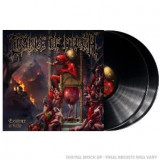
Black vinyl[30,71 €]
Belched from Hell’s depths into the rustic charms of the Witch County, Suffolk thirty long and disturbing years ago, CRADLE OF FILTH are undisputed giants of the heavy metal realm. Imperious purveyors of a perennially unique strain of dark, dastardly and wilfully extreme metal, with deep roots in the worlds of gothic horror and occult curiosity, the band led by Dani Filth has weathered three decades of tumult and trial, earning a formidable reputation as both a singular creative force and one of the most riotously entertaining live bands the metal world has ever produced.
From primitive early works like 1992 debut »The Principle Of Evil Made Flesh« to more expansive and theatrical classics like ‘Cruelty And The Beast’ and ‘Midian’, CRADLE OF FILTH defied trends and constructed their own idiosyncratic world of foul grandeur, becoming one of the UK’s most notable metal bands in the process. Since then, they have traversed the world countless times, hoovering up plaudits and praise from an ever-expanding international fan base. Resolutely prolific, the band’s catalogue has grown in depth and stature all the while, irrespective of line-up changes or the whims of the faithful.
In more recent times, CRADLE OF FILTH have hit an unmistakable hot streak of creativity and urgency. As a new line-up coalesced around the creation of 2015’s »Hammer Of The Witches«, fresh impetus propelled the band to new heights, as the revitalised crew became more in demand around the world than ever before. 2017’s ‘Cryptoriana - The Seductiveness Of Decay’ repeated the trick with even more explosive flamboyance. Until a global pandemic brought the music industry to a jarring halt, CRADLE OF FILTH were almost permanently on the road and absolutely fucking flying. As a result, it should surprise no one that the band’s brand new album, ‘Existence Is Futile’, is yet another monumental and electrifying journey through the dark.
Buoyed by these recent triumphs, CRADLE OF FILTH recorded »Existence Is Futile« during 2020, piecing the record together in isolation, at Grindstone Studios in Suffolk with studio guru Scott Atkins (Devilment/Benediction/Vader). Although instantly recognisable as the work of these veteran blackhearts, the thirteenth CRADLE OF FILTH album is a wholly different beast from its immediate predecessors. Pitch-black, perverse and at times absurdly brutal and extreme, it hangs together with mesmerising fluidity. It is also absolutely rammed with giant, rousing melodies and moments of jaw-dropping invention. No one could mistake the venomously catchy likes of ‘How Many Tears To Nurture A Rose?’ or monstrous ballad ‘Discourse Between A Man And His Soul’ for anything other than CRADLE OF FILTH, of course, but ‘Existence Is Futile’ confirms that the band’s exploratory instincts remain as sharp as ever.
Underpinned by its huge and disarmingly organic production, »Existence Is Futile« is plainly the darkest and most unsettling album CRADLE OF FILTH have made in a while. Eschewing the band’s trademark twisted storytelling in favour of horrified glimpses into the mortal void and ruminations on the inevitable destruction of life on Earth, its poignancy and relevance to the cluster of nightmares facing humanity in 2021 is impossible to ignore, even if Dani Filth insists, not unreasonably, that he didn’t anticipate a global pandemic when the news songs were being written.
With the best possible timing, CRADLE OF FILTH were already due to make a new album during those long, lonely months of lockdown in 2020. Having grabbed the opportunity with both hands, Dani avows that unavoidable isolation from the rest of the world was the best possible incentive to get the job done, while also adding plenty of eerie atmosphere to the whole experience.
Sonically speaking, ‘Existence Is Futile’ is easily the most powerful and dramatic record CRADLE OF FILTH have ever made: it’s the sound of band’s enviable onstage chemistry spilling over into the studio, propelling each member of the band to new levels of intensity. Combined with the expected labyrinthine arrangements and moments of spellbinding bombast, ‘Existence Is Futile’ may be the most vivid representation of the CRADLE OF FILTH experience yet.
Also, diehard fans will be thrilled to learn that horror icon Doug 'Pinhead' Bradley makes a welcome return to the CRADLE fold, lending his dulcet tones to the epic ‘Suffer Our Dominion’, and to one of the forthcoming new record’s bonus tracks, as Dani explains.
“There are also two bonus tracks in addition to the album, one of which is the culmination to the ‘Her Ghost In The Fog’ trilogy, which began on »Midian«.
For this we had little hesitation in enlisting our friend and actor Doug Bradley to reprise his narrative role. Doug lives in Pittsburgh, which he refers to ‘The Pit’, thus we directed his narrative over Skype from his local studio. He adopts this almost David Attenborough-ish role on ‘Suffer Our Dominion’, which is possibly the most politically astute song we’ve written of late. As a band we usually shy from branching into politics, but it’s something that needed spouting. The fact we’re fucking our ecology up and desperately need to address the situation pronto…”
So, if we’re all going to perish in the fire of our own stupidity, we might as well have a suitably deranged and destructive soundtrack to do it by.
A bewitching, fearless nosedive into the abyss, the band's thirteenth studio album confirms the ferocious efficacy of CRADLE OF FILTH in 2021. Bold, brave, wildly imaginative and heavy as hell, the band’s latest runaway train-ride through the flames is the perfect album for these most imperfect of times. As Dani concludes, “Be like the virus! Mutate and survive!”
- A1: The Fate Of The World On Our Shoulders
- A2: Existential Terror
- A3: Necromantic Fantasies
- A4: Crawling King Chaos
- B1: Here Comes A Candle.. (Infernal Lullaby)
- B2: Black Smoke Curling From The Lips Of War
- B3: Discourse Between A Man And His Soul
- B4: The Dying Of The Embers
- C1: Ashen Mortality
- C2: How Many Tears To Nurture A Rose?
- C3: Suffer Our Dominion
- C4: Us,Dark.invincible
- D1: Sisters Of The Mist
- D2: Unleash The Hellion
Purple/Black Marbled Vinyl[39,62 €]
Belched from Hell’s depths into the rustic charms of the Witch County, Suffolk thirty long and disturbing years ago, CRADLE OF FILTH are undisputed giants of the heavy metal realm. Imperious purveyors of a perennially unique strain of dark, dastardly and wilfully extreme metal, with deep roots in the worlds of gothic horror and occult curiosity, the band led by Dani Filth has weathered three decades of tumult and trial, earning a formidable reputation as both a singular creative force and one of the most riotously entertaining live bands the metal world has ever produced.
From primitive early works like 1992 debut »The Principle Of Evil Made Flesh« to more expansive and theatrical classics like ‘Cruelty And The Beast’ and ‘Midian’, CRADLE OF FILTH defied trends and constructed their own idiosyncratic world of foul grandeur, becoming one of the UK’s most notable metal bands in the process. Since then, they have traversed the world countless times, hoovering up plaudits and praise from an ever-expanding international fan base. Resolutely prolific, the band’s catalogue has grown in depth and stature all the while, irrespective of line-up changes or the whims of the faithful.
In more recent times, CRADLE OF FILTH have hit an unmistakable hot streak of creativity and urgency. As a new line-up coalesced around the creation of 2015’s »Hammer Of The Witches«, fresh impetus propelled the band to new heights, as the revitalised crew became more in demand around the world than ever before. 2017’s ‘Cryptoriana - The Seductiveness Of Decay’ repeated the trick with even more explosive flamboyance. Until a global pandemic brought the music industry to a jarring halt, CRADLE OF FILTH were almost permanently on the road and absolutely fucking flying. As a result, it should surprise no one that the band’s brand new album, ‘Existence Is Futile’, is yet another monumental and electrifying journey through the dark.
Buoyed by these recent triumphs, CRADLE OF FILTH recorded »Existence Is Futile« during 2020, piecing the record together in isolation, at Grindstone Studios in Suffolk with studio guru Scott Atkins (Devilment/Benediction/Vader). Although instantly recognisable as the work of these veteran blackhearts, the thirteenth CRADLE OF FILTH album is a wholly different beast from its immediate predecessors. Pitch-black, perverse and at times absurdly brutal and extreme, it hangs together with mesmerising fluidity. It is also absolutely rammed with giant, rousing melodies and moments of jaw-dropping invention. No one could mistake the venomously catchy likes of ‘How Many Tears To Nurture A Rose?’ or monstrous ballad ‘Discourse Between A Man And His Soul’ for anything other than CRADLE OF FILTH, of course, but ‘Existence Is Futile’ confirms that the band’s exploratory instincts remain as sharp as ever.
Underpinned by its huge and disarmingly organic production, »Existence Is Futile« is plainly the darkest and most unsettling album CRADLE OF FILTH have made in a while. Eschewing the band’s trademark twisted storytelling in favour of horrified glimpses into the mortal void and ruminations on the inevitable destruction of life on Earth, its poignancy and relevance to the cluster of nightmares facing humanity in 2021 is impossible to ignore, even if Dani Filth insists, not unreasonably, that he didn’t anticipate a global pandemic when the news songs were being written.
With the best possible timing, CRADLE OF FILTH were already due to make a new album during those long, lonely months of lockdown in 2020. Having grabbed the opportunity with both hands, Dani avows that unavoidable isolation from the rest of the world was the best possible incentive to get the job done, while also adding plenty of eerie atmosphere to the whole experience.
Sonically speaking, ‘Existence Is Futile’ is easily the most powerful and dramatic record CRADLE OF FILTH have ever made: it’s the sound of band’s enviable onstage chemistry spilling over into the studio, propelling each member of the band to new levels of intensity. Combined with the expected labyrinthine arrangements and moments of spellbinding bombast, ‘Existence Is Futile’ may be the most vivid representation of the CRADLE OF FILTH experience yet.
Also, diehard fans will be thrilled to learn that horror icon Doug 'Pinhead' Bradley makes a welcome return to the CRADLE fold, lending his dulcet tones to the epic ‘Suffer Our Dominion’, and to one of the forthcoming new record’s bonus tracks, as Dani explains.
“There are also two bonus tracks in addition to the album, one of which is the culmination to the ‘Her Ghost In The Fog’ trilogy, which began on »Midian«.
For this we had little hesitation in enlisting our friend and actor Doug Bradley to reprise his narrative role. Doug lives in Pittsburgh, which he refers to ‘The Pit’, thus we directed his narrative over Skype from his local studio. He adopts this almost David Attenborough-ish role on ‘Suffer Our Dominion’, which is possibly the most politically astute song we’ve written of late. As a band we usually shy from branching into politics, but it’s something that needed spouting. The fact we’re fucking our ecology up and desperately need to address the situation pronto…”
So, if we’re all going to perish in the fire of our own stupidity, we might as well have a suitably deranged and destructive soundtrack to do it by.
A bewitching, fearless nosedive into the abyss, the band's thirteenth studio album confirms the ferocious efficacy of CRADLE OF FILTH in 2021. Bold, brave, wildly imaginative and heavy as hell, the band’s latest runaway train-ride through the flames is the perfect album for these most imperfect of times. As Dani concludes, “Be like the virus! Mutate and survive!”
- 1: I Will Be Your Only One (Monika Werkstatt Version) Monika Werkstatt 03:42
- 1: 2 Paradise (Monika Werkstatt Version) Monika Werkstatt 04:55
- 1: 3 Radiator (Monika Werkstatt Version) Monika Werkstatt 03:26
- 1: 4 Komm Darling Lass Uns Tanzen Gehen (Monika Werkstatt Version) Monika Werkstatt 03:32
- 1: 5 You You (Monika Werkstatt Version) Monika Werkstatt 03:28
- 1: 6 Schreiender Tag (Monika Werkstatt Version) Monika Werkstatt 03:50
- 1: 7 Geld (Monika Werkstatt Version) Monika Werkstatt 03:27
- 1: 8 Mother (Monika Werkstatt Version) Monika Werkstatt 03:35
- 1: 9 White Sky White Sea (Monika Werkstatt Version) Monika Werkstatt 03:46
- 1: 0 Herzschlag (Monika Werkstatt Version) Monika Werkstatt 03:53
- 1: Zukunft (Monika Werkstatt Version) Monika Werkstatt 02:42
- 1: 2 Nite Time (Monika Werkstatt Version) Monika Werkstatt 04:02
- 2: 1 Zukunft (Sender Freies Berlin) Mania D. 0:18
- 2: Radiator (Zossener Straße Cute Version) Mania D. 56
- 2: 3 I Will Be Your Only One („Malaria!“ Ep) Malaria! 03:09
- 2: 4 Nite Time („A Touch Bcl“ Album Version) Matador 04:46
- 2: 5 Herzschlag (7Inch Single, Monogam) Mania D. 0:56
- 2: 6 Paradise (Demo Version) Matador 03:04
- 2: 7 White Sky White Sea (Edit, „Weisses Wasser“ Ep) Malaria! 04:5
- 2: 8 Zukunft (Live In Düsseldorf) Mania D. 0:56
- 2: 9 Komm Darling Lass Uns Tanzen Gehen (Live In Düsseldorf) Mania D. 01:54
- 2: 10 Mädels Sind Toll (Live Berlin) Malaria! 04:35
- 2: 11 You You (Live In Washington D.c., 9:30 Club, 1983) Malaria! 05:37
- 2: 1 Schreiender Tag Matador 04:13
- 2: 13 Mother (Demo Version) Matador 03:00
M_SESSIONS - THE PROCESS
"M_Sessions" is offering a contemporary version of Mania D., Malaria and Matador’s music for the 40th anniversary plus the rare originals. Bringing the past into the now and into the future.
Monika Werkstatt seemed the perfect choice for new interpretations. Founded in 2015, comprising female electronic musicians and producers from the entourage of Monika Enterprise and Moabit Musik. The loose collective played dozens of improvised concerts around Europe and released a studio album and live recordings in everchanging artist constellations.
The M_Sessions involved Pilocka Krach, Beate Bartel, Midori Hirano, Mommo G, Lucrecia Dalt, Antye Greie-Ripatti, Natalie Beridze, Annika Henderson and myself. Here the form of interpretation is focussing on keeping the freedom of their improvised work and adapting it to the collective appropriation of songs. I cannot imagine a better reinterpretation of the material with its real life ups and downs and with its enthusiasm.
The original core team of Beate Bartel, Bettina Köster, Manon P. Duursma and myself selected "Rare Originals" from the repertoire of the 3 bands where we saw special relevance and beauty - these tracks are on LP2. We rediscovered live tracks, living room recordings and demo versions from our times long gone. (G.Gut)
M_DOKUMENTE // THE BOOK - THE RECORDS - THE EXHIBITION
The project M_Dokumente focuses on the All Female bands Mania D., Malaria! and Matador in the West Berlin music and art scene of the late 1970s and 1980s. We celebrate this 40 years retrospetive with a big festival weekend from 21.-24.10.2021 at Silent Green from a explicitly female perspective.
The three bands around their members Beate Bartel, Bettina Köster and Gudrun Gut played concerts in different formations from 1979 on, released records and toured around the world. The self-determined appearance of the musicians was new, raised some eyebrows and was reflected both in the music and the lyrics, but also in their unique style and the genre-crossing approach of "more art in the music, more music in the art". To this day, the bands are considered visionary, they shaped a new image of women in pop culture and are pioneers and role models for the still important and necessary emancipatory movement in the music industry. Far beyond the borders of Berlin.
3Ms
The three, reunited: Malaria, Matador and Mania D, unter einem Dach, but gutted, replaced with electronic hearts, new beats, new beasts, the time has changed, yet the politics, the problems, the heartache remains the same. 2021 sees the anniversary of the 3 M’s and therewith the production of an album of songs, covering a selection of the bands’ finest output, this time assembled by a new set of feminist misfits; producers, fangirls, instrumentalists, under the strict guidance of original members Gudrun Gut and Beate Bartel. M-Sessions features: AGF, Lucrecia Dalt, Sonae, Midori Hirano, Islaja, Natalie Beridze, Pilocka Krach, Annika Henderson (Anika), Lupe, Gudrun Gut and Beate Bartel. Beginning in West Berlin, in 1979, with the inception of Mania D, spawning Malaria! and later Matador; in a time when music was essential to movement, to escape, to space, to the scene and to the rebellion of the people; three bands stood for trial and error, trial and terror, anti- conformity, and anti-consumerism, for girl power and sticking it to the man, and for just doing whatever the hell they wanted. The three, their existence slightly staggered, with different members, different grudges, different heartbreaks, different instrumental expressions, were joined by a string of barbed wire, piecing pigeon hearts, within the playground that was the desolate ex-capital, now again capital, Berlin; a place where artists and freaks could run free amongst the wrinklies and army dodgers; no microscopes, no rules, no property developers. (ANNIKA HENDERSON)
Heavy psych power trio Charles Moothart, Ty Segall and Chad Ubovich hit the stage for the first time together in five years bringing a full set spanning their entire discography, and new album, III! Recorded at Zebulon in Los Angeles, CA. In Oct 2020 the band released their first album in 5 years, III, scorching the earth with pure primitive rock and roll mastery captured by the sonic guru Steve Albini. It’s a record that is meant to be heard and experienced live, and their Levitation Sessions set is the smoldering slab of heavy psych we’ve all been waiting for, recorded at Zebulon in Los Angeles, CA. Director Joshua Erkman alongside sound engineers Matthew Littlejohn and Mike Kriebel, capture FUZZ’s intense energy backdropped by electric artwork from artist Tatiana Kartomten. “We wanted to create something that felt like more than just a replacement for seeing us live. This is the first time we had played songs from III in the context of a set, and we found new footing on some of the old songs. This led us down avenues we hadn’t seen in rehearsal. To find ourselves in the space right in between ‘lost’ and ‘found’ (aka live) was both alarming and electrifying after having been away from it for so long.” -FUZZ
‘Electronic Ambient Remixes Three’ was originally
released in 2001 and includes ambient remixes
and soundscapes utilising Chris Carter’s original
Throbbing Gristle rhythm tapes from the 70s and
80s.
Tracks from this instrumental series have been
used internationally in gallery installations,
performed at numerous electronic music festivals,
featured on TV and radio broadcasts and within
Hollywood movie trailers.
‘Electronic Ambient Remixes Three’ is now
available for the first time on double grey coloured
vinyl, as well as CD.
CD in gatefold card pack.
Double LP on grey vinyl with etched Side D and
digital download code.
The Paradigm-Shifting Fourth Studio Opus From The Norwegian Pioneers.
Presented On 2cd Deluxe Digipack Format & Including A Retrospective Look
At The Album Courtesy Of Writer Jeff Wagner.
‘Themes from William Blake’s The Marriage of Heaven and Hell’ is the fourth
studio album by Norwegian experimentalists Ulver.
Having been known for their more folklore-tinged black metal compositions on
early studio releases, in late 1997, mainman Kristoffer Rygg invited keyboardist, sound conceptualist, and composer Tore Ylwizaker into the collective, and
together they devised a plan for The Blake Album; an altogether far more adventurous endeavour than prior releases.
What resulted was a seamless integration of electronic & industrial music, with
elements of progressive metal & avantgarde rock, all fused with ambient passages, & following Blake’s plates as track indexes. A work of deep and personal
art, the album, while initially surprising to fans due to its complete shift in genre, has become a classic today, and a prime example of the boundary-pushing
evolution beyond the confines of genre expectations through the latter part of
the 90’s. Upon release, ‘The Marriage of Heaven & Hell’ received widespread
acclaim from critics within the rock, metal & alternative music press, being
awarded Album of the Month in several high-profile magazines such as Terrorizer, Metal Hammer, and Rock Hard.
The album notably includes guest vocal appearances from Darkthrone’s Fenriz,
as well as Ihsahn & Samoth; most known for their work in Emperor.
This newly remastered edition of ‘The Marriage of Heaven & Hell’ is presented
on 2CD deluxe digipack format, including full lyrics/text, plus a new article from
writer and journalist Jeff Wagner on the background, nature & triumph of such
an ambitious release.
Phonophobia is a record that inspired thousands of dirty punks all over the world, and having the chance to re-release it is such a honour for us. I don't think we need to introduce this record and this band to any of the people who are reading these lines, but a few words are necessary to explain the value of this product. Phonophobia has originally been recorded and mixed at Southern Studios in London in August 1991. This version has been remixed and remastered by Dean Jones and Phil Vane with additional production at Springvale Studios in Ipswich in October 2009. The sonic assault is now more than ever ear damaging, so prepare your turntable and your eardrums for this final violent assault!
HIDE are an electronic duo based in Chicago. The pair create dark and heavy sample - based compositions using a combination of self - sourced field recordings and various pop culture and media references. Their music is textured, minimal, and powerful, giving raw vulnerability an opportunity to unfurl. Their work is honest, confrontational, powerful and thought - provoking.
HIDE's third album, Interior Terror further abandons traditional concepts of song structure in favor of splintered rhythms and fevered, immediate release. Expanding on previous themes of autonomy and empowerment, Interior Terror addresses and questions the corporeal and immaterial body in a physical and metaphysical sense. Turning to the dread inside, reflecting on the world around us,
HIDE gives voice to the power of destruction as a c atalyst for hope, and to the collective experiences of those who've come before us as a wellspring of our own power. Raw vocal delivery of mantra - like prose issued forth yields a raging, plaintive wail that lulls, mocks, questions, proclaims and decries. A dearth of collected field recordings give way to more fluid arrangements while retaining a scathing urgency. The result is minimal, spacious, and jarring; a distant knocking grown into the pulse of a hypnotic dirge, drones emerge from shards of decomposed sound, bending, seething their way through your body.
"Do Not Bow down" is a self - directed spell for fire and regeneration. “Nightmare” explodes, unrelenting; conflating time and space to the beat of repeated blows to the head. A reflection on perpetual suffering, generational traumas and the transformative action of release. Title track “Interior Terror” belies a new brand of body horror informed by the systemic enforcement of a contemporary Western gender binary, touching on experiences of dysphoria and disassociation . “Fear” answers the question 'Where do cops come from
HIDE are an electronic duo based in Chicago. The pair create dark and heavy sample - based compositions using a combination of self - sourced field recordings and various pop culture and media references. Their music is textured, minimal, and powerful, giving raw vulnerability an opportunity to unfurl. Their work is honest, confrontational, powerful and thought - provoking.
HIDE's third album, Interior Terror further abandons traditional concepts of song structure in favor of splintered rhythms and fevered, immediate release. Expanding on previous themes of autonomy and empowerment, Interior Terror addresses and questions the corporeal and immaterial body in a physical and metaphysical sense. Turning to the dread inside, reflecting on the world around us,
HIDE gives voice to the power of destruction as a c atalyst for hope, and to the collective experiences of those who've come before us as a wellspring of our own power. Raw vocal delivery of mantra - like prose issued forth yields a raging, plaintive wail that lulls, mocks, questions, proclaims and decries. A dearth of collected field recordings give way to more fluid arrangements while retaining a scathing urgency. The result is minimal, spacious, and jarring; a distant knocking grown into the pulse of a hypnotic dirge, drones emerge from shards of decomposed sound, bending, seething their way through your body.
"Do Not Bow down" is a self - directed spell for fire and regeneration. “Nightmare” explodes, unrelenting; conflating time and space to the beat of repeated blows to the head. A reflection on perpetual suffering, generational traumas and the transformative action of release. Title track “Interior Terror” belies a new brand of body horror informed by the systemic enforcement of a contemporary Western gender binary, touching on experiences of dysphoria and disassociation . “Fear” answers the question 'Where do cops come from
- A1: Soldier
- A2: Popface
- A3: She Perfect Mate
- A4: E (I Love The Polizei)
- B1: Supersoldier
- B2: Strangers Killing Strangers 1
- B3: In Bloom
- B4: This Duck Talks English Wmv
- B5: X (Mommy)
- C1: It Will Make The World A Better Place
- C2: Sad Masturbation
- C3: Terrorist
- C4: Horizontal Foo
- C5: Wash Your Hands
- C6: Dead Hooker In The Milk
- D1: I Have Muscles Look At Me
- D2: Everything Made Up
- D3: Do You Love Your Family
- D4: Strangers Killing Strangers 2
ARTS is glad to present the very first full length work from one of our most unique artists in the roster, after a few records on the label and an impressive impact on the scene, KRTM worked on a larger project that aimed to express freely something deeper, and most likely something that was inevitable and that needed to get out into the sun. Despite the format, this is little more than a usual LP, the entire body of work is larger, but essentially presented in a very personal way in each single part of the elements and written tracks, we are glad to give you "It Will Make The World A Better Place", there are not many words that are needed to describe what you are going into, we hope that this piece of art will sign your future as will sign ours.
Toronto’s infamous psychedelic multimedia collective, Intersystems, make a surprise return with a new full-length LP, #IV. Coming via Waveshaper Media, #IV is Intersystems’ first new material since 1968! Intersystems’ pioneering avant/electronic music sounded positively alien in the 1960s, and more than 50 years later, this latest body of work sounds just as otherworldly.
When they arrived on the scene in the late 1960s, Intersystems stood out from their peers. Comprised of architect Dik Zander, light sculptor Michael Hayden, poet Blake Parker, and musician John Mills-Cockell (of Syrinx, Kensington Market and more), the group mounted groundbreaking pan-sensory events and released a trilogy of defiantly disorienting records.
Where more conventional purveyors of sonic psychedelia were content with fuzztone guitar and orientalist tropes, Intersystems managed to approximate the full psychedelic experience in all its euphoric wonder and terror. Initially wrangling homespun gadgetry, feverishly spliced-together tapes, and mutant beat poetry, Intersystems were also among the very first to deploy a Moog Synthesizer; their Moog modular system was the first to be imported into Canada. Intersystems’ three vinyl LP recordings, meanwhile, justifiably became coveted collector's items given their scarce quantity and singular unsettling vision.
The reissue of Intersystems’ full discography in 2015 prompted acclaim from a number of major outlets. Among them, PopMatters hailed the set as "one of those great lost recordings (three of 'em actually) that comes from the lysergic era..." Mills-Cockell’s work in Syrinx has also been reissued to great acclaim in recent years.
Fifty-plus years after their 1968 album Free Psychedelic Poster Inside, Hayden and Mills-Cockell decided to revive the long-dormant project with a series of sessions at Hamilton's storied Grant Avenue Studio. The resultant music remains remarkably congruent with the project's original vision while clearly emerging from the present moment. With original poet/lyricist Blake Parker now deceased, Hayden and Mills-Cockell made the counterintuitive (yet strangely apt) decision to render Parker's words electronically. As the computer-synthesized voice alternates between an eerily life-like delivery and slurred cybernetic faltering, it brings a new dystopian tint to the group's anxious surrealism. Taking cues from its predecessor, Free Psychedelic Poster Inside, a modular Moog Synthesizer system is the primary instrument, yet here it offers a dynamic blend of different sonorities: barbed wire basslines, Subotnickesque chirping, gestural plumes of colour and percussive filigree.
While the group cut their teeth in the 1960s, make no mistake these new Intersystems recordings aren't a “comeback" or an attempt to rehash the "good old days". What one hears instead is the sound of Mills-Cockell and Hayden re-energizing the project, bringing with them the myriad experience they’ve accumulated in the intervening 50 years. These aural concoctions—no less perplexing than their 1960s predecessors—build upon the Intersystems foundation but very decidedly reside in the present moment, reminding listeners of just how forward-looking this group was in the first place.
Optimo Music presents “Janara” the new album from Italy’s José Manuel. We always have our ears open for music that is unique, powerful and that can conjure up a ritualistic atmosphere, and this meistrerwerk did all that, and then some. We knew we had to release it after the first listen.
We’ll let José tell you about it….
This album is a result of the necessity of exploring and opening my mind to new musical horizons, by testing the main traditional instrument of the Italian region Campania, whose name is “Tammorra”. It is a big drum, which must not be confused with the typical tambourine, made from a wrap of wood shaped in a circle and covered with dried skin (almost always goatskin or sheepskin). This instrument was used during playful events, especially during rituals and ceremonies, such as the frequent devotional pilgrimages in honour of the Virgin Mary. By using this instrument, the sound, the rite and the magic could take possession of the mind and the body creating a perfect union. Also, the dancers, as if they were bitten by a tarantula and possessed by a strange evil, launched themselves to an uncontrolled dance by moving every part of their body.
In addition to the Tammorra, I also inserted some texts, which have been written by some Neapolitan friends and interpreted with Neapolitans voices, in honour of the “JANARA”. The Janara represents a popular belief of the Southern Italian regions, particularly of the Benevento area. The Janara is one of the many types of witches represented by folktales belonging to the rural tradition.
The Janara was expert in medical herbs, which were also be used for her magical practices, such as the manufacturing of ointment. The ointment gave her the power to become incorporeal with the same nature as the wind. According to the tradition, in order to snatch the Janara it was necessary to grab her by the hair. It was also said that if anyone was able to capture the Janara during her incorporeal moment then Janara herself would offer protection to them and their family for seven generations, in exchange for her freedom.
With this work I hope that the listener might get carried away by the spirit of this pagan and popular legend that can be still be considered as current. As a matter of fact, the folk tales speak of a probable comeback of the Janara, who after being burned at the stake seems to be thirsting for revenge for the evil suffered.
Veteran NYC based Scottish electronic musician Drew McDowall's latest work is his loftiest, most liturgical, and least industrial outing to date —and potentially the apex of his recent discography.Named after an ancient Greek word for votive offering, Agalmaexudes a hooded, devotional aura, creaking and keeling under vast rafters of stone, stained glass, and shredded wires. It's a music of majesty and mystery but also modernity, McDowall's refined modular system shape-shifting strings, piano, pipe organ, and choral masses into disorienting synthetic mirages of the sacred. He cites the intersection of “joy, terror, and the elegiac” as a centering inspiration –or, phrased more bluntly, “that 'what the fuck is going on' feeling.”
As a career collaborator himself, with stints in Coil, Psychic TV, and countless other shorter-lived partnerships, it's telling that McDowall chose this project to gather such an impressive spectrum of peers. Italian synthesist Caterina Barbieri, American drone organist Kali Malone, prolific multi-instrumentalistRobert Aiki Aubrey Lowe, operatic Humanbeast vocalist Maralie Armstrong-Rial, Saudi producer MSYLMA, and warped futurist beat-makers Bashar Suleiman and Elvin Brandhi cameo across the album's 42 minutes, contouring McDowall's nuanced negative spaces with shudders, shadows, and shivering flickers of serenity. Each of them shines in their spotlight, elevating these elusive alchemical states into surreal revelations of texture and transcendence.
McDowall's original working title for the record is revealing: Ritual Music.He speaks of his creative practice in ceremonial terms, negating binaries by seeking the middle path to anuminousequilibrium that erases the distinction between the inner and outer worlds.These compositions feel similarly processional and intuitive, at the crossroads of holiness and hallucination, the sacred vertigo of yawning naves rising into untouchable night skies. It's a vision of industrial music as enigma and invocation, cryptic hymnals of shroudedbeautysummoned in catacombs and crumbling cathedrals.
Despite its depths, Agalmais also an album of immediacy and emotion. Celestial laments of and for times of unrest and suffering. McDowall characterizes his initial intention for this music as an to attempt to convey experiences he felt incapable of putting into words: “To try and approach sublimity, or at least acknowledge it in some way.”Agalmamore than acknowledges the ineffable –it embodies it.
The dusty streets of apartheid-era Soweto, 27 July 1987. The politically charged funeral of a young activist who fled South Africa to became a commander in the military wing of Nelson Mandela's African National Congress. Police await in armoured cars. The funeral is restricted by specific government decree.
The man being buried is Peter Motau, assassinated in neighbouring Swaziland on the orders of South Africa's most notorious government-sanctioned killer, Eugene de Kock, orders carried out by his secret police unit in a bloody ambush.
For De Kock and the apartheid government, Peter Motau was a terrorist. For the singing, chanting mourners at his funeral, he was a freedom fighter, a hero from the streets of Soweto itself.
ZA87 is a raw audio document of one extraordinary day under apartheid. A father mourns, himself breaking the regulations declaring any political statements at the funeral illegal. Young activists, the "Comrades", sing in praise of the banned ANC's military wing, sirens blare, helicopters hover overhead, a police officer orders all television and photojournalists to leave. Nigel Wrench's microphone remains. Also there is Winnie Mandela, on behalf of the ANC's exiled leadership. Banned from speaking at the funeral, she speaks instead into Wrench's microphone and stages a remarkable intervention as the police seek to detain activists.
The authorities sought to keep the events of that day away from the eyes and ears of anyone who wasn't there. ZA87 breaks that silence.
Nigel Wrench is an award-winning journalist whose career began in South Africa under apartheid. He is the winner of a Sony Award for "Out This Week", BBC Radio's first national lesbian and gay news programme, and a New York Radio Award for BBC Radio 4's "Aids and Me", chronicling his experience of living with HIV. "Few journalists have quite so intimately captured the essence of their era's great moral panics as Nigel Wrench" (The Quietus).
ZA87 is the follow-up to Wrench's acclaimed first cassette on The Tapeworm, ZA86, "a remarkable documentation of South Africa under apartheid in 1986" (Boomkat), "chilling and at times stunningly beautiful" (The Quietus), "stylistically not dissimilar to Adam Curtis's 2015 documentary 'Bitter Lake', its hypnagogic float through the rushes feels curiously vivid, free of the dating or distancing effect further media packaging might bring" (The Wire).
“This lighthouse is under attack, and by morning we might all be dead!”
Demon Records presents the thrilling narrated TV soundtrack of this vintage four-part adventure at sea, starring Tom Baker as the Doctor.
A remote lighthouse in the early 1900s is the scene of this suspenseful adventure for the Doctor and Leela, when a light in the sky and a sudden dense fog are the preludes to a night of terror.
With a lighthouse keeper dead, Old Reuben fears the legendary Beast of Fang Rock has returned.
A shipwreck brings others in search of shelter, but nobody’s safety can be guaranteed. The Doctor must use all his ingenuity if he and Leela are to survive…
Presented across 2 x 140g vinyl discs in Rutan Blob green, this 1977 TV soundtrack is narrated by Louise Jameson, who plays Leela in the story. The supporting cast includes Colin Douglas, John Abbott, Alan Rowe, Sean Caffrey and Annette Woollett. Incidental music is composed by Dudley Simpson, and the familiar strains of the Doctor Who theme are courtesy of the BBC Radiophonic Workshop.
The coloured vinyl LPs are presented in a fully illustrated gatefold sleeve showing cast and credits, and inner bags featuring complete episode billings.
Dummedy-dum, Dummedy-dum, Dummedy-dum, Dum-dum…
VINYL[19,87 €]
Nahawa Doumbia's new album Kanawa concisely captures this current moment in Malian history. The singer, whose storied career spans more than four decades, reflects on the immigration crisis from the Malian perspective in the title of her new album Kanawa. Across eight songs recorded in Bamako with a band including traditional and modern instruments, Doumbia merges her early work that relied on a spare expression of her trademark didadi rhythm with the bombastic range of contemporary Malian pop. The beautifully complex musical accompaniment that results is courtesy of the large ensemble she pulled together with producer and arranger (and day one collaborator) N'gou Bagayoko. The band features two highly expressive Malian string instruments, the ngoni and the slightly smaller kamalé ngoni, as well as a variety of percussion, drum programming, karignan (a metal scraper) and acoustic and electric guitars. Doumbia's daughter, a celebrated singer with her own group and busy concert schedule, Doussou Bagayoko sings on "Adjorobena," a song about patience, tolerance and living in peace. Doumbia weaves together a roadmap of her psyche when it comes to the good and bad life has to offer. She talks about marriage and women leaving home to join another through the metaphor of a tree in the garden; she includes gunshot samples in the song "Foliwilen" to honor the bravery of hunters, soldiers and other courageous people; she uses a bird in "Djougoh" to talk about lazy people; and, in "Ndiagneko" she advises people to ignore critics, just do you. Mali has gone through an intense period of regional strife and terrorist incidents over the last ten years and Doumbia roots the album in tragic local concerns with deep global implications. "The meaning of Kanawa is so simple. We see our children trying to cross the ocean all the time. I said that many of our children die in the ocean and some of them die while crossing the Sahara. But I ask them why do they leave their country? They said that they leave because of the family situation or problems like poverty and unemployment. I ask them to stay and work in their country. I call on the UN and African leaders so that we can coordinate our efforts to find a solution, to create jobs for them so that young people stop leaving. That's why I chose it as the title of my album so that everybody can learn from it and also so that there is a reduction in the number of people emigrating. So that some will hear the message and stay home and grow the land. Leaving is not the only solution. My message is to help the youth find jobs."


![[KRTM] - It Will Make The World A Better Place 2x12"](https://www.deejay.de/images/l/3/6/970236.jpg)