Warehouse Find!
The masterful, supergroup of Phreek lead by Patrick Adams, sees three of its sought-after masterpieces, two of which have never been on a 12 inch, officially reissued and remastered on a label that’s fast becoming a go-to for in demand reissues, South Street Disco.
A pure classic, ‘Weekend’, was born back in ‘78 written by Leroy Burgess and James Calloway and produced by Patrick Adams and Burgess, they lead an expertly curated troupe for this massive Paradise Garage staple and Larry Levan favourite. That late ‘70s sound where synthesisers rose to prominence, sees a combination of cosmic keys, freakish strings and power-play funk guitars, tied together with tight percussion, bold basslines and Christie Shire’s lead vocals, that whole heartedly captures the spirit of disco. Famously remade into a house anthem 10 years later by Todd Terry, ‘Weekend’ is a timeless slice of celestial magic.
In a similar fashion ‘Everybody Loves A Good Thing’ does another blast around the cosmos - a Universal Robot Band feel emanating from the buzzing synths and awe-inspiring vocal prowess of Leroy Burgess, coupled with ‘Shining’ star, Venus Dodson. As uplifting as it gets, complete with a killer piano breakdown to draw out every ounce of anticipation.
Flip it over and a whole side is devoted to the greatness of ‘I'm a Big Freak R*U*1*2’. A mesmerising, fast-paced, disco workout with sensuous groans, sleazed up, supernatural keys and a heavy bass that just goes and goes and goes! Favoured by the biggest and best out there, from Ron Hardy to Theo Parrish, it’s got the power and energy to light up even the most demanding of dancefloors.
Поиск:ti pi cal
Все
Favorite Recordings proudly presents this new official single reissue of “Feel So Good Inside”, by Lamar Thomas. A killer deep-disco and very rare collectable single, fully coordinated for reissue by French respected DJ and Tropical rare-groove specialist, Waxist Selecta.
Lamar Thomas is an American singer, composer and producer who made a short solo career in the 70s, and then formed the duo Thomas & Taylor. He has also penned few songs for Johnny Bristol, Garland Green, Nancy Wilson, Maynard Ferguson, or Johnnie Taylor among others.
In 1980, he recorded this 2 tracks single for MCA Records, who released it on a 7inch left almost unnoticed at that time. 30 years later, this brilliant disco production has become a classic rare-groove title for a few DJs and diggers, with among them, French collector and DJ, Waxist Selecta (aKa Julien Minarro).
Schooled about this rarity by DJ Klas (aKa Josh Goldman), he then made it a real favorite in his various DJ sets. Curious to learn more about this forgotten piece, he also liaised with Lamar through the web, and discovered that all the masters had burned in a California fire at Universal.
As Julien already worked on an upcoming reissue project with Pascal Rioux and Favorite Recordings (more details in 2015), he offered him and Lamar to arrange a proper official reissue and produce a new master from his own vinyl copy. Coming out in a 12inch version built for dancefloors, the package also includes a great extended mix by Waxist.
- 1: Different Type Time (Prod. Quelle Chris & Cavalier)
- 2: Custard Spoon (Prod. Quelle Chris)
- 3: Can’t Leave It Alone Feat. Eric Jaye (Prod. Glassc!Ty)
- 4: Come Proper (Prod. Jacob Rochester)
- 5: Touchtones (Prod. Aummaah)
- 6: Déjà Vu / Tydro ‘97 (Prod. Messiah Muzik / Quelle Chris)
- 7: Doodoo Damien (Prod. Quelle Chris)
- 8: Baby I’m Home (Prod. Wino Willy)
- 9: Yeah Boiii (Prod. Quelle Chris)
- 10: All Things Considered (Prod. Wino Willy)
- 11: Pears (Prod. Malik Abdul-Rahmaan)
- 12: Told You (Prod. Fushou)
- 13: Badvice (Prod. Low Key)
- 14: Think About It Feat. Billzegypt (Prod. Obliv)
- 15: Up From Here / 7Th Ward Spyboy (Prod. Ahwlee / Quelle Chris)
- 16: Manigaults / I Miss Them (Prod. Ruffiankick)
- 17: Lazaroos (Prod. Vinny Cuzns)
- 18: Bespoke Feat. Dominic Minix (Prod. Hann_11)
- 19: 50 Bags Feat. Lord Chilla (Prod. Child Actor)
- 20: Axiom / My Gawd (Prod. Glassc!Ty / Quelle Chris)
- 21: Flourish (Prod. Quelle Chris)
"It seemed that if I didn’t somehow repeat the process of greatness, and do so immediately, multiple times away to satisfy playlist and binge watch culture, then I “wasn’t shit”. After a while I was like “nah this doesn’t feel good,… I don’t know if I am finding joy in this”. I would record songs and not release them, obsess over sessions recorded in my home with 30 takes of vocals and wake up only to delete them. When it began to feel right I found solace in an epiphany that I was not obligated to operate at any other wavelength. I am moving on a different type of time, and that doesn’t expire." -Cavalier
For heads of a certain time period of NYC hip-hop, Brooklyn born, New Orleans-based rapper and songwriter, Cavalier was the one that got away. The outrageously talented artist whose name and reputation preceded him everywhere you went in the scene. The rapper who everyone knew was so dope that he had to blow, but who never seemed concerned with any of that. The pretty boy draped in Polo who stole every live show with a feather in his hair and a mouth full of gold fronts. The cat so dedicated to his own independence that even indie labels stopped trying to sign him and projects came when they came, but when they came they were undeniable.
Cavalier was THAT guy for a lot of us; a silver-tongued philosopher with an eye for the poignant details of black life and a delivery as effortless as a young Ken Griffey’s swing. All that said, it never really felt like Cav had that moment in the spotlight that we always assumed was coming. After chiseling away through headier cult corners of the NYC hip-hop scene Cavalier was recognized for his memorable co-pilot to Quelle Chris’ 2013 Mello Music debut, Niggas Is Men. The critically acclaimed LP helped propel Quelle Chris into the forefront of indie hip-hop (and also happened to be the first production credits for Messiah Muzik). Cav followed up with his first full length, Chief, which sports a notable Raekwon feature but also early work from producers like Ohbliv and Tall Black Guy. A relocation to New Orleans and partnership with producer/vocalist Iman Omari yielded two more projects: 2015’s Lemonade EP and Private Stock in 2018. Great records all; eagerly sought by collectors and signal boosted by influential media like OkayPlayer, Solange’s Saint Heron, and Pitchfork. Cavalier’s bonafides have never been in question, but his new album Different Type Time feels like a revelation—a sonic suspension bridge between his rich history and the artform’s future.
Different Type Time doesn’t sound like the future though, its vibrations are somewhere all their own. It sounds like jazz, like a conversation overheard in roti shop, or a pool hall, or the foyer of your old building on a fall day, front door propped open with a brick. The blues is in there too, and the south—the American South, and theGlobal South, and South Brooklyn. It’s not that it sounds like the past, but you can hear everything that came before in the thick of the basslines and the yearning of the keys. Different Type Time also doesn’t sound like now, it sounds like RIGHT NOW; the bounce of the lyrics like the staccato of basketball in the park, carried on a spring breeze.
Although he doesn’t rap on DTT, Quelle Chris plays a pivotal role; producing eight songs and serving as associate producer/consigliere to Cav throughout the creative process. “There is no time wasted in explaining things when I collaborate with Quelle. He understands the universe I am in and the realities I want to create. He’s in them. And I don’t think I can envision one without him,” Cavalier explains. Messiah Muzik, Wino Willy, Ohbliv, Ahwlee, Child Actor, Fushou and several other producers round out the credits, all lending their talents to the album’s spaciously soulful sound. At the center of all these alchemies is Cavalier, nimbly dancing in and out of pockets like a sidewalk game of jumprope. Different Type Time is a masterclass in this thing we call hip-hop; daring and original, yet always standing deeply rooted in the culture.
"Espontaneamente se Tenta: Aventuras Sonoras de Djalma Corrêa is an album of deeply exploratory pieces by legendary percussionist and composer Djalma Corrêa. This double-LP set features previously unreleased recordings that cover a wide range of sonic experiments, revealing an unknown side of the prolific and groundbreaking Brazilian artist. Most of the tracks on this album were digitized for the first time – directly from the original tapes – and were compiled in collaboration with Corrêa just before he passed.
The result is a wild and unsettling collage that shows us just how original and intense Corrêa could be: from the unorthodox electroacoustic piece Evolução (Para Fita e Filme), which channels ancestral African inspirations to create a sonic cosmogonical narrative, to the proto-mixtape Exemplo de Sintetizadores, in which he transitions from transcendental drones to astral cha-cha-chas.
While the compilation might seem disjointed at first listen, it is in fact the most accurate translation or representation of his central concept: spontaneous music. Djalma's relationship with sound was always guided by his fearless approach to listening, and by his audacious and dynamic interaction with both musicians and equipment, which enabled him to work across a wide array of genres: from jazz to completely abstract music, always through a personal DIY ethic.
Corrêa developed a strong bond with experimentalist and inventor Walter Smetak, with whom he shared a studio during his formative years at Universidade Federal da Bahia. Suite Contagotas, featured in this collection, is no less than a sonic materialization of that bond: an experiment revolving around dripping water and its randomness – a tentative exploration of the ideas and possibilities envisioned by Smetak for his audacious, albeit unrealized, Estúdio OVO.
Djalma, however, is best known for his studio work in historical albums, including many by Caetano Veloso, Gilberto Gil and Jorge Ben, and for his own polyrhythmic opus Baiafro. The last track is an early recording called Bossa 2000 dC, first performed by Djalma at the 1964 Nós, Por Exemplo concert, an event which is often cited as marking the beginning of the Tropicalia movement. At the time, he was the only artist in the lineup using electronic devices to create sounds, e.g. medical oscillators and contact mics to augment his percussive palette.
The artwork is an amalgamation of material found in the Djalma Corrêa Archive (currently managed by his son Caetano Corrêa) and other material created during the period in which the record was being put together. The intention is to guide the listeners through this possibly tempestuous soundscape, giving them additional resources so that they may draw their own meanings and make their own sense of this extremely immersive and original experience – which is like nothing we've ever heard before."
very dope.
With this EP an attempt is made at documenting the vibrant action happening during the late 1970s and early 1980s in the Pioneer Valley area of Western Massachusetts, US. The story is richer than the snapshot we present here, and a more detailed account is to be found in the accompanying book that can be purchased separately.
The Five Colleges in Hampshire County congregated a vast student population that inevitably interacted with the towns in the area. Bars, music and record stores, live music and a lot of experimentation and free thinking. Hampshire College, especially, promoted new approaches to teaching, subjects that might be considered radical by some even today, although a more favourable context would now surely exist for openly debating such topics as American Indians, Kayak Design, Black Oral Tradition, Food Management, etc. And the music? The immediate "punk effect" motivated the creation of numerous bands, many short lived, others evolving into New Wave / Power Pop territory, eventually crossing into Post-Punk experimentation. What is captured in "Noho EP" is a more electronic disposition, favoured by the existence of EMS gear and other equipment at Hampshire College and University of Massachusetts. We chose to focus on a group of musicians who, for a time, played together in different combinations under the loose umbrella of the Tekno Tunes label and the structure around it.
These musicians come from very different backgrounds and the nucleus portrayed here consisted of Christopher Vine, Elliott Sharp, James Whittemore and Nicholas Brown.
Of the several line-up changes The Scientific Americans went through, it was actually only the duo of Chris Vine and Jim Whittemore who recorded "Among Bodge Watt". Never before released, it is a companion piece to their track "El Salvador" available on the 1981 ROIR tape-album "Load & Go!". The Sci Ams were founders of the Tekno Tunes label and also created the Tekno Tours "concert promotion agency", under which name they exposed local audiences to bands such as The Stranglers, The Slits, Pylon, Pere Ubu, The Psychedelic Furs, The Bush Tetras, Steel Pulse, etc. Their own sound kept progressing but at its best there's a solid dub undercurrent, pretty obvious in "Among Bodge Watt".
Human Error was born out of a collective jam by Chris Vine, Elliott Sharp, Jim Whittemore and Nick Brown. Elliott Sharp had moved to Northampton in August of 1978 and naturally became involved in the local music scene, hooking up first with Whittemore at a hi-fi audio store where he worked at the time. Basement jams followed stimulating conversations, and other musicians joined the sessions. "Clandestinator" sounds gorgeously loose, an effortless groove coming from a quasi-dub set-up. Nothing here seems calculated, the music just flows, contagious and irregular as the handclaps in the mix.
The Higher Primates later evolved into a "proper" band but started as Nick Brown's solo project. The Primates only ever released a (now sought-after) 7" single in 1980 (on the Tekno Tunes label, precisely). Both tracks on "Noho EP" were recorded the following year and never released until now. "Auto Music in the Disco Dub Style" is self-explanatory, with a steady, mid-tempo TR808 beat running through, supporting synth squelches, echoes and reverbs, a fat bassline, dissonant melodic lines and odd vocal snippets. Kind of a DJ tool when the concept was barely in place. The more uptempo "Teresa Variations" adds a Fender Jazz bass and Selmer sax to the electronics. It actually sounds more "Disco", even with the robotic, unintelligible vocals. On top of this, the vibe is sealed by the overall Radiophonic Workshop analogue strangeness applied to a dance beat.
A landmark publication celebrating the life and work of American musician and composer Arthur Russell, the man the Guardian called 'One of the 20th century's true musical visionaries'
The music of Arthur Russell defies classification. From his pioneering compositions as part of New York's vibrant avant-garde scene (alongside artists including Philip Glass, David Byrne, Laurie Anderson, John Cage, and Allen Ginsberg) to his genre-expanding disco productions, from his new wave and art pop to his posthumously released folk songs, Russell crafted timeless and foundationally influential work until his premature death in 1992 from AIDS-related illnesses.
Now, in a landmark publication assembled by critically-acclaimed writer Richard King, Travels Over Feeling collects the extensive ephemera found in Russell’s New York Public Library archive, along with pieces from the personal collections of those who were closest to him. Combining unseen visual material—handwritten scores, lyrics, photos, letters, and drawings—with new texts by King and extensive original interviews with Arthur’s collaborators, contemporaries, family, and friends, Travels Over Feeling paints a portrait of Arthur Russell unlike any which has come before, revealing a true picture of one of the most distinctive artists of the last fifty years.
Charles Arthur Russell Jr., better known as Arthur Russell (May 21, 1951—April 4, 1992) was an American cellist, composer, producer, singer, and musician from Iowa whose work spanned a disparate range of styles. After studying contemporary composition and Indian classical music in California, Russell relocated to New York City in the mid-1970s, where he became involved with both Lower Manhattan's avant-garde community and the city's burgeoning disco scene. His eclectic music was often marked by adventurous production choices and his distinctive voice. He died from AIDS-related illnesses in 1992.
Richard King was born in South Wales and for the last twenty years has lived in the rural county of Powys, in mid-Wales. He is author of Original Rockers (2015), which was shortlisted for the Gordon Burn Prize, and How Soon Is Now? (2012), which was Sunday Times Music Book of the Year. The Lark Ascending was published in 2019, and was a Rough Trade, Mojo, and Evening Standard Book of the Year. His latest book, Brittle with Relics, was published in February 2022.
Luxury Apartments have spent long enough pondering in the orb of creative frustration as art charged city dwellers and have alchemised a jagged piece of guitar work that calls on the past for a quick catch up before cracking on with their day as a witty, energised and wiry punk band. Formed before your favourite East London neighbourhood became full of high rises, cockapoos and pubs with Madri & Beavertown on Draft, there’s a whole swath of words you could use to describe Luxury Apartments, but doing so might draw too many parallels to estate agent listings wo we’re gonna let their track record and new LP do the talking… LA played with the likes of TOY, TELEGRAM, Deep Tan, Es, The Chisel and Rifle before even having an LP. Mixing dry humour with a belting live show served them well while the guys were woodshedding and earnt them early fans such as Graham Coxon and Jamie Reynolds, who I can only gather shed a single tear of seeing where they came from with all the chaotic guitar-busting, skin-splitting, bottle-smashing madness of an early LA show. But we’re here talking about NOW and NOW is the time to get your pre-order for their first LP, a half hour of power smashing the atoms of 80s c86 indie on lead track ‘Energy’, 77 punk on ‘Wire’ and new garage rock explosions on ‘Taliban’ which morph in to a piece of black wax that’s 100% guaranteed to get the disenfranchised wiggling, the fed-up hurling half bricks through foxtons windows and the punk lifers flipping off yet another boss before carving out another fork in their paths of resistance.
SIMON AND GARFUNKEL’S SWAN SONG: BRIDGE OVER TROUBLED WATER FEATURES METICULOUS PRODUCTION, GORGEOUS SONGWRITING, AND HEALING SPIRIT
Sourced from the Original Master Tapes and Limited to 4,000 Numbered Copies: Mobile Fidelity’s 180s SuperVinyl 33RPM LP Plays with Staggering Detail, Clarity, and Definition
1/4" / 15 IPS analogue master to DSD 256 to analogue console to lathe
Unifying, soothing, comforting: Simon and Garfunkel's Bridge over Troubled Water quickly became the album of an era upon release in 1970, the benchmark set serving as a beacon of hope and hymn of reassurance during a time marked by polarizing changes, social unrest, uncertain politics, and the dawn of a new era. These uplifting reasons — to say nothing about the gorgeous songwriting, meticulous production, and watershed performances — attest to why it is more relevant than ever in our current climate. Music, Bridge over Troubled Water simultaneously suggests and proves, heals all wounds and lifts all boats.
The seminal effort Rolling Stone named the 51st Greatest Album of All Time reaches illustrious sonic and emotional heights on Mobile Fidelity’s 180g SuperVinyl 33RPM LP. Pressed on MoFi SuperVinyl and strictly limited to 4,000 numbered copies, this ultra-hi-fi collector's edition brings you closer to music that picks up where the duo's Bookends leaves off. You'll enjoy deep-black backgrounds and pointillist details. Seemingly every note, breath, and movement is reproduced with exquisite accuracy, clarity, and balance. Each rotation benefits from SuperVinyl’s ultra-low noise floor and superb groove definition.
The best-selling record in the U.S. for several years running and winner of six Grammy Awards — including nods for Record of the Year, Album of the Year, Song of the Year, and Best Engineered Recording — Bridge over Troubled Water endures as a staple of accessible sophistication, angelic elegance, effortless singing, unhinged ambition, and therapeutic spirit. While it would turn out to be the final studio set for a duo surrounded by creative and personal disagreement, Simon and Garfunkel's collaborative ethos and soaring harmonies — combined with reflective narratives centred on the American experience, friendship, romance, and farewells — combine to turn the 11-track work into a paean to resolution, reconciliation, calm, and balance.
Home to the legendary title track graced by Garfunkel's pacifying solo lead vocals as well as the equally famous folk ballad "The Boxer," Peruvian-based "El Condor Pasa," upbeat "Cecilia," and rock ’n’ rolling "Baby Driver,” Bridge over Troubled Water remains as renowned for its musical diversity as its lyrical poignancy. Moving beyond the templates they'd perfected on four prior albums, Simon and Garfunkel embrace a then-unimaginable swath of styles. Rock, pop, gospel, country, R&B, South American, and jazz strains course throughout the songs, each sparked with bold experiments yet grounded in a well-orchestrated melange of melody, rhythm, and classicism that makes everything personal, familiar, and warm.
Not for nothing is Bridge over Troubled Water one of the finest-sounding albums ever made. Featuring instrumentation helmed by members of Los Angeles' fabled Wrecking Crew as well as multiple choral and string sections, songs took hundreds of hours to complete and involved pioneering recording techniques. Evoking both Phil Spector's live"Wall of Sound" approach as well as inventive effects, Bridge over Troubled Water is a triumph of texture, atmosphere, and architecture. Our audiophile edition brings the record's unique traits to the fore.
Whether the reverberation generated by Garfunkel's cassette recorder on "Cecilia," echoing drums captured in a corridor heard throughout "The Boxer," automobile noises peppering "Baby Driver," layer upon layer of voices dotting "The Only Boy Living in New York," or echo-chamber percussion on the title track, details comes through with stunning accuracy, clarity, and dimensionality. In every regard, Bridge over Troubled Water exudes genius.
A landmark recording and masterful symphony of performance, composition, and execution, Miles Davis' E.S.P. established the template jazz would follow for the following decade. The 1965 record splits the gap between accessible hard-bop and the cutting-edge approach Davis increasingly pursued into the 1970s. Adventurous, sophisticated, and yet altogether cohesive, E.S.P. stands out not only due to its elastic compositions but via its chemistry, interplay, and feeling attained by the instrumentalists. The first album Davis' classic second quintet made together, it's also very arguably the group's best. Never before has the effort been experienced in such transformational sound.
Pressed at RTI, this 180g 45RPM 2LP set of E.S.P. renders the music's dynamics, pitch, colors, and textures with lifelike realism and proper scale. Reference-caliber separation, wall-to-wall soundstages, and distinct images magnify the intensity and beauty of Davis and Co.'s creations. Whether it's the distinctive snap of Tony Williams' drum sticks against the snare head, air moving through Davis' trumpet, acoustic thrum of Ron Carter's bass, or upper register of Herbie Hancock's piano, the sound is better than you'd even hear in the most intimate jazz clubs. Prepare to be swayed on every level.
For many, E.S.P. looms among the decade's best albums if only because of the significance of Davis' line-up. While Hancock, Williams, and Carter are holdovers that began playing with one another on 1963's Seven Steps to Heaven, Wayne Shorter functions as the secret weapon and key addition responsible for this ensemble hitting a new peak. Indeed, the saxophonist helped pen two of the seven compositions here – notably, E.S.P. is entirely comprised originals and clocked in as one of the longest-running jazz LPs issued at the time – and, more importantly, grants Davis the confidence and leeway necessary for the eruption of enigma, steadiness, and tension.
As he did with John Coltrane year earlier, Davis hangs back and picks his moments to solo, with Shorter stepping up to supply the churn. Their bandmates respond in kind, itching to take off into new stratospheres all the while keeping their improvisations grounded and connected to the piece at hand. Guided by Davis' visions and inspired by current boundary-pushing works by the likes of Ornette Coleman, Cecil Taylor, and Coltrane, the magnificent results spark with variation, harmony, emotion, energy, and brilliant movement.
Interlocking lines drive "Little One," alternating rhythms pulse through the funky "Eighty-One," melodies soar on the balladic "Iris," the aptly titled "Mood" broods over minor-key structures, and "Agitation" – goosed by a two-minute percussive introduction by Williams – delivers on its promise. No record – and no group of musicians – have ever balanced coherent themes and exploratory playing in better fashion than Davis' quintet on E.S.P. It's the avant-garde record even jazz traditionalists love, and essential on every level.
"ANNO DOMINI picks up Black Sabbath’s story in 1989, two decades and multiple lineup changes into the band’s groundbreaking career as metal originators. At the time, membership had solidified around riffmaster and founding member Tony Iommi, legendary drummer Cozy Powell (Jeff Beck, Rainbow, Whitesnake), singer Tony Martin, and longtime Black Sabbath collaborator and keyboardist Geoff Nicholls (Quartz, Bandy Legs).
The group originally released Headless Cross in 1989 on I.R.S. Records, the first of five albums Sabbath recorded for the label. Praised by fans and critics alike, the band’s 14th studio release produced three singles: “Devil And Daughter,” “Call Of The Wild,” and the title track. Bassist Neil Murray (Whitesnake, Gary Moore) joined for the “Headless Cross Tour” and stayed to record Sabbath’s next album, 1990’s Tyr. Named for the Norse god of war, the album explores similar mythological themes in songs like “The Battle Of Tyr” and “Valhalla.” On “The Sabbath Stones,” the band channels Old Testament fire and brimstone into a classic bruiser.
In 1992, following a successful world tour, this incarnation of Black Sabbath was put on hold when the band reunited temporarily with Ronnie James Dio. Two years later, Martin and Nicholls were back in the studio with Iommi to record 1994’s Cross Purposes. The band was completed with the addition of founding Sabbath bassist Geezer Butler and drummer Bobby Rondinelli of Rainbow.
The Tyr-era Black Sabbath lineup reunited in 1995 when Powell and Murray returned to record Forbidden. It was the band’s 18th studio album, and its last for nearly 20 years.
Contents:
Vinyl box set includes:
• Newly Remastered Versions Of :
- Headless Cross
- Tyr
- Cross Purposes
• Brand New Remix By Tony Iommi Of Forbidden
• 1989 Headless Cross Tour Replica Concert Book
• 40 Page Book with Photos, Artwork and Liner Notes
• 1989 Headless Cross Replica Colour Poster"
For fans of Duster, LSD and The Search for God, The Microphones. Double LP (NO BOOKS!) First official physical copy of fan-made compilation of alternate tracks and demos from cult phenomenon album Deathconsciousness. Freshly remastered. With the broader adoption of the internet around the turn of the century, how people would engage with and discover underground music would change forever. As a result of the new digital era, DIY was now worldwide, and no band embraced this new frontier better than Have A Nice Life. Formed in 2000 by duo Dan Barrett and Tim Macuga, the Middletown, CT-based pair would, throughout the 00s, self-release and share a number of demos and home recordings via early social media channels as well as establish its in-house label ENEMIES LIST HOME RECORDINGS. These first steps set in motion Have A Nice Life’s rise to renown as an icon of underground music in the internet age, culminating with the release of its pivotal 2008 debut album, Deathconsciousness. Through word of mouth and online discussion, Deathconsciousness became subject to viral praise thanks to its synthesis of bleak post-punk, lo-fi shoegaze, and carpets of hypnotic drone music. Eventually, this humble self-released project would attain the status of a post-internet cult classic, amassing Have A Nice Life a fervent online following that the band would interact with in kind. In an effort to thank and continue to engage with Have A Nice Life’s internet cult following, Barrett and Macuga would regularly share links to old demos, works in progress, and outtakes from the recording of Deathconsciousness. Over time, a group of fans would compile these demos into an unofficial release. Dubbed Voids, this fan-made compilation several alternate takes of tracks from Deathconsciousness, as well as a handful of early versions of songs that would appear on Have A Nice Life’s two following albums, The Unnatural World and Sea of Worry. While undeniably reminiscent of their final album version counterparts, the earlier versions of these tracks each feel distinct in a way that makes the moody, decidedly lo-fi aura of Voids an essential slice of the Have A Nice Life discography. Hungry for more from the enigmatic duo, fans swarmed around this compilation, accompanied by loud calls for it to receive a physical release. Seeing that demand and with the band’s blessing, a pair of fan-made tape pressings of Voids would be released via Music Ruins Lives, a DIY label run by Have A Nice Life superfan Thom Wasluck, also known for his band Planning for Burial. Between both instances of the tape swiftly selling out and the compilation’s long absence from streaming services, Voids has historically been an elusive release to track down, only available in the obscurest corners of the internet or physically on the secondary market at eye-wateringly high prices.
Over a decade since its initial, unofficial release in 2011, The Flenser is proud to reissue Have A Nice Life’s Voids for the first time ever in an official capacity in physical form. Originally released digitally in early 2023 and freshly remastered for the occasion, this reissue of the beloved compilation will receive its first-ever wide release on physical formats (CD/LP/Cassette). This release also marks the first time fan-favorite tracks from Voids “Sisyphus”, “I’m Doctor House”, and “Human Error” will be available on vinyl and CD. Like a symbolic passing of the torch, the physical versions of the 2023 Voids reissue come with a foreword essay written by Wasluck, the previous custodian of Voids during the Music Ruins Lives days.
Czechoslovakian big band legend Gustav Brom has graced dancefloors with his music for a long time, you've probably heard his work and not realised it. PANORAMA returns with "Calling Up The Rain", from his 1976 album "Gustav Brom plays for you Pop Jazz and Swing" Gustav infused big band jazz and a latin groove into this dancefloor weapon, Organ solos, Trumpet solos and a screeching guitar solo. What's not to love?
Presented as a reissue by the newly launched London-based record label, PANORAMA Records, "Calling Up The Rain" reaffirms the label's discerning direction and "Don't Judge A Record By It's Cover" attitude. Championed by Gilles Peterson, Patrick Forge and a few other legends in the game, PANORAMA Records aims to reintroduce this big band hit to new audiences, establishing itself as a tastemaker in the business of reissuing global grooves. It comes with a sticker on the front with quotes from tastemakers Patrick Forge, Rainer Trueby and Zag Erlat (My Analog Journal).
With this release, record collectors can anticipate a discovery of Gustav's anthem, for the first time on a 45 and a first time official reissue, a full blown party starter, as Panorama Records presents "Calling Up The Rain" as a timeless reissue. The label shook mountains with it's first release of Gitte and Inger, with huge DJ support from Gilles Peterson, Ross Allen and other great tastemakers. PAN002 is here, Buy or cry!
Nathaniel Russell is a multi-disciplinary artist from Indiana who creates drawings, paintings, prints, murals, objects, videos, and music, often with friends and fellow artists. And in 2023, he packed up his car and drove from his home in Indiana all the way to North Carolina to record new music with his long-time friend Amelia Meath (Sylvan Esso, The A's) at Betty's, the wooded studio haven of Sylvan Esso, where recent releases from The Tallest Man on Earth, Caroline Rose, Wednesday, The A's, The Mountain Goats, Flock of Dimes, Indigo de Souza, and many more have been born. This record began with a funny and sad idea Russell had about a funeral. "I imagined a picture of a funeral with a merch table. It was an idea full of darkness and sweetness to me. Immediately I thought about what my merchandise would look like, what it would be. I began to think about what the record for sale at my funeral would sound like. I started to think about the songs I have made up and sung to and with my friends, family, and myself over the years. I noticed how the songs I had sung the longest seemed connected to others from a different time. I had changed some words and how I played them but they were all of me and my time on earth. I heard how these things fit together. Of course I now needed to see this project become a reality." Songs Of was produced by Meath, engineered by Alli Rogers, and features additional performances from Joe Westerlund (Megafaun, Califone) and Nick Sanborn (Sylvan Esso, Made of Oak).
Bill MacKay and Drag City are delirious with pride to announce the discovery of a new territory: Locust Land, a record which seeks to reflect the nerve-shredding consciousness run amok in our world today - and somehow allay it with sound. Bill"s music is a visceral crackling where it meets the air, and Locust Land can"t help but reflect its era more than any other in his discography. It"s been five years since the release of Fountain Fire - but in the interim, Bill has barely stopped moving, collaborating with artists across the spectrum, including cellist Katinka Kleijn, banjo player Nathan Bowles and keyboardist Cooper Crain. He"s also contributed to recordings by Steve Gunn, Ryley Walker, Bill Callahan & Bonnie Prince Billy (Blind Date Party), and Black Duck (on their self-titled record featuring Douglas McCombs and Charles Rumback). Forget five years - how"d he even get Locust Land squeezed out of his temporal lobes? Bill"s sense of music as art is constantly modulating - lifting off from where it is found and naturally migrating to some other place. Sometimes, that"s elsewhere - others, it"s simply to be found deeper inside the starting point. And so, the action of moving on informs the landscape of Locust Land. This manifests in several different ways. A restless energy and urgency is repeatedly felt - in the driving momentum of "Keeping in Time," "Glow Drift," and "When I Was Here" - while a dogged persistence radiates from the tone colors and percussion of "Oh, Pearl." Mating a dirge-like desolation with sparkling guitars, "Radiator" adds darkness and depth. The sense of searching, displacement and longing in vocal tracks "Keeping in Time," "Half of You," and "When I Was Here" speak literally to the tumult of current vibrations. Within the arrangements, there"s also departure from previous norms - in addition to the brilliant guitar work for which he is known, Bill plays a variety of keyboards, from piano to organ to synth, extending his music with the available voicings, while enriching the sound field without abandoning his signature brevity. For fans of his singing, and following in the recent tradition of Fountain Fire as well as his collaboration with Nathan Bowles, Keys, Locust Land expresses with an increased vocal presence - and heightened engagement, with Bill"s words and melodies drawing us closer. Also different: on his previous solo recordings, Bill played every sound. Here, he has invited other illustrious Chicagoans to join him: Sam Wagster (The Father Costume, Mute Duo) plays bass on three songs, two of which feature the percussion playing of Mikel Patrick Avery (Natural Information Society, Jeff Parker, etc.). Additionally, Janet Beveridge Bean (Eleventh Dream Day, Freakwater) adds otherworldly vocal textures to the elegiac "Neil"s Field." Whether played alone or with companions, this music projects the strength of a universal collective. Even with a piece that might earlier have passed for blissful pastorale, Bill displays some declamatory motives. The reverie which opens the album, "Phantasmic Fairy," embodies both transcendent and desperate moods, with Bill"s ineffable slide guitar playing afloat, with organs and synths, in a dream state suffused with a sense of foreboding - a requiem, perhaps for the days of unencumbered bandwidth? On the other side of the album, the strength to continue to hope appears in the lifting melodicism/exoticism of the album-closing title track, leaving the listener with the sense of having achieved a hard-won space - a place of personal contemplation and dissent, one that everyone on the planet deserves to visit every single day on earth. With cover art also by Bill MacKay (the third of his albums on Drag City to feature his work), Locust Land stands as a thoroughly personal statement from Bill to everyone everywhere.
Deluxe 180g vinyl. Art Edition LP includes set of six 12”x12” art cards.
The follow-up to Kee Avil's acclaimed 2022 debut Crease: "A stunning debut" (The Quietus); "A whiplash style of uninhibited exploration" (The Wire); "Kee Avil's debut is a force" (Foxy Digitalis); "A work of Frankensteinian wonder" (Electronic Sound); "A tightly coiled, finely wrought vision of avant-pop" (Exclaim); "A debut of fiendish creativity" (Bandcamp Album Of The Day / Albums Of The Year) Kee Avil's music is both adventurous and intimate, intellectually challenging and emotionally resonant. The Montréal guitarist and producer's 2022 debut LP Crease garnered plaudits from outlets like The Wire, The Quietus, Mojo and Foxy Digitalis, picking up a Canadian Juno Award nomination and Bandcamp Album Of The Day and Albums Of The Year along the way. Its intricate construction, unnerving atmospheres, and knife-edge take on avant-pop prompted comparisons to early PJ Harvey, This Heat, and Gazelle Twin. A remix EP with work by claire rousay, Ami Dang, Cecile Believe, and Pelada brought collaborative perspectives to four Crease tracks, offering new pathways within those songs. With Spine, Kee Avil strips back her heavily textured compositions, opening up a much rawer sound. She calls it folk… and while traditionalists might scoff, this is urgent music that reflects the precarity of modern life, as well as the jarring mixture of electronic and real-world interactions that have become the fabric of our day-to-day experiences. There's a hypnotic post-punk somnambulance to it all, using the repetition and fracturing of melodic phrases interwoven with delicate electronics to create curious and persistent hooks. While not a concept album, themes of time's passage, remembrance, and decay crop up across multiple tracks. Each track intentionally only has four elements - guitar, electronics, and two other instruments, with Kee's voice and guitar pushed to the front. Within this minimalist framework, the juxtaposition of beauty and discomfort that is key to the Kee Avil sound stands out in skin-prickling relief. "We're shaped by many versions of ourselves," says Avil. "I was looking back at these versions of myself and what could have been, what didn't end up being and what did end up being, and going back like that through time. Seeing the future, the past." Spine was written in Kee Avil's home studio after a lapse in writing while touring Crease and working on other projects. She is a well-known and respected member of the Montréal experimental scene, and formerly ran Concrete Sound Studio with Zach Scholes, who continues to work with her as a producer on Spine. Compared to the three years that went into making her debut, Spine emerged in a matter of months - a process that may also be a factor in its intensity and sharpness: "This record was much harder, like it was really discovering everything from scratch." In her desire to not simply replicate or extend the sound of Crease, she felt she had to rip up the rule book, write in a different way, and pare back songs against her usual instincts. Sometimes, when we work against our ingrained habits, we get to the core of who we really are. Spine is an exercise in that process. Without over-intellectualizing or being didactic, it hits immediately and emotionally, especially if you are a person who has spent much time in the process of self-examination. Kee's voice hisses, whispers, and chants; her guitar bends and rings; electronics skitter and crackle; violin creaks like a door in the wind. There is something so evocative about the atmospheres she creates that it's easy to overlay one's own feelings onto her work, but to do that wholly would be to overlook one of the most important things about Spine: Kee Avil's clear and thoughtful vision. This isn't just the next step forward in her artistic trajectory; it's a stunner of a record that stands on its own, a bracing and thrilling listen that has much to reveal about the contradictions inherent in being human. - jj skolnik
"I was in a dream, but now I can see that change is the only law." With a credo adapted from science fiction author Octavia E. Butler, an album title from a collection of metaphysical poetry, and an expansion in consciousness brought on by personal crisis, guitarist and songwriter Shana Cleveland learns to embrace a changing world with unconditional love on News of the Universe, the new full-length from California rock band La Luz. News of the Universe is a record born of calamity, a work of dark, beautiful psychedelia reflecting Cleveland's experience of having her world blown apart by a breast cancer diagnosis just two years after the birth of her son. It's also a portrait of a band in flux, marking the first appearance for drummer Audrey Johnson and the final ones from longtime members bassist Lena Simon and keyboardist Alice Sandahl, whose contributions add a bittersweet edge to a record that is both elegy for an old world and cosmic road map to a strange new one. But is there any band in the world more suited to capturing the chaos of change in all its messy beauty than La Luz? Formed by Cleveland in 2012, La Luz is beloved for their ability to balance bedlam and bliss, each new record another fine-tuning of the band's mix of swaggering riffs with angelic vocals borrowed from doo-wop and folk; a band so reliably great that it makes the huge step forward in confidence and sheer musicality that is News of the Universe all the more formidable. Cleveland, also a writer and painter, has developed into a truly original songwriter with her own canon of haunted psychedelia. Yet if Cleveland has spent years writing songs about ghosts, what lurks in the shadows of News of the Universe is nothing less than death itself. "There are moments on this album that sound to me like the last frantic confession before an asteroid destroys the earth," says Cleveland. The powerful sense of openness that permeates News of the Universe is at least partially due to the fact that it is a record made entirely by women-from the performing, writing, and producing all the way through to the recording, engineering, and mastering. Working with producer Maryam Qudos (Spacemoth), the all-female environment allowed Cleveland to feel safe tapping into difficult places and expressing hard emotions women are socialized to suppress. Unashamedly vulnerable, unabashedly feminine, and undeniably triumphant, News of the Universe is another knockout record from a band so reliably great that it has perhaps led people to overlook how pioneering La Luz really are: women of color in indie music forging their own path by following their own artistic star into galaxies beyond current musical trends, always led by an earnest belief in the cosmic power of love and a great riff. Never is that more true than on News of the Universe, which might be La Luz's most brutal record to date but also their most blissful.
Clear/Black Smoke Vinyl[38,87 €]
Svart Records are proud to release the long-awaited full length album "SÁLA" by Kati Rán in May 2024
If the most profound treasures are often the most deeply buried, the journey to uncover them is vital process of discovery. Five years after the 15-minute single “Blodbylgje” signaled the birth of a new, more primordial, and immersive vision after the dissolution of her band L.E.A.F., Nordic dark folk artist Kati Rán has expanded on its oceanic theme for her long-awaited full-length album, “SÁLA”. Embarking on a far-reaching musical and personal travelogue, it’s a reawakening of both the feminine narratives submerged and fragmented within Norse mythology, and the enduring, healing powers held within.
Named after the Old Norse word for ‘soul’ and ‘sea’, “SÁLA” is an act of ‘soul retrieval’, the shamanic art of trauma recovery, be it illness, death, heartbreak or loss, and the reintegration of a splintered self. Across its 13, wide-ranging, elegantly unfolding tracks, the album is an embodiment of different feminine voices and perspectives – from the Norse nine daughters of the sea, or ‘billow maidens’, through various historical and fictional figures to the late-night voices we hear in our most liminal states – all with tales to tell, riddles to solve, challenges to be accepted and guidance to offer. It’s a multiplicity that, like the ocean itself, belongs to a vast, restless dynamic: a matrix of mysteries, unfathomable depths and ever-shifting currents, accumulating into an elemental, regenerative source of power.
Recorded in a barn in Húsafell, Iceland – home to glacier ice caves and a rare lava stone marimba rediscovered for the track “Stone Pillars” – as well as Finland, Norway and at home in Kati’s native Netherlands, “SÁLA” is as much chronicle of Kati’s own perspective-shifting recording process as it as a pilgrimage through different viewpoints and internal states. That itinerate urge is also reflected in the use of different languages, ranging across Norwegian, Old Norse, Icelandic, and, for the first time, English, her combination of ancient texts, historical reimagining’s and unguarded personal reflection backed up by deep research into the most resonant recesses of Nordic lore.
Spun throughout every thread of “SÁLA” is a sense of communion - with the power of stories to offer moral guidance and the thrill of the unknown; with the element of water, recreated across the album both in field recordings and the agelessly organic nature of the music itself; with the archetypes whose qualities we are called upon to embody at our most critical moments; and with the internal hidden realms forever whispering at us from the far edges of our consciousness.
Appropriately, it’s a collaborative venture too. As well as working closely together with Finnish producer Jaani Peuhu, there are contributions from across the musical spectrum, including extreme metal vocalist extraordinaire Gaahl, the Icelandic female choir Umbra Ensemble, renowned Norwegian jazz musician Karl Seglem, Björk and Brian Eno contrabassist Borgar Magnason, members of pagan folk acts Völuspá, Gealdýr, Heilung and Theodor Bastard and even Napalm Death’s Mitch Harris on vocals.
For all the many sources “SÁLA” draws from, the result is a singular, intimately transformative rite of passage, and a retuning of the heart to the reverent continuity of the sacred. It will take you from the opening title track’s chest-pounding rhythmic pulse emerging from a traditional Norwegian bukkehorn (recorded by Karl Seglem), a galloping horse-rider and Kati’s glacial, velveteen chant, through “Kólga’s” recounting of female persecution through the ages borne on the most gossamer-light yet unbreakable of timbres and “Stone Pillar’s” gently percolating, deep wells of abandonment and incantations to recovery. “SÁLA” closes with the track “Sátta” - Old Norse for ‘peace’ and ‘reconciliation’ – ending the album as it began with the bukkehorn, as it weaves rich drones and experience-stamped poems and prayers, Kati’s vocals the most sensitively tuned of emotional barometers. An album made in dedication, and in thrall to, its own sense of destiny, “SÁLA” is, as all quests must ultimately be, a homecoming.
Album introduction written by Jonathan Selzer.
Black Vinyl[34,87 €]
Svart Records are proud to release the long-awaited full length album "SÁLA" by Kati Rán in May 2024
If the most profound treasures are often the most deeply buried, the journey to uncover them is vital process of discovery. Five years after the 15-minute single “Blodbylgje” signaled the birth of a new, more primordial, and immersive vision after the dissolution of her band L.E.A.F., Nordic dark folk artist Kati Rán has expanded on its oceanic theme for her long-awaited full-length album, “SÁLA”. Embarking on a far-reaching musical and personal travelogue, it’s a reawakening of both the feminine narratives submerged and fragmented within Norse mythology, and the enduring, healing powers held within.
Named after the Old Norse word for ‘soul’ and ‘sea’, “SÁLA” is an act of ‘soul retrieval’, the shamanic art of trauma recovery, be it illness, death, heartbreak or loss, and the reintegration of a splintered self. Across its 13, wide-ranging, elegantly unfolding tracks, the album is an embodiment of different feminine voices and perspectives – from the Norse nine daughters of the sea, or ‘billow maidens’, through various historical and fictional figures to the late-night voices we hear in our most liminal states – all with tales to tell, riddles to solve, challenges to be accepted and guidance to offer. It’s a multiplicity that, like the ocean itself, belongs to a vast, restless dynamic: a matrix of mysteries, unfathomable depths and ever-shifting currents, accumulating into an elemental, regenerative source of power.
Recorded in a barn in Húsafell, Iceland – home to glacier ice caves and a rare lava stone marimba rediscovered for the track “Stone Pillars” – as well as Finland, Norway and at home in Kati’s native Netherlands, “SÁLA” is as much chronicle of Kati’s own perspective-shifting recording process as it as a pilgrimage through different viewpoints and internal states. That itinerate urge is also reflected in the use of different languages, ranging across Norwegian, Old Norse, Icelandic, and, for the first time, English, her combination of ancient texts, historical reimagining’s and unguarded personal reflection backed up by deep research into the most resonant recesses of Nordic lore.
Spun throughout every thread of “SÁLA” is a sense of communion - with the power of stories to offer moral guidance and the thrill of the unknown; with the element of water, recreated across the album both in field recordings and the agelessly organic nature of the music itself; with the archetypes whose qualities we are called upon to embody at our most critical moments; and with the internal hidden realms forever whispering at us from the far edges of our consciousness.
Appropriately, it’s a collaborative venture too. As well as working closely together with Finnish producer Jaani Peuhu, there are contributions from across the musical spectrum, including extreme metal vocalist extraordinaire Gaahl, the Icelandic female choir Umbra Ensemble, renowned Norwegian jazz musician Karl Seglem, Björk and Brian Eno contrabassist Borgar Magnason, members of pagan folk acts Völuspá, Gealdýr, Heilung and Theodor Bastard and even Napalm Death’s Mitch Harris on vocals.
For all the many sources “SÁLA” draws from, the result is a singular, intimately transformative rite of passage, and a retuning of the heart to the reverent continuity of the sacred. It will take you from the opening title track’s chest-pounding rhythmic pulse emerging from a traditional Norwegian bukkehorn (recorded by Karl Seglem), a galloping horse-rider and Kati’s glacial, velveteen chant, through “Kólga’s” recounting of female persecution through the ages borne on the most gossamer-light yet unbreakable of timbres and “Stone Pillar’s” gently percolating, deep wells of abandonment and incantations to recovery. “SÁLA” closes with the track “Sátta” - Old Norse for ‘peace’ and ‘reconciliation’ – ending the album as it began with the bukkehorn, as it weaves rich drones and experience-stamped poems and prayers, Kati’s vocals the most sensitively tuned of emotional barometers. An album made in dedication, and in thrall to, its own sense of destiny, “SÁLA” is, as all quests must ultimately be, a homecoming.
Album introduction written by Jonathan Selzer.
- A1: Samba 00 04:58
- A2: Panorama 00 04:39
- A3: Golfo Mistico 00 04:34
- A4: Open Sky With Tears Of Blue 00 04:56
- A5: Contemporary Lullaby 00 03:05
- A6: Requiem 00 02:55
- B1: Whispers 00 04:19
- B2: Modular Clouds In Rome 00 03:21
- B3: Piano Bells 00 03:30
- B4: Space Call From Mars 00 03:01
- B5: Tuning The Orchestra With Tears Of Blue 00 03:22
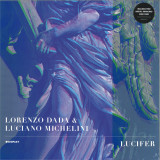
With Lucifer, Kompakt presents an album of rare beauty from two masters of modern music. A family affair, it’s a collaboration between the Italian father-and-son duo of Luciano Michelini and Lorenzo Dada, whose combined histories bring to Lucifer a depth of experience alongside clarity of vision and a finely tuned, neatly developed combined compositional voice. A lovely, beguiling suite of music that combines the electronic and the acoustic, the urban and the pastoral, its gorgeous night-eye vision and tender melancholy sits neatly within the Kompakt universe, while offering the curious listener some rich new perspectives.
There is already plenty to know both artists by. Lorenzo Dada creates across multiple fields – a techno producer and DJ who has already worked with the likes of Jay Haze, Fete, Leo Benassi, and Der, he’s released a small clutch of stylish, smartly designed EPs, and a solo album, Second Life (2018). His complementary background in classical music and composition informs his ensemble project, Tears Of Blue (who appear on Lucifer), where Dada paints with neo-classical tones for a quartet of violin, viola, cello and grand piano, supplemented by electronics for live performance.
Luciano Michelini’s history is yet richer. He may be best known, to many, for his piece “Frolic”, the theme to Larry David’s Curb Your Enthusiasm series; it was also sampled by Snoop Dogg for 2022’s “Crip Ya Enthusiasm”. But there’s much more to Michelini’s story. A successful soundtrack composer, Michelini both studied and taught at the Conservatoro di Santa Cecilia, and worked for RCA from the sixties to the eighties; his soundtracks from this period are gorgeous examples of the form, particularly his work for Il Decamerone Nero (1972), L’Isola Degli Uomini Pesce (1979), and the devastatingly gorgeous Dimensione Donna (1977).
In the eighties, Michelini and his wife Anna Gutling founded the Electronic Music Division studio and academy in Rome, which is where the majority of Lucifer was recorded. Dada reflects on the experience: “We never worked together before, so it was all new for both of us,” with Michelini adding, “I truly love this experience with my son. He’s a talented pianist and composer. I am not very familiar with electronic music nowadays, but we did it fluently.” There’s certainly a familial energy at play through Lucifer, and you can hear how Dada and Michelini, through exploration and experiment, find a shared language, balancing Dada’s tendency toward minimalism, and Michelini’s composerly voice.
Lucifer flows as a suite that interweaves electronic music with acoustic instruments: the lonely sigh of saxophone; Michelini’s lush, verdant piano; the weeping strings of Tears Of Blue (recorded at the studio of Michelini’s friend, the late Maestro, Ennio Morricone). These multiple voices are located within the electronic sighs and swarms from Dada’s kit; there are moments of propulsion, and passages of lambent drift, where the album revels in its tonal sweetness. If it flows so effortlessly, that’s because Lucifer was designed that way, as a suite or a sonata of sorts.
And the title? Dada reflects, “Lucifer was an angel who decided not to be one anymore. The miracle of life is that we can decide what we want to be, even if we are born as angels or vice versa.” This feels somehow apposite: there’s certainly something of the transformative, and the transportive, in Lucifer, a unique family collaboration of rare poetry and sensitivity, where two generations meet in the modern crucible that is the electronic music studio.