Tiny Blue Ghost are a band possessed. Haunt- ing, melodic vocals soar over a dreamy landscape of floating guitars, washy drums, and meandering bass that can pull suddenly into focus at a mo- ments notice. Moving seamlessly across genre to genre, Tiny Blue Ghost can’t simply be defined by any single label- unless you want to come up with a new term for a band that blends the best parts of bedroom pop, shoegaze, twee, indie, post-rock, and college rock.
Поиск:tiny blue ghost
Все
- 1
- Dance With The Devil
- Tiny Bard
- Celestial Dust
- Little Ghost In The Room
- Toil And Trouble
- The Red Room
- Lady Peregrine's Concubine
- Spirit Of The Forest
- Bête Noire
- Long Kiss Goodnight
- Thieves Fools And Crows
- Midnight View
- (Japanese Doll)
- Ladies Of The Road (King Crimson)
- Dirty (Johnny Winter)
- Dance With The Devil (5.1 Mix)
- Tiny Bard (5.1 Mix)
- Celestial Dust (5.1 Mix)
- Little Ghost In The Room (5.1 Mix)
- Toil And Trouble (5.1 Mix)
- The Red Room (5.1 Mix)
- Lady Peregrine's Concubine (5.1 Mix)
- Spirit Of The Forest (5.1 Mix)
- Bête Noire (5.1 Mix)
- Long Kiss Goodnight (5.1 Mix)
- Thieves Fools And Crows (5.1 Mix)
- Midnight View (5.1 Mix)
- (Japanese Doll) (5.1 Mix)
2x12"[42,65 €]
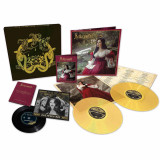
Netherworld Double Gatefold Vinyl in 'Celestial Dust' transparent gold CD / DVD - 5.1 Surround mixed by Jakko M. Jakszyk: 'Storybook' Edition 'Ladies' Double A-Side 7" Single - Ladies Of The Road / Dirty (Black Vinyl) Netherworld A6 illustrated 'Little Stories' book All housed in a Black Textured Box with Gold Hot Foil Embossing Netherworld marks a considerable step onwards from the territory that Louise Patricia Crane explored on her debut long player Deep Blue, crafting audial landscapes that go further into both inner and outer space; hallucinatory and surrealistic yet also grittier and more direct. For all that this stemmed in part from early Genesis and The Beatles, Netherworld also sits in alignment with the luxurious but oddly intimate realm of modern classics, by the likes of Tears For Fears, Tori Amos and Joni Mitchell, with passionate intensity set in a bold, cinematic vista. In realising these romantic and expansive visions, Crane not only wrote or co-wrote the entire album, but arranged, co-produced and played a wide variety of instruments on it. Yet as a supporting cast, she has surrounded herself with a formidable selection of mercurial contributors. Once again, Jakko M. Jakszyk (King Crimson) brings his fiery and mellifluous solo guitar work, as well as contributing backing vocals, keyboards and co-production. Elsewhere, the flute soliloquies of Tiny Bard are the work of Jethro Tull's Ian Andersonwhile saxophone duties are handled by Mel Collins, whose work with King Crimson marks only one chapter in an incredibly storied life in music. Providing violin and viola across the stylistic expanse of the album, Shir-Ran Yinon (New Model Army / Eluveitie) returns as a collaborator. The rhythm section for the lion's share of the record consists of the dream team of Tony Levin (King Crimson / Peter Gabriel) and Gary Husband (John McLaughlin / Billy Cobham / Allan Holdsworth) with Nick Beggs stepping in on bass for Dance With The Devil and upright bass on Long Kiss Goodnight. Crucially however, even amidst this kind of company, Louise's voice and vision is never remotely overshadowed_with the talents on offer only serving to make the backdrop to her songs still more vivid, sharp and intense.
"The Red Room Crystal-Ruby Splatter Vinyl". Netherworld marks a considerable step onwards from the territory that Louise Patricia Crane explored on her debut long player Deep Blue, crafting audial landscapes that go further into both inner and outer space; hallucinatory and surrealistic yet also grittier and more direct. For all that this stemmed in part from early Genesis and The Beatles, Netherworld also sits in alignment with the luxurious but oddly intimate realm of modern classics, by the likes of Tears For Fears, Tori Amos and Joni Mitchell, with passionate intensity set in a bold, cinematic vista. In realising these romantic and expansive visions, Crane not only wrote or co-wrote the entire album, but arranged, co-produced and played a wide variety of instruments on it. Yet as a supporting cast, she has surrounded herself with a formidable selection of mercurial contributors. Once again, Jakko M. Jakszyk (King Crimson) brings his fiery and mellifluous solo guitar work, as well as contributing backing vocals, keyboards and co-production. Elsewhere, the flute soliloquies of Tiny Bard are the work of Jethro Tull's Ian Andersonwhile saxophone duties are handled by Mel Collins, whose work with King Crimson marks only one chapter in an incredibly storied life in music. Providing violin and viola across the stylistic expanse of the album, Shir-Ran Yinon (New Model Army / Eluveitie) returns as a collaborator. The rhythm section for the lion's share of the record consists of the dream team of Tony Levin (King Crimson / Peter Gabriel) and Gary Husband (John McLaughlin / Billy Cobham / Allan Holdsworth) with Nick Beggs stepping in on bass for Dance With The Devil and upright bass on Long Kiss Goodnight. Crucially however, even amidst this kind of company, Louise's voice and vision is never remotely overshadowed-with the talents on offer only serving to make the backdrop to her songs still more vivid, sharp and intense. In as much as Netherworld is a work that exists on a lineage of progressive music and the visionary artists who've expanded their boundaries of exploration to form sound-worlds as big as their imagination, it's also a work of magical realism in the tradition of Pan's Labyrinth, The Company Of Wolves or the work of Gabriel Garcia Marquez and Haruki Murakami-in which the supernatural and otherworldly, lead to a shortcut to the essence of being human. In this World, Louise Patricia Crane is our Storyteller.
The Dead South grow more adventurous and assured with each new album. For their fourth full-length record, they brought producer Jimmy Nutt to Mexico City, where they recorded 13 songs full of plot twists, family trees, grudges, insurance scams, bacon, burials, banjo riffs and more. The Dead South flawlessly execute banjo rolls and lightning fast mandolin tremolos, 3-part harmonies and songs of classic themes -murder ballads, disloyalty, ghosts and the like, with a wink and a smile. Where Bluegrass meets Bach meets Billy Talent, for fans of Frank Sinatra and Tool alike, you"ll find The Dead South"s "Chains & Stakes". "Chains & Stakes" is truly a "Dead South" collection in the balance of darkness and levity that has come to define their unmistakable style.
The Dead South grow more adventurous and assured with each new album. For their fourth full-length record, they brought producer Jimmy Nutt to Mexico City, where they recorded 13 songs full of plot twists, family trees, grudges, insurance scams, bacon, burials, banjo riffs and more. The Dead South flawlessly execute banjo rolls and lightning fast mandolin tremolos, 3-part harmonies and songs of classic themes -murder ballads, disloyalty, ghosts and the like, with a wink and a smile. Where Bluegrass meets Bach meets Billy Talent, for fans of Frank Sinatra and Tool alike, you’ll find The Dead South’s Chains & Stakes. Chains & Stakes is truly a “Dead South” collection in the balance of darkness and levity that has come to define their unmistakable style.
This album doesn't blurt it out: There is no loud "Ta-Dah!", no exclamation mark. "The ghost that carried us away" flatters in a rather unobtrusive way. However, it has encircled you after the third song at the latest. Fragile hymns of nonchalant casualness, created by the 24-year-old Sindri Már Sigfússon. Guitars, piano, his almost bashful and yet so present voice. "Nature, mortality, love", these are the topics of his debut album. Even the one who listens only briefly, is able to make them out within the sounds. "Do you remember how the things look when you were young."
Reykjavik again. Iceland, the musical heartland. On top of that, there is a violinist with her voice in the clouds: Gudbjörg Hlin Gudmundsdóttir (violine, vocals, harmonica). There further are musicians Sindri shared his hometown and his passion: Orn (guitar, lapsteel) who forms together with Sindri and Gudbjörg the inner triangle of Seabear. Or Eiki, Orvar, Gudni and Dóri. One plays the flugelhorn, the slide-guitar or upright-bass. One belong to the live line-up of Sigur Rós (Eiki). Another is part of the sensational múm (Orvar). Some are stage members of Benni Hemm Hemm's Band - the other Icelandic artist on morr music. Sindri Már Sigfusson has invited them into his small studio, placed them in front of the only microphone, let them think about his musical thoughts. He likes the notion and the feeling of LoFi, Sindri says. Only for the recording of the drums three microphones were used. The result is reminiscent of the reduced stereo recordings of the 1960ies.
Libraries is the most direct promise that pop music is able to make. Tiny and gigantic, unobtrusive and exciting at the same time. A song like a blink into the most beautiful sunrise. A tumbling piano, swinging drums. Melodies, melancholy: "My little bird flew away from me". Or "hands remember", the singing being close to one's ear. "The voice of an old friend", a murmur, two violins. There is later "summer bird diamond", birds twitter to the accords of an old banjo, a glockenspiel. It is almost a radio play, chamber folk. And "seashell" at last, a pocket symphony, arranged around jumping drums. Sufjan Stevens would have done it in a very similar way.
History of Heat is an eroto-intellectual retelling of a love story. It is the scholarship of heat, and the sources of its production in the body: desire, exaltation, anticipation, fear, rage and mourning . It is a fable circulating through the nerves, pumped and distributed by its own mythologies. Through different chapters, we follow the heroine of our story from the initial desire to love, the sensual pull which oscillates between the grotesque and sacred longing of the flesh (‘L’Enfer en pleine lumière’ translates to ‘Hell in plain sight’)...to the sudden ghostlike appearance of the Other (Apparition) as a projection of the dream. We enter into the spiritual, the seeing visions and the blindness of love. ‘Animal’ speaks of instinct, the smell of the beloved, already the deconstruction of the divine back into the realm of the physical. The title track ‘History of heat’ sings the hesitation of love, the precipice of openness and the invitation of the contract: Dance with me... (This is where the metaphoric marriage is forged). In ‘Perfection’, the pressure which keeps the relationship on the pedestal of the absolute stunts and paralyses love. Unrealistic expectations of the self and the other person creates the push and pull of the not wanting what one wants and the fear to get what one has been asking for. ‘Tiny engine’ speaks of mechanical attachment, attachment to the lover as habit, as a second nature, and the call to the other person as a magnet. In ‘Ditectrice’, the madness and the folly of separation spawns war and confusion. It is the violent refusal to live without the other... the pleading with god. ‘Feed him’ follows with resignation and exhaustion. Love has become the beast of burden who eats away at itself insatiably. ‘War text’ brings forth the devastation, the peace treaty and finally the metaphysical Divorce. In ‘Guttermoon’, the vita contemplativa begins, the blood starts to cool, the scene is a ghost town. ‘Wrong god’ similarly winds down as an ode to remorse and mourning. Finally, ‘Cinema Verité’ closes out the album with a mistrust of ‘reality’: the heroine becomes a philosopher, she becomes an artist... did the relationship ever exist or was it a projection “In front of a movie screen” ?
History of Heat is an experimental narrative and cinematic pastiche of all original and self recorded material. A chaotic mix of sounds both analog and digitally produced recalls a warlike interpersonal breakdown. The mood established by the lyrical content of the piece is meant to be demanding, enclosing the listener within a unique and compelling cocoon of otherworldly sound. the Album is framed within a discursive love story which reflects larger relational problematics and interpersonal traumas. looped vocals act as incantations woven in and out of lyrical singing and spoken word. The instrumentals embrace chaos and intensity. Improvised violin and broken down beats compliment and balance the melancholic overtones which flutter above off the grid rhythms in this charged ficto-personal account.
- 1