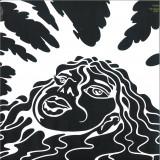
Very limited pressing of 300 units only. Following on from the two sold out records together, Freschard and Stanley Brinks come together for 12 brand new tracks. Lion Heart is an irresistibly charming collection of late night tales, woozy ballads and uptempo sing-alongs. Clemence Freschard’s beautiful vocal tones lend this a rich, French indiepop/chanteuse vibe, complemented by Stan’s wistful timbre and characteristic warm instrumentation. Stanley Brinks is renowned for his unique anti-folk style: both playful and suggestive, insightful and entertaining. Brinks was born in Paris, France, in 1973. He studied a bit of biology and worked as a nurse for a while. Half Swedish, half Moroccan, strongly inclined to travel the world, he soon began spending most of his life on the road and developed a strong relationship with New York. By the late 90s he’d become a full time singer-songwriter – André Herman Düne – as part of three piece indie-rock band, Herman Düne. Several albums and Peel sessions later and after a decade of touring Europe, mostly with American songwriters such as Jeffrey Lewis, Calvin Johnson and early Arcade Fire he settled in Berlin. The early carnival music of Trinidad became a passion, and in the early 21st century he became the unquestioned master of European calypso, changing his name to Stanley Brinks. Under this moniker he has recorded more than 100 albums, collaborated with the New York Antifolk scene on several occasions, recorded and toured with traditional Norwegian musicians, and played a lot with The Wave Pictures. Freschard grew up in a farm in French Burgundy. Aged 18 she moved to Paris, where she baked pies and cakes in a cafe. There, a local musician and regular customer called Stanley Brinks wrote a few songs for her to sing. Homeless in Paris, she saved up just enough money to get herself a ticket to New York. There she found an old electric guitar and started writing her own songs. In 2004 she moved to Berlin, where she recorded her first LP, "Alien Duck". Her second album, "Click Click", recorded in 2006, features electric guitar by Stanley Brinks. On her third album, she plays the drums herself. On her fourth “Shh...” she also plays the flute, and she breaks out the washboard on her fifth “Boom Biddy Boom”. On Midnight Tequila, Freschard brings it back to just drums and vocals // “an absolute joy.” Q // “...a set that’s as wistful and charming as it is playful and self-concious.” Uncut // “quietly charming” Pitchfork
Buscar:tones
lynyn sounds like if Aphex Twin or Autechre could compose for symphony and shred jazz. Though lynyn is a new Artist, his debut LP lexicon is essential listening for anyone interested in the compositional heights of electronic, synth, and modular music. So, who is lynyn? lynyn is the moniker of Chicago artist Conor Mackey, a working symphonic composer who has scored for institutions including the Illinois Philharmonic Orchestra and Brain.fm (the neuroscience driven musical platform where he is currently lead composer on staff). He is also a guitarist / composer in the Chicago jazz fusion quintet Monobody. After years of quietly mastering the creation of electronic music in his home, Mackey first introduced his electronic alias lynyn as producer of NNAMDI's Are You Happy EP in the Fall of 2021 (Pitchfork described his production on that project as "a novel intersection of IDM" and contemporary pop). lynyn now offers up his debut electronic oevure lexicon via Chicago label Sooper Records. lexicon displays a mastery of both musical composition and sound design, as well as a deep appreciation of the vocabulary and history of the electronic genre_ with particular emphasis on the 90s IDM movement. Throughout lexicon we are propelled through the sounds of musique concrete, footwork, hip-hop, ambience, glitch-core, IDM, drum and bass, dub, break beats, and so much more. These influences work in tandem to produce a linear experience that can be spellbinding, euphoric, and sometimes destabilizing, but without ever feeling listless or wandering. The dense arrangements of lexicon are intentionally constructed with a painstaking attention to the most minute detail, and also with a masterful awareness of the macroscopic sound design profile of the entire work. Synth sequences and modular tones merge with sounds that seem wholly organic to create a series of purposeful movements from start to finish. Mackey is particularly adept at taking disparate, often difficult to control elements and introducing them harmoniously. He is a fastidious architect and designer of sound tinkering away in his modular laboratory. lexicon is an innovative entrant into the history of IDM and electronica with all the makings of an essential contribution. What Mackey accomplishes with lexicon is a progression; he's taking the sum articulation of a genre and attempting to carry it forward by imbuing it with his own unique language as a symphonic composer. His melting together of genres and techniques is a gateway into a more wide-ranging expression of the artform, particularly with respect to the sophistication of melodic composition. The result is arguably a landmark. While rightfully positioning the lynyn moniker as an electronic alias, lexicon leaves no doubt that Mackey is a composer above all else.
Black Vinyl[21,64 €]
lynyn sounds like if Aphex Twin or Autechre could compose for symphony and shred jazz. Though lynyn is a new Artist, his debut LP lexicon is essential listening for anyone interested in the compositional heights of electronic, synth, and modular music. So, who is lynyn? lynyn is the moniker of Chicago artist Conor Mackey, a working symphonic composer who has scored for institutions including the Illinois Philharmonic Orchestra and Brain.fm (the neuroscience driven musical platform where he is currently lead composer on staff). He is also a guitarist / composer in the Chicago jazz fusion quintet Monobody. After years of quietly mastering the creation of electronic music in his home, Mackey first introduced his electronic alias lynyn as producer of NNAMDI's Are You Happy EP in the Fall of 2021 (Pitchfork described his production on that project as "a novel intersection of IDM" and contemporary pop). lynyn now offers up his debut electronic oevure lexicon via Chicago label Sooper Records. lexicon displays a mastery of both musical composition and sound design, as well as a deep appreciation of the vocabulary and history of the electronic genre_ with particular emphasis on the 90s IDM movement. Throughout lexicon we are propelled through the sounds of musique concrete, footwork, hip-hop, ambience, glitch-core, IDM, drum and bass, dub, break beats, and so much more. These influences work in tandem to produce a linear experience that can be spellbinding, euphoric, and sometimes destabilizing, but without ever feeling listless or wandering. The dense arrangements of lexicon are intentionally constructed with a painstaking attention to the most minute detail, and also with a masterful awareness of the macroscopic sound design profile of the entire work. Synth sequences and modular tones merge with sounds that seem wholly organic to create a series of purposeful movements from start to finish. Mackey is particularly adept at taking disparate, often difficult to control elements and introducing them harmoniously. He is a fastidious architect and designer of sound tinkering away in his modular laboratory. lexicon is an innovative entrant into the history of IDM and electronica with all the makings of an essential contribution. What Mackey accomplishes with lexicon is a progression; he's taking the sum articulation of a genre and attempting to carry it forward by imbuing it with his own unique language as a symphonic composer. His melting together of genres and techniques is a gateway into a more wide-ranging expression of the artform, particularly with respect to the sophistication of melodic composition. The result is arguably a landmark. While rightfully positioning the lynyn moniker as an electronic alias, lexicon leaves no doubt that Mackey is a composer above all else.
The seductive first full-length from electronic composer and multi-disciplinary visual artist Amosphère. Born in China, partly educated in Japan and now residing in Paris, her work came to the attention of a wider circle of listeners when she was invited by Laurel Halo to perform as part of a 10-hour durational ambient concert at London's Mode Exchange in 2019. Amosphère uses a careful selection of vintage electronics, sophisticated harmonic sense, and keen compositional intelligence to invite listeners into a meditative sonic space. Time expands and contracts, simplicity reveals complexity, and repetition becomes patient transformation. Spreading out over six expansive yet self-contained tracks, more die of heartbreak serves as a perfect introduction to Amosphère's warmly enveloping approach to analogue sound. Developed from scores (contained in the accompanying booklet) using techniques from concrete poetry and graphic notation as well as fragments of traditionally notated material, these six pieces take in a broad sweep of moods and approaches, from the gently burbling layered monophonic patterns of the opening 'circuit of unconsciousness', reminiscent of the sun-drenched synth figures of 70s Alvin Curran, to the haunted gliding tones and reverberating pops of the closing 'melting a piece of cadmium'. At times starkly minimal and making bold use of the stereo field, Amosphère's production approach keeps the grit and grain of her analogue gear intact, at times calling to mind the work of pioneers like Delia Derbyshire and Eliane Radigue.
Tartelet are proud to introduce the blissful, psychedelic electronic soul sound of ABUNAI on his sophomore album Chrysalis out May
20th. Across 11 songs the Oakland, CA-based multi- instrumentalist lays down a dreamlike style which should chimewith fans of Tame Impala, Khruangbin and James Blake alike. As well as the sun-soaked surrounding of his Californian home, ABUNAI’s family connection to Hawaii casts its influence over an album which has all the makings of a crossover success. Look no further than early support from the likes of Gilles Peterson, Don Letts, and Wayne Snow for further proof this album is set to blow up.
“My sound is definitely influenced by the live music I grew up with in the Bay Area,” says ABUNAI. “There's plenty of musical legacy here, including the '60s psychedelic and counterculture movements, the '90s rave scene, and the hyphy movement. "I'm always trying to connect the dots and blend all of my influences.
Chrysalis was, like so many recent albums, a project made largely in isolation during the pandemic, although ABUNAI did reach out to close collaborators Gravity and Raquel Marie to contribute some guest vocals, Kevin Farzad from Sure Sure for the acoustic drum parts and a few additional production touches from Tartelet regulars Glenn Astro and Max Graef. He bills the songs as an exercise in therapeutic self-care through lockdown as much as a balm for others. “It's music for healing,” ABUNAI explains, “for the listener to be able to marinate in the slow tempos, the dreamy textures, the swirling vocals, and the lush synthesizers. It’s very much about growth, re-emergence, and dreaming of a better future.”
As well as dealing in ear-catching pop melodies and sweet vocals, there’s an underlying theme of the ocean, which stems from his coastal surroundings and his family roots in the Pacific. “I think the album is aquatic,” he reflects, “and it feels like a voyage to me, or like a long shower, being reborn in the water. I played the album for my grandpa, who's a veteran sailor and pilot from Hawaii, and he said it was the perfect music to play when you're sailing on the open ocean at sunset.” Cast in nostalgic, soft-focus tones and endlessly soothing for the soul, Chrysalis is your new favourite record for tender moments, hazy days and starry-eyed reveries alike.
First Word Records is pleased to welcome back Souleance with a brand new single for Summer 2022!
'GUILI GUILI' is a double AA side 7" single, with an additional remix by Art Of Tones on the digital version.
French slang for "tickle", 'GUILI' is an epic disco-funk piece inspired by the likes of Azymuth, Herbie Hancock and Marcos Valle, but incorporated with Souleance's trademark sounds of fuzzy bass-heavy electronica, synths and samples, giving the track a fresh contemporary twist. Meanwhile, the (digital only) Art Of Tones mix ramps up the disco elements heavily, incorporating some vocals, strings and horn stabs to create some sure fire heat for the summertime. The flipside 'TORO' is a much more tweaked-out, synth-heavy bomb, influenced by artists such as Prince, Parliament and French electronic club music. All tracks mark the evolution of the duo into a full live band, whilst remaining true to their sonic mission of producing music crafted especially for the dancefloor.
The band have been performing live at various festivals and venues across Europe, with upcoming appearances scheduled at the Pura Vida Festival, Greece in August and Jazz à Vienne in July.
This two-track vinyl 7" / three-track digi-single is released on First Word Records, worldwide on May 27th 2022. Another essential one for your record bags.
Credits:
Bass guitar, synths and programming by Fulgeance.
Scratches and programming by Soulist.
Wurlitzer, Moog grandmother, ASM Hydra synth & Roland Juno 60 by Vincent Choquet.
Mastered by DJ VAS.
When you drop the needle on Vocal Patterns, you are entering a world that is equal parts suave, smooth, cool, nostalgic, and kitsch. With haunting and beautiful vocals, upbeat numbers, and smooth sounds made for a late 60’s summer holiday, let this cult classic transport you back to a simpler time. Originally released in 1971, Vocal Patterns features compositions by Roger Webb and vocal performances by Barbara Moore. This powerhouse duo has their own recognition outside of library music. Roger Webb worked as a musical director alongside the likes of Rex Harrison and Bette Davis and wrote songs for Shirley Bassey and Johnny Mathis. Barbara Moore, composer of the de Wolfe cult classic “Vocal Shades and Tones”, collaborated with the likes of Jimi Hendrix, Elton John, Dusty Springfield, and Tom Jones.
Tape
Charlemagne Palestine (born Charles Martin ni 1947 in Brooklyn, New York) wrote intense, ritualistic music in the 1970s, intended by the composer to rub against audiences' expectations of what is beautiful and meaningful in music. A composer-performer, he always performed his own works as soloist. His earliest works were compositions for carillon and electronic drones, and he is best known for his intensely performed piano works. He also performs as a vocalist. Palestine's performance style is ritualistic; he generally surrounds himself (and his piano) with stuffed animals, smokes large numbers of kretek (Indonesian clove cigarettes) and drinks cognac.
Oren Ambarchi (born 1969 in Australia) is a composer and multi-instrumentalist with longstanding interests in transcending conventional instrumental approaches. His work focuses mainly on the exploration of the guitar, "re-routing the instrument into a zone of alien abstraction where it's no longer easily identifiable as itself. Instead, it's a laboratory for extended sonic investigation". (The Wire, UK).
Oren Ambarchi's works are hesitant and tense extended songforms located in the cracks between several schools: modern electronics and processing; laminal improvisation and minimalism; hushed, pensive songwriting; the deceptive simplicity and temporal suspensions of composers such as Morton Feldman and Alvin Lucier; and the physicality of rock music, slowed down and stripped back to its bare bones, abstracted and replaced with pure signal.
From the late 90's his experiments in guitar abstraction and extended technique have led to a more personal and unique sound-world incorporating a broader palette of instruments and sensibilities. On releases such as Grapes From The Estate and In The Pendulum's Embrace Ambarchi has employed glass harmonica, strings, bells, piano, drums and percussion, creating fragile textures as light as air which tenuously coexist with the deep, wall-shaking bass tones derived from his guitar.
Ambarchi works with simple constructs and parameters; exploring one idea over an extended duration and patiently teasing every nuance and implication from each texture; the phenomena of sum and difference tones; carefully tended arrangements that unravel gently; unprepossessing melodies that slowly work their way through various permutations; resulting in an otherworldly, cumulative impact of patiently unfolding compositions.
Ambarchi has performed and recorded with a diverse array of artists such as Fennesz, Otomo Yoshihide, Pimmon, Keiji Haino, John Zorn, Rizili, Voice Crack, Jim O'Rourke, Keith Rowe, Phill Niblock, Dave Grohl, Gunter Muller, Evan Parker, z'ev, Toshimaru Nakamura, Peter Rehberg, Merzbow, Kassel Jaeger, Anthony Pateras, Crys Cole, Giuseppe Ielasi, Judith Hamann, Sunn 0))), James Rushford, Stephen O'Malley and many more.
For 10 years together with Robbie Avenaim, Ambarchi was the co-organiser of the What Is Music? festival, Australia's premier annual showcase of local and international experimental music. Ambarchi now curates the Maximum Arousal series at The Toff In Town in Melbourne and has recently co-produced an Australian television series on experimental music called Subsonics. Ambarchi co-curated the sound program for the 2008 Yokohama Triennale. Ambarchi has released numerous recordings for international labels such as Touch, Southern Lord, Table Of The Elements and Tzadik.
Belgian drummer Eric Thielemans is one of the most idiosyncratic figures in Belgian music, someone who not only demonstrates that special musicians always seek out (and find) their own place, but above all that they always remain students of the art of questioning and listening. No musician better illustrates the difference between playing music and playing with music than percussionist Eric Thielemans. He gets to the heart of the matter with an at times extremely minimalist approach, but on the other hand he frequently relies on a range of objects beyond the regular drum kit: a drum placed on its side, a bicycle wheel with a bow, hands and the body.
Tape
Charlemagne Palestine (born Charles Martin ni 1947 in Brooklyn, New York) wrote intense, ritualistic music in the 1970s, intended by the composer to rub against audiences' expectations of what is beautiful and meaningful in music. A composer-performer, he always performed his own works as soloist. His earliest works were compositions for carillon and electronic drones, and he is best known for his intensely performed piano works. He also performs as a vocalist. Palestine's performance style is ritualistic; he generally surrounds himself (and his piano) with stuffed animals, smokes large numbers of kretek (Indonesian clove cigarettes) and drinks cognac.
Oren Ambarchi (born 1969 in Australia) is a composer and multi-instrumentalist with longstanding interests in transcending conventional instrumental approaches. His work focuses mainly on the exploration of the guitar, "re-routing the instrument into a zone of alien abstraction where it's no longer easily identifiable as itself. Instead, it's a laboratory for extended sonic investigation". (The Wire, UK).
Oren Ambarchi's works are hesitant and tense extended songforms located in the cracks between several schools: modern electronics and processing; laminal improvisation and minimalism; hushed, pensive songwriting; the deceptive simplicity and temporal suspensions of composers such as Morton Feldman and Alvin Lucier; and the physicality of rock music, slowed down and stripped back to its bare bones, abstracted and replaced with pure signal.
From the late 90's his experiments in guitar abstraction and extended technique have led to a more personal and unique sound-world incorporating a broader palette of instruments and sensibilities. On releases such as Grapes From The Estate and In The Pendulum's Embrace Ambarchi has employed glass harmonica, strings, bells, piano, drums and percussion, creating fragile textures as light as air which tenuously coexist with the deep, wall-shaking bass tones derived from his guitar.
Ambarchi works with simple constructs and parameters; exploring one idea over an extended duration and patiently teasing every nuance and implication from each texture; the phenomena of sum and difference tones; carefully tended arrangements that unravel gently; unprepossessing melodies that slowly work their way through various permutations; resulting in an otherworldly, cumulative impact of patiently unfolding compositions.
Ambarchi has performed and recorded with a diverse array of artists such as Fennesz, Otomo Yoshihide, Pimmon, Keiji Haino, John Zorn, Rizili, Voice Crack, Jim O'Rourke, Keith Rowe, Phill Niblock, Dave Grohl, Gunter Muller, Evan Parker, z'ev, Toshimaru Nakamura, Peter Rehberg, Merzbow, Kassel Jaeger, Anthony Pateras, Crys Cole, Giuseppe Ielasi, Judith Hamann, Sunn 0))), James Rushford, Stephen O'Malley and many more.
For 10 years together with Robbie Avenaim, Ambarchi was the co-organiser of the What Is Music? festival, Australia's premier annual showcase of local and international experimental music. Ambarchi now curates the Maximum Arousal series at The Toff In Town in Melbourne and has recently co-produced an Australian television series on experimental music called Subsonics. Ambarchi co-curated the sound program for the 2008 Yokohama Triennale. Ambarchi has released numerous recordings for international labels such as Touch, Southern Lord, Table Of The Elements and Tzadik.
Belgian drummer Eric Thielemans is one of the most idiosyncratic figures in Belgian music, someone who not only demonstrates that special musicians always seek out (and find) their own place, but above all that they always remain students of the art of questioning and listening. No musician better illustrates the difference between playing music and playing with music than percussionist Eric Thielemans. He gets to the heart of the matter with an at times extremely minimalist approach, but on the other hand he frequently relies on a range of objects beyond the regular drum kit: a drum placed on its side, a bicycle wheel with a bow, hands and the body.
Obscura label head Fedele makes his long awaited return to the imprint for new EP ‘The Awake, Pt.1’, backed by remixes from Extrawelt and Midnight Operator aka Mathew Jonson and Nathan Jonson. Fedele’s penchant for synthesizer techniques and drum machines has caught the ear of global tastemakers, with projects released on the likes of Turbo, Afterlife, and Ellum receiving support from the likes of Maceo Plex, Tiga, Tale of Us, Dixon, John Digweed, Miss Kittin, and DJ Stingray. With sights set towards summer peak, the Italian returns to his Obscura Music imprint with his latest work, The Awake, Pt. 1.
Riot Dance leads the line with crisp kicks on a heady rise to set the groove before an analog-tinged synth line claims the hook. Acidic tones & ethereal stabs offer a generous dose of psychedelia, while the gritty groove ensures the cut’s ability to ignite dance floors. Modular Madness harnesses ominous flavors and a driving bassline that ebbs & flows to keep minds melting. The melodies open into swirling synthetics, with revolving reverberations and rich soundscapes capturing the ear from start to finish.
Storied German duo Extrawelt arrive on remix duty, taking the reins on ‘Riot Dance’ to twist a low- slung groover. They bring the bassline into the foreground, keeping a delightful vibe alive and welcoming a touch of light to the dark underbelly of the original, before diving back into the deep as the track unfolds. Obscura regular Mathew Jonson connects with a producer he knows well – his brother Nathan. Together, they remix ‘Modular Madness’ under their alias Midnight Operator. Picking up the pace, they maintain the acid-laced grit from the original arrangement, while adding serene melodies to the high-end. A balanced rework from two seasoned veterans.
"Animist Pools" was released July 1, 2016 in a cassette limited edition on Human Pitch records. Originally released as "Hippies Wearing Muzzles", pseudonym of Lee Evans. "A shifting center in a stream of rippling analog tones, the music of Hippies Wearing Muzzles is orchestrated to transfix, echoing sounds heard in nature with modular synthesizers and the powerful element of chance. Evoking the Fourth World Music of Jon Hassel or the kosmische innovations of Cluster, Animist Pools marks its composer, Lee Evans’ first full-length release for Human Pitch. Accompanied its popping, glyphic art design and video, the project’s hypnotic aptitude is heightened to full-effect. Citing his background in painting as a chief influence on his musical approach and thought process, Evans composes with a strong sense of space––each sound an event in a slowly expanding landscape, zooming out to reveal a world of scale in which depth and contrast take precedent over rhythm and melody. Embracing the generative compositional nature of working with the modular synthesizer, Evans himself is the final filter through which all sounds pass. The boundary between programmed repetition and human choice is subtle, but detectable, highlighting Evans’ careful, nuanced guidance of his auto-compositions. The result is ultimately an improvised structure––a living, breathing, musical creature, acting on a mixture of impulse and memory. Animist Pools is a functional body of music for everyday human applications, with the implied invitation to tune out and back in at one’s discretion. The cleanly organized musical space of Animist Pools encourages a tidying up of the mind. On a psychoacoustic level it is one, breathing life into the dusty corners of one’s headspace. Animist Pools is an immersive, meditative, and therapeutic experience."
What if music had no beginning, no end Can music exist 'for itself' or 'of itself,' without structure constraining it, defining it Can music be non-linear, non-narrative, simply experiential, existential The second full-length album on Mysteries of the Deep, Musica Enterrada from Portland's William Selman, neither answers these questions nor supposes them. But in listening, one can't help but wonder: What if I disappeared into this record forever In another time and place, William Selman was known as Warmdesk, an alias through which he issued a series of sharply precise minimal techno records. In recent past, Selman shifted gears, shedding the dynamics of tension and release that characterized his previous alias' output. Under his own name, Selman began releasing process-oriented, freeform experimental music on cassette-focused outlets like Digitalis and Hausu Mountain. Now comes Musica Enterrada, a diaphanous, weightless musical vision not unlike the theoretical square root of GRM and Popol Vuh's early electronic forays. Split into six tracks across two sides of vinyl, Musica Enterrada bubbles, churns, drifts, and dozes. Dulcet tones pile up gently like waves on shore. Patterns repeat and reconfigure, as if heard from different angles. Rhythms appear, shift the frame, then disappear, into the ether whence they came. Play Musica Enterrada on repeat. And if you disappear into it, fret not — you have drifted into solace.
Minru is the project of Caroline Blomqvist, a Swedish musician based in Berlin. Woven from light and shadow, the interplay of her folk and indie-rock blend appears from a personal space of finding life after death. On her debut LP »Liminality« she paints melody in soft tones, whispering secrets to navigate feelings of loss.
Built around winding layers of acoustic guitar, piano, and strings, Minru is a surprisingly uplifting and stirring testament to Blomqvist’s own suffering from the passing of someone close to her. Returning to Berlin from Sweden feelings of grief, confusion, and pain travelled with her, and these emotions prompted the journey both of and within the album, heard as a dreamlike actualisation of wandering lost between them. "I read that Carl Jung used the word "»Liminality«” to describe the psychological process of transitioning. I instantly felt seen; it reflected my own experience and the feelings I carried whilst making the album – a sense of the old certainties being gone, but the new not being quite there yet,” she says.
Defined as "the threshold separating one space from another" »Liminality« moves between feeling the ground beneath your feet fall away, fighting through the darkness and the doubt, and the emerging shades of hope and light as you painstakingly make peace with mortality and find yourself as a person again. "I am happy to have encapsulated this moment of time in sound," Blomqvist says, "it will always be there as a memory."
Flourishing from a preferred position of solitude, »Liminality« sees Blomqvist’s vision radiate with intensity from her home-based studio in Neukölln - a small, 2-room apartment with squeaky old wooden floors. Capturing the intimacy of the space, she recorded vocals and synth on gear partly borrowed from friends (to swiftly reunite it with its owners), and the songs flow with a stream of consciousness as feelings become entwined with melody. Time-restraint drew the process to a natural close, preventing Blomqvist from losing herself to experimentation. “Maybe I would have been stuck in »Liminality«, trying out sounds forever,” she suggests of the way ‘Into the well’s instrumental swims into a warm stream of synth pads. "It’s the cosiest moment on the album,” she says, “Cosy is a feeling I always strive for in life."
Finished and self-produced at a Berlin-Lichtenberg recording studio alongside musical friends (Povel Widestrand, Tobias Blessing, Sunniva Lilian Shaw Of-Tordarroch, Marlene Becher and Liv Solveig Wagner), the result is beautifully detailed and rich like the folk of her Swedish roots. First picking up a guitar as a kid and becoming obsessed with it, she would skip school to spend extra hours mastering the instrument, grappling to perfect the ‘Stairway to Heaven’ intro. “As a child I was fascinated by my dad’s acoustic guitars around the house and would hit the strings to make them sound,” she recalls. After attending music high school in Gothenburg and playing in bands during her teens, Blomqvist later moved to Germany. As well as enjoying walks at Tempelhofer Feld and coffee at Leuchtstoff café, she performed with Tuvaband, Adna, and Tara Nome Doyle and played in Berlin venues Loophole and Schokoladen, where music became her world. With the passing of time she felt a growing urge to find an outlet for her own songs; Minru was the answer along with her first »Yearnings« EP.
Now writing whenever she returns to Sweden, within the calm and stillness of her family’s mountainside cabin, her skilfully constructed arrangements summon the comforting atmosphere of home. “I hope listeners will feel inspired to slow down a bit, create, draw, cook something. Just be in the moment that is now.” »Liminality« is the kind of record that rewards attention. Give this album your time, it will give you its soul.
The dawn of Symphonic Therion glooming at the horizon, yet still drenched in Dark Metal execution! Though it was their fourth full-length, and we had been given a sampling of their symphonic/gothic direction with “Symphony Masses: Ho Drakon Ho Megas”, “Lepaca Kliffoth” might remain the most memorable masterpiece of the band’s career along the follow-up “Theli”. A transitional phase between the band’s Death Metal roots and the hybrid of symphonic, gothic metal which they would carry forward for the rest of their career. This is an extremely dark album. The band retains their fascination with obscure occult magick and prophecies within the lyrics, and the music revolves around killer mid-paced Metal riffs drenched in the vocal libations of Christofer Johnsson. The album starts off strongly with “The Wings of the Hydra”, and from there on the serpent has snaked about your spine. An addictive piece with an obvious Celtic Frost influence, chanting vocals, simple synth tones and arabesque guitar melodies which evoke the mythical age of the song’s namesake. The album’s ‘hit single’, “The Beauty in Black” is glorious and gothic, it uses a pair of operatic vocalists (male and female), a sort of predecessor to the revolving door of guest musicians the band would use on their later albums. Other excellent tracks include the charging “Riders of Theli”, the crushing doom of “Black” which would have fit almost perfectly on “Into the Pandemonium”. The rest of the album is equally dark and enchanting, with other standouts being the title track and “Evocation of Vovin”. Synthesizers, flutes multiple vocalists, and the core of the band are all clear and precise throughout, yet it still carries a very raw and dark, ominous tone to it which trumps the later studio efforts. This may not be quite as symphonic as many Therion fans demand of their material in recent years, but it clearly marks the point where this band transformed from a innovative Death Metal band into the Gods of Gothic Metal. There are very few parallels to something like this, and it belongs in the collection of any fan of quality Occult Metal.
- A1: Rum & Coca Cola
- A2: Oh Johnny, Oh Johnny, Oh!
- A3: Bei Mir Bist Du Schon
- A4: South American Wa
- A5: (I'll Be With You) In Apple Blossom Time (I'll Be With You)
- A6: Tico Tico
- A7: Beer Barrell Polka (Roll Out The Barrel) (Roll Out The Barrel)
- B1: Don't Sit Under The Apple Tree
- B2: Boogie Woogie Bugle Boy
- B3: Joseph! Joseph!
- B4: Rhumboogie
- B5: Shoo Shoo Baby
- B6: Say, Si Si
- B7: Pennsylvania Polka
In a pre-Rock world, no female vocal group came within touching distance of the
Andrews Sisters in terms of success. Between 1938 and 1951 they notched 90
Top 30 hits in the USA and appeared on countless other best-selling singles by
artists such as Bing Crosby, Dick Haymes, Danny Kaye, Ernest Tubb, Carmen
Miranda and Burl Ives. The Andrews Sisters were the most plagiarised of all
female singing groups and influenced many artists, including Mel Tormé, Les Paul
and Mary Ford, The Four Freshmen, The Pointer Sisters and Barry Manilow. It’s
time to celebrate the works of this wonderful trio and enjoy their incredible tones
and harmonies so grab yourself a Rum & Cola and get down with some Boogie
Woogie!
MASTERED FROM THE ORIGINAL ANALOGUE MASTER TAPES AND PRESSED ON MOFI SUPERVINYL
· A Bold Celebration of Romantics, Escapists, and Dreamers: Electric Light Orchestra’s Eldorado Marries
Rock and Symphonic Elements, Includes the Aptly Titled Hit “Can’t Get It Out of My Head”
· Mastered from the Original Analog Master Tapes for Audiophile Quality: Mobile Fidelity 180g Vinyl LP and
· Melodic, Beatles-Inspired Tour de Force Features Full Orchestra and Choral Section: Arrangements and Lyrics
Transport the Listener to Faraway Horizons
Electric Light Orchestra leader Jeff Lynne did more than figuratively reach for the sky on Eldorado. Daring to be bold, and creating imaginative worlds that invite the listener to escape the mundane, the visionary composer-musician achieved a multidisciplinary fantasia and, in the process, a prog-rock landmark. Nearly 50 years later, the concept album's brilliance can be experienced like never before in cinematic fashion.
Mastered from the original analogue master tapes, pressed on MoFi SuperVinyl vinyl at RTI, and housed in a tip-on jacket, Mobile Fidelity's numbered-edition 180g LP of Eldorado allows the long-time audiophile staple to resonate with previously unheard dynamics, tones, and colours. Conjuring the feeling of journeying to different horizons, the record's songs teem with layer upon layer of details, which can now be heard as the producers intended.
Presenting the album with breath-taking clarity yet retaining the warmth, texture, and emotion that differentiate live music from reproduced sounds, this collectible reissue features reference-quality levels of in-the-moment presence, grand-scale sound-staging, and instrumental balance. Bursting with a veritable cornucopia of stimuli, MoFi's Eldorado LP also benefits from superb separation and immersive atmospherics that stem from the meticulous remastering process – as well as an ultra-low noise floor, industry-leading groove definition, and dead-quiet surfaces courtesy of the MoFi SuperVinyl properties.
An artistic breakthrough that established Electric Light Orchestra as a pioneering band (and confirmed Lynne as the leading practicing Beatles disciple), the 1974 effort remains notable for its involvement of a full orchestra and choral section, the range of which are captured with exquisite results on this LP. Eldorado distinguished itself from the band's first two works not only via Lynne's sharpened songwriting but due to the hiring of an orchestra that augmented the group's three string players. Co-arranged by Lynne and conductor Louis Clark, the symphonic movements bolster the contagious fare without ever drowning it. The accents also act as transports into the varied narrative universes.
Finished as a story before Lynne put notes down on paper, Eldorado ironically owes its inspiration to Lynne's father. In response to his dad's criticisms about the band, Lynne conceived a melodic tour de force that, like The Wizard of Oz, which informs the cover art, emphasizes the power of everyday dreams and everyman heroism. It's no coincidence that the sonic journey begins with an overture punctuated by the words of a cynic who condemns "the dreamer, the unwoken fool."
Beautiful yet fun, ambitious yet consistent, Eldorado proceeds to celebrate such romantics and escapists. A Technicolor escapade marked by lush melodies, fluid crescendos, and an intoxicating blend of energetic rock and sweeping orchestral elements, the album weds rich imagery and sweeping sounds in manners that make the two inseparable. In Lynne and company's hands, reality and fantasy collide, and dissolve any dividing lines. The proof is not just in the epic production, but in the timeless (and catchy) nature of songs such as the balladic "Boy Blue," power-pop packed "Illusions in G Major," and, of course, the aptly titled hit, "Can't Get It Out of My Head."
Decades later, Eldorado doubles as the equivalent of an out of body experience, an invitation to break away from monotony whether you're listening to your Mobile Fidelity reissue on a large system or an excellent pair of headphones.
MoFi SuperVinyl
Developed by NEOTECH and RTI, MoFi SuperVinyl is the most exacting-to-specification vinyl compound ever devised. Analog lovers have never seen (or heard) anything like it. Extraordinarily expensive and extremely painstaking to produce, the special proprietary compound addresses two specific areas of improvement: noise floor reduction and enhanced groove definition. The vinyl composition features a new carbonless dye (hold the disc up to the light and see) and produces the world's quietest surfaces. This high-definition formula also allows for the creation of cleaner grooves that are indistinguishable from the original lacquer. MoFi SuperVinyl provides the closest approximation of what the label's engineers hear in the mastering lab.
- A1: Kopf Ab, Schwanz Ab, Has! 1:13
- A2: Nana 2:26
- A3: Jimmy Performer (Four Tones) – Dirk Blümlein 4:18
- A4: Unsichtbare Frau Bass – Dirk Blümlein 2:40
- A5: Kleines Missgestück 2:46
- A6: Der Lustige Tagedieb 3:20
- A7: Heut Nacht 2:23
- A8: Egon 2:39
- B1: Phlughaphöm 2:27
- B2: Chezus 3:45
- B3: Schlau, Versaut Und Gutaussehend Bass, Music Consultant – Dirk
- B4: Raumgleita 3:24
- B5: Miss Pickafight 2:39
- B6: Z.g.v. 4:05
- A1: The Beach Boys - 409
- A2: Dick Dale & His Del-Tones - Let's Go Trippin
- A3: The Bel Airs - Mr Moto
- A4: The Ventures - Perfidia
- A5: The Chantays - Move It
- A6: The Frogmen - Beware Below
- A7: The Gamblers - Lsd-25
- A8: Link Wray & The Wraymen - Slinky
- A9: The Mar-Kets - Surfer's Stomp
- B1: Duane Eddy - Moovin' And Groovin
- B2: The Lively Ones - Crying Guitar
- B3: The Surfmen - The Ghost Hop
- B4: Sandy Nelson - Junior Jive
- B5: The Fireballs - Bulldog
- B6: The Tornadoes - Moon Dawg
- B7: Santo & Johnny - Pineapple Princess
- B8: The Frantics - Werewolf
- B9: The Revels - Intoxica
BEST OF SURF MUSIC! BETWEEN CLASSICS AND RARITIES, BE CARRIED AWAY BY THE WAVE OF SURF ROCK !
In a genre belonging to crooners like Marvin Gaye, Sam Cooke, James Brown and Otis Redding, authenticity is a requirement.
Enter Anduze, a unique vocalis whose riffs evoke the retro sounds of the aforementioned artists, but reverently done his way
– a fresh brand, re-imagines and crefted into a modern depiction of the era.
Anduze was raised on his father’s native land of St. Croix in the US Virgin Islands. His distinctive upbringing still lines the
threading of his creative fabric, which continues to expand into all corners of taday’s musical landscape.
It’s been over a decade since Anduze last released a full album. A lot has changed and progressed since then. He left behind the LA/Hollywood nights in exchange for a better quality of life in Athens, Greece. Also, during this span, he’s been a multi-featured artist on collaborations with producers such as Satin Jackets, Art of Tones, LTJ Xperience, Gramatik, and more…
However, his most noteworthy ascent is as lead singer (and songwriter) of Austrian act, Parov Stelar, with whom he tours
worldwide. Still, with all his accomplishments within the electronic world, it was time for Anduze to get back to his own sound – SOUL.
Using the pandemic as an opportunity, instead of a crutch, Anduze recorded “Aura,” a nine-song album that blurs the lines of
soul, funk, pop, folk, and R&B, with 20 contributing musicians.
If you like Prince, Michael Jackson, Marvin Gaye, Lenny Kravitz, Terence Trent D’arby etc…this album takes influences from
all their best moments and combines them into one mighty explosion that is simply, ANDUZE.
These days he is also living the new life of his song in collaboration with LTJ Xperience entitled Bad Side which has been
included in the new game update for Play Station GTA 'Los Santos' starring the DJ producer Moodyman and in the soundtrack of the new series And Just Like That, a popular follow-up to Sex And The City, which aired worldwide.