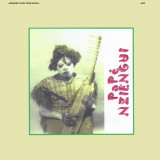
Kadi Yombo, published in 1989, is the most successful album in the quest for a fusion between tradition and modernity in Bwiti harp music of the Tsogho people of Gabon. Combining beating rattles with a layer of synthesizers, Papé Nziengui blends in a contrapuntal dialogue characteristic of harp playing: male song in appeal and female choir in response, male voice of the musical arc and rhythms of female worship. But above all it’s Tsogho ritual music and modern studio orchestration. The result is an initiatory itinerary of 10 musical pieces which are all milestones likely to be simultaneously listened to, danced, meditated on, and soon acclaimed. In the years since, Nziengui has traveled he world from Lagos to Paris, from Tokyo to Cordoba, from Brussels to Mexico City to become a true icon, the emblem of Gabonese music.
Like Bob Dylan, "electrifying" folk and Bob Marley mixing rock with reggae, some purists have criticized Nziengui for having distorted the music of harp by imposing a cross with modern instruments. They even went so far as to claim that Nziengui was just an average harpist covering his shortcomings with stunts that were only good for impressing neophytes; like playing a harp placed upside down behind his back or playing two or three harps simultaneously. Sincere convictions or venomous defamations, in any case, Nziengui never gave in to such attacks, imposing himself on the contrary to pay homage to the elders (Yves Mouenga, Jean Honoré Miabé, Vickoss Ekondo) while instructing the maximum of young people. He is thus the promoter of many young talents, the most prominent of which is certainly his nephew Jean Pierre Mingongué. In a conservative society where the sacred is confused with secrecy, exposing the mysteries of Bwiti in broad daylight can be punished by exclusion or even execution.
Papé Nziengui has always claimed that he faces such risks because he never felt enslaved to a community that governs his life, that regulates his conduct, that has a right of censorship over his activities. Like Ravi Shankar, the famous sitarist, Papé Nziengui is a man of rupture but also of openness, a transmitter of culture. As proof, he has established himself in Libreville, Gabo’s capital, as the main harpist for sessions and concerts, accompanying the greatest national artists (Akendengué, Rompavè, Annie-Flore Batchiellilys, Les Champs sur la Lowé, etc.) as well as foreign artists (Papa Wemba, Manu Dibango, Kassav', Toups Bebey, etc.). In 1988, he was the first harpist to release an album in the form of a cassette produced by the French Cultural Center (Papé Nziengui, Chants et Musiques Tsogho). At the same time, he created his own group (Bovenga), combining traditional music instruments (musical bow, drums, various percussion instruments, etc.) in the framework of a true national orchestra, which gave the first concert and the first tours of a traditional music that was both modern and dynamic, thus "democratizing" the harp, to the dismay of certain purists.
On the other hand, in modern music, dominated by the logic of profit or even commercialism, artistic creation must often be adjusted for a specific audience based on reason rather than heart. But instead of allowing himself to be distorted, Papé Nziengui has always tried to produce music that is not a caricature, worthy in its expression as in its content, of the sacredness and transcendence of the music of the Origins. This is what makes Nziengui not only the musician, but the man someone whose age hasn’t altered any of his freshness or authenticity
Search:trans fusion
Kadi Yombo, published in 1989, is the most successful album in the quest for a fusion between tradition and modernity in Bwiti harp music of the Tsogho people of Gabon. Combining beating rattles with a layer of synthesizers, Papé Nziengui blends in a contrapuntal dialogue characteristic of harp playing: male song in appeal and female choir in response, male voice of the musical arc and rhythms of female worship. But above all it’s Tsogho ritual music and modern studio orchestration. The result is an initiatory itinerary of 10 musical pieces which are all milestones likely to be simultaneously listened to, danced, meditated on, and soon acclaimed. In the years since, Nziengui has traveled he world from Lagos to Paris, from Tokyo to Cordoba, from Brussels to Mexico City to become a true icon, the emblem of Gabonese music.
Like Bob Dylan, "electrifying" folk and Bob Marley mixing rock with reggae, some purists have criticized Nziengui for having distorted the music of harp by imposing a cross with modern instruments. They even went so far as to claim that Nziengui was just an average harpist covering his shortcomings with stunts that were only good for impressing neophytes; like playing a harp placed upside down behind his back or playing two or three harps simultaneously. Sincere convictions or venomous defamations, in any case, Nziengui never gave in to such attacks, imposing himself on the contrary to pay homage to the elders (Yves Mouenga, Jean Honoré Miabé, Vickoss Ekondo) while instructing the maximum of young people. He is thus the promoter of many young talents, the most prominent of which is certainly his nephew Jean Pierre Mingongué. In a conservative society where the sacred is confused with secrecy, exposing the mysteries of Bwiti in broad daylight can be punished by exclusion or even execution.
Papé Nziengui has always claimed that he faces such risks because he never felt enslaved to a community that governs his life, that regulates his conduct, that has a right of censorship over his activities. Like Ravi Shankar, the famous sitarist, Papé Nziengui is a man of rupture but also of openness, a transmitter of culture. As proof, he has established himself in Libreville, Gabo’s capital, as the main harpist for sessions and concerts, accompanying the greatest national artists (Akendengué, Rompavè, Annie-Flore Batchiellilys, Les Champs sur la Lowé, etc.) as well as foreign artists (Papa Wemba, Manu Dibango, Kassav', Toups Bebey, etc.). In 1988, he was the first harpist to release an album in the form of a cassette produced by the French Cultural Center (Papé Nziengui, Chants et Musiques Tsogho). At the same time, he created his own group (Bovenga), combining traditional music instruments (musical bow, drums, various percussion instruments, etc.) in the framework of a true national orchestra, which gave the first concert and the first tours of a traditional music that was both modern and dynamic, thus "democratizing" the harp, to the dismay of certain purists.
On the other hand, in modern music, dominated by the logic of profit or even commercialism, artistic creation must often be adjusted for a specific audience based on reason rather than heart. But instead of allowing himself to be distorted, Papé Nziengui has always tried to produce music that is not a caricature, worthy in its expression as in its content, of the sacredness and transcendence of the music of the Origins. This is what makes Nziengui not only the musician, but the man someone whose age hasn’t altered any of his freshness or authenticity
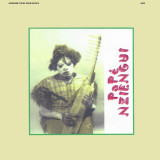
Kadi Yombo, published in 1989, is the most successful album in the quest for a fusion between tradition and modernity in Bwiti harp music of the Tsogho people of Gabon. Combining beating rattles with a layer of synthesizers, Papé Nziengui blends in a contrapuntal dialogue characteristic of harp playing: male song in appeal and female choir in response, male voice of the musical arc and rhythms of female worship. But above all it’s Tsogho ritual music and modern studio orchestration. The result is an initiatory itinerary of 10 musical pieces which are all milestones likely to be simultaneously listened to, danced, meditated on, and soon acclaimed. In the years since, Nziengui has traveled he world from Lagos to Paris, from Tokyo to Cordoba, from Brussels to Mexico City to become a true icon, the emblem of Gabonese music.
Like Bob Dylan, "electrifying" folk and Bob Marley mixing rock with reggae, some purists have criticized Nziengui for having distorted the music of harp by imposing a cross with modern instruments. They even went so far as to claim that Nziengui was just an average harpist covering his shortcomings with stunts that were only good for impressing neophytes; like playing a harp placed upside down behind his back or playing two or three harps simultaneously. Sincere convictions or venomous defamations, in any case, Nziengui never gave in to such attacks, imposing himself on the contrary to pay homage to the elders (Yves Mouenga, Jean Honoré Miabé, Vickoss Ekondo) while instructing the maximum of young people. He is thus the promoter of many young talents, the most prominent of which is certainly his nephew Jean Pierre Mingongué. In a conservative society where the sacred is confused with secrecy, exposing the mysteries of Bwiti in broad daylight can be punished by exclusion or even execution.
Papé Nziengui has always claimed that he faces such risks because he never felt enslaved to a community that governs his life, that regulates his conduct, that has a right of censorship over his activities. Like Ravi Shankar, the famous sitarist, Papé Nziengui is a man of rupture but also of openness, a transmitter of culture. As proof, he has established himself in Libreville, Gabo’s capital, as the main harpist for sessions and concerts, accompanying the greatest national artists (Akendengué, Rompavè, Annie-Flore Batchiellilys, Les Champs sur la Lowé, etc.) as well as foreign artists (Papa Wemba, Manu Dibango, Kassav', Toups Bebey, etc.). In 1988, he was the first harpist to release an album in the form of a cassette produced by the French Cultural Center (Papé Nziengui, Chants et Musiques Tsogho). At the same time, he created his own group (Bovenga), combining traditional music instruments (musical bow, drums, various percussion instruments, etc.) in the framework of a true national orchestra, which gave the first concert and the first tours of a traditional music that was both modern and dynamic, thus "democratizing" the harp, to the dismay of certain purists.
On the other hand, in modern music, dominated by the logic of profit or even commercialism, artistic creation must often be adjusted for a specific audience based on reason rather than heart. But instead of allowing himself to be distorted, Papé Nziengui has always tried to produce music that is not a caricature, worthy in its expression as in its content, of the sacredness and transcendence of the music of the Origins. This is what makes Nziengui not only the musician, but the man someone whose age hasn’t altered any of his freshness or authenticity
Les Disques du Crepuscule present a new, remastered vinyl edition of Quart de Tour, Mon Amour, the highly collectible debut album by enigmatic Belgian duo Piscine et Charles, originally released by the label in 1984.
This remastered 2021 reissue retains the original cover art, as well as adding text and previously unseen images from the Piscine et Charles archive, plus a digital copy (MP3). A limited edition of 500 copies only has been pressed on turquoise vinyl.
A duo comprising Dominique Outers and Luc Raemdonck, Piscine et Charles taped their debut album at Daylight Studio in Brussels with engineer Didier de Roos (Univers Zero, Tideline), along with several guest musicians and classical singer Lucie Grauman. A concept album of sorts, Quart de Tour, Mon Amour (which translates as Quarter Turn, My Love) combines literary lyrics with music described as a ‘neat fusion of coldwave, electronics and lounge-jazz, predating acid-jazz by about five years and conjuring impressive atmospheres.’
Despite failing to reach a wide audience at the time, the album has since become a sought-after collector’s item, with the title track recently appearing on acclaimed anthology set Uneven Paths: Deviant Pop From Europe on Dutch label Music From Memory. ‘A very unique sound, Piscine et Charles explore a poetic, romantic and enigmatic musical realm where synth-pop meets jazz and spoken word.’
Released in 1983 on a miniscule run of 300-self-financed LP’s, Dennis Taylor’s ‘Dayspring’ remains a lost masterwork of transcendental instrumental guitar. An important missing link between the 60’s folkloric experimentalism of John Fahey and Robbie Basho, and the new age atmospherics mined by William Ackerman and Michael Hedges in the early 80’s. Though Taylor’s guitar playing remains crisply unadorned on these 10 tracks, his technique and his compositions stretch beyond the folk roots of the genre. He crafts a soundworld that is both immersive and familiar. His pastoralism has a spaciousness - a pianistic drift - that feels truly timeless.
Taylor cut his musical teeth through the 60’s and 70’s playing with garage rock bands, and later finding his footing in the world of jazz/folk fusion. Sometime in the early 70’s, Taylor found his most profound inspiration to date when he witnessed a live performance from Takoma Records luminary, Leo Kottke. Enraptured by Kottke’s ability to fill the room so completely, with the sound of just one instrument, Taylor was determined to follow a similar path. Thus, he began composing music for solo guitar. He spent nearly a decade writing and honing his pieces, finally entering a studio in 1982 to commit them to tape. Taylor likened the recording experience to “a living room concert.” He recorded each song in a single take, in the order they appear on the album. Paying out of pocket for the recording sessions, studio time was at a premium, so Taylor had arrived prepared. And the results speak for themselves.
Dennis Taylor’s guitar playing is clean, precise, and masterfully proficient. And yet, ‘Dayspring’ is not merely a document of technical ability. His compositions are deeply
expressive. Taylor’s deft fingerpicking is married to achingly beautiful melodicism. His arpeggios chime and roll with painterly expression. Across the breadth of ‘Dayspring’, Dennis Taylor strikes a perfect balance between wistful nostalgia and bold expansion. Though Taylor initially hoped to release his album with new age progenitors Windham Hill, he ultimately decided to release the album on his own. He self-financed a pressing of 300 LP’s, which were largely distributed locally in his hometown of Lincoln, Nebraska. And now, Morning Trip is supremely proud to bring this album back to light. An important missing piece in the expansive tapestry of instrumental guitar music, finally restored.
Andy Bey was one of the most sought-after vocalists in the era of jazz fusion. Between 1968 and 1973 he was first choice as a studio singer for Max Roach, Duke Pearson, Horace Silver, Gary Bartz and Stanley Clarke, to mention but a few. His warm and engaging baritone voice easily crossed the bridge from conventional blues and gospel to a pugnacious, politicising style of soul – Andy Bey was 'spiritual' in every sense of the word. "Experience And Judgment", his debut album under his own name, was recorded in New York in 1973 and quickly became a cult album. Bey delivers twelve songs in single length, which are full of relaxed, funky grooves, soulful and electrifying, and quite lacking in gimmickry – in many of them a blues number is lurking in the background as a basic idea. His most important colleagues are Wilbur Bascomb, who lets his electric slap bass really thump out, and Bill Fischer who joins in on an electric piano, synthesizer and various other keyboards and really sets off a little fusion firework display. The most powerful numbers come from Andy Bey himself, such as "Experience", "Judgment", "Celestial Blues", "Tune Up" and "Being Uptight" – often powering forwards with a vengeance. Bill Fischer – at that time Artistic Director at Atlantic Records – added a few soul ballads to balance out the LP. This album inspired numerous jazz singers, including Gregory Porter. Jamie Cullum says: »What I love about Andy Bey is that he creates an atmosphere. As soon as he opens his mouth, you’re transported to another place.«
10th anniversary reissue of this rhythmically churning one-man-band monster of an album, recorded in a single inspired studio session & originally released in 2012 on Editions Mego.
From the original Editions Mego press release:
“For anyone who still associates Oren Ambarchi exclusively with the clipped, bass-heavy tones of solo electric guitar works such as Suspension, this rhythmically churning one-man-band monster of an album-length piece might seem to come out of nowhere. However, listeners who have followed the breadth of his work for the last few years (solo and in projects with collaborators from Jim O’Rourke to Stephen O’Malley and Keith Rowe to Keiji Haino) will have noted how Ambarchi has allowed increasingly clear traces of his enthusiasms as a music listener (for classic rock, minimal techno and 70’s fusion, among other areas) to surface in his performances and recordings, all the time filtering them through his signature long-form structures and psychoacoustic sonics.
Recorded in a single inspired studio session, Sagittarian Domain displaces Ambarchi’s trademark guitar sound from the centre of the mix, its presence felt only as an occasional ghostly reverberated shimmer. Endlessly pulsating guitar and bass lines sit alongside electronic percussion and thundering motorik drumming (familiar from his work with Keiji Haino) at the core of the piece, locking into a voodoo groove like Faust covering a 70’s cop show theme. The work is founded on hypnotic almost-repetition, the accents of the drum hits and interlocking bass and guitar lines shifting almost imperceptibly back and forwards over the beat as they undergo gradual transformations of timbre. Cut-up and phase-shifted strings enter around the half-way mark like an abstracted memory of the eastern-tinged fusion of the Mahavishnu Orchestra’s classic Visions of the Emerald Beyond, before returning for an extended, stark yet affecting come-down coda, equal parts Gavin Bryars and Purple Rain.
While Sagittarian Domain contains traces of a diversity of influences, it mines all of them to uncover something that is clearly an extension of Ambarchi’s own investigations up to this point, exhibiting the same care for micro-detail and surrender to the physicality of sound that are present in all of his work, extending them in new ways to repetition, pulse and rhythm”.
Splash Blue is proud to present a brand new album borne from the latest collaboration between Jean-Paul ‘Bluey’ Maunick and Francisco Sales of Incognito – ‘The New Guitar Underground Vol 1’.
THE NEW GUITAR UNDERGROUND
The New Guitar Underground are Jean-Paul ‘Bluey’ Maunick and Francisco Sales of Incognito. Neither require introduction – Bluey – founder of the legendary Incognito, Inner Shade, CitrusSun and co-conspirator on the STR4TA project, solo artist, Composer and Record Producer & Francisco Sales, guitarist of Incognito and Citrus Sun, as well as being a solo artist in his own right, have come together to deliver a set of 10 highly crafted and accomplished tracks that lift the spirits and soothe the soul.
Inspired by the inspirational playing of the giants of the guitar world – Tony Mottola, Denis Budimir, George Benson, Bill Jennings & Melvin "Wah Wah" Watson to name but a few, the album reflects the deep love that Bluey and Francisco have for this multi faceted and beautiful instrument.
Guests on this album include bass players Francis Hylton, Hendrik Linder, Rui Pedro Pity and Julian Crampton, keyboardists Matt Cooper, James Berkeley and drummer Francisco Mendolia.
Of course the quality and depth of this musical composition should not be a surprise – given the pedigree of the artists involved, however, as Bluey says himself in the album notes, ‘’This is not a project seeking chart success. Just two guitar buddies having fun chasing musical waterfalls, and not sticking to the rivers and the lakes they’re used to.
We are just making ourselves happy. And if in doing so we make you happy too, then that, as they say, is "the payoff!" The result is an intoxicating fusion of guitars, samba, latin jazz, drum-driven beats, heavy bass lines - with some scratching and sampling thrown in for good measure!
Reissue of violinist Jean-Luc Ponty's 1967 album 'Sunday Walk', originally
released on the SABA label (which later was renamed MPS), featuring an
all-star group that includes pianist Wolfgang Dauner, bassist NielsHenning Örsted-Pedersen and drummer Daniel Humair
Legendary drummer Kenny Clarke compared Jean- Luc Ponty to Dizzy Gillespie.
Fellow violinist Stuff Smith marvelled, "He plays violin like Coltrane plays
saxophone." Born in 1942, the French violinist transported jazz violin playing into
the world of modern jazz. On Frank Zappa's urging, Ponty moved to the States in
1973. Over the next years he toured with Zappa as well as the Mahavishnu
Orchestra. In 1975 he founded his own band and became one of the most
prominent figures of the jazz- fusion movement in the USA, selling millions of
albums that all reached the top of the U.S. charts.
On the 1967 'Sunday Walk' the band saunters through two blues, a waltz, and a
standard before reaching "Suite for Claudia", which begins at a blistering pace
with Ponty's saxophone- like "brilliance and fire" playing. It then settles into a
medium swing groove with Wolfgang Dauner's infectious piano play followed by a
smouldering Ponty. Daniel Humair's crisp drum solo segues into a heart- felt
waltz. After all, this was written for Ponty's wife. Ponty is here with a group of
Europe's finest at their youthful best. The way they play, it's all a walk in the park.
Beside Dauner and Humair, legendary bass player Niels-Henning Ørsted Pedersen
completes Ponty's quartet.
"The re-issue of this album by MPS makes me extremely happy as I consider it to
be one of my best recordings from the 60s. " - Jean-Luc Ponty
Nestled somewhere between the soul
jazz, spiritual jazz, fusion, and post-bop
subgenres, 1974’s Cosmic Funk headed, as
the title indicates, in a funkier direction,
with Lonnie Liston Smith’s brother Donald
contributing smooth vocal stylings to John
Coltrane’s “Naima” among other tunes. A
transitional work but a fascinating one, with
surehanded production once again from
Bob Thiele. Features the original gatefold album art…another
“post-fusion” masterwork from the Lonnie Liston Smith and the Cosmic Echoes!
- A1: Dick Khoza And The Afro Pedlars - Chapita
- A2: Ensemble Of Rhythm And Art - Pelican Fantasy
- A3: Spirits Rejoice - Sugar Pie
- B1: Makhona Zonke Band- The Webb
- B2: Abacothozi - Night In Pelican
- C1: The Black Pages - There Goes
- C2: The Headquarters - Moshate
- C3: The Shyannes - Asso-Kam
- D1: Almon Memela’s Soweto - Pelican City
- D2: The Drive - I Have A Dream
‘The Afro Modern Seventies Sounds of Soweto’s First Nightclub
• Over ten years in the making, this is the first compilation from South African vinyl re-issue specialists Matsuli Music
• Ten track double gatefold album journey through jazz, funk, fusion and disco, detailing the incredible story and sounds behind the Soweto nightclub during the height of apartheid
• Uniquely South African take on the trans-Atlantic sounds of Philadelphia, Detroit and New York City
• Cover artwork by Zulu Bidi (of Batsumi fame) with unseen photographs, and liner notes by Kwanele Sosibo featuring interviews with key musicians, players and a former president of South Africa
• Audio mastered and cut for vinyl by Frank Merritt at The Carvery with heavyweight 180g vinyl pressed at Pallas in Germany
A night-time haunt in the backstreets of Soweto run by a well-known bootlegger should have been a prime zone for nefarious underworld activities. Instead, it nurtured an underground of a different kind. Soon after its opening in 1973, Club Pelican became a spot where musicians steeped in the tradition of South African jazz began to cook up experimental sounds inspired by communion, competition and the movements in funk and soul blowing in from the West. Located in an industrial park on the western edge of Orlando East, Soweto, Club Pelican was off the beaten track, among a matrix of railway and industrial infrastructure. In a different time and place, this would have been a prototypical nightclub location, except there was no local precedent to follow. This was Soweto’s first night club.
In the intervening years, this location has served to heighten the now-defunct spot’s legendary status as a singular venue, one that ruled the night in the Seventies. Initially called Lucky’s and established in 1973, the Pelican’s impact on the Soweto cultural landscape was immediate. Lorded over by a charismatic figure known as Lucky Michaels, the club became the jewel in a nondescript collection of family businesses. It boasted a diverse pool of talent in its succession of house bands and an A-list of ghetto-fabulous singers as
its cabaret stars. Its VIP section was a veritable who’s who of Soweto society and its stage, hosting a mix of the day’s pop culture infused with the creativity and individual histories of the musicians, the Pelican filled a live music vacuum.
One Night in Pelican captures the halcyon seventies period with a single nightclub embodying an indomitable spirit of its troubadour players. While schooled and rooted in “standards” and local forms, the music could take any direction, at a moment’s notice. This compilation features all the key groups and players of the time: Abacothozi, Almon Memela’s Soweto, The Black Pages, Dick Khoza and the Afro Pedlars, The Drive, Ensemble of Rhythm and Art , The Headquarters, Makhona Zonke Band, the Shyannes and Spirits Rejoice.’
Translucent red LP housed in a beautiful gold mirror-board sleeve with large Thundercat logo hologram sticker and gold holofoil detail. Includes two bonus tracks: ‘$200 TB’ and ‘Daylight (Reprise)
Vinyl only (no digital) 2021 Black Friday release
If indeed "you blows who you is," as Louis Armstrong once famously said, then Stephen Bruner's bass is a mainline to the soul of a man whose DNA was transcribed from the stars onto staff paper. His Flying Lotus-produced debut, The Golden Age of Apocalypse, offers both stone-cold skill and uncanny astrality, picking up where the pair left off on 2010's Cosmogramma and further distilling the jazz current running through that landmark Lotus release. A longtime contributor to others' albums, Bruner, aka Thundercat, is accompanied by an impressive cast ranging from Erykah Badu to members of Sa-Ra and J*DaVeY, to pianist Austin Peralta and his own Grammy-winning brother, drummer Ronald Bruner, Jr. Still, the end result is unmistakably a Thundercat record -- a lush and magical document combining classic jazz fusion, futurist electronic strains and timeless musical seeking.
Spanning a cosmic stew of players, locations and times, The Golden Age of Apocalypse was years in the making. . There's the ebullient "Daylight," a soft whirl of bluesy piano, New Age synth, snapping beats and warm bass. There's "Walkin'," an upbeat soul strutter powered by Bruner's digitally distorted plucks. There are raw, improvised numbers like "Jamboree" and virtuosic bass pileups like "Fleer Ultra." One of the album's most stunning moments arrives with a spacious cover of George Duke's "For Love I Come," a taut beauty spangled with crystalline harp and keys. Bringing this string of divinely unexpected moments to a moody and cinematic close is "Return to the Journey." There, Bruner sings, "Time will pass us by," but listeners needn't worry. Inside of this space, time really isn't a thing.
Limited Transparent Magenta Vinyl. Enigmatic pop outsider Tony Gallardo makes music that's perpetually perched on the outskirts of Mexico's fertile electronic underground. Since 2008, he has been releasing music that inhabits its own artistic universe, a cross between Frank Zappa, Daniel Johnston, The Knife, OutKast and Rosa Pistola. He co-founded the Cocobass label, pioneered the fusion of L.A. noise and cumbia known as ruidos6n and has released music under a plethora of monikers: dark techno as Boi Patrol, ramshackle electronic pop as Maria y Jose, experimental surf rock as El Capricho and experimental dembow as La Fiebre X. "Selected Works" assembles some of Gallardo's most crucial material from a run of EPs released between 2008 and 2013. These tracks show the breadth of his output, running through sleazy, neon electro ('Bruja', 'Mi Presa'), neck-snapping tropical dance music ('Kibose', 'La Conquista'), and eerie Mexican trap ('Plata 0 Plomo', 'Ultra'). It's introspective, haunted music from one of Mexico's most original and most under-appreciated artists that paints a picture of a psychedelic musical landscape that's hard to resist. One listen to the album's closer 'Club Negro', originally released in 2013, should tell you all you need to know. This track is the perfect introduction to the world of Tony Gallardo, with screwed 'n chopped Spanish vocals, 7 doomy syncopated beatbox rhythms and wobbly houseparty electronics.
Recommended if you like: Com Truise, Toro Y Moi, Tycho, Tourist. British Columbia producer Jamison Isaak didn’t anticipate an adulthood of globe-trotting songcraft, but teenage exposure to iconic French house music videos cast a spell on him that still holds: “I knew then this is what I wanted to do'’ Catalyzed by synthetic sights and sounds from oceans away, he patiently taught himself primitive software and recording programs, reverse engineering the heady, swooning horizons of the dance music that had permanently bewitched him. A decade later, having amassed an expansive discography of soft-focus synth pop and romantic electronic a crisscrossing the planet many times in the process the subtext of his project’s journey rings clear: “Teen Daze is dream fulfillment'’ Enter Interior. An ode to electric futures glimpsed in ecstatic heights, from bedrooms to big rooms, it’s an album of first loves refracted through prisms of wisdom, wounds, and wonder. Filter house and flashing lights; soft acid and vaporous neon; bumping clubs in spiral towers: “Like what the teenagers in Akira might be listening to'’ Collaborative cameos by multi-instrumentalist Joseph Shabason (on sublime fantasia opener “Last Time In This Place”) and vocalist Cecile Believe (on the glitch-glamorous anthem “2AM (Real Love)”) evocatively expand the record’s palette but otherwise Interior is Izaak’s love letter to his own artistic awakening, to the paradigm shifts inherent in youthful discovery and remote dreaming — your world exploded, your life forever changed. Years of devotion and divergence have honed his craft radically; tracks like “Nite Rune “Nowhere and“Translation”are among the most supreme bangers in the entire Teen Daze canon, a delirious fusion of textural finesse and emotional transcendence. It’s music of skylines, escape, and sensual energy, forever cresting through nights that never end.
Black Truffle is pleased to announce Live Hubris, documenting the hypnotic and electrifying live performance of Oren Ambarchi’s 2016 LP Hubris by a fifteen-strong band at London’s Café Oto. Over three days in May 2019, Oto toasted Oren Ambarchi at 50/Black Truffle at 10 with Ambarchi and a large group of close friends and collaborators in a series of performances that interspersed existing projects with new collective endeavours, culminating with this: fourteen members of the extended Black Truffle family together on stage, joined by one special virtual guest, to translate the intricately studio-constructed layers of Hubris into a muscular live band workout.
Operating with only the bare minimum of pre-gig preparation after the planned afternoon rehearsal had to be wrapped up prematurely due to noise complaints, the gargantuan group lurches into motion with a 21-minute rendition of ‘Hubris Part 1’, powered by the pulsating electronics of Konrad Sprenger (the ‘ringmaster’ at the ensemble’s core) and no less than seven electric guitars spinning a web of intricately interlocking palm-muted polyrhythms. The layers of closely related but metrically distinct lines create ripples of shifting accents, flickering changes in emphasis that ricochet along the endless central pulse. Gradually building in density, this motorik continuum becomes the backdrop for the haunting tones of Eiko Ishibashi’s processed flute and an extended feature from long-distance guest Jim O’Rourke on guitar synth.
After the brief interlude of the second part, where Albert Marcoeur-esque guitar arpeggios accompany a halting attempt at phone conversation, the full ensemble gears up for the epic side-long rendition of ‘Hubris Part 3’. Now joined by the astonishing triple drum line-up of Joe Talia, Will Guthrie and Andreas Werliin, the layered pulse of the opening piece becomes a burning funk-fusion groove. Beginning on a medium simmer, the ensemble initially stick to its pulsating one-note mantra, over which Ambarchi unfurls a beautiful example of his signature shimmering Leslie-toned guitar harmonics, eventually joined by Ishibashi’s flute and some brooding, distorted dissonance from Julia Reidy’s guitar. Building steadily for the first nine minutes, the heat then rises dramatically with a first, gloriously loose chord change: with the all drummers now rolling and tumbling like a twice-cloned Jack DeJohnette circa 1970, Mats Gustafsson enters on baritone, his tortured roars and shrieks driving the band to peaks of insane intensity. Finally, the exhausted ensemble drops out, leaving only the jagged, skittering fuzz of Ambarchi’s guitar, brought to an abrupt conclusion at the command of crys cole. Arriving on hot pink vinyl with artwork by Lasse Marhaug and an extensive selection of live photos by Ivan Weiss and Fabio Lugaro, Live Hubris brings this ambitious and outrageous evening of music to the safety of the home stereo.
strumentalist Teddy Lasry's story is noteworthy not just in regards to the music he released, but in the ways approached the craft of composing and experimenting with sounds and sonics.
Always intrigued with the capabilities of instruments, their groove and their feel, it was very much his family’s influence that helped to fuel these life long affections. As a performer in a parisien cabaret, Teddy’s father Jacques would mingle with giants like Serge
Gainsbourg and Charlie Chaplin (impressed by his ability to improvise, Chaplin wanted him to become his accompanist, but the pianist politely refused). Jacques and his wife (Teddy’s mother Yvonne), would later become members of the innovative experimental group Les Structures Sonores, and surround their children’s lives with sounds. Electronic music was still in its infancy and Les Structures Sonores, with their resonators that produced long, mysterious tones, were deemed ‘cosmic’. It was the era of the launching of the first Russian Sputnik and every time a radio or television station wanted music for their science fiction programs, they turned to one of their compositions. Showing a natural ability with multi instrumentalism, Teddy was rewarded with a spot in the band, allowing him to really explore unconventional methods of composition.
Following a brief stint with Ariane Mnouchkine's avant-garde Théâtre du Soleil after graduating school, Teddy joined the pioneering prog band Magma, with whom he would record three groundbreaking records during the early 1970s (According to former member
Laurent Thibault, their album Mëkanïk Dëstruktïẁ Kömmandöh and its sound were strong influences on David Bowie during the recording
of Low and Iggy Pop’s The Idiot at Hérouville). Despite the successes with these projects, Teddy was constantly searching for new ways
of expressing himself through music, leading him into the beginnings of a solo career that would last the better part of three decades.
Teddy’s transition into his solo career came with contrasting fortunes, in that he was now becoming a music to image composer but with the unfortunate realisation that his eyesight was gradually worsening (due to being diagnosed with retinitis pigmentosa at an early age). Nonetheless, his solo career would begin in 1975, and for the rest of the decade his sound would become increasingly mired in electrified Funk-Fusion and its endless sonic possibilities. The resulting music would serve to highlight Teddy’s love affair with the possibilities found within tireless instrumentation, with the flute and particularly synthesisers becoming a mini-obession of his (he once spent a 7,000 Francs loan, which was meant to be spent on fixing his roof, on synths).
To this day Teddy continues to record and experiment with music, a passion which in many ways has never left his sid, even at the age of 75. His career was one that was fuelled by innate curiosity and an intrinsic desire to discover new methods of expressionism, be it through the realms of Jazz-Funk, ambient electronics, Swing music or indeed through the medium of instrumentation itself. On this compilation, we look to encapsulate the essence of his innovative sound, and from start to finish a sense of his ingenious approach to composing structure and mood is made abundantly clear. The funk-jazz fusion style that embodied the majority of his 70s work is on full display here, with the vibrant flute driven "Los Angeles", the Miles Davis inspired "Blue Theme", the progressive and driving
"Chamonix", and the deeply intricate "Krazy Kat", along with one of his finest 80s slow jams, "Funky Ghost". Two cuts off the ‘Back To
Amazonia’ album are also featured (Teddy’s last album including his Prophet T8, Yamaha DX7 and Oberheim drum machines). "Raising
Sun in Bali" and the title piece both emphasise an ever present passion for synthesisers. "Birds of Space", a standout track off the e=mc2 album, closes the comp, and is a fitting way to end this journey.
Pulled together in close collaboration with Teddy and his family, this collection of songs looks to introduce new listeners to his work and we are proud to present this limited and carefully remastered compilation on vinyl, including extensive liner notes.
With governments finally admitting that UFOs do in fact exist, and humanity attempting to heal from a state of recent crisis, the timing couldn’t be more appropriate for the newest addition to the HYPOCRISY catalog: WORSHIP, due to be released Fall 2021 via Nuclear Blast Records. Aptly titled, the album cover shows a mass of humans reaching up mindlessly to the sky as glowing spaceships shaped like the HYPOCRISY crosses sigil beam down to descend upon earthen civilizations and Mayan temples. Designed by artist Blake Armstrong (Kataklysm, In Flames, Carnifex, etc.), WORSHIP’s artwork speaks to the history of the relationship between humanity and extraterrestrials. “They’re coming back to collect,” explains founder and HYPOCRISY mastermind Peter Tägtgren.
A track entitled CHEMICAL WHORE breaches the subject of pharmaceutical addiction, and those who engineer it. “We are all chemical whores. We regularly consume prescriptions and drugs because we think we need it; we use one pill to heal the damage done by another medicine... it’s a vicious cycle.” Musically, it’s the only song that was written by all 3 core members of the band and translates into a recognizable, mid-tempo HYPOCRISY sound much like ERASER or FRACTURED MILLENIUM. Traveling from Sweden to Russia, the band also shot an official music video for CHEMICAL WHORE.
The DEAD WORLD music was written by Peter Tägtgren’s son, Sebastian. “We actually started to write an album together, something like 11 or 12 songs, but we never put any vocals in there and we just sort of set it aside. Then when I started writing HYPOCRISY I realized I really liked the song… it feels fresh. I think my kid got some new blood in there.” While the song comes equipped with a modern feel, the writing is still old fashioned at its core. Going into detail about the illuminati and black ops government, the lyrics examine how miserable these figureheads and theories can make us. “Call it fantasy, call it sci-fi, there are plenty of conspiracies in the world but I find these ones interesting,” explains Tägtgren.
GREEDY BASTARDS is another track outlined by simplicity and catchiness. Chugging riffs encapsulate a sound that almost verges on the realms of thrash while still keeping its feet firmly planted in the world of death metal. The lyrics touch on the greed and methods of control that we see various governments around the world today; how they manipulate people against one another and abuse the masses.
For Tägtgren, the inspiration to write new HYPOCRISY comes in waves. “I believe we were out on tour for another project and I began to get hungry again. I started spitting out some new riffs and when I had 7-8 songs done, I invited the rest of the guys to join me and contribute, and from there we started putting everything together. We had a break for a few months, continued recording, went back on tour… it never stops. There was a lot of jumping back and forth, and then COVID came and things got really weird.”
Tägtgren was one of the many musically inclined who was forced into sudden isolation upon the onset of COVID 19, only for Tägtgren, this is common practice when creating new songs. “A lot of things in the world stopped, and it was time to finish everything I hadn’t finished.” As usual, all recording and mixing took place at Tägtgren’s home studio in Sweden.
It has been 8 long years since the last record, and HYPOCRISY fans can feel the itch. WORSHIP is 11 tracks of precise, ferocious musicianship. Commonly inspired by the fusion of the modern and the ancient, HYPOCRISY has once more found a way to combine innovative ideas with classic sound in order to deliver something metalheads can enjoyably consume with awe and brutal vigor. HYPOCRISY is Peter Tägtgren (Lead Guitar & Vocals), Mikael Hedlund (Bass Guitar), and Reidar “Horgh” Horghagen (Drums).
- A1: Holographic (Carl Craig's Ride Or Die Anthem)
- A2: (Re)Evolution (Jon Dixon Remix)
- B1: Second Wave (Steve Rachmad Remix)
- B2: Universal Language (Claude Young Remix)
- C1: Immersion (Stephen Brown Remix)
- C2: Second Wave (John Beltran's Pan Am Remix)
- D1: Second Wave (Stephen Lopkin Remix)
- D2: Metamorphosis (Shawn Rudiman Remix)
All Detroit Techno, taken from the album DnA
After a monster year for Vince Watson, with releases on Get Physical, Tronic, SushiTech, All Day I Dream alongside his own Everysoul Audio and a host of remixes, he now ends 2021 brining his label’s biggest and most adventurous release to date: ‘DnA reSequenced’.
After the massive response to his 18 track ‘DnA’ album in 2019, Vince had a vision of having some of the tracks remixed by his favourite Detroit ‘flavoured’ artists from the 3 places that musically have made it all possible for him: Scotland, Amsterdam, Detroit.
So it is with great pleasure that Everysoul can announce remixes by none other than Carl Craig, Claude Young, John Beltran, Jon Dixon, Shawn Rudiman, Stephen Lopkin, Steve Rachmad and Stephen Brown.
Planet E boss Carl Craig is no stranger to Vince’s work, having released 4 of his singles on Planet E and previously remixing his track ‘It’s Not Over’. His remix of ‘Holographic’ takes the heavy synth lines into typical C2 remix territory, building and building with layers into a crescendo.
Jon Dixon may be one of Detroit’s rising stars as a solo artist, but as a band member of Underground Resistance and Timeline, he plays with some of the best Detroit Techno groups around: Galaxy2Galaxy and is a classically trained pianist. Jon’s releases over the last few years now showcase his personal styles and Vince was desperate to work with him, with a keen respect for his musicianship. His Remix of
John Beltran has been one of Vince’s favourite producers for over 25 years and his Pan Am remix is a journey of blissful Beltran fusion styles.
Claude Young takes his remix into a completely new and different direction, moving from the Electro of the original into an experimental masterpiece, respecting the tricky chord programming of the original and adapting into sounds that only Claude Young is able to extract.
Steve Rachmad is one of Vince’s closest allies in Amsterdam and having worked together on many projects over the years, Steve was the first name on the list. His 4/4 edition of Second Wave takes the deep Detroit chords and harmonies into a much darker and groovier direction, with early Transmat character and the funk that Steve Rachmad is known for.
Shawn Rudiman’s remix is a no nonsense straight to the floor banger, taking all the elements of the original into a much more streamlined and live improv version for the floor rather than the head.
Stephen Lopkin is one of Vince’s favourite Scottish producers and his remix takes the original into his own unique style and identity. The original had very unique chord progressions and timing and Lopkin was able to successfully extend this to make it even more complex but with a seamless flow that keeps the groove flowing.
Stephen Brown is also a top Scottish producer who Vince has been supporting and spinning for over 20 years, and his remix of Immersion removes the fluffy jazzy elements from the original and opts directly for the dancefloor, taking Immersion into new territory.
DnA
Nair Mirabrat is a Uruguayan ensemble led by the composer Martín Ibarra. The candomberos of Montevideo are dressed in the infinite colors of the world and they immerse themselves in the world of song and dance, building bridges between the inside and the outside. "Juntos ahora" is built based on the myth of the hero and his journey through the symbolic labyrinth. Death, time and place are the themes where the lyrics wander. DESCRIPTION Martín Ibarra and his Nair Mirabrat ensemble bring a garden variety of electrifying rhythms with "Juntos ahora", fusing together elements of candombe fusion, jazz, and pop. Deep in the Montevideo music scene, Nair Mirabrat effortlessly transcends genres and local tradition bringing forth a new era of influence as they revel in the bliss of Ibarra's soaring vocals over tropical rhythms. Ibarra and crew are a modern-day mixture of Jaime Roos, OPA, Hugo Fattoruso and Eduardo Mateo with their explorative, forward-thinking passion of keeping it 100% Uruguay. Chris J. Morris
On 19th August at 2PM BST, Ed Sheeran will announce his brand new album ‘=’ alongside an album pre-order. 14 tracks in length, the album will be released on 29th October 2021.
Ed Sheeran is an era-defining artist. Through his fusion of thought-provoking songwriting, universal pop and multi-genre influence, his rich tapestry is not only perfectly suited to his audience but it’s something that transcends generations.
Since surfacing on the UK circuit in 2010 with his ‘No.5 Collaborations Project’ – an eight-track EP featuring his favourite grime artists of the time – the Suffolk-raised recording artist has resonated with fans across the world through his peerless songcraft and versatility. And now, with four UK No.1 albums to his name – ‘+’ (2011), ‘x’ (2014), ‘÷’ (2017) and ‘No.6 Collaborations Project’ (2019) – he has sold over 55 million albums and 160 million singles across the world.
Most notably, Ed’s 2017 blockbuster release, ‘÷’ (Divide), saw Ed reign supreme as one of the most in-demand pop stars on the planet – a feat he has continued to sustain ever since. Crowned as the fastest-selling album, ever, by a male artist in the UK, the chart-shattering album housed a swarm of singles including ‘Castle on the Hill’, ‘Perfect’ and ‘Shape of You’, with the latter becoming Spotify’s most-streamed song of the last decade.
But it’s not just his recorded music that’s seen the former Glastonbury headliner become one of the sought-after artists of the 21st century either. Possessing a mystical ability to turn 90,000 capacity venues into the pub back-rooms that he first started playing in, Ed made history in 2015 after becoming the first-ever artist to play Wembley Stadium solo - without a band and with just his guitar and loop pedal - over three, consecutive sold out nights. Move forward to the summer of 2019 and Ed would re-enter history books after the completion of his mammoth two-year Divide tour, which would officially become the most-attended tour of all time after it culminated with special homecoming shows in Ipswich, Suffolk.
Ed Sheeran - who was awarded an MBE for his services to music and charity in 2017 - is the proud recipient of 1 x IFPI Award (best-selling global artist of 2017); 4 x Grammys; 4 x Ivor Novello’s; 6 x BRIT Awards (including two consecutive wins for ‘Global Success’ in 2018 and 2019); 7 x Billboard Awards + more.
At the end of 2019, Sheeran was presented with the Official Chart Company’s first-ever ‘No.1 Artist of the Decade’ award following a host of accomplishments in his native UK including the most No.1’s across the UK’s Official Singles and Albums chart from the years 2010-2019.