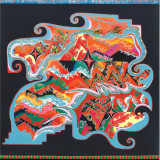
The follow-up to his acclaimed Constellation debut Third Album released in lockdown spring 2020, Markus Floats returns with Fourth Album, pushing the Montréal-based artist's distinct abstract electronic compositions into newly evocative terrain (while preserving his record-titling literalism). Faced with another couple of years spent unexpectedly, though not unfamiliarly, secluded and studio-bound, working on both paintings and music, Floats emerged by the end of 2022 with a set of tracks "about 60% finished" and a determined desire to throw off the shackles of distancing and isolation. "I had always thought about Markus Floats as a solo project but I am wrong about that. Fourth Album is about asking for help, inviting in, and making a home. It's about trust, exploration, and the effort of letting go."Sharing his in-progress recordings with a trio of close friends and collaborators from the powerhouse free music ensemble Egyptian Cotton Arkestra, each of these players then spent a day improvising to the tracks at Montréal's Hotel2Tango studio. With violin by Ari Swan, saxophone and mbira by James Goddard, and guitar and drums by Lucas Huang, Floats stitched their extemporized instruments back into his compositional process. The result is a fluid, lustrous, dynamic expansion of his sound and structure that continues to strike the ineffable balance of abstraction and soulfulness rightly highlighted and celebrated in the critical response to Third Album. Fourth Album sustains much of that previous work's enchanting equanimity, while inviting a bit more restlessness, accident and grit, with the incorporation of acoustic instruments and improvisation melding Floats' own background in Electroacoustic Studies and Jazz Performance more than ever before.Signature avant-electronic explorations of arpeggiated and timbral transformation, subtle shifts in harmonic consonance and dissonance, and a through-composed praxis that draws coterminously upon free jazz, musique concrète and modern Minimalism, all continue to shape Fourth Album to great effect. But an additional palette of sonic and gestural raw material is now also decidedly "out-of-the-box", charting a wider range of gestures, textures and temporalities. Fourth Album complexifies and intensifies across its 12 tracks, thematizing dualities and introducing new elements of play and accident, even a sort of looseness here and there, as it conjures communal expressivity within shorter, still scrupulous formal structures. Fourth Album also for the first time includes spoken word as a recorded element, previously only (and always) a feature of Markus Floats live performances. The album's final track samples the poet and activist Fred Moten, closing with these words: "What we've been trying to figure out how to get to is how we are when we get together to try to figure it out." This koan of socially-engaged process and creation/advancement of meaning through praxis and immanence reflects the unique fusion of intangible materiality and affective sensibility at work in Markus Floats music, unfolding in new depths and currents with Fourth Album.
Search:transform colláge
Singer-songwriter Dora Morelenbaum is one of the stunning voices at the forefront of Brazil’s exciting new musical wave. Her sublime 'Vento De Beirada' EP takes you on a trip into the sensuous sounds of Dora's world. On first hearing her music, we were reminded of the transformational moment when we first discovered the Brazilian singer-songwriter, Joyce. The music is completely new to you, yet instantly familiar, like rediscovering a past love.
Dora is a member of the Brazilian Latin-Grammy-winning superstar quartet Bala Desejo; a trailblazing light opening up Brazilian music to a whole new audience outside of the country. 'Vento De Beirada' EP showcases a different sound to the riotous, joyful, avant-garde Tropicália sound of Bala Desejo. This solo set takes a more dream-like, downbeat, MPB stance. It is firmly contemporary, yet you can also trace the lines of influence back to idols such as Gal Costa and Maria Bethânia.
The EP is comprised of four tracks that have already garnered critical acclaim following their digital release. It starts with the tender and gentle 'Japão', which was inspired by the melodies of the legendary Japanese composer, Ryuichi Sakamoto. Sakamoto once collaborated with Dora's musician parents, Paula and Jaques Morelenbaum, when she was young. 'Dó a Dó' is drenched in lush, sweeping strings that were arranged by her father himself, and is co-written by Dora and Tom Veloso of the band, Dônica. There’s further collaboration on the EP, including production from one of the lynchpins and stars of the current Rio scene, Ana Frango Elétrico. Fellow Bala Desejo band member, Lucas Nunes, contributes towards the production, writing, and guitar with Guilherme Lírio also on production, guitar, and bass. Whilst Bala Desejo’s Zé Ibarra penned the song 'Vento De Beirada' with Lucas and Victor Vasconcellos.
The four-track EP has been cut to 12" and mastered for vinyl by Joker (Liam McLean). With crystalline beauty and a breezy sense of ease and serenity, sounding classic yet contemporary. This release serves as the perfect introduction to an extraordinary talent.
Mike Salta & Mortale release their debut album ‘Moloko Island’ on Music For Dreams label. Moloko Island is a getaway where good vibes can float freely. An island where only fantasy set the limits.
It is a collection of tracks, some of which have already been buzzing around the balearic / downtempo scene for a while now. The Album includes the infectious ‘Hey Moloko’ which was picked up by Hot Chip for their splendid Late Night Tales compilation, and the gamers amongst you may have noticed it in the most recent Playstation – Gran Turismo 7 soundtrack. Outro track ‘Bye Moloko’ is a brand new Re-edit of this classic.
The music of Mike Salta aka Gert Nygaard flaunts an eclectic palette, collecting strands from New Orleans funk, 80’s italo disco or Brazilian tropicalia and transforming them into rich and sun-drenched dance music.
The album is produced in collaboration with long-time studio partner Mortale, and is a sumptuous piece of chillout to call on the summer. A full-bodied groove of an album to transport you and soundtrack those sunny days & balmy evenings. Moloko Island concludes a voyage and reconcile an era where electronics and acoustics have been explored and united in the unique sound and vibe Mike Salta and Mortale has strived to unfold
I feel a deep sense of loss listening to this music, but at the same time the possibility of going beyond it through sound. It doesn't want to illustrate anything, but I would like it to be transformative, even of a feeling that sounds like death. It is an elegy." — Furtherset
The Infinite Hour is a shattered elegy synthesized in electronics. Furtherset's music does not explain, settle or justify, it rather simply manifests the grip of anguish. As a whole, the album's six compositions resemble the labored breathing of one who mourns a disappearance and fears oblivion. A feeling like having one's chest weighed down by a stone, while still being attentive to one's breath, and aware of what remains. From this dimension The Infinite Hour arises and transfigures loss into a space that is always extending: the hour is infinite, the melody is circular, and even stasis has its own measure that is exceeded into eternity.
The album was created between 2020 and 2022, in a slow process of writing and continuous refinement parallel to the previous EP, Auras. The compositions found their final form during the mixing process carried out together with composer & sound artist Bienoise (Mille Plateaux). They were later named based on references to authors who influenced and are dear to Furtherset: Amelia Rosselli, Vladimir Chlebnikov, Hubert Damisch, Dante Alighieri. Each track, composed with its live rendition in mind, manifests itself to the listener as a possible variant of a path that is never definitive. Their live performance, an increasingly distinctive moment within Furtherset's work, is a gesture of concentration and extension, where every composition is developed through meticulous variations of each singularity.
The Infinite Hour is one possible manifestation of an ever-changing musical landscape, a universe with unmistakable sounds but always on the verge of disintegrating, collapsing, and opening up spaces, times, infinities.
Furtherset is the musical project of artist and musician Tommaso Pandolfi (1995). His compositions' distinctive traits are stratifications and recursive shifting modulations, synthetic clusters and sampling, alongside rhythmic and embracing harmonies. The project is envisaged as formal research that follows a path towards saturation and layering, but is always capable of generating voids in which the listener can take their place and fill them according to their own focus.
- Will It Get Better
- Be There For Me
- Where To Begin
- Better Side
- After This
- Forever And A Day
- Me And You
- Not Afraid To Change
- Someone's Waiting Now
- This Is Not The End
"I worked on this album over 3 years while juggling a lot of life transitions" says Adrian. "It was an intense period of time, but I found meaning and purpose in the music".
A balance of isolation and collaboration mark the new Adrian's new album with delightful tension- the synth infused, moody tracks express an untethered longing while upbeat numbers "Where To Begin" and "Me and You" transform anxiety into courage and a sense of grounded acceptance. A sparkle of pop influences - think Rex Orange County and Vampire Weekend - combine with Adrian's vulnerability on "After This" to speak to the disorienting personal growth that comes with major upheaval. "After This" sees Adrian moving through challenging and unexpected scenarios to discover hope and belonging.
It stands as a beacon of hope for those among us that have temporarily lost our footing.
The inaugural release on KMRU's own fledgling OFNOT imprint, 'Dissolution Grip' is an ambitious project that emerged from his studies at Berlin's prestigious UDK. The Kenyan composer and sound artist is best known for his field recording work, and as he traveled across Europe and the wider world for regular live performances, he made a point to snapshot each city. But the more he studied and the more he examined his practice, the more KMRU began to wonder what the purpose of these recordings were, and what bearing they might actually have on his self-expression. Simultaneously, he'd begun to dive more wholeheartedly into the world of synthesis. In a way, synthesis is the most basic form of sound, and KMRU started to wonder not just how he could harness these sounds but how he might be able to more dynamically combine them with field recordings.
Guided by Jasmine Guffond at Berlin's Universität der Künste (better known as UDK), KMRU looked at waveforms - the visual representation of sound itself - and embarked on a process where he would write scores from the shapes, gradually turning the scores into raw synth sounds. Considering the spaces he was inspired by and shuttled through, KMRU decided that instead of using environmental recordings as an aesthetic marker, he would use these captured moments to guide the waveforms. So each sound is birthed from a field recording, but none of those recordings are audible in their original form. For example, on the digital bonus track 'Along A Wall', KMRU recorded in an old shack on his family's compound in Nairobi, where wind was shaking the building to its foundations. Listening to the finished piece, we can hear subtle electronic tones that rub and vibrate against each other, slowly saturating and mimicking the erratic motion of the wind. The original recording has been removed, but the feeling remains.
The album's opening side 'Till Hurricane Bisect' is a 15-minute epic that evolves at its own glacial pace, carefully transforming blustering wind sounds into gasping drones, glassy oscillations and choked distortion. Cosmic and meditative, it's a testament to KMRU's skill as a sound engineer and patience as a composer, combining the gentle world building of his acclaimed Editions Mego album 'Peel' with the rumbling energy of 'Limen', last year's collaboration with Aho Ssan. On the title track, KMRU takes the opportunity to flex his orchestral muscle, conducting a cast of warbling synth tones into a durational symphony. Starting as quietly as a whisper, 'Dissolution Grip' expands at its own pace until it's a dense wall of harmony, powerful but never completely overwhelming. It's music embedded with a rich sense of place that informs us of KMRU's past and present, and signals where his musical philosophy might take us in the future.
- A1: Tony Tuff - Answer
- A2: Prince Green - Serpent
- A3: Preddi - Blessed
- A4: Ghadian - One Unity
- A5: Steve Harper - Jah Jah Never Fail I
- A6: Ben Dice - Words Of The Wise
- A7: Johnny Clarke - Love & Understanding
- B1: Steve Harper - Rise Up
- B2: Steve Harper - Creation
- B3: Pacey - Little Way Different
- B4: Daddy Ants - Murderation
- B5: Kerosene Oil - Do Anything
- B6: Willie Williams - Plastic World
- B7: Tippa Irie - Chant Down Babylon
‘Time Will Tell’ : A journey in reggae music from Bristol to Kingston JA.
Embark on the wild journey of a reggae-loving Bristolian youngster who travelled to the heart of Jamaica on intrepid mission to record a timeless reggae album in the 90s. ‘Time Will Tell’, a collaborative masterpiece uniting the extraordinary talents of Henry & Louis (Andy Scholes & Jac kLundie), Blue & Red (aka Rob Smith from Smith & Mighty) and renowned Jamaican and UK-basedv ocalists.A musical opus that infuses reggae's rich history into modern rhythms straight outta Bristol.
It all began in the summer of 1997, when Andy Scholes decided to trace the origins of reggae music straight back to its origins; armed with a 16-track reel-to-reel and an abundance of passion,he flew to Jamaica with a desire to record his reggae heroes over riddims built by Rob & Jack in Bristol.
Through a series of unexpected events Andy crossed paths with UB40 in the streets of Kingston.He built a friendship with the band and their lead singer, the legendary Ali Campbell took a ninterest in the project, generously giving Andy free access to his studio in Port Maria allowing him to bring life to ‘Time Will Tell’.
Scholes got in the studio with various Jamaican artists and recorded with Tony Tuff, Prince Green, and Johnny Clarke, each contributing their distinct voices and adding to the album's spiritual and conscious themes. The mystical vibe continued with the participation of other artists like Ghadian, Shalom, Pacey, Ben Dice, and Kerosene Oil, each bringing their own authentic style to the project.
The making of ‘Time Will Tell’ required time, dedication, and the synergy of a like-minded collective. The album embodies the warmth and transformative power of music serving as a driving force for positive change.
22 years after its initial release, the album is freshly remastered and reissued onto 12” vinyl by Dubquake Records!
But after collectively moving across the country from Burlington, VT to Seattle, WA, the scrapped tracks transformed substantially into florid, at times entrancing compositions.
The pulsating "Circles" opens the album with lilted reflections on empathy, breathing in midtempo syncopation with subdued guitar tip- toeing around melodic drumming. supernowhere's cast of Meredith Davey (bass, vocals), Kurt Pacing (guitar, vocals), and Matt Anderson (drums) share a collective ambition for maximum interplay and collaborative writing, materializing cleanly knotted compositions that evoke vivid dreamscapes and the profound epiphanies drawn from them ("The Hand", "Ecdysis"). On upbeat "Dirty Tangle" Davey's voice glides through Pacing's angular arpeggiations, carving her own rhythmic lane with her distinctive, descanting singing style.
"Skinless Takes A Flight" notably would not have come to fruition without the help of engineer Dylan Hanwright (mix. Gulfer, mem. Great Grandpa, I Kill Giants), whom the band met shortly after relocating to Seattle. Hanwright offered up the studio where the album was recorded as a temporary rehearsal and writing space during the pandemic, which in turn gave him intimate familiarity with the music, resulting in an album that was recorded as intimately as it was written. Hanwright helped make the little moments shine too, as heard in the fleeting vocal harmonies on "Augury", or the spiraling chaos in "Basement Window," a further testament to the collaborative, everyone's-input-matters nature that characterizes supernowhere's dizzying yet meditative sophomore record.
Daniel Ögren is one of the key artists in Sweden’s contemporary, underground music scene. He has already accrued quite the back catalogue, both as a member of the sensational quartet Dina Ögon and also as a solo artist with eight albums already under his belt. ‘Fastingen-92’ was originally released as a limited-edition vinyl pressing in 2020 on the independent label Sing A Song Fighter Records (the same label that first introduced us to Dina Ögon's music). The album came to our attention after hearing Daniels' solo band performing live at the Stockholm Jazz Club, Fasching. The band featured Love Örsan and Christopher Cantillo of Dina Ögon fame (who also records with the incredible Sven Wunder), and their sensational genre-busting set blew us away. It convinced us that this now out-of-print album needed to reach a wider audience.
‘Fastingen-92’ doesn't sit in one genre, it draws from Daniels's love of South American folk music, soul, Nordic folk music and film soundtracks, resulting in something unique, dreamlike and transformational.
It features 'Idag’, an epic, beautiful, cinematic song that introduces the ethereal vocalist Anna Ahnlund. ‘Idag’ has gained a cult following and Daniel has stated that it was the spark that started the Dina Ögon project. Tracks like 'Annalena' and 'Kristinehamn by Night (for Christopher)' sound like a new club sound that hasn't yet been invented (which Nicola Cruz would spin in his DJ sets), mysterious, hypnotic, and engaging. Other songs like 'Maj (for Tintin)' and 'Picasso' venture into blissed-out Scando-Balearic realms. Daniel's love of nature and the inspiration he draws from the geographic environment of the Swedish countryside can be felt in these tracks, they take you to other places and times and are simultaneously familiar, ancient and alien.
Alongside the collaborations with Anna and Christoper, the album features Josefin Runsteen playing the drums on 'Idag' and Swedish musicians Edvin Nahlin and Ulrik Ordin. The majority of the album was played, recorded and mixed by Daniel. For the Mr Bongo edition, we have added the bonus track 'April’, which was previously only available digitally. ‘Fastingen - 92’ is a truly remarkable record that gets into your soul, so please delve in!
Daniel Ögren is one of the key artists in Sweden’s contemporary, underground music scene. He has already accrued quite the back catalogue, both as a member of the sensational quartet Dina Ögon and also as a solo artist with eight albums already under his belt. ‘Fastingen-92’ was originally released as a limited-edition vinyl pressing in 2020 on the independent label Sing A Song Fighter Records (the same label that first introduced us to Dina Ögon's music). The album came to our attention after hearing Daniels' solo band performing live at the Stockholm Jazz Club, Fasching. The band featured Love Örsan and Christopher Cantillo of Dina Ögon fame (who also records with the incredible Sven Wunder), and their sensational genre-busting set blew us away. It convinced us that this now out-of-print album needed to reach a wider audience.
‘Fastingen-92’ doesn't sit in one genre, it draws from Daniels's love of South American folk music, soul, Nordic folk music and film soundtracks, resulting in something unique, dreamlike and transformational.
It features 'Idag’, an epic, beautiful, cinematic song that introduces the ethereal vocalist Anna Ahnlund. ‘Idag’ has gained a cult following and Daniel has stated that it was the spark that started the Dina Ögon project. Tracks like 'Annalena' and 'Kristinehamn by Night (for Christopher)' sound like a new club sound that hasn't yet been invented (which Nicola Cruz would spin in his DJ sets), mysterious, hypnotic, and engaging. Other songs like 'Maj (for Tintin)' and 'Picasso' venture into blissed-out Scando-Balearic realms. Daniel's love of nature and the inspiration he draws from the geographic environment of the Swedish countryside can be felt in these tracks, they take you to other places and times and are simultaneously familiar, ancient and alien.
Alongside the collaborations with Anna and Christoper, the album features Josefin Runsteen playing the drums on 'Idag' and Swedish musicians Edvin Nahlin and Ulrik Ordin. The majority of the album was played, recorded and mixed by Daniel. For the Mr Bongo edition, we have added the bonus track 'April’, which was previously only available digitally. ‘Fastingen - 92’ is a truly remarkable record that gets into your soul, so please delve in!
- A1: The Battle Dub Feat Emilie Chick (Straight Dub Mix)
- A2: Galactic Beats Dub (Straight Mix)
- A3: Lava Dub Feat Ua (Straight Dub Vocal Mix)
- A4: Mirror Dub Feat Josué Thomas (Straight Mix)
- A5: Outer Space Dub Feat Dj Krush (Straight Dub Mix)
- B1: I'm Thinking, I'm Spacing Dub Feat Afrika Bambaataa (Straight Dub Mix)
- B2: Sumimasen Suite Dub Feat Emily Capell, Rebel Dread (Straight Dub Mix)
- B3: We Need Power Dub Feat Josh Milan (Straight Dub Mix)
- B4: Hear?There? Beyond Dub Feat Kan Takagi, Reck (Straight Dub Mix)
Yasushi Ide, the Japanese Street Music Icon Unleashed "Cosmic Suite 2" in a Revolutionary Blend of Genres.
Yasushi Ide, the revered figure in Japanese street music, has recently unveiled his latest musical opus titled "Cosmic Suite 2," a rebel music masterpiece that pushes the boundaries of musical genres.
This groundbreaking album features collaborations with esteemed pioneers including Afrika Bambaataa, Don Letts, Josh Millan, Jeff Mills, DJ Krush, Tony Allen, and more. By transcending the limitations of time, genre, and even mortality, Ide has crafted a truly unique and eclectic street music experience unlike anything seen before.
Notably, Ide enlisted the expertise of Grammy-winning sound engineer Steven Stanley to embark on the reconstruction of "Cosmic Suite 2" using his renowned dub mix techniques. The outcome of this collaboration is the birth of "Dr. Steven Stanley Meets Yasushi Ide - Cosmic Disco Dub," a mesmerizing rendition that showcases the genius of both artists.
Hailing from Jamaica, Steven Stanley is a highly regarded sound engineer and producer whose illustrious career spans several decades, primarily in the realms of reggae, dub, and rock music. Having worked with acclaimed acts such as Talking Heads, Black Uhuru, and Tom Tom Club, Stanley has solidified his status as a living legend within the industry. His contributions to Tom Tom Club's "Genius of Love" and his Grammy-winning work on Black Uhuru's "Anthem" further exemplify his unparalleled expertise. Additionally, Stanley has collaborated with notable artists including Grace Jones and B-52's.
In "Dr. Steven Stanley Meets Yasushi Ide - Cosmic Disco Dub," Stanley expertly integrates elements from the original "Cosmic Suite 2" tracks, employing his unique dubbing techniques to enhance the sonic experience. Through the addition of his signature dubby reverb and other distinctive sound manipulations, Stanley elevates the album to an entirely new dimension.
"The Battle" Transformed into an Enchanting Disco Dub Experience, Infused with Stanley's Horn Section Effects for a smoky ambience.
In the mesmerizing track "Galactic Beats," the legendary Afrobeat pioneer Tony Allen's powerful drums take center stage. Skillfully applying his dub effects, Stanley adds vibrant layers and new dimensions to the composition, further enhancing its sonic palette.
Another standout is the dub version of "LAVA," featuring acclaimed Japanese singer UA. The track, which was already a fan favorite in its original form, undergoes a remarkable transformation in this dub rendition, further accentuating its appeal.
"Outer Space" Transcends Time and Genre with a Dream Collaboration Between the Late Legendary Reggae Drummer Style Scott and Japan's Turntablist Extraordinaire, DJ Krush. While the original track exudes a stoic and deep cosmic dub essence, Stanley ingeniously reimagines it as a nostalgic old-school dancehall masterpiece.
"Sumimasen" is a track that exemplifies Stanley's mastery, where the unique Japanese word "Sumimasen" (meaning "I'm sorry") is transformed into a psychedelic and deeply immersive dub journey. The track features captivating echoes on the vocals and twisted synth elements, transporting listeners to a cosmic realm of sonic exploration.
Furthermore, it is crucial to highlight "Hear, There, and Beyond," a collaboration between Yasushi Ide, Kan Takagi, the pioneering figure of Japanese hip-hop, and RECK, the bassist from the legendary punk rock band FRICTION. This reconstructed version takes the original track to unprecedented heights. With a remarkable shift to tribal drums in the midst of the song, the energy intensifies, resulting in a wild and exhilarating musical experience.
The reconstruction of this album evokes memories of Mad Professor's "No Protection," a renowned dub reconstruction of Massive Attack's work that remains an enduring masterpiece in the genre. With its exceptional craftsmanship and artistic vision, "Dr. Steven Stanley Meets Yasushi Ide - Cosmic Disco Dub" has the potential to be regarded as another timeless dub reconstruction masterpiece, solidifying its place in music history.
- A1: Introduçào
- A2: From The Foundation - Ft Dub Judah
- A3: City Walls - Ft Ras Addis
- A4: More Jah Songs - Ft Tena Stelin
- B1: Moses - Ft Ras B
- B2: Strictly Ital - Ft Ras Addis
- B3: Babylon Ambush
- B4: There's A Love - Ft Christine Miller
- C1: Respek I-Spek - Ft Levi Roots
- C2: Touch I Heart - Ft Afrikan Simba
- C3: Rua Joào Vieira 106
- C4: Sangue Brasileiro (Brazilian Blood)
- C5: Nyah Keith
- D1: Transformai - Ft Ras Bernardo & Jeru Banto
- D2: Zulu Dawn
- D3: Hail Jah - Ft Ras Addis
- D4: Foundational Dub
When Transform-I was released in 2009, Bristol’s Dubkasm were unmistakably prominent on the reggae scene but it is this LP - their tenth release - that put them on the map and cemented their status as outernational roots innovators and one of the most creative outfits in reggae. By 2006, Jah Shaka had been rinsing their percussive vocoder smash ‘Zulu Dawn’ (track 15) at the end of every dance for close to three years. Dubplates from the LP became firm favourites on some of the greatest soundsystems in the world, including Aba Shanti-I, Iration Steppas, and Channel One.
DJ Stryda and producer Digistep’s reputation grew still further when the pair managed to get an extremely rare vocal from the legendary Dub Judah, who at the time had not voiced a tune for many years. The resulting 7”, ‘From the Foundation’ (track 2) was the first tune to be released from Transform-I, an album which took the music world by storm with its singular blend of a deep, conscious roots reggae sound with instrumentation that drew on Digistep’s Brazilian heritage.
As the great DJ and journalist Steve Barker said in his rave Wire magazine review of the initial release, ‘Like many innovations heard for the first time, you wonder why this has not been done before’. Indeed, the LP’s blend of percussion instruments like zabumba, cavaquinho, and cuica with an absolutely stellar cast of vocalists including Tenastelin, Christine Miller, and Ras B, with a pre-Reggae Reggae Sauce fame Levi Roots recording from his living room, became timeless the moment it was released. Barker praised the album for being ‘more orthodox than expected’, by which I think he meant that the album is a completely authentic roots record, rather than an attempt to mix musical flavours to conceal a lack of ideas. Instead, ideas flew back and forth across the Atlantic, as basic tracks were laid in the Dubkasm Studio (then in Brazil, now in England) and overdubs and vocals were recorded in London, Nottingham, Bristol and Norway, with the final mixes being done at the Daddy Roots studio in Bristol. The combination is seamless both because Digistep grew up with Brazilian music, courtesy of his father, and because Dubkasm have lived and breathed reggae since their formation in 1994 – just go and listen to early releases like ‘Chemical Reaction Dub’ (1996) or ‘Hornsman Trod’ (2003) and you’ll hear heavyweight productions with a Rasta ethos immersed in U.K. soundsystem culture.
Since the album’s release, Dubkasm have gone from strength to strength and collaborated with a dazzling array of artists. Transform-I was remixed by some of Bristol’s best electronica producers in 2010, and 2013’s 12” ‘Victory’ became a huge soundsystem hit around the world, before being voiced by two of the greatest singers of all time, Luciano and Turbulence, and being remixed the following year by one of the world’s finest dubstep producers, Mala (who in 2016 released his own project fusing Latin music with electronic bass – the excellent Mala in Cuba).
The first project of its kind, beautifully reissued in its original format by Dubquake (the outfit behind France’s incredible OBF Soundsystem), Transform-I is the LP that launched Dubkasm on their current trajectory and has truly lived up to its name.
Shapes of Rhythm is proud to present the self-titled debut LP of Turkish psychedelic pop from MLDVA & Çınar Timur. This record is a celebration of the classic music and culture typically of the 70s and 80s, but which also leans into western jazz funk and soul jazz moments. If you're into the Turkish music legends of the 70s and 80s such as Barış Manço and more recently Altın Gün or Derya Yıldırım & Grup Şimşek, you've come to the right place.
MLDVA were formed in Krakow, Poland in 2013 as a DJ and production outfit. Under the influence of Greek and Turkish folk and psych-rock music they began to transform into a band, taking up instruments including the Saz which is one of the most recognisable trademarks of the Turkish sound. Two years later in 2015 they invited Turkish instrumentalist Çınar Timur to join them and this completes the line up on their debut. This electric album is packed with excellently-recorded expansive tracks which are full of energy, psychedelic deep grooves, hard-hitting breakbeats and everything else you'd expect with classic Turkish sounds.
The instrumental double-header of Neşat Erkaş' Zülüf Dökülmüş Yüze, moving into the time-honoured traditional Kozan Dağıis the perfect opening track. The introduction is an overture of sorts with two minutes of Çınar Timur's pondering guitar. This tees up the record perfectly before heading into a break-beat driven workout with the band matching Çınar's evocative and energetic riffing. The result is a tight sound and a heavy groove that sets the tone for what's to come.
With the band unveiled, Sarı Çizmeli Mehmet Ağa, written by Barış Manço (a legend in Turkish popular music), hits a relaxed, deeper and more psychedelic groove, dominated by Wojciech Długosz's dreamy Rhodes piano, set against choppy wah-wah guitar licks that characterize that classic electric Turkish pop sound. We're introduced to Ulaş Çıbuk's vocals for the first time, telling the historic tale of a charitable village lord Mehmet Ağa from 19c Anatolia known for his generosity. He shared his fortune with people inneed and as a result, died penniless. This track also features the unique sound of Çınar's Mictrotonal electric guitar.
Bir Adım Öte is MLDVA & Çınar Timur's magnificent mellow moment, marking the halfway point in their debut. The group shows that it's not all about the frenetic in a nod to western Soul-Jazz constructs. They showcase restraint, emotion and that joy in repetition of a wonderful guitar refrain. Not content with holding this down, Wojciech Długosz's Rhodes solo steps into a world that's US-influenced Soul jazzand is a lesson in reduction and feeling. Çınar Timur then takes a solo turn, keeping it western-influenced with an on the spot improvisation. When the three minutes of solos are over, we're brought back out of thedream and towards the East again.
Adımız Miskindir Bizim kicks off like a hip hop/funk crossover tune, until the chord changes muscle in, to remind you where you are in the world. As with other tracks on the debut, the tune is marked by recurring motifs, this time from Çınar's microtonal electric guitar. We've more solo Rhodes action, thist ime busier and more urgent. The lyrics–originally written by Yunus Emre – criticizevalues such as holding grudges that destroy ideas of love, friendship and peace among people which causes hostility. Adımız Miskindir Bizim concludes with an uplifting vocal vamp which switches it up unlike any of thetracks on the LP.
In Fesupanallah– made most popular by Erkin Koray – Ulaş Çıbuk sings about the simple subject ofbeing patient with never ending problems in life, and trying to find a solution for them. This cut takes a rhythmical side-step to the rest of the album. The kick drum maps out a solid four-four, but the vocals and guitar lines move around it to impose Fesupanallah as being the record's most traditionally Turkish-sounding cut.
The album's closing track Ölüm Allah'ın Emri (another Manço classic) was recorded live in the band's more familiar surroundings of Krakow's Cheder Cafe during 2020's Jewish Culture Festival. The lyrics tell the tale of someone who has accepted death but cannot accept the separation that comes with it. We open with a dreamy, psychedelic mood before progressing into a heavy-riffing rock feeling with probing synths. Ulaş delivers his vocals over the top of a stripped back, shuffling groove. As the track progresses towards a frenetic conclusion, drummer Szymon Piotrowski cuts loose, combining with Grzegorz Dąbek's synth lines.
MLDVA & Çınar Timur's debut LP is not the sound of a band starting out. Taking time to hone their craft and let influences across the global spectrum of music mature, this is the result of years of jamming, gigging and collaborating. Now, after prestigious festival appearances and their place on Saz Power – an essential modern Turkish music compilation – they're making a lasting contribution to a rich, time-honored culture. MLDVA & Çınar Timur releases Friday 30 June 2023 on limited edition vinyl LP and digital download/streaming services on Shapes of Rhythm. Global distribution by Kudos Records.
First Ever Vinyl Reissue (released in collaboration with the Numero Group)
180g BLACK vinyl limited to 500 copies (w/obi strip). Non-Returnable.
Little is known about the mythical band ‘Heart-Soul & Inspiration’ and their band leader, L.A. drummer and producer Vince Howard…The crooning Howard got his start in 1957 on Herb Newman’s Era label where he released a bunch of excellent Doo Wop, Funk & Soul singles. Over the ensuing decade Howard slowly began piecing together his “Orchestra” consisting of bassist Jimmy Soul, guitarist Ron Carr, and pianist John True.
Howard’s Heart-Soul & Inspiration Orchestra cut their self-titled (and only) album in 1974 for John Spriggs’ Los Angeles-based Viscojon concern under the watchful eye of R&B godfather Johnny Otis.
The result was the birth of an astonishing piece of art filled with playful sexy moans, climaxing grooves and soulful hooks. One of the many highlights on the album (and clocking in at an epic eleven minutes), Vince Howard’s “I’m Gonna Love You More” is a tantric reimagining of Barry White’s 1973 sexually charged classic. Where White was content delivering a subtle and syrupy innuendo, Howard transformed the break-heavy track into a meandering funk workout.
Sadly, after their Barry White/Isaac Hayes facsimile LP failed to gain traction, the group released their final recordings—“Funk on Down” b/w “Fallen Angel”—for Viscojon in 1975 which became a hit among prominent DJ’s in the nightclub circuit. This ushered in the end for Howard’s Heart-Soul & Inspiration project.
Heart-Soul & Inspiration was a true example of a bright light burning out way too quickly. Thankfully we are left with the unique (and very rare) document that is their self-titled album. Almost impossible to get ahold of…a well-deserved reissue has been long overdue. This is an album that deserves a prominent place in every serious Funk & Soul enthusiast’s record collection!
Berlin-based artist Werner Soyeaux under his stage name Black Davil is a core part of the Berlin collective Ick Mach Welle. Schnall Schnall is his debut solo artist EP on Killekill, with own productions accompanied by collaborations with Bettina and DJ Normal 4, alongside remixes by Rhyw and Gesloten Cirkel.
The EP opens with the dark intro Alptraum, which Gesloten Cirkel transforms into an ill-tempered acid-electro monster. The title track Schnall Schnall provides a stark contrast to these, with bright overtones existing alongside deeply rooted sonic bedrock.
Rhyw adds a level of abstraction and futurism with his remix of this track, whilst retaining the dub-influenced vibe of the original.
Following on from this Geldschere is collaboration with Dusseldorf artist DJ Normal 4, with Black Davil contributing his own lyrics and voice, to create a track that could be fittingly described as "Acid Punk Rock"!
The final track on the release is a cheeky ode to the Ick Mach Welle family. Here the Davil's passion for Hardtekk, Gabber and similar rough styles of music become clear.
I Shall Die Here / Earth Triumphant is an expanded edition of the fourth full-length album by The Body, first released to widespread acclaim, and terror, in 2014. Sharing their moribund vision with Bobby Krlic, aka The Haxan Cloak, the tried and true sound of The Body is shred to pieces on I Shall Die Here, mutilated by process and re-animated in a spectral state by the collaboration.
This double album set is expanded with the previously unreleased Earth Triumphant, a full-length companion album that would become I Shall Die Here, showcasing The Body's brutality in its most primal form. With both albums revisited by The Body and Seth Manchester at Machines With Magnets and remastered by Matt Colton at Metropolis Studios, this is the definitive edition of a shocking classic of unbridled bleakness and innovation. Formed by drummer Lee Buford and guitarist Chip King in Little Rock, Arkansas in 1999, The Body soon relocated to Providence, Rhode Island. The duo remained in Providence for a decade before moving west to their current home of Portland, Oregon. Their debut self-titled album (Moganano, 2003) and on the widely-acclaimed, classification curtailing of All the Waters of the Earth Turn to Blood (At A Loss, 2011) readied the band for even more experimentations. The employment of the Assembly of Light Choir's classical chorales on All the Waters, alongside more industrial music techniques such as vocal sampling and drum programming, prompted RVNG to inquire with King and Buford which darker corners of the electronic universe they were presumably interested in exploring.
The undertaking of I Shall Die Here was aided by Seth Manchester and Keith Souza, The Body's long standing engineer and creative collaborator, and noted producer Bobby Krlic. Krlic's own work as The Haxan Cloak struck a similarly despairing chord to The Body with the celebrated Excavation (Tri Angle, 2013), itself a minimalist evocation of the afterlife. I Shall Die Here shares similar nether space with the morbidly deviating darkness of Excavation, but remains sculpturally frozen in a sort of earthen purgatory.
The Body's musical approach, engraved by Buford's colossal beats and King's mad howl and bass-bladed guitar dirge, became something even more terrifying with Krlic's post-mortem ambiences serving as both baseline and outer limit. I Shall Die Here sonically serrates the remains of metal's already unidentifiable corpse and splays it amid tormented voices in shadow. This expanded edition gives us a window into the creation of a classic with the inclusion of its in utero twin, Earth Triumphant. Recorded as a nearly finished album by Buford and King before The Haxan Cloak's transformation, it stands as a raw statement of intent, the original DNA for what would soon mutate into something wholly new.
Fans of I Shall Die Here will find familiar sonic fragments in a more primitive state - like seeing an out-of-context photograph of a family member taken well before you knew them - but the album stands on its own in its minimalist brutality, a natural bridge to what The Body was soon to become. The Body's I Shall Die Here / Earth Triumphant will be released in digital and vinyl formats on June 30, 2023. On behalf of The Body, The Haxan Cloak, and RVNG Intl., a portion of the proceeds from this release will benefit Intransitive, an organization that works to advance the cause of Trans liberation in Arkansas through art, education, advocacy, organizing and culture in order to create effective systemic change and on-the-ground impact.
I Shall Die Here / Earth Triumphant is an expanded edition of the fourth full-length album by The Body, first released to widespread acclaim, and terror, in 2014. Sharing their moribund vision with Bobby Krlic, aka The Haxan Cloak, the tried and true sound of The Body is shred to pieces on I Shall Die Here, mutilated by process and re-animated in a spectral state by the collaboration.
This double album set is expanded with the previously unreleased Earth Triumphant, a full-length companion album that would become I Shall Die Here, showcasing The Body's brutality in its most primal form. With both albums revisited by The Body and Seth Manchester at Machines With Magnets and remastered by Matt Colton at Metropolis Studios, this is the definitive edition of a shocking classic of unbridled bleakness and innovation. Formed by drummer Lee Buford and guitarist Chip King in Little Rock, Arkansas in 1999, The Body soon relocated to Providence, Rhode Island. The duo remained in Providence for a decade before moving west to their current home of Portland, Oregon. Their debut self-titled album (Moganano, 2003) and on the widely-acclaimed, classification curtailing of All the Waters of the Earth Turn to Blood (At A Loss, 2011) readied the band for even more experimentations. The employment of the Assembly of Light Choir's classical chorales on All the Waters, alongside more industrial music techniques such as vocal sampling and drum programming, prompted RVNG to inquire with King and Buford which darker corners of the electronic universe they were presumably interested in exploring.
The undertaking of I Shall Die Here was aided by Seth Manchester and Keith Souza, The Body's long standing engineer and creative collaborator, and noted producer Bobby Krlic. Krlic's own work as The Haxan Cloak struck a similarly despairing chord to The Body with the celebrated Excavation (Tri Angle, 2013), itself a minimalist evocation of the afterlife. I Shall Die Here shares similar nether space with the morbidly deviating darkness of Excavation, but remains sculpturally frozen in a sort of earthen purgatory.
The Body's musical approach, engraved by Buford's colossal beats and King's mad howl and bass-bladed guitar dirge, became something even more terrifying with Krlic's post-mortem ambiences serving as both baseline and outer limit. I Shall Die Here sonically serrates the remains of metal's already unidentifiable corpse and splays it amid tormented voices in shadow. This expanded edition gives us a window into the creation of a classic with the inclusion of its in utero twin, Earth Triumphant. Recorded as a nearly finished album by Buford and King before The Haxan Cloak's transformation, it stands as a raw statement of intent, the original DNA for what would soon mutate into something wholly new.
Fans of I Shall Die Here will find familiar sonic fragments in a more primitive state - like seeing an out-of-context photograph of a family member taken well before you knew them - but the album stands on its own in its minimalist brutality, a natural bridge to what The Body was soon to become. The Body's I Shall Die Here / Earth Triumphant will be released in digital and vinyl formats on June 30, 2023. On behalf of The Body, The Haxan Cloak, and RVNG Intl., a portion of the proceeds from this release will benefit Intransitive, an organization that works to advance the cause of Trans liberation in Arkansas through art, education, advocacy, organizing and culture in order to create effective systemic change and on-the-ground impact.
Over the course of eight thrilling tracks, ‘Royal’ leads listeners on a topsy-turvy journey from Middle Eastern exotica to Spaghetti Western style scores, via scorching Mediterranean beaches.
Highlights of the album include the surf-meets-Western delights of “Silver Lining”, where irresistible guitar lines are piled high and topped with euphoric synths and rock drums, resulting in a timeless soundtrack for both headless nights in dive bars and heedless days at the funfair.
“Juda” follows, a deadly combination of Zepellin and Middle Eastern rock with subtle hints of synth funk. The track is named after living legend and Middle Eastern guitar hero, Yehuda Keisar, who also joins the band for this song, contributing a scorching solo. The thunderous guitar riffs are matched pound-for-pound by the irresistible percussive groove.
Boom Pam, widely renowned for their spellbinding Middle Eastern guitar music, have unveiled their highly anticipated fifth album, 'Royal'. Celebrating their twentieth anniversary, the Tel Aviv based band combine cinematic atmospherics and high-powered surf rock on
their first album for international ambassadors of Middle Eastern grooves, Batov Records.
Boom Pam “Rock the Casbah” on title track “Royal”, revealing another card up their sleeve, as they transform a famous 80's Israeli radio theme into a discoinspired super jam with a punk edge.
The band maintain their reputation for first-rate and distinctive surf rock on the fast paced “Daber Yafé” and “Monsour”.
The sonic imprint is both warmed and widened by the rare addition of a tuba supplying the lower frequencies.
Meanwhile, opener “Lava Tongue”, and “Golden” emphasize the melodic side to the band, conjuring dreamy sunset mirages to hypnotize the listener.
Boom Pam have established themselves as pioneers of modern Middle Eastern surf rock, combining sophisticated yet catchy guitar riffs, with roaring tuba basslines and fiery drums. In the past decade the band have frequently collaborated with and backed legendary Turkish folk singer-songwriter, Selda Bagcan, on stage and record, and performed at some of the world's most renowned festivals, including Primavera Sound, Lollapalooza, Fuji Rock, the Montreal Jazz Festival and many more.
An engaging listen from beginning to end, ‘Royal’ is the perfect representation of Boom Pam’s incredible 20-year journey, showcasing their superior skills in pushing the boundaries of their genre.
The next chapter of the Natural Information Society is here. Since Time Is Gravity, credited to Natural Information Society Community Ensemble with Ari Brown, presents a newly expanded manifestation of acclaimed composer & multi-instrumentalist Joshua Abrams nearly 15 year, 7 albums &-counting flagship ensemble. Joining the core NIS of Abrams (guimbri & bass), Lisa Alvarado (harmonium) Mikel Patrick Avery (drums) & Jason Stein (bass clarinet) are Hamid Drake (percussion), Josh Berman & Ben Lamar Gay (cornets), Nick Mazzarella & Mai Sugimoto (alto saxophones & flute), Kara Bershad (harp) & Chicago living legend of the tenor saxophone Ari Brown. Recorded live to tape at Electrical Audio & The Graham Foundation, cover painting Vibratory Cartography: Nepantla, by Lisa Alvarado. 2xLP on Eremite USA, 2xLP & CD on Aguirre/Eremite Europe. Out 14-04.
Since first developing Natural Information Society in 2010, Joshua Abrams has been gradually expanding the group’s conceptual underpinnings, its musical references & the sheer number of the group’s members. Its music is, in a sense, an expansive form of minimalism, based in repeated & overlaid rhythmic patterns, ostinatos & modality. Its roots, its scale & its meaning become clearer in time. If time is gravity, it also allows us to carry more. Having begun as fundamentally a rhythm section with Abrams’ guimbri at its core, the version here can stretch to a tentet, including six horns.
Abrams has been expanding his minimalism gradually, but he has long understood a key to minimalism’s potential: the breadth of its roots in the late 1950s & early 1960s, ranging from the dissatisfaction of young European-stream composers with the limitations of serialism to the simultaneous dissatisfaction of jazz musicians with the dense harmonic vocabulary of bop & hard bop. The former began exploring rhythmic complexity & narrow tonal palates in place of harmonic abstraction (Steve Reich’s Drumming, Philip Glass’ Music with Changing Parts; perhaps above all Terry Riley’s In C & his late ‘60s all-night organ & loop concerts); the later reduced dense chord changes to scales (signally with Miles Davis' Kind of Blue, but rapidly expanding with John Coltrane’s vast project). In the 1950s the LP record opened the world with documentation of Asian & African musics, key influences on both minimalists & jazz musicians. If John Coltrane’s soprano saxophone suggested the keening shehnai of Bismillah Khan, the instrument was rapidly taken up by two key minimalists, LaMonte Young & Riley, similarly appreciative of its flexible intonation, the same thing that kept it out of big bands.
If the guimbri, the North African hide-covered lute that Abrams plays with NIS, involves a rich tradition of hypnotic healing music associated with the Gnawa people, Abrams’ music also touches on other musics as well — other depths, memories & healings, different drones, rhythms & modes. As the group expands on Since Time Is Gravity, he has made certain jazz traditions in the same stream more explicit as well. If there is a mystical & elastic quality involved in the experience of time, both in direction & duration, you will catch it here. The parts for the choir of winds expand on the roles of Abrams’ guimbri, Mikel Patrick Avery & Hamid Drake’s percussion & Lisa Alvarado’s harmonium: at times, the winds are almost looping in the tentet version, each hitting a repeating note in turn, at once drone & distinct inflection on temporal sequence. The brilliance of the work resides in Abrams’ compositions, the NIS’ intuitive execution & in Ari Brown’s singular embodiment of the great tenor saxophone tradition, including the oracular genius of Eddie “Lockjaw” Davis, & Yusef Lateef. The three pieces by the expanded NIS featuring Brown —the opening “Moontide Chorus” & “Is” & the ultimate “Gravity”— have an immediate impact, & togther might be considered a kind of concerto for tenor saxophone. Here Brown presses almost indistinguishably from composed melody to improvised speech, getting so close to language that he might have a text. Everything here is a sign. Note the tap of the Rhythm Ace that links “Moontide Chorus” to “Is”, the attentive heart always present, even when signed by a machine. There’s a link here to the methodologies & meanings of dub music & the linear & vertical collage of beats, textures & tongues: treated with reverence, a sample of a beat-box can be as soulful, as hypnotic, as a mbira or a tamboura. If those pieces with Brown are heard as a suspended concerto, the three embrace & enfold the other works, like the sepals of a flower. That placement will also touch on the mysteries of our perception of time.
Particularly in “Is”, but elsewhere as well, a phenomenon of transcendence arises in which time appears to be tripartite, at once moving backwards & forwards & standing still. This is an act of technical brilliance certainly, but also an illumination of music’s ability to represent temporal consciousness through polymetrics. This particular listener has only heard it before in a few places, including the horn shouts & bowed basses of Coltrane’s Africa, in moments of Charles Mingus’ The Black Saint & the Sinner Lady, in certain pieces where tapes were literally running backwards, & earlier still in Dizzy Gillespie’s Cubana Be, Cubana Bop, in which the composer George Russell & conguero Chano Pozo found a music that spoke at once in the voices of Stravinsky’s Rite of Spring & the vestigial rites, rhythms & songs of the Yoruba language & Santeria religion of inland Cuba.
In Joshua Abrams’ compositions & the realization of them by the NIS, in the time of one’s close listening & memory thereof, distinctions between the “natural” & the “social”, the “quotidian” & the “transcendent” are erased, suspended or perhaps irrelevant. Consider two of the ensemble pieces, one named for nature, the other social science. In “Murmuration” the repeated wind figures of flute & alto saxophone combine with the interlocking patterns of harp, guimbri & frame drum (tar) to create a perfect moving stillness, not an imitation but a witness to the miracle of the starlings’ astonishing collective art, a surfeit of beauty that might be the ultimate defense tactic.
“Stigmergy” takes its name & concept from the Occupy movement’s Heather Marsh, who proposes a social system based on a cooperative rather than competitive models, one in which ideas are freely contributed & developed as ideas rather than an individual’s property. In its form, Abrams’ “Stigmergy” is the closes thing to traditional jazz, a series of accompanied solos by each of the wind players. However, the composed accompaniment is a radically collectivist notion: a repeated rhythmic figure, call it ostinato or riff, in which the different winds each play only a note or two of the figure, a concept both more collectivist & individualistic in its conception than any typical unison figure. It suggests another of the underlying recognitions that propel the Natural Information Society, the group as social organism, the teleology of hypnotic anarchy, all parts in place, functioning systematically, evolving & expressing itself, its nature & society, as a transformative organism.
George Lewis has described music as “a space for reflection on the human condition”. This suggests that, rather than a “distraction”, at least some music might serve as a distraction from distraction. It’s a focus, a clarity, a awareness, an external invitation to interiority, as if music itself is a model for form & contemplation, an organism contemplating for us or as us. If that is a possibility, & I am sure I have heard such musics, than this music is among them. How many of our rhythms, melodies & harmonies (cultural, historical, biological, psychic) might such music carry, translate & transform in the particulate ecstasy of our own murmuration? (Stuart Broomer, April 2022)
Stimela were a popular and successful South African Afro-fusion outfit led by guitarist, vocalist, songwriter, producer and arranger Ray Phiri. The band was formed under the name ‘The Cannibals’ during the 1970s when Phiri got together with drummer Isaac Mtshali, keyboard player Thabo Lloyd Lelosa and bass player Jabu Sibumbe. They initially started out as instrumentalists, but later evolved to Afro-fusion when they joined forces with vocalist Jacob “Mparanyana” Radebe in 1975. The story of ‘The Cannibals’ ends when Radebe died in 1978 but the ‘Stimela’ story was only just beginning.
In 1979, after a life-changing experience in Mozambique (where they were stranded for three months) the band members had to sell all their belongings to take a train home. This trip was a watershed moment as it was here where they conceived the new name for the band: The Zulu word for “locomotive-train” STIMELA.
Stimela would soon become little short of an institution in their home country of South Africa. With soulful tunes and gripping lyrics, the band has recorded platinum-winning albums such as Fire, Passion and Ecstasy, Shadows, Fear and Pain & Look Listen and Decide. In addition to recording their own material, the group supplied instrumental accompaniment on albums by a lengthy list of legendary artists. Stimela would go on to gain global fame after being featured on Paul Simon’s iconic 1986 ‘Graceland’ album and the mega tour that followed.
Ray Phiri would enter into many successful collaborations with major acts and artists such as Harari, Joan Baez, Willie Nelson and Manu Dibango. In 2017 he was diagnosed with lung cancer and died at the age of 70. Phiri has received many awards in recognition for his contribution in the music industry, one of these is the Order of Ikhamanga awarded to him by the South African president. This was to honor his sterling contribution to the South African music industry and the successful use of arts as an instrument of social transformation.
Stimela is the tale of a South African band who have battled their way through dark days to take their rightful place in the forefront of the South African apartheid-era music invasion. One of their most memorable tracks “Whispers in the Deep” was even restricted from being broadcasted by the old South African Broadcasting Corporation.
On the album we are presenting you today (Fire, Passion and Ecstasy from 1984) the unique sounds of Ray Phiri’s Stimela are fully showcased. Expect infectious hypnotic build-up grooves, cinematic lowdown jazz-funk, Afro-soul, delightful reggae, gospel influences and funky synth-boogie sounds…all with a touch of early eighties new wave and hints of Island disco mixed with sensual bubblegum pop. It comes as no surprise that the album has now become a sought-after item due to its addictive and original-sounding nature, a must-have for any self-respecting record digger!
These recordings completely encapsulate Stimela’s fusion style. They managed to craft a modern South African sound that continues to influence SA musicians to this day. Never in a rush, yet always with a sense of purpose and direction – like the steam train after which they took their name.
Tidal Waves Music now proudly presents the first reissue of this fantastic Afro-fusion classic since 1990 (originally released in 1984 on Gallo Records) & this is also the first time the album is getting a release outside of the African continent. This rare record (original copies tend to go for large amounts on the secondary market) is now finally back available as a limited 180g vinyl edition (limited to 500 copies) complete with the original artwork. Also included is a double-sided insert containing rare pictures of the band.