Saturations is a composition by Danish multidisciplinary artist Niels Lyhne Løkkegaard, and features a clarinet choir consisting of 19(!) clarinet players.
Niels Lyhne Løkkegaard (b. 1979) considers his work to be a basic research in realities working within the domains of imaginary & physical sound as well as other non-sonic media, and since 2012 Niels Lyhne Løkkegaard has experimented with creating music that lets the instruments transcend their inherent sonic norms and reappear in another form by way of multiplication of sound.
His work with multiplication of sound has led to numerous compositions in which one instrument is multiplied a number of times: One piece is written for 9 pianos, another for 10 hi-hats and yet another for countless triangles and so on.
The multiplication brings out bodily timbral phenomena, interference of sound waves and vibrations, and brings out what Niels Lyhne Løkkegaard calls the sound’s potential of transformation. He describes this as the quality in a musical piece, when you no longer hear recognizable instruments, but instead the individual sound, as well as the individual musician, is dissolved into the collective sound.
A sonic as well as human synthesis.
He explains the concept of this sound as follows:
“Imagine you enter a room with vibrant acoustics, such as a cafe full of people having conversations, and when you’re close to those conversations you hear the language and understand the words. If you step away from the tables, however, and stand in the doorway, you begin to loose the ability to distinguish the words from one another. Now instead of hearing the individual conversations, melts all the conversations together, and transform into a one new sound. A sound of people without words and language. Just as when you hear a group of geese squawk, or the wind in tree tops, a kind of nature given sound of people. Once the language is dissolved and the words stop making sense, what is left, is the sound."
The work of NLL has been presented at a variety of different venues and museums such as MoMA (NY - as a part of the René Magritte exhibition The Mystery of the Ordinary, 2013), Imaginary West Indies (Overgaden Copenhagen, 2017), ISCM (Vancouver, 2017), Radiophrenia (Glasgow’s Centre for Contemporary Arts, 2017), CPH:DOX (Copenhagen, 2017), Roskilde Festival (2017), Harpa (Reykjavik, 2017), G((o))ng Tomorrow Festival (Copenhagen 2016, 2018), Nordic Music Days (Norway, 2019), Akusmata (SF, 2020) and his works has been released on labels such as Topos (DK), Archive Officielle (CA) and Important Records (US). NLL is associate professor at RMC in Copenhagen, and has given lectures at the California Institute of the Arts (CalArts), Goldsmiths University of London a.o.p. NLL has been awarded with several prizes a.o. from the Danish Art Foundation and the Sonning Foundation.
Поиск:transform
Все
Florence Adooni shares a long history with Philophon. Being part of Guy One's group she is the voice on his radio hit "Estre". Furthermore, she is a member of Alogte Oho's Sounds of Joy and can be heard on his smasher "Mam Yinne Wa". Last but not least, Jimi Tenor chose her to sing on his instant club classic "Vocalize My Luv". In addition to all these cooperations, Florence has locally released a series of albums under her own name and with no doubt she can called the queen of Frafra-Gospel.
"Mam Pe'ela Su'ure" is a typical Frafra-Gospel Hymn, sung during Sunday services accompanied only with shakers and hand clapping. Our version here is backed up by Kumasi's finest High Life players, who transform the song into a massive wave of groove. "Naba Aferda" is a homage to the Chief of Zuarungu, Florence's home village, which was also the home village of the legendary Christy Azuma, who became the first international Frafra-Star in the 70s. Christy was always a big inspiration for Florence and makes her proud to be from a small village called Zuarungu.
Way nding is Christopher Bissonnette’s sixth solo studio release and his rst, of hopefully many, for 12k. The album embodies an evolution of Bissonnette’s work, moving from an exclusively synth-based series of explorations to an amalgam of electronics and acoustic methods. Each track seeks to nd grandeur on a diminutive scale. Bissonnette’s focus has shifted from sweeping pastoral drones to introspective passages with delicate melody and elusive harmonies interlaced with studio and eld recordings. This minute scale is also re ected in a photographic series that studies the domestic landscape of home. The sequence of images transforms the banality and insigni cance of the familial interior into expansive vistas and bucolic panoramas. Way nding is Bissonnette’s most intimate and gauzy work to date and executed with beautiful restraint.
With a new project called Don Juan 73, in which Magne met up with his old crony Roger Vadim again after the wreckage of the latter's low-key Hollywood escapade. The filmmaker's project with screenwriter Jean Cau was a rereading of the legend of Don Juan, now transformed as a female in the shape of Brigitte Bardot. Together, Magne and Bergman wrote several songs based on a fusion of cultures: an English rock voice (Mister Eye) over romantic melodies, all of it structured with themes that had a stoned atmosphere (Swedish Dream, for flute and orchestra), plus power-packed pieces that cast sidelong glances at Carl Orff.
5th album from Tangent. Limited edition white vinyl with DL card.
Evolutionary Cycles is the 5th full length from Dutch ambient beats duo Tangent. Their previous album Approaching Complexity leaned heavily on piano motifs. In contrast, Evolutionary Cycles spotlights the duo's adeptness at creating an atmosphere that focuses on moody elongated synths and tightly syncopated percussion experiments.
The album can be viewed as one of their more sullen efforts. During the writing process, the duo used the impact the human race has on nature as their overall inspiration; While this is a troubling and topical subject, there is always lightness in juxtaposition to Tangent's emotional weight.
- A1: Sterling Moss & No Comment! - Apocalypse
- A2: No Comment! - Music Washes Away From The Soul
- B1: Geezer & No Comment! - A Common Enemy
- B2: No Comment! - Fuk No
- C1: Secret Hero & No Comment! - Not Very Sensible
- C2: Cv Junkies - You Got It!
- D1: No Comment! & Strait-Jackit & Rats On Acid - Work That Body Baby
- D2: No Comment! - My House Is Small
- A1: Overture
- A2: Why Can’t The English?
- A3: Wouldn’t It Be Loverly
- A4: The Flower Market
- A5: I’m An Ordinary Man
- A6: With A Little Bit Of Luck
- B1: Just You Wait
- B2: Servants’ Chorus
- B3: The Rain In Spain
- B4: I Could Have Danced All Night
- B5: Ascot Gavotte
- B6: Ascot Gavotte (Reprise)
- B7: On The Street Where You Live
- B8: Intermission
- C1: The Transylvanian March
- C2: The Embassy Waltz
- C3: You Did It
- C4: Just You Wait (Reprise)
- C5: On The Street Where You Live (Reprise)
- C6: Show Me
- C7: The Flowermarket
- D1: Get Me To The Church On Time
- D2: A Hymn To Him
- D3: Without You
- D4: I’ve Grown Accustomed To Her Face
- D5: End Titles
- D6: Exit Music
My Fair Lady is a 1964 American musical drama film adapted from the 1956 Lerner and Loewe stage musical that was based on George Bernard Shaw’s 1913 stage play Pygmalion. It stars Audrey Hepburn as Eliza Doolittle, a Cockey working-class girl whom phonetics professor Rex Harrison (played by Henry Higgins) attempts to transform into someone who can pass for a cultured member of high society. The film became an instant classic, winning
8 Academy Awards and achieving commercial successes well. This soundtrack features all the songs from the film, plus 11 bonus tracks. It is released as a limited edition of
1000 individually numbered copies on transparent purple swirled vinyl.
“ABBEY ROAD’S world-renowned engineers have been cutting grooves into discs since the studios first opened their doors in 1931. This record was pressed from a master cut using a precision technique known as half-speed mastering. The procedure requires the source master and the cutting lathe to run at half speed on a specially adapted Neumann VMS-80 lathe.
This rare and specialised technique transforms difficult to cut highend frequencies into relatively easy to cut mid-range frequencies. The result is a cut with excellent high frequency response and very solid and stable stereo images. In short, half-speed mastering produces a master of the highest quality that enables the pressing plant to produce a superlative record.”
‘Island’, the latest album from Oscar-nominated composer and
songwriter Owen Pallett, released on Domino / Secret City
Records (Canada).
Almost entirely acoustic, ‘Island’ begins with 13 darkened
chords and was recorded live at Abbey Road Studios with the
London Contemporary Orchestra. The introduction is the sound
of waking up alone and on the shore of a strange land. What
follows is a shimmering and luscious orchestral album that
draws across the full breadth of Pallett’s discography, from
‘Heartland’’s Technicolor to the glittering, fingerpicked guitar
that marked Pallett’s first records with their trio, Les Mouches.
In addition to Pallett’s Grammy Award-winning work with
Arcade Fire, Pallett’s commissions have included string, brass
and orchestral work for Last Shadow Puppets, The National,
The Mountain Goats, Christine and arrangements for Frank
Ocean, Caribou, R.E.M., Linkin Park, Sigur Rós, Taylor Swift and
the Pet Shop Boys.
Since the release of ‘In Conflict’ (2014), Pallett has earned an
Oscar nomination for their film scoring work on Spike Jonze’s
‘Her’ and an Emmy for Sølve Sundsbø’s ‘Fourteen Actors Acting’.
Their score for Matt Wolf’s ‘Spaceship Earth’, a documentary
about a crew who spent two years quarantined inside a replica
of Earth’s ecosystem called BIOSPHERE 2, is out now.
Limited double gatefold LP version (16 tracks) of the exciting new release from hip hop legends A Tribe Called Quest.
A Tribe Called Quest - Q-Tip, Phife Dawg (who passed away on March 22nd, 2016), Ali Shaheed Muhammad, Jarobi White - the groundbreaking 90's group that forever transformed the urban music landscape reunited on their first and last studio album together in eighteen years. Guests on ''We got it from Here...Thank You 4 Your Service''
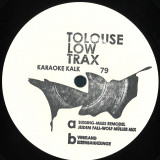
„Well recommended for the freaks“ the Manchester based independent music specialist Boomkat once finished a review about a release of Düsseldorf based DJ and producer Tolouse Low Trax aka Detlef Weinrich (also known as one fourth of the German avant-band Kreidler). What a freak distinguished we do not really know - we just assume he walks this world on a different path. Tolouse Low Trax surely does!
The latest evidence of this fact are four tracks of whom two are remixes by befriended artists, and two are coming right out of the middle of Tolouse Low Trax’s very own sense for odd and catchy grooves. His friend Miles, also known as one-half of the experimental industrial techno and dark ambient duo Demdike Stare, puts hand on the track “Sussing”, originally released on Tolouse Low Trax’s latest album “Jeidem Fall” in 2012. He covers it with an enigmatic, shadowy veil in terms of sounds, space, and obscure driving arpeggios in order to give the track a “brighter haze” feeling. A subliminal hypnotic transformation that swings with a unique dark and demanding drive. The second remix was done by Wolf Müller, a Düsseldorf based musician that released two highly acclaimed EPs on the German DIY label Themes for Great Cities. His profession as a percussionist calls the tune as he mutates the original track “Jeidem Fall” into a tribal celestial dance tune that jacks with an Afro-Baroque elegance.
Also the two EP contributions of Tolouse Low Trax himself move on very different terrains but seem to come out of the same experimental laboratory. With “Vindeland” he delivers a track full of dark synthlines and drunken shuffled patterns that morphs into a nervous soigné sensation. In contrast his arrangement “Eisenbahnzunge” starts with a celestial arpeggio until a strange alienated voice appears and everything melts layer by layer into an elliptical ambient experiment beyond the usual definition. Both tracks are deeply rooted in Tolouse Low Trax’s very own spontaneous minimal hardware approach of producing bold, hypnotic dance-not-dance music that shall not only illuminate the so called freaks!
- A1: A Shell Immerse In The Dark
- A2: Back To Chambi Lake
- A3: Sepik Dream
- A4: The Frogs Of Darana
- A5: Virgin Of The Dawn
- A6: Dance Of Heinghene
- B1: Kaluli Crayfish Song
- B2: Voices Of The Spirits
- B3: Vaihiti
- B4: Wahnui, The Guardian Of The Yam
- B5: Incantation Chant
- B6: Kaluli Storm Song
- B7: Twilight In The Low Tide
A journey back in time, maybe thousands of years ago, somewhere in the isolated islands of Melanesia. Here, just like a sound alchemist, Roberto Musci transforms organic nature elements into a unique sound performance of self-estrangement.
In the artists’ laboratory, we will discover a melting pot of ancestral ceremonial sounds collided with contemporary chamber music and experimental-electronic methods based on music research. Among these, ethnical music of the populations of Kanaki, Itamul, Kaluli, Niugini, Abelam, Huli, Enga unconventionally search for an intrinsic connection between humankind and music, part of our lives since the dawn of times. Several studies have highlighted in the DNA of the people of Melanesia genetic traits that trace their origins back to the man of Neanderthal and Denisova (about 70,000 years ago). Their isolation has preserved primitive culture and, perhaps, music.
Roberto Musci composed “Melanesia” based on the Plunderphonics technique mixing traditional ethnic music with contemporary chamber music and concrete music. Mastered by Kassian Troyer at Dubplates & Mastering, “Melanesia” is released in a limited edition 12", 180g vinyl, with a cover artwork created by Giuseppe Lo Schiavo.
Roberto Musci is an Italian music composer, performer, saxophonist and guitar player, born in 1956 in Milan, Italy. From 1974 to 1985 he traveled around the world to research African, Indian, Near East, and Far East music. During his travels, he recorded on-field music, studied and collected ethnic music instruments from across many countries and cultures.
His LP “Water messages on desert sand” composed and performed with Giovanni Venosta was Grammy-nominated in the UK in 1987. Roberto Musci released LPs and CDs with many European labels, including Raw Material, Island Records, Music from Memory, and Recommended Records. He collaborated with musicians and researchers from all over the world, composed and performed music for films, live soundtracks for silent movies, audio-video installations, poems, dance, and theatre.
His latest project, "Melanesia", is composed based on the Plunderphonics technique mixing traditional ethnic music with contemporary chamber music and concrete music. The artist puts together live recordings of tribal ethnic music of indigenous people from the Pacific islands of Melanesia, performed with the body and with archaic instruments. Along with these, contemporary chamber music collides with the sea, wind, rain, thunderstorms of the Melanesian islands, modified according to the techniques of Concrete Music, in homage to Pierre Schaeffer and Pierre Henry, two of the artists who shaped his way of experiencing sound.
On Interior, Swiss composer Samuel Reinhard excavates intricate resonances at the periphery of our attention. Across four movements, Reinhard follows a process whereby he layers and loops fragments of piano improvisations. Yet Interior complicates its own systematicity by using samples that are not only recognizable as piano notes, but as live recordings of a piano being played. Reinhard composes from traces both analog and digital: we can hear static hiss and clicks, but also the soft trace of a finger pressing a key or the shuffle of a body shifting position.
Interior asks us to think about where we are, and how close we are willing to look, feel, and listen. Over the course of the four movements sounds return, familiar but transformed. What sounds like repetition is something more like accumulation, a thickening of space. Whether regarded at intimate range or from a distance, these compositions reveal more the longer we linger in the presence of each.
Rolling through life, an open mind like an ocean, an infinite ride that comes furiously crashing to a halt. This is Whitney K’s ‘Two Years’, a deep dive into the Canadian songwriter’s journey through vulnerability, change and ultimately letting his guard down. Whitney K is the wandering stalwart Konner Whitney, a White- horse Yukon resident who has spent time in Vancouver, Montreal, Burnaby and Los Angeles. We met the character in 2016 through his intoxicating 4-track recorded manifesto ‘Goodnight’, a head on collision into 24 hours of illusioned romance and modern day escapism.
Fast forward to 2021, lift those curtains, aptly titled ‘Good Morning’ is the opening track on ‘Two Years’, a different cracker, a deliberate record about transformation, where to put it simply, Whitney K has arrived. Enlisting the aid of main collaborator and bandmate Josh Boguski, the focus has been shifted, folklore and realism becoming reckoning and truthfulness, what was outsider folk is now political poetry, life in motion delivered through a freeway ridden baritone voice that transforms the mundane into extraordinary.
Serpente is the alias of Bruno Silva, a prolific and consistent fixture of the Portuguese scene. Silva has operated under numerous aliases throughout the years including the much loved Ondness name. With past releases on Not Waving's Ecstatic and Discrepant, among others, Silva's next release is a long awaited addition to the Alien Jams catalogue, an album called "Irmãs," Portuguese for "Sisters."
Comprising of two 17 minute tracks, both "Da Clara" and "Para Celeste" are intrinsically linked, mirroring and then inverting one another. Sisters share recurring motifs, typical of the Serpente project, both tracks artfully transform the strictest percussive forces into expressive and mind expanding mantras. Redolent of their live incarnations, Serpente gigs often involve a transformative and immersive experience, and "Irmãs," embodies this spirit, embracing melodic digression in a sustained and flowing state.
- A1: Phantoms Of Dreamland (Lh Mix)
- A2: Men In Green (Neue Grafik Rework)
- A3: End Of An Era (Felicia Atkinson Fennel And Moon Mix)
- B1: Our Man In (D.k. Remix)
- B2: Rainwater Fjit (Jimmy Edgar Remix)
- B3: Phil 5 (Lucrecia Dalt Remix)
- B4: Ball Of Fire (Object Blue Version)
- C1: Maid Of The Mist (Nick Höppner Remix)
- C2: Spookie Boogie (Luca Durán Remix)
- D1: El Teb (Mehmet Aslan Remix)
- D2: Are You Psychic (Parco Palaz Remix Pt I)
- D3: Are You Psychic (Parco Palaz Remix Pt Ii)
- D4: Maid Of The Mist (Oso Leone Rework)
Born in Croydon, UK in 1960 and working in Switzerland for decades, Michal Turtle has led a storied career as a composer, arranger, technician and producer, consistently aligned with some
of the most exciting bands and projects within the realms of pop and experimental music. A figure as masterful in the realm of expansive ambient recordings as advertising jingles, it’s only in recent
years that Michal’s solo productions have gained acclaim and a cult following that continues to grow ever wider.
Turtle made a long-awaited return earlier in 2020 with the extended ‘On a Canvas Lived a Baby’, a one-sided twelve of new material released on Planisphere Editorial. Now, the Basel based label
invites a diverse and international cross-section of electronic musicians to reinterpret the artist’s back-catalogue, each delivering a thoughtful remix driven by the same sense of curiosity,
exploration and genre-blurring that Turtle himself helped pioneer. Each track on the remixes collection was originally recorded between 1980 and 1985, in between Turtle’s regular tours with established bands. Opening the collection, Laurel Halo adopts her LH alias for a textural and tripping revisit to ‘Phantoms of Dreamland’, transporting the haunting original to a hyper-detailed alternate dimension. Zoning back in, Neue Grafik finds typically eclectic form with ‘Men in Green’, turning the dials and blending ideas as if tuning between the emerging musical scenes that defined Turtle’s early-eighties life in Camden, London. In stark contrast, avant-garde polymath Felicia
Atkinson designs a ‘Fennel and Moon’ version, weaving between earthy field recordings and an aching piano line, conjuring an almost ritualistic atmosphere, far from the city. Radical musical turns continue to define the collection as son of Detroit, Jimmy Edgar takes
‘Rainwater Fijit’ down a dark, damp tunnel, expanding on the pitter patter of Turtle’s more outlandish studio experiments, blending vocal experiments with fresh funk. Colombian experimentalist Lucrecia Dalt pulls further bizarre shapes from a patchwork of samples, a heaving,
gasping industrial shuffle, before French producer D.K. returns a stronger rhythm, both building on Turtle’s lovingly naive tributes to the legacy of sample culture and his trusty ARP2600.
Ostgut Ton mainstay and Panorama Bar resident Nick Höppner proceeds to sensitively rewire ‘Maid Of The Mist’ into a blossoming, introspective celebration of melody and ambience, an
almost weightless experience that lends itself well as a breather before Luca Duran’s analogue, acid-tinged take on Spookie Boogie takes Turtle’s esoteric touches back into the direction of the
funk and italo records at the heart of his initial inspiration.
The Remixes final chapter continues to expand in distinct and wide-reaching sonic directions. London’s Object Blue seems to slow time itself across her sublime interpretation of ‘Ball Of Fire’.
Initially Turtle’s tribute to Howard Hawks 1941 film classic and the legacy of old Hollywood, worlds further collide into rolling, weightless bliss.
Fellow Swiss citizen Mehmet Aslan stirs an enchanting, percussive mystery that unfolds with great
pleasure on El Teb, while Parco Palaz conjures not one but two radically different remixes of ‘Are
You Psychic?’, demonstrating both their imaginative nous, as well as the depth of Turtle’s legacy.
Finally, an irresistible vocal contribution from Oso Leone adds even further colour and joy to ‘Maid
of The Mist’, sending off this ambitious collection on a transformative, dream-pop high.
With further details set to be revealed, there is an ongoing development focused around the
accompanying art and visuals. The Peruvian born and now Amsterdam based graphic designer
Jonathan Castro leads the art direction, along with visual artist Chris Harnan. Both artists look to
explore the intersection between sound, imagery and its reorientation, exhibited through the
musical contributors and visual translation.
“I am happy and honoured to have been the spark for this remarkable compilation.
The magnificent work done by this collection of very special people speaks for itself, so listen and
be transported. It has been half a lifetime since my original tracks were written, and I am gratified
to know that they are somehow still relevant enough to be reworked and reinvented.”
The band that became Nightshift formed in 2019 in the ecosystem of Glasgow's current indie scene. The city's fertile & creative group of musicians have been committed to pushing the boundaries of and blurring the lines between DIY, punk, experimentalism and indie pop for decades now; a home to bands like Shopping, Vital Idles, Current Affairs, Still House Plants, and Happy Meals as well as forebears like Orange Juice, Teenage Fanclub and Yummy Fur. Nightshift slot right in with all mentioned, featuring members from current indie stalwarts Spinning Coin, 2 Ply and Robert Sotelo. Initially formed by guitarist David Campbell and bassist Andrew Doig as a "No Wave/No New York/ early Sonic Youth/This Heat-esque" group, the addition of Eothen Stern (keyboards/vocals) and Chris White (drums) instantaneously transformed their approach (guitarist/vocalist/clarinetist Georgia Harris joined as the band was writing "Zöe"). The band self-released a full-length tape on CUSP Recordings in early 2020, laying the foundation of their sound; hypnotic, melodic, understated indie post-punk with hooks that stick around long after you've heard them. "Zöe" is the band's newest effort, and first for Trouble In Mind. Unlike the band's previous album, the songs on "Zöe" weren't conceived live in the band's practice space, but rather pieced together and recorded remotely during quarantine lockdown, with each member composing or improvising their parts in homes/home studios, layering ideas over loops someone made and passing it on. The isolation actually allowed for an openness and creativity to flow and many of the songs took on radically different forms from when they were originally envisioned. Vocalist & primary lyricist Eothen Stern says "The process of writing these songs separately during lockdown was a kind of exquisite corpse - I liked this gesticulation of reaching out to one another and responding. Building up the next layer and passing it on." Stern says "poetic restraints" to writing & Eno's Oblique Strategies concepts were on their mind when composing the words to the songs on "Zöe" and lists the influence of author Rosi Bradiotti's book "The Posthuman". "Zöe" means "live drive", derived from the word conatus. Bradiotti defines conatus as "an effort or striving, endeavour, impulse, inclination, tendency, undertaking, serving is an innate inclination of a thing to continue to exist and enhance itself." and Stern views it as "...a kind of feminist re-claiming of communal public, anti- privatisation, looking to strive for social and environmental justice. Zöe kind of became a character of striving for me when writing.". "Zöe" kicks off with "Piece Together", a hypnotic song anchored by the band's chanted vocals and serpentine guitar licks. "Spraypaint the Bridge" showcases Harris' clarinet in an unexpected & delightful melodic shift during the song's anti-chorus. Elsewhere tunes like the swooning "Infinity Winner" and "Outta Space"s minimalist, slinky rhythm swirl in a late-night vibe, while "Make Kin" ruminates on "Looking to kinship as a way of engaging with entangled environmental and reproductive issues... how a band is a bond" and lurches forward with kinetic guitar strangling and staccato rhythmic percussion from White and Doig. "Power Cut" is the album's centerpiece, kicking off side two and lures the listener into its world over it's 7-minute runtime. Lulling them into involuntary movement with its waves of melodic harmonies, synth drones and metronomic pulse, until they all come crashing down in the song's dissonant midsection. The band acknowledges the whiffs of nostalgia prevalent in "Zöe"s songs (the title track in particular), and the nature of writing and recording the album is soaked in the self-work, reflection and reevaluations involved not only personally but creatively in each member's lives. Consequently, the album becomes a collection of sketches of hope, growth, awareness of the power of the world and the power of self, kith, kinship, friendship, resistance, and possibility.
Recorded in Chicago, Manhattan and Toronto, After Dark by Forest
Management is a collection of re-contextualized turntable audio sourced from an old vinyl copy of Claude Debussy’s La Mer.
The album shows composer John Daniel continuing to explore the territory he gestured at in 2018’s 21st Century Man, and is his biggest statement yet, clocking in at over an hour. Endlessly remixed in a software environment, the music of La Mer is transformed into new color. After Dark was inspired by events twenty years ago near the time Daniel first encountered Debussy