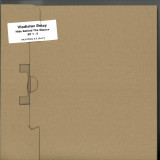
Vladislav Delay's complete "Hide Behind The Silence" series. Intuitive and raw music, momentary and reflective, released on Ripatti's own label Rajaton.
Stillness is a myth. Consider concepts such as ”still water”, or ”still air” for that matter. Go to a restaurant, ask them for a glass of still water, hold it against the light and see where we’re at. Even though the water itself has been captured and imprisoned in the glass, it never stops breathing. It’s filled with tiny particles, dancing. Everything can be explained on a molecular level, but since we’re not scientists – and even if you happen to be – it’s the natural world of perception that moves me.
Still air is very similar. A hot summer’s day with zero wind feels completely still. It’s the closest I have felt to complete stillness. Or for a more urban adaptation, imagine the same vibe inside a normal apartment. In those moments, revelations and mind- blowing experiences can be had with experiments in stillness.
Try this: Just sit down for a minute on a sunny day, making sure there’s enough natural light. Do absolutely nothing. Try not to breathe for a bit. (If you need a mental anchor, you can play Cage’s 4’33” in your head but nothing else.) Watch the tiny dots of dust dancing :..’ ̈.:; ́ ́*°.,’:,. ̈ ̈ ̈ ̈:,.’
The movement is crazy, but the feeling of stillness comes from witnessing how subtle it is. In (perceived) complete stillness, every act of microscopic mobility seems to speak volumes. Yet, it feels both reassuring and oddly threatening that the stillness is never complete. What if we would need absolute stillness? Or is it just enough that we can perceive something as such? Extremes attract, so for both water and air, extraordinary movement is equally fascinating. That is also a luxury item of sorts. For us to enjoy a very ”loud” body of water or air, we need to be safe, in enough control of the situation. So when you are, it’s worthwhile to pay attention and take it all in.
A rapid flowing free with extreme strength and just barely in control. Look at that water go! No still water on this one, only ”sparkling”. A windy day when birds seem surprised how hard it is to fly, but in the end they make it. Trees bend but don’t break. The wind shows you its movement but doesn’t hurt you. It feels friendly, like a big clumsy dog that doesn’t quite understand its size.
It’s beautiful to be a guest of the elements, but not at the mercy of them. A new kind of dialogue forms.
Q&A with Sasu Ripatti:
1) Tell us something about the EP series ”Hide Behind the Silence”, what’s the idea and what can we expect?
Exploration of inaction. Of many kinds. In arts and in personal life, or at bigger and more serious levels. Questioning myself as a human being as well as an artist. Acknowledging the growing activism all around, and the very clear need for it, and how it reflects my own inaction.
Musically speaking, after Rakka, Isoviha and Speed Demon, I finally found some relief, but more importantly lost the need to go musically ever more outward and intensive. I felt quite strongly certain periods/moods from the past and they made me revisit some musical ideas or states of mind I was exploring early on.
It’s about live moments being captured, not much premeditation or editing. More intuitive and raw, even though the end result (to me) feels and sounds quite introspective and calm. It’s not very ambitious. Momentary and reflective.
2) Your music doesn’t sound very silent. Does it come from somewhere behind the silence?
Oh, this time to me it sounds quite quiet and playing with space if not silence. I don’t know what’s actually behind silence, but I think silence is the source of everything. We just don’t understand it yet.
3) What kind of thoughts or experiences gave inspiration to this series?
Writing this in Nov ’22, it’s not a stretch to say the world has been really unwell. Sometimes, like Mika Vainio put it, the world eats you up. I feel a bit like that. And I try to hide in my studio and stay away from it all, but it’s getting harder by the day. I’ve been questioning myself and thinking if what us artists are doing is worth anything, and whether it’s just a selfish thing I’ve been doing for the past 25 years, running away from everything. I haven’t come to a conclusion yet.
4) Is it easy for you to be in silence, or around silence?
Absolutely. I not only hide behind silence but I also love silence. It’s only since I started going back to nature as a grown-up person that I sensed and was enveloped by silence, true silence. I have begun to appreciate it a lot. I think all the people should spend more time in silence.
All tracks composed and produced by Sasu Ripatti.
Artwork by Marc Hohmann, photography by Shinnosuke Yoshimori.
Mastering by Stephan Mathieu for Schwebung Mastering.
Vinyl cut by SST Brueggemann.
Publishing by WARP Music Ltd.
Поиск:try
Все
Genre-smashing alternative artist grandson announces his new album I Love You, I’m Trying out on Vinyl 19th January via Fueled By Ramen. Where his past work tackled political and social issues in nature, the new album turns the lens definitely inward resulting in a 12 track collection of grandson’s most personal and vulnerable songwriting to date.
- A1: Please Come Out
- A2: Wicked
- B1: Working With
- IB2: N My Head
- C1: Got Your Money
- C2: Didn't You Know
- D1: Two-Door
- E1: Memory Lane
- E2: Good Girls And Boys
- F1: All I Want From You
- F2: Don't Sell Rock
- G1: What Yours
- G2: Tweets
- H1: You Check
- H2: Hero Forever
- I1: Don't Pick Up
- I2: You Don't Know Me Anymore
- J1: Tenderly With You
- J2: Now Let's Wait
Sasu Ripatti's complete "Dancefloor Classics" series. Music for imaginary dancefloors, released on Ripatti's own label Rajaton.
”Look up, into the light” she said, while the camera shutter clicked. ”Like this? Does it look holy?” His neck felt stiff. Her reply: ”Yes, just like that. What do you mean holy? Like religious? ”No, more like trying to look very far, somewhere beyond what we can see.” ”Okay, stand still, I’m going to come close to you now. The light hits your face great.” click, click, click.
He noticed her fingernails. They were not polished. Natural. Even somewhat rugged, as if something wore out the fingers slightly. What had these hands held besides the camera? What made the edges of her fingernails drift off?
He thought it’s weird to look straight into the camera. The photographer had closed her left eye, the one not looking into the lens. Then it opened, she looked up, perusing the surroundings, then she closed her eye again, then looked up, closed, looking up, very quickly. It all seemed very professional. Maybe she calculated the light, making sure it’s close to perfect. ”What will these photos look like?” – the thought popped into his head briefly. It was liberating to think it wouldn’t matter.
”What’s that song playing?” he asked. ”Wait a sec, Ol’ Dirty Bastard?” she replied. ”Oh yeah, right. But the sample?” ”Hey, could you look up again, like that. No, lower.”
New directions: ”Look out from the window, turn left.” ”My left or yours?” ”Yours, I always try to think from the direction of my model.” How professional! This is a good shoot, so natural. Should I worry about how the photos look like? No, I don’t want to. His thoughts bounced around. What would the story be like? It’s a big newspaper, everyone will read it. Maybe someone drinks coffee and eats a stroopwafel while they do it. Will they place the waffle on top of the mug for a brief while, so that it gets hot and the syrup melts a little? Then it feels wet, and you can bend the cookie.
She broke his train of thought off midway through: ”Now turn right, but look left, and slightly up, but don’t turn your face right.” ”Umm, like this? Sounds like a set of pilates instructions.” she laughed ”You do pilates?” ”Yeah, it’s hard sometimes. Have you tried?” ”No”, she said. ”I’m not good for sports that are done in groups.” ”Yeah, but in pilates you can just be inside your mind, drowning in your private thoughts.”
”What are you thinking in pilates?” she asked, taking more photos. ”Well, mostly just which way is right. And which left.” click, click.
Q&A with Sasu Ripatti:
1) Tell us something about the EP series ”Dancefloor Classics”, what’s the idea and what can we expect?
I’ve been slowly writing these sort of dance music pieces and finally curated them together for a conceptual release. I like to create music for a dancefloor that exists only in my imagination and doesn’t try to suck up to the standardized reality.
2) Your vinyl format is 10” which is quite special (as opposed to LP / 12”). Why did you choose it?
It’s my favourite format, absolutely. The size is perfect, and you can make it sound really good @ 45 rpm. And you still can make great artwork.
3) You seem interested in sampling/repurposing, what does it mean to you as an artist to approach something already existing from a new angle? How does the source material inform you about the approach to take?
I guess i could flip it around and just say I’ve outgrown synths or electronic sounds to a great extend, and having gotten rid off all my synths already good while ago I’ve used samples as my main source material a lot. It’s obvious on this series that i’ve sampled existing music, but I also sample instruments and things in the studio and resample my own library that I have built over the years, it’s quite large. To me the end result matters, not so much how I get there. Once I have something on my keyboard and play around, it’s all an instrument, though with sampling other music it becomes a really interesting and complex one as you’re possibly playing rhythm, but also harmonic content and maybe hooks or whatever, all at once.
I never sample premeditadedly, like listening to records and looking for that mindblowing 3 sec part. I just throw the cards in the air and see what lands where, just full intuition and hopefully zero mind involved, playing tons of stuff, trying things, just recording hours of stuff. Then comes the interesting part to listen to hours of mostly crazy stuff and finding that mindblowing 3 sec part.
4) What is your relationship with the dancefloor (conceptually and/or in experiences / as a performer)?
Very complicated. I have never really felt comfortable on a dancefloor but have always wanted to. There’s something in club music, in theory, that really speaks to me. It has never really materialized for me – speaking mainly from a performer’s point of view who goes to check on a dancefloor for a moment after a concert. I never have DJ’d or felt much interest towards it. But again, I love the idea and concept of DJing. As well as producing music for imaginary DJs. Lately, as in the past 10+ years, I haven’t even performed in any sort of club spaces. So my relationship to the dancefloor is quite removed and reduced, but there’s quite a bit of passion and interest left.
All tracks composed and produced by Sasu Ripatti.
Artwork & photography by Marc Hohmann.
Mastering by Stephan Mathieu for Schwebung Mastering.
Vinyl cut by SST Brueggemann.
Publishing by WARP Music Ltd.
"Keith Porteous, who was A&R at BMG brought me to a bar called The Absinthe to check out a new band he was working with. What was immediately interesting about them was that, while their tastes were root-ed in ‘70’s rock, they didn’t sound retro. They had created a classic rock sound for their generation. What was also great is that they were four distinct personalities-four characters, like the Beatles or the Monkees. But they all dressed in matching outfits and did coordinated rock moves on stage. Amazing. I went to Moncton, NB and met the guys at an old schoolhouse that they’d wrangled to do pre-pro-duction. We spent a week or so workshopping their super cool songs and hanging out at their favorite watering holes. They had sold me with their live show and part of the trick of producing them was to try to capture that. I knew we weren’t going to do a lot of overdubs or ornate production. That week was an absolute blast. The guys were so funny and so engaging, just dripping with personality, which I knew was going to serve them well in the music business. I remember going to a Chinese Buffet with them and their girlfriends and watched them eat half of the food in the restaurant. I think the bill came to less than $100 for the nine of us. I still love the record and I wish it had made them world famous rock superstars. Every song on it is so uniquely them, they had perfectly distilled their influences, both old and new, and I don’t think any other band could have made this record. " - Moe Berg
Out of print for quite a few years now, this album is a stunning power-pop gem recorded at a time when this kind of girl group pairing with punk rock was unusual.b This is one of the most iconic albums released on Greg Shaw's Bomp! Records. It now includes bonus tracks on top! Definitely stood the test of time. Check out the titles, these young ladies were wearing their collective hearts on those sleeves of theirs. This kind of girl group pairing with punk rock was unusual at the time and it provided a much-needed antidote to the male dominated skinny tie brigade. Nikki looked like Pam Dawber (Mindy from Mork and Mindy) and sounded like Clare Grogan (of Altered Images) what was not to be instantly smitten by. Born and bred in Detroit, Miss Corvette reportedly ran away from home at age 16 because her mother refused to allow her to attend an MC5 show. Greg Shaw wrote the following in the liner notes to the 20th Anniversary label compilation, Destination Bomp! "Nikki was a tireless worker. Like some coalminer's daughter, she'd travel around the country with her band. Playing 200 shows a year. She knew everybody and was a lot of fun to hang out with so, I figured that if all her friends bought the record... so I signed her. The girl had style and attitude galore plus, she had master guitarist/songwriter and former Romantic Peter James. One of Detroit's most savvy cats." The lady herself kindly supplied the following summary. "We went to LA and signed with Bomp in maybe 1979 but Greg wasn't sure what to do with us. We did the Honey Bop single with Ronny Weiser at Rollin Rock and a couple songs with the Kessel Brothers. We started something with Kim Fowley that did not work out. They kept trying different producers until we finally decided to go back to Detroit and do the album on our own. We didn't have a lot of experience but we knew what we wanted and Detroit was part of that so we recorded the album and had a blast doing it. Peter wanted us to be poppier and I wanted to be more punk. We sort of met in the middle with what I've always called Bubblegum Punk. I can't believe it's been 43 years since this came out and there are still kids discovering it and people who grew up with it that still listen to it. I constantly hear from people all different ages, all over the world about how much they love it album and that really means so, so much to me!" Hear the phenomenon for yourself.
The first in a four-volume retrospective of Kuduro and tarraxinha pioneer DJ ZNOBIA. Incoming unto the world for a very long time from the musseke of Rangel, home of Casa da Mé&e Ju, in the Angolan capital o Ldanda, one if not the pivotal visionary of his country’s music electronic and digital modernism DJ Znobia, o/fum/an inventor. Usually considered the first purveyor of the fluency regarding tarraxinha (drinking in its foundational slow shuffle from the city of Benguela), as well as a main player in free thinking, spontaneous, funny, depressive, silly, melancholic, hilarious all encompassing beats within kuduro, batida, techno and beyond, his influence as a producer, DJ, MC and public fiuce has had a great imprint in Angolan culture for the better part of the last three ecades. This venture went through over 700 tracks of his archive (more than double are lost in the meantime between his and the NNT library) in order to collaboratively select a fiercely representative albeit balanced affair from his production, between instrumentals for sung kuduro, instrumental kuduro/batida, sung and instrumental tarraxinha, and other creative styling from the late 90’s to the mid 2000’s. Forms now heard around the world which started here, with Znobia a decisively influential contributor, along with several of his peers and collaborators, which will be also in evidence in this four volume retrospective. His story is way too far flung for this endeavor to try and make a simple narrative out of it. You have to be him, you have to be within this territory, and we ask of the people who will approach to ask him what has happened with the history of this music and what is the current reality at ground zero Luanda, as he is a mirror and visionary of its streets, in a country with such complicated dynamics and brutal treatment of its citizens. To try to put in a clean slate for this conversation, let’s talk to a genius of street music. Your question. First, here's the opening collection of what we have to share with you.
- A1: Are You Actively Eating That Candy Bar?
- A2: Sounds About Right, Bruce
- A3: Collapsing East Wing
- A4: Baby Shower
- A5: Nora
- A6: Run
- B1: Not This Time, Kid
- B2: Can Of Tomatoes
- B3: See You Soon
- B4: Please Work
- B5: Today's The Day
- B6: Phasing
- B7: Escape From The Lab
- B8: Zod
- B9: What Is This Place?
- C1: Spaghetti
- C2: Into The Batcave
- C3: I Loved You First
- C4: Fate
- C5: I Am Batman
- C6: Batdoneon
- C7: Kal-El?
- C8: Escape From Siberia
- C9: Now We Try Not To Die
- D1: Supergirl
- D2: Want Some Help?
- D3: I Gave You A Warning
- D4: What Could Go Wrong?
- D5: Let's Get Electrocuted
- D6: I've Got You
- D7: You Wanna Get Nuts?
- E1: Let's Get Nuts
- E2: Cyclonic Diversion
- E3: I'm Not Going Alone
- E4: We Can Fix This
- E5: Inevitable Intersection
- E6: We Can Save Her
- F1: The Dark Flash
- F2: Worlds Collide (Superman Version)
- F3: You're My Hero
- F4: Into The Singularity
- F5: Call Me
Der OST des zweifach GRAMMY-/BAFTA-nominierten Komponisten Benjamin Wallfisch zum US-SciFi-Action-Film 'The Flash' von Regisseur Andy Muschietti mit u.a. Ezra Miller, Michael Keaton, Sasha Calle, Ben Affleck und George Clooney. Die zweite Verfilmung der Comicfigur The Flash aus dem DC Extended Universe kam im Sommer 2023 auch hierzulande in die Kinos. Wallfisch adaptiert darin auch Batman-bezogene Themen wie z.B. Danny Elfmans 'The Batman Theme'. Beide Formate umfassen 42 Titel mit über 80 Minuten Musik. Die Farbe des Triple-Vinyl basiert auf dem ikonischen rot-gelben Anzug von The Flash, während das Triple-Gatefold mit The Flash, Batman und Supergirl verziert ist.
Das von der Kritik hochgelobte Debüt-Studioalbum der amerikanischen Rockband The Strokes. Aufbauend auf ihrer 2001 erschienenen EP "The Modern Age" formten die Bandmitglieder ihre Kompositionen hauptsächlich durch Live-Takes während der Aufnahmesessions, während Songwriter und Leadsänger Julian Casablancas weiterhin das Leben und die Beziehungen der urbanen Jugend detailliert beschrieb. Aus dem Album wurden drei Singles veröffentlicht: "Hard to Explain"/"New York City Cops", "Last Nite" und "Someday". Jetzt auf rotem Vinyl erhältlich.
- A1: Forever Chemicals (Live In Europe 2023)
- A2: Beautiful James (Live In Europe 2023)
- A3: Scene Of The Crime (Live In Europe 2023)
- A4: Hugz (Live In Europe 2023)
- A5: Happy Birthday In The Sky (Live In Europe 2023)
- B1: Bionic (Live In Europe 2023)
- B2: Surrounded By Spies (Live In Europe 2023)
- B3: Sad White Reggae (Live In Europe 2023)
- B4: Try Better Next Time (Live In Europe 2023)
- B5: Too Many Friends (Live In Europe 2023)
- C1: Went Missing (Live In Europe 2023)
- C2: For What It's Worth (Live In Europe 2023)
- C3: Slave To The Wage (Live In Europe 2023)
- C4: Song To Say Goodbye (Live In Europe 2023)
- C5: The Bitter End (Live In Europe 2023)
- C6: Infra-Red (Live In Europe 2023)
- D1: Shout (Live In Europe 2023)
- D2: Fix Yourself (Live In Europe 2023)
- D3: Running Up That Hill (Live In Europe 2023)
Premium Box Set, Limited Edition (316 x 316 x 20 mm) = Clear Vinyl 2LP Gatefold, Blu-ray, CD Softpack-Gatefold, exklusives Faltposter 30 x 60 cm
Collapse Into Never - Placebo Live in Europe 2023, aufgenommen @ Low Festival, Spanien
This Is What You Wanted -> Blu-ray mit Full-Length-Konzertfilm, aufgenommen in Mexico City 2023
Live From the White Room -> Live-CD mit "Never Let Me Go" Albumtracks im Softpack-Gatefold, aufgenommen @ Studio 1, Twickenham Studios
Repress.
Mar & Sol first release Is Aleluia Lp from the Cabo Verde singer Pedrinho. At the time, late 70's, this Lp was one of the biggest successes from Cabo Verde music. Singer Pedrinho moved to Lisbon when he was 18 years old, and recorded this album, the first one of his career.
Aleluia was produced in the same street where Mar & Sol is based nowadays, in Rua de S.Bento, Lisbon, Portugal. This street was also where Pedrinho come to live when he arrived in Portugal, like the majority of the musicians and emigrants from the old African Portuguese colonies move at that time, to try a new luck.
A big community grew here and these artists got the opportunity to record their own traditional music by the hands of local labels.
Now is the time for Mar & Sol to give a new life to all this music, this is the first of many reissues that are coming to start the series of the label.
- A1: The Rock Island Line 2:08
- A2: I Heard That Lonesome Whistle 2:21
- A3: Country Boy 1:48
- A4: If The Good Lord's Willing 1:37
- A5: Don't Make Me Go 2:25
- A6: Remember Me 1:56
- A7: Big River
- B1: Give My Rose To Rose 2:33
- B2: I Was There When It Happened 2:13
- B3: Next In Line 2:42
- B4: Wreck Of Old ´97 1:42
- B5: Belshazzar 2:47
- B6: Doin' My Time 2:33
Black Vinyl[16,60 €]
Coloured Vinyl[20,80 €]
Marble Vinyl[25,00 €]
Orange/Black Splatter Vinyl[26,68 €]
The iconic baritone country singer Johnny Cash sold over 90 million records, an incredible achievement for one who endured terrible hardship in the Great Depression, picking cotton with his sharecropper family from the age of five. After a spell in the Air Force, Cash settled in Memphis and with guitarist Luther Perkins and bassist Marshall Grant, known as the ‘Tennessee Two,’ Cash pitched up at Sun Records just as Carl Perkins and Elvis were trying their luck, Cash’s brilliant debut With His Hot And Blue Guitar containing all-time anthems like ‘Folsom Prison Blues’ and his perky cut of ‘Rock Island Line’. A must for all Cash fans.
- A1: The Rock Island Line 2:08
- A2: I Heard That Lonesome Whistle 2:21
- A3: Country Boy 1:48
- A4: If The Good Lord's Willing 1:37
- A5: Don't Make Me Go 2:25
- A6: Remember Me 1:56
- A7: Big River
- B1: Give My Rose To Rose 2:33
- B2: I Was There When It Happened 2:13
- B3: Next In Line 2:42
- B4: Wreck Of Old ´97 1:42
- B5: Belshazzar 2:47
- B6: Doin' My Time 2:33
Clear Vinyl[19,12 €]
Coloured Vinyl[20,80 €]
Marble Vinyl[25,00 €]
Orange/Black Splatter Vinyl[26,68 €]
The iconic baritone country singer Johnny Cash sold over 90 million records, an incredible achievement for one who endured terrible hardship in the Great Depression, picking cotton with his sharecropper family from the age of five. After a spell in the Air Force, Cash settled in Memphis and with guitarist Luther Perkins and bassist Marshall Grant, known as the ‘Tennessee Two,’ Cash pitched up at Sun Records just as Carl Perkins and Elvis were trying their luck, Cash’s brilliant debut With His Hot And Blue Guitar containing all-time anthems like ‘Folsom Prison Blues’ and his perky cut of ‘Rock Island Line’. A must for all Cash fans.
- A1: The Rock Island Line 2:08
- A2: I Heard That Lonesome Whistle 2:21
- A3: Country Boy 1:48
- A4: If The Good Lord's Willing 1:37
- A5: Don't Make Me Go 2:25
- A6: Remember Me 1:56
- A7: Big River
- B1: Give My Rose To Rose 2:33
- B2: I Was There When It Happened 2:13
- B3: Next In Line 2:42
- B4: Wreck Of Old ´97 1:42
- B5: Belshazzar 2:47
- B6: Doin' My Time 2:33
Clear Vinyl[19,12 €]
Black Vinyl[16,60 €]
Marble Vinyl[25,00 €]
Orange/Black Splatter Vinyl[26,68 €]
The iconic baritone country singer Johnny Cash sold over 90 million records, an incredible achievement for one who endured terrible hardship in the Great Depression, picking cotton with his sharecropper family from the age of five. After a spell in the Air Force, Cash settled in Memphis and with guitarist Luther Perkins and bassist Marshall Grant, known as the ‘Tennessee Two,’ Cash pitched up at Sun Records just as Carl Perkins and Elvis were trying their luck, Cash’s brilliant debut With His Hot And Blue Guitar containing all-time anthems like ‘Folsom Prison Blues’ and his perky cut of ‘Rock Island Line’. A must for all Cash fans.
- A1: The Rock Island Line 2:08
- A2: I Heard That Lonesome Whistle 2:21
- A3: Country Boy 1:48
- A4: If The Good Lord's Willing 1:37
- A5: Don't Make Me Go 2:25
- A6: Remember Me 1:56
- A7: Big River
- B1: Give My Rose To Rose 2:33
- B2: I Was There When It Happened 2:13
- B3: Next In Line 2:42
- B4: Wreck Of Old ´97 1:42
- B5: Belshazzar 2:47
- B6: Doin' My Time 2:33
Clear Vinyl[19,12 €]
Black Vinyl[16,60 €]
Coloured Vinyl[20,80 €]
Orange/Black Splatter Vinyl[26,68 €]
The iconic baritone country singer Johnny Cash sold over 90 million records, an incredible achievement for one who endured terrible hardship in the Great Depression, picking cotton with his sharecropper family from the age of five. After a spell in the Air Force, Cash settled in Memphis and with guitarist Luther Perkins and bassist Marshall Grant, known as the ‘Tennessee Two,’ Cash pitched up at Sun Records just as Carl Perkins and Elvis were trying their luck, Cash’s brilliant debut With His Hot And Blue Guitar containing all-time anthems like ‘Folsom Prison Blues’ and his perky cut of ‘Rock Island Line’. A must for all Cash fans.
- A1: The Rock Island Line 2:08
- A2: I Heard That Lonesome Whistle 2:21
- A3: Country Boy 1:48
- A4: If The Good Lord's Willing 1:37
- A5: Don't Make Me Go 2:25
- A6: Remember Me 1:56
- A7: Big River
- B1: Give My Rose To Rose 2:33
- B2: I Was There When It Happened 2:13
- B3: Next In Line 2:42
- B4: Wreck Of Old ´97 1:42
- B5: Belshazzar 2:47
- B6: Doin' My Time 2:33
Clear Vinyl[19,12 €]
Black Vinyl[16,60 €]
Coloured Vinyl[20,80 €]
Marble Vinyl[25,00 €]
The iconic baritone country singer Johnny Cash sold over 90 million records, an incredible achievement for one who endured terrible hardship in the Great Depression, picking cotton with his sharecropper family from the age of five. After a spell in the Air Force, Cash settled in Memphis and with guitarist Luther Perkins and bassist Marshall Grant, known as the ‘Tennessee Two,’ Cash pitched up at Sun Records just as Carl Perkins and Elvis were trying their luck, Cash’s brilliant debut With His Hot And Blue Guitar containing all-time anthems like ‘Folsom Prison Blues’ and his perky cut of ‘Rock Island Line’. A must for all Cash fans.
Legendary Jamaican songsmith Gregory Isaacs' 1995 album 'Private Lesson' on Radiation Roots. The set includes laidback cuts 'Preacher Boy', 'Feeling Sad Tonight', Diplomatic Fool', 'She Doesn't Want Me', 'Slave Master' and many more.
A real soul gem from 1970 on the James Brown affiliated Deluxe label, the first and only album by this mysterious singer: Marie Queenie Lyons.
It is perhaps apropos that Queenie Marie Lyons’s best known song is titled ‘See And Don’t See.’ For all the acclaim that song has accrued, and all the times it has been compiled, reissued and, yes, bootlegged — for all the times it has been seen — Queenie herself has somehow remained unseen. How did a singer from Ashtabula, Ohio record one of the great female-led soul albums and then simply fall off the map, never to record or perform again? Queenie was a natural performer and a gifted singer. At the age of fifteen, she was doing three shows a week at a local venue. In early 1962, Queenie moved to Queens and was soon playing gigs across the city — an early engagement was with Gene Krupa at the famous Metropole Café in Times Square — as well as touring with established acts like Fats Domino and Ray Charles. The following year, Queenie made her debut recording, for a subsidiary of RCA called Groove, credited to an entirely fictitious “Shelley Shoop and the Shakers.” It remained Queenie’s only presence on wax until early 1968, when a Nashville-based label called Sims gave her her first accurately attributed single, “A Minute Of His Goodtime / Good Soul Lovin’.” Although the 45 is now a highly collectible part of the Northern Soul and Lowrider Oldies pantheons, it made no impact at the time, as Sims was focused on more typical Nashville sounds. A few months later Queenie was back in New York City, performing R&B and pop covers with her band when a man passed her his business card at a performance. The card read James Brown Enterprises. James Brown “was my idol,” she says, and someone whose business acumen and stage presence she strove to emulate. Although Queenie ended up on tour with James Brown for only a month or so, when the group reached Cincinnati in mid-’68 she entered the King Records studio there to record what would become the
album you hold in your hands. The songs were a combination of covers, some of which she’d been doing in her live shows, like ‘Fever’ and ‘Try Me,’ and originals written by producer Henry Glover and pianist Don Pullen, who was the bandleader on the session. The album opener, ‘See And Don’t See,’ was also recorded by the veteran R&B singer Maxine Brown, but Queenie’s version blows hers away. “Soul Fever” is a supremely funky and soulful affair, with Queenie’s powerful and captivating voice magnetically attractive, with an urgency that is impossible to ignore. ‘Your Thing Ain’t No Good Without My Thing,’ ‘Your Key Don’t Fit It Anymore,’ and ‘I Don’t Want Nobody To Have It But You’ are as funky and soulful as the best of Tina Turner and Aretha — a statement not to be made lightly!
The album was critically acclaimed — the October 10, 1970, issue of Billboard listed it as their sole “four star” pick in the Soul category — but perhaps due to the tumult at Starday-King, whose stewardship had turned over several times in only a few years, it never seemed to be able to break through to a larger audience.
- On The Sunny Side Of The Ocean
- Special Rider Blues
- St Louis Blues
- How Green Was My Valley
- (Poor Boy) Long Way From Home
- The Death Of The Claptop Peacock
- Spanish Two Step
- In Christ There Is No East Or West
- Steam Boat Gwine Round The Bend
- Sligo River Blues
- Poor Boy
- When The Springtime Comes Again
- On The Sunny Side Of The Ocean
David Tattersall, the Wave Pictures guitarist and frontman releases a solo album of interpretations of John Fahey tunes, recorded live in the studio. "I have been a fan of John Fahey's music since I was very young; it has always been with me and I can't remember a time when I wasn't affected by it. It is weird music, and very good. Of course, Fahey is an important cult figure in the history of music: as the first man to find a language for steel string guitar that can stand proudly alongside the established tradition of nylon string classical guitar; as one of many men who rediscovered obscure old blues musicians and recorded them for a new generation in the 1960s; as one uniquely able to reconcile 20th century avant-garde music with folk tradition; as an early indie-label DIY pioneer. For me personally, Fahey went beyond technique, and to some extent beyond historical or intellectual justifications for his work. He explored his emotions through his instrument of choice, and in so doing made the case for the guitar as the ultimate conduit for emotional expression. While there are many imitators who try to play ''like Fahey'', I avoided using his fingerpicking style or sense of rhythm, and tried instead to use his music to explore my own emotions, my own dreams and memories. I was more interested in the lyrical and expressive aspects of Fahey's music than in the techniques of it. I tried to find myself within his compositions and without composing anything I feel that I have managed to make a David Tattersall record that says as much about me as any of the many albums that I have written. John Fahey's beautiful discography shows that the guitar can carry as much mystery and soul as the human voice, and simply put, I wanted in on a little of this action. This is my second all-instrumental solo acoustic album, and where this differs from my first attempt, Little Martha, is that here I improvised freely. I used Fahey's originals only as guides. I'm not sure what I was looking for, perhaps something beyond explanation, but I tried to be as free as possible, and I am delighted by the spontaneous results. Hopefully, they will make the listener feel happy and dreamy, just like the effect that Fahey's many albums have on me. One of the most important things that Fahey ever said was his advice to guitarists to try to feel the emotions that each chord they play on a guitar brings forth. He is telling guitarists to not only play the guitar, but to let the guitar play them. I did my best to follow this advice. I hope you enjoy listening to the album, that it brings you some dreamy moments, and that it sends you back to happily explore the originals. I had a great time recording it. Naturally, I can't put the experience adequately into words but that's the whole point. I think Fahey was a genius of the kind that creates a whole genre single-handedly. There could be thousands, millions, of reinterpretations of his compositions. In fact, there probably already are. And long may this continue. All tracks were recorded live with no tampering."
Van Halen did more than announce to the world the earthshaking arrival of a revolutionary guitarist. Performed by an enterprising California quartet that took its name from two of its principal members, the 1978 debut ripped headlines away from punk, injected fresh energy into a then-moribund rock 'n' roll scene, reimagined how heavy music and throwback pop could coexist, and invited everyone to experience the top-down pleasures of a beach-front Saturday night every day of the week no matter where they lived. Painstakingly restored by Mobile Fidelity Sound Lab, and the first of a multi-album series in an exciting partnership between the famous reissue label and Van Halen, Van Halen delivers feel-good thrills and hormonally charged desires like never before.
Limited to 12,000 numbered copies, pressed on dead-quiet MoFi SuperVinyl at RTI, and mastered from the original analogue master tapes, Mobile Fidelity's ultra-hi-fi UltraDisc One-Step 180g 45RPM 2LP collector's edition pays tribute to the record's merit and allows fans to experience Van Halen's original blend of raw power, Hollywood flair, and vaudeville fun for generations to come. Playing with reference-setting sonics that elevate a 10-times-platinum landmark whose importance cannot be quantitatively measured, this definitive version provides a clear, clean, transparent, balanced, and turn-the-volume-up-to-11 view of an album that birthed entirely new styles. Since MoFi's unique SuperVinyl compound allows you to crank the decibels to your wildest desires without risking noise-floor interference, prepare to not only hear but feel Van Halen in your chest, no fifth-row concert seat necessary.
The premium packaging and gorgeous presentation of the UD1S Van Halen pressing befit its extremely select status. Housed in a deluxe box, it features special foil-stamped jackets and faithful-to-the-original graphics that illuminate the splendor of the recording. No expense has been spared. Aurally and visually, this UD1S reissue exists as a curatorial artefact meant to be preserved, touched, and examined. It is made for discerning listeners that prize sound quality and production, and who desire to fully immerse themselves in the art – and everything involved with the album, from the iconic cover art to the meticulous finishes and, yes, of course, Eddie Van Halen's pioneering fretwork and his brother Alex's double-bass percussion.
Indeed, could a piece of music that transformed how countless guitarists approached their instrument be more fittingly named than "Eruption"? Likely not, and in just 102 seconds, Eddie Van Halen rewrote, reimagined, and reconfigured a vocabulary last significantly updated a decade earlier by fellow six-string wizard Jimi Hendrix. Akin to the Washington State legend, Eddie Van Halen developed his own techniques and tones all the while making his seismic accomplishments seem effortless. Devoid of the pretence, ego, and showiness that infected many of his imitators, the Dutch native sticks to a straightforward approach that underlines the authority, prowess, and visionary scope of his playing and then-unheard-of finger-tapping skills. Throughout Van Halen, he establishes himself as an instant idol – a savant whose otherworldly combination of breadth, poise, feel, speed, force, and melody seems beamed in from another galaxy.
As does nearly every song on the record, whose cohesiveness and dynamic put into perspective the advanced chemistry and one-for-all spirit the youthful band had out of the gates. Having paid its dues for years in bars and clubs – going as far as recording a 24-track demo for Kiss bassist Gene Simmons at Village Recorders only to be spurned by management companies that felt its music wouldn't go anywhere – Van Halen finally got a deserved break when Warner Bros. executives signed the group in 1977. The subsequent recording sessions further testify on behalf of the band's synergy and alignment. Completed in just a few weeks with producer Ted Templeman, Van Halen was primarily cut live in the studio with minimal overdubs and edits. The explosiveness, energy, and electricity remain definitive, and as heard on this UD1S set, put the group on a private stage – humming amplifiers, Frankenstrat guitar, bright spotlights, sweaty headbands, and then some.
Van Halen yielded just one hit in the form of a Top 40 single (a breathless cover of the Kinks' "You Really Got Me") but practically every song on the revered LP has become a staple. Named the 202nd Greatest Album of All Time by Rolling Stone and considered by countless experts as one of the best debuts in history, the record displays what can happen with four distinct talents gel and strive for the same purposes. In Van Halen's case, the latter almost always involved partying, freedom, sex, and, in the immortal words of singer David Lee Roth, living "life like there's no tomorrow." The celebration manifests from the opening notes of the strutting "Runnin' with the Devil" – announced with the blare of droning car horns, Michael Anthony's robust bass line, and Alex Van Halen's thumping drumming – and continues through the conclusion of the white-hot "On Fire," goosed by Eddie Van Halen's race-track-ready lines, Roth's flamboyant deliveries, and the rhythm section's cat-like pounce.
Picking out individual highlights on Van Halen is akin to trying to count all the stars in a clear nighttime desert sky: There are far too many to identify, once you see one you notice another dozen you didn't spot before, and the cluster is best enjoyed as a whole. What's evident over repeat listens is the sheer diversity, a fact that's often overlooked: The high harmonies and background funk of "Jamie's Cryin'"; the insistent cane-and-a-tophat shuffle and doo-wop shoo-bop vocal break on "I'm the One"; the throwback acoustic blues that spreads into fast-paced, single-entendre wildfire on the Roth-led standout interpretation of John Brim's "Ice Cream Man." Like the man says, on Van Halen, all the flavours are guaranteed to satisfy.
More About Mobile Fidelity UltraDisc One-Step and Why It Is Superior
Instead of utilizing the industry-standard three-step lacquer process, Mobile Fidelity Sound Lab's new UltraDisc One-Step (UD1S) uses only one step, bypassing two processes of generational loss. While three-step processing is designed for optimum yield and efficiency, UD1S is created for the ultimate in sound quality. Just as Mobile Fidelity pioneered the UHQR (Ultra High-Quality Record) with JVC in the 1980s, UD1S again represents another state-of-the-art advance in the record-manufacturing process. MFSL engineers begin with the original master recordings, painstakingly transfer them to DSD 256, and meticulously cut a set of lacquers. These lacquers are used to create a very fragile, pristine UD1S stamper called a "convert." Delicate "converts" are then formed into the actual record stampers, producing a final product that literally and figuratively brings you closer to the music. By skipping the additional steps of pulling another positive and an additional negative, as done in the three-step process used in standard pressings, UD1S produces a final LP with the lowest noise floor possible today. The removal of the additional two steps of generational loss in the plating process reveals tremendous amounts of extra musical detail and dynamics, which are otherwise lost due to the standard copying process. Every conceivable aspect of vinyl production is optimized to produce the most perfect record album available today.
MoFi SuperVinyl
Developed by NEOTECH and RTI, MoFi SuperVinyl is the most exacting-to-specification vinyl compound ever devised. Analogue lovers have never seen (or heard) anything like it. Extraordinarily expensive and extremely painstaking to produce, the special proprietary compound addresses two specific areas of improvement: noise floor reduction and enhanced groove definition. The vinyl composition features a new carbonless dye (hold the disc up to the light and see) and produces the world's quietest surfaces. This high-definition formula also allows for the creation of cleaner grooves that are indistinguishable from the original lacquer. MoFi SuperVinyl provides the closest approximation of what the label's engineers hear in the mastering lab.



