Echolocation is the debut album by Pamela Z, the pioneering Bay Area intermedia composer and performance artist. Written and recorded over three years, and self-released and distributed on cassette in 1988, Echolocation is genre-defying document of Z’s earliest experiments with live voice and delay, and the impetus of an artist’s three decade search for sounds yet unfelt.
Born and raised in Buffalo, New York, Z traded one snowy backdrop for another to attend the University of Colorado in Boulder at the tail end of the 70s, where she pursued a degree in music while taking local gigs covering Joni Mitchell and Malvina Reynolds b-sides on an acoustic guitar. While a host at KGNU, Z discovered a vast world of avant-garde music in the community radio station’s library, and was inspired to create towards, and alongside, the fringe sounds she pulled from the stacks and broadcast. This revelation intersected with a new era of accessible and affordable instruments and home recording technology, and a diversifying community of artists self-releasing music on cassette and finding an audience through underground publications.
Z moved again to San Francisco in 1984, legally changed her last name, and furthered her practice of vocal processing in live environments. A city simultaneously nurturing and stratifying the free spirit of the two decades prior, Z assumed an immediate role in the Bay Area’s interdisciplinary performance art scene, and began curating Z Programs, her own concert and event series.
Поиск:university
Все
Tone B. Nimble hit us with a seemingly endless list of possible songs to license, and to that end we’re blessed to be able to offer a ‘bonus’ chapter of two in-demand University gospel choir cuts - Side One from Oral Roberts University (Tulsa, OK) and Side Two from Rutgers University (New Jersey). Original LPs are hard to come across, here Tone B. Nimble selects the best two tracks, re-mastered in DJ friendly 7" 45RPM format!
"Soul is My Salvation is a collection of dance friendly gospel songs. The mission is to simply uplift your spirit through music and word. Dancefloors around the world mirror the reactions of Churches from the 70’s and 80’s when experiencing these recordings" - Tone B. Nimble
International power duo Dasom Baek (traditional Korean flutes) and Violeta García (cello) present their debut album. is the sound of two leading composers and improvisers pushing their instruments to the technical and creative limit, then beyond into places unnavigated, futuristic and often haunting.
Dasom and Violeta tussle with playful and at times brutal mastery between passages of sparse melody, acrobatic percussion and harmonic drift, while interjecting voices fracture and reassemble into intimate, improbable forms. It is hard to imagine an album more abundant in ideas and motifs, all atomised as soon as they are brought to life. The effect is a tapestry of rugged spirits - moving, and at times just plain beautiful.
Recommended for fans of Okkyung Lee, John Butcher, Messiaen, or Ernst Reijseger.
Dasom Baek is a composer, improviser and performer of traditional Korean instruments, mainly Daegeum, Sogeum. Dasom pursues ground-breaking and modern music rooted in traditional Korean instrumental performance. She is a Certified Master of Important Intangible Cultural Asset, no.45. She has achieved Bachelor's and Master's degrees from the Korea National University of Arts, and is currently undertaking a PhD course at Seoul National University. She has also represented Korea at the International Flute Festival. In 2019 she was selected as a fellow for the OMI Music residency in New York, collaborating with various genres of musicians from different countries. In 2020, she released her debut album, titled . In 2021 she was selected as a showcase artist at SXSW Festival.
Violeta García is a cellist, improviser and composer born in 1990 in San Nicolás de los Arroyos, Buenos Aires, Argentina. She studied at the Conservatory Astor Piazolla, and holds a degree in Composition from the Conservatory Manuel de Falla, with Ricardo Capellano. She also has a degree in Musical Arts, specialising in violoncello, from the Universidad Nacional of Arts (U.N.A).
LIMITED RED VINYL.
“I think my music provides space for me to say the things I can’t always say in real life.” says Virginia native songwriter and multi-media artist Corrinne James. “That’s what I love about songwriting—There’s room in music for all of the conversations that can’t exist in reality.”
While studying New Media and Cinematography at the University of Virginia, James created a secret Bandcamp under the alias Naomi Alligator, and began uploading her intimate home recordings online. Inspired by the sparse and confessional qualities of Liz Phair’s early portastudio recordings, James decided to create her own musical journal to share and process personal anecdotes.
Her modern folk production and poetic songwriting links the sounds of classic folk artists like Joan Baez and Steeleye Span to a 21st century context. James wrestles with guilt, purpose, and jealousy through vivid narratives in the songs that make up her vast self-releases. This fall, five years since her first upload and over a dozen releases later, James will share her new four-track EP, Concession Stand Girl, while making her debut on Carpark.
On the title track for Concession Stand Girl that opens the EP, James sings the inner monologue of an unappreciated ticket-taker at a high school football game. James plucks a sparkly banjo and sings details of the concession stand girl’s relationship to each of the spectators who must go through her to enter the game. “Although seemingly insignificant, the concession stand girl must interact with each spectator as they enter the football game. Despite being unable to physically see the game, inside of her head she narrates her relationship to the people at the game.” The track “Anywhere Else” sits in contrast to the rest of the EP, being the only song where James plays guitar instead of banjo.
The last song written for the EP, “Anywhere Else” describes the tense emotions that come from comparing yourself to others in the eyes of your partner. “The protagonist is convincing herself, as well as her partner, that she could leave at any moment. She doesn’t want to be taken for granted anymore.” “Big Blue World” is a touching closer to the EP, where James sings about finding her way back to the place that feels most like home. James examines the fleeting nature of ambition and asks what really creates the feeling of contentment. Describing the song’s lyrics James says, “You can achieve everything you want, but sometimes it doesn’t feel like anything compared to just feeling at home and feeling who you are deep down.”
On the fringe of the indie Rust Belt scene since the 1990s,
Moviola has quietly forged a low-key career of high-quality
recorded output over twenty-five years, issuing ten (!) records
and countless 7-inch singles (including splits with Cobra Verde,
Hiss Golden Messenger, Handsome Family and many others).
In this artistic continuum, the band has evolved from everything
from 4-track fuzz to hi-fi country soul. Today, the band steps
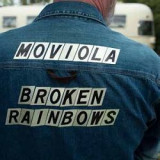
forward with Broken Rainbows, its strongest collection of songs
to date, written, recorded, and mixed inside the group’s HQ in
Columbus.
Jake Housh started Moviola in 1993 as a student at “The”
Ohio State University as a noisy, fuzzed out lo-fi noisemakers.
Over the years, the band has morphed into a unique DIY
music and art-making collective with five distinct singers and
songwriters, recalling the creatively democratic lineage of The
Mekons, The Band, Pink Floyd, many others. Moviola is Jake
Housh, Ted Hattemer (Thomas Jefferson Slave Apartments),
Scotty Tabachnick, Greg Bonnell, and Jerry Dannemiller.
Broken Rainbows is a milestone release, showcasing a band
newly energized and assured in its artistry, and supportive of its
members’ songcraft. The eleven-song album hovers over a plot
of ground that’s optimistic in its despair. Album topics range
from the personal to the political, showcasing each member’s
unique songwriting within an overall cohesive band aesthetic.
“Moviola was one of those groups I met early on back in the day
that showed me how to do it. Broken Rainbows is a highlight—
pastoral thumpers, fuzzy indie radness, hooks to spare, pretty
much all the good stuff. Feels like a glorious drive from one
disparate end of Ohio to another. I love this band.”
—Eric Johnson (Fruit Bats)
Grains is the debut album by Numinos on Mille Plateaux. The Cologne-based producer, DJ, author and lecturer has been writing the tech-reviews in "Groove" for many years, tests equipment for various specialist magazines and teaches at the Institute for Pop Music (IFPOM) and Institute for Computer Music and Electronic Media (ICEM) of the Folkwang University.In his current creative phase, he conceptually deals with the topic of "granular synthesis".
A "grain" is thus, to a certain extent, a tiny spectral snapshot from a larger musical context - an infinitely expandable, flowing intermediate state. This is also where the connection to the cover motif is found that shows the negative of a photograph of a wild field and has been taken Bernd Adamek-Schyma: The negative as an eternal intermediate state between the motif and the developed image. And despite the fact that "Numinos" has a fully equipped studio with a wide range of instruments, the 20 Euro iPad app "Borderlands Granular" turned out to be the creative catalyst that enabled the trained pianist to implement his sound ideas with direct haptic influence.The app gives the Cologne-based sound artist the opportunity to extract tiny fragments from the sample based on their specific tonality, to recontextualize them and thus work out structures that are not audible at the original tempo.
The results are polyrhythmic sound scenes that appear harsh, artificial and strange in a moment, only to transform into contemplative, warm and familiar frequency stratification minutes later. Numinos deceives the listener in many ways. Above all with the supposed rhythm that does not exist. Because in fact almost all granular clusters within the pieces run in completely asynchronous loops. The addition of a simple kick drum then forces the brain to suddenly hear apparent triplets, quintoles or dotted eighths in these mathematically completely chaotic structures, which are purely fallacy.
Doug Payne is a graduate of LaGuardia High School of Music & Art (also known as FAME) in Manhattan NY, and Howard University in Washington D.C. He performed as a member of the Sister Sledge tour ("We are Family") has produced several recordings for quite a few East Coast acts and worked as the Music Director for The Dreamlovers, Eddie Holman, The Coasters and the house-band for the Atlantic City television show Chat-24.
We are happy to present two of his self released singles in full on one long 12". She Is On The Money is a A+ Boogie floor filler this previously unreleased in this full version massive 15 Mins long mix direct from master tape. On the flip we have Doug's first single "Holiday" which was previously 45 only and very hard to find, plus some other mixes of "She is On The Money" from a second tape, HEAT!
Honing your skills is under-appreciated in times of instant gratification and the continuous stream of music. Rotterdam-based producer Kofi The Unknown subverts this idea and took time for spiritual introspection, studying rhythms and sound production. Where being a late bloomer normally is seen as a sobriquet, the producer, composer and beatmaker wears it as a badge of honour and solidifies it as an honorary title by pinning it to his debut EP on Wicked Wax: The Late Bloomer. Wearing his heart on his sleeve, Kofi The Unknown shares his journey that led to The Late Bloomer, an emotional journey through sophisticated dance music, straight from the heart, aimed at the soul and feet.
Highly influential to Kofi’s sound and this EP is London’s Broken Beat scene. Syncopated drums, soulful chords and heavy bass lines work in tandem to emphasise the danceability the genre is known for. This is further solidified by the track Kofi released leading up to this release: One for Motet, an ode to the Broken Beat MC and Jazz Refreshed host Jason Hicks. The Late Bloomer further develops Kofi’s ode, but provides his Rotterdam flavour and brings his Hip Hop and Funk lineage into the mix.
Embrace Mistakes sets the stage for what’s to come in various ways. It is a textbook case of how dance music can tell a story and be introspective. Kofi’s honesty shines bright on the entire EP and strikes from the first kick drum on. It also shouldn’t be hard to recognise and feel the emotion the producer shares on the title track The Late Bloomer. The emotionally-laced chords and crushing drums are reminiscent of late nights at a warehouse or emotional sequences from a dystopian movie.
Staying true to his ethos ’exploring the university that music holds’, Kofi finds this beyond music production as The Late Bloomer provides an audible experience through creative mixing. Stuttering analog synths, enveloping leads, multiple percussion rhythms and off-beat snare rolls hit from all directions of the stereo spectrum, further underlining the sophistication of his merit. While the EP follows the Broken Beat accents on dance, it is an equally mindful listening experience.
Kofi The Unknown is a Rotterdam native producer with a knack for rhythms. His keen ear is informed by mentor and Dutch enigma Trian Kayhatu. While Kofi has taken the time to perfect his skills under the guidance of Trian, the two are simultaneously working on the exciting follow-up project to this debut EP. Without looking too far ahead, enjoy The Late Bloomer. It’s not only a crown jewel Kofi proudly wears, it is also establishing him as a future household name in the sophisticated dance scene. "
MILKY CLEAR VINYL.
''The lightness of the C86 Sarah Records guitars come with the significant counterweight of more ominous Factory Records basslines.The lyrics and vocals are stark, sandpapery and sardonic, akin to Jonathan Richman, Kiwi Jr and, Bodega.'' Ducks Ltd. - EP Review - God Is In The TV
Toronto’s Ducks Ltd. (formerly Ducks Unlimited), the bright jangle-pop duo of Tom McGreevy (lead vocal, guitar, bass, keyboards) and Evan Lewis (guitar, bass, drum programming), accomplish the impossible. The pair craft songs that play to very specific inspirations without drowning underneath them—immediately evidenced on their critically acclaimed EP, Get Bleak, and sharpened on Modern Fiction, their debut LP. “The Servants, The Clean, The Chills, The Bats, Television Personalities, Felt,” Evan rattles off. “Look Blue Go Purple is one I reference a lot with our production.” Echoes of ‘80s indiepop abound, but they never overwhelm. This is not a nostalgic record, after all, nor is it a derivative one. Instead, across 10 cheery-sounding songs, Ducks Ltd. explore contemporary society in decline, examining large scale human disaster through personal turmoil (hence the title, taken from a university course called Gnosticism and Nihilism in Modern Fiction, influenced by Graham Greene novels. Bookish indie fans, look no further.)
Writing the album was intimate. Tom drafted the nucleus of a song on an unplugged electric guitar and brought it over to Evan’s apartment, where the pair sat in his bedroom, placing percussive beats from a drum machine under nascent melodies, passing a bass back and forth, adding organs and bridges where necessary. “It’s computer music trying extremely hard not to sound like computer music,” Tom jokes. Fearful that limited and expensive studio time would kneecap the project creatively, eroding their charming naivete, the pair re-recorded the album in a storage space owned by Evan’s boss. Ornamentation through collaboration followed: there’s Aaron Goldstein on Pedal Steel in the Go-Betweens’ “Cattle and Cane”-channeling interlude “Patience Wearing Thin,” Eliza Niemi on cello (“18 Cigarettes,” a song loosely inspired by a 1997 Oasis performance of “Don’t Go Away”), and backing harmonies from Carpark labelmates The Beths (on an ode to friendship at a distance, “How Lonely Are You?,” “Always There,” and on the sped-up Syd Barrett stylings of “Under The Rolling Moon.”) While in his native Australia due to covid-19, Evan worked closely with producer James Cecil (The Goon Sax, Architecture in Helsinki) on Modern Fiction’s finishing touches—at one point, in the mountains of the Macedon Ranges in Victoria, recorded a string quartet (featured on “Fit to Burst,” “Always There,” “Sullen Leering Hope,” “Twere Ever Thus,” “Grand Final Day.”)
It’s danceable, depressive fun, with some relief: in “Always There” and “Sullen Leering Hope,” Modern Fiction’s faithful heart. “There’s a tendency in my writing, because of my world view, to be very bleak.” Tom explains. “A quality I don’t always see in myself and really appreciate in others is the courage to go on.” And yet, the record manages resiliency—enough for pop fans to fall in love with.
"Future indie classics that reek of modern New York City Charm” – DIY Magazine
"Captures honest-to-god truths in a new light’ – The Line of Best Fit
“A nostalgia-tinged hit, filled with jangly guitars and contagious melodies” – Wonderland
‘WANDERKID’ is the sophomore album from New York’s next lo-fi legend, JW Francis, and will be released whilst its creator is in the middle of trekking 2000 miles along the Appalachian Trail in the US. The follow up to JW’s critically acclaimed debut album ‘We Share A Similar Joy’, ‘WANDERKID’ will be released on 3rd September by Sunday Best Recordings. “WANDERKID is an album about escape. It’s supposed to be a gut punch of a record about an anti-hero named WANDERKID who wants to get OUT: out of his living situation, out of his head, out of his life. This album is like looking out the car window with an urgent desire to be on the other side. It was finished during the most recent global pandemic, so hopefully folks find it relatable.”
JW is fast making a name for himself as one of the most exciting new artists around. Born in Oklahoma, JW landed in New York City at 19 to study Economics at Columbia University, but not before making stops, stays and stints in Vermont, aged 12 and Paris, aged 13. Whilst at Columbia, the troubadour started music blog Rare Candy and founded student-run recording studio CU Records. Musically, JW takes his lead from the greats of the Downtown scene - Patti Smith, The Velvet Underground, Television, Talking Heads, The Strokes, Yeah Yeah Yeahs - and is fast emerging at the forefront of the next generation.
Dans le Sable is the first new album in over 40 years by composer, pianist, and digital audio pioneer Loren Rush (b. 1935). Active in the Bay Area new music scene since the late 1950s alongside composers such as Robert Erickson and Pauline Oliveros, he also co-founded the Stanford University’s Center for Computer Research in Music and Acoustics in 1975. His music has been performed by the Boston Symphony, the New York Philharmonic, and the San Francisco Symphony Orchestra amongst others.
The title piece "Dans le Sable" (1967-68, 70) covers the first side of the record, of which Charles Shere in the Oakland Tribune (1972) writes: “A surreal opera scene. A narrator dwells on the significance of passing time. A soprano sings Barbarina's cabaletta from Figaro, which describes her distraught search in the sand for a lost pin. The chamber orchestra—mostly solo instruments—plays soft, half-forgotten tunes reminiscent of the Parisian music hall. If Marcel Duchamp wanted to put painting once more at the service of the mind, so did Rush seem to want to make a composition that speaks directly to that thing behind the mind—the point where it connects with the soul. And he succeeded. But only because the work is so brilliantly constructed, so careful in its structure and the timing of its phrases, so well balanced in the disposition of its parts that it quite overcomes the audience.”
The second piece on the album “Song and Dance” begins with the watery held tones of “Song.” Melancholy phrases are deconstructed and stretched in different retellings, invoking a harmonic fog. We are then thrust into “Dance,” one of the first orchestral pieces to employ computer-generated digital synthesis. A hypnotic and percussive march is propelled into a storm of early computer-processed cannonades.
Recital is proud to now illuminate the deeply overlooked composer Loren Rush, whose meticulous attention to detail has perhaps kept his toiled-upon works in the shadows these past decades. Dans le Sable is among the most gorgeous records I have heard.
LIMITED BLUE WITH BLACK SPLATTER VINYL +DL CODE
Gestural Abstractions is the third full-length album from post-shoegaze duo Winterlight. After an admittedly difficult gestation for their second album The Longest Sleep Through the Darkest Days, this new album developed organically and somewhat swiftly from the moment the pandemic lock-down was initiated.
This mandatory seclusion allowed Tim Ingham to sit with his guitar or at the piano and play uninhibited. With daughter and bassist Bel returning home from university, her presence galvanized the creative process, which resulted in the duo writing their first song together: In Solitude. It is a song in which there is very much an equal display of Tim and Bel's influences and songwriting styles.
Gestural Abstractions is a focused dynamic collection of works teeming with expressive confi- dence; An upliftingly shimmering shoegaze leaning post-rock gem.
A work that literally immerses the listener into an acoustical substance. The sound becomes almost like matter, like jelly. Soon, you're swimming in sound, getting lost inside it.
With the Sonic Waters project initiated in 1978, my aim was to situate field of electronic music within a liberating and futuristic experience, outside the concert halls and in sync with the development of new instruments - in particular the Synclavier digital synthesizer, the first model of which I acquired in 1977. As concert space, the Pacific Ocean seemed to me to be the ideal experimental medium for both acoustic and cultural reasons. I then developed the aesthetic and technical elements that would contribute to the conception of Underwater Music. Numerous performances would follow spanning four decades, in natural sites or in large public pools such as those of Sydney, Paris or Venice during the 2006 Biennale.
Michel Redolfi (1951), French composer and sound artist, is the founder of Underwater Music. The natural elements captured and highlighted by experimental technology are a constant in Redolfi's catalogue: many compositions explore the earth environments such as in 'Pacific Tubular Waves', 'Jungles', 'Desert Tracks' (re-released on Sub Rosa records) and especially with 'Sonic Waters', a work that literally immerses the listener into an acoustical substance. During the mid-seventies Redolfi carried out his electro-acoustic research in the United States, with major electronic music centers including the California Institute of the Arts and chiefly the University of California in San Diego. As invited resident of their studios, Michel Redolfi launched the underwater music concerts, with the series 'Sonic Waters' performed in the Pacific Ocean. Michel Redolfi's underwater creations have since been regularly programmed by major international festivals, with multi-media installations held in ecological marine reserves or in historical city pools. Among them, the Sydney Festival, Paris 'Nuit Blanche', Ars Electronica in Linz, the 2006 Venice Biennale (nominated Golden Lion) and lately the 2018 Ars Musica festival in Brussels. This record presents different variations of Sonic Waters from 1980 to 1987, alternating studio mixes with their re-recordings in the depths of the Pacific. Michel Redolfi CD's and LP's are currently published by Sub Rosa, INA-GRM and Radio France.
'The Works and Days: The Black Sections' is a sound collage album that emerged out of the production material of the film, The Works and Days (of Tayoko Shiojiri in the Shiotani Basin). The film — winner of the Encounters Golden Bear for Best Film at the 2020 Berlinale — is the second feature of C.W. Winter & Anders Edström. It is an eight-hour fiction shot for a total of twenty-seven weeks, over a period of fourteen months, in a village population forty-seven in the mountains of Kyoto Prefecture, Japan. It is a geographic description of the work and non-work of a farmer. A portrait, over five seasons, of a family, of a terrain, of a sound space, and of a duration. The film was named one of the Ten Best Films of the Year by critics at: Artforum, Cargo, Cinema Scope, Desistfilm, Filo, La Internacional Cinéfila, Mubi, Nobody, Senses of Cinema, and Sight & Sound.
The film is accompanied by this LP, TheWorks and Days: The Black Sections, by C.W. Winter, and the photo book, Shiotani, by Anders Edström. The album features musical excerpts from Tim Berne & Bill Frisell, Tony Conrad, Graham Lambkin, Mary Jane Leach, Alvin Lucier, Phill Niblock, Folke Rabe, Éliane Radigue, and Akio Suzuki. Producing, editing, and recordings by C.W. Winter. Mastered by Stephan Mathieu.
Winter & Edström’s first feature, The Anchorage, won a Golden Leopard at Locarno Film Festival and won the Douglas E. Edwards Independent/Experimental Film/Video Award from the Los Angeles Film Critics Association. It was named one of the Ten Best Films of the Year by critics at Cinema Scope, Film Comment, Senses of Cinema, Variety, and Indie Wire and was named Best First Film of the Year by The New York Times. Their first film, a documentary short called One Plus One 2 was made in collaboration with the late British guitarist, Derek Bailey. Their film/video work has shown at such venues as the Institute of Contemporary Art (Boston), Centre national de la photographie (Paris), Kunstmuseum Wolfsburg, Fotomuseum Winterthur, NRW-Forum (Düsseldorf), the Harvard Film Archive, Anthology Film Archives, the Wexner Center for the Arts (Columbus), Centre de cultura contemporània de Barcelona, the Tokyo Metropolitan Museum of Photography, and the National Museum of Modern Art (Kyoto).
C.W. Winter was born in California. In 2020, he completed his DPhil in Art Practice & Theory at The Ruskin School of Art at the University of Oxford. He received his MFA from California Institute of the Arts where he studied closely under Thom Andersen, James Benning, and Allan Sekula. His writing has appeared in Cinema Scope, Moving Image Source, Purple, and Too Much. He lives in the United Kingdom where he is currently a Visiting Professor at the Royal College of Art and a Lecturer at the University of Oxford.
Side A excerpts:
“Thursday, May 5, 1977 & Friday, May 6, 1977: Part 4” Performed by Tony Conrad. Used by arrangement with The Tony Conrad Estate
“Sethwork” Performed by Phill Niblock. Used by arrangement with Phill Niblock
“What?? (Second Version)” Performed by Folke Rabe. Used by arrangement with the Folke Rabe Estate
“Pipe Dreams” Performed by Mary Jane Leach. Used by arrangement with Mary Jane Leach
“What?? (Second Version)” Performed by Folke Rabe. Used by arrangement with the Folke Rabe Estate
“2011” Performed by Tim Berne & Bill Frisell. Written by Tim Berne. Published by Party Time Music BMI. Recording courtesy of Minor Music Records/Screwgun Records
Side B excerpts:
“Ceremoniolose” Recorded by Graham Lambkin. Used by arrangement with Graham Lambkin
“Kugiuchi” Performed by Akio Suzuki. Recorded live for TheWorks and Days Used by arrangement with Akio Suzuki
“Music on a Long Thin Wire (Side A)” Performed by Alvin Lucier. Used by arrangement with Alvin Lucier
“A Third Trombone” Performed by Phill Niblock. Used by arrangement with Phill Niblock
“Triptych: Part 1” Performed by Éliane Radigue. Used by arrangement with Éliane Radigue
‘Concordance’ is Susan Howe’s and David Grubbs’s fifth album in the
fifteen years of their unexpected and richly satisfying collaboration. Here
they’ve pared down their materials to voice and piano, aspiring to the
hushed intensity of their live performances. What had previously resulted
from Grubbs’s recomposition of recorded materials now arrives as
unadorned duo performance.
“Howe is a poet who has spent her career reminding us that our
experiences of meaning and sound are synchronous.” - Tess Taylor, The
New York Times
‘Concordance’ is Susan Howe’s and David Grubbs’s fifth album in the
unexpected and richly satisfying collaboration that began with ‘Thiefth’
and includes ‘Souls of the Labadie Tract’, ‘Frolic Architecture’ and
‘WOODSLIPPERCOUNTERCLATTER’. Where these works feature the
fragmentation and multiplication of Howe’s recorded voice - in a style
akin to her celebrated text collages - with ‘Concordance’ they’ve pared
down their materials to voice and piano, aspiring to the hushed intensity
of their live performances. After fifteen years of working together, the
subtleties of inflection and interaction that previously resulted from
Howe’s nuanced delivery and Grubbs’s composition using recorded
materials now arrives as unadorned duo performance.
One of America's greatest living artists, Bollingen Prize-winning poet
Susan Howe’s text for ‘Concordance’ originates in a collage poem of the
same name published by Grenfell Press, which then became the title
work in her most recent book, published to acclaim by New Directions in
2020. She has continued to rework the text for this performed version,
incorporating material from her 2015 book of essays, ‘The Quarry’. Her
source material is scissored from print concordances of the poetry of
Milton, Herbert, Arnold, Browning, Dickinson and Coleridge, as well as
old field guides to birds, rocks, trees, moths and mushrooms; Howe’s
fiery commitment to placing these echoes of the past in dialogue with the
present speaks to her position as one of America’s essential artists.
David Grubbs is Professor Of Music at Brooklyn College and The
Graduate Center, CUNY. He is the author of ‘The Voice in the
Headphones’, ‘Now that the audience is assembled’ and ‘Records Ruin
the Landscape: John Cage, the Sixties, and Sound Recording’ (all
published by Duke University Press) and, with Anthony McCall,
Simultaneous Soloists (Pioneer Works Press). Grubbs has played in
Gastr del Sol, The Red Krayola and Squirrel Bait and performed with
Tony Conrad, Pauline Oliveros and Will Oldham, among many others.
Erased Tapes debut. Wait, what? How? Anyone who has seen
the trail blazing sonic pioneer live will know Nils likes to
deadpan a joke. Graz is in fact the first studio album he
recorded for the label back in 2009, that somehow remained a
secret… until now.
Nils Frahm has quietly changed the musical landscape,
reincarnating the centuries old figure of a pianist-composer for a
new generation of music fans. As Nils’ word-of-mouth popularity
grew and grew, so did the pop-culture profile of his instrument. He
founded Piano Day with a team of like-minded friends in 2015 to
help that process, some years releasing an album of piano
recordings to celebrate one of humankind’s greatest inventions.
Graz is one such record; an unheard snapshot of a young Nils
recorded at Mumuth, the University of Music and Performing Arts
Graz, in 2009 as part of the thesis Conversations for Piano and
Room produced by Thomas Geiger, which received an award in
the Classical Surround Recording category at the 127th AES
Convention in New York.
Whilst at the time it was decided to keep the grand piano
recordings from the Graz sessions locked away and instead focus
on his close mic’ed, dampened piano explorations which would
become his acclaimed studio album Felt in 2011, two of the pieces
— most notably Hammers — lived on as part of his live set, and
were expanded on and re-recorded as part of his breakthrough
2013 record Spaces (a collage of field recordings from concerts
which broke the Fourth Wall and included audience coughs). Over
his mercurial career, Nils has pushed and pulled at the boundaries
and parameters of his prolific work like that. He’s physically
changed his piano (the softened prepared strings of Felt) played
with a modified body (Screws recorded with 9 fingers and a broken
thumb) played with scale (Solo recorded on the 3.7 metre high
Klavins M370) and with the different layers of formats (last year’s
Tripping with Nils Frahm nested his studio setup inside a live
performance, concert film and live album). Now with Graz he has
found the final frontier for play: time itself and his own discography.
Graz is a moment of time at the very beginning of Nils’ quiet
revolution. The essential genius is already evident; the harmonic
language of classical, and the immediacy of jazz. Nils seems to
pull down each idea moment by moment, gently, to not scare away
the muse. He describes: “sometimes when you hear a piano, you
might think it’s a conversation between a woman and a man. At
the same time, it can hint at shapes of the universe and describe
how a black hole looks. You can make sounds that have no relation
to anything we can measure.”
A pumping ground-to-air dance missile written and produced at the dawn of the new century by a duo with some huge music background. Hailing from Montclair State University, Gail Lou is an acclaimed performer, musical director and vocal coach. Her vocal performances in Tri-State’s recording sector, as both lead singer and background vocalist, span from R&B, Gospel, Jazz, to Soul and electronic Dance. Alongside Shawn Lucas, who’s the behind-the-scene producer of the duo, she’s been laying down compositions for music releases and opera and theatre shows soundtracks. This release comes out of a Funk Investigation of my brother Yann. Remastered and adapted to the 7” format it went just straight in the pipeline.
Having already unearthed three collections of archival ‘70s recordings by Catherine Christer Hennix, Blank Forms continues their annual illumination of the visionary Swedish composer’s music by turning to more recent work with this first-time vinyl edition of Hennix’s “Blues Alif Lam Mim in the Mode of Rag Infinity/Rag Cosmosis,” a 2014 piece first released as a CD in 2016 (Important Records).
The double album captures the April 22, 2014 premiere of Hennix’s composition by by the Chora(s)san Time-Court Mirage, her expanded just intonation ensemble, featuring a brass section of Amir ElSaffar, Paul Schwingenschlögl, Hilary Jeffery, Elena Kakaliagou, and Robin Hayward; live electronics by Stefan Tiedje and Marcus Pal; and voice by Amirtha Kidambi, Imam Ahmet Muhsin Tüzer, and Hennix herself. Intended to reveal the blues’ origins in the eastern musical traditions of raga and makam, “Blues Alif Lam Mim in the Mode of Rag Infinity/Rag Cosmosis” has its roots in Hennix’s 2013 realization of an “Illuminatory Sound Environment,” a concept developed in 1978 by anti-artist Henry Flynt on the basis of Hennix’s own “The Electric Harpsichord.”
As Hennix explains in Other Matters, Blank Forms’ 2019 collection of her writings:
“Rag Infinity/Rag Cosmosis presents fragments of ‘raga-like’ frequency constellations following distinct cycles and permuting their order, creating a simultaneity of ‘multi-universes.’ When two such ‘universes’ come in proximity of each other and begin unfolding simultaneously along distinct cycles, there is a kaleidoscopic exfoliation of frequencies as one universe is becoming two, but not separated—the effect of cosmosis is entrained, binding two or more frequency universes into proximity where their modal properties interact and blend, creating in the process entirely new microtonal constellations in an omnidirectional simultaneous cosmic order with phenomenologically ‘transfinite’ Poincaré cycles (cyclic returns to initial conditions).”
As with Hennix’s best work, the organic unfolding of this quivering drone belies a precision that opens onto the infinitesimal. Upon its mesmerizing ebb and flow, the vocalists incant a devotional poem written in Arabic by Hennix and featuring quotations from the Quran. Also reproduced on the album’s gatefold jacket, Hennix’s reduction of the sacred text to its most elegant formulation invites the contemplator to bring their inner knowledge to the composition for use as a prompt for meditation. Yet the piece offers depth to even the most secular listener willing to immerse themselves in music brimming with such serene intensity.
Catherine Christer Hennix (b. 1948) started her creative life playing drums with her older brother Peter, growing up in Sweden where she heard jazz luminaries, such as John Coltrane, Eric Dolphy, Dexter Gordon, Archie Shepp, and Cecil Taylor perform from 1960 to 1967. Directly after high school, Hennix went to work at Stockholm’s pioneering Elektronmusikstudion (EMS), where she developed early tape music, incorporating computer generated speech done at the Royal Technological University (KTH), where she was an undergraduate student. After traveling to New York In 1968, she met artists Dick Higgins and Alison Knowles who invited her to stay at the Something Else Press Town House where she had the opportunity to meet, among others, composers John Cage, James Tenney, and Phil Corner. During the following years she developed fruitful collaborative relationships with many composers in the burgeoning American avant-garde, including, most significantly, Henry Flynt and La Monte Young. Young introduced Hennix to Hindustani raga master Pandit Pran Nath and she would later study intensively under him as his first European disciple. While Hennix continued to make music performing alongside Arthur Russell, Marc Johnson, Henry Flynt, and Arthur Rhames, she also served as a professor of Mathematics and Computer Science at SUNY New Paltz and as a visiting Professor of Logic (at Marvin Minsky’s invitation) at MIT’s Artificial Intelligence Laboratory. In recent years Hennix has led the just-intonation ensemble the Chora(s)san Time-Court Mirage, which has featured musicians Amelia Cuni, Amirtha Kidambi, Chiyoku Szlavnics, Hilary Jeffrey, Amir El-Saffar, Benjamin Duboc and Rozemarie Heggen. She currently resides in Istanbul, Turkey pursuing studies in classical Arabic and Turkish makam.
- 1: Road To Avalon
- 2: Click Click Domino (Feat. Marcus King)
- 3: Line On The Page
- 4: Raining For You
- 5: Little Liars
- 6: Deep River (Feat. Marcus King)
- 7: Heartworn Traders
- 8: Calico Coming Down
- 9: Learn To Love You Better
- 10: Long Gone & Heartworn (Feat. Jake Kiszka)
- 11: Mountain Lion Blues
- 12: Sing A Hallelujah
- 13: Has My Midnight Begun
For nearly two straight years following the release of their critically acclaimed debut, Chasing Lights, Ida Mae lived on the road, crisscrossing the US from coast to coast as they performed hundreds of dates with everyone from Willie Nelson and Alison Krauss to Marcus King and Greta Van Fleet. And while those shows were certainly formative for the electrifying British duo, it was what happened in between — the countless hours spent driving through small towns and big cities, past sprawling suburbs and forgotten ghost towns, across rolling plains and snow-capped mountains — that truly laid the groundwork for the band’s transportive new album, Click Click Domino. Written primarily in the backseat of a moving car, the record embodies all the momentum and possibility of the great American unknown, offering up a series of cinematic vignettes full of hope and disappointment, promise and regret, connection and loneliness. The songs on Click Click Domino are raw and direct, fueled by an innovative mix of vintage instruments and modern electronics, and the performances are loose and exhilarating to match, drawing on early rock and roll, classic country, British folk, and 50’s soul to forge a sound that’s equal parts Alan Lomax field recording and 21st century garage band. Turpin and Jean produced the album themselves, recording primarily on their own in their adopted hometown of Nashville during the COVID-19 pandemic, and while the collection is certainly bolstered by appearances from high profile guests like Marcus King, Greta Van Fleet’s Jake Kiszka, and Ethan Johns, the heart and soul of the record remains Ida Mae’s intoxicating chemistry, which has never felt more vibrant, ambitious, or self-assured. Now married, Turpin and Jean first met a little over a decade ago while attending university in Bath. The pair bonded immediately over their love for the sounds of bygone eras, and they quickly earned rave reviews everywhere from the BBC to the NME with their raucous first group, Kill It Kid. Starting over fresh as a duo named for Sonny Terry and Brownie McGhee’s “Ida Mae,” the first song they ever harmonized on, Turpin and Jean relocated to Nashville in 2019 and released Chasing Lights to similarly widespread critical acclaim. Rolling Stone hailed the album’s “stomping swirl of blues and guitar-heavy Americana,” while The Independent lauded its “retro lustre” and “impressive experimentation,” and NPR’s Heavy Rotation called it “tightly drawn, harmonic and hypnotic.” The music helped the earn the duo a slew of support dates with the likes of Greta Van Fleet, The Marcus King Band, Blackberry Smoke, Josh Ritter, Rodrigo y Gabriela, and The Lone Bellow, as well as performances at Bonnaroo, the Telluride Blues & Brews Festival, the Philadelphia Folk Festival, Germany’s Reeperbahn Festival, and Switzerland’s Zermatt Unplugged.
York Pennsylvania born and raised, R&B vocalist Carman Bryant has performed throughout the U.S. and all over the world. There’s a saying in the Harrisburg/York Pa.area “If you want a seat, you better get there early” for a performance by Carman and her band.
Carman's recording "Midnight Star” is an unreleased recording that was produced many years ago by Cecil DuValle of the Teddy Pendergrass band. The original studio masters were lost when Cecil moved to England because Teddy Pendergrass stopped performing. "Take a Chance" is a duet by Doug Payne and Carman from the same recording sessions at Alpha International Studios that was located in South Philadelphia. This was during the time that Doug Payne was on the "We are Family" tour with Philly recording group "Sister Sledge''. Doug Payne is a graduate of Howard University Washington D.C., and Fiorello LaGuardia High School of Music & Art in New York City, this is the same school that was used for the movie and television series "FAME" starring Debbie Allen and Irene Cara. Doug had two songs signed with TSOP Gamble & Huff's publishing that were selected to be recorded by Phyliss Hyman before her death. In 1981 Doug Payne started his own label in Philadelphia with the release of "HOLIDAY" by Doug Payne & Polygon.
Carman and her son Terrell Bryant aka Nakuu both have been busy lately
recording new music to hit the scene around the same time.Terrell Bryant is
the son of Jason Bryant who started The SOS Band.
Doug's wife June Payne is a former member of Philadelphia recording group The "Three Degrees".
Limited coloured marbled vinyl edition of this album
Spencer Davis was born in Wales in 1939. He studied languages and spoke fluent German, French and
Spanish. This was one of the reasons why he was later called „Professor“ in music circles. While studying
in Birmingham, he began performing as a musician and was together with Christine Perfect, who later
became a world star with Fleetwood Mac. Together with Steve and Muff Winwood and Pete York, he
formed his first Spencer Davis Group, with which he had numerous hits in Europe and the United States.
At the end of the 1960s, the four musical geniuses parted ways and each went his own way. Spencer
Davis continued as a solo artist, founded several new bands, including other Spencer Davis Groups with
different lineups, reworked old and new songs and released numerous other records. In the meantime, he
taught at the University of California. He also hosted a talk show and was in the management of Island
Records. He collaborated with Bob Marley, Robert Palmer and Eddie and the Hot Rods, and also
promoted the solo career of former Spencer Davis Group member Steve Winwood. On October 19, 2020,
Spencer Davis died of pneumonia in Los Angeles at the age of 81.
The Jive Turkeys are made up of four musicians who have been playing together for the better part of the last five years in a hip-hop group called Soundscape. Soundscape is a group based in Oxford, OH, home of Miami University. This is where Matt Amburgy (organ), Terry Cole (bass), Andrew DeRoberts (guitar), and Rob Houk (drums) first met. And while Soundscape has always provided all of them the opportunity to grow and develop as musicians through the group's unique fusion of genres (hip-hop, funk, jazz, rock).
Tape
It might be easy to assume that the distinctly focused compositional voice unveiled on Rose Bolton's The Lost Clock is the product of its creator's rigorous, almost hermetic dedication to her own particular aesthetic universe. A quick survey of Bolton's artistic career, however, reveals that her carefully sculpted approach to abstract electronica has been forged through a longstanding engagement with a wide range of intertwining creative activities.
This album—coming out on Important Records' cassette imprint, Cassauna—demonstrates both the Toronto-based composer's unique mastery of colour and her gift for breathing a tactile, organic quality into synthetic landscapes. Bolton's distinctive sensibility is akin to that of a painter—every hue has been carefully mixed so as to imbue its accompanying gesture with its own life and personality. This tangible dimensionality her electronic work assumes, however, can be traced back to the work Bolton has been doing since the 1990's. She has produced a large and varied catalogue of work that includes pieces for solo performers, chamber ensembles, orchestra, electronics, voice, and to accompany installations and films. A number of her works reside in several of these zones simultaneously, such as Song of Extinction, an ambitious collaboration between herself, filmmaker Marc de Guerre, poet Don McKay, and multiple live ensembles, that was mounted in an abandoned power station for Toronto's Luminato Festival.
This quasi-instrumental vitality isn't the only feature of The Lost Clock that reflects Bolton's diverse artistic practice. It can also be heard within the structural realm. Each of the collection's four tracks trace a patient unfolding and favour a certain roundness of timbre, even as finer details begin to fidget along the perimeter of the music. As with her writing for the concert hall, Bolton doesn't shy away from the evocative here, yet she doesn't pursue this poignancy through conventional, direct or quasi-narrative means. Her compositions lead the listener gradually through their impressionistic sonic scenery, but neither the path they take nor their ultimate destination are at all predictable. The ostensible gentleness each piece exudes dissolves as dissonances slowly insinuate themselves, obscure textures writhe just out of earshot, percussive lattice work materializes, or as the overall blend begins to exert a heavier weight. Her lucid-dream vision of form functions in tandem with her acute micro-level attentiveness to engender a vivid and elusive soundworld that resists classification.
Over more than two decades Rose Bolton has been garnering acclaim and enthusiasm from audiences and major collaborators alike. Last year, her brooding string quartet The Coming Of Sobs was nominated for Classical Composition of the Year at the JUNO Awards, following earlier accolades such as SOCAN Awards for Young Composers, and the Canadian Music Centre's Norman Burgess Fund. Her music has been commissioned by the likes of the CBC, stalwart experimental music festival the Sound Symposium, as well as key interpreters and ensembles such as percussionist David Schotzko, accordionist Joseph Petric the Esprit Orchestra, Continuum, Arraymusic, the Kitchener-Waterloo Symphony, and guitar quartet Instruments of Happiness (led by Tim Brady). Together with Marc de Guerre, she produced an 8-speaker sound and video installation for Toronto's Nuit Blanche Festival. She's also been featured by the likes of revered pianist Eve Egoyan, The Vancouver Symphony, L'ensemble contemporain de Montréal, The Music Gallery, and AKOUSMA, while appearing in concert alongside the likes of Jerusalem in My Heart (Constellation Records), Tanya Tagaq, and Francis Dhomont. Bolton is also a respected film composer, notably contributing music to the highly regarded documentary Anthropocene: The Human Epoch (co-directed by Jennifer Baichwal, Nicholas de Pencier and Edward Burtynsky).
As a performer, she variously employs electronics, violin, and viola. Parallel to her engagement with exploratory approaches, she's invested in the fiddle traditions of the British Isles, and various Canadian regions. She teaches this repertoire at the Royal Conservatory of Music. Bolton has also performed with Rhys Chatham, Owen Pallett, opened for Charlemagne Palestine, and appears on recordings by the likes of Chatham and Aidan Baker. In 1999 she joined the Canadian Electronic Ensemble, whose fifty-years together make them the world's longest-running live-electronic music group. In February 2020, the CEE held a residency and provided guest lectures at Carnegie Mellon University's music department. Bolton has also led workshops at the Banff Centre, also founded the SOCAN/ Moog Audio-sponsored program EQ: Women in Electronic Music, which worked to foster community and mentorship among (trans/cis) women and non-binary individuals.
Perila (Aleksandra Zakharenko) left her native Russia six years ago, landing in Berlin. Finding her place almost immediately - first at Berlin Community Radio and through that amongst a group of like-minded creative individuals (including her current flatmates Special Guest DJ and exael) - she started a regular practice of working on an expressionistic "sonic diary" of field recordings and electronic sound research for her own pleasure. When the opportunity arose to create her own podcast series, WET (or Weird Erotic Tension) was born. Upon hearing her evocative and atmospheric music layered with friends Nat Marcus and Inger Wold Lund's erotic spoken word poetry, Sferic Records asked to release it, and Perila - a project name originally used for her BCR show - truly came to be. Aleksandra, who was raised in St. Petersburg, has been involved in music since childhood thanks to her melomaniac father. She's been both drummer and singer in local bands in Russia, and is also the co-founder of radio.syg.ma - one of the first online stations in Russian focusing on experimental sounds - but Perila is something else entirely. You could loosely describe it as ambient, but her soundworld is so specific and transportative, filled with detail and movement, it's more akin to hauntological musique concrète, touched by song. Her fascination with voice and language - she studied English literature at university - is still evident, although that's now her voice, her texts, her crooning you can hear on the Everything Is Already There cassette (Boomkat Editions, 2020), her processed breaths on the Meta Door L cassette (Paralaxe Editions, 2020). The Wire Magazine got it right when they said about Irer Dent that, "Sensuality is presented as a secret pass to a higher consciousness." For her debut album, How Much Time it is Between You and Me?, released via Smalltown Supersound on June 11th, Aleksandra takes inspiration from the concept of time, which she felt keenly during the pandemic. Recorded primarily in September 2020 in a rural village in France - her only travel during the first year of the pandemic period - surrounded by mountains but otherwise alone with no internet, her perception of time there differed immensely. She describes the trip as, "an immersive experience into self," viewed through a "silence prism" where everyday sounds usually ignored felt amplified. While her work has always dealt in intimacy - be it the private thrills of WET or the audible closeness of our surroundings - the organic response and consistent feedback she gets for Perila made Aleksandra recognize a longing, a need for it in today's world. Intent on creating work based in honesty and tenderness, Perila's practice also explores how we feel music and emotion throughout the body and how sound can help to release it. How does the sound enter a body and travel through it? Where does movement start? How do you reach and unblock emotional clusters with the help of sound and deep listening of the body responses? Aleksandra likes to describe her music and performances as trips - thick narratives drifting along sound to get closer to self. Let Perila guide you through this journey.

Heavenly Recordings announce the debut solo album from
acclaimed Bay Area multi-instrumentalist, producer and
composer Dougie Stu.
Dougie grew up outside of Chicago and his early education
began in jazz clubs and festivals as a teenager - frequenting
sessions with Jeff Parker, Fred Anderson, Nicole Mitchell and
other members of the AACM. Left exceedingly inspired, he
continued on to the University of Michigan, studying bass
under Detroit jazz royalty Robert Hurst and Geri Allen, where
he deepened his practice in Jazz and Contemplative
Studies.
Now, based out of Oakland and Los Angeles, Stuart
collaborates within many Jazz, Hip-Hop, and Experimental
music scenes. His works include compositions for the NPR
podcast Snap Judgement, along with co-writes and
production with various groups including: Brijean, Bells Atlas,
Meernaa, Luke Temple and Jay Stone.
Dougie Stu’s ‘Familiar Future’ is a uniquely jazz-attuned
album that is soulful and ethereal. It draws inspiration from
artists and producers like Lonnie Liston Smith, Charles
Stepney, David Axelrod and Alice Coltrane. Stuart has
arrived at a sound that harkens back to the golden era of
soul jazz and R&B, while still sounding contemporary.
The band feature the immediately recognizable guitar
stylings of Jeff Parker (Tortoise), who was one of Stuart’s
biggest influences growing up in Chicago, Maya Kronfeld
(Georgia Anne Muldrow, NYEUSI) on Fender Rhodes, Steve
Blum (Bells Atlas) on synthesizer, percussionists Brijean
Murphy (Toro Y Moi, Poolside), John Santos (Tito Puente,
Dizzy Gillespie) and drummer Hamir Atwal (tune-yards).
Special guests include Marcus Stephans on flute, Shaina
Evoniuk on violin and Crystal Pascucci on cello. The album
was engineered and mixed by Rob Shelton at Tiny
Telephone and he also appears on synthesizer on one song.
These tracks were recorded early-to-mid `74, almost a year after the band had formed and almost 2 1/2 years before the release of the first Saints` single in 1976. The recording was made in Ed Kuepper`s parents` garage, except for "Misunderstood" which was recorded at Queensland University, direct onto a mono cassette-deck and features the second line-up of the band. Before this the Saints were a 3-piece, with Ivor Hay on piano and no drummer. It captures the band near the beginning of its first phase, as opposed to the EMI release which was at the end, and without getting into a debate about aesthetics, this one`s probably better. In a different universe this would have been the first Saints LP.
Spoken word version of Steve Von Till's first poetry book. Limited, one-sided + etched.
Intimate voice recordings with hallucinatory textures and treatments.
Harvestman: 23 Poems Poems & Collected lyrics received wide acclaim establishing Von Till as a poet in his own right.
Side B LP etching artwork by Matzatl
Features stunning linocut artwork by Matzatl on the cover.
In 2020 Steve Von Till published his first book of poetry, Harvestman: 23 Untitled Poems and Collected Lyrics. Published by the University of South Dakota’s Astrophil Press, the book established Von Till as a formidable and thoughtful author of verse—a fact that Neurosis fans knew all along, but the wider world was only just becoming aware of.
“There is a depth of hope, acceptance and loss that permeates these poems,” Joseph Haeger said in his review for The Inlander. “Like any great piece of art, Harvestman contains multitudes, and that’s exactly what I was hoping for when I cracked it open. Von Till has already established himself as a great musician, and he’s about to put his stake into the ground proving himself to be a damn good writer.”
For 2021, Von Till has reimagined Harvestman in a new format, delivering an intimate and captivating reading of the collection with sound enhancements. “Being a constant sound-seeker, I thought it would be more interesting to have some textures and treatments to break up the intimate voice recordings,” Von Till says of his decision to add some atmosphere to the spoken-word version of Harvestman. “The background sounds used on some of the tracks were pieces related to No Wilderness Deep Enough that were either not used or repurposed to interweave further connections between my artistic output at this time of my life.”
“In some respects, Trust is a simultaneous documentation of progression and regression. A homecoming of sorts, influenced by the interim where we developed our skills as producers and our skills as artists. Armlock, as a vehicle, seems like returning full circle to where we started.”
Trust, out June 2, 2021, is the debut release of Australian duo, Armlock. It’s a nuanced record that explores trials felt in personal growth, from resentment to submission to complacency. A quiet, thrashing gem of songcraft, the record makes as much use of the intimate, empty space as it does of its layered, heavy instrumentals. Each one of these songs conjures a summer storm of internal conflict, with the angst and uncertainty that comes with realizing that you’re finished growing, and rather than feeling a sense of ease you’re left restless and discontented.
Multi-instrumentalists Simon Lam and Hamish Mitchell met studying jazz together at Monash University in Melbourne. While rehearsing standards for a small ensemble in 2010, the two discovered their mutual hatred of the genre, opting to explore experimental, song-based electronic music. Alongside Solitaire Recordings owner, Dan Rutman, they went on to form the group I’lls, releasing four records in five years, and, later, the two went on to form Couture. Simultaneously, Lam (along with his cousin Chloe Kaul) found success with the synthpop group Kllo, amassing over 100 million streams on Spotify and critical acclaim from Pitchfork, The Guardian, GQ, NME, NYLON, and Stereogum. Lam’s solo project Nearly Oratorio (also on Solitaire Recordings) has achieved acclaim in its own right, as has Mitchell’s work as a producer and designer for artists like Jack Grace.
With their first release as Armlock, the duo maintains the depths of I’lls’ electronic soundscapes but brings the warmth of analogue instruments with Lam’s clear, disillusioned singing up front. He sounds both heartfelt and dejected in equal measure, with a dispassionate coolness that synergizes with the vulnerability of his lyrics. Live, the duo are backed by a reel-to-reel tape, with Mitchell on guitar and Lam singing, bridging their electronic past and indie present.
HIGHLIGHTS An emblematic figure of the Brazilian avant-garde and a key part of the cultural climate that made the rise of tropicália possible, Walter Smetak was a Swiss musician and inventor of instruments who developed his career in Brazil. "Smetak" (1974), his debut album, was produced by Caetano Veloso and Roberto Santana, and had the support of Gilberto Gil. It sums up a personal universe that combines Afro-Brazilian ritual traditions, theosophy, microtonal studies, collective improvisation and the use of unconventional musical instruments. Liner notes by Caetano Veloso. DESCRIPTION Walter Smetak was a Swiss cellist, composer, inventor of musical instruments, sculptor and writer who developed his career in Salvador, Brazil, and became an emblematic figure of the Bahian avant-garde and a key part of the cultural climate that made the rise of tropicália possible. Since 1969, he has carried out various workshops of experimental music at University of Bahia. His music was materialized in two albums: "Smetak" (1974) and "Interregno" (1980). "Smetak" was produced by Caetano Veloso and Roberto Santana, with the support of Gilberto Gil. There he unfolded a radical sound universe, based on the investigation of Afro-Brazilian ritualistic traditions, microtonality studies and collective improvisational open processes, always under the influence of theosophy, which he discovered in Brazil, and which allowed him to generate a symbolism represented in the construction of his own unconventional instruments, many of them of a sculptural nature, made with unusual materials such as PVC pipes, pumpkins and polystyrene foam, which he called plásticas sonoras. Around 150 instruments were created by Smetak, many of them in a surrealist style. They have been exhibited on various occasions in museums and galleries. His music was often based on graphic scores, many of them of great beauty. In addition to Smetak, Caetano Veloso and Roberto Santana, musicians such as Gereba, Tuzé Abreu, Djalma Correa, Capenga, among others, participated in the recording of this album. The author of one of the most important studies on Smetak, Marco Scarassatti, has written on the work of the Swiss-Brazilian artist: "His original and metaphysical work goes beyond any mysticism created around his figure. He investigated the relationship between sound and light, space and form, microtonality, collective improvisation, as a sound alchemist, a multimedia and unplugged prophet-visionary. While transforming matter, Smetak transformed himself and many of those around him." This reissue reproduces the much sought after original 1974 edition, published by Phillips. It includes the catalog of instruments used, adds a brochure with new photos and presents the remastered audio. The liner notes were written by Caetano Veloso. This project is part of Incidencias Sonoras: COINCIDENCIA experimental music & sound art platform, by the Swiss Arts Council Pro Helvetia.
The group Magizter formed in Malmö, Sweden in the early 90s, and mainly consisted of former members of the Hungarian industrial band Das Kapital, of which some managed to flee to Sweden from the communist regime before the fall of the Soviet Union.
Gyula Szilagyi, who was the first to make his escape via train through Berlin in 1987, recalls: “it was a few weeks before mandatory military service would begin, and our passports should have been turned over to the authorities”. Risking deportation and prison, he was granted asylum in Sweden after some months in Stockholm.
Szilagyi and the rest of the band were all part of the underground scene in Budapest, of which some had been under surveillance by the secret police since their teens. It was a tight knit community where anti-communist and illegal literature was distributed, and many bands shared mutual members.
The track “Das Kapital” was produced in Malmö in 1993 by Szilagyi and fellow Magizter member Zoltan Lengyel, in a home studio overlooking the Möllevång Square, were Szilagyi had moved after some years working at the glass factory in Orrefors. He had managed to save a few performances by Das Kapital recorded on cassette, of which one served as sample material for the Magizter track; an homage of sorts to a group involuntarily disbanded.
The cassette sampled here was recorded in 1986 during a live concert at the university-affiliated venue Ráday Klub, where Das Kapital performed alongside the British industrial act Left Hand Right Hand (who had formed from the Sheffield band Zahgurim).
On the eve in question, Szilagyi remarks: “we used a guitar that we had made ourselves to resemble a Kalachnikov rifle. During the concert at Ráday Klub the guitar was destroyed using a drill machine. It made a powerful sound effect”
A remix of the remix is offered by Vienna-based Heap, who with his own productions as well as his work with the Neubau label is building a bridge towards the new era of European industrial music.
Billy Harper is one of the great tenor saxophonists in the post-Coltrane mold. Originally from Houston, TX and with a degree from the venerable University of North Texas College of Music, Harper emerged on the New York City jazz scene in the late 1960s performing with Art Blakey, Max Roach, Lee Morgan and others. Known for his soulful and propulsive tone, Harper was already a highly regarded and prolific session man before the release of his debut album as a leader on the cult favorite Strata-East label in 1973.
Recorded in 1975, Black Saint was the second album for Billy Harper as bandleader and is the most acclaimed and fully realized of his long career. The inaugural release of the Italian label Black Saint – to which the album lent its name – is comprised entirely of Harper compositions; the peaceful and subdued opener “Dance, Eternal Spirits, Dance!,” the swinging and fiery “Croquet Ballet” and the side-long epic “Call Of The Wild And Peaceful Heart.” Harper’s group features trumpeter Virgil Jones - a graduate of Roland Kirk’s mid-60s groups and session player for McCoy Tyner, Charles Tolliver and others - along with Joe Bonner on piano, David Friesen on bass and Malcom Pinson on drums.
Black Saint is too melodic and swinging to be free jazz but too forward-thinking to be described as modal post-bop; Harper’s advanced compositional sense and galvanic tenor work make this an album of pure fire music. This is a beautiful album back into print on its original format for the first time in over 40 years.
Japanese veteran dj & producer “kza”(half of dj duo “force of nature”) have released his first solo album in 2009 on only cd.
kza is one of best dj in the modern disco/house scene in japan and also well known as vinyl digger.
this album was made with his knowledge from his big collection of vinyl.
we’re listening to this album at studio mule and feeling we should release this album on vinyl.
finally we are going to release this epic modern disco album on 2lp.
Sub Rosa presents in their Early Electronic series, the final chapter of music by Beglian key composer of early electronic experiments, André Stordeur (1941-2020). Side A features a previously unreleased, stark and poignant composition from 1979; while the B side is vibrant and almost playful of pieces from the 2000s.
André Stordeur His musical career started in 1973 with a tape composition for the soundtrack to a film on Gordon Matta-Clark titled Office Baroque. Later in the 1970s, he participated to avantgarde music ensemble Studio voor Experimentele Muziek, founded in Antwerp, Flanders, by Joris De Laet. Since 1980, Stordeur composes exclusively on Serge synthesizer, either a Serge series 79 and a Serge prototype 1980, which was especially built for him by Serge Tcherepnin himself. In 1981, Stordeur composed the music of Belgian film director Christian Mesnil's documentary Du Zaïre au Congo. He studied at IRCAM in 1981 with David Wessel and then flew to the US to study with Morton Subotnick. Stordeur became an influential sound synthesis teacher and, in 1997, completed his Art of Analog Modular Synthesis by Voltage Control,4 a guide to everything modular.
Oberheim While 'Oberheim' is the centerpiece of this LP, we pressed for the first time on vinyl three pieces from the session André called 'Synthesis Studies,' previously featuring on Complete Analog and Digital Electronic Music, 1978-2000. 'I was helped in my studies by a must-have book: The Techniques of Electronic Music, by Thomas Wells and Eric Vogel (University Stores, 1974). That book aside, I learned synthesis on my own. After a trip to India in 1968, I discovered Indian music and took tabla and sitar classes in New Delhi; my teachers were students of Chatur Lal and Ravi Shankar. Later, in the 2000s, while living in the US, I tried to recreate through synthesis all the Indian musical instruments I loved so much.' 'Drone' is one of his most spectacular works.
Fiddlehead wasn’t supposed to make a second record. But, if we’re being totally honest, they weren’t supposed to make their first record either. Formed in what singer Pat Flynn describes as “a deeply, deeply, laughably depressing part of my life,” Fiddlehead was born with modest intentions. Flynn and his then-roommate, guitarist Alex Dow, decided to work on some songs, and with Basement having just broken up, guitarist Alex Henery entered the fold. Drummer Shawn Costa and bassist Adam Gonsalves—who has since been replaced by Casey Nealon—linked up with them and, all together, they wrote what would become the Out Of The Bloom EP. Those five songs established what Fiddlehead would be, a band that merged elements of post-hardcore, post-punk, and classic ‘80s emo into something that felt distinctly theirs.
Between The Richness effectively picks up where Springtime & Blind left off, as Flynn dives headfirst into that same subject. But astute listeners will notice a major difference this time: Flynn is singing about himself. “These massive things happened in my life between the first record and this record. It just so happened that I ended up getting married, I had a child, and it was around the 10-year anniversary of my father’s passing. So what if I want to write another record about how I feel about the loss of my father? Will people be like, ‘Pick another topic, dude.’ So, the opening track is called ‘Grief Motif’ because it’s the idea that this is an eternal struggle that will never go away. Take it or leave it, but it will be part of this dude as long as he’s got a pen in the hand.”
Between The Richness explodes with an energy that usurps that of Springtime & Blind. The guitar riffs of Dow and Henery are their most anthemic and combustive yet, making songs like “The Years,” “Get My Mind Right,” and “Down University” not just serve as the backbone for Flynn’s personal ruminations, but empathetic, emotional musical stabs that hit the listener just as hard. Meanwhile, Costa and Nealon give the songs a propulsive heft, allowing a track like “Million Times” to dart into unexpected territories without ever feeling alien
Fiddlehead wasn’t supposed to make a second record. But, if we’re being totally honest, they weren’t supposed to make their first record either. Formed in what singer Pat Flynn describes as “a deeply, deeply, laughably depressing part of my life,” Fiddlehead was born with modest intentions. Flynn and his then-roommate, guitarist Alex Dow, decided to work on some songs, and with Basement having just broken up, guitarist Alex Henery entered the fold. Drummer Shawn Costa and bassist Adam Gonsalves—who has since been replaced by Casey Nealon—linked up with them and, all together, they wrote what would become the Out Of The Bloom EP. Those five songs established what Fiddlehead would be, a band that merged elements of post-hardcore, post-punk, and classic ‘80s emo into something that felt distinctly theirs.
Between The Richness effectively picks up where Springtime & Blind left off, as Flynn dives headfirst into that same subject. But astute listeners will notice a major difference this time: Flynn is singing about himself. “These massive things happened in my life between the first record and this record. It just so happened that I ended up getting married, I had a child, and it was around the 10-year anniversary of my father’s passing. So what if I want to write another record about how I feel about the loss of my father? Will people be like, ‘Pick another topic, dude.’ So, the opening track is called ‘Grief Motif’ because it’s the idea that this is an eternal struggle that will never go away. Take it or leave it, but it will be part of this dude as long as he’s got a pen in the hand.”
Between The Richness explodes with an energy that usurps that of Springtime & Blind. The guitar riffs of Dow and Henery are their most anthemic and combustive yet, making songs like “The Years,” “Get My Mind Right,” and “Down University” not just serve as the backbone for Flynn’s personal ruminations, but empathetic, emotional musical stabs that hit the listener just as hard. Meanwhile, Costa and Nealon give the songs a propulsive heft, allowing a track like “Million Times” to dart into unexpected territories without ever feeling alien
An acid rock LP on the Isley Brothers’ T-Neck label? Yes, the unlikely collaboration resulted from a Jimi Hendrix concert at New York’s Syracuse University, supported by the Isleys and mixed soul-rock group, Soul Survivors, who had worked with Tom Bell and Gamble & Huff. When Soul Survivors morphed into Privilege, they convinced the Isleys to sign them to T-Neck, the result being this rare self-titled album, a fine set of hard-rocking originals, expertly produced by the Isleys with plenty of stereo panning, blistering guitar from frontman Edward Leonetti, atmospheric organ from Paul Venturini and melodic bass lines from Jack Douglas, later an engineer for Aerosmith, Lou Reed and Cheap Trick. A true classic, not to be missed!
On 16th April 2021, three years to the day since producer Tim Larcombe and I began work in the studio, my debut album will be
released independently on our label EKT Records.
spell_hope is about finding the hope, the way forward, the light in dark places, the order in chaos, the things that are most
important. It is about creative freedom. Not compromising on integrity and originality, and resisting the shortcuts, the temptation of
an easier road. It is about reaching that end goal, that unstoppable ambition. The power we all have within us to change things, to
make things happen. To keep running even after our legs tell us to “stop!”.
The track list adventures from realms of the organic to the electronic, modern to classic, the understated to the overtly dynamic.
Brimming with an inadvertent frankness which I realised more fully after the event of recording (much of the time when I write I let
my subconscious do the talking), these songs comprise a journal, in words and melodies, of my life up to this point…
“Towers” was written at the piano back in 2013, in the moment I resolved to leave my university course behind in favour of the path
that has led me to writing this now - a song I have since been determined would end up on my first record. “Stronger Heart” at the
first sense of heart-break. “Plans” at my first sense of true partnership. “Stones”. “Big Bad Thoughts”, “Small Things” and “Spell
Hope” reactions at various points to the difficulties and destitution of my chosen career piling on top of other issues (- we all have
‘em right?), over time challenging my determination and mental stability.
‘Archive Series Volume no. 5: Tallahassee Recordings’ is the lost-in-time debut
album from Iron & Wine. A collection of songs recorded three years prior to his
official Sub Pop debut, ‘The Creek Drank the Cradle’ (2002). A period before the
concept of Iron & Wine existed and principal songwriter Sam Beam was studying
at Florida State University with the intent of pursuing a career in film.
‘Archive Series Volume no. 5’ documents the very first steps on a journey that
would lead to a career as one of America’s most original and distinctive singersongwriters. ‘The Creek Drank the Cradle’ arrived like a thief in the night with its
lo-fi, hushed vocals and intimate nature, while almost inversely Tallahassee
comes with a strange sense of confidence. Perhaps an almost youthful discretion
that likely comes from being too young to know better and too naïve to give a
shit.
The recordings themselves are more polished than ‘The Creek Drank the Cradle’
and give a peak into what a studio version of that record might have offered up.
‘Archive Series Volume no. 5’ was recorded over the course of 1998-1999 when
Beam and future bandmate EJ Holowicki moved into a house together. Beam
had not been performing publicly however, he was known for playing an original
song or two in the early morning glow of a long night. Holowicki - also in the film
program and who would go onto a career as a sound designer at Skywalker
Sound - had a mobile recording device and after some prodding convinced his
friend to record these late-night meditations.
Together they would record close to twenty-four songs, ideas and sketches, with
EJ on bass and Sam on vocals, guitar, harmonica and drums. The recordings -
all captured in the house where they lived - have a ‘live in the room’ feel akin to
say Neil Young’s ‘Harvest’ or Nick Drake’s ‘Five Leaves Left’, rather than the
homespun lo-fi 4-track home recording experiment taking place at the time.
These recordings, minus one track, have never been made available and were
instead left preserved on a hard drive for the last twenty years. The one track
that floated out there, called ‘In Your Own Time’ was shared without a title to
childhood friend Ben Bridwell (Band of Horses) at some point. The song became
known as the ‘Fuck Like A Dog’ song and Ben shared it with more than a few
folks during the golden era of mix CDs. Two of those folks were Jonathan
Poneman from Sub Pop and journalist Mike McGonigal, who included it on his
best songs of 2001 mix CD, passed out to friends and acquaintances. And for
many that is where the Iron & Wine story begins, until now.
‘Archive Series Volume no. 5’ is the foreword to your favourite book that you’ve
somehow skipped over time and time again. It’s an alternative history mixed with
some revisionist history told over the course of eleven songs. It’s also the debut
record by Iron & Wine some twenty years after the fact.
La grande vallée (1993/95), 20'41
Musical composition, design and sound production carried out at the INA grm Studios (Paris) in 1993/95
Original audio recordings in the Drôme and the Mont Ventoux areas
Voice: Hélène Bettencourt
Vocal occurrences: Frédéric Malenfer, Bruno Roche, Lionel Marchetti
Bass clarinet (for processing): Jean Andréo
Micro-climat (1989/90), 21'33
Micro-climat is the first movement of the Sirrus cycle (Micro-climat, Passerelle, Sirrus) composed in 1989/90
Musical composition, sound design and production, audio recordings in 1989/90 at the CFMI studios in Lyon (Lumière University, Lyon 2)
"I wonder if my fascination for clouds (without being an obsession) may have risen at the end of the 80s as, whilst composing Micro-climat, I would regularly wander between the Vercors mountains and the high plateaus of the Monts du Forez discovering, through my eyes, body, breath, active observation and walk, that natural forms when constantly changing and yet swollen with a unity of matter (in this instance, water) open one up to a deep, fundamental breath and a clear field for the mind. The sky and its forces: our ally.
A model for a natural music which, although fixed, as in musique concrète (a rule of the genre), moreover on a recording tape, will remain charged with such a poetic quality that (isn't it its role or rather its reality?) it will ensure a perpetual renewal for our senses, so as to reach another idea of the world, far more open and richer than what we could have imagined."
Lionel Marchetti, 2011
Lionel Marchetti is a major figure of the "third generation" of concrète musicians, a term he values. Listening to these works, imbued with poetry and traversed by micro-narratives, one can indeed retrieve the original concrète spirit, the one that draws from the sonic world, with ears wide open, so as to extract a fertile, rich and multiple substance then shaped and conveyed towards a formal and musical abstraction. Lionel Marchetti has mastered this process, but his real distinctive feature is a truly unique talent for setting climates (as one sets traps) and keeping us on constant alert. The two pieces in this record perfectly illustrate the entrancing dimension of Lionel Marchetti's music, whose charm leads us, through each successive listening, to become voluntary captives so as to better liberate ourselves.
François Bonnet, Paris, 2020
- A1: Need Somebody To Love
- A2: Quarter Moon
- A3: One More Chance
- A4: Things Aren’t What They Used To Be
- A5: Love Is A Golden Word
- A6: Causing Complications
- A7: Just Can’t Let You Go
- A8: Hippy Hippy Shake
- A9: I’m Perfect
- B1: I Thought You Were My Friend
- B2: Stuttgart Special
- B3: Run Run Belinda
- B4: Who Knows
- B5: Janine
- B6: I Believe
- B7: Boy Of The City
- B8: Can’t4Lieve It’s True
17 Track compilation of all of their studio recordings, remastered and pressed on Electric Blue Vinyl. Presented in gatefold sleeve with never seen before photographs ,a printed lyric inner sleeve and poster.
The VIP’s were formed in 1978 while at Warwick University. Within weeks they were gigging at clubs in the Midlands, often on the same bill as THE SPECIALS in Coventry. Soon they found a manager, Clive Solomon, who with Timmy Mallet (now a TV and Radio presenter) and both students at the university, financed the group’s first single the EP ‘Music For Funsters. In the summer of 1978 they built up a loyal following in London. The single was picked up by John Peel, who played it constantly on his BBC radio show through the year. The 3 track EP, featuring ‘I’m Perfect’, ‘I Believe’ and ‘Boys of the City’ was released on Clive Solomon’s own ‘Bust’ label.
In 1979 the VIP’s could be found playing all over the country, frequently on the same bill as Squire, stablemates on Clive Solomon’s label.
In early 1980 they went into Olympic Studios in Chiswick to record some tracks with ex-THE ANIMALS bass player and SLADE/Jimi Hendrix manager Chas Chandler. The track ‘I Thought You Were My Friend’ was recorded at these sessions A few weeks later a major record deal was agreed with Gem Records/RCA and ‘Causing Complications’ came out in March. To coincide with the release the VIP’s went on tour supporting SECRET AFFAIR.
After the tour the single ‘The Quarter Moon’ was released, another track produced by Mike Leander. It received extensive airplay around the UK and beyond, and was also picked as BBC Radio 1’s Record of The Week by DJ Mike Reid on his Morning Show, as well as being Radio Luxembourg’s ‘Power Play’ for two weeks. The constant touring, recording and radio play had earned them a spot on Top of The Pops but they were suddenly told -on the afternoon that they were due to appear - that an industrial dispute at the BBC had resulted in the show being cancelled. Disappointed, they continued to record and tour, this time with MADNESS, THE BEAT and DEXYS MIDNIGHT RUNNERS amongst others. This time Bob Seargent (of The BEAT and HAIRCUT 100 fame) was recruited to give ‘Need Somebody To Love’ that sparkle and edge to capture The VIP’s live sound on vinyl. Although perhaps the most representative of the band’s sound, Top of The Pops again eluded them.
By the end of 1980 the VIP’s were selling in Spain, Germany, Italy and France through the RCA label but they seemed to be losing heart with the business. Illness -Jed had been touring with a collapsed lung - and tensions saw the band play their last concert at Leicester University. A fourth and final GEM single, ‘Things Aren’t What They Used To Be’ (a song taken from their earlier Mike Leander recording sessions) proved to be their last. With several songs still to be recorded, it was a frustrating time for all.
Paul Shurey and Guy Morley has already made alternative plans for THE NEW VIP’s and recruited Simon Smith from THE MERTON PARKAS to play drums while Paul returned to his native keyboards. With Tony Conway on guitar and Andy Godfrey on bass they became MOOD SIX.
Paul Shurey played a central part in the birth and proliferation of the Rave movement in the 80’s, 90’s and 2,000’s, initiating a great a great many DANCE RAVES all around the world. Very sadly he died in 2017. He was also a gifted artist/cartoonist, and it’s his picture which graces the album’s sleeve. He is a brother very greatly missed.
Guy Morley works in film editing and Andrew Price is involved in developing community projects in and around his native Bristol.
“We became lifelong friends and shared a great and very exciting rock and roll dream.”