French producer stuckinwaveforms makes his casa voyager debut with a cohesive album that threads together a fresh take across multiple genres. Each track is crafted with precision, bridging heavy-beat energy and deep listening moments. Tested and approved!
Search:uns
- A1: Ich Bin, Ich Bin Musik
- A2: Wo Bleibt Mozart?
- A3: Schließ Dein Herz In Eisen Ein
- A4: Gold Von Den Sternen
- A5: Wie Wird Man Seine Schatten Los?
- B1: Irgendwo Wird Immer Getanzt
- B2: Wie Kann Es Möglich Sein
- B3: Warum Kannst Du Mich Nicht Lieben?
- B4: Der Einfache Weg
- B5: Mozart, Mozart!
- B6: Wie Wird Man Seine Schatten Los? (Finale)
HitSquad Records bringt die Größen des deutschsprachigen Musicals endlich dort hin, wo sie hingehören : Auf die
schönsten Vinyl-Schallplatten. Nach dem handsignierten Solo-Album von Everybody’s Darling Pia Douwes, einem von
den Fans-kurierten Best-Of der Songs aus Elisabeth, und einer Kompilation der Tanz Der Vampire Melodien, die die
Show unsterblich machen, erscheint nun ein weiteres KUNZE-LEVAY Meisterwerk auf WEISSEM Vinyl: Auch die
größten Hits aus MOZART! glitzern schon bald auf 12 hochwertig präsentierten Zoll.
Default Mode by Raleigh & Takenaga continues the newly established X series – Harmony’s platform for new voices and limitless exploration. Hailing from Prague, the duo embodies the next wave of adventurous sound design and musical talent from the imprint’s home town.
Incentive Program opens the EP’s A side with a drifting, trance-tinged flow wrapped in sweeping pitch movements and fractured vocals. The track sets a shadowy, almost sinister atmosphere, pulling all witnesses into its slow-burn gravity. It’s a steady build, tipping the floor over the edge. Stiff Envelope pulls you into its depths as it continues to build tension with resonating synth hits that quiver over a powerful trance foundation. With a few moments of silence that let its unsettling atmosphere settle across the stereo field before swinging back in at full force, this one is tailor-made for big systems.
B side’s Ground Floor carries on with metallic swells and shimmers that ring underneath the surface as the tension built on the A side bursts, settling into a grounding four-on-the-floor moment and leaving just enough time to breathe before Raleigh stirs up a concoction of devious vocals, snappy percussion, and a seductive bassline that lifts the mood tastefully. Takenaga wraps up the record with Head Count, a razor-sharp blend of crisp percussive cuts and stuttered crumbles that are seeking the perfect pitch all the way, climbing up and down. Heads are counted on a lively groove that radiates playful momentum and commands the dance floor to get in formation, keeping a tight rhythmic focus. Infused with the pulse of UK club culture, this track delivers a fresh and forward-thinking sound perfect for adventurous turntables.
Continuing his refraction of the rave continuum into pointedly dislocated, delicately bruising sound system meditations, Low End Activist returns to Peak Oil with a second instalment in his Airdrop series. This time around, he channels the ghosts of foundational tech-step and the quantum leaps of late-90s D&B to provide the inspirational fuel for his skeletal, astral constructions. A strong stylistic thread continues to weave through the LEA output from his earlier self-released EPs and Sneaker Social Club albums, where haunted atmospherics, blown out subs and snatches of breaks dart around each other in empty dancehalls, but the finer point of the sound design and synthesis makes very specific references to landmark moments in hardcore's evolution.
By weaving his own autobiography into the music, the Activist maintains a fundamental theme of his work to date. 'Colin's Golf', 'Smithy's Porsche,' 'Merv's Lazy Eye' and 'Brillo's Teeth' are all personal codes harking back to the formative Oxford rave scene. With the framework in place, he uses textures, timbres and studio tricks from scene-leading pioneers and local heroes of the era as ingredients in thoroughly modernist concoctions. None of the reference points are deployed as literal callbacks — they're waymarkers for the creative process and faint triggers bedded deep into Airdrop II's strange formations. Fleeting sonics might trigger latent memories for those who were there. For everyone else, Airdrop II is another step further along rave's eternally unspooling odyssey, guided by decades of precedents on a path into the future.
From out of the dark, sparks of feedback birdsong signal a return to the singular sonic environments of Rafael Toral"s sound-world. A year after Spectral Evolution, his acclaimed album of electric guitar conceptions, comes the companion work Traveling Light. Sharpening his focus around a set of jazz standards, his move from abstract form to solid song elicits glints from beyond time and space, crafting a unique listening lens for deep listeners. In the early years of his practice, Toral used the guitar as a generator to create discreet texture and droning tones. Later, he abandoned the guitar entirely, focusing on self-made electronics to render his music with a post-free jazz perspective. For the music of Spectral Evolution and Traveling Light, Toral has combined his methodologies: radically expanding the space within their harmonies with his self-made machines, while engaging directly with his instrument and the chords of the material. In addition to Toral"s proxy orchestra of guitars, sine wave, feedback and bass guitar, Traveling Light features the sounds of clarinetist José Bruno Parrinha, tenor saxophonist Rodrigo Amado, flügelhorn player Yaw Tembe, flautist Clara Saleiro, who each guest on one song. In every contour of Traveling Light"s path - arrangement, improvisation and production - the spring of the old pours through the new in an unstoppable flow. The result is a listening experience of these standards that remains "in the tradition", even as the elongated harmonies seem to alter time such that, as Toral notes, "the chords become events on their own."
- A1: The Village Circle
- A2: The Facilitator
- A3: The Offering (Feat. Sypha)
- A4: The Mountain Top
- B1: The Initiates Piece (Feat. Billy Woods)
- B2: The Cleansing
- B3: The Ama (Feat. The Stooky Bros)
- B4: The Shadow Dancer (Feat. Sypha)
- C1: The Burial (Feat. Talibah Safiya)
- C2: The Farmer
- C3: The Serpent Charmer
- D1: The Serviceman
- D2: The Poet Pours Liberations
- D3: The Shamans (Feat. Shabaka Hutchings)
- D4: The Home Celebration
Temple Needs Water. Village Needs Peace." is a philosophical exploration into the essence of community, spirituality, and transformation.
This 15-track collaboration between producer Real Bad Man and Memphis rapper LUKAH medi-tates on themes of unity, leadership, sacrifice, and renewal. With contributions from billy woods (Armand Hammer), Adrian Utley (Portishead), and Shabaka Hutchings, this album ascends through personal and spiritual achievements, delves into the duality of knowledge, the unseen forces, and the cyclical nature of life and death.
The album reflects on growth, resilience, duty, ancestral wisdom, and the healing power of words, culminating in a celebration of inner peace and communal harmony. With a backbone of musically ambitious beats and soul-baring verses, this album carves its mark as the year's most enthralling listen.
2025 Repress
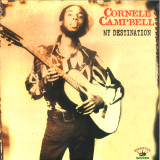
The mighty Falsetto voice of Mr Cornell Campbell is another we believe, unsung hero of the Jamaican music scene. Who in our opinion should have broke through to a wider audience, than his cult status currently provides. We have unearthed straight from the master tapes an album that was due for release around the mid 70’s. A few of these cuts, found their way out on limited 7”s, that were mainly for the domestic Jamaican market. But as a complete body of work, never found a release until now. We hope like us, once you have played the tracks, you will feel that this set of cuts, stands up amongst Cornell’s finest work. Cornell Campbell (born 1948, Jamaica), made his first recordings in the early 1960’s for Coxone Dodd at Studio 1. Tracks like ‘Under the Old Oak Tree’, ‘My Treasure’ and later as a duo with Roy Patton ‘Salvation’ and ‘Sweetest Girl’, were local hits on the Jamaican Sound Systems. A short spell with the Uniques was followed by his roll as lead vocalist with the Eternals, under the monicker of Don Cornell. Their finest moment being the classic ‘Stars / Queen of the Minstrels’ cuts which still stand up today as some of Jamaica’s finest.
The 1970’s saw Mr Campbell move on to work with producer Bunny ‘Striker’ Lee, for whom he cut most
of his big tunes. He and fellow singer Johnny Clarke, would become Bunny’s 70’s equivalent to his 1960’s stable of singers like Slim Smith, Pat Kelly and Ernest Wilson. They would provide the voice to his many hits of the day. Bunny not being called ‘Striker’ for nothing. Cornell also had a series of hits around his theme as the ‘Gorgon’. The mighty figure unbeatable at the dances in the Greenwich Town district of Kingston. ‘The Gorgon’, ‘The Conquering Gorgon’. ‘Natty Dread in a Greenwich Farm’. These were all firm favourites at the dances in Jamaica. He also worked with other notable producers around this time. Winston ‘Niney’ Holness “I Heart is Clean’, Tappa Zukie ‘Follow Instruction’
and culminating in a massive hit ‘Boxing’ in 1979 for producer Joe Gibbs. But it was his time with Bunny Lee that set the levels for his record output. This unreleased album is from this period in time, when Cornell Campbell never sounded sweeter......
Elations Recordings presents "Tairen", an evocative cello recording marking the debut solo release of Melbourne/Naarm-based cellist LEM (Lauren Meath). This deeply personal work is an impressionistic reflection on place, memory and self at the intersection of classical technique and folk sensibility; expanding Meath's lateral, avant garde approach to sound with piano and textural percussion, resulting in a work that unintentionally falls into the post-minimalist tradition.
Conceived as a single piece across five movements and recorded between 2022 and 2024, "Tairen" reflects on memories of a formative place and period for Meath. Each movement scores part of an imagined landscape, mirroring the cliffs and expansive southern ocean of the coastal Otway ranges, remembered and reinterpreted. While tied to a place and time, ultimately "Tairen" is an exploration and expression of self.
Each piece explores this landscape, retaining its own identity while unified by recurring themes, moods and motifs. Meath emphasises restriction in her approach, creating subtly shifting layers of slowly evolving cello lines with expressive unstructured free playing bursting out. In all but one movement ("Bird"), cello is performed in a single take, utilising joined looping pedals on a semi acoustic cello from luthier Paul Davies. Equal parts meditative and expressive, uplifting and melancholic, the instrument becomes a proxy for the human voice creating a work that is intensely beautiful.
While Meath has a background in classical and pop, LEM has always been a more interior, personal project on the boundaries of minimalism and folk; in the past only as a live project featuring only herself, taking a lateral approach to sound through bow, harmonics and voice. While built on this foundation, "Tairen" expands Meath's typically minimal live approach with piano ("Sky") and additional textural percussion. Produced and engineered by James Tom and Danny Smith and with additional percussion from Dylan Lieberman. Mixed and mastered by Cam Parkin.
a fascination flows down the chemical gradient. songbirds take flight from a colonial square in montevideo and fall as acorns in the foothills of the sierra nevada. the moon aches, holding a teeming darkness to the edges of the clearing as we make quick work for the machines. first a pulse, then an armature is spun up around it while the whipping plasma of virtual half-thoughts cools and hardens into something more familiar. a gleaming clash of frogsong begins to reveal its cadences, unspooling into regular striations. it forms a grid in the air, the water rises to meet it, and pressed between these mirrored planes of disappearance we find our vector and glide towards the horizon.
Kucera & Delayed Sentence Present the Analog Rhythms EP
Scrap & Delete continues its trajectory as a home for uncompromising techno with the Analog Rhythms EP. A collaborative release from Kucera and Delayed Sentence that merges their respective strengths into a tightly honed four-tracker of futuristic machine music.
Opening cut "Analog Rhythms" sets the tone with raw propulsion and hypnotic focus. Anchored by a driving low end and jagged synth pulses, it balances grit with surgical control. A track built for long blends and warehouse immersion.
"Between Networks" dials into a more kinetic space. Its interlaced groove patterns, off-axis drum programming and haunting vocal grooves create a feeling of constant shift, evoking unstable connections and digital interference while maintaining absolute floor impact.
On "Synthax," the duo lean into sci-fi atmospheres. Bleeding-edge textures swirl through a thickly percussive dancefloor orientated framework, creating a dark yet spacious momentum that's equal parts cerebral and physical.
Closing cut "Twisted Ankl3" is the EP's most unhinged moment. A wonky workout full of broken signal bursts and twitchy rhythmic grooves. It's a subtly evolving sequenced post-industrial DJ tool, leaving dancers disoriented and locked in.
With Analog Rhythms EP, Kucera and Delayed Sentence showcase a shared vision rooted in sonic discipline, hardware fluency, and unrelenting energy. This is high-functioning techno at its most distilled. A perfect fit for Scrap & Delete's refined catalogue.
This project seeks connections between what is happening in biogenetics (cloning, biomechanical grafts), in art (the body as a territory to be redesigned), and all modern practices of intervention in music such as remixing, cutting and pasting, sampling.
To consider the sonic landscape as an unstable, moving cell culture, which allows experimentation on the body of musical pieces, on their chemical composition in an entirely artificial way. Surgical score, altered rhythms, reworkings.
Music is a mirror of what is happening in our time.
- A1: Lectric Workers Feat Funny Randon - The Garden (Vocal)
- A2: Lectric Workers Feat Funny Randon - The Garden (Instrumental)
- B1: Lectric Workers Feat Funny Randon - The Garden (Flemming Dalum Remix)
- B2: Lectric Workers Feat Funny Randon - The Garden (Flemming Dalum Remix Edit)
- C1: Dario Dell‘aere - Eagles In The Night
- C2: Dario Dell‘aere - Eagles In The Night (Instrumental)
- D1: Dario Dell‘aere - Eagles In The Night (Flemming Dalum Remix)
- D2: Dario Dell‘aere - Eagles In The Night (Hysteric Edit)
- E1: Delanua - How Many Fill (Vocal)
- E2: Delanua - How Many Fill (Instrumental)
- F1: Delanua - How Many Fill (Flemming Dalum Remix)
- F2: Delanua - How Many Fill (Flemming Dalum Remix Edit)
- G1: Claudio Mingardi - Forever Mine
- G2: Claudio Mingardi - Forever Mine (Radio Version)
- G3: Claudio Mingardi - Forever Mine (Instrumental)
- H1: Claudio Mingardi - Forever Mine (Flemming Dalum Remix)
- H2: Claudio Mingardi - Forever Mine (Also Playable Mono Nu Disco Remix)
- I1: Art Fine - Dark Silence (Long Version)
- I2: Art Fine - Dark Silence (Art Fine Version)
- J1: Art Fine - Dark Silence (Flemming Dalum Remix)
- J2: Art Fine - Dark Silence (Dj Tintin Vocoder Remix)
- J3: Art Fine - Dark Silence (Zyx Edit Remastered 2022)
Hania Rani ist eine mehrfach preisgekrönte Komponistin und Pianistin, die mühelos zwischen der Welt der
klassischen und der experimentellen Musik wechselt.
Aufgenommen in den Abbey Road Studios mit einem 45-köpfigen Orchester, markiert „Non Fiction“ einen
neuen Abschnitt in Ranis Karriere, da sie von den elektronischen Klängen ihres gefeierten Albums „Ghosts“
in den symphonischen Bereich übergeht und eine Brücke zwischen ihrem eleganten Experimentalismus und
ihrer klassischen Ausbildung schlägt.
Non Fiction ist Ranis erstes Klavierkonzert und symphonisches Werk. Es ist auch eine Reaktion auf die Entdeckung der Kompositionen des jungen Musikwunderkindes, Josima Feldschuh, die während der Schrecken
des Zweiten Weltkriegs im Warschauer Ghetto entstanden sind. Bewegt von der Geschichte des jungen
Mädchens, beschloss Rani, sie durch die Linse der aktuellen Schreckenssituationen in der Ukraine und im
Gazastreifen zu betrachten und zu untersuchen, wie wir diese durch moderne Medien wahrnehmen. Dabei
erforscht Rani die ständige Koexistenz von Harmonie und Unordnung, schafft eine klangliche Metapher
für das Überleben des menschlichen Geistes angesichts von Gewalt und nutzt den emotionalen Wert von
Klängen, um diese irgendwie fernen Konflikte für uns auf menschlicher Ebene nachvollziehbarer zu machen.
Skylax Records is proud to unveil the reshaped and definitive edition of Blue Mondays’ "The Homage" EP – a record that bridges the golden age of Italo Disco, the raw proto-house energy of Frankie Knuckles & Ron Hardy, and the resurgence of true underground dance music. This release has been meticulously refined to give it the space it deserves: a future classic, driven by iconic reworks and a visual identity worthy of its legacy. A1. The Homage (Vedichecista Mix) delivers a hypnotic journey into Italo Disco euphoria, A2. The Homage (Instrumental) strips it down to pure musical essence, and A3. Countach (Driving Mix) propels us into the unstoppable energy of classic Italo Disco, showcasing Blue Mondays’ unmatched ability to capture the era’s true spirit. On the B-side, B1. The Homage (Floorfillers Remix) injects a raw acid energy designed for peak-time floors, while B2. The Homage (Jolene Remix) delivers a filtered French house gem straight out of 1998, crafted by one of our leading torchbearers of the "real music" renaissance. Wrapped in a stunning sleeve designed by H5, evoking the iconic aesthetics of Joy Division, New Order & Peter Saville, "The Homage" EP captures the essence of an era when the dancefloor was sacred, the music was raw, and the underground thrived. We took our time to reshape this release because it deserved nothing less. Now it’s ready – sharpened, elevated, and destined to become a definitive Skylax classic. This is not just another EP. This is Blue Mondays. Skylax. The resurrection of the underground.
Unusual Traxx second vinyl release is finally here.
The label returns on wax with a fresh 4 tracks VA, featuring standout cuts from Paolo Mosca, Charlie Iapicone & Fosk, Mark Shadow, and A. Naranjo. Each artist delivers their own unique vision, from warm and groovy rhythms to playful synth work and rolling basslines. A versatile package that captures the Unusual sound in full.
Bread&Butter Records celebrates its 10th EP with a powerful statement from Romanian duo NTFO, a name synonymous with precision minimalism and timeless groove. The release unfolds across four masterfully produced tracks, each one engineered for those moments when the dancefloor turns into something deeper, heavier, and unforgettable.
Calibre sets the tone in classic NTFO fashion. Its stripped-bacb bassline rolls with hypnotic intent, carrying just enough weight to lock the floor in. By the three-minute mark, subtle shifts into a trance-like state, gently elevating the room into waves of euphoric release. It’s understated yet devastatingly effective, the type of cut that DJs treasure for its power to transform the atmosphere without ever shouting too loud.
Electr pares things back even further, pushing into pure minimal territory. Built on a sleek harmonic groove, it’s a masterclass in restraint, every sound feels perfectly placed, every movement precise. This is a track that thrives in the early hours, where tension, patience and subtle shifts in rhythm rule the floor.
Forap flips the script, injecting an upbeat energy that hits with instant impact. Around the three-to-four minute mark, a vocal element cuts through, commanding attention before the groove locks back in with unstoppable momentum. Hypnotic yet uplifting, it’s the perfect peak-time tool a track that lifts the room into a collective high, as though flying on pure feeling.
Nanomos closes the EP with finesse. A deeper, darker exploration, it glides through murky textures and intricate percussive details, carrying an otherworldly atmosphere that keeps the listener suspended in motion. It’s a slow-burner that lingers long after the last note fades, a testament to NTFO’s ability to balance groove and emotion in equal measure.
With this release, Bread&Butter not only cements its reputation as one of London’s most exciting underground imprints but also showcases NTFO at their most refined. Four cuts, four moods, all bound by that unmistakable Romanian touch that continues to set standards worldwide.
Reintroducing Soar - the alias of Christian Aebi, serial DIY taper and one-man orchestra from Langenthal, a fog-shrouded town in the Swiss provinces. Krautophobia, ambient lo-fi agriculture, analogue soul balm and slowspeed psych gelati-blitz cardboard pop only gesture towards the sound world he coaxed from his broken Tascam four-track recorder, in attics, churches, junkyards and at the kitchen table.
The spark for Soar was likely time and space, somewhere in the autumn of 1994. Armed with a cable salad of Sixties guitar/bass, fairground drums, mould-speckled organs and toy instruments, Aebi coaxed five albums, an unverified run of 25 cassettes, and a handful of gigs. Mostly issued through Zurich label Corazoo, the records arrived in hand-pasted sleeves, rough-cut reproductions of his teddy bear-fixated artwork that carried the same imperfect immediacy as the music. With Rudi Steiner, performances in galleries, clubs and halls bent into live sound-image happenings - part installation, part film, part flea-market-instrument theatre - invariably leaving the house engineers bewildered.
At the time of his untimely death in 2021, Aebi remained a village secret, his music passed quietly between friends and local ears. Now, Swiss graphic designer and Ghost Riders compiler Ivan Liechti has pieced together a portrait from the afterglow, gathering tangled audio formats, paintings, illustrations, photographs and notebooks with his family, former label and peers. What emerges is a first glimpse of Soar's intimate cosmos - brushing against Füxa, Spectrum, Dump, Stereolab and King Crimson, but orbiting a dimension entirely his own.
- A1: Hot Cargo - If You Were Mine (Version 2)
- A2: Weeks & Co - Rockin’ It In The Pocket (Instrumental)
- B1: Hot Cargo - What's In It For Me (Short Mix)
- B2: The Jammers - Out To Get You (Demo)
- C1: Kaviar - Love Robots (Version 2)
- C2: Weeks & Co - Knock Knock (Demo)
- D1: The Jammers - Flaunt It
- D2: The Jammers - Dance 2000
A Treasure Trove of NYC Post-Disco Gems from 1980–1983
New York City, early 1980s. Post-Disco and Boogie Funk pulse through the streets, clubs, and studios—and Richie Weeks stands at the heart of it all. A true force in the scene, Richie had just dropped the now-classic “Rock Your World” in 1981. Signed to the iconic Salsoul Records, he was riding high: performing at legendary venues like Paradise Garage, Studio 54, Roseland, and Bond International, touring Europe, and recording tirelessly with top-tier vocalists and musicians in studios across the city.
With his projects The Jammers and Weeks & Co. storming the charts both in the U.S. and abroad, Richie was unstoppable. Fueled by a relentless creative drive, he spent countless hours in the studio—writing, arranging, and producing a massive catalog of dancefloor anthems, many of which never saw release. Until now.
Jerome Derradji and Past Due Records are proud to present Richie Weeks – The Love Magician Archives: Boogie & Post Disco. NYC 1980–1983 Vol. 3, the third installment from Richie’s personal archive. Spanning 1980 to 1983, this collection features eight electrifying, previously unreleased tracks from The Jammers and Weeks & Co., as well as the futuristic grooves of Kaviar and Hot Cargo. Richie shines through the entire record—his writing, production, vocals, and arrangements are absolute killers.
Housed in a deluxe double LP package with an insert featuring the second chapter of Richie’s musical journey—penned by Jerome Derradji—this volume is a vital piece of New York’s post-disco history.
Essential for fans of Salsoul, Prelude, and deep crate-digging dancefloor gold diggers.
Das Avant-Rock-Sextett aus Beirut verschmilzt auf diesem großartigen Nachfolger seines gefeierten 2023er Debüts "Mais Um" Psych/Kraut, Improv/Skronk, Elektronik, Gothic und Jazzelemente mit traditionellem ägyptischem Gesang und moderner arabischer Poesie. Produziert von Radwan Moumneh (Matana Roberts, Sarah Davachi, Jerusalem In My Heart). Der Titel des zweiten SANAM-Albums ist ebenso vielversprechend wie die Musik der libanesischen Band. "Sametou Sawtan" bedeutet aus dem Arabischen übersetzt "Ich habe eine Stimme gehört". Spukhaft oder spirituell, wie auch immer man die Phrase liest, sie spricht von der Fähigkeit von Klang und Sprache, innezuhalten, Aufmerksamkeit zu stehlen und uns für den Moment zu öffnen. In ähnlicher Weise vermischt die Musik von SANAM zarte Rasereien und feuerverbrannte Balladen, indem sie frei fließende Rock- und Jazzgerüste mit der tief verwurzelten arabischen Tradition verbindet. Sie in vollem Flug zu hören bedeutet, in der Gegenwart gehalten zu werden und sich neu zu orientieren, um einen offenen Horizont zu eröffnen. Die Arbeit an "Sametou Sawtan" begann im Frühjahr 2024. Die ersten Ideen, die in den Tunefork Studios in Beirut entstanden, wurden im April während eines Aufenthalts in Beit Faris, einem mittelalterlichen Haus in der Küstenstadt Byblos, weiter ausgearbeitet. Das Sextett: Sandy Chamoun (Gesang), Antonio Hajj (Bass), Farah Kaddour (Buzuq), Anthony Sahyoun (Gitarre, Synthesizer), Pascal Semerdjian (Schlagzeug) und Marwan Tohme (Gitarren), wurde vom Produzenten Radwan Ghazi Moumneh (Jerusalem In My Heart) unterstützt. Die letzten beiden Tracks des Albums sind Aufnahmen aus den Beit Faris-Sessions, während der Rest in den La Frette Studios in Paris während der Europareise der Band im Sommer 2024 aufgenommen wurde. Die Platte verarbeitet Gefühle der Distanz und der Entwurzelung. "In den letzten fünf Jahren hatte ich das Gefühl, dass jeder den Libanon verlässt", erklärt Chamoun. "Das Album handelt nicht wortwörtlich davon, sondern von der Vorstellung, dass dich etwas verlässt. Eine Distanz zu den Ereignissen, obwohl du in ihnen lebst, eine Distanz zu deinem Haus, obwohl du in ihm wohnst." Ob in der sehnsüchtigen Ballade "Goblin" oder dem langsam brennenden, autotune-überladenen Freakout von "Habibon", Sametou Sawtan fängt das Streben nach festem Boden in einer Welt ein, die diesen nur selten bieten kann . Das Album hat die hypnotisierende Intensität des SANAM-Live-Erlebnisses, während es der Musik Nuancen, Tiefe und eine enorme dynamische Bandbreite verleiht. Wie bei ihrem Debüt sind die Texte vieler Tracks entliehen, Worte, die in neue Kontexte gestellt werden, um die Gegenwart zu verarbeiten. "Hamam" interpretiert ein ägyptisches Volkslied neu. In "Hadikat Al Ams" treibt der krachende Hardrock-Stampfer den Text des zeitgenössischen libanesischen Schriftstellers Paul Shaoul an. Und sowohl "Sayl Damei" als auch der Titeltrack verwenden Gedichte des iranischen Dichters und bahnbrechenden Mathematikers Omar Khayyam aus dem zwölften Jahrhundert. "Wenn man etwas von Omar liest, fühlt man eine Verbindung zur Gegenwart", sagt Chamoun. "Das Gefühl, dass es keinen klaren Weg gibt." "Sametou Sawtan" enthält auch zwei Lieder mit Chamouns eigenen Texten, darunter den Opener "Harik". Es war die Keimzelle des Albums, geschrieben von Chamoun im Februar 2024, wobei die Band den Track um ihre Worte herum aufbaute. Es beginnt mit einem Schauder, zerfetzter Elektronik und einer keuchenden Stimme, die das Schlagzeug durchdringt, bevor sich die Band zu einem triumphalen Aufstieg aufschwingt. Es geht um Eintauchen in "ein unendliches Feuer", verrät Chamoun. Den Text zu "Tatayoum" schrieb sie allein, bevor sie ihn der Band vorlegte. Er spiegelt eine andere Art von Intensität wider, "eine Schleife, eine Besessenheit", wie sie sagt. Buzuq webt durch schwebende Elektronik und drängende Trommeln, während Chamoun arabische Worte rezitiert, die die Liebe beschreiben. Die unaufhörlichen Energien, die in diesen Tracks erforscht werden, sind nicht unbedingt negativ. Sie vergleicht deren Intensität mit der eines Schriftstellers, der in einem Gedankengang gefangen ist, im Guten wie im Schlechten. "Es geht nicht darum, deprimiert oder traurig zu sein", sagt Chamoun. "Es ist eine Falle, aber sie kann auch magisch sein." "Sametou Sawtan" wurde von Farah Fayyad mit ikonischen Grafiken und Design versehen.