The new recordings from The Dengie Hundred unfurl on Tain Records after a busy year releasing a solo tape on Sagome and a collaborative LP and tape with Japan Blues on Demdike Stare's DDS imprint.
Lammas Land is an album which meditates on the Walthamstow Marshes, an ever-changing watery landscape, rich with history and wildlife. The Dengie Hundred writes:
"I am sitting at my table overlooking the marshes listening to Lammas Land in November 2023, watching crows fight a never-ending aerial battle with the gulls. In summer, you can see bats from here every evening, fluttering around the windows as the light begins to fade, but today it is colder so there is smoke rising from the boats on the River Lea and the dog walkers are wrapped up tight against the wind.
Most of Lammas Land was made sitting right here, playing guitar and recording the sounds passing by. I would hang a microphone out of the window to capture the ‘putput’ boat which delivers provisions, or the trains that rattle along the tracks that cut across the marshes and up to Stanstead, carrying passengers to the airport and away.
I wonder what tourists make of the marshes as they cross them, the landscape opening up for a moment between the urban sprawl of the East End and the rampant development of Tottenham. They offer a jarring pause of green and sky. I feel very lucky to be living in that pause, a resident, for now…
The album contains a whole year of found sounds recorded from the window and while out walking. It is full of bird song and radio sounds, singing, life.
Many others have been inspired by this space, this pause. The author Esther Kinsky who wrote River, published by Fitzcarraldo Editions, captures this area so perfectly. I borrowed the two track names for this album from her book. I hope she doesn’t mind.
Also, the photographer Paul Fuller whose work reflects the atmosphere I feel here precisely. On hearing the music he wanted to collaborate on the Lammas Land project, He spent a year filming the marsh through the seasons. Some of his images are included with the vinyl release, and there is an accompanying film close to completion. I am so pleased this project is continuing in new forms.
The vinyl also contains a piece of writing, ‘Sound Fishing’, by Gemma Blackshaw, an author, art historian and curator who in a twist of fate also found herself spending time on the marshes, but that is her story, for another day."
The Dengie Hundred
Lammas Land
LP, with essay insert + five photographic prints
Cat No: TAIN02
Price: £14.49
Due next week
A: A hand full of ever thickening twilight
(Sample clips 1 / 2 / 3)
B: A string of pearls pulling
the night away
(Sample clips 1 / 2 / 3)
Cerca:urban d k
White Vinyl[31,72 €]
Khanate's self titled debut (2001) has all the pleasant ambiance of a plane crash site, a bleak urban waste of mangled and torn metal beams and hissed alarms. When Khanate first issued instructions to the void in 2001, the band was embraced as the next iteration of guitarist Stephen O'Malley's tube-cracking forays into amplifier variance; a fascinating further step of vocalist Alan Dubin and low-frequency shifter James Plotkin's space charts; and a warning for the crawling-pace hammers of Tim Wyskida's drums. But Khanate was not preaching of coming doom or offering emotional catharsis. The band was totally post-dread. The worst had already happened, and would continue to happen, over and over. The 5 songs on Khanate sound like an "orchestrated root canal" (Julian Cope).
Black Vinyl[30,21 €]
Khanate's self titled debut (2001) has all the pleasant ambiance of a plane crash site, a bleak urban waste of mangled and torn metal beams and hissed alarms. When Khanate first issued instructions to the void in 2001, the band was embraced as the next iteration of guitarist Stephen O'Malley's tube-cracking forays into amplifier variance; a fascinating further step of vocalist Alan Dubin and low-frequency shifter James Plotkin's space charts; and a warning for the crawling-pace hammers of Tim Wyskida's drums. But Khanate was not preaching of coming doom or offering emotional catharsis. The band was totally post-dread. The worst had already happened, and would continue to happen, over and over. The 5 songs on Khanate sound like an "orchestrated root canal" (Julian Cope).
Marjaa: The Battle of the Hotels” is a concept album born of the idea of merging singer & songwriter Mayssa Jallad’s two vocations: music and urban research/architectural history. Written in collaboration with producer Fadi Tabbal, the music builds upon Tabbal’s spatial approach to sound and Jallad’s research on Beirut’s Hotel District. The album is a reference to Jallad’s Historic Preservation master's thesis, in which she detailed the history of the “Battle of the Hotels”, a 5-months battle that took place in Beirut at the beginning of the Lebanese Civil War, from October 22nd, 1975 to March 29th, 1976. Jallad saw architecture as a main protagonist of the battle, as she discovered it was the first high rise urban battle in the world. The close of the battle resulted in the 15-year Green Line, an urban rift which split Beirut into “East and West”, restricting movement and communication and creating a violent divide that still resonates today. The album comprises two parts. Part A: Dahaliz, is a stroll in the city, where Jallad tries (and fails) to follow an old map. Musician Youmna Saba is a companion in this journey of remembering the once winding corridors (“Dahaliz”) of the city, destroyed by new developments since the 1960s. Empty skyscrapers propel her onto a past filled with the violence of snipers, and a present filled with the glamorous injustice of empty luxury real estate endorsed by powerful warlords-turned-politicians. In Part B: Maaraka, Jallad inhabits the building of the Battle of the Hotels, as its events unfold. She calls the fighting militias the Blues and Reds, respectively the Lebanese Front (Christian Nationalists) and the Lebanese National Movement (Pro-Palestinian leftists), leveling the playing field, and drawing a map of the battle through songwriting. Sary Moussa produces the conclusion of the battle in “Holiday Inn (March 21 to 29)”, which ends with the ultimate severance of the city of Beirut. The music caters to post-war youth who have never been taught this difficult history. Once we consider the “Battle of the Hotels” as our common heritage, it provides an opportunity to teach the value of civil peace. It is also a call to protest for the renewal, rather than the recycling of the political class that has once destroyed the country and holds us, to this day, hostage of its violence. Limited edition of 300 copies. 140gsm vinyl pressed at Microforum (Canada).
- 01: Introdose
- 02: Więcej Psylo
- 03: Synestezja
- 04: Halun (Feat. Neile)
- 05: Painkiller (Feat. Dj Bulb)
- 06: Niech Płynie (Feat. Fasola, Cywinsky &Amp; Dj Ph)
- 07: Suspense (Feat. King Kashmere &Amp; Ńemy)
- 08: Dziwna Rzeczywistość (Feat. Wuja Hzg)
- 09: Kolejny Tydzień (Feat. Axel Holy &Amp; Cywinsky)
- 10: Ogrody (Feat. Dj Chederac)
- 11: Afterglow
- 12: Outrodose
Only 200 copies of black 180g vinyl was made.
"Macrodose" is an album recorded in the classic form of Producer & MC, (Antiquant and Prykson Fisk). JuNouMi Records (est. 2002) gives this hip-hop project the highest mark of quality. Real underground rap album including many guests such as Axel Holy and King Kashmere from UK.
Prykson writes about the album as follows: Macrodose is a lyrical "trip report" with a perfect musical accompaniment, a diary of a total life transformation inspired by the power of medicine contained in entheogens.
To emphasize the urban character of the project, we asked the well-known street artist TYBER to create the graphic design of the album, which is ultimately based on a dedicated mural painted in September in Gdańsk.
Mr. Aleksander aka Prykson Fisk aka Fred Flin100NER is 170 kg of live hip-hop. Beat-boxer, MC and DJ, associated with Hip-Hop culture since 2003. Prykson is an experienced psychonaut and owner of the KOMORA REC home studio. Creator and author of over 20 albums and mixtapes. His official debut K02M02 (2020) landed in the respectable 7th place of OLiS... Representative of the MOST BLUNTED team, KOLOKOS - one of the creators and founder of such projects as: Renegaci Funku, Hedora, Prykson Ifs and Dusty Vibez. He played beats in every genre, from dubstep, grime, drum and bass, through rap, to jazz and funk played live with a band. He has conducted countless workshops in the field of hip hop (beat-box, rap) throughout Poland... A fan of good food, underground music, multidimensional visual art and conspiracy theories. An experienced gourmand of life and a well-known local healer.
Antiquant - 24-year-old producer from Zielona Góra. He has collaborated with artists such as Ryfa Ri, Mada, Asthma, Mareceli Bober. With his beats, he tries to drown the listener in an ocean of cosmic sounds. The axis of its production is the artistic achievements of producers such as flying lotus, monte booker and j dilla. In his songs, he does not limit himself to one style, his beats are often a patchwork of various genres of music. In his productions you can hear boom bap drums, trap eight hundred eighth notes and jazz trumpets coexisting in the strangest musical ecosystems. Antiquant appreciates experiments, loves to push his boundaries, look for undiscovered sounds and use effects in ways they shouldn't be used.
On 'Der Ferne', Phil Struck intricately weaves an abstract tapestry of textures, incorporating elements reminiscent of Hassellian-like sounds and multi-textured dubby soundscapes, a testament to the musician's getaways from urban life, journeying in the heart of nature. The music's warm and concise amalgamation of audio fragments lends it an ineffable quality, evoking hazy, sun-drenched memories, while the radiating reminiscences of the natural world invite contemplation of its true essence, remaining captivating for the discerning listener. What enigmatic experiences await discovery, and should the extraordinary always overshadow the ordinary?
„Der Ferne im Nahen. Der Ferne jenseits der Stadt. Der Ferne und den Dingen, die sich einem dort zeigen.“
"Der Ferne" stands as the fourth album by ambient and experimental artist Phil Struck, hailing from Kiel, Germany.
Tokyo architect Hiroki Takahashi is a world-builder both in matter and sound. His latest collection of serene micro-miniatures was inspired by “the dissatisfaction with reality that I feel on a daily basis.” Escapism offers exactly that: percolating patterns of fiberglass synthetics and fluorescent melody, assembled into minimalist bio-domes of refracted light and hanging gardens.
Recorded during metropolitan commutes, afterhours office meditations, and various windows of urban stasis, the album actualizes the ambient muse of its maker, willing space from density, tranquility from tedium. As with his work in exotic atmosphere unit UNKNOWN ME, Takahashi’s touch is hushed, precise, and prismatic, coaxing spectrums of illusion and bliss in its tinted glass spirals: “Extreme tension produces extreme relaxation.”
Forged in a warehouse in Liverpool's Baltic Triangle, Beatowls emerge in 2023 as a genre-defying trio. Darcie Chazen, Tom Roberts and Carl Cook, possess distinct talents, fusing elements of electro, folk, and psychedelia into captivating, dark atmospheric grooves.
The city’s urban-industrial mood inspires their sound, weaving evocative and cinematic tones into their upcoming debut album Marma.
For Fans Of : Dean Blunt and Inga Copeland,The XX, Portishead , Nancy & Lee
Badalamenti/Lynch, Broadcast, Warp Records.
Above all, Beatowls embody a journey. Their story starts from a shared passion, extends into this collection of songs and sounds, and hints at a future filled with creative exploration.
From a dream in a Liverpool warehouse to a national platform, Beatowls stand on the cusp of an era promising audio adventures steeped in originality, emotive tales, and sonic diversity.
Error Subcutaneo was born under the sweltering sun of Santo Domingo, Dominican Republic, but their project portrays the colder, more urban side of life in the Caribbean, where cacophonous violence and Cold War monoliths collide with dreams of a better tomorrow The duo take elements of hip- hop, modular electronics, island syncretism, and bebop to twist and distort contemporary narratives on music composition, representing the greater movement of Latin American resistance directly from its epicentre Temporada Ciclonica is a recollection of alibis from a quenched island imaginarium. Palm trees dance in sync with the gales, an omen of the upcoming hurricane season. Pictographic technologies seek refuge in time's embrace, as eerie scents of petrichor and blood fill the corridors beneath the temple steps.
The cyclone's ravaging beauty and destruction bring rain, fertility and life to the land, an allusion to the cyclical nature of creation. Masters of musical past ride the storm's eye, a semiotic double- entendre on the spinning nature of the vinyl medium. A pupil glimmers from the dark, a kid rubs its belly in the womb. Press: Truth and Lies - review "a challenging but exhilarating journey through the minds of two young artists who's deep knowledge of local and international music places no harness on their creativity. Raw and instant, these boys look at the world as it is and let its contradictions flow into their creations. 9/10" Received airplay on BBC Radio 6 Music (Gilles Peterson), BBC Radio 3 (The Late Junction - Wolf Eyes' Mixtape) + The Lot Radio NYC - Marco Wibel - Darker Than Wax
- A1: Big Wick Energy
- A2: Nowhere To Run-Lola Colette
- A3: Sand Wick
- A4: Change Your Nature
- A5: Continental Breakfast
- A6: Wick In Osaka
- A7: High Tablein Osaka
- A8: A Grave Accusation
- A9: Grief On A Train
- B1: Would Die For You-In This Moment
- B2: Of Mincing & Men
- B3: A Grave Situation
- B4: To Get Back In
- B5: Killa's Teeth
- B6: Ambition And Worth
- B7: Dog Lover
- B8: Jw, Loving Husband
- B9: Stairs Arrival
- C1: Marie Douceur, Marie Colère-Manon Hollander
- C2: John Wick Rises
- C3: Paris Radio Intro
- C4: Chess Club
- C5: Urban Cowgirl
- C6: Quite The Mess You've Made
- D1: Sacré-Coeur Sunrise
- D2: Pistol Procession
- D3: Ten Paces
- D4: Twenty Paces
- D5: Helen A Handbasket
- D6: Eye For An Eye-Rina Sawayama
- D7: Cry Mia River
- C7: The Ex Ex
- C8: The Ex Ex Chapter 3
- C9: Arc De Triomphe
- C10: Wrong Train
Der Soundtrack zu John Wick Charter 4 von Tyler Bates & Joel J Richard in limitierter Auflage auf Transparent Orange Vinyl als Doppel-LP!
Der offizielle Soundtrack zu John Wick 4 mit den bekannten Songs: Nowhere to Run - Lola Colette, I Would Die for You - In This Moment, Marie Douceur, Marie Colère-Manon Hollander & Eye For an Eye-Rina Sawayama. In limitierter Auflage als Doppel-LP auf Transparent Orange Vinyl.
- Ltd. Col. 2LP: (Transparent Orange Vinyl)
Disciples bringt eine Neuauflage des modernen Detroit-Elektro-Klassikers des enigmatischen Projekts NRSB-11 heraus, das in erster Linie eine Zusammenarbeit zwischen Gerald Donald (Drexciya, Dooplereffekt, Arpanet, Japanese Telecom) und DJ Stingray 313 (Urban Tribe, offizieller Drexciya-Tour-DJ, gefeierter Solokünstler) ist. Ursprünglich 2013 als limitierte Auflage auf dem belgischen Label WéMè erschienen, war ihr einziges Album 'Commodified' schnell vergriffen und erfreut sich seitdem großer Beliebtheit, derzeit steht es auf 1.783 Discogs-Suchlisten. Die erste Reissue erscheint als CD mit 3 Bonustrack (NRSB-11 EP aus 2012) und als Clear-Vinyl-2LP-Edition, bei der das Original-Cover im Siebdruckverfahren auf eine PVC-Außenhülle gedruckt wurde, mit den beiden Vinyl-Discs in transparenten Poly-Innentaschen.
180g virgin vinyl limited edition, the complete album + 1 bonus track Big Bill Broonzy was among the finest and most influential of the pre-World War II Chicago bluesmen, bringing the blues to new levels of sophistication. A finger picker and singer without compare, Broonzy combined ragtime and hokum blues with elements of folk, country, and urban sounds in his songs. Big Bill's Blues consists of ten solo recordings made in February 1956 at Philips' studios in Baarn, Holland. Includes the classic "Key to the Highway.
Vladislav Delay presents the fourth EP in his "Hide Behind The Silence" series with five 10" releases coming throughout 2023. Intuitive and raw music, momentary and reflective, released on Ripatti's own label "Rajaton".
Stillness is a myth. Consider concepts such as ”still water”, or ”still air” for that matter. Go to a restaurant, ask them for a glass of still water, hold it against the light and see where we’re at. Even though the water itself has been captured and imprisoned in the glass, it never stops breathing. It’s filled with tiny particles, dancing. Everything can be explained on a molecular level, but since we’re not scientists – and even if you happen to be – it’s the natural world of perception that moves me.
Still air is very similar. A hot summer’s day with zero wind feels completely still. It’s the closest I have felt to complete stillness. Or for a more urban adaptation, imagine the same vibe inside a normal apartment. In those moments, revelations and mind- blowing experiences can be had with experiments in stillness.
Try this: Just sit down for a minute on a sunny day, making sure there’s enough natural light. Do absolutely nothing. Try not to breathe for a bit. (If you need a mental anchor, you can play Cage’s 4’33” in your head but nothing else.) Watch the tiny dots of dust dancing :..’ ̈.:; ́ ́*°.,’:,. ̈ ̈ ̈ ̈:,.’
The movement is crazy, but the feeling of stillness comes from witnessing how subtle it is. In (perceived) complete stillness, every act of microscopic mobility seems to speak volumes. Yet, it feels both reassuring and oddly threatening that the stillness is never complete. What if we would need absolute stillness? Or is it just enough that we can perceive something as such? Extremes attract, so for both water and air, extraordinary movement is equally fascinating. That is also a luxury item of sorts. For us to enjoy a very ”loud” body of water or air, we need to be safe, in enough control of the situation. So when you are, it’s worthwhile to pay attention and take it all in.
A rapid flowing free with extreme strength and just barely in control. Look at that water go! No still water on this one, only ”sparkling”. A windy day when birds seem surprised how hard it is to fly, but in the end they make it. Trees bend but don’t break. The wind shows you its movement but doesn’t hurt you. It feels friendly, like a big clumsy dog that doesn’t quite understand its size.
It’s beautiful to be a guest of the elements, but not at the mercy of them. A new kind of dialogue forms.
Q&A with Sasu Ripatti:
1) Tell us something about the EP series ”Hide Behind the Silence”, what’s the idea and what can we expect?
Exploration of inaction. Of many kinds. In arts and in personal life, or at bigger and more serious levels. Questioning myself as a human being as well as an artist. Acknowledging the growing activism all around, and the very clear need for it, and how it reflects my own inaction.
Musically speaking, after Rakka, Isoviha and Speed Demon, I finally found some relief, but more importantly lost the need to go musically ever more outward and intensive. I felt quite strongly certain periods/moods from the past and they made me revisit some musical ideas or states of mind I was exploring early on.
It’s about live moments being captured, not much premeditation or editing. More intuitive and raw, even though the end result (to me) feels and sounds quite introspective and calm. It’s not very ambitious. Momentary and reflective.
2) Your music doesn’t sound very silent. Does it come from somewhere behind the silence?
Oh, this time to me it sounds quite quiet and playing with space if not silence. I don’t know what’s actually behind silence, but I think silence is the source of everything. We just don’t understand it yet.
3) What kind of thoughts or experiences gave inspiration to this series?
Writing this in Nov ’22, it’s not a stretch to say the world has been really unwell. Sometimes, like Mika Vainio put it, the world eats you up. I feel a bit like that. And I try to hide in my studio and stay away from it all, but it’s getting harder by the day. I’ve been questioning myself and thinking if what us artists are doing is worth anything, and whether it’s just a selfish thing I’ve been doing for the past 25 years, running away from everything. I haven’t come to a conclusion yet.
4) Is it easy for you to be in silence, or around silence?
Absolutely. I not only hide behind silence but I also love silence. It’s only since I started going back to nature as a grown-up person that I sensed and was enveloped by silence, true silence. I have begun to appreciate it a lot. I think all the people should spend more time in silence.
All tracks composed and produced by Sasu Ripatti.
Artwork by Marc Hohmann, photography by Shinnosuke Yoshimori.
Mastering by Stephan Mathieu for Schwebung Mastering.
Vinyl cut by SST Brueggemann.
Publishing by WARP Music Ltd.
- A1: Azuma's Theme (Gnossienne No. 1 - Erik Satie)
- A2: Sono Otoko Kyobo Ni Tsuki (Violent Cop) (End Title)
- A3: Kiyohiro's Theme
- A4: Kiyohiro's Theme Ii
- B1: Sono Otoko Kyobo Ni Tsuki (Violent Cop) (Main Title)
- B2: Fear (Gnossienne No. 1 - Erik Satie)
- B3: Intorno All'idol Mio (Antonio Cesti)
- B4: Sono Otoko Kyobo Ni Tsuki (Violent Cop) (Main Title - Saxophone Version)
WRWTFWW Records is thrilled to announce the official reissue of Daisaku Kume's original soundtrack for the highly acclaimed 1989 Japanese crime/drama movie Violent Cop. Available for the first time outside of Japan, the album comes in a limited edition of 500 copies worldwide with a 45 rpm cut providing full audio pleasure and an iconic record sleeve featuring the movie director and star: the one and only "Beat" Takeshi Kitano!
Violent Cop marks Kitano's directorial debut - a gritty neo-noir in which he stars as a rogue detective fighting a sadistic crime syndicate, only to discover widespread internal corruption in the police force. Poetic, minimalistic, with a superb balance between small soothing moments of beauty and vertiginous sudden violence, the film spearheaded a superb international career for the multi-talented filmmaker, actor, and comedian, which includes works such as Sonatine, Hana-Bi, and Battle Royale. The release of the soundtrack on vinyl presents an excellent opportunity for fans to explore the musical underpinnings of one of Kitano's earliest creations.
Daisaku Kume, known for his work as the keyboardist for late 70s fusion bands T-Square and Prism, showcases versatile musical prowess on the soundtrack, taking listeners on a sonic journey through a blend of genres including magnificent Erik Satie re-interpretations, melancholic smooth jazz sometimes reminiscent of Taxi Driver, ambient-classical, and modern Western atmospherics. It's the perfect setting for Kitano's stoic but tormented lonesome urban cowboy character. Raw power mixed with timeless elegance.
Violent Cop (Original Soundtrack) by Daisaku Kume follows the recent release of the soundtrack from another groundbreaking Japanese movie, Shin'ya Tsukamoto's Tokyo Fist (1995), with music by industrial visionaries Chu Ishikawa & Der Eisenrost, also currently available on WRWTFWW Records.
- 1: Deranged
- 2: 11414
- 3: Even A Worm Will Turn
- 4: Festering In Squalor
- 5: Code Of Silence
- 6: Gowanus Death Stomp
- 7: Streets Of Destitution
- 8: Make (One’s) Bones
- 9: Crown Of Tar
- 10: Thirty Caliber Pesticide
- 11: The Third Rail
- 12: Mortsafe (Resurrection Men)
- 13: Lupara Bianca
- 14: Carried By Six
- 15: Vermin Victory
- 16: Enraged
Black Vinyl[25,84 €]
Die dunkle, schäbige Unterwelt von New York City taucht wieder auf, wenn das Stadtbild durch Abwässer, Crackrauch und den Handel mit Fleisch verdorben ist. Die Straßen, die einst voller Leben waren, sind von dem grotesken und schmutzigen Chaos vergangener Zeiten durchdrungen. Inmitten dieser rauen Wirklichkeit, in den Mauern der schwach beleuchteten Gassen, stinkt es nach Körperflüssigkeiten und Rattenkot.
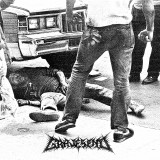
Auf den Bahnsteigen der U-Bahn verüben verzweifelte Seelen wegen ein paar mickriger Dollar wahllos Gewalttaten aneinander. Der East River fließt in einem kränklichen Grün, und der Farbton der Stadt spiegelt die Schatten wider, die diese illegalen Unternehmungen werfen. Inmitten dieser beunruhigenden, düsteren Realität ist nun eine Klanglandschaft entstanden, die das Grauen einfängt - in Form des zweiten Albums von Gravesend.
Das neue Album "Gowanus Death Stomp" verdichtet die Grausamkeit, die auf dem Debüt "Methods of Human Disposal" von 2021 zu hören war, zu einem noch düstereren und ursprünglicheren Trommelfeuer der Gewalt. An der Kreuzung von krimineller Verkommenheit und urbanem Unwohlsein bedienen sich Gravesend vieler Werkzeuge des Handwerks. Black / Death / Grind / War Metal verschmelzen nahtlos zu einer Teergrube aus beißendem Hinterhof-Sadismus und Acid-Zungen-Gesang.
Wie eine frisch geborgeneLeiche unten am Hafen weht der Geruch von Verwesung aus jedem Track auf 'Gowanus Death Stomp'. Und wie bei NYCs Underground-Legenden von Cro-Mags über Swans bis Type O Negative verkörpert Gravesend den Puls der Stadt, selbst wenn dieser Puls auf dem Beton ausblutet.
- 1: Deranged
- 2: 11414
- 3: Even A Worm Will Turn
- 4: Festering In Squalor
- 5: Code Of Silence
- 6: Gowanus Death Stomp
- 7: Streets Of Destitution
- 8: Make (One’s) Bones
- 9: Crown Of Tar
- 10: Thirty Caliber Pesticide
- 11: The Third Rail
- 12: Mortsafe (Resurrection Men)
- 13: Lupara Bianca
- 14: Carried By Six
- 15: Vermin Victory
- 16: Enraged
Neon Green Vinyl[25,84 €]
Die dunkle, schäbige Unterwelt von New York City taucht wieder auf, wenn das Stadtbild durch Abwässer, Crackrauch und den Handel mit Fleisch verdorben ist. Die Straßen, die einst voller Leben waren, sind von dem grotesken und schmutzigen Chaos vergangener Zeiten durchdrungen. Inmitten dieser rauen Wirklichkeit, in den Mauern der schwach beleuchteten Gassen, stinkt es nach Körperflüssigkeiten und Rattenkot.
Auf den Bahnsteigen der U-Bahn verüben verzweifelte Seelen wegen ein paar mickriger Dollar wahllos Gewalttaten aneinander. Der East River fließt in einem kränklichen Grün, und der Farbton der Stadt spiegelt die Schatten wider, die diese illegalen Unternehmungen werfen. Inmitten dieser beunruhigenden, düsteren Realität ist nun eine Klanglandschaft entstanden, die das Grauen einfängt - in Form des zweiten Albums von Gravesend.
Das neue Album "Gowanus Death Stomp" verdichtet die Grausamkeit, die auf dem Debüt "Methods of Human Disposal" von 2021 zu hören war, zu einem noch düstereren und ursprünglicheren Trommelfeuer der Gewalt. An der Kreuzung von krimineller Verkommenheit und urbanem Unwohlsein bedienen sich Gravesend vieler Werkzeuge des Handwerks. Black / Death / Grind / War Metal verschmelzen nahtlos zu einer Teergrube aus beißendem Hinterhof-Sadismus und Acid-Zungen-Gesang.
Wie eine frisch geborgeneLeiche unten am Hafen weht der Geruch von Verwesung aus jedem Track auf 'Gowanus Death Stomp'. Und wie bei NYCs Underground-Legenden von Cro-Mags über Swans bis Type O Negative verkörpert Gravesend den Puls der Stadt, selbst wenn dieser Puls auf dem Beton ausblutet.
Der prägende Sound von Martin Rev, der vor allem im Zusammenspiel mit seinem langjährigen musikalischen Partner Alan Vega und der gemeinsamen Band Suicide in seiner Radikalität und Einzigartigkeit zu einem Einfluss für mehrere Generationen von Musikern werden sollte, findet seinen Ursprung insbesondere in der essentiellen Energie des Rock"n"Rolls, der Rev als Teenager prägte und so etwas wie die musikalische Entsprechung der urbanen Atmosphäre seiner Heimatstadt New York war. Nachdem Rev zunächst im Free Jazz und freier Musik nach neuen musikalischen Ausdrucksformen suchte, entwickelte er rasch eine Faszination für die elektronische Klangerzeugung, die es ihm ermöglichte, völlig alleine und autark zu arbeiten. Er experimentierte mit einfachstem Equipment, kombinierte verschiedene Geräte und Effekte und übersetzte so die Wurzeln des Rock"n"Rolls in einen neuen, bisher ungehörten elektrisierenden Sound, der sowohl der Beginn von Suicide als auch einer spannenden Solo-Karriere sein sollte. Die vorliegende Sammlung "The Sum of Our Wounds" umfasst verschiedenste Aufnahmen, die zwischen 1973 und 1985 entstanden. Dabei ist die Zusammenstellung weitaus mehr als nur eine Kollektion von Demos und Outtakes; vielmehr hat man das Gefühl, ein in sich geschlossenes Album zu hören und sich selbst Kompositionen, die einem bereits bekannt sind, gänzlich neu zu erschließen. Die Kassettenstücke besitzen in ihrer spröden Brüchigkeit eine große Sensibilität, eben wie eine Sammlung von Verwundungen.
Funk The System! The recipe is simple: Dig deep, listen to your heart, record everything you got on a dusty old desktop computer, leave it to simmer for the time of a pandemic, and if it's still fresh, serve it up on the finest plate of black wax! This collaboration started in Dusseldorf in the year 2018. Locked up for a week in the Flanger Studios, Wolf Muller and Credit 00 recorded everything: from the jaw harp to smartphone apps, chopping up GDR Jazz breaks and squeezing the Funk out of every synthesizer and drum machine at hand. You will hear the open mindedness towards all sorts of musical influences from the first note. Each of the five tracks showcases a wild mix of flavours: Disco Reggae, B-Girl Breakbeats, Protest Folk, Subway Funk, Tabla Rhythms, you name it... they'll take it and shake it! It is obvious these two got sonically socialized and educated by the multiculturalism of Hip-Hop in their early days. After the first Recording Session, the tracks fermented for some time until they were cracked open again. This time in Leipzig at Credit 00's Westend Workshop. That's also where Rizmi from Birmingham joined the team and lent her voice to the title track. She reinterpreted the lyrics of the obscure German 1980s Workers' Rock Song, that Wolf digged out for the Intro Skit of ,,Funk The System". A long time in the making, Rat Life is very happy to finally publish this EP!
Have you heard of the Nurse With Wound List? If you are a fan of creative-experimental-unlikely music, certainly. You would therefore be aware that amongst the recommendations that Steven Stapleton slipped into the first album of his group Nurse With Wound, were to be found a few restless frogs: Jef Gilson, Luc Ferrari, Jacques Thollot, Urban Sax, Horde Catalytique and last but not least Jean-Jacques Birgé and Francis Gorgé. Stapleton admired their album Défense de. The two Frenchmen just had to conceive of a fabulous precursor to the channel tunnel (check out the inside of the record, you’ll see) to enable Stapleton to come to France in 1980. The Englishman was looking for contributions to a compilation to be released on his United Dairies label that he had created with John Fothergill, and he naturally called on Birgé and Gorgé, who were then playing with Bernard Vitet in ‘Un drame musical instantané’.
It was a done deal and the compilation would be named In Fractured Silence. Alongside Nurse With Wound and Un drame musical instantané, could be heard Hélène Sage (whom Birgé introduced to Stapleton) and Sema, a project from the experimental British musician Robert Haigh who had participated in key records in the Nurse With Wound discography, such as Homotopy to Marie and Spiral Insana.
The curtain is raised and it is Un drame musical instantané who start the ball rolling. Mystery abounds; synthesisers lurk, percussion clatters and the sounds (creaks, whistles, vocal insertions...) fire in all directions. For the piano, it’s a debacle, the Drame won, Hélène Sage can take over. Heading up a quintette including Gorgé and Vitet, she creates a cushioned chamber music with strings and many silences.
On the B side, it’s the other side of the channel. Sema’s piano first off, which dares everything, even melody, before spilling out its darkest ideas in a raucous requiem. Finally, Stapleton appears, delving into his collection of female voices to devote himself to an iconoclastic transformation and concoct a song which collapses under the assault like Marianne at Agincourt. After having listened to In Fractured Silence, you will simply have to choose sides.