
Search:val e

monstrously rare private pressing from 1973 originally on the deroy imprint, motiffe play twisted king crimson esque progressive rock with dark jazz elements, 99 were pressed with just a handful having hand drawn covers, record deals were offered but musical differences split the band, with the mighty Flux emerging jn the aftermath, before ace guitarist Grimaldi joined Argent to help craft their masterpiece 'Circus'. valued at £2000, this is the first fully authorised legal edition with all members consent and full history written by the band in the inner gatefold. The Gryphon image is also drawn by the band for the cover.

9
“The Vale” is in immersive electronic album of dark soundtrack work. It’s the first of several Everyday Dust releases scheduled for Castles in Space in 2021.
Everyday Dust is RJ McConnell. Based in Scotland, RJ ditched piano lessons when he realised I had no interest in being an instrumentalist. Instead he wanted to create his own musical works from the ground up. He goes on, “I was much happier working my way through music theory books on my own and applying my learning to my own music. We had a little home studio when I was a child. My Dad was also a musician and was involved in local amateur theatre where he prepared and operated all the sound cues on reel to reel tape. So from an early age I was messing around with tape machines, making tape loops and recording music. For years I tried to make the most interesting tones I could from a Yamaha home keyboard by passing it through my Dad’s guitar pedals, or recording to tape and playing it back at different speeds etc. My first proper synth was the Roland SH101.” He went on to study music and sound for theatre and worked for many years as a theatre composer before branching into larger events and eventually film and documentary work.
The Vale story starts in 2018. RJ again, “I was brought in as composer for an independent horror short that was being filmed in Istanbul. The film was a vampire movie, very atmospheric and beautifully shot. I was aware of being a Scottish composer on a Turkish film and therefore didn’t want to attempt in any way to make anything that sounded traditionally Turkish. I wanted to represent the idea of these ancient beings who had existed in one of the oldest cities in the world for centuries. I wondered how I could imply this “ancient” world with the instruments I had to hand. I recorded various old metal whistles, which were slowed right down to become eerie arcane horn blasts that sounded like they had come from another time. I also recorded lots of melodica, which was again slowed down to sound like wheezing old harmonium drones. I spent another day recording inside an old piano, plucking individual strings and also hammering them percussively with wooden beaters. Using synthesizers and effects as the “glue” to bring these sounds together I started to work on the cues for the film. I had scored most of the film by the time I heard it was being cancelled. The concept and story had been taken over by a streaming site who wanted to make it into a series - with a drastically different tone and style.
“Later that same year I had worked on a project that incorporated the folklore of a celtic water sprite who kept the waterfalls and streams running smoothly so they could turn the mills of the local village. In return the villagers would bring the water sprite bannocks (Scottish flatbreads) each day. I started to daydream about a darker, Lovecraftian twist on this story. Some Ancient One dwelling in the forests and controlling the water - the very life essence of the village - in return for offerings of the soul. The concept was filed away in the back of my mind for some months.
“The following year I was on a flight to visit my friend in Bodrum. He had been the producer and editor on the original disbanded Vampire film, and I found myself thinking about the project again. I wondered if the sound cue files were still on my laptop, which they were. It had been a year since I’d even heard them. Hearing the eldritch folk-tinged sounds of the whistles and plucked strings my mind instantly returned to the idea of the Lovecraftian folk horror story. I started jotting down notes and musical ideas and by the time I landed in Bodrum I already had the album title - The Vale. Having the album concept and prototype ideas to work with was a huge head start in making the album. Although all of the original cues were so dramatically developed and transformed that they really just served as the initial clay on the wheel.
“I used a Doepfer A100 modular synth to create the animalistic yelps, conches and horns that were improvised over the original cues as a response to the arcane “folk” world of the acoustic instruments. This half-acoustic half-modular landscape was the sonic scene-setter I needed to move onto the composition and musical journey of the album. I composed and developed most of the musical parts on an Oberheim Matrix 6 synthesizer. However all the percussion, rhythmic sequences and ornamental synth sounds were created from improvised modular sessions multitrack recorded. A lot of editing later, the soundtrack to the movie in my mind was finally there.

5
Miles in Tokyo is a live album recorded on July 14, 1964, by the Miles Davis Quintet (featuring Sam Rivers, Ron Carter, Herbie Hancock and Tony Williams) at the Tokyo Kōsei Nenkin Kaikan, Shinjuku, Tokyo, Japan. It is the first recording of Davis in Japan and the only album to showcase an early incarnation of his Second Great Quintet featuring Sam Rivers on tenor saxophone, following George Coleman’s departure. After this, Wayne Shorter’s appointment completed the classic line-up which recorded such albums as ESP and Miles Smiles, through to Miles in the Sky. The legendary Miles in Tokyo album is now available on vinyl in Europe for the first time. The heavyweight gatefold contains a 4 page-booklet glued inside, like the original
1969 Japanese LP version.
180 GRAM AUDIOPHILE VINYL
• GATEFOLD SLEEVE WITH 4 PAGE BOOKLET
• FOR THE FIRST TIME AVAILABLE ON VINYL IN EUROPE
• RECORDED IN 1964 AT THE TOKYO KŌSEI
NENKIN KAIKAN, SHINJUKU, TOKYO
• THE MILES DAVIS QUINTET FEATURING SAM RIVERS, RON CARTER, HERBIE HANCOCK
AND TONY WILLIAMS

Cobalt Chapel release ‘Orange Synthetic’, the follow-up to their much lauded self-titled debut album and its companion piece ‘Variants’. ‘Orange Synthetic’ is an exploration of the epic county they call home, Yorkshire. Written during this tumultuous turn of the decade, it is inspired by the humanity, anecdotes and folklore of the region, and the surrounding landscape.
The album delves into stories which exist at the edge of history and myth: the drowning of a village under Lake Semerwater, the mystery of the lost geodesic domes of RAF Fylingdales, the fate of John Hotham of Hull, beheaded for treason during the English Civil War, a psychedelic folk song about an infamous Cragg Vale farmer killed in a fight over a flock of sheep, the cry of Skylarks over Erringden Moor.
The album’s name stems from a line in the title track, telling the story of the fateful Yorkshire Folk, Blues & Jazz Festival in Krumlin, fifty years ago. Hit by a violent storm, it resulted in the devastation of the site, near-deaths from exposure and the promoter being found wandering the moors, days later.
Cobalt Chapel’s atmospheric style remains distinctively their own, through Cecilia Fage’s crisp English vocals and choral arrangements, and Jarrod Gosling’s use of organs such as the Vox Continental, Philicorda, and the USSR-era Elektronika Organ. These are the foundations of their rich, experimental yet melodic sound, and this album sees them expand on it with the addition of mandolin, guitars, and drawing on Cecilia’s classical background, with clarinets and recorders.

8
Ein einzigartiger Künstler an einem legendären Ort: Tripping with Nils Frahm dokumentiert seine transzendentalen Liveshows in der geschichtsträchtigen Kulisse des Funkhaus Berlin. Gleich vier Shows im Funkhaus Berlin gaben den Auftakt zu Nils Frahms ambitionierter All Melody Tournee Anfang 2018, die sein gleichnamiges und allseits gepriesenes Studioalbum in den nächsten zwei Jahren auf die Bühnen dieser Welt brachte. In den folgenden über 180 ausverkauften Shows war der Ausnahmekünstler unter anderem im Sydney Opera House, in der Disney Hall in Los Angeles, im Barbican in London, in der Elbphilharmonie sowie auf zahlreichen großen Festivalbühnen zu Gast. Dennoch blieben Frahm die Konzerte im ehrwürdigen und für seine großartige Akustik gerühmten Saal 1 im Funkhaus Berlin in,mm besonderer Erinnerung.
Als Frahm ein knappes Jahr später zu vier weiteren Konzerten im Funkhaus einlud, waren die Tickets binnen Stunden vergriffen. Frahms langjähriger Freund und Filmemacher Benoit Toulemonde, der unter bereits für die Film-Konzertserie La Blogothèque mit zahlreichen weltbekannten Künstler-innen und Bands zusammenarbeitete, hielt die Abende an diesem geschichtsträchtigen Ort mit einem siebenköpfigen Kamera-Team fest.
Tripping with Nils Frahm ist ein Dokument Frahms vielfach gepriesener Fähigkeiten als Komponist und passionierter Live- Musiker sowie der besonderen Stimmung und Atmosphäre seiner legendären Funkhaus-Shows. Ein außergewöhnlicher musikalischer Trip — exklusiv und intim, roh und direkt.
"It was about time to document my concerts in picture and sound, trying to freeze a moment of this period where my team and I were nomads, using any method of travel to play yet another show the next day. Maybe tonight is the night where everything works out perfectly and things fall into place? Normally things go wrong with concerts, but by combining our favorite moments of four performances, we were able to achieve what I was trying to do in
these two years of touring: getting it right! When you hear the applause on the end of the film you should know that I was smiling happily, being a tad proud and feeling blessed to share these moments with you.
Much love, Nils"

9
Following DJ LOSERs output on labels like VEYL, PUPPY TAPES or Clan Destine Records is Stealth Hope. A blend of various styles and genres, Stealth Hope showcases the wide range and potential of the Greek artist who is destined for big things to come.

12
• The Love Affair was formed in 1967 (originally as the Soul Survivors) and burst onto the UK charts in January 1968 when ‘Everlasting Love’ reached # 1. Featuring lead singer Steve Ellis’ distinctive vocals, this was followed by four more Top 20 hits, three of which were Top 10, including ‘Rainbow Valley’ (# 5), ‘A Day Without Love’ (# 6) and ‘Bringing On Back The Good Times’ (# 9).
• Side One of this album features all five hits (including a re-mastered version of ‘Everlasting Love’) plus the single unreleased at the time, ‘Time Hasn’t Changed Us’, after which Steve Ellis left the band.
• Side Two features six highlights from Steve Ellis’ solo career, starting with two favourites by Ellis, the band he formed with Zoot Money, produced by Roger Daltrey. Next up are covers of Jimmy Webb’s ‘Evie’, and also ‘Rainy Night In Georgia’. Taken from Steve’s 2018 album, ‘Lonely No More’ and ‘Cry Me A River’ both feature Paul Weller as co-writer, performer and co producer.
• The inner sleeve features liner notes by Steve Ellis and photos and memorabilia from his own collection. The record is pressed on 180g gold vinyl.

12
In a time where everyone from Whitney Houston to Frank Zappa have been re-created in hologram form, where Grimes recently suggested in an interview that “we were at the end of human art”; there could scarcely be a better time for genre-shifting Leeds-based six-piece Team Picture to bring forth the thrillingly expansive synth-pop opus of their debut album The Menace of Mechanical Music.
Inspired by an early 20th century essay under the same name by American marching band leader John Philip Sousa, Team Picture take a look at the automation of creativity on this, their first record with a fully settled line up. Themes centre around the value of creative identity in an automated age, the increasingly disposable nature of art and where that leaves its creators. At twelve songs split into a three-part suite; The Menace of Mechanical Music is emphatically maximalist.
Tracks like the breathy, twinkling Flowerpots, Electric Beds and Handsome Machines’ Icarus-like striving for the sun are an antidote to a music world awash with digital production manipulation and songs written to algorithm. In debating the loosening of the human grip on creativity, Team Picture have poured every last drop of emotion into the recording process.
The group’s now trademark three-way vocal delivery and blurring of textures takes on new structure and purpose. They’ve always had a self-awareness to themselves, too. Initially grouped in with the guitar psych crowd, thanks to their fledgling repeato-rock, they were quick to disassociate themselves from that on 2018's mini-album Recital. With The Menace of Mechanical Music, they expand their sound further still, pirouetting from the likes of Sleeptype Auction – which glimmers like a late 80’s 4AD artefact – through various FX-laden dreamscapes, to the squelchy post-punk of closer Quit Reading. Yet the group were as much influenced by the work of the Early Netherlandish painter Hieronymus Bosch, and his triptych The Garden of Earthly Delights, as they were music touchstones ranging from Kate Bush, Cass McCombs and The Cure.
It’s Sousa words that resonate most deeply within the record however: “The fears of Sousa echo the fears of today's musician,” says Lewis of the late band leader’s 1907 text. “The re-appropriation of funds and support that the artist needs to survive, the gradual erosion of musicianship and self-improvement, that art will become disposable, and that our cultural identity will disappear.”
Recorded with producer Matt Peel (W.H Lung, Eagulls), half the group were unemployed during the session and a daily routine would see them undertake universal credit meetings and job interviews in the morning, before heading to the studio to work into the night. “It was an anxious process but an enjoyable one” says the band’s guitarist Josh Lewis. Indeed, beyond the increasingly golden gated idea of ‘making it’ as an artist, this new album is simply about surviving as one.
Sousa’s vision of a society that had deferred to automation, where babies were rocked to sleep by wheels and pulleys, and people no longer played piano with their own hands. Well over 100 years later and on the precipice of a technological shift never seen before, The Menace of Mechanical Music is the most human response that Team Picture could have given.

11
THERION have always been a band that have challenged themselves to explore new paths, while remaining true to their musical core values. For their 17th studio album, mastermind Christofer Johnsson and his collaborator Thomas Vikström have created something that has been previously unthinkable to the guitarist and the singer. "We have done the only thing that was left of all the different angles to explore", explains Christofer. "We have decided to give the people what they kept asking for. 'Leviathan' is the first album that we have deliberately packed with THERION hit songs."
True to the Swede's words, the album opens with the catchy and swift tune 'The Leaf Of The Oak Of Far' featuring female and male antiphonal singing as well as a choir that seems to have evolved straight out of THERION's breakthrough full-length "Theli" (1996). This is immediately followed by the obvious highlight 'Tuonela', in which Christofer cleverly underscores this hit-track's Finnish vibe by employing NIGHTWISH’s "metal voice" Marko Hietala. Next up in this parade of future fan-favourites is the title track 'Leviathan' that offers classic THERION material with operatic female vocals and a massive choir.
Christofer Johnsson's passion for classic voices, choirs, and orchestral elements as well as his penchant for epic melodies in combination with rock and metal shines clearly through the following sing-along ballad 'Die Wellen Der Zeit', which indicates another nod to German romantic composer Richard Wagner. "Ever since 'Theli', Wagner has been and will always be at the core of THERION", emphasises Christofer. "When we started to combine metal and opera, it was something new and original. Today, symphonic metal has long been a firmly established genre."
When THERION came into being in 1988 by changing name from the already existing band BLITZKRIEG, which was founded a year earlier, Christofer had rather taken inspiration from SLAYER's "Reign In Blood" among other classic metal albums. At the beginning, the Swedes were firmly rooted in death metal, a genre which they helped to define, as witnessed by their debut album "Of Darkness...." (1991). Yet even back then, there were hints of "something else" lurking beneath the rough surface.
The use of female vocals is another core ingredient of THERION today, which developed gradually. CELTIC FROST had basically introduced the female element to extreme metal on "To Mega Therion" in 1985. THERION began with both a female and male vocalist emulating a church like choir already in their sophomore full-length 'Beyond Sanctorum' (1992). With Symphony "Masses: Ho Drakon Ho Megas" (1993) and "Lepaca Kliffoth" (1995), Christofer continued to developed his trademark sound by gradually drifting towards cleaner vocals and more keyboards. With "Theli", the Swedes had firmly established a reputation of pushing the boundaries of metal in the 90s – among such acts as their compatriots TIAMAT, THE GATHERING, and MOONSPELL that were often referred to as "gothic metal" at the time.
THERION continued to break new ground leaving inspiration for others to follow in their wake: On "A'arab Zaraq - Lucid Dreaming" (1997), Christofer further explored the use of Near Eastern music in metal which he had already begun in 1992, while "Secret Of The Runes" (2001) dared to have Swedish lyrics in some songs. While critics were left confused and fans challenged, THERION were often ahead of their times and vindicated in hindsight. Even the band's 25th anniversary excursion "Les Fleurs Du Mal" has by now overcome the initial shock the album caused and is only beaten in terms of streaming by the classic "Vovin" (1998).
When Christofer faced the question of where to go next after the dramatic "Beloved Antichrist" (2018) had finally fulfilled his musical mission, his answer is "Leviathan" named after a giant sea monster from Judeo-Christian myth that has roots in Babylonic lore: THERION have created a giant hit album – and for the first time in the history of the Swedes, their fans are not asked to explore something new, but simply to lean back and enjoy the best from their band!

14
The Light Below is the third album from Walking Papers. This is a limited edition collector’s double white vinyl
The Seattle-based blues rock outfit were called ‘the best rock band in Seattle’ by The New York Times and UK’s Classic Rock magazine voted Walking Papers one of the Top Bands of 2016. The Light Below is a continuation of the impactful and artful sound Walking Papers have developed that brings listeners to new places every time

- That Old Feeling
- It’s Always You
- Like Someone In Love
- My Ideal
- I’ve Never Been In Love Before
- My Buddy
- Let’s Get Lost (Bonus Track)
- But Not For Me
- Time After Time
- I Get Along Without You Very Well
- My Funny Valentine
- There Will Never Be Another You
- The Thrill Is Gone
- I Fall In Love Too Easily
- Look For The Silver Lining
- Just Friends (Bonus Track)
16
‘Chet Sings’ by the trumpeter and vocalist Chet Baker is a classic of West Coast cool jazz. Recorded between 1953 and 1956 this CD reissue includes 10 bonus tracks and vinyl inludes 2 bonus tracks.
The collective personnel accompanying Baker includes Russ Freeman on piano & celeste; Jimmy Bond, Carson Smith, Joe Mondragon, bass; Peter Littman, Lawrence Marable, Bob Neel, Shelly Manne, drums; among others. The 20-page booklet features complete information and specially prepared liner notes by Penguin
Guide to Jazz’s writer Brian Morton and by France’s prestigious Jazz Magazine.
SINGS

9
Audiophile reissue of the first RSD release from legendary jazz bassist Ron Carter, the most-recorded jazz bassist in history and member of the second great Miles Davis Quintet (1963 - 1968).
180g double vinyl, gatefold sleeve.
Carter leads his “Foursight” quartet on this live recording from Sweden recorded in November 2018. The group includes drummer Payton Crossley, tenor saxophonist Jimmy Green, the and star pianist Renee Rosnes.
“With us, nobody knows exactly what happens when,” Carter praised the Foursight Quartet’s unique selling point. “This is precisely why every concert is a real challenge. We almost always play 35 to 40 minutes without a stop at the beginning. No breaks, just slight changes that show the beginning of a new song. If we were a classical music band, it would be called a symphony with five movements.
This kind of thing only works with this band!”
Personnel: Ron Carter (bass), Renee Rosnes (piano), Jimmy Greene (tenor saxophone), Payton Crossley (drums)

6
Trumpet genius Booker Little appeared on many seminal records such as Max Roach's "We insist", Eric Dolphys' "Far Cry" and John Coltrane's "Africa Brass". Recorded in 1960 for the Time label, this is Booker Little's second album as a leader (there would only be four) and a major statement in his too short career. A dynamic and yet relaxed session with Little as the only horn in the band, a fine quartet featuring Winton Kelly or Tommy Flanagan on piano, Scott LaFaro on bass, and Roy Haynes on drums. A highly interactive combo inspired by Little's unique trumpet approach. "Little's immediately recognizable melancholy sound and lyrical style are heard in top form" as Scott Yanow stated in his 4½ stars album review.

9
Sabaturin is Charles-Émile Beullac (Galerie Stratique, Canada) and Simon Crab (Bourbonese Qualk, United Kingdom). In the spirit of old school tape exchanges that resulted in musical collaborations developed over long periods of time but informed by the infinitely easier processes of the digital age, "Kenemglev" was assembled without the musicians ever meeting.
The title "Kenemglev" means "consensus" in Breton, something which quite naturally had to be achieved between both musicians. The other consensus was a sort of virtual middle ground symbolized by the Breton language, particular to a geographical area (Brittany) that both agreed would stand for a neutral meeting point between their respective native languages and, consequently, cultures. All titles are Breton words and the name Sabaturin ("standing on one feet", "to be off-balance") expresses mainly Charles' excitement: "Simon's bold approach has been some kind of a shock therapy for my music".
The sleeve was designed by Simon Crab, using a Chladni pattern simulation based on specific pitches. Looking like stained glass, it sort of reflects the way the music is presented: although including 9 titles, the album's tracklist flows uninterrupted on each side of the vinyl, semi-mixed, blended.
Detailed electronic ambience, glitches, loops and tiny details are augmented by a sort of signature rhythmic grid we recognize from "My Government Is My Soul"-era Bourbonese Qualk. It never settles into a formula and so the music remains loose, as much Mille Plateaux as classic 80s industrial shortwave-sampling or dub, rolled into one same entity, touching base with the gorgeous glitch dub "Morgouskus". This concludes a gentle and discreet album that doesn't require the validation of being associated with any of the current keywords in the electronic music scene.
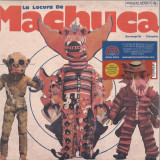
- A1: Samba Negra - Eberebijara
- A2: King Somalie - Monkey 'S Dance
- A3: El Grupo Folclórico - Tamba
- A4: Los Viajeros Siderales - El Campanero
- A5: Rio Latino - Ayu
- B1: Aníbal Velásquez - La Mazamorra Del Diablo
- B2: La Francachela - Mosquita Muerta
- B3: El Grupo Folclórico - Juipiti
- B4: King Somalie - Le Mongui
- C1: El Grupo Folclórico - El Tornillito
- C2: Samba Negra - Long Life Africa
- C3: La Banda Africana - Te Clavo La... Mano
- C4: Myrian Makenwa - El Platano
- D1: El Grupo Folclórico - Tucutru
- D2: Grupo Bola Roja - Caracol
- D3: El Grupo D'abelard - Otro Perro Con Ese Hueso
- D4: Conjunto Barbacoa - Wabali
17
La Locura de Machuca is the story of one man’s bizarre odyssey into Colombia’s coastal music underground, and the wild, hypnotic sounds he helped bring up to the surface.
One night in 1975, a successful tax lawyer named Rafael Machuca had his mind blown in Barranquilla’s ‘Plaza de los Musicos’. Overnight he went from a high ranking position in the Columbian revenue authority to visionary production guru of the newly formed record label that bore his name, Discos Machuca, and for the next six years he devoted his life to releasing some of the strangest, most experimental Afro Psychedelia Cumbias ever produced. La Locura de Machuca is the story of one man’s bizarre odyssey into Colombia’s coastal music underground, and the wild, hypnotic sounds he helped bring up to the surface.
The Colombian music industry was thriving in the mid-seventies, but while homegrown bolero and vallenato tunes were doing well on the charts, it was imported African records that were setting crowds on fire at the picos – the sound-systems that fuelled neighbourhood parties – and wherever those records were played there were always a handful of groups who were inspired to plug traditional Cumbia directly into the electric currents coming from across the Atlantic.
It was these obscure bands, who fused Colombian and African rhythms with the swirling organs and psychedelic guitars of underground rock, that fired Machuca’s imagination. While the label made its money releasing popular hits by legends such as Alejandro Durán and Aníbal Velásquez, that money was poured back into a unique run of experimental releases by fringe artists such as La Banda Africana, King Somalie, Conjunto Barbacoa, and Abelardo Carbono, one of the godfathers of Champeta Criolla.
When Machuca couldn’t find groups to realise his particular vision, he simply created them himself. Drawing on a fearsome roster of musicians associated with the label, he assembled bands that lasted only as long as it took to record an album ,and unleashed the results – complete with arrestingly unusual album covers – under a series of different names such as Samba Negra or El Grupo Folclórico. This unorthodox approach led his longtime recording engineer, Eduardo Dávila, to describes Machuca’s productions as the “B-Movies of Colombian music.”
The story of Doctor Machuca and his eccentric exploits tells of one of Colombia’s most atypical and peculiar record companies; a defining pillar of Afro-Caribbean psychedelia. His productions have come to represent the roots of Champeta and set the pedigree standards for Afro and Costeño avant-garde. The seventeen tracks on La Locura de Machuca, harvested from the darkest, strangest corners of the Discos Machuca catalogue, sound like little else recorded before or since.

- 1: Dungeon Dance
- 2: Poison Moon
- 3: I Fire Myself
- 4: The Bell
- 5: Painted Horses
- 6: The Hour Glass
- 7: 13 Bees
- 8: The Golden Fruit
- 9: Whisper From The Tree
- 10: 1542
- 11: Valley Of One Thousand Perfumes
- 12: Tiger Rising
- 13: An-Deluzion
- 14: The Fox And Hound
- 15: Rider On The Stormy Sea
- 16: Return To Pirates (Kingston St Session)
- 17: Poison Moon (Kingston St Session)
- 18: Killed By The Telephone (Kingston St Session)
- 19: Valley Of One Thousand Perfumes (Orchestral Version)
19
Remastered by Bob Weston, ‘Mountains’ comes back to us as a gold foil-embossed gatefold double LP and includes the previously unreleased original takes of ‘Return to Pirates’, ‘Poison Moon’ and ‘Killed by the Telephone’, which were delivered along with the original master tapes 20 years ago but were omitted from the final album.
The record is completed by a newly recorded orchestral version of ‘Valley of One Thousand Perfumes’ produced by composer Joe Wong (Russian Doll, Midnight Gospel) and mixed by Dave Fridmann.
At the turn of the Century, Timony (Ex Hex, Wild Flag, Hammered Hulls) was already a celebrated presence in American underground music - a fixture of D.C. and Boston rock ’n’ roll via her work in Autoclave and Helium respectively. By 1998, though, Helium was drawing to a close and Timony was feeling uncertain about the future. “I had never been good at the rock ‘n’ roll business, and making a living from being in a band just didn't seem like it was in the realm of possibility for me,” she writes. “I just knew I wanted to make another record because that was the part of being in a band that I liked the most.”

12
As Midnight Sister, multi-disciplinary LA artists Juliana Giraffe and Ari Balouzian make motion pictures. Yes, sometimes with moving images _ but most often only with the music they create together. Balouzian's serpentine, string compositions are movie scenes that allow Giraffe, a brilliant character actor, to cloak herself in a new roles and voices. A bit of Jon Brion's score work; some old Hollywood strings; a solid dose of glam and outsider disco from 70s independent cinema. Any perceived artifice is always matched by an indelible human fingerprint, something perfectly off. Giraffe and Balouzian's respective work in fashion, visual art, video and film scoring _ along with the gang of virtuosos with which they surround themselves _ all wonderfully coalesce as Midnight Sister. And if 2017's `Saturn Over Sunset' was their collection of short films about outcast life in The San Fernando Valley, then their new album `Paining the Roses' is the inventive, meta motion picture that cements them as auteurs. `Painting the Roses' is in many ways a fairy tale -- not so much the sweet-and-happyending kind as something richer, packed with imagination and rooted in the complex human messiness beneath a story's artifice. Frontwoman Giraffe describes it as "this tightrope of being real yet synthetic, organic yet staged, light yet dark, logical yet irrational, beautiful yet dilapidated. Joyful nonsense." Here, disguises like masks and paint are not meant to hide but to liberate, to "set a part of us free", and Midnight Sister often embody this themselves, appearing highly stylized, curious, warm and inviting but a little askew. `Painting the Roses' is a story told through the looking glass, one where we examine ourselves in a funhouse mirror but find clarity in its twists. Giraffe traveled to visit family in Argentina during the making of the album and reconnected greatly with that part of her family history, art and culture. Balouzian created the core album opener "Doctor Says" during a session in the desert outside of LA. The guitar, which reminded Giraffe of South America, has a slow, sweltering surf-tango to it, like Dick Dale doing Carlos Gardel. And even though the song was inspired by Giraffe's reconnection with Argentina, the song is about the fading of some close friendships during the making of the album. "Man, you have changed," Giraffe sings, unclear if tis directed to a friend or to herself. Later on the album, "Wednesday Baby" _ named after Giraffe's rescue dog _ is patient, subtly baroque pop. It follows Giraffe through one of those gloomy days spent in tunnelvision doldrums from which only a sunbathing turtle or your canine companion can pull you out. By the time collaborator Max Whipple's saw comes beaming down from heaven in the song's 3rd part, we're hypnotized by the song's charming ennui. The song lands someplace both familiar and aloof, a little slice of timelessness taken straight from The Cake of Perfect Songcraft.

7
James Giuffre was an American jazz clarinetist, saxophonist, composer, and arranger, notable for his development of forms of jazz which allowed for free interplay between the musicians. His 1960 album Western Suite features an unusual trio of clarinet, guitar and valve trombone. The first half of the album is devoted to Giuffre’s country music/folk- inspired suite, while the second half features a lengthy and abstract version of the big band standard “Topsy” and a Thelonious Monk song.

• 180 GRAM AUDIOPHILE VINYL
• INCLUDES INSERT
• FEATURING THE HIT SINGLES “TRUE COLORS”,
“CHANGE OF HEART” & “WHAT’S GOING ON”
• 2-TIME GRAMMY NOMINATED ALBUM
• GUEST APPEARANCES BY BILLY JOEL, RICK DERRINGER, THE BANGLES, AIMEE MANN, NILE RODGERS, AND MANY MORE
• SECRET INSCRIPTIONS IN RUN-OUT GROOVE
• BLACK VINYL
Cyndi Lauper’s second studio album True Colors was a successful one, earning her two nominations at the 29th Annual Grammy Awards and a number 4 position in the Billboard 200 chart. With this release Lauper wanted to prove that she was no longer interested in being just an “icon”. Her intention was to create something, that could have proved her artistic values. And that’s what True Colors did for her career. It spawned several successful singles, like “True Colors”, “Change Of Heart”, and “What’s Going On”. The album has been certified double platinum in the United States and sold 7 million copies worldwide.
