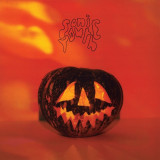
Black vinyl LP. Debut album by striking experimental duo featuring Aboriginal songman Fred Leone. Mixed by Jake Miller (Björk, Arca), mastered by Alex Wharton (The Beatles, MBV). RIYL: Autechre, Arca, Björk. Yirinda means 'Now' in Butchulla language. Australian duo Yirinda combine ancient Aboriginal language with sublime modern production. Fred Leone and Samuel Pankhurst's music invokes thousands of generations of story and culture, while emerging as something entirely new. Fred is one of three Butchulla songmen - a song and language custodian for the Butchulla people from the Fraser Coast region of Queensland, including K’gari (formerly known as Fraser Island). He sings the songs on this album in the endangered Butchulla language, now spoken by only a handful of people. Samuel is an internationally acclaimed contrabassist / producer known for his kaleidoscopic harmonies and polyrhythmic mastery. Their self-titled debut album was recorded in Brisbane by Samuel, then mixed in London by Jake Miller (Björk, Arca, Yves Tumor) and mastered at Abbey Road by Alex Wharton (The Beatles, My Bloody Valentine). The album sets Fred’s powerful vocals against striking experimental soundscapes, rich with strings, horns, double bass, synthesizer, piano and percussion. Every arrangement began with Fred's voice alone and from there sounds and systems were constructed. The result is otherworldly, a timeless art music outside Western convention. Yirinda have performed at the Australian Art Music Awards, Vivid Festival, Golden Plains, Dark Mofo, Supersense and elsewhere, and been covered by ABC Radio and NME Australia. Fred has toured Europe as a member of The Black Arm Band, and as a solo artist supporting Ash Grunwald. He founded Australia’s first Aboriginal hip hop label Impossible Odds in the late 2000s. Samuel has performed with the Brodsky Quartet and is a member of the Australian Art Orchestra. He has scored extensively for contemporary dance, and his studio work covers everything from the Bluey TV show to Hiatus Kaiyote
quête:val ex
"Days Gone By," the latest creation from Manuel Gonzales (MGUN), showcases his remarkable versatility inside of the contemporary musical landscape. This 9-track EP, released for 100 LIMOUSINES, is a vibrant mosaic of raw, gritty sounds that capture the quintessence of Detroit's musical heritage.
Each track on the album is an immersive experience that echoes the feel of street techno, rhythmic and driving. MGUN's ingenious use of the studio as an instrument is striking, as he shapes tracks that embody the essence of bedroom production. The album vibrates with deep sub-bass frequencies, eerie highs, and peculiar artifacts of found sound.
Gonzales, a name synonymous with raw and unadulterated music, brings his signature touch to the 100 LIMOUSINES catalog, a label rapidly gaining recognition for its bold defiance of genre constraints. "Days Gone By" is more than a mere collection of tracks; it's a deep dive into Gonzales' daily sonic experiments, a testament to his relentless pursuit of pushing the boundaries of techno music.
This album is an essential listen for those who value the fusion of Detroit's robust underground legacy with innovative, avant-garde electronic music. It's a journey designed for those who revel in the unrefined authenticity of analog production and the boundless potential of cross-genre exploration. "Days Gone By”, an absolute experimental body of music, a unique auditory adventure that defies convention.
For Listeners Who Enjoy: Rob Hood, A Guy Called Gerald, RZA, Autechre, UR
- Chance Is Her Opera
- Heatwave Pavement
- Green Ray
- Orange Zero
- Late July
- Darkness-Blue Glow
- Mono Valley
- Coastal Lagoon
- Alkaline Eye
- 3: Am Walking Smoking Talking
- Three Fires
- Disc 2
- She Smiled Mandarine Like
- Under The 3000 Foot Red Ceiling
- Orange Zero (Single)
- Chance Is Her Opera (Demo)
- Late July (Demo)
- Alkaline Eyed (Demo)
- She Smiled Mandarine Like (Demo)
World Of Echo are proud to announce the long-awaited reissue, on 17th February, of the self-titled debut album by Bristol’s Movietone. Originally released in 1995 by Planet Records and reissued on CD in 2003 by The Pastels’ Geographic Music imprint, this is the first time Movietone has been reissued on vinyl. An expanded double-LP edition, it includes the extra tracks from the 2003 CD (their first two singles, and an unreleased demo of “Chance Is Her Opera”), and adds three more unearthed gems: demos of “Alkaline Eye” and “She Smiled Mandarine Like”, and an early take of “Late July”, recorded in a garden by Dave Pearce (Flying Saucer Attack) in 1993. Taken together, this is the definitive collection of music from the first phase of one of Bristol’s most remarkable groups.
Movietone was the cumulation of a series of events, explorations, and discoveries, starting at secondary school – the group’s core membership of Kate Wright, Rachel Brook, Matt Elliott and Matt Jones met at Cotham School in Bristol. As for many other groups, their early years were all about experimenting, and finding ways to ‘make do’, a DIY sensibility that would inform Movietone through their decade-long lifespan. From formative rehearsals in a shed in the garden of Brook’s family home, to recording early material to four-track in Redland Library, and on into the Whitehouse and Mr Grin’s studio sessions for their debut album, Movietone’s music fell together in a creatively unpredictable, yet conceptually rigorous manner.
By the time they released Movietone, they’d found a home with Bristol’s Planet, run by author Richard King and James Webster, who had both released their first two singles, “She Smiled Mandarine Like” and “Mono Valley”. There was other music happening around them in Bristol, too, from the Jones brothers’ avant-rock outfit Crescent (who were Movietone’s closest conspirators), through Elliott’s jungle/electronica project Third Eye Foundation, and Brook and Elliott’s membership of Flying Saucer Attack. A closely knit community, Movietone are the centre of this nestling architecture of groups.
The vision in the music, mostly, belongs to Wright, but Movietone ran in democratic creative consort. Listening back to Movietone, you can hear this democracy in action through the wildness of the music, which is balanced by the poetics of Wright’s lyrics and melodies. Full of half-captured memories and entangled abstractions, there’s an elliptical, ruminative quality to much of the writing here that shows the deep influence of the Beat Generation writers, along with a twilight environment captured in the songs that’s pure third-album Velvets, Galaxie 500, early Tindersticks, Codeine. Unpredictable interventions – the crashing glass in “Mono Valley”, the sudden explosions of “Orange Zero” – point towards the noise blowouts of My Bloody Valentine, the unpredictability of Sonic Youth; Wright’s understated vocal cadence suggest a deep, embodied understanding of John Cage’s Indeterminacy.
Movietone would go on to make three fantastic albums for Domino – Night & Day (1997), The Blossom Filled Streets (2000) and The Sand & The Stars (2003) – and their Peel Sessions were released early in 2022 by Textile. Still held in high regard by artists like Steven R. Smith, and The Pastels, whose Stephen McRobbie once described them as “one of the great unknown English groups,” it’s an absolute thrill to listen to Movietone anew – still inspired, still seductive, still magic, still mysterious.
It was winter. Six Parts Seven had returned to Ohio after touring out to Washington State, to record Casually Smashed to Pieces. There was down time between the recording and the actual release of that album in January 2007, and we were rehearsing, playing local shows, and collaborating, with most of us involved in other projects to keep the momentum going (Mike w/ Talons, Al w/ Beaten Awake), but the one we all came together over was recording an album with Joey Beltram, the songwriter behind Goodmorning Valentine, a local band we shared players with, a band we deeply admired. The music on Kissing Distance came together over two weekend days. There were a lot of people around; 6P7 and GMV players coming and going from the Saint Ledger House. There were handles of whiskey, there was weed, stacks of Marlboro Reds for the ones still dragging butts. We all went 'dancing' at Thursday's, in Akron, Ohio, on Saturday night. Not sure how we were productive the following day. Chalk that one up to relative youth. Over those two days, songs were cut without any prior rehearsal time. None of us remember how the idea came up. In hindsight, it seems inevitable. The first song on the album, "Mediation in D," had been written a couple of years before, and was the decided spark that set the fire blazing: for both bands, this song was the starting point, an invitation to take things further, to expand, combining players from both bands, our 'toolbox' had increased in size from a single hammer to a toolbox. Everything came easily at this point. "Drunk from the Bottle," is the first of the one-take/one mic songs: an SM58 used for both vocal and guitar, making it impossible to over-think anything: You got the version, or you did not, that simple. "Instrumental #2," is the last full/core band recording by Six Parts Seven. The first piece in our catalog written/arranged by Tim Gerak. This song would have been developed on our follow-up to Casually Smashed to Pieces. Alas, an album never came to be. The ache in this is real. It's there in the bass guitar, tuned high and open, played with a slide, and utilizing one of Jamie Stillman's pre- Earthquaker Devices fuzz pedals. "Lonely Daughter," is another one-take/one-mic song, notable for the lead-guitar, played by James Matthew Haas, who overdubbed his part, months later, standing alone on the deck at Joey's folks place, playing to the moonlight, making magic...
The brand new EP "Wellental" by Extrawelt on Traum is herewith reveled to the fans. Their new 3 track vinyl 12" gives a nod to the mayhem and urgency of techno all finely tuned. Straightforward in its brilliance and simplicity, yet carefully measured with a maturity that speaks the language of Extrawelt´s minimalism.
We attest: a unique techno track for the dance-floor on the a side, a trippy track on b1 and a very musical one as B2.
What happens within these 3 tracks is nothing short of alchemy, traversing all sorts of grounds without ever losing the plot. It’s due to the duo’s keen grasp of sound design—they always exchange ideas, on an expansive set of hardware, so no matter what tunnel they’re traveling down head-first, the sounds are always pristine, filled with unexpected details.
The EP opens with the title track "Wellental" which translates as "wave trough". Wave trough valley refers in particular to the points of maximum negative deflection in a traveling wave. In contrast, the points of maximum positive deflection are called wave crests. Musically this converts in a way that, although the title track "Wellental" has a lot of forceful steady forward motion and zig zag sequences cutting into it, it also has that "hanging time" feeling that adds unpredictability and tension to the track. You can defiantly sense that Detroit theme in a post Detroit interpretation here.
The flip-side starts with "Unter Wasser" which is illustrated by urgent uptempo beats that can push it on the dance floor and dreamy, surreal soundscapes on the other hand that account for that great under water feel. The track sounds a bit like the "Deep End" film soundtrack from CAN in that respect.
The B2 track is called "Samtstrand" and there is a reason for this since the track is very gentle and brushes over a surface with velvet hands but in contrast to that, the Extrawelt beats are kicking out the jams here! So this song has a twin drive going!
- A1: Ale Hop - Head Transplant
- A2: Daniela Huerta - Tza Tun Tzat
- A3: Debashis Sinha - For The Waters Ever Taste The Heavens Up Parts I-V
- B1: Hexorcismos - ¿Acaso De Veras Se Vive Con Raíz En La Tierra?
- B2: Hexorcismos & El Irreal Veintiuno - Interferencias
- B3: Jessika Khazrik - Gebera
- C1: Khyam Allami - Mix V6
- C2: Kloxii Li - Anhaga
- C3: Kmru - Hidden Options
- C4: Maf - What's Heard Once Entered (Nommo)
- D1: Portrait Xo - Mutualism_151122
- D2: Simina Oprescu - Granularities
- D3: Visions Of Lizard - Barranca Del Muerto
For the last seven years, sound artist, technologist, and electronic musician Moisés Horta Valenzuela (aka Hexorcismos) has been studying artificial intelligence and generative art, wondering how these new technologies might be augmented into his musical process. Born in Tijuana and currently based in Berlin, Hexorcismos has long attempted to break down the permeable borders between musical styles and expressions, using the spaces in between to reinforce his politics and worldview. And on 'MUTALISMX - becoming sonic network', he expands his vision, inviting artists from across the globe to collaborate on work that questions the biases inherent in AI models, offering a collective alternative that could serve as a blueprint for further research.
The majority of AI art at this stage works with "big data", taking ideas from the cultural canon and muddying them with our contemporary reality. But if we accept that mass culture is always politically biased, always swaying towards historical prejudices, then there must be a counter-narrative. Hexorcismos began to develop a bottom-up approach, using "small data" to interrogate his idiosyncratic approach to art; he built a tool called SEMILLA.AI based on neural audio synthesis that could not only mimic his sonic fingerprint but transform it into another. So when he offered the synth to his network of collaborators, he gave them the option of either using only their data or sharing the signatures of each other artist involved in the project, blurring their identities into a mutual voice.
The result is a compilation that unspools with the coherence and fluidity of a single-artist album or adventurous DJ mix, genreless and boundless but unified by a singular message. Hunanese-American artist Kloxii Li for example takes rugged percussion and tense, industrial ambience, smudging her soundscape into a swirling gust of ghostly dissonance. Hexorcismos himself contributes two compositions: the lengthy, hypnotic 'Acaso de veras se vive con raíz en la Tierra', an AI-powered scramble of his pointed tribal guarachero experiments; and 'Interferencias', a collaboration with Mexican club veteran Bryan Dálvez, aka El Irreal Veintiuno that drives intense dancefloor rhythms into a dense haze of frozen drones and radio static. Elsewhere, Berlin-based Lebanese artist and writer Jessika Khazrik dissolves her voice into a mesh of obscured rhythms and dissociated whirrs, blending the organic with the artificial but retaining an overpowering sense of humanity.
Some artists were drawn to the nebulous aspects of the technology, searching for truth in a soup of different sounds, while others, such as KMRU, used Hexorcismos's synthesizer the examine their output. On 'hidden options', the Kenyan sound artist fed his immense catalog into the neural net, bringing out his mannerisms and tendencies in the process. Each track is singular but myriad, prompting both mutual respect and a sonic becoming, a feedback process between the artist and the tool, the individual and the collective. Data sets are made by people, and by engaging directly with musicians, Hexorcismos suggests a new way of utilizing a technology demonized and glorified without careful examination. Each artist owns their AI model, and alongside the album Hexorcismos will release SEMILLA.AI to the public (with custom-made models to start the process), allowing anyone to access this revolutionary technology.
Even the album's artwork reflects the political message, conceptualized by Chilean duo hypereikon, who used AI processes to develop a visual reflection of the technology and its possibilities. Operating outside of academia and capitalist enterprises, MUTUALISMX proposes an alternative future - one without borders that's not beholden to the Western canon, where independent labor can be prioritized and celebrated, and where creativity can truly flourish.
Opaque white vinyl in printed innersleeve, includes Bonus 7". A Welsh rock trio with a predilection for delivering stadium-sized riffs with shoegazey vistas and dreamy post-punk riffage, The Joy Formidable return with their new album 'Into The Blue', to be released August 20th 2021. Taking a cue from bands like Yeah Yeah Yeahs, My Bloody Valentine, and Arcade Fire, the trio have continued to push their expansive sound on previous studio albums, from the breakthrough debut 'The Big Roar' (2011), through to the last studio album 'AAARTH' (2018), whilst always maintaining the hook-driven indie rock foundation laid down on their debut EP 'A Balloon Called Moaning' (2009). Currently the band split their time between their native Wales and the closest thing they could find in the U.S, "In the middle of nowhere" Utah, where they recorded the new album 'Into The Blue', which is being released worldwide this summer. March 26 brings us the first single in the campaign, title track 'Into The Blue'; we invite you to hear a band that reflected on where they've been, and where they needed to go for their next chapter. "Into the Blue is about opening your eyes to beauty & love again. Making it to the other side. Whilst not conceived as a metaphor for the times we all live in now, it certainly turned out that way" - Ritzy, Rhydian & Matt - The Joy Formidable
Auf seinem dritten Album ,Sleepwalking" verwebt der neuseeländische Komponist, Multi-Instrumentalist und Produzent JONATHAN BREE mit seinem unverwechselbaren Baritongesang stark orchestrierte Elemente - üppige Streicher, Hörner, Celeste- und Sopranchöre - mit Kammerpop aus einer vergangenen Zeit (LEE HAZLEWOOD & NANCY SINATRA). Die Songs tauchen auf eine ausgesprochen moderne Art und Weise in die Avantgarde ein und aus ihr heraus, darunter der Hit ,You're So Cool", dessen Masken-Video Ende 2023 über 31 Millionen Views auf YouTube hat und zum Musikvideo des Jahres 2017 im New Yorker Time Out Magazin gekürt wurde. ,You're So Cool" zeigt seine mysteriöse Band im Masken-Outfit, welches JONATHAN in den letzten Jahren mit einem weißen Ganzkörperanzug, einer Gesichtsmaske (mit Wangenknochen!) und einer Schalenperücke verfeinert hat. Ein gezupftes Cello, eine minimale Bass-Line und ein Schlagzeugmuster bilden JONATHANS Markenzeichen, dass sich durch das gesamte Album zieht. Mit ,Sleepwalking" blickt JONATHAN BREE in Richtung 60er Jahre Lounge, Exotica und französischen Pop. Es gibt mehrere Duette auf dem Album, insbesondere mit der neuseeländischen Musikerin PRINCESS CHELSEA (in ,Static" und ,Plucking Petals"), mit der JONATHAN seit vielen Jahren zusammenarbeitet. Die katalanische Musikerin CLARA VINALS ist zu Gast auf der Single ,Say You Love Me Too", die einen ausgeprägten SERGE GAINSBOURG-Stil hat, mit geflüsterten, intimen Vocals, die über einer markanten Basslinie und einem Drum-Pattern sitzen, das den Song antreibt.Als bekennender Workaholic und sozialer Einsiedler verbringt JONATHAN seine Tage (und Nächte) in einem schäbigen Heimbüro und versucht sein Plattenlabel Lil' Chief Records (Home of PRINCESS CHELSEA, RUBY SUNS u.a..) zu leiten, während er gleichzeitig Alben für Künstler wie PRINCESS CHELSEA produziert, in viralen Musikvideos für Duette über das Rauchen (,Cigarette Duet") auftritt und dann noch Zeit findet, sein eigenes Material aufzunehmen und seine Masken-Videos zu drehen. Und manchmal schläft er sogar. Aber nur manchmal.
We are very excited about Lizz Wright’s new album, and her 2024 European tours. The initial teaser single, Sweet Feeling, is doing quite nicely on Spotify, Apple, etc. and the second single, Your Love, featuring Meshell Ndegeocello, to be released in February, will have a dance remix as well. The album will be April 12. Her London date of March 15 at Cadogan Hall is confirmed, and Virgin staff is invited. Joe Baxter is doing PR and radio for the UK.
Michal Vaľko, aka Line Gate makes a return to mappa with his third cassette for the label. Once again the material is deeply minimalist, but shows marked evolutions in the Slovak, Prague-based artist’s unique trajectory. This time comprising two relatively short pieces (compared to the 40- and 60-minute works previously published on mappa), 'Trap' is perhaps Line Gate’s darkest yet.
Whereas previously his works focused on psychoacoustic phenomena, or highlighted the sacredness and timelessness of “the drone”, ‘Trap’ is a personal reflection of the artist’s innermost feelings, and perhaps a mirror that is held up to each listener: disillusionment, hopelessness and apathy have become an ever-present features of the society around us. ‘Trap’ very directly expresses the feelings of being lost, of despair, of wandering and not seeing the end. Vaľko utilises drones and repetitive vocal/instrumental phrases to express the endlessness of these feelings, and his own captivity within them.
The pieces draw once again on the hurdy-gurdy, but also on Vaľko’s processed, sometimes transposed voice. On “Maze I” layers of humming voices and meandering sung melodies form an impenetrable wall of sound, as the voices’ timbres intertwine and overlap, giving rise to fascinating overtones and singular resonances. On “Maze II” Vaľko returns to the earthy sound of the hurdy-gurdy alongside some deep, crooning voices (transposed an octave lower) and embellishes its drones with a performance on glass cups. More than ever, Line Gate's music resonates not just in sonic terms, but also in its deep humanity and social relevance.
Culled from three 1985 gigs in the UK during a transitional and transcendent time in the band’s story, Sonic Youth’s The Walls Have Ears appeared / disappeared as a 2LP set in 1986, not just a live album but an artful tapestry full of live experimentation with songs, between-song tape segues, darkness, humor and audio verité. It’s now issued for the first time officially under the band’s auspices.
The ’85 shows were the second time the band appeared on UK soil, Brits now getting juiced to the mythos of the emerging guitar-slinging American independent underground; an art / punk band from NYC sporting casual attitudes and tees sporting Bruce Springsteen, Madonna, and Prince made some good press copy on top of their bludgeoning stage appearance. Paul Smith of the newly-founded Blast First label acted as an overseas diplomatic envoy for Sonic Youth through their SST years as well as issuing their classic 1988 Daydream Nation outside the USA. However the Smith-produced ‘bootleg’ of their ’85 UK gigs surfaced much to everyone’s surprise, just before EVOL was to be released. It turned out to be a marker of the group’s dissatisfaction that ultimately led to the release’s deletion, and the band and Smith parting ways after Daydream.
In this 2LP set brimming with primitive classics like ‘The Burning Spear,’ ‘Death Valley 69,’ and ‘I’m Insane’ (uncredited on sleeve), segues and live guitar changes ooze together threaded by Madonna tapes and vocal loops off the board (somewhat a necessity for distraction until the band had a full fledged stage crew to prepare guitars). The first two sides of Walls are massive, cavernous, with newly-drafted drummer Steve Shelley. SY tear it up especially on one trash-fi excerpt of ‘Blood On Brighton Beach’ (actually ‘Making The Nature Scene’) from a legendary outdoor gig November 8th where Thurston Moore, Kim Gordon and Lee Ranaldo’s guitars treble-blast dissonant shockwaves over the black-stoned beach of Quadrophenia fame.
The record’s second slab spotlights an April 1985 at London’s Hammersmith Palais and was one of the final appearances live of Bob Bert on drums, again featuring some molten takes on ‘Brother James,’ ‘Flower’ (listed as ‘The Word (E.V.O.L.)’), and others. This document remains an essential representation of some lean and mean years of the quartet’s throttling march out into the world. (by Brian Turner)
Culled from three 1985 gigs in the UK during a transitional and transcendent time in the band’s story, Sonic Youth’s The Walls Have Ears appeared / disappeared as a 2LP set in 1986, not just a live album but an artful tapestry full of live experimentation with songs, between-song tape segues, darkness, humor and audio verité. It’s now issued for the first time officially under the band’s auspices.
The ’85 shows were the second time the band appeared on UK soil, Brits now getting juiced to the mythos of the emerging guitar-slinging American independent underground; an art / punk band from NYC sporting casual attitudes and tees sporting Bruce Springsteen, Madonna, and Prince made some good press copy on top of their bludgeoning stage appearance. Paul Smith of the newly-founded Blast First label acted as an overseas diplomatic envoy for Sonic Youth through their SST years as well as issuing their classic 1988 Daydream Nation outside the USA. However the Smith-produced ‘bootleg’ of their ’85 UK gigs surfaced much to everyone’s surprise, just before EVOL was to be released. It turned out to be a marker of the group’s dissatisfaction that ultimately led to the release’s deletion, and the band and Smith parting ways after Daydream.
In this 2LP set brimming with primitive classics like ‘The Burning Spear,’ ‘Death Valley 69,’ and ‘I’m Insane’ (uncredited on sleeve), segues and live guitar changes ooze together threaded by Madonna tapes and vocal loops off the board (somewhat a necessity for distraction until the band had a full fledged stage crew to prepare guitars). The first two sides of Walls are massive, cavernous, with newly-drafted drummer Steve Shelley. SY tear it up especially on one trash-fi excerpt of ‘Blood On Brighton Beach’ (actually ‘Making The Nature Scene’) from a legendary outdoor gig November 8th where Thurston Moore, Kim Gordon and Lee Ranaldo’s guitars treble-blast dissonant shockwaves over the black-stoned beach of Quadrophenia fame.
The record’s second slab spotlights an April 1985 at London’s Hammersmith Palais and was one of the final appearances live of Bob Bert on drums, again featuring some molten takes on ‘Brother James,’ ‘Flower’ (listed as ‘The Word (E.V.O.L.)’), and others. This document remains an essential representation of some lean and mean years of the quartet’s throttling march out into the world. (by Brian Turner)
White Vinyl
Soon after the release in 2022 of a triple album dedicated to electronic language, Principles of Geometry continues their orbiting journey that began exactly 20 years ago with "Penta," a Maxi composed of five electro-geometric vignettes that confirm what we already knew: the discreet French duo pilots one of the most underestimated projects in European IDM.
By returning just one year after a massive fifth album (26 tracks), Principles of Geometry makes a clear artistic move: shifting from electronic language unfolded on ABCDEFGHIJKLMNOPQRSTUVWXYZ to gesture, as one would associate intellect with manual, actions with words. On "Penta," to be visualized as the five fingers of a hand sketching the immediate and spontaneous pleasure of a hand pressing a chord, Guillaume Grosso and Jeremy Duval thus combine two essential concepts of their electronic music: the need to make the listener dance with their brains, and to touch with their mental images.
With nods to the godfathers of the genre (Autechre and Boards of Canada) or crossing paths with Aphex Twin in a Michael Mann film, "Penta" is therefore a beauty of gesture first conceived with the fingers, and without the need for words to evoke either the romance or the violence of a chord on a Roland Juno 60.
Mastered by the legend Noel Summerville (Boards of Canada, Kraftwerk, My Bloody Valentine) and designed by Ian Anderson of The Designers Republic (responsible for the graphics of the cult WipEout and many collaborations with the Warp label), this Maxi is therefore listened to as much as a recreational return to the future of the 90s as it is a concise summary of the equilateral career of Principles of Geometry; equally distant between pure emotion and the need to ponder the notes played in this very special ship.
FOR FANS OF: Big Thief, Whitney, Good Morning
Auf ihrem neuen Album Any Light präsentieren Loving eine Reihe von Songs, die aus Momenten zufälliger Inspiration entstanden sind: ein spontan
verfasstes Gedicht, eine längst vergessene Sprachnotiz, ein unheimlich treffendes Buch, das sie in ihrem Studio entdeckt haben. Um diese Songs zum
Leben zu erwecken, haben sich die in British Columbia lebenden Musiker Jesse Henderson und David Parry einem langen Prozess des freien
Experimentierens hingegeben und oft mehrere völlig unterschiedliche Versionen eines Stücks erdacht, bevor sie sich für eine endgültige Version
entschieden. Durch all diese gemächliche Erkundung ist Loving zu einem Werk gelangt, das ein ähnliches Gefühl von charmanter Empfänglichkeit
vermittelt, auch wenn die Songs so komplexe Themen wie Depression, existenzielle Unsicherheit und die psychischen Folgen des Lebens in einer
zunehmend digitalisierten Welt behandeln. Das von dem Duo produzierte und von Parry gemischte, gemasterte und produzierte 10-Song-Projekt
umfasst einen weitaus ausgefeilteren Sound als sein Vorgänger.
Written by veteran journalist Shawn Reynaldo, First Floor is a weekly newsletter that focuses on electronic music, along with the culture and industry that surround it. Over the course of just a few years, it’s become one of electronic music’s most influential platforms, routinely putting many of the genre’s thorniest issues under the microscope while reckoning with changes in the culture during a time of profound transformation.
A collection of Reynaldo’s most thought-provoking essays, First Floor Volume 1 provides a nuanced, wide-ranging look at contemporary electronic music culture, with a particular focus on systemic issues that often go undiscussed.
Topics covered included the evolving nature of electronic music fandom and artistry, value shifts brought on by the current changing of the generational guard, the shortcomings of the modern music press and the growing gap between electronic music’s foundational rhetoric and the genre’s present-day norms.
Incorporating both pieces originally published in the newsletter (all of which have been updated) and exclusive new material from Reynaldo himself, the book also features a foreword by veteran artist and 3024 label founder Martyn.
A known entity to the most attentive and adventurous of black metal fans, with Valonielu ORANSSI PAZUZU offers a vibrant, colorful cataclysm of psych, space rock, and black metal that cannot be easily categorized as any one particular genre or any single influence. At once celestial and boundless yet malevolently grim and harsh, Valonielu is certain to elevate ORANSSI PAZUZU to new levels of importance within the modern music scene. ORANSSI PAZUZU’s previous album Kosmonument was received with great critical acclaim as a brilliant album by a band developing into something all their own. On Valonielu, the band has sharpened their songcraft into a more succinct and salient statement, formidably invoking ’90s-era Darkthrone yet boldly reaching further out into the multiverse of the psych and experimental side they have always inhabited. From the beginning chainsaw riff of album opener “Vino Verso” (“Askew Sprout”) to the climactic, world-downfall of final track “Ympyra On Viiva Tomussa” (“A Circle Is A Line In The Dust”), ORANSSI PAZUZU masterfully establish a cosmology all their own. Recorded at Orgone Studios in London and produced by Jaime Gomez Arellano (Ulver, Gates of Slumber, Hexvessel…), Oranssi Pazuzu’s third album Valonielu will be released in Europe by Svart Records and in North America by 20 Buck Spin.
In 2013 Finland’s Oranssi Pazuzu issued their ‘Valonielu’ LP, an album of timeless creative immensity that was met with ubiquitous praise throughout the world, and solidified the band’s position as one of the most forward-thinking and interesting metal bands. Now Oranssi Pazuzu returns with the follow-up album and fourth overall, the mind-bending masterwork ‘Värähtelijä’. Oranssi Pazuzu, since birth, has never been satisfied to stick with a formula. Each album has seen the band expand upon its previous incarnation and then, like a supernova, blow it up and transform again into something recognizable but completely new. ‘Värähtelijä’ continues in this vein, giving the band much more room to diverge and explore the vast regions of hypnotic progressive psychedelia and the nebulous outer limits of Scandinavian black metal. Songs explode with radiant ultraviolet color and plunge into the deep black darkness of innermost consciousness. If ‘Valonielu’ was the creation of a universe, ‘Värähtelijä’ is the magnification and expansion of its infinite boundaries. Not meant for genre purists, Oranssi Pazuzu are on a trip all their own; modern electric pioneers on an expedition to unlock the keys to the hidden spaces all around and inside us.
What Do We Do Now is the fifth solo studio LP recorded by J Mascis since 1996. This is obviously not a very aggressive release schedule, but when you figure in the live albums, guest spots, and records done with his various other bands (Dinosaur Jr., The Fog, Heavy Blanket, Witch, Sweet Apple, and so on), well, to paraphrase Lou Reed, "J's week beats your year." What Do We Do Now began to come together during the waning days of the Pandemic. Utilizing his own Bisquiteen Studio, J started working on writing a series of tunes on acoustic with a different dynamic than the stuff he creates for Dino. "When I'm writing for the band," he says, "I'm always trying to think of doing things Lou and Murph would fit into. For myself, I'm thinking more about what I can do with just an acoustic guitar, even for the leads. Of course, this time, I added full drums and electric leads, although the rhythm parts are still all acoustic. Usually, I try to do the solo stuff more simply so I can play it by myself, but I really wanted to add the drums. Once that started, everything else just fell into place. So it ended up sounding a lot more like a band record. I dunno why I did that exactly, but it's just what happened." Two guest musicians are playing this time out; Western Mass local Ken Mauri (of the B52s) plays piano on several tracks. Since J himself has some experience with keys, when asked why he needed a hired gun, he says, "Ken is great, and he plays all the keys. I tried playing some keyboards on the first Fog album, but I'm really only comfortable playing the white notes, so it's kind of limiting. laughs Nowadays, I could just turn the pitch on a mini Mellotron to play different sounds, but black keys just seem hard. For whatever reason, I just like banging on the white ones. Seems like it's harder to figure out how to stretch your fingers around the other ones." Mauri has no such qualms and plays all the keys very damn well. He sounds especially great on "I Can't Find You," where he is Jack Nitzsche to J's Neil Young, creating one of the album's loveliest tunes. The other guest musician, Matthew "Doc" Dunn, is also prominent on this track. Dunn's steel guitar manages to both widen and soften the musical edges of the music, giving it a full classicist profile. Dunn is an Ontario-based polymath who J met through Matt Valentine. After J played on Doc's great 2022 Sub Pop single, "Your Feel," he figured it was time for payback. Both Dunn and Mauri add beautifully to the songs here, helping to transform them from acoustic sketches into full-blown post-core power ballads. What Do We Do Now is the finest set of solo tunes J has yet penned, and the way they're presented is just about perfect. Asked if he would be touring to support the album, J says he'll be doing some weekend dates, but he probably won't be putting a band together. And I'm sure these songs will sound great solo and acoustic, but the arrangements on this album are truly great and put a cool, different spin on Mascis' instantly Recognizable approach to making music. So, what do we do now? Not sure. But apparently, what J does is to make one of his most killer records ever. Hats off to him. - Byron Coley
toechter is an all-female trio operating from Berlin. toechter’s 2nd full-length album »Epic Wonder« sees its classically trained members blend elaborate string arrangements with ethereal indie pop and delicate rhythms. Katrine Grarup Elbo, Lisa Marie Vogel and Marie-Claire Schlameus exclusively use analogue sound sources (such as violin, viola, cello, and their voices), which were then electronically processed.
Named after the Greek god of the wind, toechters 2022 album »Zephyr« exhaled deeply with concurrently invigorating and confusing sounds. »Epic Wonder«, their second album, was created in the spring and summer of 2023. Playing with forms and contours, the music sounds like the awakening of something new. One seems to be listening to an ongoing conversation, an exchange about what music could be, where it wants to go and how it contributes to our view of life. It all rests on a simple premise:
»Every sound you hear in our universe comes from us. The string trio is the core of toechter, the starting point of all our work.«
Those looking for new worlds of sound can find them in the work of this classically- trained musicians. Whether they add voices or percussive instruments, sample the sounds, or manipulate them electronically; ultimately they are exploring the string trio's place in a world shaped by the digital.
»Prelude« opens the album, seemingly a conversation, yet not only between humans. We catch the word ›love‹ which soon morphs into pure sound images, while a violin theme tentatively takes over. Is it the dawning of a new day? The chorus of sound transforms into a fascinating rhythmic figure, creating a club-like experience that fades out in delicate structures. A perpetual transformation.
According to toechter, »Epic Wonder« is all about making connections. Connections between people, animals, plants, fungi, rocks, soils, oceans, ice caps, stars, and planets. One imagines oneself in a folk-pop song of the 60s, or even blown around by Morricone's desert wind:
»The world as we see it is in desperate need for a deeper understanding; for compassion, for empathy. We have to understand that we are all part of the same organism. Epic Wonder is a dream, a wish, a longing for kinship between all species that share the world - all that is alive.«
The acoustic throbbing and knocking in »Sea Of Serenity« makes you think of encounters with mythical creatures or planetary oceanography; and out of the mechanically clacking groove of »Shift Souls« a gentle, but steady movement awakens with voices that seem to sound from the depths of the sea. Everything is in flux, floating in and out of dimensions and elements.
The album ends with »Mercury«, spherically elegant and almost science fiction-like. Here, a pizzicato melody leads us back to the baroque, simultaneously representing a detail of intertwined sonic worlds, while the steady, housy baseline develops its driving theme.
»Creating the music for the album, we allowed ourselves to waft away with the aspiration that connections are possible. Sometimes dwelling on subtle, yet marveling phenomena like the evening fog covering a valley on Midsummer, sometimes on grandiose splendors like the genesis of mountains or the birth of a child - letting interactions and encounters with other beings float through the musical universe as drips of emotional perceptivity.«
For the visual manifestation of »Epic Wonder«, toechter has engaged with Finish up-and-coming lens-based artist Aino Kontinen. Her work will grace both the cover art of the album and accompany the first single and video as an ephemeral tale in motion.