- A1: A Wish For Us No Spirit
- A2: Christmas Together No Spirit
- A3: Snow Drop Jazzyhan, Breadsim
- A4: Cosy By The Hearth Mondo Loops
- A5: Warm Hearts Vhskid
- A6: Winter Whispers Morningtime
- B1: By Candlelight Maelstro, Mondo Loops
- B2: Hot Chocolate By The Fire Pajama Boy, Drunk Urameshi
- B3: Peppermint Mocha Steezy Prime, Spaniel Mac
- B4: Snowlight Kiabits, Dani Catalá
- B5: All These Presents (And Still No Socks) Casiio, Sling Dilly
- B6: Merry Christmas Krynoze, Meno
- C1: Snowflake Flowray, Okinami
- C2: Sleigh Bells Okinami, Solar Body
- C3: White Village Kiabits, Dani Catalá
- C4: The Old Town Dani Catalá, Casiio
- C5: Home In Christmas Softy, Lucid Keys
- C6: December Glow Erwin Do, Coloured Rocks, Sheath
- D1: Noel Harmony Lock, Toti Cisneros
- D2: Merry Haze Jam'addict
- D3: Snow All Day Softy, Lock
- D4: Rudolph's Eve (Feat. Lofiluc) Phlocalyst, Viktor Minsky
- D5: Grandma's Gift Softy, Kainbeats
- D6: Opening Presents Xander., Lucid Keys
- D7: Toys Under The Tree Lucid Keys, Marsquake
Поиск:villa åbo
Все
Delphine Dora, the prolific French composer and multi-instrumentalist, graces Marionette with a suite of keyboard instrumentals that evoke futurism and the transcendental. Based in France and actively releasing music since the 00’s, Delphine’s remarkable solo and collaborative projects loosely connect the dots scattered across modern classical, folk, ambient, and poetic writing - always seeking new ambitions in terms of her sound.
Leaving behind the chaos of city life for the quiet solitude of a small village in the French countryside, Delphine finds herself fully immersed in the present moment and committed to her multi-disciplinary creative practices, savoring the experiences of deep listening in nature and her environment. Drawing from an academic background in Outsider Art and Art Brut, Dora yearns to express intimate inner dialogues, revealing the beauty of vulnerability through transportive musical passages to the mystical and sublime.
L’inéluctable pulsation du temps was composed in 2018, at a time when Delphine’s life was becoming increasingly busy, marked by relentless touring and concerts unfolding in rapid succession across different places. Written in parallel with L’Inattingible, her most ambitious album, it stands as its instrumental counterpart. The recordings reflect a period of exploration and assimilation of the Nord Electro, an instrument that opened up vast sonic possibilities, particularly for the development of rich polyphonies inspired by repetitive music. The track titles draw inspiration from an essay by Hartmut Rosa on the notions of acceleration and alienation - a reflection that resonates strongly with the pre-covid era right before the quarantine. The album reveals Delphine’s most colorful and rhythmic side, an aural mille-feuille, in total contrast with her previous melancholic vocal works.
On L’inéluctable pulsation du temps, Dora sustains atmospheric drone miniatures that form the foundation for flowing, cyclical arpeggios, spiraling into a liminal dream space where the repetitive phrasing of melodies rewards introspective listening. The compositions move through (dis)enchanted landscapes, taking unexpected turns into more haunted terrain, their contours further blurred by Dora’s intuitive articulation and sense of refinement. By mirroring both the acceleration of time and the experience of alienation, Delphine conjures up timeless sonic meditations, rendering the inevitable pulsation of time as something at once mesmerizing and unsettling.
- A1: Ali Ou Hayani
- A2: Ana Sahraoui
- A3: Nihayat Hob
- A4: Angham Chaabia
- A5: Dikrayat
- A6: Alach Yayouni
- B1: Layali Fass
- B2: Lobna
- B3: Tanger L'été
- B4: Taksim Abdou
- B5: Hanan
- B6: Interlude
Abdou El Omari was born in 1945 in Tafraout, south of Agadir -- a village suspended between the pink granite peaks of the Anti-Atlas and the waves of the Atlantic. A landscape already musical in itself. He grew up in the dry mountain light, surrounded by the rhythms of nature and Berber's culture. Very little is known about the man -- a veil of mystery still surrounds his life, only deepening the fascination. In the 1970s, as Morocco was transforming, Abdou El Omari shaped a sound of his own -- a visionary blend of spiritual jazz, psychedelic funk, Moroccan traditions, and early electronic experimentation. Today, his work is resurfacing, rediscovered by a new generation of listeners in search of lost horizons. This record stands among its rarest and most precious fragments. At twenty-two, he founded his first group, Les Fugitifs, which gained him local fame. Soon after, he released records and cassettes on labels such as Cléopâtre, Hassania, Boussiphone, Hilali, and his own, Al Awtar, while performing on RTM (national radio and television). He also composed for artists like Naima Samih, Laila Ghofran, and Aicha El Waad. In 1976, through the label Gam, he released his only vinyl album, Nuits d'été -- a record that would become cult decades later, reissued in 2017 by Radio Martiko. In the 1980s, his music grew quieter, more secret. He tried to recover his old tapes from the studios he had recorded in, but gradually withdrew from the scene and returned to hairdressing. A pioneer of musical fusion, he opened paths that would remain unexplored for years. He passed away in 2010, never witnessing the rediscovery of his music by diggers, bloggers, and collectors online. One day, his close friend and poet Aziz Essamadi, rescued a cardboard box from the trash -- a box containing Abdou El Omari's personal archives. It was later entrusted to Casablanca based collector Ahmed Khalil, founder of the label Dikraphone. Inside were treasures preserved by chance: demos, rehearsals, private recordings, unseen photographs -- and a stunning, almost forgotten cassette. Here, El Omari sounds bolder than ever, exploring territories where pop, cosmic disco, electric blues, and Moroccan tradition merge without boundaries. Armed with his ARP Odyssey synthesizer, hypnotic grooves, and the celestial layers of his Farfisa, he expanded the dialogue between deep roots and electronic exploration. This album is the continuation of a vision -- a music of the Moroccan future: rooted, but reaching for the unknown. Colorful, magnetic and timeless, here is music for dancing as much as for dreaming.
A mutant beat manifesto from Miami luminaries Jonathan Trujillo (Jonny from Space) and Pablo Arrangoiz (El Gusano, DJ Fitness, Baüzer Vep), Crespi Drum Syndicate’s Colada Talk follows the duo’s debut on Sonido Isla with a freshly freaked collection of percussive oddities. Rooted in foundational clave rhythms and avant-garde experimentation, Crespi Drum Syndicate emerges from the amphibious underbelly of Miami’s Latin-infused club scene with their singular electro-acoustic vision.
Extensive live recording sessions, free improvisation, and a ritualistic studio practice
— countless hours spent twisting and rearranging sounds from found objects and Buchla modular systems — coalesce into new rhythmic forms. Atonal saxophone, bass clarinet, and slide whistle further expand upon Trujillo and Arrangoiz’s ever-evolving sonic palette, while NYC’s AceMo lends a hand on the heavily syncopated “Siu,” and closer “Boubow” might be the duo’s most hook-driven production to date with its mangled pop vocal and lewd drum-line bounce.
Landing somewhere between Steve Reich’s polyrhythmic “Six Marimbas,” Moebius & Plank’s industrial Krautrock sessions, and Ricardo Villalobos’ hypnotic techno minimalism, Colada Talk delivers on a world of subtropical rhythmic futurism and experimental body music that’s as heady as it is culo-shaking.
The Sound of Hardstyle Vol. 2 – The Anthems marks the long-awaited return of the iconic vinyl series, celebrating the most unforgettable anthems that defined an era. This exclusive release features monumental tracks like ‘Scrap Attack’ by Headhunterz, ‘Lost In Dreams (Alpha² Remix)’, and Alternate Reality, the legendary Qlimax anthem by Brennan Heart.
Each groove on this vinyl takes you back to a time when anthems weren’t just tracks, they were moments that united crowds, shaped festivals, and pushed the boundaries of the Hardstyle sound.
Whether you’re a vinyl collector or a true Hardstyle devotee, The Sound of Hardstyle Vol. 2 – The Anthems is a must-have piece of history.
Deluxe Edition[35,08 €]
‘Heart Under’, Just Mustard’s second album and first for Partisan Records
(IDLES, Fontaines D.C., Laura Marling), is an album that asks you to forget
what you know. At every turn, this remarkable record reconfigures and
stretches the ideas and ambition of a rock band and turns a year of lockdown
and personal struggles into a breath-taking artistic statement.
Across its 10 tracks, the album presents a coherent style and ethos - those
scything guitars, Katie’s magical vocals - but still incorporates a wide and
untethered vision. There are brooding, atmospheric rock songs (‘Still’, ‘In
Shade’) and others that apply a lighter, dreamier touch (‘Sore’, ‘Mirrors’), all
tied together with impeccable instrumentation and a united vision.
On debut ‘Wednesday’, the band played with dreamier soundscapes and
production techniques, and ‘Heart Under’ serves as the next stage of this
development, with every instrument brilliantly pushed to its limit and every
boundary of the band stretched.
After the band had finished recording and producing the album, ‘Heart Under’
was pushed even further into singular territory when the band worked with
mixer David Wrench, whose previous collaborators include Frank Ocean,
Let’s Eat Grandma, Jamie xx, FKA twigs and beyond. “We wanted someone
who had done pop and electronic records and didn’t just work within rock
music,” Katie says.
“Ireland’s buzziest new band” - The FADER
“Their rapturous reception here at SXSW is a testament to their startling
evolution as well as the excitement that can only come from watching a band
just beginning to realise the full extent of their powers.” - NME
“They have well and truly mastered the art of atmospheric rock” - Loud And
Quiet (9/10)
Supporting Fontaines D.C. on their European and US tours this year. They
were handpicked by Robert Smith to support The Cure in Dublin in 2019.
Eire headline tour in June, UK headline tour in September, including Village
Underground, and EU headline tour in October.
Choice Music Prize nomination for Irish Album Of The Year for their debut
album, ‘Wednesday’.
CD housed in a cardboard wallet with lyric and photo insert.
LP pressed on black vinyl and housed in a single sleeve jacket with lyric and
photo insert.
- A1: Choro (Remastered 2026)
- A2: Menino Pequeno Da Bateria (Remastered 2026)
- A3: Ginza (Remastered 2026)
- A4: The Girl From Ipanema (Remastered 2026)
- B1: A Taste Of Honey (Remastered 2026)
- B2: Ballad Of Pancho Villa (Remastered 2026)
- B3: Little Fishes (Remastered 2026)
- B4: Mambeando (Remastered 2026)
Der Pianist Vince Guaraldi und der brasilianische Gitarrist Bola Sete begegneten sich zum ersten Mal
während eines Aufenthalts im Club Trois Couleurs in San Francisco – eine schicksalhafte Begegnung, die
eine fruchtbare kreative Partnerschaft begründete, die schließlich West Coast Jazz mit Bossa Nova und
afro-brasilianischen Rhythmen verbindet.
Das 1964 aufgenommene Album „From All Sides“ war die zweite Zusammenarbeit des Duos (insgesamt
gab es drei) und gilt als eines ihrer entspanntesten und fröhlichsten Werke. Das Album ist mühelos und
eskapistisch und gleitet von einer federleichten Interpretation von „The Girl from Ipanema“ zum temperamentvollen Galopp von „Ballad of Poncho Villa“.
Während Guaraldi vor allem für seine zeitlosen Peanuts-Soundtracks gefeiert wird, werden langjährige Hörer
hier melodische Fäden erkennen, die später in diesem beliebten Universum wieder auftauchten. Adaptionen
des wehmütigen „Menino Pequeno da Bateria“ (später überarbeitet als „Little Drummer Boy“) und des
unbeschwerten „Choro“ erschienen später jeweils auf „A Charlie Brown Christmas“ (1965) und „He’s Your
Dog, Charlie Brown“ (1968).
Diese Neuauflage des Albums erscheint als Teil der Original Jazz Classics Series auf 180-Gramm-Vinyl,
gepresst bei RTI, mit vollständig analogem Mastering von den Originalbändern bei Cohearent Audio und
einer Tip-On-Hülle, die das Original-Artwork originalgetreu nachbildet.
- 1: Fanjiry
- 2: Alohotsy
- 3: Sikilony
- 4: Kalavabitiky
- 5: Zongoya
- 6: Zipo Tralala
- 7: Tsapatsapao
- 8: Roro Soa
- 9: Alakarabo
After decades spent shaping the sound of southern Madagascar and becoming one of the defining voices of tsapiky, Damily returns with Fanjiry, his most intimate and focused record to date. Known for electrifying village ceremonies and carrying the fever of Toliara across continents, he takes a sharp turn — not away from trance, but deeper into its core.
Recorded in just three days at Studio Black Box with analog wizard Peter Deimel, Fanjiry strips the tsapiky band down to a single guitar and a single heartbeat. Damily plays alone, yet fills the space completely — bass, rhythm, melody, pulse, and breath merging into a dense and vibrating sound. Every riff is architecture, every harmonic a door opening onto memory, childhood landscapes, and nights where music heals, binds, and exhausts the dark.
There is no nostalgia here, no museum of tradition. Fanjiry is a new frontier for tsapiky: raw, precise, suspended between earth and sky, born from craft and necessity. The title — the last star before dawn — captures its essence: a quiet moment before the world awakens, where a single guitar can hold an entire history and still point forward.
- Fanjiry
- Alohotsy
- Sikilony
- Kalavabitiky
- Zongoya
- Zipo Tralala
- Tsapatsapao
- Roro Soa
- Alakarabo
After decades spent shaping the sound of southern Madagascar and becoming one of the defining voices of tsapiky, Damily returns with Fanjiry, his most intimate and focused record to date. Known for electrifying village ceremonies and carrying the fever of Toliara across continents, he takes a sharp turn - not away from trance, but deeper into its core. Recorded in just three days at Studio Black Box with analog wizard Peter Deimel, Fanjiry strips the tsapiky band down to a single guitar and a single heartbeat. Damily plays alone, yet fills the space completely - bass, rhythm, melody, pulse, and breath merging into a dense and vibrating sound. Every riff is architecture, every harmonic a door opening onto memory, childhood landscapes, and nights where music heals, binds, and exhausts the dark. There is no nostalgia here, no museum of tradition. Fanjiry is a new frontier for tsapiky: raw, precise, suspended between earth and sky, born from craft and necessity. The title - the last star before dawn - captures its essence: a quiet moment before the world awakens, where a single guitar can hold an entire history and still point forward.
Black Vinyl[26,01 €]
On a Sunday in the early 70s in South LA one could asily find themselves experiencing the Pan Afrikan Peoples Arkestra doing what they do for the community, performing incredible music. "Live at Widney High December 26th, 1971" is a previously unreleased PAPA recording. It finds director Horace Tapscott conducting the band at Widney Career Preparatory & Transition Center, a special-education magnet high school in Los Angeles. The band played shows here between 1970 and "72, often sharing the bill with contemporaries John Carter and Bobby Bradford"s group, and at one point the Sun-Ra Arkestra. These weekend shows were free and meant for the surrounding Black community. On this date the PAPA performed a range of compositions from the Ark"s expansive songbook, including arrangements of tunes by Pharoah Sanders and John Coltrane.
- A1: The Letter
- A2: L'intrigue
- A3: Drinking At A Stream
- A4: Oakwood Green
- A5: Children Of Clay
- A6: Sur La Plage
- A7: Her Masters Voice
- B1: The Draw In Room
- B2: The Slides
- B3: Fleur's Dolls
- B4: Mortuary
- B5: The City Sleeps
- B6: Birds
- B7: Silence & Wisdom
- B8: Festival
- C1: Our English Friends
- C2: Piroette
- C7: Albert The Mud Fish
- C8: Who Art In Heaven
- C9: Shackleford Breeze
- C10: 2 Blind 2 See
- C11: Zazinthos
- C3: The Third Movement
- C4: Play Room
- D1: Little Brown Jig
- D2: Tounges
- D3: Shalama
- D4: The Sun On The Sea
- D5: Interlude
- D6: The Snow Falls & The Village Is Overflowing With Children
- D7: Double Happiness
- C5: Starboard She Said
- C6: Los Estrellas
The short, mysterious career of the female French duo Deux Filles is bookended by tragedy. Gemini Forque and Claudine Coule met as teenagers at a holiday pilgrimage to Lourdes, during which Coule's mother died of an incurable lung disease and Forque's mother was killed and her father paralyzed in an auto accident. The two teens bonded over their shared grief and worked through their bereavement with music. However, after recording two critically acclaimed albums and playing throughout Europe and North America, Forque and Coule disappeared without a trace in North Africa in 1984 during a trip to visit Algiers. The short and terribly unhappy lives of Forque and Coule are at the root of the small but fervent cult following the mysterious duo have gained since their disappearance, not least because the placid, largely instrumental music on the duo's albums betrays no hint of the sorrow that framed their personal lives.
This would be a terribly sad story if a word of it were true. In reality, Deux Filles were Simon Fisher Turner, former child star/teen idol and future soundtrack composer, and his mate Colin Lloyd Tucker. Turner and Tucker left an early incarnation of The The in 1981 to pursue another musical direction. Turner claims that the idea of Deux Filles came to him in a dream, and he and Tucker strictly maintained the fiction throughout the duo's career. Not only did they pose in drag for the album covers, the duo once even played live without the audience realizing that the tragic French girls on-stage were actually a pair of blokes from south London. Deux Filles released two albums through Turner and Tucker's Papier Mache label, 1982's Silence & Wisdom' and 1983's Double Happiness'. Both albums are included here and blend watery piano, occasionally ghostly vocals, sheets of synthesizers, heavily processed guitars and the barest minimum of percussion. Drifting and wistful, they're a pair of lost ambient gems from a time when the genre had yet to mature, an excellent example of post-Eno, pre-Orb ambient music.
All songs have been remastered for vinyl by George Horn at Fantasy Studios in Berkeley. The vinyl comes housed in gatefold sleeve with original front covers of both albums, and a centerfold of archive images and the original liner notes. Each LP includes a sticker of the Lino cuts by Adrian Gill that was included with the original pressing.
"Like an early French film soundtrack with melodramatic overtones, the sound is jagged and disjointed but never harsh. Lilting guitars and ample use of echo smack of Vini Reilly, relying on the hypnotic qualities of the sound rather than abrasive noise" (Sounds, 03/1983)
Hidden away amidst the bustle of Rio de Janeiro’s Catete neighbourhood is a small alleyway behind a cast iron gate. At its end is Bairro Saavedra, the courtyard surrounded by Neo-colonial houses where Brazilian guitar virtuoso Fabiano do Nascimento spent much of his childhood. Built in 1928, this secluded neighbourhood with its wooden shutters, tiled floors and tranquil benches, provides the inspiration for the title of Do Nascimento’s new album VILA, a collaborative project with a sixteen piece orchestra led by trombonist and arranger Vittor Santos.
Recorded between Rio de Janeiro and Los Angeles, VILA is grand, tender, warm, playful and nostalgic. On this stunningly ambitious work, the delicate compositions led by Nascimento's guitar, which sits central in the mix, are surrounded by Santos’ breathtaking orchestral arrangements which swirl in all directions: complimenting, questioning, responding; in constant conversation.
Like the eclecticism of the architecture Do Nascimento grew up surrounded by, his music straddles many worlds at once. He is known as a Brazilian acoustic guitar master and as such has collaborated with Arthur Verocai, Airto Moreira and Itibere Zwarg. But equally at home in Los Angeles's jazz and experimental music scenes, Do Nascimento is also known for his work with artists like Sam Gendel and Carlos Nino.
Vittor Santos is an arranger and Trombonist who has worked extensively with many of the greats of Brazilian music, including João Donato, Marcos Valle, Toninho Horta, and Elza Soares.
=====================================
Credits:
Fabiano do Nascimento – 6, 7 and soprano guitars.
All orchestral arrangements and production by Vitor Santos.
Recorded at Electro-Sound studio, Los Angeles and Estúdio Fibra, Rio de Janeiro
Engineered by Jason Hiller and Garbiel Lucchini
Mastered by Mike Bozzi
Oboe – Francisco Gonçalves
Contrabaixo – Rodrigo Villa
Drums – Márcio Bahia
Violino - Ricardo Amado
Violino – Thiago Teixeira
Violin – Daniel Albuquerque
Violin – Márcio Sanches
Viola – Ivan Zandonade
Viola – Dhyan Toffolo
Cello - Hugo Pilger
Cello – Janaína Salles
Double Bass – Rômulo Gomes
Clarinet – José Batista
French Horn – Philip Doyle
Trombones - Vittor Santos
Violin – Daniel Guedes
French artist Trypheme debuts on Impatience with “Odd Balade”, a darkly-hued collection of songs drawn from human delicacy and dreamworld mythology.
“Odd Balade” is Trypheme’s most ambitious and boldest record to date - both lyrically and musically. The album’s thirteen tracks resist rigid genre boundaries and flutter from medieval folk realms, sprawling synths, gothic 80s wave, leftfield pop, haunted vocals, mutant electronica to reverbed guitars - all reflected through her own shadowy prism. Especially album closer “A Walk In The Vercors” evokes a soothing serenity that echoes the sonic balm of Julee Cruise.
Trypheme’s musical repertoire trends heavily electronic and somewhat abstracted, but on “Odd Balade”, the artist slips into the role of the modern troubadour with a shift to a more poetically and personal songwriting that is infused with symbolism and dreamlike fantasies. The connective tissue of the album is the audacity to love and the vulnerability that ensues. As intimate and introspective as the lyrics are, the themes remain universal and human to the core: the fear of losing a loved one, the melancholia of leaving places and t“the fear of losing a loved one, the melancholia of leaving places and the cycles of life. The record was largely composed in Chars, stirred by the French village’s eerie atmosphere and frequent trips to the seaside in Brittany, where Trypheme resides. Drawing inspiration from the rugged terrain of the seaside landscapes, the writings of Allen Ginsberg and Mark Fisher and the hyperrealist art of Scott Prior, Trypheme uses her songs to depict life with broad strokes of rhythm.
On “Odd Balade” Trypheme consolidates herself as a gifted, nimble songwriter, masterly producer and subtly powerful vocalist. The record combines her skill for crafting lush, alien sound worlds and efficient, alluring arrangements with stealthily devastating songs. Belin’s voice becomes a key ingredient, appearing on eleven of Odd Balade’s thirteen tracks, by turns heavily manipulated, sampled and replayed as a form of percussion, or basically bare.
“Odd Balade” is the manifestation of Trypheme’s roving artistic practice, a ceremonial-grade sacrament cast in a rich nocturnal glow. Pairing the mundane with the mythic, the album stays true to its core: odd and strangely familiar.
RIYL - Riding off into the sunset to an unknown destination, hauntology, present, tales told by the fireside, hot summer rain, adventures, to feel a warm presence when you are walking in the forest or in the mountain, coastal landscapes, sailor’s stories, slow motion, vitesse, heavy blossoms, colors, the warmth of the sun, the tenderness of the moon, getting lost in unfamiliar streets, city’s lights, motorway rest area by night, magic numbers, rendez-vous, picnic, serendipity, poetry, the smell of old records and old books.
Tiphaine Belin has been releasing music as Trypheme since 2016. Odd Balade was written and produced by Belin, and mixed by Belin and Abel Roux. It was mastered by Amir Shoat. Cover art photography is by Ariane Kiks, with art direction by Ariane Kiks in collaboration with Mathilde Chaize.
Nanook of the North is back with their second album, following the enthusiastically received 2018 debut "Nanook of the North," (Denovali) The duo of a composer and violinist Stefan Wesołowski and electronic producer Piotr Kaliński were acclaimed by Boiler Room, The Wire or NPR. Bob Boilen of Tiny Desk Concerts called Nanook of the North's performance "one of the wow moments of SXSW". Their new material is a raw and minimalist sonic landscape, practically devoid of percussive elements but featuring vocals by an acclaimed mezzo-soprano Margarita Slepakova. As with the debut, the music on "Heide" is rooted in nature and its primordiality. The title of the album alludes to wildness and untamedness, and the material was recorded last winter in a village located in the middle of forests in the northern Poland, which is clearly felt in the atmosphere of the 9 new tracks on "Heide".
Stefan Wesołowski is a Polish composer and violinist, author of critically acclaimed original albums and film music scores. Associated with publisher Mute Song and record labels like Important Records, Lakeshore Records, Ici D'ailleurs and Back Lot Music. He is an author of original soundtrack to „Listen to me Marlon” (Universal) - Oscar-shortlisted and BAFTA-nominated documentary on Marlon Brando directed by Stevan Riley and original soundtrack to Irish feature film by Nathalie Biancheri entitled „Wolf” (Focus Features), starring Lily-Rose Deep and George MacKay, premiered 2021 at Toronto Interational Film Festival.
Piotr Kaliński is na electronic music producer and guitarist. Based in Gdańsk, Poland. Associated with record labels like R&S Records and Instant Classic. Member of Hinode Tapes, Hatti Vatti and JANKA bands. One of the most active figures in Polish alternative scene - in last few years he performed live in many countries across Europe, Japan, Korea and United States. Kaliński is an author of original music for short films, fashion brands campaigns like Calvin Klein or Paul Smith and games (i.e. „Cyberpunk 2077”).
Margarita Slepakova is a coloratura mezzo-soprano specialized in the field of historical practices of early music. Based in Switzerland, she is a renowned opera, concert, and recital singer, collaborating with ensembles and orchestras all over Europe. Slepakova is a founder of Le Sommeil project, specializing in French music of the 17th century. She sang in many concert halls and opera houses including Carnegie Hall and Royal Albert Hall during BBC Proms. Margarita also performs contemporary music and has premiered pieces written especially for her voic
2025 Repress
Thomas Melchior's beautiful Apariciones EP has been reworked by two iconic pioneers of electronic music, Baby Ford and Ricardo Villalobos.
This is the first time ever Melchior's solo material has been remixed, both Baby Ford and Ricardo Villalobos respect this by producing
two beautiful gems that show the unique characteristic sound of each artist.
Malena Zavala is an Argentinian-born, London-based artist, producer, and filmmaker, known for crafting ethereal, genre-blending music that navigates the space between her Latin heritage and her British upbringing. With the forthcoming album If This Life Could Start Again set for release on 30 January 2026 on Paraná Records, Zavala presents her most intimate, cohesive, and accomplished work to date, marking a significant evolution in her artistic journey.
With her new album, Malena creates an atmospheric dream pop world, weaving singer-songwriter intimacy with synth pop, Argentine folk, indiepop, rock and experimental music, threaded together by her blissful vocals and dreamy guitar work. Gorgeously warm and vivid, If This Life Could Start Again charts the journey from pain to acceptance, mapping out the non-linear nature of healing through a sonic landscape. Each song embodies a distinct emotion within that journey, from grief and chaos to feeling lost, seeking refuge, finding confidence, and finally acceptance and letting go. Drawing on her Argentinian roots, Malena uses the Andes mountains as both a visual and thematic anchor – the difficult climb towards higher ground becomes a metaphor for healing, whilst being lost at rock bottom reflects the darkest moments of the journey.
Completely composed and performed by Malena herself, the album was recorded in Girona’s L’Empordà countryside in Spain with producer Luke Smith. As a professional producer and audio engineer, this was Malena’s first time relinquishing production control – an intimate creative shift that allowed their shared vision to shape the album’s rich, enveloping sound.
However, Zavala’s career to date has been a testament to self-sufficient artistry. Her critically acclaimed debut, Aliso (2018), was written, recorded, and produced alone in her parents’ garage, which honed her dreamy bedroom pop sound. The album, praised by The Guardian for its “gently warped and beguilingly melancholy guitar pop,” ****, immediately catapulted her from DIY beginnings to prestigious stages, supporting acts like Lord Huron at London’s Roundhouse and Men I Trust at Village Underground and subsequently continuing on their UK/EU tours. Later with standout performances at Latitude, Green Man, and All Points East. Her consistent radio support from key influencers including BBC Radio 6 Music, BBC Radio 1's Huw Stephens, and Steve Lamacq has solidified her presence on the airwaves.
Her second album, La Yarará (2020), saw Zavala delve deeper into her roots, exploring Latin traditions like Cumbia and Bolero. This exploration of identity continues powerfully on the new album, but with a newfound lyrical depth and sonic confidence. The new album, If This Life Could Start Again, is a raw and transformative eight-track journey that maps the emotional landscape of healing. Written after a period of personal upheaval, the album traverses themes of grief, hereditary trauma, and self-discovery. The record’s narrative is structured like a mountain ascent. A challenging climb through varied emotional terrain, posing the central question: “Will you join the journey?” Sonically, this journey mirrors the non-linear path to acceptance, evolving from acoustic folk and synth-pop to funk-infused rhythms and rock anthems.
As a formidable live performer, Zavala has built a robust touring profile across the UK and Europe. She will embark on an extensive tour in February and March 2026 to support the album, with dates spanning major cities from London and Glasgow to Berlin, Paris, and Barcelona.
With If This Life Could Start Again, Malena Zavala fully realizes her artistic vision as a self-taught producer to an autonomous artist commanding her career through Paraná Records whilst reflecting the vast landscapes of her heritage and affirming her place as a compelling and evolving voice in contemporary music.
- Elegia
- Voce In Xy
- Canti Delle Sfere
- Frammenti Di Sonno
- Movimenti E Silenzi Per Spazi Bianchi
- Antico Adagio
- Ondulazione Melodica
- Motus
- Frammenti Di Suono
- Vocis
- E Echi Armonici Part 1
- F Echi Armonici Part 2
For the first time, all the 1978 recording sessions of Lino Capra Vaccina's legendary Antico Adagio - including Frammenti da Antico Adagio and Echi Armonici da Antico Adagio - collected in one definitive deluxe edition. Minimalism, and so much more. Sheets of resonance, stunning harmonic interplay, intricate rhythms rising as one. Sidelong works of pulsing, hypnotic, ritualistic drone built from vibraphones, marimbas, gongs, bells, and cymbals, threaded by the sustained vocal tones of Juri Camisasca and Dana Matus. A trance-inducing, meditative, cosmic world of sonic interplay - the world beyond, joined with that which lays within.
Before an aberrant idea of progress ludicrously sped up our daily lives, even in hectic Milan it was possible to "play slowly" - with no pressure, simply following the path your art was showing you. This music moves between modal fascinations, ritual evocations, and states of hypnotic trance, evoking the acoustic environment of Tibetan and Zen Buddhist ceremonies and the temporal structures of Noh theatre, from which Vaccina took the name of his original label, Nō. Now, fittingly, this complete collection appears on Ubi Kū, the label of the Italian Buddhist Union.
Lino Vaccina (1953) first gained note as a member of Aktuala, creating a hybrid of rock, avant-garde, and ancient musics while incorporating sonic traditions from across the globe. After leaving in 1974, he studied at Milano's Civica Scuola di Musica, collaborating with Franco Battiato and Juri Camisasca, and forming Telaio Magnetico in 1975. In 1978 he self-released Antico Adagio in a tiny edition and wouldn't be heard from again until 1992. From 1979 to 1985 he was percussionist with the Orchestra of Teatro alla Scala under maestros such as Abbado and Ozawa. His career has been marked by an incredibly high bar of quality and a tragically slim recorded output - a rigorous and sensual language fusing Oriental, Mediterranean, and African influences with ritual elements and a cosmic sense of time.
As Massimo Torrigiani writes: "Lino Vaccina's music captivates through its internal coherence and its ability to generate states of suspension and deep listening - through undulations, small melodic fragments, dialogues between acoustic instruments and resonances that seem to evoke a phantom orchestra. An example of personal exploration, discipline and openness that speaks across time to anyone willing to be drawn into its sound."
Frammenti da Antico Adagio and Echi Armonici da Antico Adagio contain material from the original sessions, restored and issued by Die Schachtel in 2014 and 2017. The new masters, prepared by Giuseppe Ielasi, are based on those restorations and the original material. The package includes previously unpublished photographs from the May 1978 sessions and liner notes by Mauro Radice in Italian, English, and French. Cover art by Dana Matus. Printed by Legno, Milano & Mother Tongue, Verona.
Personnel: Lino Capra Vaccina (vibraphone, marimba, tablas, wooden drums, darbuka, cymbals, gong, metal sheets, bells, bass drum, tom, snare drum, piano, voice), Dana Matus (voice, percussion, cetra), Juri Camisasca (voice), Mario Garuti (violin), Roberto Mazza (oboe). Original production by Massimo Villa & Lino Vaccina with Piero Cannizzaro. Recorded May 1978 at Circle Studios, Milano.
The heights of the Italian avant-garde, at their very best.
In his own time, in his own tone and in his own company.
‘Win and lose without losing oneself’’ This line from French rapper Oxmo Puccino greatly accompanied David Walters while composing his fourth studio album. Over the eleven tracks on ‘Ti Love’, David took his time to find the right tone and in turn, tell his truth.
‘Ti Love’, is a French-Creole abbreviation for “petite love”, meaning ‘little love’, evoking that sweet fondness found in those small gestures and little acts of kindness.
Think of things like young kids' brotherly love or a stranger lending you a helping hand, while expecting nothing in return. It’s these motions that allow this album to feel full of real life, carried by beating drums that also pull at our heart strings.
Basing himself in a small village in Martinique, where David had not long since scattered the ashes of his late mother, the multi-instrumentalist decided to remain there and let the writing of Ti Love pour out from deep inside him. Taking influence from around the island, the energy from his makeshift studio set up in Fort de France, allowing a resilient yet grieving man to recount, let go and come to terms with his recent loss.
So embracing these new circumstances, on the rugged coastal Caribbean island of Martinique, David took up an artist’s residency in the island’s capital Fort de France, located near the town’s port is the ‘Manoir des Artistes’, a bustling recording studio space. A place where the walls shake as the latest sounds being created are blasted by locals and visitors alike. Most studio doors are wide open; as music here is a huge part of everyday life, feedback from encouraging neighbouring musicians is on hand and welcomed. A contrast to the isolation often assumed with working in more traditional music studios.
It was here in this stimulating environment that David recorded Ti Love’s initial demos.
With his first collaborator onboard, Neeweed, a 25-year-old producer and gospel expert who David met at the Martinique Jazz Festival.
Of the album’s initial versions of the record David recollects: ‘It took me three years to write it, then I rewrote it, reworked it. In the end I'm really glad I stepped back and listened to myself.’ I found a great ally in GUTS, who ended up being the artistic director of the record”
David surrounded himself with the right people who helped him express himself in the best possible way. He called on other friends and musical comrades; album opener and title track, ‘Ti Love’ features the incomparable Fatoumata Diawara (World Circuit Records / Africa Express) and further along additional production came in from; Izem, Art Of Tones, and GUTS himself, who all added just the right amount of ‘little love’ to this
project. Further helping hands came from Californian producer and DJ Captain Planet, who David was introduced to a few years ago. Closer to home, here in Europe, the German producer Bluestaeb appears on two tracks: the very catchy disco funk ‘Mr Maraboo’ and ‘Kite Koule’, the latter being the first single lifted from the album, where David invited Nigerian guitarist Keziah Jones.
Elsewhere on the album, fellow Heavenly Sweetness recording artist Blundetto contributed two tracks; the reggae ‘Voodoo Love’, which is David's tribute to Studio One, and the very sweet and resilient ‘Bon Voyage’, which closes the album... "It's gold, it doesn't need anything changing.” remarked David - ‘Bon Voyage’ is a goodbye to his mother, whose voice called him from the bottom of the sea one night while he was surfing during the full Moon.
Released almost 20 years after his debut album ‘AWA’ released on French imprint Ya Basta, home to Gotan Project and many others, David boasts a long list of radio supporters including; Gilles Peterson, Cerys Matthews and Don Letts at the BBC, while further field Cosmo Radio in Germany, and KCRW in Los Angeles.
On this new record, David has shown sincerity and vulnerability, while still honouring the infectious groove that he is known for the world over. Despite the upsets, a little love can indeed go a long way.
CREDITS:
Produced by Bluestaeb / Blundetto / Captain Planet / Izem / Art of Tones
A&R : Guts
Mixed by Mr Gib @ Onetwopassit
Except "Bon Voyage” and "Voodoo Love" mixed by Jerome “Blackjoy” Carron
Mastered by Benjamin Joubert @ Biduloscope
Art by Elliott Walters
Força Maior combines the vital saxophone explorations of Pedro Alves Sousa with the infinitely subtle electronic processing of Pedro Tavares. Sousa (aka Má Estrela) is known for manipulating his woodwind through guitar pedalboards & amplifiers, creating far-from-ordinary sonics rooted in unceasing curiosity. For his part, Tavares (aka funcionário) conjoins video & sound work to create space for the pensive wanderings where memory and imagination interlace.
The album Morte Lilás was recorded over a week in June 2023 in Pedro Alves Sousa's family farm, located in the village of Ferreirim, near Lamego, in Portugal. The partly abandoned farm served as the residency, studio, and inspiration for the album: it is a 400-year-old granite farm that belonged to a member of the "40 conspirators"—a group that led the revolution for Portugal's independence from Spain in the 17th century.
Morte Lilás is a remarkable album of committed meditation. Each day on the farm was a recording day for the two Pedros: Sousa on sax & electronics, Tavares on sampler & processing. Apart from slight sonic incursions from the surrounds—the birds on 'Quinta à tarde'—and the sporadic use of sine tones, the source sounds all start from the saxophone. It is then processed both by Sousa & Tavares. The album unfolds as a saxophonic tapestry that breathes with quiet intensity. Each piece invites close listening, revealing fine gestures and tonal shifts that shape a contemplative, ambient space. Força Maior move with calm precision.
The album opens with the unhurried overture 'Quinta à Tarde' a Portuguese pun on Eno's Thursday Afternoon that announces the textures at play. Sousa's breathy entrance is paired with a soft, delicately shifting, backdrop. As the track progresses, time seems to stretch. The arrangement resists urgency, favouring subtle evolution over dramatic turns. Pensive layers shift & drift, creating a sense of suspended motion that brings the listener into the environs of Morte Lilás. 'Quinta à Tarde' is a long-form fade, shifting emphasis from Sousa to Tavares.
'Cubos' continues the gauzy feel, but with a more up-tempo tilt. Rhythmic clicks & pings setup a swung time for the sax to interpose melodic lines that are fed back & bent with cascading delays. Força Maior in distilled form.
Força Maior is in top form on the title track 'Morte Lilás', a sprawling centrepiece that showcases their command of atmosphere & emotional pacing. By turning up the reverberation & leaning into a continuous format, they dissolve the gap between hypnotic trance & articulate reverie. Then, a moment of stillness. The track pauses, not abruptly but like a tide pulling back, revealing the contours beneath. What follows is a return to the album's more relaxed architecture: understated rhythms, softened textures, and a sense of spaciousness that opens space for reflection. It is a transition that feels organic, as if the song itself needed to exhale before settling back into its contemplative groove.
'Menta' is another short-form miniature of the band's signature contours: beautiful loops of air pressure gradients that carry an emotive weight & light.
The album closes with 'Cascata do Inferno'. The title suggests violence, but the music whispers instead—an atmospheric cascade of breath & tone that emerges in slow, deliberate waves. Short melodic cycles are matched by shimmering electronic chords. It's a piece that rewards patience, draws the listener in to drift downstream, eyes closed, into the serene turbulence of its current.
- 1: You Haven't Done Nothin
- 2: Master Blaster (Jammin')
- 3: Visions
- 4: Higher Ground
- 5: Renewable
- 6: Jesus Children Of America
- 7: If It's Magic
- 8: She's Gone
- 9: Pastime Paradise
- 10: Big Brother
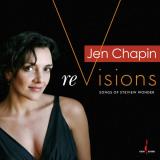
In 2008, accompanied solely by her husband, bassist Stephan Crump , and saxophonist Chris Cheek, she created reVisions in which she reimagined a collection of Stevie Wonder songs to offer social commentary on Barack Obama's historic rise to power. As much a testament to Chapin's unique artistic sensibility as a celebration of the enduring appeal and relevance of Wonder's songs, ReVisions, which also includes sensibility as a celebration of the enduring appeal and relevance of Wonder's songs, ReVisions, which also includes two self- penned numbers, puts a new spin on Wonder classics like 'Masterblaster (Jammin'),' 'You Haven't Done Nothin',' 'Higher Ground' and 'Village Ghetto Land.' Bolstered with new liner notes featuring a recent interview with Jen Chapin, ReVisions: The Songs Of Stevie Wonder is reissued in 2026 as part of the Chesky Original Masters series on 180g One Step Pressing Vinyl LP and Hybrid Stereo SACD