Limited to 300 copies. The Groove Connection formed in Medway, Kent during the early '90's, amongst the Acid Jazz heyday, playing clubs, pubs and festivals up and down the land with their urban jazz-funk grooves. The band comprised of usually six to eight members over the years, including Mark 'Bertie' Gilbert, the former (initial) bass player from The Milkshakes, and was originally an instrumental project, with vocals added later giving the band further appeal. Recording/releasing their first CD EP in 1996 (In Full Pursuit), described by Blues & Soul as 'an impressive debut set', The Groove Connection also released a 7" vinyl single in 1998 (What It Is), which was produced by respected DJ and percussionist Snowboy. A year later, their first album 'Infiltration' was released. All releases were via their own NeuJaz label. As well as working with Snowboy, the band also supported Jamiroquai twice in 1997 (at Finsbury's Jam in the Park and the Phoenix Festival), as well as playing to a full house at the Jazz Cafe, Camden on many occasions, and the band toured the UK as part of the Messin' Around Jazz Cotech collaboration. In 1999, the band found themselves on the Verve Records' released compilation 'Messin' Around Presents Root Down', alongside Lalo Schifrin, Jimmy Smith, The JBs, and Roy Ayers to name just a few. In 2001 the band recorded, and released their second album 'Back To Brooklyn', introducing vocalist Laura Knight and guest hammond virtuoso Gary Baldwin, a ten-track full-length, CD-only release. Other tracks were recorded in the same session… Two tracks that didn't make the last album were 'Can You Hear Me' and 'When I'm With You', both vocal filled, and we've decided to capture them onto two continuous 'grooves'.
Cerca:what! what! records
- A1: Silvi's Dream (Damiano Von Erckert Remix)
- A2: What I Used To Play (Roman Flügel Remix)
- B1: The Worm (Robag Wruhme Remix)
- B2: We Are (Jonathan Kaspar Remix)
- C1: Feiern (Krystal Klear Remix)
- C2: Mystic Voices (Benjamin Damage Remix)
- D1: Sven | Väth – Nyx (Pas Deep Heet Remix)
- D2: Butoh (Robert Hood Remix)
- E1: Nyx (Planetary Assault Systems Remix)
- E2: Being In Love (Harald Björk Remix)
- F1: Catharsis (Mano Le Tough Remix)
- F2: Silvi‘s Dream (Florian Hollerith Remix)
The life-affirming energy at the heart of Sven Väth‘s recent album Catharsis is revisited, reanimated, and remixed by some of the most exciting names around, closing the circle on a superlative burst of
recent work that has not only given us the epic original LP, but also the extraordinary compilation What I Used To Play.
Roman Flügel, Benjamin Damage, Robert Hood, Planetary Assault Systems, Mano Le Tough… do we need to go on? This hand-picked list of luminaries have answered the call and certainly don’t disappoint, each fusing their signature sound with Sven‘s DNA to create a wild, uncompromising companion piece to the original album.
True to form, the running order is very much rooted on the dance floor, Silvi‘s Dream, revisited by Damiano von Erckert, explodes like a Balearic sunrise. Dreamy strings with a touch of Detroit create a lovely atmosphere while the beautiful piano sound goes right into your heart and appears as if you could feel the warm sun on your skin. Roman Flügel’s acidic rework of What I Used To Play is a homage to the 80s and the early sound of electronic music which creates nostalgic feelings and offers a greatly produced retro soundscape à la Kraftwerk. Staying close to the original, but with the perfect amount of spin, it’s a symbiotic interplay of synthetic bass pads, and a tiny bell melody. Robag Wruhme’s cranking minimal funk takes us down The Worm-hole. A concise interference sound builds
up sustained tension, tangled but structured, deep and yet driving. Robag took over the deep and dirty rhythms of the original perfectly and delivers a versatile piece. This opening salvo oozes quality and
sets things up perfectly for the electrified celebration of hi-octane technology come.
Jonathan Kaspar‘s growling interpretation of We Are provides a melancholic atmosphere with fascinating percussion parts. Zaps shoot through the air like small laser pistols while we let ourselves
be carried away by the bass, the frisky vocal stutter effect is the icing on the cake. Speeding things up, the euphoric trance that engulfs Krystal Klear’s epic version of Feiern. Expansive strings increase up
to ecstasy and guide us to a love-filled unity. This remix is sure to be an excellent peak-time smasher for the open-air season. On to a wild ride of pure techno with Benjamin Damage, who delivers a dry and uncompromising Berlin Techno version of Mystic Voices. Harder pace but the string synthesizer harmony brings light to an otherwise gloomy environment. Next up is Luke Slater’s PAS Deep Heet Mix to add a retro nineties vibe to proceedings on Nyx. Entering a rough space with gigantic clap impacts, we are blessed with straightforward Techno. Shimmering and spooling, this groove hits the
mark. Then, as if it was ever in doubt, Sven‘s lofty place in the techno firmament is underlined by a peak-time contribution by non-less than Detroit legend Robert Hood. Unmistakable, you must recognize the signature Robert Hood drive on Butoh. Chord stabs fulfill the Detroit feeling with offtaking string elements and high-energy vocal transformations. It’s a warm embrace that triggers emotions. Planetary Assault Systems then blasts things ever deeper into the cosmos on a second outing of Nyx. Reduced and to the point but of course, true to form, with powerful tribal percussion parts and intensive cutting hi-hats.
From there on in, the collection gradually re-enters the atmosphere, burning with a phosphorescent, melancholy glow. Harald Björk extrapolates Being In Love into a hypnotic groove for the early hours. A playful and atmospheric electronica interpretation to soothe our souls due to disharmonious synth pads and a dreamy deformation of the original melody. Mano Le Tough harnesses the ethno-rhythms
and brooding energy of Catharsis into a low-slung, tribal stomper. Anomalous organ parts ring out and link up with a trance-like sequence, summer feelings arouse as you feel like you can almost smell Ibizan air. The collection comes full circle with a second equally seductive interpretation of Silvi‘s Dream by Florian Hollerith. Stripped-down and hypnotic, the homage to Sven's girlfriend Silvi is extended as a reverence to Sven himself. Sven's profound vocal clearly infuse time and space and leave a forever-lasting memory of love.
By accident or design, it somehow leaves us with the reassuring sense that, although this specific part of the journey may be drawing to a close, the mission of the man behind it all most definitely isn't.
written & produced by: Sven Väth & Gregor Tresher
Stephen Steinbrink discovered a short YouTube video of a street magician who approaches a highschooler walking home in Barstow, California. “Here, let me show you my idea,” he says, as he places a quarter on the kid’s hand. The magician performs some relaxed flourishes, and the coin vanishes. In silence, the kid stares at his hand at the nothing where there once, indisputably, was something, until his wonder finds a single word: “Cool.” The title of Disappearing Coin, the new album from Oakland songwriter Stephen Steinbrink, comes from this short clip. “When I look at it now,” he says, “I relate to the kid, who’s obviously uneasy in his body, and going through the experience of being a teenager in the early 2000s growing up in a bleak desert town like I did. I also relate to the coin, an inanimate disc of possibility. And I relate to the magician, an absurd facilitator of sending what is tactile and concrete into the wispy conceptual realm.” “I’ve watched it probably a hundred times,” he says. “It cracked me up but also blew my mind open the feeling of wonder I experienced watching this video became a guide as I navigated new ways of staying in the realm of what’s both real and magical.” Following the 2018 release of Utopia Teased, Steinbrink completed an apprenticeship in the nearly-lost art of Stained Glass, becoming a glazier at a studio that over three years, fully restored the enormous 90-year-old windows in San Francisco’s Grace Cathedral. He committed to his Buddhist study, beginning lay monastic training before the process was thwarted by the pandemic. He dove deeper into music production for other artists, engineering two albums by Boy Scouts released on Anti- Records in 2018 and 2021. Steinbrink delighted in the way these pursuits pulled at the thread of ego’s tapestry and decentralized him from his craft, allowing him to embody a new role as a creative caretaker engaging in practices that felt communal and restorative. “As I slowly began writing for myself again, I tried to imbue my new songs with this sense of playfulness and wonder I felt while exploring these other interests.” He says. Feeling unlocked from the pressures of perfection that he often felt in his earlier work, creating Disappearing Coin felt buoyant and healing. “The album feels like an integration of all of my past musical selves zeroing in on the present,” Steinbrink explains, “I felt free to explore new ways of writing, through different perspectives, experimenting with fictional songwriting, visual archetypal language, and total collaboration.” This “total collaboration” was a joyous new venture after years of solo performing and recording. The album can be seen as a 42 minute session of show and tell, the manifestation of Steinbrink repeating the mantra of “Here, let me show you my idea” to himself over and over. Disappearing Coin is at once a welcome return for the veteran Steinbrink and the debut of a totally new artist, one who has found a new path to himself with new goals of openness, curiosity, and self-acceptance. “Recalls the magic pop purity of Arthur Russell...its minimalism manages to feel enlightened and transformative.” PITCHFORK // “Melodic and self-assured. Steinbrink delivers his knotted lyricism with a smooth lilt.
Sophisticated, suave, and masterfully composed, this 45 is a sonic love letter to late 60s and early 70s soul, nodding to the giants of the genre and bowing to its unsung heroes. With inspiration from artists like The Moments, Baby Huey, The Delfonics, and especially the late Curtis Mayfield, this 7" is drenched in the era-defining tone that can only come from its origins on analog tape. From the first notes of the first track "Beck & Call", the songs shimmer and glow from one moment to the next like a summer's drive with the windows down, with a steady cruise anthem like "Daydreaming" floating by like a cool breeze. Friends since childhood, The Sextones are Mark Sexton (guitar, vocals), Alexander Korostinsky (bass), Daniel Weiss (drums), and Christopher Sexton (piano). Having known each other for so long, their musical chemistry is effortless and forms the foundation of the band's longevity and creative workflow. Despite their bond, each member has been able to channel their creativity into other acclaimed groups_Alexander and Mark with their cinematic-soul project Whatitdo Archive Group, whose acclaimed debut LP The Black Stone Affair was released on Record Kicks in 2021, and Daniel with the soul/jazz group Delvon Lamarr Organ Trio (Colemine Records). Flexing their creative muscle individually has only strengthened The Sextones' collective songwriting ability and heralds their formidable return to the spotlight. With their recent signing to Record Kicks, the self-made heroes of soul begin a new chapter in their sonic journey, ready to scale new heights and plumb deep emotional depths in service of the genre they love.
Attarazat Addahabia & Faradjallah's album came to us as quite a mystery. Our friends from Radio Martiko got access to the studio archive of the Boussiphone label and a reel labeled “Faradjallah” was among the items they had found there. After listening to the selection of reels they borrowed, Radio Martiko felt it was not a fit for their label and helped us licensing it from Mr. Boussiphone instead. We knew nothing about the band. We just had the reel with the music but very little information. What we knew was that the music was incredible and very unique. Gnawa sounds were combined with funky electronic guitars, very dense layers of percussions and female backing vocals more reminiscent of musical styles further south than Morocco. We started asking around whether anyone knew the band with no immediate success until we asked Tony Day, a musician from Morocco who helped us during our search for Fadoul’s family. His sharp memory came through once again, remembering all the names of the Attarazat Addahabia band members and even how to contact the bands singer and leader Abdelakabir Faradjallah. After visiting him at his home in Casablanca with our Moroccan colleague Sabrina multiple times, he shared his personal story. His father arrived in Casablanca from Aqqa at the age of six and his mother came from Essaouira. Abdelakabir was born in the neighbourhood of Benjdia in 1942. Abdelakabir Faradjallah studied fine arts in Casablanca, graduating in 1962. He also played soccer in the second team of "Jeunesse Societe One". His brother-in-law Ibrahim Sadr worked for one of the biggest football teams of the time in Morocco called "Moroco Sportive Union", which allowed him to travel to France occasionally. While Ibrahim was never part of the band he brought along a few instruments from trips.
Yet the majority of the instruments they could not afford to buy were build by Faradjallah and Abderrazak, Faradjallah's brother who passed away early. For instance they had built a Spanish guitar and a drum made of wood barrel and sheepskin by themselves.During the 1950s Faradjallah was booked as a singer for surprise parties with friends. He started to write his first songs including "L’gnawi" in 1967 and wanted to make people discover Gnawa culture, or maybe rather his take on the culture to be more exact. Faradjallah recalls his first interaction with the genre in the streets of the Dern neighbourhood, where he used to go to elementary school. Gnawa is one of the essential musical genres of Morocco. It combines ritual poetry with traditional dances and music linked with a spiritual foundation. Musically a lot of influences originated from West Africa as well as Sudan. Gnawa is usually played by a selection of specific instruments such as the qaraqab (large iron castanets centrally associated with the music), the hajhouj (a three string lute), guembri loudaâ (a three stringed bass instrument) and the tbel (large drums). People would put shells on their clothes and instruments and use incense at their parties. "Sidi darbo lalla - lala derbo khadem..." came from Gnawa verses Faradjallah used to sing when he was 14. The lyrics tackle a global (im)balance of power and the question of social status in this course. The band Attarazat Addahabia was formed in 1968. The original line-up included 14 members, all from the same family. They played their first small concerts here and there starting in 1969. Later in 1973 they performed bigger shows for instance at the Municipal Theatre followed by the "Al Massira Show" at Velodrome Stadium in downtown Casablanca. Their first album "Al Hadaoui" (the one you are listening to) was recorded at Boussiphone studios in 1972 and was never released before. Nobody seems to remember the exact reason why Boussiphone ended up deciding not to put the album out. The album's title track also served as the basis for Fadoul's "Maktoub Lah", who frequented the same circles as the band for some time.
Their shows sometimes could go as long as 12 hours, starting at 5pm in the afternoon, with an occasional break here and there. In the 1980s the band took a brief break. Faradjallah recalled the reason for that break like this: "Zaki, the bands drummer, had fallen in love with a young girl from Mohammedia. Soon after, he fell very ill. The group members were convinced that the girl had given him ‘s'hor’ (a kind of local Moroccan version of "black magic"). For four years, the whole group stopped playing. It was unthinkable to find another drummer to replace Zaki, even temporarily." So they waited four years for Zaki to "get back on his feet" before going back on stage. Apart from very few gigs here and there Faradjallah stopped playing music in the mid 1990s. Some members from the younger generations formed a new band and still play frequently to this day. Faradjallah runs a television repair shop coupled offerings beverages and snacks in the Belevedere /Ains Sbaa district of Casablanca. While Faradjallah was primarily a musician, he would work for the local cinema and paint their posters for new movies by hand and he designed all artworks and cover posters of the band.
And this eventually led to him participating actively in our first exhibition dealing with Habibi Funk’s work in Dubai 2018. He helped us by creating calligraphic complementations on large photo prints for that show.
Während sich die australischen Metal-Juggernauten Parkway Drive auf eine Welttournee vorbereiten, um ihr 20-jähriges Bandjubiläum zu feiern, kündigt Epitaph Records die Veröffentlichung der Debüt-EP der Band aus dem Jahr 2004 an, zum ersten Mal auf Vinyl. Diese erweiterte Version von Don't Close Your Eyes enthält die ursprünglichen 8 Tracks der ersten EP der Band und zusätzlich Bonustracks von ihrem Split-Album mit I Killed the Prom Queen und von den Compilation-Alben What We've Built und True Till Death, Volume I.
Parkway Drive stammen aus der australischen Küstenstadt Byron Bay und stürmten aus ihrer ruhigen Umgebung heraus, um eine explosive Mischung aus komplizierten Metal-Riffs, heftigen Breakdowns und emotionaler Hardcore-Spannung zu bieten. Mit den Chartstürmern Horizons (2007) und Deep Blue (2010) entfachte die Band regionales Feuer, bevor sie 2012 mit Atlas den internationalen Markt eroberte. Mit Ire (2015) führte die Gruppe Clean-Gesang in ihr Werk ein, und auf Reverence (2018) und Darker Still (2022) bewegte sie sich weiter in Richtung eines melodischeren, aber nicht weniger aggressiven Metal-Stils.
Parkway Drive sind auch nach 20 Jahren immer noch eine Naturgewalt und einer der Top-Headliner in der harten Musikszene. Don't Close Your Eyes lässt die Anfänge der Band wieder aufleben und ihre größten Fans werden sich freuen, dieses Album endlich auf Vinyl zu haben.
Während sich die australischen Metal-Juggernauten Parkway Drive auf eine Welttournee vorbereiten, um ihr 20-jähriges Bandjubiläum zu feiern, kündigt Epitaph Records die Veröffentlichung der Debüt-EP der Band aus dem Jahr 2004 an, zum ersten Mal auf Vinyl. Diese erweiterte Version von Don't Close Your Eyes enthält die ursprünglichen 8 Tracks der ersten EP der Band und zusätzlich Bonustracks von ihrem Split-Album mit I Killed the Prom Queen und von den Compilation-Alben What We've Built und True Till Death, Volume I.
Parkway Drive stammen aus der australischen Küstenstadt Byron Bay und stürmten aus ihrer ruhigen Umgebung heraus, um eine explosive Mischung aus komplizierten Metal-Riffs, heftigen Breakdowns und emotionaler Hardcore-Spannung zu bieten. Mit den Chartstürmern Horizons (2007) und Deep Blue (2010) entfachte die Band regionales Feuer, bevor sie 2012 mit Atlas den internationalen Markt eroberte. Mit Ire (2015) führte die Gruppe Clean-Gesang in ihr Werk ein, und auf Reverence (2018) und Darker Still (2022) bewegte sie sich weiter in Richtung eines melodischeren, aber nicht weniger aggressiven Metal-Stils.
Parkway Drive sind auch nach 20 Jahren immer noch eine Naturgewalt und einer der Top-Headliner in der harten Musikszene. Don't Close Your Eyes lässt die Anfänge der Band wieder aufleben und ihre größten Fans werden sich freuen, dieses Album endlich auf Vinyl zu haben.
Fiddlehead's third album Death is Nothing to Us is a defiant, new chapter for the band. Since 2014, the Boston-based group have been honing their unique sound, bringing together the energy of hardcore, the anthemic melodies of `90s alternative, and the unbridled passion of Revolution Summer era emo. Their previous albums, 2018's Springtime and Blind and 2021's Between The Richness, dealt heavily with grief from different perspectives, and now their latest feels like a de facto culmination, drawing together many of the catalog's through-lines sonically and lyrically. The band again teamed with producer Chris Teti for their third record, and his punchy production captures Fiddlehead's live energy while showcasing the massive guitars and undeniable catchiness that makes their music so immensely satisfying. The album's concise 27 minutes sound like a natural extension of all of the band's strengths, but is glued together by vocalist Pat Flynn's singular tuneful roar. Flynn, since his time as the vocalist of Have Heart and now as Fiddlehead's frontman, has earned a reputation as one of hardcore's most thoughtful lyricists. He interweaves his ruminations on life, death, and all the joy and tragedy in between with references to Roman philosopher Lucretius; the author Jean Améry; other musicians like Bad Brains, Alex G, or Wire, and even references to the band's own back catalog. The humanity across Death Is Nothing To Us is palpable in every note. It's the kind of art that observes pain with real honesty rather than prescribing a solution for it-and in doing so, inadvertently offers some sense of hopefulness. The album finds Fiddlehead so deeply delving into the pain, confusion, nuances, and contradictions of sadness-so willingly wrapping their arms around a concept as existentially baffling as death itself-that they've created an album that is truly life-affirming. Death is Nothing to Us exemplifies so much of what makes Fiddlehead a special band: taking these heady, unanswerable questions and wrestling with them in a very earthbound way, all wrapped up in the urgent power of a three minute punk song.
For Fans Of... El Michels Affair, Adrian Younge, Roy Ayers, Karriem Riggins, The Roots, Khruangbin. Producer "Grimez" has been making music for 20 years deep. Grimez has ghost produced tracks for 50 cent, Hi-Tek, Kool Keith, Stick man (DEAD PREZ), Killah Priest, Sadat X, MOOD & Talib Kweli, and Mighty Diamonds to name a few. Gritty & raw analog instrumentals Deep, Hard Hitting Soul-Jazz Meets Dub Instrumental Analog Grooves For Your Psyche. In few words, Doctor Bionic can be described as Instrumental b-movie psych-hop. But that doesn't tell the whole story. Doctor Bionic is the brainchild of Cincinnati's Jason Grimes, formerly the producer of the hip-hop group MOOD (with emcees Main Flow & Donte). Having grown up in the Scribble Jam scene here in Cincy, and running in circles that included artists like Hi-Tek & Talib Kweli, Grimes' music has continued to evolve from sample-based loops, to live instrumentation with deep layering; provided by a revolving door of local musicians. The common thread in most Doctor Bionic tracks are the neck snapping drum breaks, but the tempo adjustments and varying instrumentation lends itself to a collection of non-genre specific songs - held together in unity by the flawless drums, often provided by Josiah Wolf (of indie-rock band Why?). The result of these recording sessions are a masterclass in musical juxtaposition. Spacious yet clustered. Futuristic nostalgia. Ideal for long car rides or setting the vibe during a laid back gathering of friends. Also Available From Doctor Bionic: Animal Totem LP, The Invisible Hand LP
- A1: Back & Forth
- A2: Are You That Somebody
- A3: One In A Million
- A4: I Care 4 U
- B1: More Than A Woman
- B2: Don't Know What To Tell Ya
- B3: Try Again
- B4: All I Need
- C1: Miss You
- C2: Don't Worry
- C3: Come Over (Feat. Tank)
- C4: Erica Kane
- D1: At Your Best
- D2: Got To Give It Up (Remix)
- D3: We Need A Resolution (Feat. Timbaland)
- D4: Rock The Boat
2023 Repress
I Care 4 U is the first posthumous compilation album by the "Princess of R&B," Aaliyah. Following her tragic and untimely passing, Blackground Records released a posthumous record including songs from her studio albums and previously unreleased tracks and demos, as well as hit singles and recordings that ultimately did not land on any previous albums. The compilation album was a commercial success and debuted at number three on the Billboard 200 and was certified platinum. It features the previously unreleased "Miss You."
- A1: What In The World
- A2: Alive
- A3: Hero
- A4: The Good
- A5: Day Off
- A6: A Window
- B1: I Might Be In Love
- B2: Sweet Sarah
- B3: Tears
- B4: You're Not Here
- B5: Glowing Up
- B6: Mama
it ihrem Debütalbum „Ch. 1, Vs. 1“, einem modernen Soul-Pop-Album von Weltklasse, zeigte Cynthia Erivo, Hauptdarstellerin der Erfolgsserie „Aretha“ (Disney Plus), der Bühnenversion
von „The Color Purple“ und diverser erfolgreicher Hollywoodfilme, erstmals ihr Riesentalent als Sängerin und Songschreiberin.
Auf Wunsch ihrer Fans erscheint es jetzt auch als LP!
- 1: Aeons 03:30
- 2: Will Of The Beast 03:5
- 3: Golden Tombs 0:09
- 4: I'd Like To Rule The Ice Age 03:21
- 5: Burnt Shadows 03:27
- 6: Love In Toxic Wasteland 03:13
- 7: Headless Pin Up Girl 04:0
- 8: Most Of What They Pour On Me Is Scorn 03:2
- 9: Killer Bees 03:0
- 10: Deranged 03:30
- 11: Digitalis 02:35
- 12: Forever Watching The Skies 03:46
The legend that is Acen returns after the incredible success of his Trip To The Moon box set with an absolutely epic single "Champion". This new track heralds his upcoming Monolith box set, and is exactly what you would expect from Acen. With a sound like it just came out a few months after Trip To The Moon - which is to say, both forward thinking and timeless, this is heavy beats, classic stabs, ruff bass and proper original rave stabs as only Acen can bring. With flipside remixes from Innercore and Jimmy J & Cru-l-t, this single will be gone before you can imagine it....
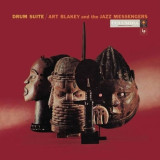
One of the inventors of the modern bebop style of drumming, Blakey is known as a powerful musician and a vital groover; his brand of bluesy, funky hard bop was and continues to be profoundly influential on mainstream jazz.
For more than 30 years his band, Art Blakey & The Jazz Messengers included many young musicians who went on to become prominent names in jazz. Recorded in 1956, Art Blakey's Drum Suite is a wonderful hybrid of African, Latin, and hard bop rhythms that prefigures the concept of Afro-beat by at least a decade. The sheer energy, not to mention its very special and fresh-sounding intimacy, make it especially astounding.
Even more amazing is that the three parts of the suite -- Blakey's "The Sacrifice," Ray Bryant's "Cubano Chant," and Oscar Pettiford's "Oscalypso" -- were recorded straight through live, and were only intended to be a pre-take run-through. As is obvious here, Blakey and company nailed the whole thing right out of the box.
Groundbreaking for its time, and still sounding vital, powerful, and visionary, the Drum Suite album is somewhat of a lost masterpiece that deserves a fresh audience.
"Art Blakey's first release for Columbia Records is essentially two records. Side one is a percussion ensemble playing what would, ten years later, be called Afro-Cuban drumming. Side two is the mid-fifties version of the Jazz Messengers featuring Jackie McLean on saxophone. Side one features Blakey, Jo Jones and Charles Wright on drums, Candido and Sabu on bongos, and Oscar Pettiford and bass and cello. The group plays three compositions, one by Blakey, one by Pettiford and one by Ray Bryant, fusing African, Cuban, and calypso percussion into a well-integrated suite.
"The group recorded a run through and it was so perfectly executed that they used the practice run for the release, unedited except to add some Swahili chants by the percussionists during a few passages. One cannot help but think of Olantunji's Drums of Passion, another Afro drumming landmark, here. Blakey's drum suite was recorded at Columbia's 30th Street studios in New York in 1957 and is in mono. The almost stereoscopic image is truly remarkable. Mastered by Kevin Gray and pressed at RTI, Drum Suite is a valuable record of one of the most important figures in jazz history. Recording: 9/10. Music 9/10." - Dennis Davis, Hifi+
"...The three-part suite was laid down in one take with no arrangements, and begins with a few tympani thwacks followed by an African chant. Soon the ensemble kicks in and the group takes off an a sweaty Afro-Cuban-bop journey that will leave you breathless, as the thing crackles with terrific energy. Side Two is more conventional hard bop, but given this group's mastery of if not invention of the style, these tracks are extremely satisfying. Kevin Gray's remastering is detailed and immediate, with plenty of bit and air, if not the widest dynamic range. For anyone interested in percussion of this genre, this is not to be missed." - Wayne Garcia, The Absolute Sound
- 1: History (Extended Version) 03:37
- 2: Then You Run 01:7
- 3: The Pool 01:0
- 4: Daydream 01:56
- 5: Stink's Dream 01:41
- 6: Uncle Reagan 01:17
- 7: Teamwork 01:45
- 8: Stand Off 01:31
- 9: A Great Artist Knows When To Stop 02:01
- 10: For Mirko 01:25
- 11: Herd 02:57
- 12: Two Minds 04:09
- 13: Closer 02:15
- 14: Fingertip 01:25
- 15: The Hotel 03:55
- 16: I Know Him 01:51
- 17: Death Drive 02:12
- 18: In The Blood 02:02
- 19: Summer's Not Over 03:31
GAZELLE TWIN - aka composer, producer, singer, and visual artist Elizabeth Bernholz - has scored Sky's brand new TV series "Then You Run".
Created for television by Ben Chanan (The Capture), based on the novel YOU by Zoran Drvenkar, Then You Run follows four rebellious London teenagers on a city getaway to Rotterdam. This contemporary eight-part series boasts an incredible cast of rising stars; Leah McNamara (Normal People) as Tara, Vivian Oparah (Rye Lane) as Stink, Yasmin Monet Prince (Hanna) as Ruth and newcomer Isidora Fairhurst as Nessi.
The four friends embark on what should have been the perfect summer break which soon spirals into a dark and perilous adventure. When their attempt to take on some of the most dangerous people in Europe doesn’t quite go to plan, they find themselves on the run with three kilos of heroin, more questions than answers about Tara’s family, and a gang of deadly criminals tracking their every move.
Invada Records have previously released two recent Gazelle Twin scores (2020’s Nocturne and 2021’s The Power).
Her 2018 acclaimed album Pastoral was described by Pitchfork as “...belonging to a proud tradition of English satire, plumbing the depths of the nation’s psyche and twisting it to wryly discomforting ends”.
Baxck in stock! PRESSED ON RED & GREEN OPAQUE VINYL! De La Soul and A Tribe Called Quest may have been more commercially successful, but the afrocentric, jazz political rap movement and unfadeable Native Tounge Massive started with the Jungle Brothers. Their debut full length “Straight Out the Jungle” opened up many doors that are walked through by today’s artists like Mos Def, Common and even Kanye West. Their taste for jazzy horn samples helped kick-start the entire jazz-rap movement, and their James Brown fixation was one of the first. Plus, the group’s groundbreaking collaboration with legendary house producer Todd Terry, “I’ll House You,” paved the way for numerous hip-house hybrids that shot up the dance and pop charts over the next few years and appeared to be a staple on every East Coast Rap Album from ‘88 until ‘92. The opening track “Straight Out the Jungle” samples the classic Bill Withers drum break as the JB’s tell you where they are coming from. “Black Is Black” (featuring a young Q-Tip) and “Sounds Of The Safari” introduces the pro-black edge, while the sexually subtle classics “Jimbrowski” and “I’m Gonna Do You” are funny, clever and timely. Hard, smart, fun, clever and brilliant, Mike G., Africa Baby Bam and Sammy G may not have realized it but they crafted a classic rap album that stands the test of time. Available here on high grade, loud pressed, double vinyl for the first time ever!
- 1: All I Can Think About 0:47
- 2: My Year (This Is Going To Be) 03:03
- 3: Private Spies 04:2
- 4: Comfortable Situation 05:11
- 5: The Beating 03:48
- 6: Hide Without Delay 05:13
- 7: Twice 04:41
When Ryan Olcott, songwriter and frontman of Twin Cities’ iconic indie rock band 12 Rods, found unfinished Rods demos during lockdown, he was surprised. When he realized they were good, he was shocked. He quickly set to finishing and recording the compositions, which became If We Stayed Alive, the first 12 Rods album in twenty-one years. “These are songs that I forgot about,” he explains, “but upon finding them, I thought, ‘Wow, these are actually okay.’” That was the easy part. Reacquainting himself with twenty-year-removed craft and technique took some getting used to -- some parts longer than others. He recorded all the instruments in a week, but vocals took a bit longer. “Oh my god!” he laughs, “it took a couple days to get my voice back with that range and that power, but I could do it.” Any cobwebs that needed dusting are long gone. If We Stayed Alive is everything longtime fans have wanted, and the perfect introduction to what some called “America’s Radiohead" and what others have called one of the best indie bands of the ‘90s.
Freak Frequency was a fitting title for the new material Greg Obis was planning for Stuck, the frenetic and twisted post-punk outfit he formed in 2018. Inspired by the doomy social economics of Mark Fisher’s Capitalist Realism, the bleak worldbuilding of horror games Demon’s Souls and Bloodborne, and the bombastic yet arty satire of Devo, Obis channelled his audio analogy into Freak Frequency, an album ringing out with explosive sounds and ideas.
Stuck formed after Obis’ previous projects, Yeesh and Clearance, called it quits in short proximity. Obis is on guitar and vocals, which span from booming theatrics to ecstatic yelps. The project’s rhythm section is completed by shoegaze guitarist-turned-chugging bassist David Algrim and tightly wound drummer Tim Green—also a graphic designer, and the artist responsible for Stuck’s distinctively unified visual aesthetic. Original co-guitarist Donny Walsh contributed freely inventive lines for the first few years of the project, including on Freak Frequency; Ezra Saulnier of Red Tunic, the newest member of the band, now brings calculated contrapuntal riffs to match Obis’ parts.
The building blocks of Stuck include the egg punk eccentricities of Uranium Club and The Coneheads filtered through noise rock power, à la Jesus Lizard or Slint; that melange is glittered with the precision microtones of Unwound and Women. “I want the feeling of immersion and chaos and tension, with a big guitar amp playing a big chord,” says Obis of his inspirations, citing friends and peers Cloud Nothings and Preoccupations. “But I want it delivered by having a lot of smaller points of light poking through.”
In fact, writing for Freak Frequency began while Content’s recording was still underway—beginning with “Scared,” which features acoustic layers under feedback squalls. “Time Out,” with motoric guitars in the sputtering lineage of Wire, was also composed in late 2019. Obis wrote it about the cycles of compulsion and shame woven into social media use, and the way negativity drives algorithmic engagement. It became an exciting exercise for the group in ramping up speed; “I thought I knew how far I could push Tim’s tempos,” Obis recalls. “But Tim kept insisting we do it 20 bpm faster than what I had. He is an absolute monster for playing that.”
Album opener “The Punisher,” a spiral staircase of disembodied guitars and rhythmic slams over a 2/4 beat, came in the aftermath of the January 6 insurrection. It felt immediately emblematic to Freak Frequency, and Obis describes it as his favorite Stuck track: one he wishes he could write again and again. “It hits all the boxes that Stuck can do: it’s goofy, but there’s a lot of intricate guitar interplay, and at the end, there’s a big payoff,” he explains. The last song written was “Do Not Reply,” a pre-album single that came to Obis after engineering for Melkbelly and channelling their earworm melodies. Algrim wouldn’t let it on the record unless Melkbelly’s front person Miranda Winters dueted on vocals; she was happy to oblige, and the gritty epic closes Freak Frequency.
With slippery snark, percussive heft, and funhouse mirrors of sludge, Freak Frequency delivers its needed screeds with gratifying nuance. If Stuck’s interpretation of this messed-up world goes down like a bitter pill, it’s only because its sugar coating is too delicious to keep from eating.
Codek is the brainchild of Jean-Marie Salaun who grew up in Paris influenced by the folklore of the inner city. In 1978 he joined art rock group SpionS and collaborated with Robin Scott (M 'Pop Music'). He began working as Codek, a play on the brand name Kodak with the 'Me Me Me' single released in 1980. In 1981 the 'Tam Tam'/'Closer' single was released on West African Music, a tiny label from the Ivory Coast, and re-released a year later by Island Records in the UK (where the B-side was re-named 'Tim Toum'). 'Tam Tam' was inspired by Burundi drummers playing in the plaza in front of Beaubourg where the song was recorded. Jean-Marie enlisted one of the drummers from the circle, Georges Atta Dikalo, to lay down percussion for the song. The female singers were from the French Caribbean and added falsetto tribal chants. Claude Arto achieved complex rhythmic patterns using a modular synthesizer and heavy processing. Jean-Marie recorded himself beating his chest for the thump noises. The recording of spanned over two years. They started on 16-track in Studio d'Auteuil, where Jean-Marie blew the woofers, before resuming in Studio Centre Georges Pompidou with an added 8-track recorder.
In 2017 we reissued the 'Tam Tam'/ 'Closer' single and shortly after the 24-track master tapes were discovered in Paris by original engineer Gérard Chiron. We arranged for graphic designer Maycec to pick up the tapes and immediately began to think of remixers for this project. First up is producer and DJ Daniele Baldelli who gave the original single a spiritual home in the Cosmic 80s scene of Italy. Here he's teamed up with Marco Dionigi for two remixes. Remix A goes full on funky disco baseline while Remix B a more balearic affair. We remember Justin sharing a memory of DJing the original Island Records promo at the Mudd Club in 1981 so we had to ask him for remix. He teamed up with his Whatever/Whatever production partner Bryan Mette and delivered an hypnotic pulsing house remix and an extended edit. All songs have been mastered for vinyl by George Horn at Fantasy Studios in Berkeley. The jacket is new twist designed by Eloise Leigh on the 1981 edition artwork by Angela Boy, inspired by primitive electronics and African paintings.
A complex and sometimes belligerent character in real life, on record,
John Martyn was the epitome of the folk-dreamer, embodying the spirit
of the bourgeoning London acoustic scene of the late 60s
Well- known and respected for his 70s albums Solid Air and One World, this is
where it began.The second and final John and Beverley album, The Road To Ruin
came out in late 1970; it is a mature, fully realised work, and a glimpse of what
would have happened had Island not encouraged John to go back to being a solo
artist. Opener Primrose Hill was later sampled by Fat Boy Slim, and the John-led
Parcels offers a template for what would become his signature style as the
decade progressed. It is one of those rare albums that creates its own
atmosphere, late night intensity, middle age soul.
This re-issue faithfully replicates the original 1970 Island Records UK release and
is pressed onto high quality 180g vinyl.