With such a raft of quality music coming across the Summer from NuNorthern Soul, we thought we would put together an EP of some of the tracks featuring across the upcoming months...
We have taken our favourite tracks from various digital releases and present them on one vinyl 12" EP On the A side we take Nick J Smith's 'Waves Take Hold' from the Waves Take Control EP'
'Waves Take Hold', is a kaleidoscopic, life-affirming exercise in late 1980's style Italian Dream House, that's so warm and rush-inducing that it's likely to get the hairs on the back of your neck standing to attention.
Full of ricocheting drum machine hits, sun-bright lead lines, elongated chords and rich bass, it sounds like it was tailor-made to soundtrack sunrise in Rimini...
Bonnie & Klein 'Ocean Leap' taken from the Ocean Leap EP
There's a deeper and dreamier feel to the 'Ocean Leap' track, whose bubbly melodic motifs and synthesizer panpipe flourishes offer subtle nods towards 1980's Greek new age electronic composers such as Vangelis Katsoulis amd Dimitris Petsatakis.
Bonnie & Klein's synthesizer-heavy melodiousness comes accompanied by dub disco strength bass and undulating, off-kilter drums, but retains the rush-inducing bliss associated with the pioneering work of their Greek predecessors.
AA is given up to the 10 minute + track from Mirage: 'Endless Ocean' taken from their Reflections of the Sun EP.
'Endless Ocean' is a slowly building masterpiece. After a hushed, atmospheric opening, the track bubbles away on waves of hazy bongo beats, lapping water sounds and seductive chords before rushing skywards in a swarming swirl of trance-style synthesizer lead lines, echoing electronics and picturesque piano motifs.
Поиск:whos who
Все
Eno Williams, frontwoman of Ibibio Sound Machine, uses both English and the Nigerian language from which her band's name is derived for the dazzling new album Doko Mien. Long lauded for jubilant, explosive live shows, Ibibio Sound Machine fully capture that energy on Doko Mien, the followup to their Merge debut Uyai.
In a glowing piece in the New York Times, those songs were praised for following 'in the tradition of much African music, [making] themselves the conscience of a community.' By pulsing the mystic shapes of Williams' lines through further inventive, glittering collages of genre, Ibibio Sound Machine crack apart the horizon separating cultures, between nature and technology, between joy and pain, between tradition and future. That propensity for duality and paradox seems common in people whose lives span continents.
Williams was born in the UK, but grew up in Nigeria, always steeped in her family heritage. She obsessed over West African electronic music, highlife, and the like, but was equally empowered by Western genres such as post-punk, disco, and funk. The London octet have enveloped themselves in that maximalist quilt proudly since their 2013 formation. Though it can often bring with it news of stress and uncertainty, the modern world further brings all these disparate traditions into connection.
'Everyone has everything now,' says multi-instrumentalist Max Grunhard. 'Everyone has immediate access to every genre, picking things up from everywhere—like magpies.' And while they haven't suddenly left their African roots behind, Doko Mien does find increased representation of English lyrics in the ratio. By sharing more directly with more universal lyrics, the record feels more anthemic, reaching for grander heights.
'We wanted to give people a reason to sing along, to find their soundtrack every day,' Williams says. 'We wanted everyone to feel as if they're part of the music as well.'
Late album highlight 'Guess We Found a Way' addresses the change with a coy smile. 'Guess we found a way to speak to you/ Guess we found a way to say what's true/ To say what's real,' Williams coos over glistening chains of reverberant synth and diamond dust percussion, before returning to Ibibio in the chorus. Perhaps the best example of the group's ability to convey meaning across language and tradition, to blend past and future into a singular present comes on 'She Work Very Hard'. The traditional Ibibio folk tale bobs over the waves of tuned percussion, chunky synth, and pinprick highlife-esque guitar, while Jose Joyette's drums and Derrick McIntyre's bass funk groove bring everyone to the dance floor. 'These stories won't be forgotten. Feel the music: it speaks to everybody,' Williams says. 'We can travel back in time together, while convening on a futuristic, present tense. We hope that we can give people that reason to wake up, that one song to sing and dance and be happy.'
Doko Mien: Tell me everything. On their new album, Ibibio Sound Machine provide the perfect companion, ready to digest as much as possible and then further unfurl beauty and hope. They remember and honor the past and charge forward toward the future, all while intensely expanding the present.
Repress available in early May.
Faitiche releases a new collaboration between the Japanese sound artist ASUNA and Jan Jelinek: the album Signals Bulletin brings together joint improvisations and compositions made over a period of three years in Berlin, Kyoto and Kanazawa. ASUNA’s meandering organ drones merge with Jelinek’s pulsating synthesizer and field recording loops to create dense superclusters that span broad harmonic arcs.
"Watching the Japanese sound artist ASUNA playing the organ, some people might be surprised. ASUNA is no virtuoso flying over the keyboard in a rage. Instead, with the calm gestures of an office worker, he cuts strips of adhesive tape to the correct length before sticking them onto the keys of his instrument. In this way, large clusters of keys are held down, creating a dense and sustained range of frequencies, while the sound artist continually prepares further sets of keys or removes tape again. I have rarely seen a more convincing performance concept, with such a power to fascinate.
I first met ASUNA when we both gave a concert at the 21st Century Museum of Contemporary Art in Kanazawa, his home city. He performed the organ drones as described above and I immediately knew I wanted to collaborate with him. Six years and five meetings later, we completed Signals Bulletin. The album includes both joint improvisations and compositions, recorded in Berlin, Kanazawa and Kyoto.
Whether using prepared organ, Casio keyboards or mechanical plastic toys, ASUNA creates rich textures of sound that barely change over long stretches of time. It is a music without breaks. For a while, I was unsure how my loops made using modular synthesizers and live sampling fitted here – until I realized the role I had to take in this duet: I would provide the rhythmically pulsating foundation over which his dense continuums could unfold.
The result is harmonically drifting superclusters that put us into a meditation-like state. It can perhaps be compared to Automatic Writing – a mode of creative expression floating somewhere between concentration and distraction. Both the structure of our pieces and our approach to our instruments allow a similar “absence”: we let the machines play and repeat themselves – while we, in a mild form of trance, adopt the role of observers, intervening only occasionally.
It is no coincidence that ASUNA owns a collection of Doodle Art – drawings jotted down during conversations or while talking on the phone. It is said that works made like this point to the unconscious and reveal pet motifs – because a doodler always inadvertently returns to his or her favourite themes. The artwork for Signals Bulletin features pictures from the collection, in this case sheets of paper from the pads provided in stationery shops to test out pens. The special quality of such doodles is that the jumble of drawings is the work of a collective whose individual members do not know each other. Layer by layer is added, by someone different each time – until it becomes a dense cluster of lines and symbols ..."
Jan Jelinek, Berlin 2018
Back in 2007 Names You Can Trust was launched with an EP from Greenwood Rhythm Coalition. For NYCT's landmark 50th single release, the group returns, drawing on the same long-simmering stew of African, Caribbean and American funk and dancefloor vibes that flavored that first release, but with a sound more deeply infused and farseeing than anything they've done before. The spacey, arcing cut is woven through with guitar that blurs the lines between western twang and soukous popcorn and anchored by cabinet-rattling low end. Spread over two sides of a seven-inch single or available in unedited form digitally, "Jewels" is hypnotic and quite uncategorizable, except to say that sitting still will not be an option when it spins. Adventurous DJs, headphone journeyers, underground dancers, postmodern tropicalistas, and all those whose musical tastes dwell somewhere in the magical twilight of imaginary cities, take note.
Rain&Shine proudly present Steve Elliott's first album -True Image (1981). After failing to find musicians with the same direction and devotion to music he had acquired, Steve taught himself to play eleven different instruments and move from hometown of Pasadena, California to Denver Colorado.
Eager to express his musical ability, Steve became a DJ on KDKO radio, and would then go on to compose, arrange and perform True Image on September 20th 1981 with a collection of drum machines, synthesizers, and contributing musicians on rhodes, flute, guitar and vocals.
Mr. Elliott's philosophy is 'You hold in your hand a dream, a dream come true by a man whose only objective was to express the love he contains, the love we all contain within through music.'
On many collectors want lists, passing for a median price of $450 online.
Having previously collaborated with the likes of Shafiq Husayn, Chester Watson and Foreign Beggars, electronic space funk outfit Paper Tiger return from an explorative journey to the dark edges of the cosmos with their long-awaited third album ‘Rogue Planet’.
The Leeds and London-based outfit (whose collective playing credits include Yellow Days, Werkha, Nubiyan Twist, Cinematic Orchestra & more) once again seamlessly combine elements of live recording and improvisation, their emphasis on blending organic sounds with electronic production techniques. The result is music which is interesting and technically proficient, but remains vibrant, colourful and funky -captivating both in headphones and on the dancefloor.
Just like the journey from debut long-player ‘Laptop Suntan’ to sophomore album ‘Blast Off’, and in-keeping with the band’s space travel fascination, ‘Rogue Planet’ is a cosmic leap from its predecessor. Band leader Greg Surmacz explains: ‘There is still humour and a sense of playfulness hopefully -largely provided by our MC Raphael Attar -but the overall sound is much more lush, jazzy and soulful. We wanted to make something that fits into our universe but hits a deeper emotional nerve’.
With diverse guests ranging from the legendary Steve Spacek on lead single ‘The Cycle’ to Olivia Bhattacharjee (the vocalist of Gondwana Records-signed Noya Rao) on the shuffling, leftfield beats of ‘Bioluminescent’ and Chicago-born but LA-based MC Lando Chill’s quick-fire delivery on the ironically titled ‘Slow Motion’ the album is a rich and varied listen. It’s a record drenched in futuristic soul, brimming with textured samples and intriguing progressions demonstrating the enviable musicianship on show here. G-Funk-esque melodies run throughout, joined by reverberating celestial horns and scattered drum patterns.
- A1: Throbbing Gristle – Dead On Arrival
- A2: Deutsch Amerikanische Freudschaft – Der Musolini
- A3: Cabaret Voltaire – Walls Of Jericho
- B1: Polyphonic Size - Zas
- B2: The Neon Judgement - Chinese Black
- B3: Da Davo - Sex Head
- B4: Borghesia - No Hope No Fear
- C1: Chris & Cosey - Exotika
- C2: Click Click - Headf
- C3: Front 242 - Body To Body (1988 Mix)
- C4: The Cassandra Complex -One Millionth Happy Customer (Ebm Mix)
- D1: The Weathermen - Poison (Lethal Mix)
- D2: Nitzer Ebb - Control I’m Here (Strategic Dancefloor Initiative Mix)
- D3: Meat Beat Manifesto - Radio Babylon
Electronic Body Music, abbreviated as EBM, is a term whose origin stems from the Belgian group Front 242, chosen to describe their electronic music; cold and dancing, free of the dominant influences of the time. Powerful, cold and minimalist electronic rhythms were the hallmarks of this new genre.
The movement quickly garnered followers with the British group Nitzer Ebb but also in the rest of Europe, with the likes of Borghesia and The Neon Judgment, later signed to labels like PIAS, Antler- Subway, Wax Trax!, Mute, Off Beat, Zoth Ommog, Pendragon and Metropolis.
EBM’s popularity grew rapidly in the underground scene during the 1980s and early 1990s, especially in Europe, before breaking through in the rest of the world, also influencing the subsequent electro-industrial scene.
‘Dancing In Darkness: EBM, Black Synth & Dark Beats From The 80s’ - to give it its full title - is a compilation of some of these bands; bands that changed contemporary music in terms of ideology, politics and aesthetics.
CD version in digipack with poster booklet. 2LP version in gatefold sleeve.
Alt-rock icon Josephine Wiggs is best known as bassist in The Breeders, rising to superstardom in the '90s and continuing to draw crowds and critical acclaim in the wake of their 2018 album All Nerve.
But over the years, Wiggs has released several of her own albums, all of which delightfully defy genre. Her new solo record, We Fall, is both a departure and a distillation of an enduring personal aesthetic: moody and spare but also melodic, at once contemporary and nostalgic.
Some influences are clear: We Fall is reminiscent of the experimentalism of Brian Eno's Another Green World and recalls the delicate, languid minimalism of Harold Budd. The album's classical inflections, sharpened by a dialog with electronic elements, evoke Alva Noto and Ryuichi Sakamoto. This is an album of juxtapositions: minimalist at moments, richly layered in others; ambient while also sharply focused; melancholy yet resolute.
There's something both dreamy and scientific about We Fall. Wiggs, an enthusiastic amateur mycologist, has an impressive collection of mushrooms she's photographed in her travels. We Fall could be the soundtrack to what can't be captured in a single photo—the growth and decay of miraculous creatures that a less astute and sensitive eye might overlook entirely.
Composed, performed and recorded by Wiggs, with drums and electronics by her longtime friend and collaborator Jon Mattock (Spacemen 3, Spirit , We Fall is a lyrical, bucolic album with an undercurrent of disquiet. Think of a wintertime walk in the woods as dusk falls too soon. True to the classic album form, the 10 almost entirely instrumental tracks on We Fall form a compelling whole: a crystalline meditation on paths not taken and words unspoken, an elegy for moments lost and last embraces.
JOSEPHINE WIGGS BIO
Josephine Wiggs grew up in an unconventional family north of London. Returning home from a summer holiday with a donkey riding in the back of the family's 1927 Rolls Royce was not considered at all bizarre. Wiggs studied cello as a child, segued from college in London to undertake a master's degree in Philosophy, and then, in a move few would have predicted, joined a rock band.
After making three albums with The Perfect Disaster (1987-1990), Wiggs left to join Kim Deal (Pixies), Tanya Donelly (Throwing Muses), and Britt Walford (Slint) in forming indie supergroup The Breeders, whose debut album Pod came out in 1990. Following a shift in line-up—with Kelley Deal on guitar and new drummer Jim Macpherson—The Breeders released Last Splash in 1993; with its hit single 'Cannonball' and 'Divine Hammer,' they became alternative rock superstars.
During the same period, Wiggs released two lower-key albums with Jon Mattock (Spacemen 3, Spiritualized): Nude Nudes (1992) under the name Honey Tongue, and Bon Bon Lifestyle (1996) using the moniker The Josephine Wiggs Experience. She also recorded and produced Klassics with a K (1996), the beloved and only album by the Kostars (Luscious Jackson's Jill Cunniff and Vivian Trimble). During a brief run of shows, Wiggs joined the band on drums, showing her range of musical ability.
In the late '90s Wiggs collaborated with Vivian Trimble as Dusty Trails, whose eponymous 2000 album is an homage to neo-noir soundtracks, spaghetti westerns, and Gallic pop. Time Out described it as 'one of the most subtly suggestive, understatedly elegant...things likely to have caressed your cochlea in years.'
Allusions in Dusty Trails to film music foreshadowed the next stage of Wiggs's career, writing scores for feature and documentary films—from Happy Accidents by Brad Anderson in 1999 to Appropriate Behaviour by Desiree Akhavan in 2014. Her new album We Fall began as a suite of short pieces for the documentary film Built on Narrow Land. Wiggs has also composed and recorded music to accompany live performance and short films by the acclaimed Brazilian choreographers chameckilerner.
In 2013, following the 20th anniversary of Last Splash, the classic lineup of The Breeders reunited for a world tour. Five years later in 2018 they released All Nerve, with Wiggs co-writing two songs and singing lead on the standout track 'Metagoth.' We Fall, Josephine Wiggs' third album of her own design and ninth album in a career spanning three decades, will be released on vinyl and available for download and streaming on April 12, 2019 by Sound of Sinners.
A new addition to the label’s extended family, Tracey arrives on Dial with his debut LP, Biostar. Following previous releases on Aus Music, Voyage Direct and Intergraded, ‘Biostar’ pushes the technical and emotional craft of this vital young producer in exciting new directions, submerging listeners in thirteen tracks of sublime electro, ambient experimentation and warm, tonal techno. Based in the Netherlands, Tracey’s music is undoubtedly indebted to a legacy of emotive electronic music, the sort whose stark futurist vision cannot be equalled. Instead he strives and succeeds to create something personal and charismatic from a perhaps familiar palette of sounds. Somewhere between experimentation and understated songwriting, ‘Biostar’ is a worthy edition to Dial’s legacy of unique, artist-led albums. In the tradition of established Dial artists such as Lawrence, Roman Flugel and Efdemin, Tracey’s immediately apparent strength is an almost supernatural ability to conjure affecting and memorable melodies with minimalist intent, often just utilising the raw textures of his machines. From album-opener ‘THRRVL’, Tracey tracks the initially gentle undulations of his studio seemingly waking to life, plotting a neat melodic shuffle on ‘TRR’ and then, by, ‘CCLRT’, something dense, trippy and yearning. From hereon in, ‘Biostar’ plots an intriguing course through hypnotic, clockwork crunch (‘THWRD’), to Drexciyan submersion (‘HDRCSTCS’) and rhythmic experimentation on ‘PHTCPHRK’. Some of the more affecting moments on ‘Biostar’ emerge from it’s more obtuse sections; ‘DTFNK’ deciphers a surprisingly catchy melody among waves of scrambled signals, while the initially skittish ‘DRMRBT’ blossoms into an electro lullaby at 126bpm. By the arrival of wistful closing track ‘CLSTLBNG’, listeners are likely to emerge content from the deepest exploration yet of Tracey’s unique analogue ecosystem.
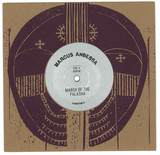
ZamZam 70 is our first team-up with the man of mystery known as Marcus Anbessa. An enigmatic figure whose identity must remain secret for the time being, his infrequent releases on labels such as Lion Charge, Tribe 12, and The Most High (as “Unknown Artist”) are eagerly awaited by those who know, charting an uncompromising vision down a path untrod by the weakheart or the follow-fashion. We love music that builds its own sound world with only passing reference to familiar genres or signposts, music that believes in itself utterly - for this reason we feel genuinely blessed to present these two sides.
“March of The Falasha” is pure roots music that, firmly planted in the soil of dub and sound system, reaches back even further into the mists of time through technological means. Downbeat steppers is the idiom, pure heartbeat is the pulse. Like an old soul young in years but full of wisdom, a distorted flute melody wanders ahead through the undergrowth of bass, light filtering through the ancient canopy above in the form of swung percussion and flickering echoes overlapping and intertwining like vines and creepers weaving on temple walls. Ancient-to-the-future.
“Creator” strikes a different yet equally dread chord, 140-ish post-apocalyptic Rasta business focused squarely on bass and space, hard, insistent drums and infinite echo trails flinging from the snares and percussion, creating hypnotic tracers like sparks swirling heavenward from a well-tended fire in blackest night.
Imagine African Headcharge on Jah Tubbys, or a rootsman groundation resuscitating ancient machines in the crumbling ruins of a near-future world and you begin to see what Marcus Anbessa brings. This music reminds us that nature herself will some day claim Babylon and grind it to dust, regardless of our efforts to save it or hasten its fall.
mule musiq's sub label studio mule has formed a group of shifting members and are now releasing a debut album with 8 tracks of reworked obscure japanese gems.
the album contains the three singles the group released so far, featuring miyako koda of the ex-perimental pop band dip in the pool -- whose "on retinae" was reissued by music from memory to great acclaim -- on vocals and mule musiq staple kuniyuki on production with direction by label head toshiya kawasaki.
one of them, "carnaval," is a cover of the japanese dance classic by taeko ohnuki, produced by ymo. "shinzo no tobira" is a remake of the track by mariah, a band led by sax player yasuaki shi-mizu, from their album utakata no hibi -- which was one of the reissues that sparked the global interest in obscure japanese music in the last few years. studio mule's version features japanese lyrics rewritten by miyako koda. "face to face" is a cover of the ambient pop gem from the ultra rare album desire by yumi murata of mariah -- an album visible cloaks is a fan of.
also included is a rework of "kagami no naka no jugatsu," a song by tamao koike produced by ymo, turned into a dubby balearic pop track -- dubbier than the version included on the yen label compi-lation -- sang by nanako sato, one of the artists enjoying some newfound success following a string of reissues stemming from the "city pop" revival craze. the oriental ambient pop "yugao" by singer songwriter mioko yamaguchi is covered by vocalist saho terao, whom some describe as this gen-eration's taeko ohnuki.
"the april fools" is a rework of yukihiro takahashi's track, which itself was also a cover of the origi-nal song by burt bacharach. this new version boasts a more experimental arrangement with nanako sato handling the vocals. ymo's "ballet," originally with vocals by yukihiro takahashi, was reconstructed into a dance floor-ready instrumental by kuniyuki. many say yoshiyuki ohsawa's "soshite bokuwa toho ni kureru" is one of the greatest songs of the '80s. the 12" dance version is reshaped here into a melancholic balearic house track.
the album cover is by the increasingly popular hotshot photographer kota shouji.
Oliver Doerell is putting out an album that sounds like a late electronica manifesto. As CUMMI FLU, Doerell mainly does sound design. There is not a sound on Z that has been included by chance. A puzzle whose pieces do not always fit seamlessly together. Some go over the edges a little bit, giving an overall impression of unevenness. And this blurring or ambiguity is what makes Doerell's music so special.
The first release on a new label: Pura Vida Sounds founded by Guts, in conjunction with Heavenly Sweetness. El Tipo Este is a pioneer of Hip Hop in Cuba and Al Quetz, a leading French beat maker.
This canny combo have drawn from the local musical currents, absorbing Afro-Cuban sounds, adding the freedom of jazz, the metronome of hip hop and a healthy bass shake of neighbouring island Jamaica.
For Cubans, El Tipo Este is the pioneer of all things hip-hop. As founding member of Obsesion, one of the nation's most notable hip hop exports. Early champions of his music included Gilles Peterson, who selected a track
to include in his 'Havana Cultura; New Cuba Sounds' compilation. Hot off the heels of this, El Tipo Este was enlisted to assemble the full band of musicians for the Havana Cultura tour. This unit played stages across Europe, USA and
closer to home in Latin America, and in turn this led to collaborations with The Roots and Mos Def For this long player, El Tipo Este he has enlisted beat maker France's Al Quetz to carry his rhymes. Originally known as Quetzal, Al Quetz is a crucial figure in
the world of beat making. A sound scientist whose cut, loop, program, paste compositions has seen him collaborate with the likes of Onra, Guts, La Fine Equipe and Milk Coffee & Sugar.
b1 Regla Sound System
[|] b2 Tu Vera
[] b3 Dicen
[~] c1 Usame
[] c2 Interludio En El 106
[] c3 Inflowencias
[] d1 Ya No Me Pertenezco
[] d2 Revolucion Vivencial
[] d3 Tierra, Semillas Y Frutas
[{] b1 Regla Sound System
[|] b2 Tu Vera
[}] b3 Dicen
[~] c1 Usame
[] c2 Interludio En El 106
[] c3 Inflowencias
[] d1 Ya No Me Pertenezco
[] d2 Revolucion Vivencial
[] d3 Tierra, Semillas Y Frutas
[{] b1 Regla Sound System
[|] b2 Tu Vera
[}] b3 Dicen
[~] c1 Usame
[] c2 Interludio En El 106
[] c3 Inflowencias
[] d1 Ya No Me Pertenezco
[] d2 Revolucion Vivencial
[] d3 Tierra, Semillas Y Frutas
- A1: Oracle
- A2: High Priestess
- A3: Dreamscape From The Night Kitchen
- A4: Sunset
- B1: Embrace (Live Version, Nyc 1987)
- B2: Environment (Temporary & Indefinite Edit By K. Leimer)
- C1: Sadhana Environment (Pharaohs Mana Mix)
- C2: Sadhana Environment (Dreems \\\\'Natu¨rliche Liebe\\\\' Remix)
- D1: Sadhana Environment (Oahu Suite By Lieven Martens Moana)
Over two years in the making, 'Talisman' is a retrospective and re-interpretative celebration of the work of American musician Robert ÆOLUS Myers. Touched first by the emotional depth of the music, and subsequently by the warmth and wisdom of the man, Origin Peoples sought to capture a snapshot on this special vinyl release.
This newest chapter of the ÆOLUS myth seen for the first time on vinyl are five of his most expressive pieces, alongside a quartet of remixes by kindred spirits from all corners of the globe. This is the first time his music has been interpreted by others, and Robert's delight at the result speaks volumes of his adventurous and open-minded attitude. Approaching the often intangible new age genre with a humanist approach, Robert creates immersive and expansive pieces which connect with the listener on a spiritual and emotional level.
Archetypal narratives are retold through nuanced electronics, evocative motifs and empathetic flute, the varied compositions informed by Myers' classical training, spiritual pursuits and study of ethnomusicology. Part retrospective, part remix project, 'Talisman' is the perfect reflection of Robert ÆOLUS Myers, a musician whose timeless expression of theme and emotion has enriched minds, bodies and souls for almost 40 years.
Debutant Dextre arrives on Echovolt with Sleep Axis, a fine first outing whose four ear-catching club cuts beautifully blur the boundaries between dreaminess and restlessness. It's a set of tracks tailor-made for the early morning hours, where wakefulness and insomnia often battle for supremacy.
The young Warsaw producer's debut is confident and quietly impressive, offering a quartet of cuts that wrap alien lead lines, intergalactic electronics and drowsy, occasionally spacey chords around machine grooves and thickset synthesizer basslines that variously draw influence from deep house, electro and Motor City techno. For proof, check the spacey dancefloor warmth of '128 Organs', the weighty, bleep-sporting shuffle of 'Napoleon' and the rushing positivity of 'Nobilis', whose sun-bright lead lines are more playful than a toddler on a sugar rush.
Repress!
Contemporary house merged with space-age jazz & broken beat from Copenhagen newcomer Nejrup on debut release MANDA backed by a uniquely off-kilter remix from London soul stalwart K15 (Eglo / Wild Oats)
MANDA is a selection of intricate compositions for the dancefloor with a jazz centered approach to combining dance grooves with modular soundscapes & live instrumentation.
For Nejrup, a self-learned synthhacker, pianist and producer from Copenhagen, his debut MANDA is a result of years of experimentation and never-ending practice and noodling on his Fender Rhodes & homebuilt synth collection. Delivering a compositional complexity influenced by Radiohead and Floating Points, while letting his tunes simmer with airy synths and improvised live instrumentation combined with a love for depthful harmonies.
K15 backs the release with a soothing, heavily syncopated remix, as only he could do it. The Londoner, whose soulful touch and ear for melody has earned him high status in the jazz encompassing house- and broken beat circuit, through Kyle Hall's 'Wild Oats' and Alexander Nut's 'Eglo Records' and as center of the Culross Close outfit.
- A1: Ich Will Dir Helfen
- A2: A La Manière (With Roya Arab)
- A3: Ondine
- B1: Aspiration (With Mona Soyoc)
- B2: One Of These Days (With Hafdis Huld)
- B3: Théorème
- B4: Mortel Battement / Nocturne (With Alain Bashung)
- C1: Organique
- C2: The Watcher (With Mona Soyoc)
- C3: Qu’est-Ce Qui M’a Pris (With Philippe Poirier)
- D1: Xr 116 / Messe Rouge
- D2: Untitled
- D3: Ondine (Alt Take)
- D4: Piasong
The sensitive mountain » (la montagne sensible) is the nickname Alain Bashung came up with for Arnaud Rebotini. At the height of his fame, after the success of Fantaisie Militaire in 1998, Bashung readily agreed to create an album with Rebotini. The two men didn’t know each other; their record label had introduced them. Bashung brought in “Mortel Battement” and “Nocturne,” two poems by Jean Tardieu, which he recited in a voice simultaneously warm and flat, and Arnaud produced an impressionist soundscape that ended with an apocalypse of metal. Bashung was so proud of their collaboration that he offered to give several interviews to promote the record. Today, listening back to this moving Léo Ferré influenced "talking singing" exercise, it’s hard not to hear the template for L'Imprudence, the album that Bashung went on to record with Rebotini two years later. In a similar way, the album Organique sparked a productive partnership between Rebotini and filmmaker Robin Campillo, which resulted in their being awarded a César for Best Original Music in 2018. The director, who trusted Rebotini to create the soundtracks for his films Eastern Boys and 120 Beats per Minute, never kept his love for the 2000 record a secret.
Yet it’s an understatement to say that when it was released, Organique was not in the spirit of times. That year was all about the French touch. The funky samples of Modjo’s “Lady” and Superfunk’s “Lucky Star” ruled the sweaty dancefloors. Although Rebotini was familiar with the electronic scene, he had something else in mind when he set about creating Organique. Under his own name or under the pseudonyms Aleph, Avalanche, Black Strobe, Maison Laffitte, and of course Zend Avesta, he had already released several quite bizarre and experimental techno, house, or jungle maxi singles on pioneering labels like P.O.F., Source, and Artefact, run by his friend Jérôme Mestre’s, whom he had met back when both were working as record salesmen at Rough Trade’s ephemeral Parisian store. It was at Artefact, still financed at the time by Barclay and Universal, that he naturally proposed this record project, which was a bit "different." It was his first real album.
Arnaud Rebotini has never hidden his love-hate relationship with the electronic scene. He’s a fan of rave music, Rex, and later Pulp, but he listens mostly to metal and contemporary music, mainly American minimalists such as Terry Riley, Philip Glass, Steve Reich. He wanted to mix this genre with a more French aesthetic inspired by Debussy, whose unconventionality fascinates him. From the first suspended guitar note of Organique, you can pick up another influence, possibly poppier. In the style of Mark Hollis, the erratic leader of Talk Talk, whose only solo album’s silences and dissonances left their mark two years earlier, we hear the fingers touching the keys of the clarinet on “Ondine.” The instruments have presence, character. Nothing is smooth. Everything is organic.
Although it’s sometimes labeled as electronica because of Rebotini’s career, there’s nothing digital about Organique. No "pro tools" editing or samples, only programmed drums and some synth layering. And his guest vocalists. Playing the role of electro producer, he invited Bashung, of course, to join him on the album, but also Roya Arab, who Rebotini first spotted while she was playing in Archive, and her sister Leila, Gus Gus alum Hafdis Huld, Kat Onoma’s Philippe Poirier on the “Samuel Hall” inspired track “Qu’est ce qui m’a pris,” and former KaS Product member Mona Soyoc.
The frustration of a tour where he had "little to do on stage," the desire to sing himself, and the creation of the Black Strobe project, a haunting mix of blues and rock, stopped Zend Avesta from putting out another album. Eighteen years later, the Organique we rediscover today has lost nothing of its strangeness, nor beauty. When it came out, Bashung said, "What is interesting for a musician is to feel that you have a piece of wasteland in front of you, something to clear.” That remains true today.
Sublunar Records, the label run by Sciahri and Dagdrom, starts 2019 with his tenth re- lease.
'Corpora' is a new trilogy project whose elements will see the light throughout the year.
Part I involves Nuel, known for his collaboration with Donato Dozzy on the Aquaplano project and author of for two genre defining album on Further Records.
His contribution 'Intarsia' is a polyrhythmic mixture of ascending synth spirals where every element is tuned for maximum clarity and impact.
Then Sam KDC, an integral part of ASC's cutting edge Auxiliary label and regular on Geoff Presha's Samurai and Samurai Horo, comes in with 'Skirmish', a ritualistic experience where a memorable melodic figure is surrounded by delicate drum patterns. On the B side co-founder Sciahri releases all the tension with 'Linfa', pushing his signature sound into heavy atmospheric disturbances where distorted grooves bounce among skittering bits of percussion.
Xao returns to Astral Black with his new eight-track LP, Eternal Care Unit. Created after relocating to Germany and distanced from the UK sounds and scenes that had influenced his previous work, ECU sees Xao further explore the ethereal futurism displayed on 2017's Alloys EP. In keeping with the title (Eternal Care Unit is a medical slang term for the morgue), the release soundtracks the transcendental shift from the physical to the spiritual realm.
Over the course of the record's thirty minute running time, Xao traverses through the hauntingly beautiful soundscapes of tracks like the opening 'Embryno' to the sonic brutalism of 'Corvid Tendencies' and 'Vent Jockey', interspersed with the driving off-kilter rhythms found on the likes of 'Bernet Franca' and 'Blades//Savants'.
The physical release comes with full colour sleeve artwork from fast rising designer Patrick Savile, whose has previously done work for the likes of Bokeh Versions, Warp, WGSN and more.
- A1: Descalço No Parque
- A2: Onde Anda O Meu Amor
- A3: Bicho Do Mato
- A4: Vou De Samba Com Você
- A5: Samba Legal
- A6: Ôba Lá Lá
- B1: Gabriela
- B2: Zópe Zópe
- B3: Saída Do Porto
- B4: Dandara, Hei
- B5: Samba Menina
- B6: Guerreiro Do Rei
Just a year after introducing Brazil to his first album, “Samba Esquema Novo” (1963), whose title made its theme clear, one of the greatest artists in national music, Jorge Ben, achieved great popular acceptance and was already releasing his third LP. Titled “Ben É Samba Bom” (1964), the album features songs that are still hits today and returns to shelves as part of the “Classics on Vinyl” collection from Polysom, in 180-gram vinyl.