Buscar:wild lies

Estilos
Todo
Various - Harde Smart: Flemish & Dutch Grooves From The 70"

After taking a deep dive into the dusty crates with Belgian & Dutch music, Harde Smart now unearths a smooth selection of jazzy, funky & soulful gems from their collected vinyl stash. All the music you hear, was recorded and produced during the 1970's, in either Flanders (the Dutch-speaking part of Belgium) or Holland. Besides exquisite grooves and hard-pounding drums, the selected songs also have Dutch lyrics in common, making this a rather unique way to approach and compile lyric-driven Flemish and Dutch music from back in the days. Record collectors all over this language area seem to have neglected a considerable part of their own musical legacy for a few decades, while firmly searching for rare grooves and breaks in the bins with more exotic music.

Yet nothing is so certain as the unexpected. 'Flemish & Dutch grooves from the 70's' is the first 'Dutch' compilation album to uncover the genuine, Afro-American funk and soul vibe. A sound that - albeit infrequently - influenced the work of some of the popular and less popular singers and musicians in this small part of the world in the 70's. Although influences undoubtedly also derived from the French chanson and rock music from that era. This 21-track album smashes all musical predictability and takes you on a weird and nostalgic trip; offering a revised set of 'essential homegrown classics' for the local listener, yet also being very exciting to the ears of the non-Dutch speaking audience.

No en stock

Haga su pedido ahora y le encargaremos el artículo en nuestro proveedor.

21,81

Ültimo hace: 6 Años
Melt Banana - Fetch

Melt Banana

Fetch

12inchAZ09
AZAP
Release unknown

From the whip-like crack of Yako's signature staccato vocals and impossible-to-memorize lyrics to the relentless overdrive tempo of their oneof-a-kind prog-core, Melt-Banana have long resided in a cybertopia of their own devising where the limits of technology and human capability are old-world concerns as quaint and cumbersome as bartering with a blacksmith. The demos for Fetch, their first studio album since the severely fried pop-punk of 1997's Bambi's Dilemma, were completed in March 2011, but the Fukushima earthquake changed everything, including
their ability to concentrate on recording. Which stopped completely.

Once they felt ready to return to their music, they decided to approach the songs on a sound-by-sound basis, choosing each tone with meticulous attention to detail, affirming their personal connections, being themselves naturally and openly.


Fetch scrapes glam shimmers off punk's outermost fringes and forges them into a rather intensely technical Deanscape packed with fantastical hybrids. Agata's guitar riffs, seemingly composed in tandem with skipping CD players, are more bad-ass than ever, bright and fractured like the soundtrack for a CC-Hennix-scored biker flick. The album is juiced with electronics and post-rock production, tempering what could easily be a
tiresome and predictable frenzy, yielding unexpected associations: Kate Bush climaxing on Walter White's blue meth; demos of late-period Wire playing metal run through Wasp synthesizers and Autotune; unripe wild
lychees keeping time on an Ankgor Wat tin roof during a monsoon.

They've been performing live as a duo since summer 2012, and will do the same for their '2 do what 2 fetch' tour in support of the album. After nearly 20 years of playing with a live rhythm section, their use of a PC, while opening possibilities for a variety of drum and synth voicings, does not signal a move away from the traditional live band sound, as heard, for example, via the future transmissions from downtown Noiseapolis on
2009's Lite Live: Ver. 0.0. Yako and Agata say they need to feel real band sounds onstage as much as someone in the audience. This is a group that routinely excels at several kinds of impossible simultaneously, so of course any new challenge they come up with for themselves is sure to blow the doors off your Mini Cooper. - First record as a duo expands the M-B sound
into multiple dimensions - LP includes digital download card; first
pressing on clear vinyl

Reservar

El artículo no se ha publicado. Tú puedes reservar ahora el artículo y después de ser pagado se te será enviado.

33,57

Ültimo hace: 2026 Años
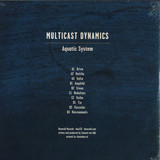
Multicast Dynamics - Aquatic System

"Aquatic System"" is the second installment of the series, written and composed in two remote geographical places - namely at waters in Finland and Fuerteventura. Inspired by the complexity of water, its movement, various forms, inhabitants and hidden energy, the album was assembled mainly using synthesizers and processed field recordings of the ponds, streams, lakes and oceans of the different locations. With a vibrant story and conceptualization the focus lies in taking the listener on a observing, thoughtful and reflective journey through the aquatic system of our waters. Aquatic System opens with an impression of a frozen surface imagining icy and calm underwater movements underneath. Soon a slow process of melting begins and while the water starts to move in tiny streams of sound, small lifeforms evolve, curiously sending out small pulses in their flowing and constantly moving habitat. The aquatic nature awakens. Zooming out to larger waters high frequencies arise and colliding forms become audible. Larger marine life forms can be faintly heard when entering a much wilder environment, sensing sound-swirls of wind, foaming water tops and impressive large waves crashing on dark rocks. Finally ending at the shore, where the great ocean appears on the horizon, the environment is surrounded with moisture. From the calm reflective landscape derives an inward moment, recalling the organic and atmospheric quality of the sound journey. ""Aquatic System"" has been developed into an audiovisual performance together with visual artist Emilia Kwiatkowska and was performed several times in Spain and Finland, before the music has been finalized for the tracks.

No en stock

Haga su pedido ahora y le encargaremos el artículo en nuestro proveedor.

25,84

Ültimo hace: 8 Años
The Sahib Shihab Quintet - Seeds

Back in stock!

Some friends think that Shihab the man owes the balance of his soul to his beautiful Danish wife. They may be right; for Eros is the very essence of what Shihab plays.Yet Eros is a god with many a face. A tale of tender mournings Shihab's flute is telling in MAUVE - a piece that translates its title into delicately changing colors of sound. In UMA FITA DE TRES CORES he has his instrument wooing with the proud self-reliance of Latin grandezza. Calmly, softly, almost blandishly Shihab blows the solo flute in the Jimmy Woode composition MY KINDA WORLD. Serene and somewhat playful his own title ANOTHER SAMBA comes along - a most uncommon composition by the way: lasting for sixty bars as if growing independent out of itself, with solos that appear to be additional spinnings rather than improvised choruses; and yet; a perfect, self sustaining melody no element of which is superfluous. In the last of the pieces for flute, in Klook Clarke's THE WILD MAN, which is based on a flourish of trumpets, Shihab for the first time reminds of the sombre, the demon-like face of God Eros. He contrasts flawlessly intoned passages with challenging phrases, phrases raucously sung into the flute - really, he is a 'wild man' who is playing like that. This raucous challenging sound prevails throughout the four baritone-titles ('Shihab never withholds long to caress', Campi says). Shihab blows the instrument the same way he speaks: without any delay, directly coming to the point. And he treats it like a voice, not aiming at an artificially homogeneous sound in all the registers, but at their different modes of expression. In the high pitches the horn gains a brilliant tenor-like quality - for instance in PETER'S WALTZ, dedicated to Shihab's son Peter, and in Kenny Clarke's simple drum fills comprising theme JAY-JAY. In the deep register Shihab produces snotty sounds filling lady's ears with horrors like Pan - thus in JAY-JAY and in the boppy blues SET UP . Shihab's sense of a scurrilous humor breaks through in SEEDS (which reminds of the West-African heritage of jazz with its multiple rhythms and its renunciation of harmonious development - only the eight bars of the bridge base on a progression of chords): not only does he omit the notorious bombastic chord by the ensemble after his own final cadenza, he even ends with a minor second above the keynote. Seems as if Shihab now unrestrictedly conveys to his music all the experiences and emotions he formerly did not deal with in a musical way. Shihab the man need not be disturbed so that Shihab the musician may improvise passionate choruses. It would be unjust, however, to forget the choruses of the four other musicians for those by the 'born leader'. Francy Boland, taciturn and always introverted: he plays an extrovert, a masculine piano. Even with spare single note lines he produces a piercing and ringing sound that hitherto nobody except him has discovered, a bluesy sound bespeaking the very element of frustration that lies within the title of the trio number WHO'LL BUY MY DREAM. The unfailing feeling for rhythm the musicians of the CBBB praise with the arranger Boland, becomes manifest in the piano solo on SET UP. Francy's improvisation is rhythmically styled in a Monk-like manner, and yet no accent could be set differently. Maybe this is the secret of the Shihab-Combo. 'Rhythm is our business', this credo of Jimmy Lunceford could be the one of the five musicians as well. Sadi hits his vibes as dryly as if wanting to bring its ancestors to memory, the wooden chimes of West Africa's coastal tribes. To reach the fullest poignancy possible, he intentionally calms down even the resonance in MY KINDA WORLD. In UMA FITA DE TRES CORES Jimmy Woode bears out the crispy jazz beat against Sadi's Bongos and Klook's Latin-American percussion all by himself. Moreover - and that, too, is connected with the school of the Duke who was the first in the history of jazz to discover the instrument's potential as a melody instrument - Woode rips a marvelous counterpoint to the inventions of the other melody instruments, take for example PETER'S WALTZ. And then there is Kenny Clarke. Klook. On the entire record he only uses his brushes. Means by which different drummers only know to bring forward impressionistically blending noises: He drums a vigorous beat with them, fanciful fills, a solo, melodious and at once skillfully playing with cross rhythms in JAY-JAY. The 'born leader', the 'outstanding baritone saxophonist of modern jazz' (Joachim-Ernst Berendt), he could not wish himself different sidemen for this record overdue since some years.

Reservar05.08.2013

debe ser publicado en 05.08.2013

16,18

Ültimo hace: 2026 Años
Artículos por página
N/ABPM
Vinyl