Clear Vinyl
Post-punk/new wave hero Ann Margaret Hogan’s second album of solo piano and field recordings for Downwards is a box of subtle wonders, mastered by Veronica Vasicka and highly recommended if yr into Satie, Virginia Astley, Sarah Davachi.
A weight of history flows through Hogan’s keys with a stark intimacy, beautifully illuminated by naturally effortless, quietly grand songwriting. It’s a direct continuation of the landscaped themes
and atavism of 2020’s ‘Honeysuckle Burials’ and the ‘Reversing Into Tomorrow’ collaboration with Karl O’Connor, vividly capturing the slow passage of time in a way that has quite literally compelled
us to stop the relentless mind-grind for its 40 minute duration on more than one occasion.
After previous fixations on the iron age forts and burial mounds of the Clywdian Range in North Wales, Hogan transmutes the scenery of her more immediate locale, Oxton on The Wirral - from the cadence of its red sandstone landmark Thor’s Rock, to memories of its boating lake, for example - into a quiet yet ravishing suite inflected with traces of wildlife and industry recorded on long walks, all subsumed within a deep blue estuarial atmosphere silted by the strange reality of life in
the current era, echoing the surreal, sunny period when the album was conceived.
A generation on from her pivotal work with spar Marc Almond and likes of Deux Filles and Nick Cave, and forty generations since The Wirral hosted, as she says “a Norse parliament at Thingwall”,
Hogan weaves time and place into a reflective, funereal sort of parlour music, turning daily ambulations amid the gorse and under luminous skies into gorgeous, life affirming and intimate self expressions.
The eight pieces are mostly improvised and flow with a free, fleeting concision from the palpable warmth of ‘Forgotten Prelude’ and bluesy ache of ‘Fragile Elements’ to more funereal modes in ’Mesto’ and ‘Funeral Cargo’ suggestive of a Viking burial soundtrack. At its core, ‘Wolfswalzer’, a dedication to her one time collaborator and erstwhile Kraftwerk member Wolfgang Flür - is described by Hogan as “a simple waltz of coffee, food, friends and music”, and ‘Impromptu’ is the
album’s slowest, soaked in the feeling of atmospheric immanence that defines the album’s timeless appeal. It’s an unspeakably moving album, words really do it no justice.
Поиск:wo land
Все
Erased Tapes debut. Wait, what? How? Anyone who has seen
the trail blazing sonic pioneer live will know Nils likes to
deadpan a joke. Graz is in fact the first studio album he
recorded for the label back in 2009, that somehow remained a
secret… until now.
Nils Frahm has quietly changed the musical landscape,
reincarnating the centuries old figure of a pianist-composer for a
new generation of music fans. As Nils’ word-of-mouth popularity
grew and grew, so did the pop-culture profile of his instrument. He
founded Piano Day with a team of like-minded friends in 2015 to
help that process, some years releasing an album of piano
recordings to celebrate one of humankind’s greatest inventions.
Graz is one such record; an unheard snapshot of a young Nils
recorded at Mumuth, the University of Music and Performing Arts
Graz, in 2009 as part of the thesis Conversations for Piano and
Room produced by Thomas Geiger, which received an award in
the Classical Surround Recording category at the 127th AES
Convention in New York.
Whilst at the time it was decided to keep the grand piano
recordings from the Graz sessions locked away and instead focus
on his close mic’ed, dampened piano explorations which would
become his acclaimed studio album Felt in 2011, two of the pieces
— most notably Hammers — lived on as part of his live set, and
were expanded on and re-recorded as part of his breakthrough
2013 record Spaces (a collage of field recordings from concerts
which broke the Fourth Wall and included audience coughs). Over
his mercurial career, Nils has pushed and pulled at the boundaries
and parameters of his prolific work like that. He’s physically
changed his piano (the softened prepared strings of Felt) played
with a modified body (Screws recorded with 9 fingers and a broken
thumb) played with scale (Solo recorded on the 3.7 metre high
Klavins M370) and with the different layers of formats (last year’s
Tripping with Nils Frahm nested his studio setup inside a live
performance, concert film and live album). Now with Graz he has
found the final frontier for play: time itself and his own discography.
Graz is a moment of time at the very beginning of Nils’ quiet
revolution. The essential genius is already evident; the harmonic
language of classical, and the immediacy of jazz. Nils seems to
pull down each idea moment by moment, gently, to not scare away
the muse. He describes: “sometimes when you hear a piano, you
might think it’s a conversation between a woman and a man. At
the same time, it can hint at shapes of the universe and describe
how a black hole looks. You can make sounds that have no relation
to anything we can measure.”
Cindytalk is the mercurial, expressionist outlet of Scottish artist Cinder. An evolution of her early 1980's Edinburgh-based punk band The Freeze, she launched the project upon moving to London, inspired by the crossroads of exploratory UK post-punk and early European industrial. Her work thrives on chance and transformation, collaging elements of noise, balladry, soundtrack, catharsis, and improvisation. After a series of celebrated albums for the Midnight Music label as well as collaborations with This Mortal Coil and Cocteau Twins, Cinder migrated to the United States, becoming involved with various underground techno collectives around the Midwest and West Coast. Subsequent relocations to Hong Kong and Japan further expanded Cindytalk's horizons, resulting in a fruitful partnership with Viennese experimental institution Editions Mego, for whom she released five full-lengths of swooning, granular atmosphere. 2021 finds her as engaged as ever, at the precipice of long-awaited back catalog reissues alongside multiple new works, guided by her lasting love of discovery and deviation: “new pathways always being uncovered.”
The 3rd album by Scottish industrial enigma Cinder aka Cindytalk began life as the soundtrack to an experimental film by English director Ivan Unnwin entitled Eclipse (The Amateur Enthusiast's Guide To Virus Deployment), and was originally slated for release via Factory Records' video division, Ikon. Inspired heavily by Alan Splet's eerily disembodied sound design in David Lynch's Eraserhead, the collection's 15 pieces seethe between field recordings, wistful piano vignettes, and lurking metallic haze – a hybrid palette Cinder characterized at the time as “ambi-dustrial.” Unfortunately Ikon collapsed on the eve of the project's completion so the film was never distributed, but the Midnight Music imprint repackaged Cindytalk's score as an LP in 1990 under the name The Wind Is Strong... (full title: The Wind Is Strong - A Sparrow Dances, Piercing Holes in Our Sky).
Cindytalk is the mercurial, expressionist outlet of Scottish artist Cinder. An evolution of her early 1980's Edinburgh-based punk band The Freeze, she launched the project upon moving to London, inspired by the crossroads of exploratory UK post-punk and early European industrial. Her work thrives on chance and transformation, collaging elements of noise, balladry, soundtrack, catharsis, and improvisation. After a series of celebrated albums for the Midnight Music label as well as collaborations with This Mortal Coil and Cocteau Twins, Cinder migrated to the United States, becoming involved with various underground techno collectives around the Midwest and West Coast. Subsequent relocations to Hong Kong and Japan further expanded Cindytalk's horizons, resulting in a fruitful partnership with Viennese experimental institution Editions Mego, for whom she released five full-lengths of swooning, granular atmosphere. 2021 finds her as engaged as ever, at the precipice of long-awaited back catalog reissues alongside multiple new works, guided by her lasting love of discovery and deviation: “new pathways always being uncovered.”
The 3rd album by Scottish industrial enigma Cinder aka Cindytalk began life as the soundtrack to an experimental film by English director Ivan Unnwin entitled Eclipse (The Amateur Enthusiast's Guide To Virus Deployment), and was originally slated for release via Factory Records' video division, Ikon. Inspired heavily by Alan Splet's eerily disembodied sound design in David Lynch's Eraserhead, the collection's 15 pieces seethe between field recordings, wistful piano vignettes, and lurking metallic haze – a hybrid palette Cinder characterized at the time as “ambi-dustrial.” Unfortunately Ikon collapsed on the eve of the project's completion so the film was never distributed, but the Midnight Music imprint repackaged Cindytalk's score as an LP in 1990 under the name The Wind Is Strong... (full title: The Wind Is Strong - A Sparrow Dances, Piercing Holes in Our Sky).
Cindytalk is the mercurial, expressionist outlet of Scottish artist Cinder. An evolution of her early 1980's Edinburgh-based punk band The Freeze, she launched the project upon moving to London, inspired by the crossroads of exploratory UK post-punk and early European industrial. Her work thrives on chance and transformation, collaging elements of noise, balladry, soundtrack, catharsis, and improvisation. After a series of celebrated albums for the Midnight Music label as well as collaborations with This Mortal Coil and Cocteau Twins, Cinder migrated to the United States, becoming involved with various underground techno collectives around the Midwest and West Coast. Subsequent relocations to Hong Kong and Japan further expanded Cindytalk's horizons, resulting in a fruitful partnership with Viennese experimental institution Editions Mego, for whom she released five albums of swooning, granular atmosphere. 2021 finds her as engaged as ever, at the precipice of long-awaited back catalog reissues alongside multiple new works, guided by her lasting love of discovery and deviation: “new pathways always being uncovered.”
Across decades of activity Cinder’s body of work has forever followed its own elusive muse but nowhere is this restless spirit more apparent and ambitious than the 4th Cindytalk LP, Wappinschaw. Conceived as “a call to arms” inspired by Scotland and its struggle for independence, the title refers to an archaic Scottish battle inspection during which clan chieftains surveyed their group's weapons to ensure they were combat ready. A mindset of reflective preparation threads throughout the record, manifested in forms both naked and noisy, ancient and anguished.
Opening with an aching solo vocal rendition of the British folk standard “The First Time Ever (I Saw Your Face),” the album then surges into the Cindytalk classic, “A Song Of Changes,” sparkling and spiraling in strange waves of sorrow and joy. From there the mood fragments, tracing asymmetrical paths of feverish dirge, pensive spirituals, noir abstraction, spoken word (landmark Glaswegian writer Alasdair Gray guests on “Wheesht”), bagpipe drone, and apocalyptic post-punk. Given its aggressive eclecticism, it's not surprising that Cinder describes the creation of Wappinschaw as a “precarious” process, composed from “scraps” with abruptly shifting personnel – a situation only compounded by the impending dissolution of their label at the time, Midnight Music.
Cindytalk is the mercurial, expressionist outlet of Scottish artist Cinder. An evolution of her early 1980's Edinburgh-based punk band The Freeze, she launched the project upon moving to London, inspired by the crossroads of exploratory UK post-punk and early European industrial. Her work thrives on chance and transformation, collaging elements of noise, balladry, soundtrack, catharsis, and improvisation. After a series of celebrated albums for the Midnight Music label as well as collaborations with This Mortal Coil and Cocteau Twins, Cinder migrated to the United States, becoming involved with various underground techno collectives around the Midwest and West Coast. Subsequent relocations to Hong Kong and Japan further expanded Cindytalk's horizons, resulting in a fruitful partnership with Viennese experimental institution Editions Mego, for whom she released five albums of swooning, granular atmosphere. 2021 finds her as engaged as ever, at the precipice of long-awaited back catalog reissues alongside multiple new works, guided by her lasting love of discovery and deviation: “new pathways always being uncovered.”
Across decades of activity Cinder’s body of work has forever followed its own elusive muse but nowhere is this restless spirit more apparent and ambitious than the 4th Cindytalk LP, Wappinschaw. Conceived as “a call to arms” inspired by Scotland and its struggle for independence, the title refers to an archaic Scottish battle inspection during which clan chieftains surveyed their group's weapons to ensure they were combat ready. A mindset of reflective preparation threads throughout the record, manifested in forms both naked and noisy, ancient and anguished.
Opening with an aching solo vocal rendition of the British folk standard “The First Time Ever (I Saw Your Face),” the album then surges into the Cindytalk classic, “A Song Of Changes,” sparkling and spiraling in strange waves of sorrow and joy. From there the mood fragments, tracing asymmetrical paths of feverish dirge, pensive spirituals, noir abstraction, spoken word (landmark Glaswegian writer Alasdair Gray guests on “Wheesht”), bagpipe drone, and apocalyptic post-punk. Given its aggressive eclecticism, it's not surprising that Cinder describes the creation of Wappinschaw as a “precarious” process, composed from “scraps” with abruptly shifting personnel – a situation only compounded by the impending dissolution of their label at the time, Midnight Music.
Lunar Tredd – Fimber Bravo’s first album on Moshi Moshi since the much acclaimed Con-Fusion – tells the tale. The highlife fusion of You Can’t Control Me resonates in the wake of the global Black Lives Matters protests. There is fire in these impactful clarion calls to resist oppression, recognise strength in resilience and fight against the corruption of power.
Bravo’s been a constant collaborative force - as his time as leader of 20th Century Steel Band, as musical director of Steel ‘n’ Skin, and appearances with everyone from Sun Ra Arkestra to Hot Chip, shows. Lunar Tredd reflects the influence of the music handed down to him by “ancestors” . Helped by an enviable cast of friends and collaborators, Fimber has shifted those touchstones to create something that sounds resolutely like the here and now.
Those friends that appear on Lunar Tredd, include Alexis Taylor of Hot Chip and The Horrors’ Tom Furse; The Invisible drummer Leo Taylor and Senegalese percussionist, Mamadou Sarr dropping in on rhythm duties, while there are also appearances from Susumu Mukai aka Zongamin, the brilliant Kora player Kadialy Kouyate, vocalist Cottie Williams, Vanishing Twin’s Catherine Lucas, and production from Lapo Frost and Ghostpoet producer Shuta Shinoda. Some, like Zongamin and Williams go way back with Fimber, other connections are newer, but all have quickly become part of the London-based musician’s musical family.
Indeed, Fimber never loses sight of where he’s come from on LUNAR TREDD - even as he looks to where he might go next. As a musician, he’s still finding new creative peaks nearly 50 years after he began.
»Dog Mountain« is the second release by the Zurich-based producer and composer Laurin Huber on Hallow Ground. After last year’s »Juncture« saw the Edipo Re co-founder work mostly with synthesizers and programmed rhythms, the four tracks are much more restrained, drawing on tape loops and feedback, recordings of acoustic guitar and synthesizers such as the Korg MS-10 as well as field recordings that relate to the overarching topic that informed the making of the record. While »Juncture« had previously aimed at deconstructing the binaries and dualities that shape our lives and thinking, »Dog Mountain« is dedicated to geographical divisions that result from political processes and social constructions. »›Here‹ means one nation, ›there‹ another,« writes Huber in a literary piece that accompanies the record. »Being in sound, such a separation seems odd.«
While treating the metaphor of the border as a »membrane, registering and translating the vibrations of its surroundings« and thus as something that is constantly (re-)defined, maintained and defended however, the artist also takes into consideration that »one cannot escape one’s standpoint,« as he puts it. The music on »Dog Mountain« may transcend and overcome certain borders, but it does not deny the realities that they impose on each and every one of us – whether in our political lives or in the realm of sound. This is mirrored in Huber’s engaging in the structural and sonic interplay of repetition and difference. Working with slowly evolving and modulating elements that are exposed to slight shifts, »Dog Mountain« puts a focus on the interaction between small elements that together form a bigger whole which is marked by constant evolution and change.
Opener »Raja« (»border« in Northern Sami and Finnish) starts off with a two-note melody played on an out-of-tune guitar. Different field recordings and synthesizer sounds drop in and out of the mix until the dynamic shifts and Huber starts playing more notes on his instrument, thus increasing the tension. It’s a meditation on minimalism, but also a piece that mediates between notions of what constitutes the difference between noise and music or referentiality and abstraction in sound. After »Nickel« (named after a Russian monotown near the border to Norway) dedicates itself to explore the friction between hissing white noise and melancholic tape loops, »A Town Is Not a Town« (a phrase taken from the documentary »Kiruna – Rymdvägen«) structurally mirrors the experiment of »Raja« with very different sonic means.
Closing the record, »Storskog-Borisoglebsk« (the title refers to the northernmost land border between Schengen-Europe and Russia) is the longest and most challenging piece, working with both long-form drones and musique concrète elements. It proposes a synthesis of the opposites that are explored patiently and with much attention to detail throughout this record.
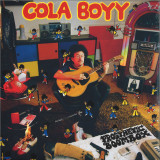
There’s liberation on the dance floor in the songs of Matthew Urango – glimpses of revolution that glimmer beneath the disco ball. “I want my music to bring people together,” says the Californian pop innovator, best known as Cola Boyy. “Because standing together is our best chance at fighting this shit show.” The shit show in question is a broken, brutal system the acclaimed multi-instrumentalist has witnessed up-close. Urango was born with spina bifida and scoliosis in Oxnard, California: a town in which almost 30,000 are estimated to live in poverty. Prosthetic Boombox, his eagerly awaited debut album, might at first glance seem a joyous confetti-burst of pop eclecticism, engineered to sound like “scanning between stations on a car radio, landing on all these different sounds and styles” as Urango puts it. Dig deeper, though, and you’ll discover a simmering sense of rebellion. “The working class are injured, struggling to pay rent and struggling to put food on the table,” he says. “I want to represent that.” Prosthetic Boombox
achieves that goal in a thrilling flurry of inventive indie, funk and soul: take Urango’s car radio analogy, place it in a time-travelling Delorean with Prince in the passenger seat, and you’re half-way there.
Look no closer than Prosthetic Boombox’s euphoric opener, the Avalanches-assisted ‘Don’t Forget Your Neighbourhood.’ The track – which Urango says mixes “the Beach Boys, French disco, house keys and ragtime piano, kinda like the Cheers soundtrack!” – ends with lyrics urging listeners to “fight for your town with your fist closed, strike it and make it more than just a memory.” It’s a reminder that the working classes need to “turn our fists against our oppressors instead of each other,” he explains. After that emphatic introduction comes a horn-laced funk wig-out titled ‘Mailbox’ – a song that gives Dua Lipa’s Future Nostalgia a run for its Studio 54-themed money, featuring rising Londoner JGrrey. Elsewhere, ‘Song for the Mister’ ventures into smooth R&B territory, before ‘Roses’ – a collaboration with Myd of Ed Banger fame – offers a bouquet of bustling disco guitars and infinite bisous of Connan Mockasin’s band drops in on the immaculate ‘Go the Mile’. Urango saves his most introspective moment for the album’s starry closer. ‘Kid Born in Space’, a cosmic collaboration with MGMT frontman Andrew VanWyngarden, sees the artist reflect on what he once had to overcome as a disabled person of colour. “I see them looking down on my dreams of being,” he sings tenderly. “I hear them making fun of my voice, but I keep on moving forward, I refuse to live in anyone else’s shadow.” Prosthetic Boombox, on this subject, is more than an album title – it’s a statement of intent.
“The message of my music is that our class is exploited, oppressed and murdered on the daily. That’s not right, and the system that enables that deserves to be wiped off the face of the earth,” he says. “The only way that happens is if we’re united. That’s the point of my music – to relate to people and unite them.” And what unites more than raucous, irresistibly danceable pop? Prosthetic Boombox is a riot of joyous grooves and catchy hooks for good reason. “I want to reach and spread my message to as many people as possible. You can’t do that if you’re some obscure motherfucker, you know?” he laughs. Don’t bet on him being an “obscure motherfucker” for long.
Land of the Free? with revered classic songs like the incendiary “F*ck
Authority,” was a wake -up call from Pennywise, aimed at the slumbering
masses of America, an attempt to shake people out of their lethargy and
prod them into thinking about the world.
Originally released in June 2001, the band’s six studio album tackled the political and social issues of the day, from police corruption and mass shootings to
elections, topics that 20 years later are just as relevant.
Pennywise have made a name for themselves over the past 33 years as a politically minded, melodic hardcore /punk band that has sold millions of albums
and become one of the most successful independent acts of all time.
Formed in 1988, the band played backyard parties in their hometown of Hermosa Beach, California, without having any aspirations other than playing as
many songs as they could before the police showed up. Hermosa Beach and
the surrounding neighborhoods are a prominent place in popular culture, with
groups like Black Flag, The Circle Jerks and Descendents merging a fast rebellious sound with the surrounding aggressive surf and skate culture.
Inspired by their predecessors, Pennywise were at the forefront of a second
wave of American punk rock that would catapult the movement from a tightknit subculture into a worldwide movement.
- A1: Ocean Logo
- A2: Title
- A3: Map Screen
- A4: Woody Land 1 & 2
- A5: Woody Land 3 & 4
- A6: Spider Attacks
- A7: World Clear
- B1: Adventure Park
- B2: House
- B3: Living Room
- B4: In The Washbasin
- B5: Washbasin Boss
- C1: Volcano Underpass
- C2: Volcano Underpass 2
- C3: Clouds
- C4: Ograoum Papas
- C5: Mean Streets
- C6: Little Clown
- D1: Ice Scream
- D2: Mr Blizzard
- D3: Ending
- D4: Game Over
Mr. Nutz has marked a generation of players with its colorful world and enchanting music. Developed by only three persons in the early 90s and published by Ocean, the game was a worldwide phenomenal success and remains one of the most beloved platform game released on the Snes at the time.
To celebrate the upcoming 30th anniversary of the little squirrel, we have the pleasure to pay a tribute to this jewel made in France with the release of the original soundtrack, newly illustrated by its original creator, Philippe Dessoly!
Mr. Nutz original soundtrack is composed by Raphaël Gesqua and remastered for the vinyl format in this 'Totally Nutz' collector Edition !
- Tkay Maidza - Where Is My Mind? (Pixies)
- U.s. Girls - Junkyard (The Birthday Party)
- Aldous Harding - Revival (Deerhunter)
- The Breeders - Dirt Eaters (His Name Is Alive)
- Maria Somerville - Seabird (Air Miami)
- Tune-Yards - Cannonball (The Breeders)
- Spencer. - Genesis (Grimes)
- Helado Negro - Futurism (Deerhunter)
- Efterklang - Postal (Piano Magic)
- Bing And Ruth - Gigantic (Pixies)
- Future Islands - The Moon Is Blue (Colourbox)
- Jenny Hval - Sunbathing (Lush)
- Dry Cleaning - Oblivion (Grimes)
- Bradford Cox - Mountain Battles (Breeders)
- Sohn - Song To The Siren (Tim Buckley)
- Becky And The Birds - The Wolves
- Act I And Ii (Bon Iver)
- Ex:re - Misery Is A Butterfly (Blonde Redhead)
- Big Thief - Off You (The Breeders)
In 2020, 4AD turned 40. Never one to be on time for a party, the label is
commemorating that landmark this year with the release of ‘Bills & Aches & Blues’.
The compilation features 18 of its current artists covering a song of their
choosing from 4AD’s past: a creative experiment rooted in the spirit of
collaboration and a snapshot of 4AD, 41 years after its inception.
‘Bills & Aches & Blues’ will be released on double CD and double LP. The
first 12 months’ profits from ‘Bills & Aches & Blues’ will be donated to The
Harmony Project, a Los Angeles-based after-school programme for children
from communities and schools that lack equitable access to studying the arts
or music.
‘Bills & Aches & Blues’’ 18 recordings contain fascinating connections
between artist and track. The earliest song chosen (by U.S. Girls) is The
Birthday Party’s ‘Junkyard’, from 1981; the most recent are the two Grimes
covers (‘Genesis’ and ‘Oblivion’, respectively by Spencer. and Dry Cleaning)
from 2012. Suitably, for the one band that bridges 4AD past and present, The
Breeders are all over ‘Bills And Aches And Blues. They’re covered three
times - ‘Cannonball’ by Tune-Yards, ‘Mountain Battles’ by Bradford Cox of
Deerhunter and ‘Off You’ by Big Thief, whilst The Breeders cover ‘The Dirt
Eaters’ by their ‘90s contemporaries His Name Is Alive.
Landmark songs such as ‘Cannonball’, ‘Song To The Siren’ and Pixies’
‘Where is My Mind?’ will feel comfortable to casual fans, however by
contrast, much joy can be found in the album’s surprise choices, such as Air
Miami’s ‘Seabird’ and the Lush B-side ‘Sunbathing’, covered respectively by
new signings Maria Somerville and Jenny Hval.
‘Bills & Aches & Blues’ is named, arguably (as Elizabeth Fraser never
published the lyrics), after the opening line of Cocteau Twins ‘CherryColoured Funk’. Perhaps too unique and uncoverable in their own right, their
legendary take on Tim Buckley’s ‘Song To The Siren’, under the name This
Mortal Coil (along with Buckley’s pre-Starsailor acoustic version) informs
SOHN’s cover.
Some tracks unearth hitherto hidden shared DNA, such as Future Islands’
and Colourbox’s ‘The Moon Is Blue’; other tracks are more akin to
reinvention. Aldous Harding distils the melodic essence of Deerhunter’s
‘Revival’ and recasts it in her own uncanny image. U.S. Girls’ future-disco
‘Junkyard’ and Bing & Ruth’s neo-classical instrumental ‘Gigantic’ are even
more radical interpretations. Leading off the album, Tkay Maidza brings both
her Art Rap and R&B game, but also an unexpected ‘80s synth pop template,
to Pixies’ ‘Where Is My Mind?’, a perfect title for these chaotic times.
Where the Streets Lead is the new album from Slowly Rolling Camera, and builds on their acclaimed 2018 release Juniper. Inspired by colliding worlds of jazz, trip-hop, and cinematic soundscapes, SRC’s music blends strong melodies, big grooves, and surprising turns of phrase, and is infused with expansive emotional gravitas. The music on this album, recorded throughout 2020, encompasses greater scale, with an 8-piece string section and a list of world-class guests including Mark Lockheart, Jasper Høiby, Verneri Pohjola, Chris Potter and Sachal Vasandani as well as the band's regular guitarist Stuart McCallum. Where the Streets Lead is emphatic in its purpose: communicating the joy of collaboration and, through an audio-sensory landscape, a vision of the world. There is a boldness and simplicity in the album’s conception, balanced with attention to detail in its production and sound design. Slowly Rolling Camera’s last album Juniper set the band on a new path. Where the Streets Lead is a natural progression and development in the band’s’ continued exploration.
- A1: Peach Of Immortality
- A2: Umbrella Spinner
- A3: Dialogue Between A Grandmaster Of The Knights Hospitaller & A Genoese Sea-Captain
- A4: Vulning
- A5: Lathe Of Heaven
- A6: Sirin
- A5: Nowhere Much Narrower
- A6: Charioteers
- A7: Milk Street
- B1: Magic Mountain
- B2: Ophir
- B3: Paradigm & Places
- B4: Threadneedle
- B5: Ferae
- B6: Forest Of Materials
Black Truffle is pleased to present Sylva Sylvarum, an epic new work from Ora Clementi, the collaborative project of crys cole and James Rushford. Primarily conceived and recorded over several months together in Melbourne, Sylva Sylvarum is a stunning step forward from the mumbled, creaking sound world of the duo’s debut, Cover You Will Softer Me (Penultimate Press, 2014). From the opening ‘Peach of Immortality’, which takes an unpredictable journey from layers of chiming bells, vocal harmonies and lush synth pads to a desolate landscape of half-animal, half-digital wooshes and cries, it is immediately clear that cole and Rushford are working here with an entirely unique sound palette. Throughout the record’s four sides, we hear a large array of carefully detailed synthesizer sounds (many of them recorded at the remarkable Melbourne Electronic Sound Studio), sparse drum machine hits, wind instruments and field recordings of animals, often with a twistedly late 80s/early 90s flavour that at various points calls up New Age references, Robert Ashley’s later operas or the thinned-out textures of early digital GRM.
Threaded through this distinctive array of sounds are the two musicians’ voices, sometimes singing, sometimes speaking through varying degrees of manipulation. A guiding thread through the pair’s collaboration, beginning with their initial experiments with lip-readings, the presence of these two voices – cole’s crisp and sibilant, Rushford’s rich and low – reinforces the sense that the music is immersed in itself, less performed by two people than occurring between them. On Sylva Sylvarum, these voices first come to the forefront on the third piece, ‘Dialogue Between a Grandmaster of the Knights Hospitaller and a Genoese Sea Captain’, where in unison they intone fragments of a description of an imaginary space taken from a 17th century utopian text. The two voices resurface periodically thereafter, most stunningly in the unexpected turn into cushiony dream pop on ‘Magic Mountain’. At other points, the subtle manipulation of pitch and intonation in the close-miked vocal performances filters the recitations through a fog of abstraction that climaxes with the almost incomprehensible alternating syllables of the side-long closer ‘Forest of Materials’. Like the album’s title, these textual elements are drawn from various literary descriptions of utopias, a theme that also informed the pair’s musical approach. Far from anything dryly illustrative, utopia figures into Sylva Sylvarum as an invitation to inhabit otherworldly spaces that, like the empirical details that proliferate in these literary utopias, are grounded in mundane reality but shot through with the eldritch. Admirably framed by the abstracted digital topographies of Sabrina Ratté’s artwork, the uncanny sweep of the album’s fifteen pieces is expansive enough to take in stretches of crackling austerity, warped microtonal keyboard etudes and moments of stunning beauty, the latter most strikingly when cole and Rushford are joined by Callum G’Froerer on trumpet and Joe O’Connor on trombone for a series of dream-like moments moving from growling overtones to poignant lyricism.
Presented in a deluxe gatefold sleeve with stunning artwork by Sabrina Ratté and pressed on mint green vinyl. Mixed and mastered by Joe Talia at Good Mixture, Berlin.
- A1: Dandara's Purpose
- A2: Gap Between Worlds
- A3: A New Hope
- A4: Their Pleas Echoed Through Time
- A5: No More Singing Birds
- A6: Once A Beautiful Horizon
- A7: Remain In Oblivion
- A8: Weight Of A Doubt
- A9: Mãe
- B1: A Leap Towards Freedom
- B2: Crumbling Memories
- B3: Eternal Sigh
- B4: Lingering Question
- B5: Hidden In Logic
- B6: Hopefully A Nightmare
- B7: Golden Menace
- C1: Golden Fortress
- C2: The Relentless Choir
- C3: Stories Of Freedom
- C4: Dandara's Legacy
- C5: Hidden Thoughts Beyond The Crimson Maw
- C6: Resolutely Unimpressed
- C7: Not Born For This
- C8: Not Made For This
- C9: Not Ready For This
- C10: Restless Machines
- D1: The Defeated Crone
- D2: Rushed Ouroboros
- D3: That Party You Can't Miss
- D4: Violent Ambush
- D5: Chained Wings
- D6: Hesitant Salt
- D7: Menina
- D8: Tormented Mind
- D9: Weight Of A Change
- D10: Stories Of Peace
- D11: Dandara's Fanfare
The Dandara: Trials of Fear Edition Original Soundtrack features over one hour of ethereal, surreal and organic music created specifically for the exploration of the Salt's surreal world. Blending eclectic electronic scores with sweeping, melodious soundscapes, Thommaz Kauffmann's score is like taking a ride into a new, wonderous land.
Dandara's light but incredibly strong presence was the starting point for all the sound presented in this album, consisting of a soundtrack that sounds hopeful and melancholic at the same time. Her lonely journey into the corrupted regions of Salt narrates each gesture made to fight the fears deep inside the Salt's most uncharted caves.
The textures and musical aesthetics in this soundtrack match a world that suffers from its abandonment to spontaneity, creativity, and vitality. It is with the presence of Dandara that there is a break in these standards imposed in Salt by an authoritarian regime.
Wrapped up in a beautiful, sturdy tip-on gatefold with a rough, black and white aesthetic, this vinyl 2xLP comes with two "Salt" white 180g in two printed inner sleeves.
Composed, produced and mixed by Thommaz Kauffmann
Artwork by Luísa Almeida
Game developed by Long Hat House
Published by Raw Fury
- Generation Genocide
- Let It Slide
- Good Enough
- Something So Clear
- Thorn
- Into The Drink
- Broken Hands
- Who You Drivin’ Now?
- Move Out
- Shoot The Moon
- Fuzzgun ‘91
- Pokin’ Around
- Don’t Fade Iv
- Check-Out Time
- March To Fuzz
- Ounce Of Deception
- Paperback Life (Alternate Version)
- Fuzzbuster
- Bushpusher Man
- Flowers For Industry
- Thorn (1St Attempt)
- Overblown
- March From Fuzz
- You’re Gone
- Something So Clear (24-Track Demo)
- Bushpusher Man (24-Track Demo)
- Pokin’ Around (24-Track Demo)
- Check-Out Time (24-Track Demo)
- Generation Genocide (24-Track Demo)
The classic 1991 album remastered and expanded with rare and previously
unreleased tracks. Extensive liner notes by band biographer Keith Cameron.
A landmark of the grunge era.
By going back to basics with ‘Every Good Boy Deserves Fudge’, Mudhoney
flipped conventional wisdom. Not for the first time - or the last - they would be
vindicated. A month after release in July 1991, the album entered the UK
album chart at Number 34 (five weeks later, Nirvana’s ‘Nevermind’ entered
at 36) and went on to sell 75,000 copies worldwide. A more meaningful
measure of success, however, lay in its revitalisation of the band, casting a
touchstone for the future. The record is a major chapter in Mudhoney’s
ongoing story, the moral of which has to be: when in doubt, fudge it.
The album began at Music Source Studio, a large space equipped with a 24-
track mixing board - downright futuristic, compared to the 8-track setup that
birthed the band’s catalytic 1988 debut, ‘Touch Me I’m Sick’. The Music
Source session quickly turned into a false start when the results, in guitarist
Steve Turner’s words, “sounded a little too fancy, too clean.” Lesson learned,
the band went primitive and got to work at Conrad Uno’s 8-track setup at Egg
Studio. Named after the cartons pasted on the walls in an optimistic attempt
at sound-proofing, Egg boasted a 1960s vintage 8-track Spectra Sonics
recording console, originally built for Stax in Memphis.
So it was that, in the spring of 1991, Mudhoney made ‘Every Good Boy
Deserves Fudge’. The resulting album is a whirlwind of the band’s influences
at the time: the fierce ‘60s garage rock of their Pacific Northwest
predecessors The Sonics and The Lollipop Shoppe, the gnashing posthardcore of Drunks With Guns, the heavy guitar moods of Neil Young, the
lysergic workouts of Spacemen 3 and Hawkwind, the gloomy existentialism
of Zounds and the satirical ferocity of ‘80s hardcore punk. The quartet’s
special alchemy meant these fond homages never slid into pastiche.
Ultimately, ‘Every Good Boy Deserves Fudge’ epitomised the best of
Mudhoney: here was a band reconnecting with its purest instincts and, in the
process, reinventing itself.
This 30th Anniversary edition, remastered by Bob Weston at Chicago
Mastering Service, stands as testimony to the creative surge that drove them
in this period. The album sessions yielded a clutch of material that would
subsequently appear on B-sides, compilations, and split-singles. This edition
includes all those tracks and a slew of previously unreleased songs,
including the entire five-track Music Source session.
In 1971, following his tenure with Frank Zappa’s Mothers of Invention, George Duke took Joe Zawinul’s seat with the Cannonball Adderley Quintet. During this secondment, Duke was also commissioned by Hans Georg Brunner Schwer’s MPS to produce what would unfold as a landmark album, fusing electric experimentation with latin percussion and African instrumentation. This single draws two of the highlights from this date, with the jazz dance behemoth ‘My Soul’ on the A side, and the funky trip ‘Au Right’ on the flip.
"Gaspard Auge is releasing his Debut Album “Escapades”, out in June 25th
He is best known as one half of Justice, the duo that united rock and rave and whose dancefloor smashes defined a generation.
Gaspard made an instrumental album whose sound will be familiar to Justice ’s fanbase , echoing some previous works & inspirations of the cult duet.
Escapades sounds like a UFO landing from another galaxy, or time, a baroque masterpiece that reimagines European classical music for this century. OFFICIAL BBC THEME FOR THEIR COVERAGE OF THE EUROS."
Tonnon produced the album with longtime collaborator, and The Beths’ guitarist and producer, Jonathan Pearce. Tonnon wrote the bulk of the songs during an extensive period of touring after the release of Successor - a period where Tonnon performed with Nadia Reid in Europe, The Veils in the USA, and The Chills, The Phoenix Foundation and Don McGlashan in New Zealand. The pair workshopped songs between tours, often recording new parts as the live versions developed.
Tonnon and Pearce recorded between 2017 and 2020, and in that time, Tonnon’s practise evolved heavily. He incorporated new technology into his set, including the Wellington-designed Synthstrom Deluge, which allowed him to adapt his set for new performance environments;Art Galleries, Museums, even New Zealand Fashion Week. He took that technology further when he collaborated with the Otago Museum on the immersive show for Planetariums, A Synthesized Universe, which travelled to Arts Festivals around New Zealand in 2019.
Creating a music video for ‘Old Images,’ which explored a lost passenger train network, Tonnon came to the idea for a new experience-based show called Rail Land. It took audiences on railways to reach distant community halls around Aotearoa. The show saw Tonnon combine historical research and spoken word narrative, with the immersive lighting and musical technology he developed for A Synthesized Universe. In March, Rail Land finished a three-night run at Auckland Arts Festival, cementing Tonnon’s move to the concept show.
Over time, Tonnon and Pearce’s production moved further from the traditional rhythm sections that powered songs like Successor’s ‘Water Underground.’ In their place came off kilter electronic rhythms, like the beat in ‘Two Free Hands,’ and textures that blur lines between organic and synthesized sound. Guitars are set against synthesizers, and drums against drum machines in ‘Entertainment’ and ‘Peacetime Orders,’ which Tonnon also used in his soundtrack for RNZ’s 80s spy-themed podcast The Service. In ‘Leave Love Out Of This,’ a ballad starts with a piano and a string quartet, but ends in a wall of electronic sound.
The constant has been Tonnon’s lyrics. Whether singing about evolution and the future of work in ‘Two Free Hands,’ the television industry in ‘Entertainment,’ or environmental disaster and regulatory failure in ‘Mataura Paper Mill,’ Tonnon has followed a distinct approach to subject matter, description and phrasing that have seen him longlisted for the APRA Silver Scroll three times.
Tonnon’s explorations of local government and civic infrastructure in his work - an unusual preoccupation for a songwriter, have taken new meaning in his adopted home of Whanganui, where last year, he was elected by councillors as Whanganui District Council’s representative for public transport.
After Tonnon moved to Whanganui, and Pearce toured almost constantly after the success of The Beths’ first album, the pair conducted their collaboration over distance, but with key sessions at Pearce’s Karangahape Road studio, including drums and bass with long time band members Stuart Harwood and David Flyger, a string quartet led by Charmian Keay and arranged by Matthew Bodman, and additional drums with The Beths’ Tristan Deck.
As Leave Love Out Of This is released, Tonnon and Pearce find themselves in very different places to where they started, working on Auckland’s Karangahape Road, close to the venues like Wine Cellar and Whammy Bar where they regularly performed. Back in New Zealand since Covid, Pearce has had to adjust to being in one of Aotearoa’s best-known bands, while Tonnon, when not working on conceptual shows, wrestles with how to restore civic infrastructure to a post industrial city in the regions.
Created over a life-altering period of, Leave Love Out Of This is the culmination of years of experimentation and development - with new technology, new sounds, and new ways of creating, and performing music.
2023 Repress
This latest limited 7" from Mr. K features two incomparable baroque soul masterworks, one from a Chicago-based band that defied categorization and the other a deep cut from a living legend songwriter and performer.
The psychedelic soul of Rotary Connection’s “I Am the Black Gold of the Sun” still sounds revolutionary and unlike anything else, a full fifty years after it was originally released in 1971. Swathed in ethereal ripples of strings (courtesy the Chicago Symphony Orchestra) innovatively arranged by unsung genius Charles Stepney, and rooted in a rock solid foundation provided by the cream of Chicago’s cutting edge session musicians (among them guitarist Phil Upchurch and drummer Morris Jennings, veterans of countless soul jazz cuts), “Black Gold” sits in uncharted territory somewhere between soul, rock, jazz and classical chamber music. It’s a gorgeous territory, a fantasy land where Minnie Riperton and Sidney Barnes’s vocals transmit mystical, uplifting vibes, the entire affair anchored throughout by an addictive piano riff—a mixture that proved irresistible to Masters at Work, who covered it for their Nuyorican Soul project in 1997. Mr. K’s edit doesn’t try to force anything fancy on this masterpiece, simply tightening it up and taking advantage of the lush remastering to present this progressive classic on 45 for the first time.
In keeping with the orchestral soul mood, Mr. K turns to Stevie Wonder’s “Pastime Paradise” for the flip. Whereas “Black Gold” paints a portrait of a magical land, Stevie’s lyrics on “Pastime Paradise,” originally issued in 1976, are a penetrating look at the very earthbound concerns of modern society and its follies, an urgent message to look ahead rather than languish in dreams of the past. The sensitive string accompaniment provides just the right amount of gravitas and emphasis to Stevie’s voice without overwhelming it, while the hare krishna-inspired tambourine keeps the rhythm effectively. Mr. K’s edit again keeps things true to the original, simply providing a subtle intro that uses the tambourine rhythm to lead into the body of the song.