Dark Entries and Papi Juice Records team up for No Jack Swing, the solo electronic debut of multi-hype man Brontez Purnell. The Southern-raised, Oakland-based musician and writer has centered his queerness and Blackness in projects Gravy Train and Younger Lovers as well as in his award-winning books 100 Boyfriends and Since I Laid My Burden Down. On No Jack Swing, Purnell gives us a love letter to the most beloved (and secularized) of drum patterns - that is, the electronic 808 “Amen Break”. Beginning recording in 2020, Purnell conceived of No Jack Swing as an audio zine of found sound materials: chain letters of instrumentals recorded in bedrooms, poems from boys in France, found gospel tapes from his childhood family Baptist Choir, and the sound of records skipping on his bedroom turntable. No Jack Swing is as much a homage to No Wave and New Jack Swing as it is an answering to the gods of Indie, Electroclash, Disco, and Gospel. Amidst all this background noise, the unexpected occurs: all the niche pretensions collapse to a singularity - the sound of High Pop! No Jack Swing was produced by Nightfeelings. Each copy of includes a lyric sheet with a photo of Brontez.
Buscar:young man blues
Seine Stärke ist ein Songwriting das musikalisch wie poetisch kratzt und schabt: am amerikanischen Traum, an dessen Wirklichkeit und den Menschen die ihn bevölkern. Immer wieder wurde seine spröde Musik und einfühlsamen Texte mit denen von Leonard Cohen, Lou Reed und Bob Dylan verglichen und somit Gewicht verliehen. Zu großer Bekanntheit führte das nicht, Simon Joyner bleibt ein outsider mit seinem Loner-folk, aber für die, die ihn entdecken bietet er ein Kraft von rauher Schönheit. Conor Obers von Bright Eyes nennt Joyner, der seit 1990 seine dunklen Americana Songs veröffentlicht, einen entscheidenden Einfluß. Simon Joyner's neuestes Album gerät noch dunkler und eindringlicher. Sein Thema hier ist Isolation, und er übernimmt es gleich auch als Grundlage für seine Produktion Ihm war es wichtig, dass die beteiligten Musiker allesamt alleine waren um ihre jeweiligen Parts zu finden. Die Abgeschiedenheit der einzelnen Musiker auf Songs From A Stolen Guitar bietet somit weniger Spontaneität vieler früherer Arbeiten von Joyner, führt aber zu einer Art Silberstreifeneffekt: Joyners Songs, die hier sorgfältiger und vielleicht absichtsvoller produziert wurden als auf jedem seiner früheren Alben, kommen viel klarer durch und stellen sowohl seine schillernden Wortspiele als auch seine klare Vision in den Vordergrund. Ein Kritiker bringt einen Vergleich zu Neil Young und meinte "Wenn (sein 2012 Album) 'Ghosts' sein 'Tonight's the Night' war - zornig, nackt und bodenlos - dann könnte sich 'Songs From A Stolen Guitar' als sein Harvest erweisen." Songs From A Stolen Guitar wurde in verschiedenen Städten aufgenommen. Joyner nahm seinen Gesang und seine Gitarre live in Omaha auf; Bassist Wil Hendrix fügte seine Parts zu Hause in San Francisco hinzu, Michael Krassner nahm seine Gitarren- und Klavier-Overdubs zu Hause in Phoenix auf, und Schlagzeuger/Percussionist Ryan Jewell nahm in Colorado auf. Dieser musikalische Kettenbrief machte sich dann auf den Weg zurück nach Omaha, wo David Nance (Gitarren und Backing Vocals), Ben Brodin (Orgel und Vibraphon) und Megan Siebe (Bratsche und Backing Vocals) - getrennt voneinander - ihre jeweiligen Beiträge einspielten. Dieses Vorgehen zahlt sich aus. Die "virtuelle" Band spielt eine unterstützende, aber komplementäre Rolle und erzeugt immer das richtige Maß an Spannung, um diese emotionsgeladenen Geschichten zu begleiten und zu umhüllen. Das Zusammenspiel ist einfühlsam und kohärent, auch wenn es aus geografischer Entfernung und Abgeschiedenheit zusammengefügt wurde und oft wie Musik klingt, die durch den Nebel eines Herbstmorgens gefiltert wurde. Doch wenn es um Simon Joyner-Platten geht, zahlt man sein Ticket, um großartige Songs zu hören, und auch in dieser Kategorie enttäuscht Songs From A Stolen Guitar nicht. Eins der seltenen Alben, das nach dem klingt, worum es geht: die Kluft zwischen Einsamkeit und Alleinsein, die Grenzen zwischen Liebe und Hingabe, der Unterschied zwischen dem Tornado und dem, was er hinterlässt.
Translucent Dark Red & Black Marbled Colored Vinyl. Seine Stärke ist ein Songwriting das musikalisch wie poetisch kratzt und schabt: am amerikanischen Traum, an dessen Wirklichkeit und den Menschen die ihn bevölkern. Immer wieder wurde seine spröde Musik und einfühlsamen Texte mit denen von Leonard Cohen, Lou Reed und Bob Dylan verglichen und somit Gewicht verliehen. Zu großer Bekanntheit führte das nicht, Simon Joyner bleibt ein outsider mit seinem Loner-folk, aber für die, die ihn entdecken bietet er ein Kraft von rauher Schönheit. Conor Obers von Bright Eyes nennt Joyner, der seit 1990 seine dunklen Americana Songs veröffentlicht, einen entscheidenden Einfluß. Simon Joyner's neuestes Album gerät noch dunkler und eindringlicher. Sein Thema hier ist Isolation, und er übernimmt es gleich auch als Grundlage für seine Produktion. Ihm war es wichtig, dass die beteiligten Musiker allesamt alleine waren um ihre jeweiligen Parts zu finden. Die Abgeschiedenheit der einzelnen Musiker auf Songs From A Stolen Guitar bietet somit weniger Spontaneität vieler früherer Arbeiten von Joyner, führt aber zu einer Art Silberstreifeneffekt: Joyners Songs, die hier sorgfältiger und vielleicht absichtsvoller produziert wurden als auf jedem seiner früheren Alben, kommen viel klarer durch und stellen sowohl seine schillernden Wortspiele als auch seine klare Vision in den Vordergrund. Ein Kritiker bringt einen Vergleich zu Neil Young und meinte "Wenn (sein 2012 Album) 'Ghosts' sein 'Tonight's the Night' war - zornig, nackt und bodenlos - dann könnte sich 'Songs From A Stolen Guitar' als sein Harvest erweisen." Songs From A Stolen Guitar wurde in verschiedenen Städten aufgenommen. Joyner nahm seinen Gesang und seine Gitarre live in Omaha auf; Bassist Wil Hendrix fügte seine Parts zu Hause in San Francisco hinzu, Michael Krassner nahm seine Gitarren- und Klavier-Overdubs zu Hause in Phoenix auf, und Schlagzeuger/Percussionist Ryan Jewell nahm in Colorado auf. Dieser musikalische Kettenbrief machte sich dann auf den Weg zurück nach Omaha, wo David Nance (Gitarren und Backing Vocals), Ben Brodin (Orgel und Vibraphon) und Megan Siebe (Bratsche und Backing Vocals) - getrennt voneinander - ihre jeweiligen Beiträge einspielten. Dieses Vorgehen zahlt sich aus. Die "virtuelle" Band spielt eine unterstützende, aber komplementäre Rolle und erzeugt immer das richtige Maß an Spannung, um diese emotionsgeladenen Geschichten zu begleiten und zu umhüllen. Das Zusammenspiel ist einfühlsam und kohärent, auch wenn es aus geografischer Entfernung und Abgeschiedenheit zusammengefügt wurde und oft wie Musik klingt, die durch den Nebel eines Herbstmorgens gefiltert wurde. Doch wenn es um Simon Joyner-Platten geht, zahlt man sein Ticket, um großartige Songs zu hören, und auch in dieser Kategorie enttäuscht Songs From A Stolen Guitar nicht. Eins der seltenen Alben, das nach dem klingt, worum es geht: die Kluft zwischen Einsamkeit und Alleinsein, die Grenzen zwischen Liebe und Hingabe, der Unterschied zwischen dem Tornado und dem, was er hinterlässt.
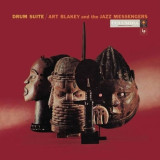
One of the inventors of the modern bebop style of drumming, Blakey is known as a powerful musician and a vital groover; his brand of bluesy, funky hard bop was and continues to be profoundly influential on mainstream jazz.
For more than 30 years his band, Art Blakey & The Jazz Messengers included many young musicians who went on to become prominent names in jazz. Recorded in 1956, Art Blakey's Drum Suite is a wonderful hybrid of African, Latin, and hard bop rhythms that prefigures the concept of Afro-beat by at least a decade. The sheer energy, not to mention its very special and fresh-sounding intimacy, make it especially astounding.
Even more amazing is that the three parts of the suite -- Blakey's "The Sacrifice," Ray Bryant's "Cubano Chant," and Oscar Pettiford's "Oscalypso" -- were recorded straight through live, and were only intended to be a pre-take run-through. As is obvious here, Blakey and company nailed the whole thing right out of the box.
Groundbreaking for its time, and still sounding vital, powerful, and visionary, the Drum Suite album is somewhat of a lost masterpiece that deserves a fresh audience.
"Art Blakey's first release for Columbia Records is essentially two records. Side one is a percussion ensemble playing what would, ten years later, be called Afro-Cuban drumming. Side two is the mid-fifties version of the Jazz Messengers featuring Jackie McLean on saxophone. Side one features Blakey, Jo Jones and Charles Wright on drums, Candido and Sabu on bongos, and Oscar Pettiford and bass and cello. The group plays three compositions, one by Blakey, one by Pettiford and one by Ray Bryant, fusing African, Cuban, and calypso percussion into a well-integrated suite.
"The group recorded a run through and it was so perfectly executed that they used the practice run for the release, unedited except to add some Swahili chants by the percussionists during a few passages. One cannot help but think of Olantunji's Drums of Passion, another Afro drumming landmark, here. Blakey's drum suite was recorded at Columbia's 30th Street studios in New York in 1957 and is in mono. The almost stereoscopic image is truly remarkable. Mastered by Kevin Gray and pressed at RTI, Drum Suite is a valuable record of one of the most important figures in jazz history. Recording: 9/10. Music 9/10." - Dennis Davis, Hifi+
"...The three-part suite was laid down in one take with no arrangements, and begins with a few tympani thwacks followed by an African chant. Soon the ensemble kicks in and the group takes off an a sweaty Afro-Cuban-bop journey that will leave you breathless, as the thing crackles with terrific energy. Side Two is more conventional hard bop, but given this group's mastery of if not invention of the style, these tracks are extremely satisfying. Kevin Gray's remastering is detailed and immediate, with plenty of bit and air, if not the widest dynamic range. For anyone interested in percussion of this genre, this is not to be missed." - Wayne Garcia, The Absolute Sound
Vor über 20 Jahren gegründet, veröffentlichten The Wave Pictures über 20 eigene Alben (zuletzt gleich zwei in 2018), neben spannenden Nebenprojekten wie der Garage-Rock-Supergroup The Surfing Magazines, mehrere Werke mit Stanley Brinks oder Dave Tattersalls Gitarrenbeiträge für Billy Childish. All diese Arbeiten beherbergen Daves frei fliessende Quelle des Songwritings und die tiefe Zuneigung der Band für Rock'n'Roll, Blues, Jazz, Classic Rock und natürlich Daves legendäre Liebe zu guten Gitarrensoli. Inspiriert vom klassischen Neil Young, ist das neue Doppelalbum 'When The Purple Emperor Spreads His Wings' voll und ganz dem Country verschrieben, mit Cowboy-Mundharmonika, Mandoline und Daves sanften akustischen Gitarrenklängen.
Under the moniker of Jaye Jayle, Louisville guitarist/vocalist Evan Patterson has spent over a decade exploring the more abstract realms of the American singer-songwriter process. On his latest album, Don't Let Your Love Life Let You Down, Patterson continues to mine his unique strain of the meditative blues while finally breaking the shackles of defeat and passing into a realm residing between Western stoicism and mystic wonder. Like Leonard Cohen fronting some intermediary step between Spacemen 3 and Spiritualized, Don't Let Your Love Life Get You Down, conjures an aura of psychedelic grace and enveloping warmth through its pairing of pensive baritone poetics, druggy studio manipulations, and gospel-infused blues. Abetted by the production and mixing skills of Ben Chisholm (Chelsea Wolfe). Across the eight songs of Don't Let Your Love Life Get You Down takes the old American singer-songwriter template and imbues it with a kaleidoscope of synesthesia delights culled from a half-century's worth of fringe music. This aural grandeur reinforces the life-affirming radiance of Don't Let Your Love Life Get You Down. Though Jaye Jayle retains the hypnotic repetition and austere instrumentation of their past, the added layers and saturation of sound intensifies the immersive hallucinatory spirit only previously hinted at in their work. As with all Jaye Jayle records, it's still best suited for the hours after midnight, but it now holds the promise of dawn. Jaye Jayle is Evan Patterson, with him as always is Todd Cook, Corey Smith, and Neal Argabright. With special guest Chris Maggio, Victoria Fisher, Patrick Shiroishi, and Bonnie `Prince' Billy. RIYL Leonard Cohen fronting Spiritualized, Spacemen 3, JJ Cale, Lungfish, Angels of Light, Young Widows Ltd single colour vinyl LP!
- A1: When I Paint My Masterpiece
- A2: Most Likely You Go Your Way (& I'll Go Mine) (& I'll Go Mine)
- A3: Queen Jane Approximately
- A4: I'll Be Your Baby Tonight
- B1: Just Like Tom Thumb's Blues
- B2: Tombstone Blues
- B3: To Be Alone With You
- B4: What Was It You Wanted?
- C1: Forever Young
- C2: Pledging My Time
- C3: The Wicked Messenger
- C4: Watching The River Flow
- C5: It's All Over Now, Baby Blue
- C6: Sierra's Theme
Gatefold, 2 x black Vinyl, Special Cover vanish, printed Innersleeves
Das Album SHADOW KINGDOM präsentiert Dylan mit einigen Songs aus seinem legendären Backkatalog in neuen Interpretationen - darunter Fan Favorites wie "Forever Young" und "It's All Over Now, Baby Blue" sowie ausgesuchte Katalogperlen wie "Queen Jane Approximately" und "The Wicked Messenger". Ursprünglich für ein exklusives Streaming-Film-Event eingespielt, das im Juli 2021 lediglich in einem begrenzten Zeitraum von einer Woche ausgestrahlt wurde, ist SHADOW KINGDOM nun erstmals auf Vinyl, CD und digital erhältlich. Die Setlist des Albums umfasst 13 Originalsongs, die Dylan für seinen Auftritt in "Shadow Kingdom" persönlich ausgewählt hat, sowie das abschließende Instrumental "Sierra's Theme". "Dylan zeigt immer wieder, wie sehr man selbst als notorische lebende Legende auf der Höhe der Zeit bleibt." (Joachim Hentschel, Süddeutsche Zeitung). "Die für diesen Anlass halbakustisch umarrangierten Songs sind dabei geradezu betörend. 'Tombstone Blues' als entschleunigtes Rezitativ ist einer der Höhepunkte, ein geisterhaftes 'What Was It You Wanted' ein anderer." (Maik Brüggemeyer, Rolling Stone).
Clear Black Swirl Vinyl! "Are they black?" fragte Iggy Pop, als er sich das erstmals 2006 veröffentlichte Album der BLACK ANGELS zum ersten Mal in das Trommelfell schraubte. Mitnichten, aber trotzdem eine berechtigte Frage. Denn wann hatte man zuletzt solch ,bluesy pools of garage-scum shame mongering" (SPIN Magazine) gehört, wenn nicht wenigstens ein Schwarzer in der Band für den Sound verantwortlich war? Aus dem tiefsten Texas kommt dieses Quintett, das sich im Mai 2004 fand und knappe zwei Jahre später ein Debütalbum auf den Tisch legte, dass Schlagzeilen wie "The Black Angels could be your new favorite band" (Splendid) oder ,This is an advance warning: you will want to claim early ownership of the Black Angels." (Sydney Morning Herald) erntete. Inspiriert vom psychedelischen Sound der 60er Jahre, verloren sich THE BLACK ANGELS auf "Passover" nicht in unendlichen Drone-Schleifen sondern zelebrierten ihren selbsternannten Native American Drone'n'Roll in angenehm relaxter aber immer wieder aufs neue spannender Atmosphäre. Eben neuzeitlicher Psychedelic Rock mit einem konstant primitiven Beat, der den Spirit der 13TH FLOOR ELEVATORS und der frühen STONES wieder aufleben ließ.
In the years since The Aces released their acclaimed sophomore album, ‘Under My Influence’ in 2020, the band has been on a journey of self-discovery. Faced with the realities of a global pandemic, sisters Cristal and Alisa Ramirez (lead vocals/guitar and drums, respectively), Katie Henderson (lead guitar/vocals), and McKenna Petty (bass) used quarantine as a time to reflect, confronting personal mental health issues as well as processing experiences they’d had growing up together in Provo, Utah, as part of the Mormon church. When The Aces returned to the studio, their vision — and the honesty and trust between them — felt stronger than ever. The result of this growth period is ‘I’ve Loved You For So Long,’ the band’s third LP. Written and executive-produced by the group (along with Keith Varon, the sole collaborator on the project), the album is a sparkling indie-rock record that’s by far their most personal and self-assured work to date. From tracks that ruminate on mental health and self-sabotage to searing anthems about love, longing, and heartbreak, ‘I’ve Love You For So Long’ is a record that’ll work its way into your head and heart — and will have you singing along all the way through. ‘I’ve Loved You For So Long’ is also an opportunity for The Aces to reach new heights and build on their many previous successes. To date, the group has earned over 205 million career streams; ‘Under My Influence’ alone garnered more than 75 million (including 35 million on its lead single “Daydream”). The album also appeared on numerous charts, including #53 on Billboard’s Top Albums list. Further, The Aces have toured with the likes of 5 Seconds of Summer, X Ambassadors, The Vamps, and COIN, and have played at festivals all over the world, including NY Pride, Lollapalooza, Firefly, Bonnaroo, OUTFEST, and more. After selling out their last U.S. headline tour in 2021, the band will hit the road again this year, with dates soon to be announced.
VERVE BY REQUEST SERIE: remastert vom analogen Originalband, audiophiles 180-Gramm-Vinyl von Third Man Pressing/Detroit, Gatefold-Sleeve.
Durch die letztjährige Grammy-Nominierung der Jazzharfenistin Brandee Younger sind in jüngster Zeit viele Jazzfans wieder auf das schmale, dafür aber umso erstaulichere Œuvre ihres großen Vorbilds Dorothy Ashby aufmerksam geworden. Ihr wohl exzentristischstes, zugleich aber unglaublich zugängliches Album nahm sie 1970 für Cadet Records auf: “The Rubáiyát Of Dorothy Ashby”. Auf ihm vertonte sie Vierzeiler des persischen Dichters Omar Chayyām (1048-1131), wobei sie auf reizvolle Weise Spiritual Jazz, Funk und Blues mit Elementen asiatischer und afrikanischer Musik verschmolz. Neben ihrer Harfe spielt Ashby hier auch die japanische Koto und sang.
Dorothy Ashbys ”The Rubáiyát Of Dorothy Ashby” erscheint am 12. Mai zeitgleich mit der verschobenen LP Archie Shepp - Kwanza (Verve By Request) 00602448476180.
‘’Ace Todmorden label makes a significant discovery on its own doorstep: a superb cache of ‘loner folk’ songs recorded in the early-70s by Hebden Bridge’s answer to Nick Drake’’ UNCUT PLAYLIST
"This is music that can confidently hold its own with pioneers such as Davey Graham, Michael Chapman, Bert Jansch and Jackson C Frank, as influenced by jazz, blues and steel guitar as any of the old songbook classics from ancient Albion.” Benjamin Myers
"Defiantly Northern and out of this world" Folk Radio
Anti-counter culture loner folk from a teenage attic in the heart of rural Northern hippiedom.
Today the valley town of Hebden Bridge in West Yorkshire is world-renowned as something of a bohemian backwater. It wasn’t like this back in the late 1960s and the early 1970s, when a disparate selection of radicals, drop-outs, heads, musicians, artists and writers started to be attracted to the Calder Valley. Local lad and future poet laureate Ted Hughes called the area “the fouled nest of industrialisation”.
Over time, those seeds of radicalism and collectivism ensured Hebden Bridge evolved into a place where people could be themselves and all shades of individual oddness not only tolerated but actively encouraged. But back at the turn of the dreary 1970s it remained a monochrome world defined by its unforgiving surrounding landscapes, where the old gritstone over-dwellings were stained with soot and rain lashed down for weeks.
It was here that Trevor Beales, who was born in 1953, grew up, and from where he drew musical and lyrical inspiration.
Perhaps it was this dual nationality heritage, unusual in the valley’s largely white working class population at the time, that gave the teenager Trevor Beale’s music an outsider’s perspective. The discovery of Bob Dylan, Django Reinhardt, The Byrds and James Taylor at a young age, lead to him picking up a guitar at the age of ten, and he was soon writing his own originals and performing them at local (though often remote) folk clubs and pubs.
Recorded in the attic of the family home at Ivy Bank in Charlestown on the verdant wooded slopes at the edge of Hebden Bridge between 1971 and 1974, these early recordings are collected here for the first time and mark Trevor Beales long-overdue solo debut.
In these songs is a suffer-no-fools sense of realism that is defiantly Northern, yet also expresses a worldliness that belies Beales’ young years, whilst also showcasing an inherent storyteller’s ear for narrative. Here is a postcard from the past at that crucial musical period of transition, when the idealistic exponents of the 1960s emerged into an austere new decade that was to be shaped by strikes, rising unemployment and economic upheaval.
Two aspects of this music make it remarkable: Beales’ natural ability showcases a sophisticated guitar-picking style that was leagues ahead of many of his (older, more recognised) contemporaries. This is music that can confidently hold its own with pioneers such as Davey Graham, Michael Chapman, Dave Evans, Bert Jansch and Jackson C Frank, as influenced by jazz, blues and steel guitar as any of the old songbook classics from ancient Albion.
Secondly, his lyrics are a far cry from either the naïve bedroom scribblings of a teenager who has barely left his upland home, nor do they fall foul of the type of lazy cliches and sub-Tolkien imagery that was still in abundance in the early 1970s. Most remarkably the earliest songs here were laid down less than a year after he left school (an unearthed report written by his headteacher on July 3rd 1970 noted he had “a considerable ability and interest in music”, though his education ended abruptly when he simply walked out of a science lesson one sunny day while at sixth form, never to return).
Trevor’s music is grounded in reality – his reality. ‘Then I’ll Take You Home’, for example, considers the Guru Marajai, who encouraged his acolytes to give over their worldly possessions, yet who drove a Rolls Royce and lived like a playboy. Unsurprisingly, this latest in a long line of spiritual charlatans found several followers in Hebden Bridge, and Beales casts a disdainful eye over the growing popularity for such false prophets.
With its ancient narratives and propensity for myth-making, folk has certainly produced it’s fair share of cult figures who have enjoyed rediscovery or career resurgence and with this debut compilation of home recordings, rescued from cassette tapes, Trevor Beales might just be the latest addition. Certainly he was the real deal.
Crucially, Beales' music is never jaded or cynical, but instead possesses a poet’s ear, a strong sense of self and some sound critical faculties. And much of it recorded at an age when he could neither vote nor order a pint of heavy.
Trevor Beales died suddenly and unexpectedly on March 29th 1987, aged 33. He left behind Christine and their young child Lydia.
"Released in April 1966 by Decca Records, Aftermath was the Rolling Stones’ fourth British studio album. It was issued by London Records in the US in June 1966. Recorded at the RCA Studios in California, it was their first album released in true stereo.
It is also one of the first ‘popular’ albums to eclipse the 50-minute mark, and contains one of the earliest rock songs to exceed 10 minutes (the blues jam Goin’ Home). The album’s release was briefly delayed by controversy over the original packaging idea and title – Could You Walk on the Water? – due to London Reocord’s fear of offending Christians in the US.
The album was considered an artistic breakthrough for the band, being the first to consist entirely of Jagger–Richards compositions, (after their maverick young manager, Andrew Loog Oldham, had shut them in the kitchen of their flat until they had written some more original songs!).
It also featured strongly the immaculate guitar work of Brian Jones and the remarkably wry, observant song-writing of Jagger–Richards
Jones played a variety of instruments not usually associated with their music, including sitar, dulcimer, marimbas and Japanese koto, as well as guitar, harmonica and keyboards, though much of the music is still rooted in Chicago electric blues. The burgeoning influences of psychedelia, Bob Dylan and the tensions around the world, are evident in classics like Paint It Black, an eerily insistent number one hit, available on the US version of the LP.
Other classics included the jazzy Under My Thumb, where Jones added exotic accents with vibes, and the delicate Elizabethan ballad Lady Jane, with distinctive dulcimer, the wry observational Mother’s Little Helper with its unashamed lyrical drug references, and the overlooked gem – the brooding, meditative I Am Waiting.
The American edition was issued with a shorter track listing, substituting the single Paint It Black in place of four of the British version’s songs, in keeping with the industry preference for shorter LPs in the US market at the time."
"Released in April 1966 by Decca Records, Aftermath was the Rolling Stones’ fourth British studio album. It was issued by London Records in the US in June 1966. Recorded at the RCA Studios in California, it was their first album released in true stereo.
It is also one of the first ‘popular’ albums to eclipse the 50-minute mark, and contains one of the earliest rock songs to exceed 10 minutes (the blues jam Goin’ Home). The album’s release was briefly delayed by controversy over the original packaging idea and title – Could You Walk on the Water? – due to London Reocord’s fear of offending Christians in the US.
The album was considered an artistic breakthrough for the band, being the first to consist entirely of Jagger–Richards compositions, (after their maverick young manager, Andrew Loog Oldham, had shut them in the kitchen of their flat until they had written some more original songs!).
It also featured strongly the immaculate guitar work of Brian Jones and the remarkably wry, observant song-writing of Jagger–Richards
Jones played a variety of instruments not usually associated with their music, including sitar, dulcimer, marimbas and Japanese koto, as well as guitar, harmonica and keyboards, though much of the music is still rooted in Chicago electric blues. The burgeoning influences of psychedelia, Bob Dylan and the tensions around the world, are evident in classics like Paint It Black, an eerily insistent number one hit, available on the US version of the LP.
Other classics included the jazzy Under My Thumb, where Jones added exotic accents with vibes, and the delicate Elizabethan ballad Lady Jane, with distinctive dulcimer, the wry observational Mother’s Little Helper with its unashamed lyrical drug references, and the overlooked gem – the brooding, meditative I Am Waiting.
The American edition was issued with a shorter track listing, substituting the single Paint It Black in place of four of the British version’s songs, in keeping with the industry preference for shorter LPs in the US market at the time."
Critically acclaimed rock group EELS announce
vinyl reissues of earlier records ‘End Times’, ‘Hombre Lobo’ and ‘Tomorrow Morning’, released via E Works / PIAS.
EELS will hit the road this Spring for the longawaited Lockdown Hurricane tour of Europe and North America, starting in March in Nottingham. The reissues follow EELS’ critically acclaimed
2022 record, ‘Extreme Witchcraft’, which found
praise at MOJO, NME, The New York Times,
Stereogum, SPIN and more. EELS have had one of the most consistently acclaimed careers in music. The ever-changing
project of principal singer / songwriter E (Mark Oliver Everett), EELS have released 14 studio albums since their 1996 debut, ‘Beautiful Freak’. In 2008, E published his highly acclaimed book,
‘Things the Grandchildren Should Know’, and starred in the award-winning ‘Parallel Worlds, Parallel Lives’ documentary about the search to understand his quantum physicist father, Hugh
Everett III. Single LP on standard weight black vinyl in a
gatefold sleeve with matt machine varnish.
- A1: The Mod 4 - A Puppet
- A2: The Yardleys - Just Remember
- A3: Decompressed Impossibility - You Can't Ride Away
- A4: The Living End - Brigitta
- B1: The Newports - Feelin' Low
- B2: The Landlords - I'm Through With You
- B3: The Prisners Dream - Autumn Days
- B4: The Fortels - She
- B5: The Bohemians - Say It
- C1: Tresa Leigh - Until Then
- C2: Wm. Penn & The Quakers - Ghost Of The Monks
- C3: The Tempters - I Will Go
- C4: Jerry Mcgee - Twilight Zone
- D1: Carroll - The Boy Called Billy Joe
- D2: The Common People - Here, There & Everywhere
- D3: Dennis Harte - Summer's Over
- D4: Toe Head - Goodnight Jackie
2023 REpress
A North American road trip of coming of age garage soul mapped by Ivan Liechti, Ghost Riders is Efficient Space’s latest narrative compilation, hovering in a liminal emotional ravine between moonlight melancholy, teenage heartache and unchecked, unrealised ambition. Across seventeen open hearted ballads recorded 1965-1974, the 2LP collects and connects dots between British Invasion fanatics, child prodigies, the loners and the luckless, in a kind of trans-continental survey of those swept up in rock’n’roll mania and buoyed by local newspaper ads promising fame and gold records.
From the tangerine dreams of 8th grade all-girl combo The Mod 4 to the tri-state jukebox aspiring echoes of The Tempters, The Yardley’s poetic Farfisa vamp and lilting folk pop, and The Landlords’ weepy break up b-side blues, these are mostly one shots by dreamers whose experience was brief before being checked back to the reality of suburban normality and realistic career options. Hailing from the regional backwaters of Illnois, Arkansas, Nevada, Massachussets, Ohio, Idaho, Texas and beyond, the licensed artists were scouted by way of local fire departments, spiritualist fellowships and animal welfare centres, often barely a stones throw from where their contributions were originally laid.
A barely teenage Dennis Harte's ‘Summer’s Over’ perhaps best taps the collection’s essence. A gut-wrenching lament of the passing of the season as if it was the last on earth. Flanked by players from The Left Banke, Harte, a now-piano tuner to the stars, is from the minor segment that found longevity in showbiz. Likewise with Michigan icon Lyn Nowicki who cast her ghostly voice over Beatles cover song chameleons The Common People and Jerry McGee, The Ventures member and conduit of Dr. John’s ‘Twilight Zone’.
Ghost Riders simmers with the scent of youthful summers, the pang of schoolyard romance, and the excitement (and disenchantment) of teenage naïveté, delivered via a deceptively simple and frequently wonky garage band set up. The vision of record collector and graphic designer Ivan Liechti, these eternal psych-folk howlers are further crystallised by Colin Young’s fastidious audio restoration, the original artwork of Elise Ganebin-de Bons and an aptly penned forward from Sonic Boom.
- 1: Adolescents - I Hate Children
- 2: Middle Class - Out Of Vogue
- 3: Agent Orange - Bloodstains
- 4: Dead Kennedys - Chemical Warfare
- 5: Simpletones - I Like Drugs
- 6: Suicidal Tendencies - Fascist Pig
- 7: T.s.o.l.- Abolish Government/Silent Majority
- 8: Circle Jerks- Beverly Hills
- 9: Wasted Youth - Fuck Authority
- 10: The Gun Club - She’s Like Heroin To Me
- 11: Redd Kross - Burn Out
- 12: China White - Live In Your Eyes
- 13: Circle Jerks- Live Fast Die Young
- 14: Negative Trend - How Ya Feeling?
- 15: Eddie And The Subtitles - American Society
- 16: Channel 3 - Manzanar
- 17: Flipper - Ha Haha
- 18: Rikk Agnew O.c. - Life
- 19: Social Distortion - Playpen
- 20: Dead Kennedys - California Überalles
- 21: Shattered Faith - I Love America
- 22: The Weirdos - Helium Bar
- 23: Middle Class - Insurgence
- 24: Germs - Communist Eyes
- 25: Adolescents - Kids Of The Black Hole
Futurismo present their new anthology series: Altered Vision, beginning with SUBURBAN ANNIHILATION The California Hardcore Explosion / From The City To The Beach: 1978-1983.
This aggressive collection draws from California’s rich history of punk, more specifically hardcore: a new sound that eschewed melody for intensity, a sound that took punk harder and faster, a sound intrinsically American. Whilst hardcore was also burning over on the East Coast, it was in California that it had ignited and sprawled, a sonic punch in the face that raged socio-political disdain and total abandonment for commercialism, fuelled by a crumbling American Dream and the collapse of family values.
Suburban Annihilation takes you from the major cities, to the coastal towns, to the SoCal suburbs, showcasing some the most important bands of the West Coast. Blasting off with the Adolescents ‘I Hate Children’, it heads from the year zero of Middle Class’s ‘Out Of Vogue’ to the surf punk of Agent Orange’s ‘Bloodstains’, from the blues tinged outlaw of The Gun Club’s ‘She’s Like Heroin to Me’ to the classic anti-anthems: ‘Live Fast Die Young’ by the Circle Jerks, lifted from their seminal Group Sex album, and the hardcore staple ‘California ÜberAlles’ by the Dead Kennedys. Also present are so many other bands integral to the era: T.S.O.L, Wasted Youth, Germs, Social Distortion, Suicidal Tendencies, Negative Trend, Flipper and many more.
Though the music was designed to repel, this historical document has been lovingly designed to remind us that this genre created some of the most immediate and acutely-realised music ever produced. Making this collection of choice cuts essential for long-time fans of hardcore and punk, just as those new and inquisitive about one of the most angry and pissed off genres to have given birth in America.
This 2xLP comes in a choice of limited edition coloured vinyl, it has a tracklist co-curated by Henry Rollins, it contains liner notes by Lisa Fancher of Frontier, a bio by award winning author Benjamin Myers, and contains a booklet featuring an array of images by the legendary punk photographer Edward Colver.
NO(w) Beauty is a jazz quartet in its most traditional form.
In the perfect continuity of the history of this music, these four young musicians have gathered in Paris, where Hermon Mehari, trumpeter of American origin, has settled, like many of his peers before him. There, in the detours of the jazz clubs, a dialogue was created, then a friendship, thanks to the common language of music. Their personalities and influences mingle and define their sound. Jazz standards, blues, French and European classical music, soul, hip-hop, but also modern jazz and the avant-garde. A traditional quartet, but one that wants to be in tune with the times, and that looks ahead.
The three Frenchmen, in addition to having studied jazz, are largely rooted in French popular and learned music and their influences range from improvised music to Olivier Messiaen via Claude Nougaro... Enzo Carniel and Damien Varaillon both studied at the CNSM in Paris, renowned for its excellence and its very "European" aesthetic. Stéphane Adsuar studied at the Berklee School of Music in Boston, the leading school in the United States. Hermon Mehari, originally from Kansas City, Missouri, brings his unique heritage to the table, while innovating in the tradition of the great American trumpeters.
Together they create a space where all these influences intermingle, without nationality, without borders.