‘The Nearer The Fountain, More Pure The Stream Flows’, the new studio
album from Damon Albarn, is released by new label home Transgressive
Records.
‘The Nearer The Fountain, More Pure The Stream Flows’ was originally
intended as an orchestral piece inspired by the landscapes of Iceland.
This last year has seen Albarn return to the music in lockdown and
develop the work to 11 tracks which further explore themes of fragility,
loss, emergence and rebirth. The result is a panoramic collection of
songs with Albarn as storyteller. The album title is taken from a John
Clare poem Love and Memory.
The CD edition includes a 20-minute ‘hidden’ track of a new and original
recording that inspired some of the record’s themes.
The deluxe version of the album takes the form of a casebound book
with additional photography, original scanned lyrics and artwork from
Damon, alongside a clear vinyl version of the album and a bonus 7”
featuring an exclusive song from the recording sessions, plus a high
quality digital download. Also available on black vinyl and cassette.
A recent special Globe Theatre performance in London sold out
immediately and was streamed globally to 72 countries around the world
and received rave reviews across the board.
quête:z orchestra
We used to enjoy presenting Chapelier Fou's work using the idea of music in the form of a treasure hunt. However, while the phrase in itself it still just as relevant today, we would never have imagined that it would become such an integral part of one of his albums. Or two of his albums to be perfectly exact - Méridiens and Parallèles. Two records with twelve songs each which answer each other back in the form of anagrams. They are like the two sides of the same planet - similar but simultaneously so different. They need to be discovered one after the other taking the time necessary to travel through the sound territories produced by his imagination. The starting point is a sombre night in Uqbar… Chapelier Fou's opening reference to Borgès was obviously not made by chance. He subsequently confided in us the objective of his diptych, namely to combine reality with fiction to question certainties and our relationships with the imaginary sphere. He has continued with his traditional classical-contemporary electronic approach which, although now known to a wide audience, has the advantage of opening up a whole range of possibilities right up to the infinite scale. Moving away from an "État Nain" (Dwarf State) to take refuge on an asteroid...Throughout Méridiens, each composition can be seen as a universe in itself or a specific landscape with its own temporality. Proof of this is the introduction to the chamber music format composed for and performed by only strings which can only be given the date we want to give it. This is "État Nain" in which violins are played like guitars. In some parts we find the spirit of the Penguin Cafe Orchestra and the idea of cheering up classical instruments and not taking everything too seriously. In other parts, we find something close to a mischievous and childish unplugged grunge anthem that could be from the French series Les Shadoks. This mischievous view of things is shown to full effect in Am Scharchtensee. The introduction shows Chapelier Fou's whole classical universe and mastery of orchestration in which "modular" electronics provide a subtle and discreet backdrop. Then, the record suddenly switches to a surrealist dialogue between these classical sounds and modular synthesizers with the flavour of the German pioneers Kluster/Harmonia to name but one example. Timelessness and imaginary places. La vie de cocagne confirms this choice of total freedom. It's traditional music with old sounds, a kind of forgotten bourrée (old French dance) in which electronic sounds disturb the established order and thus reach another musical dimension. Le méridien du Péricarde followed by Désert de Sonora push this idea of a trompe l'oreille and a hall of mirrors even further. The latter track ends almost like a catchy 80s melody and we can no longer find any logical meaning. We let ourselves be carried away by this profusion of madness and are a little amazed by this mastery of sound, composition and space. It sometimes all seems like a succession of conjuring tricks. Chapelier Fou takes not being serious very seriously indeed. The end song Everest trail is the perfect conclusion, a deadpan track in which the primary aspect of a totally classical melody in all its straightness is underpinned by a permanent exchange of electronic tweets which mocks the main musical posture. This impertinence harks back to Pierre Schaeffer who directed the ORTF's very serious experimental department in another era and allowed the development of Jacques Rouxel's series Les Shadoks thus introducing the general public to the notion of concrete music. This is also perhaps why Louis Warynski's stage name is French – because he has opted to use his French musical heritage. Thus the first singles selected from this album, Constantinople with its groovy and jazzy allure and Le Triangle des Bermudes evoke composers like Michel Magne or Michel Colombier both of whom have totally open minds and consider all music to have the same importance, namely that of sound. In absolutely all the tracks that make up Méridiens, you will find at least one detail - a pattern, melody, sometimes a simple sound - that will draw you back to explore it a little more. And the words are carefully weighed for sure. It's quite simple. This is undoubtedly his most hypnotizing and catchy album. Chapelier Fou has become a complete master of his own universe. He draws the start and finish lines himself and no one can follow him in a field that now belongs to him alone. Composed imaginary spheres, illustrated territories...Music is just as meaningful as the more visual arts. Therefore the artwork of Méridiens had to project each of the twelve tracks considered individually and not just the whole album as such. Chapelier Fou therefore asked his old friend the contemporary artist Corentin Grossman to create twelve windows to represent glimpses of the twelve worlds composed for the record. Windows or mirrors when it comes to that? You can never be sure of anything...Space OK. But what about time? The years go by and sometimes we forget that fact. But a simple glance back is often enough to gently touch the time that has passed. It is over 10 years since his first official record and he has been composing, recording and sharing his music for almost 20 years. 20 years is a long time. It makes some people look old while others fall into reassuring but sterile nostalgia. Chapelier Fou, on the other hand, has released his most ambitious project and tried to take a higher view of his discography that was itself nevertheless irreproachable. Although the journey is over we can see Parallèles universes on the horizon. Chapelier Fou has announced 12 additional tracks which are like echoes of the compositions on Méridiens' and will be released on the album Parallèles next spring. They are neither twins nor opposites – they are instead totally original new compositions which go further in exploring a universe which is already richly abundant.
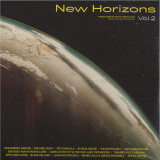
- A1: Thembelihle Dunjana – Pressin’ On
- A2: The Sn Project - Afrikanization
- A3: Sisonke Xonti - Sinivile
- A4: Muhammad Dawjee Ft Siphephelo Ndlovu - Otherness
- B1: Tefo Mahola - First Offering
- B2: Ayanda Sikade - Zimkhitha
- B3: Linda Sikhakhane - Inner Freedom
- C1: Sibusiso Mash Mashiloane - Ke Mashiloane
- C2: Marcus Wyatt & The Zar Jazz Orchestra - Race For Timbuktu
- C3: Spha Mdlalose - Indlela
- D1: Blake Hellaby - Hodge
- D2: Leagan Starchild Ft Justhlo – Fiend
- D3: Ndabo Zulu & Umgidi Ensemble - Nandi’s Suite (Interlude Ii)
- D4: Afrika Mkhize - Be Still
Following a definitive first volume jam-packed with forward-thinking musical talent working in the South African creative improvised music idiom, New Horizons returns with a fresh iteration of young artists who continue in the same tradition and tone.
The compilation showcases recent recordings from 14 more leading lights in South Africa’s contemporary jazz scene: pianists Thembelihle Dunjana, Afrika Mkhize, Sibusiso ‘Mash’ Mashiloane, Blake Hellaby and Siphephelo Ndlovu’s The SN Project; saxophonists Sisonke Xonti, Muhammad Dawjee and Linda Sikhakhane; singer Spha Mdlalose; drummers Ayanda Sikade, Leagan Starchild and Tefo Mahola; and trumpeters Ndabo Zulu and Marcus Wyatt accompanied respectively by Umgidi Ensemble and The ZAR Jazz Orchestra.
Together they form part of a vibrant, connected community charting new sonic territory that speaks to today’s troubled times while building on the country’s unique and proud jazz history.
The Cool Feedback Quartet’s music is quite similar to a philharmonic orchestra manipulating new material:
feedback, or in other words, the unexpected beauty of sound when it is let loose. Becoming its master so as to make the
best use of it, like a new instrument, the guitar pick up plays again on request. Harmonizing sounds like a string section
gone wild would, like light piercing through ether, tearing up the background and taking us for good to unknown territory.
The bandleader, Grégoire Garrigues, who first got the idea of the concept and got the ball to roll, is a well-known and
respected French guitarist.
Malamanya burst onto the recording scene with their self-titled debut in 2017, a bonafide tribute to the traditional sounds of Afro-Latin music in Cuba and the Caribbean, and perhaps more notably, that tradition's evolution into New York City's quintessential '70s street sound,la salsa. At first glance, you might wonder how this 9-piece orchestra out of Minneapolis of all places would manage to tap into such a sound, but the group's pedigree and vintage recording chops tell the real story. Tracked and mixed inpuroanalog at bass player and engineer Tony Schreiner's Brown Bag Studios, and featuring a multi-national mix of players from around the world, the group's first two original compositions make for an impressive debut on Names You Can Trust. Led by the fiery female voice of Cuban immigrant Zusel Balbìn, "La Tormenta" is one of the finest examples of modern-daysalsa durato come out in recent years. The recipe here includes huge orchestration complete with dual trombones and a rhythm section entirely in step with the group's impressive following ofsalseros —and the flavor is nothing butauthentico. The B-Side "Frio" features the group's complimentary lead male voice incantadorandcongueroLuis Ortego Castrellon. It's a double shot of peak dance floor design, and a prime example of the group's growing international appeal, wherever the taste for the sauce is desired.
Mocambo Records is proud to present the official reissue of this uberrare piece of German psychedelic soul! Susan Avilés' epic 'Eine schöne Welt' from 1970 is one of the toughest 45s to get hold of. With its dope wah-drumbreak-intro, lush orchestration and powerful vocal performance, the tune has deservedly turned from an obscure sleeper into one of the most wanted European rare grooves. On the flip side is the orchestral folk soul 'Versuche zu versteh'n' - and uptempo number with breakbeat drumming hidden behind a wall of sound that has become an obscure b-boy favourite.
The record comes in a picture sleeve with original photos from the era - a picture showing the singer holding a copy of her own single and a shot for an autograph card to support the original release.
All audio and photography licensed from the family estate of Susan Avilés. The original recordings have been carefully remastered for this limited vinyl run by Michael Schütz.
- A1: Abyad Barraq (With Greg Fox)
- A2: Sa'at (With Alexei Perry Cox)
- A3: Istashraqtaq (With Beirut)
- A4: Tanto (With Lucrecia Dalt)
- A5: Ana Lisan Wahad (With Farida Amadou & Pierre-Guy Blanchard)
- B1: Qalaq 1 (With Alanis Obomsawin & Diana Combo)
- B2: Qalaq 2 (With Roger Tellier-Craig)
- B3: Qalaq 3 (With Moor Mother)
- B4: Qalaq 4 (With Rabih Beaini)
- B5: Qalaq 5 (With Oiseaux-Tempete)
- B6: Qalaq 6 (With Viz Reka Csiszer)
- B7: Qalaq 7 (With Tim Hecker)
- B8: Qalaq 9 (With Mayss, Mazen Kerbaj, Sharif Sehnaoui & Raed Yassin)
The Acclaimed Arab-Levantine Contemporary Music & Art Project Returns With Its First New Album Since 2018. Led By Lebanese-Canadian Producer Radwan Ghazi Moumneh, Whose Many Credits Include Matana Roberts, Big | Brave, Sarah Davachi, Suuns. Featuring A Different Guest Collaboration On Each Track, Including Tim Hecker, Moor Mother, Beirut, Lucrecia Dalt, Greg Fox. Europe & Canada Tour In November 2021 With Experimental 16mm Analog Films By New Duo Member Erin Weisgerber.
One of the most renowned and uncompromising entities working in 21st century avant-garde Arab-Levantine art and music, Jerusalem In My Heart presents a new album of vital and haunting electronics and electroacoustics, framed by founder and producer Radwan Ghazi Moumneh’s spoken and sungArabic, buzuk-playing and sound design. Qalaq is the most distilled, variegated and finely wrought Jerusalem In My Heart album to date – featuring a different guest/collaborator on every track, yet as cohesive, emotionally resonant, sonically adventurous and narratively powerful as any release in JIMH’s celebrated discography. Guests across the album's 13 tracks include Moor Mother, Tim Hecker, Lucrecia Dalt, Greg Fox, Beirut, Alanis Obomsawin, Rabih Beaini and many more. “Qalaq” is an Arabic word with many shades of meaning but Moumneh particularly intends it as “deep worry” – on various obvious global levels, but also specifically with respect to Lebanon: its collapsing domestic politics, economy and infrastructure; the tragedy and aftermath of the 2020 Beirut port explosion; the intractable geography and geopolitics that continue to condemn the country to corruption, disruption, destabilization and violence. Moumneh writes: “The Side Two tracks are all named ‘Qalaq’ and then numbered, representing the degrees of layered and complex violence that Lebanon and the Levant have reached in the last couple of years, from the complete and utter failure of the Lebanese sectarian state that has driven the economy to a grinding halt, to its disastrous handling of the migrant influx from neighbouring failed states, to the endemic corruption that led to the August 2020 port explosion, to the latest chapter of Palestinian erasure and yet another brutally asymmetrical and disproportionate bombing campaign on Gaza.” Qalaq is shaped by a "dismantled orchestra" ofmusical collaborations, forged through long-distance file exchange during lockdown winter 2020-21 (and the inverted companion to JIMH's previous 2018full-length Daqa'iqTudaiq, which featured a 15-piece orchestra recorded live in Beirut). Moumneh initially through composed Qalaq in purposely stark and skeletal form, then gave each guest artist a section to decompose, edit, re-interpret and recompose as they desired, working their stems back into his own mixes for each piece/section and moulding newfound coherences in the overall work. The result is The album artwork with a front cover colour photograph by Myriam Boulous capturing a scene during the Beirut October Revolution of 2019.
k 11 Qalaq 6 (w/ VÍZ Réka Csiszér)
Black Screen Records has teamed up with Tumult Kollektiv to release their beautiful orchestral soundtrack to Twirlbound's open-world action adventure game Pine on limited edition double vinyl this spring. The soundtrack will be available on limited edition 140g transparent blue/green vinyl and comes in a beautiful sleeve with all original artwork by Ollie Hoff (@OllieHoff) and includes a Steam Key for the game, a Bandcamp Code for the digital soundtrack and liner notes by Tumult Kollektiv. Pine is an open world action adventure simulation game. Set in the beautiful world of Albamare, you take on the role of Hue, a smart young adult who will have to explore, trade and fight his way through a stirring ecology filled with creatures much smarter than humans. Music, sound and implementation by Tumult Kollektiv.
Distilling order from a crushing whirlwind of chaos has been the stock in trade for Red Kite since the Norwegian jazz-rock supergroup joined forces in 2014. Apophenian Bliss, the much anticipated follow-up to the quartet’s powerhouse 2019 self titled debut references the tendency in the human brain to find patterns and connections even when none actually exist. While it may be a stretch to call Red Kite’s blistering alchemy of surging psychedelia, steamroller rock and fringe-dwelling jazz “benign,” it’s at least a far less harmful application of the term than the conspiracy theories warping minds across the globe.Still, corralling the heady pandemonium of heavy prog, free jazz, combustible fusion and avant-metal into a cohesive sound is one thing; bringing that music to life in the face of the real-world chaos of a global pandemic is something else entirely Musicians : Even Helte Hermansen – Baritone guitar Trond Frønes - Bass Bernt André Moen – Rhodes Torstein Lofthus – Drums and percussion For Fans Of: Mahavishnu Orchestra, Return To Forever
4 Reworked & Reimagined tracks from Motherhood and a cover of Deftone’s “Teenager”. Clear w/ Blue Glitter Colored Cassette Shell, with full pull-out J-Card artwork. Recommended If You Like : Bjork’s Live Box, The Deftones Cate Le Bon. Montreal’s No Joy—since 2009, a noisy four-piece shoegaze band, from 2015 onward, the sonic experiments of founding member and principal vocalist Jasamine White-Gluz has rejected convention, opting to find cohesion in vast, bold, indiscernible structures. In the beginning, the group excavated melodious riffs from squalling guitars, now, White-Gluz approaches songwriting with abstract meticulousness, no longer tethered to her six-string instrument. In 2018, it was the modular electronica of No Joy / Sonic Boom, an EP collaboration with Spaceman 3’s Pete Kember. In 2020, her first full-length as a soloist and No Joy’s first album in five years, Motherhood, her guitar returned for a genre-agnostic, maximalist treatise on aging. Fertility, family, death, birth, her voice heard loud in the mix, White-Gluz became a commanding force among the many-splendored sounds of trip-hop, trance, nu-metal, dance rock, and, of course, shoegaze, delivered through banjo, vibraphone, scrap metal, slap bass, even kitchen appliances. Who knew chaos could have such lucidity? Now, White-Gluz’s ever-expansive evolution has brought forth Can My Daughter See Me From Heaven, an EP reanimation of five songs from Motherhood, transformed by new orchestral instrumentalists: an opera singer, a cellist, a harpist, French horn musician. These songs, recorded entirely remotely, are not a correction. They are a spring rebirth—an opportunity to grow those tracks, similar to the transformation they would’ve undergone live, on stage. “Songs take on a new life when I’m on tour. These songs didn’t get that chance. I still had more to say with them,” White-Gluz explains. “I probably never would’ve been like ‘let’s get a bunch of classically trained players together,’ if it wasn’t for covid-19 canceling tours. This EP was an opportunity to do something that wasn’t obvious. It’s a bedroom recording, but it doesn’t sound like we recorded this in our bedrooms. I wanted to do something that sounded bigger than Motherhood did, and Motherhood was recorded before covid.” Where many musicians used last year’s disaster to look inward, releasing solitary, insular albums, No Joy did the opposite: “It was more, ‘Let’s try everything!’ Give me something to look at!”
- A1: A Mark Of Resistance
- A2: There Is Always A Girl With A Secret
- A3: Silence Is Silver
- A4: Bower Of Bliss
- B1: Wooddrifts
- B2: Nkosezane - For My Daddy
- B3: Like Jenga (Only It Reaches All The Way To The Sky And It’s Made Of Knives)
- B4: Doggerland (Between The Acts)
- C1: Fundamental Things
- C2: Fractions Fractured Factions
- C3: I’m In Love With The End
- C4: Surrender
- C5: Gargle (Command V)
- D1: Dishàng Shuãng (Edit)
- D2: Transport Me
- D3: An Infinite Thrum (Archipelago)
- D4: The Abandoned Colony Collapsed My World
absent origin’ reassembles and reimagines recordings and musical
scores composed by Mira Calix, globally, over the past decade. It’s a
collage album about edges and borders, cutting and tearing, and
composing new combinations that point to an audio visual manifesto for the 21st Century.
“Like Duchamp, I had started out wanting to make an album, or box, of approximately all the things I produced. In the end, I realised - as much as a collage is the coupling of two or more realities, it also offers the means to examine the materials and culture of an era, questioning and expanding its borders.” - Mira Calix
Every song on the album was created by applying a different collage
process relating to a different visual artist, spanning the history of collage to contemporaries of the practice. The sonic materials are subjected to a myriad of processes; layered, synthesised, constructed and assembled into electronic melodies, textures and complex, frisky dance rhythms that are constantly shifting in surprising ways. absent origin employs collage to make sense of the current moment of displaced voices, disjunction and political unrest.
Calix’s recording sessions from all over the world are the many
fragments we hear across the album; from India to Tasmania, Jordan to Belgium, China to Uganda, her former home of South Africa, to her
current home in Britain. Slicing into these are further recordings of
vocalists, percussionists, choirs, orchestras, quartets and soloists, never appearing in the form in which they were originally intended. The record is a polyphony of predominantly diverse female voices held together by pulsating baselines, haunting electronic sounds and orchestrated melodies and with them, we travel.
The album fizzes with a political energy and the interconnectedness of
everything. At this moment in time, there is an impossibility of separating one thing from another; the effect is strange and not exactly reassuring.
Collage suggests infinite possibilities and each track here is a singularly unique compositional combine, a dizzying hall of mirrors with its own unlikely harmony, its own distinctive rhythm. On ‘absent origin’, collage becomes the tool to make sense of a present that is often anything but.
2LP in printed inner sleeves with 5mm spine outer, printed insert and
digital download code.
Built around the successes of his soundtracks and songs for the movies of Christophe Honoré, Alex Beaupain’s profile in the ‘chanson française’ landscape is quite unique. Beaupain alternates between soundtracks, songs he writes for others (mainly great French actresses) and his own solo albums.
In march 2021, Beaupain paid tribute to the late Serge Gainsbourg for the 30th anniversary of his passing during a special live on air event where he covered in full, with the Radio France Philharmonic Orchestra, Gainsbourg’s penultimate shocking album from 1984 : Love On The Beat.
This experience led him directly in the studio with Saint DX as producer, the French American duet Faux Real singing backing vocals and a full string section to re-record this cult album with a 2021 twist. He had also dreamed of covering that particular album that had so much impact on him, musically and lyrically, when he first discovered it. The 80s funky sound of the record, produced by Billy Rush, was a new start for Gainsbourg and at the time, the lyrics schocked everyone but achieved to avoid any censorship.
“I was 10 when Love On The Beat was released in 1984. Covering the full album was an idea I always kept somewhere in my mind as I was fully aware of the long lasting impact this particular record had on all the teenagers at the time. This collection of songs is far from being the most covered or talked about works form Gainsbourg, but I’ve always had the feeling they were ‘mine’. That everything started there for me and that, one day or the other, I would have to come back to it.” (Alex Beaupain)
- A1: Columbia Symphony Orchestra & Bernstein - Rhapsody In Blue (Excerpt)
- A2: Rr Orchestra - Sarabande
- A3: John Barry - Midnight Cowboy
- A4: Pascal Roge - Gnossiennes #3
- A5: Michael Andrews - Mad World (Feat Gary Jules)
- A6: Arthur Fielder & Boston Pops Orchestra - March Of The Siamese Children
- A7: Nick Ingman & Orchestra London Sinfonietta - Adagio For Strings
- B1: John Williams - Cavatina
- B2: Philip Glass - Powaqqatsi
- B3: Michael Kamen - The Office
- B4: Bernard Hermann - Outer Space
- B5: Ray Noble & His Orchestra - Midnight, The Stars & You
- B6: Thomas Newman - Horse
- B7: Wendy Carlos & Mark Ayres - Ode To Joy
- C1: Deodato - Also Sprach Zarathustra
- C2: Thomas Newman & Hollywood Studio Symphony - Brooks Was Here
- C3: Mike Oldfield - Tubular Bells (Excerpt)
- C4: Hotei - Battle Without Honor Or Humanity
- C5: John Carpenter & Mark Ayres - Halloween (Main Theme)
- C6: Bernard Hermann - Main Title
- D1: Giorgio Moroder - Chase
- D2: Isaac Hayes - Theme From Shaft
- D3: Lalo Schifrin - Bullitt (Main Title)
- D4: Vangelis - Tears In Rain
- D5: Louis Armstrong - We Have All The Time In The World
"60 Years of cult and classic soundtracks presented on 2 x 180g
Featuring Bernard Hermann, John Barry, Thomas Newman, Giorgio Moroder, Isaac Hayes, Lalo Schifrin, Mike Oldfield, Vangelis...
This double album is a new collaboration between long-time Umor Rex artists Andreas Gerth (one half of Driftmachine) and Carl Oesterhelt (11 Pieces for Synthesizer). Both developed their shared musical cosmos during their time with the now defunct Tied +Tickled Trio. Oesterhelt is also known for his solo compositions for orchestras and for collaborations with Johannes Enders and Hans-Joachim Irmler of Faust.
As futurism seems inherent to electronic music, the backward-looking view is alien to its nature – consequently, a dialectical struggle between these principles is rarely expressed with the means of electronics. Especially today, its essence as a medium of progress stands in opposition to a sceptical position. By reconnecting us with history, The Aporias of Futurism seeks to define a critical location, that stands in opposition to the postmodern concept of interpretation, deconstruction and reformulation and the belief in progress that goes with it.
The working method for the album Andreas and Carl followed was the usual musique-concrète-technique – cut/assemble/edit/process pre-recorded sounds – but instead of deconstructing the concrete noises into an abstract sound entity, they followed a different path: the organic interweaving of orchestral structures with the electronically processed noise layers into a composition in the sense of classical modernism at the beginning of the 20th century.
Carl started with sketches recorded via a broken CD player, processed through a ring modulator, which sounded like old electronic music from the 1950s. To interact with these fragments Andreas recorded and processed a plethora of everyday noises, atmospheres, tonal fragments from the modular, industrial and shortwave radio noise, percussion in the form of door slamming, falling metal sheets, ball tracks, and so on. So, while they still played within the futuristic discipline, the reference to the past is actually unmistakable. One can hear it in the tonality of the contrasting orchestral passages, in the sound character of the processed samples and the sonic electronic layers. But it is precisely here, where a narrative tension develops. Theses and antitheses, extreme (unresolved) opposites, contrasts… essentially inner contradictions, or expressed in another word aporias… … but there is another factor at play here, something that plays a subordinate, almost ostracized role in the post-modern context: beauty (albeit the beauty of ruins) – beauty, the only refuge of the pessimist.
In the course of the process, a wide range of motifs and ideas emerged from the fog of memory. Free associations of concepts, books and authors from a wide period of time, such as Milton's Paradise Lost, William Blake, Robert Graves, ancient Rome, as well as Borges and Juan Rulfo. This flood of images is also incorporated on the album cover as a "free interpretation" of cultural objects and their relations in time.
The overarching motif of a sceptical rejection of the idea of Futurism is illustrated by a quote from Emile M. Cioran, the writer who most closely embodies the common spirit of the work presented here.
"But here comes the strangest thing: the Futurist idolizes becoming only until he has enforced that order for which he fought; then the ideal conclusion of time becomes apparent to him, the ‘always’ of utopia, which concludes and crowns the historical process. The conception of the Golden Age of Paradise par excellence, thus grips believers and unbelievers alike. But between the original paradise of the religions and the eschatological of the utopia there is the whole distance that separates a nostalgia from a hope, a repentance from a delusion, an achieved from an unrealized completion."
All music composed by Andreas Gerth and Carl Oesterhelt between Berlin and Munich, Germany in 2021. Produced and mixed by Andreas Gerth in Berlin. Mastered by John Tejada in Sherman Oaks, USA. Artwork by Daniel Castrejón in Mexico City.
Limitierte farbige LP! "Public Storage" baut auf dem Sound von Vus früheren Veröffentlichungen auf und unterstreicht ihre Stärken als Songwriterin mit einem tieferen Sinn für Glanz, Raffinesse und Dringlichkeit. Sie nennt es eine "sehr invasive und intensiv klingende Musik", die erfrischend unkonventionell zu den zeitgenössischen Trends ist; dies ist Musik, auf die man sich einlässt, anstatt sich zurückzulehnen. Co-Produzent Jackson Phillips (Day Wave) half Vu dabei, eine riesige, körnige, facettenreiche Welt zu erschaffen, in die sie sich stimmlich hineinbegeben kann, wobei ihre ausgeprägte Altstimme frei zwischen beschwörenden, tiefgründigen Betrachtungen und gefühlvollen, himmelwärts strebenden Ausbrüchen hin- und herpendelt. Die ersten Klänge, die wir hören, sind bezaubernd: Vereinzelte Klaviertasten gehen in "April Fool" in warme Schläge und Selbstharmonien über, während Vus Protagonistin ihre Umgebung und ihre Fähigkeit zu kommunizieren verleugnet. Das sanfte bernsteinfarbene Glühen geht über in den Titeltrack des Albums, einen dunkleren, düsteren, lauteren Ort. Vu rennt durch "Public Storage" mit einer Reihe von trotzigen Zurückweisungen (Versagen, Familie, Magie) und kathartischen Forderungen. Es ist eine seltene und kraftvolle Zurschaustellung von Verletzlichkeit von einem Texter, der das Abstrakte dem Autobiographischen vorzieht. Aubade", das auf einem Disco-Synthie-Muster und groovenden Bass-Stabs aufbaut, hat den hellen Schwung seines morgendlichen Namensvetters, der geschickt im Widerspruch zu seinem niederschmetternden Thema steht. Der Kontrast setzt sich in "Keeper" fort, einem pulsierenden New-Wave-Song mit träumerischen Synthesizern und einem coolen, knurrenden Erzähler, der diese Kraft erneut herausfordert. "Gutter" kehrt zum grungigen Lowlight zurück, mit muskulösen Gitarrenriffs, die sich über einem Bett aus Rückkopplungen abzeichnen und zusammen mit orchestralen Streichern zu einem brüllenden Finale anschwellen. Die hintere Hälfte von Public Storage bietet einige der markantesten Momente: Das rhythmische, hooklastige "Everybody's Birthday" spricht von der bösen Absurdität der Gegenwart, dem Ende der Zeiten. Die Nacht ist rot, die Stimmung ist blau, und die Scham ihrer Figur ist goldfarben. Vu hebt sich "Maker" für den Schluss auf, einen letzten Versuch im Existenziellen.
- A1: Columbia Symphony Orchestra & Bernstein - Rhapsody In Blue (Excerpt)
- A2: Rr Orchestra - Sarabande
- A3: John Barry - Midnight Cowboy
- A4: Pascal Roge - Gnossiennes #3
- A5: Michael Andrews - Mad World (Feat Gary Jules)
- A6: Arthur Fielder & Boston Pops Orchestra - March Of The Siamese Children
- A7: Nick Ingman & Orchestra London Sinfonietta - Adagio For Strings
- B1: John Williams - Cavatina
- B2: Philip Glass - Powaqqatsi
- B3: Michael Kamen - The Office
- B4: Bernard Hermann - Outer Space
- B5: Ray Noble & His Orchestra - Midnight, The Stars & You
- B6: Thomas Newman - Horse
- B7: Wendy Carlos & Mark Ayres - Ode To Joy
- C1: Deodato - Also Sprach Zarathustra
- C2: Thomas Newman & Hollywood Studio Symphony - Brooks Was Here
- C3: Mike Oldfield - Tubular Bells (Excerpt)
- C4: Hotei - Battle Without Honor Or Humanity
- C5: John Carpenter & Mark Ayres - Halloween (Main Theme)
- C6: Bernard Hermann - Main Title
- D1: Giorgio Moroder - Chase
- D2: Isaac Hayes - Theme From Shaft
- D3: Lalo Schifrin - Bullitt (Main Title)
- D4: Vangelis - Tears In Rain
- D5: Louis Armstrong - We Have All The Time In The World
60 Years of cult and classic soundtracks presented on 2 x 180g
Featuring Bernard Hermann, John Barry, Thomas Newman, Giorgio Moroder, Isaac Hayes, Lalo Schifrin, Mike Oldfield, Vangelis...
Skyline Recordings is only releasing another long-awaited killer from the musical masters that are The Family Fortune
“ANDY’S CAFE” is a head-nodding, horn-driven, up-tempo, sassy, dancer.
Produced by the geniuses that are The Easy Access Orchestra; Andy’s Café is a great DJ tool with its killer, horn-driven, funk groove on the A side and if that’s not enough, there’s the Hammond and the Clav on the flip.
- A1: The Anatomy Of Clouds
- A2: Breaking The Horizon
- A3: Reflected In The Waves
- A4: In Spite Of The Weather (Bill Ryder-Jones Re-Imagining)
- A5: Breaking The Horizon (Eluvium Broken Mix)
- B1: The Warmth Of The Sun (Peter Gregson Duet)
- B2: The Anatomy Of Clouds (Yann Tiersen Remix)
- B3: The Anatomy Of Clouds (Malibu Sweet Hereafter Remix)
FEATURING REWORKINGS BY YANN TIERSEN, BILL RYDER-JONES, MALIBU, ELUVIUM and
PETER GREGSON.
140g black vinyl with lacquers cut by Alchemy, printed inner sleeve, limited to 500 copies.
Michael Price has announced a new album, The Hope of Better Weather - part reissue, part reworks - due out onThe Control Room on 15 October 2021.
The new album takes his 2012 EP, The Hope of Better Weather, originally recorded by Price alone in a room with a
piano improvising, and brings it fully to life with the addition of a series of reworkings by Yann Tiersen, Bill
Ryder-Jones, Malibu, Peter Gregson and Eluvium.
He explains, “I wasn't trying to control what anybody else was doing. Everybody that joined in with the project gives
their own little piece of freedom. I was really interested in what freedom we all give ourselves, as well as being
fascinated to see what a little germ of an idea can mean to somebody else.”
Listen to Yann Tiersen’s rework of ‘The Anatomy of Clouds’: LINK
Listen to the original version of ‘The Anatomy of Clouds’: LINK
The five pieces, alongside these new reworkings capture a stark beauty, tenderness and delicacy in their tone. But
they are also wind-like in their shifting, expansive and elemental essence - capturing an exploration of the natural
world. “Nearly 10 years ago when I recorded these improvisations, I felt like I was missing the natural world - things
like the weather, the beach at Scarborough and all those kinds of visceral things.”
When Price revisited the work in recent months - at a time when many of us found ourselves more aware of the
natural world - he reconnected with it in a way that looks to connect with his next artistic steps. “You start off with
listening to 10 year old piano recordings and then you go through the reinterpretations of people looking at that
material now through their own lens. The fixation with weather, coastlines and with people connected with nature, is
really strong all the way through this project. Coming out the other side of it, it's kind of like a Northern weather feeling
- coming out with your collar turned up with a hat on, a bit drizzly and shit outside, but with a kind of determination
that is the route forward.”
Most musicians, if they are lucky, will master one craft or field within their career. For Michael Price, he’s managed
three, with his music spanning across piano, orchestral and soundtrack work. The soundtrack work - for TV shows
such as Sherlock, Dracula, and Unforgotten, and films such as Eternal Beauty, Cheerful Weather and Just Jim - has
seen Price win an Emmy, as well as receive countless nominations (including a BAFTA nomination). His work as a
solo artist takes the form of beautiful improvised piano works, such as Diary (2017), or via lush, grand, hyper-detailed
orchestral work, as heard on critically acclaimed releases via Erased Tapes such as Entanglement (2015) and Tender
Symmetry (2018). His latest release, The Hope of Better Weather, is rooted in the piano world but also exists as a
bridge crossing into new terrain..
The process of putting together the release has been an emboldening and liberating one for Price, and he finds
himself feeling buoyant about the possibilities of what lies ahead – which includes a new solo orchestral album. “It is
super freeing and liberating,” he says. “There's these little green shoots of a freedom emerging.”
Flatland/Spaceland is the debut solo release from renowned pedal steel player, visual artist and composer Joe Harvey-Whyte, who has worked with the likes of Tony Visconti, The Hanging Stars and Susanne Sundfor. Flatland/Spaceland blurs the borderlines between ambient and neoclassical to create an engaging and meditative listening experience.
The first side of the 2 track EP, titled Flatland is a glacial ambient creation made using pedal steel guitar processed through multiple effects together with field recordings and occasional revelatory sounds from Himalayan singing bowls. Spaceland, on side B, takes the composition and refracts it through an orchestral lens. A 26-piece ensemble delicately creep in to the calming world echoed by side A. As the piece develops the result is something more akin to a film soundtrack. Occupying the space between ambient and neoclassical, Flatland / Spaceland by Joe Harvey-Whyte invites us to take a step back from the busyness of our lives for 20 minutes and reflect.
Marking the triumphant return of live music to London's West End - Andrew Lloyd Webber has brought together an 81-piece orchestra to record new alum Andrew Lloyd Webber: Symphonic Suites from three of his best-loved musicals. This recording is the first live performance to take place at the newly refurbished Theatre Royal Drury Lane, following Lloyd Webber's LW Theatres' 2-year, £60m total restoration. The Symphonic Suites album, which will be released in September 2021, is a recording of three newly-orchestrated suites from Evita, Phantom of the Opera and Sunset Boulevard, specially selected from Lloyd Webber's repertoire of award-winning musicals.