Zeitgeber is a project that sees Lucy and Speedy J exploring roots and limits. The duo have both indulged their experimental sides from time to time. Perhaps most notably Speedy J with his mid-'90s run on Novamute, and Lucy on his 2011 full-length for Stroboscopic Artefacts. But Zeitgeber is something more, with two artists pushing each other to go further. SA018 is a single that gives only a slight hint as to what is to come in the shape of a complete LP. 'Body Out' is floor-ready techno with a twist. The textures that lie beneath feel like they're just as important (if not more), slithering and twittering away in constant dialogue with the just-slightly-off-the-grid beat. 'Body In' is the inverse of the A-side, a slow-moving chorus of indescribable ambience. As a precursor to the forthcoming album, it's a perfect taster of the uncompromising sounds yet to be heard. - Zeitgeber is a new project run by Lucy (Stroboscopic Artefacts' label head) and Speedy J (Electric Deluxe's boss). ' - 'Body Out Body In' is the Single that precedes Zeitgeber upcoming Album.
Cerca:zeitgeber
- 1
10” clear vinyl) Five years on since their last joint outing in Stroboscopic Artefacts Monad series, Speedy J and Lucy team up again as Zeitgeber on 'Seventeen Zero Four', a new three-tracker descending deep into the filthy, tenebrous outskirts of club music.
Five years on since their last joint outing in Stroboscopic Artefacts Monad series, Speedy J and Lucy team up again as Zeitgeber on 'Seventeen Zero Four', a new three-tracker descending deep into the filthy, tenebrous outskirts of club music. Torchbearers of techno as a life-affirming vehicle for human expression, as can be experienced through their multi-dimensional back catalogue of solo records and shared live performances at some of the finest clubs and events including Concrete, Goa Club and London’s E1, it's safe to say Jochem and Luca share a certain taste for taking things off the beaten path and into new perspectives. True to their bold approach towards production, 'Seventeen Zero Four' proudly continues the pair's tradition of chiselled floor-focused shifts and divagations outside the ringfenced domain of no-nonsense 4/4 mechanics initiated on their self-titled debut album in 2013.
Drawing first blood, the title-track 'Seventeen Zero Four' submerges us in a state of amniotic solitude as hell's all set to break loose around. Sonar bleeps drip and dissolve across invisible plateaux as thunder rumbles and roars in the distance, mirroring and shattering all linearity between the bars. 'One Zero Five' then implements a further straightforward groove, sequenced hats and kicks carving out a more familiar scenario for the dancers to appropriate, whilst maintaining that oddball, slightly off kind of minimal, dubbed-out blur. Rounding off the package, 'Twenty Zero Two' throws further jazz into the mix, letting its sine curves hula hoop into the upper layers of the outer-audio-space as a shrewdly engineered industrial swing drops the hammer for an epic last stretch.
Zeitgeber and L.B Dub Corp split the second in Stroboscopic Artefacts' series of fifth anniversary records. Zeitgeber is the collaborative project of SA label boss Lucy and Dutch techno royalty Speedy J. Their joint alias birthed an exceptional long-player last year and has since been presented as a b2b act at festivals and clubs around the world. 'Totemism' is their first officially released output since that album, and is every bit as compelling. 'Totemism' opens with distant, reverberating bells and a thin film of hiss and crackle. But, one minute in, heavy and incessant drums cut through the ambience, hitting you straight in the chest. The surrounding atmosphere evolves and filters in-and-out of the mix until, halfway through, the track takes an unexpected turn with an elastic bassline and acid squelches. Then, the drums hit you again. This is an 11 minute masterclass in widescreen, narrative techno from two of the scene's most experienced and inventive producers. Luke Slater, a man of many aliases, slips into L.B Dub Corp mode for the B-side of this record. This particular moniker of Slater's generally trades in raw, culturally-inspired house music, though has also appeared on Stroboscopic's Stellate series with two deep and beatless dubs. For his contribution to SA's 5 Year anniversary, Slater re-visits a classic club cut of his own, delivering 'Take It Down Again (In Dub)'. 'Take It Down Again' is a brilliantly-realised exercise in tension, dub delay and mixing board creativity, all made to shine by a dose of oddball musicality and sampling. This version of 2010's 'Take It Down' is more restrained and tonally varied, equipped to instil a brooding and tribal darkness on the floor.
- A1: Seventh Mirror
- A2: Ionization
- A3: Cloud Chamber
- A4: Harmonic Oscillator
- A5: Transfiguration
- A6: Urzeit
- A7: Cybernetic Dreams
- B1: Interference
- B2: Computer Garden
- B3: Pyramid
- B4: Halide Crystals
- B5: Integratron
- B6: Imaginary Forces
- B7: Phantom Lfo
- B8: Opticks
- C1: Mannequin
- C2: Mind In Light
- C3: Palantir
- C4: Vertigo Of Flaws
- C5: Exit Syndrome
- C6: Stasi
- D1: Atomic Voyage
- D2: Ultraviolet
- D3: Violence Cascades
- D4: Traumsprache
- D5: Zeitgeber
- D6: Prism
- D7: Threnody
- D8: Mind Oscillation
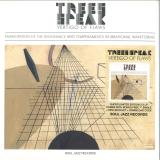
Trees Speak are back!
Speak’s new album, “Vertigo of Flaws: Emancipation of the Dissonance and Temperaments in
Irrational Waveforms” comes as a double-vinyl edition, single CD and digital release. The limitededition first pressing only of the vinyl includes a bonus 45 enclosed in an 8-page 7”x7” booklet
insert housed within the gatefold sleeve with cover artwork created by Soviet Union propaganda
artist Lazar Markovich Lissitzky in 1911.
Trees Speak are back!
This new release is a vast leap into an ocean of space and sound, a quantum leap into cybernetics, biology, anti-gravity,
time travel, dream speech and transfiguration. A seriously next step release!
Showing no signs of slowing down their rapid creative pace – incredibly this is their fourth album in the space of just over
one year – ‘Vertigo of Flaws’ is a mighty 29 tracks, one and a half hours of music across one double album that is surely
going to be a defining point in their musical career, a giant leap into the sonic unknown, an epic exploration of intensity
and sound.
Alongside their now trademark German krautrock motoric-beat rhythms, angular New York post-punk attitude, tripped-out
60s spy soundtrack, psyche-rock, and 70s synthesizers and vocoders, here you will also hear a new cosmic spacial
awareness (both personal inner space and galactic outer space) and a truly wilful pushing of sonic boundaries - as police
sirens, static noise, alarms, radio signals, avant-garde voices, and orchestral string quartets, all collide to add beautiful
dissonance to uber-powerful, intense, addictive and propulsive rhythms - in the process creating a truly unique
soundscape that Trees Speak have made wholly their own.
If you ever wanted to hear Can, Hawkwind, Destroy All Monsters, Pere Ubu, electric eels, John Cage, Liquid Liquid,
Tangerine Dream, Suicide, Neu!, Laurie Spiegel, Art Ensemble of Chicago, John Barry, Mother Mallard’s Portable
Masterpiece Company, Sun Ra, Stockhausen, John Carpenter, Electro-Acoustic and Musique Concrete and Mars in one
band - then this is it!
Trees Speak are Daniel Martin Diaz and Damian Diaz from Tucson, Arizona and their music often draws on the cosmic nighttime magic of Arizona’s natural desert landscapes. ‘Trees Speak’ relates to the idea of future technologies storing
information and data in trees and plants - using them as hard drives - and the idea that Trees communicate collectively.
Special guests from the hyper-creative hub of the Tucson music scene on this release are Gabriel Sullivan, Ben Nisbet, Saul
Millan, Stephani Guilmette, and Davis Jones.
The album Vertigo of Flaws was recorded in Brooklyn, New York, and Tucson, Arizona during the plague of 2021.
Extract from Vertigo of Flaws sleevenotes:
‘As we travel through space and time, avoiding the discarded remains of the industrial period, the
deconstruction of social norms through the expression of art, music, and philosophy guide the human
experience towards the unknown.
All that remains are musical echoes scattered throughout the universe, like ancient vibrations that now
populate the cosmos. These waves now show signs of decay. Melody, beauty, tonality have all but fallen
away as dissonance blossoms. As John Cage wrote in 1937,
“Whereas, in the past, the point of disagreement has been between dissonance and consonance, it will be,
in the immediate future, between noise and so-called musical sounds. New methods will be discovered,
bearing a definite relation to Schoenberg’s twelve-tone system and present methods of writing percussion
music and any other methods which are
free from the concept of a fundamental tone”.
Similarly, George Van Tassel claimed the Integratron as capable of
rejuvenation, anti-gravity, and time travel. So, what remains of the
“people”? We have adopted from them our own Zeitgeber: their pulses
now guide our sun, our planets, our earths, and are the new circadian,
diurnal, and ultradian rhythms of the galaxy. Traumsprache, dream
speech, is now the internal language of trees.
Decaying metal and machines liberated the note unto nature’s table,
and we sip the delicious nectar of music once more irrational, elaborate,
violent, vast. The past is the future, musical disintegration its own rebirth.
We are nature, once more the computer of the Universe.’
Back In Stock!
The debut collaboration between techno alchemists Ben Klock and Lucy will probably provoke quivers of anticipation before a single note has been heard. After all, both producers have carved out names for themselves as scene innovators at what they do, and both have already proven that they can more than capably work in a duo format without sacrificing an iota of their unique aesthetics: in Lucy's case, there has already been the sublime Zeitgeber pairing with Speedy J., and Klock has joined forces with the likes of Marcel Dettmann to craft some of the more memorable output from the Ostgut Ton label. This new release makes good on each producer's talent for working with epically unfolding tracks, maintaining a strong command of both 'drone' and melodicism, and envisioning sound as a kind of inter-dimensional mass transit. As the record indicates, things can get very interesting when the two working methods superimpose perfectly, but can be just as interesting when the two fall slightly out of phase with one another.
Listeners familiar with the classic kosmische feel will be taken immediately by the opening gambit "Bliss," whose feeling of floating through the coldness of space is accompanied here by nicely warm production values. The bassline that introduces the subsequent track ("War Lullaby") is close to being a continuation of the opener's leitmotif sequence, although with a change in atmosphere that will keep curious ears from turning away too soon: an FX-shrouded voice delivers a monologue at once seductive and foreboding, followed by a confident kick thump with ephemeral trailing clatters in tow. This affective orientation pulses through the whole record well, building up to the second rhythmic track ("Santeria") which is the busiest and most engaging of the bunch. Here a variety of sonic flavorings are ritually thrown into the pot and allowed to simmer - fleeting snatches of conga, phasing zaps and rhythmic ricochets all make for a rich concoction that epitomizes the progress that has been made in techno music within this decade. The closing "A Ghost Love story," like the opener, is a non-'dance' piece, but is no less compelling for that fact: as a foam of white noise pans between the listener's ears, a slurred / pitch-bent refrain conjures the feeling of either entering or exiting from some erotically tinged hypnagogic state.
Speaking of which, the overall impression given off by this record is that of a special kind of reciprocity: that is, of dreams influencing reality and reality feeding back into dreams. The rhythmic intensity of these tracks, at once an indicator of a hard and immediate reality, is regularly complemented by oneiric flourishes that make the partitioning line between these two realms of consciousness less distinct. As the next chapter in the Stroboscopic Artefacts saga, and in the personal journeys of both Ben Klock and Lucy, it will contribute to the ongoing mission of all these parties: giving longtime fans what they want while expanding their consciousness and inquisitiveness.
- A1: Lotus Eater - Tripholium
- A2: Shifted - K Pop
- B1: Efdemin - Entropie
- B2: L.b. Dub Corp - Look Shiny
- C1: Rrose - The Myth Of Purity
- C2: Lucy - The Goat God
- D1: James Ruskin - From Here On
- D2: Denise Rabe - Paralysed Spheres
- E1: Zeitgeber - Double Down
- E2: Adriana Lopez - It All Adds Up
- F1: Chevel - Va Lavorar
- F2: Alessandro Adriani - Two Journeys
- F3: Serena Butler - Giubia
Stroboscopic Artefacts releases ‘X – Ten Years Of Artefacts’, a 13-track album curated by Lucy, the nom de techno of Luca Mortellaro. It celebrates ten years of his label by boldly confirming its raison d’être: a continual redefinition of modern techno.
‘X – Ten Years Of Artefacts’ is a various artists album in which the label’s key artists respond to its tenth anniversary with fresh compositions. Artists with divergent perspectives and MOs are equally at home expressing themselves. These tracks’ timbres, tempos and moods differ greatly yet—somewhat improbably—they seem together, ideologically unified.
The album will be later complemented by a special remixes EP, with four new reworks of pivotal back catalogue material from the label (Donato Dozzy, Caterina Barbieri, Xhin and Klock). And from fall 2019, Lucy and an incredible cast of Stroboscopic Artefacts artists will begin an extended club tour to mark the anniversary.
On ‘X – Ten Years Of Artefacts’, Mortellaro features solo as Lucy, in collaboration with Rrose as Lotus Eater and together with Speedy J as Zeitgeber. (Rrose also appears alone with “The Myth of Purity.”) Shifted, Efdemin, L.B. Dub Corp (Luke Slater), James Ruskin, Denise Rabe, Adriana Lopez, Chevel, Alessandro Adriani and Serena Butler each feature, representing a group of singular artists whose relationships with the label range from years to months—Stroboscopic Artefacts’ past, present and future must exist simultaneously.
Back in September 2009, Lucy released “Why Don’t You Change/Dub Man Walking,” the first record from Stroboscopic Artefacts, which began a discography that, ten years later, is almost unparalleled in its ambition and vision. Put simply, Mortellaro wanted to create something that didn’t exist. Stroboscopic Artefacts would be respectful of, and indebted to, the great techno and electronic music artists of the past but would develop new paths forward for the label and the genre. The label refused to perpetuate the established dichotomies of electronic music — between the dance floor and home listening, between club music and experimental music, between the past and the future. It took risks knowing it wouldn’t always work. But within a year or so of the label’s inception, it was obvious Stroboscopic Artefacts’ approach had captured imaginations far beyond its Berlin base, showing us that the boundaries of techno are often constructs of limited imagination.
The label pursued constantly evolving methods of releasing music. It created concept-driven series like Monad, Stellate and Totem, establishing frameworks that would give freedom in limitation. Standout albums by Lucy, Xhin, Dadub, Zeitgeber, Chevel, Kangding Ray, Lotus Eater and Alessandro Adriani were deeply considered longform presentations.
With this new album, remix EP and tour, now is the moment for Stroboscopic Artefacts to look fondly at its past while drawing breath, reenergised, and hinting at new chapters.
- 1