Fetter’s Body of Noise erupts at the threshold between ravey hypnosis and avant-pop experiment, slithering through the hinterlands of unconscious desire. Nine shape-shifting tracks conjure haunted landscapes where beauty refuses clarity and dancefloor logic warps underfoot. Vocals swoon, drift, and demand—stacking into fragments that multiply and weave through saturated pulses and shimmering, snarling synths.
Opening track "Like a Rose" traces a dreamer’s transition into the unstable physics of a perplexing but familiar dream world, where they gradually become lucid. “Beast” follows up humming with shadowed urgency, threading a path through self-sabotage and metamorphosis. “Spathiphyllums” drifts a while in a lush lostness, aching for something new before fracturing into wild, cathartic collapse. Side B’s “Do I Exist? (D.I.E)” and “The Longing” spiral into existential wonder, searching for a human origin story—both personal and collective—against a backdrop of uncertainty, while “Headache” thrusts forward as an absurd and insistent manifesto to stay the course and harness one’s own power within the madness.
Body of Noise is crafted not only for sweating bodies in motion, but for distorting time and opening psychic portals, where surrender becomes strategy and uncertainty transforms into ecstatic navigation. Rooted in all-hardware improvised production and shaped by Fetter’s years of boundary-blurring visual and performance art, their debut LP feels alive and in flux. Reminiscent of a spectral pop chorus trapped in a loop of broken machinery, or a lost broadcast from a dancefloor in a parallel realm, Body of Noise is a journey into chaos, transformation, and a bold refusal to be contained.
About Fetter:
Fetter makes clubby self-destructing noise pop to dance and weep to. Oscillating between ethereal and pounding, their all-hardware, largely improvised live sets take listeners through a foggy wilderness of saturated rhythms and menacing synth lines, a golden voice guiding the way through. Fetter is the stage moniker of multimedia artist Jess Tucker. Their performances take place in clubs as well as galleries, often incorporating video, installation, and interactive performance art elements to create other-worldly surrounds of mesmerizingly unhinged bodies and faces.
Buscar:2 elements
After countless hours in the studio, we are proud to present EZ PC, a sonic journey infused with elements of funk, jazz and abstract soundscapes.
The record features the legendary Samuel Appapoulay, whose versatile musicianship adds depth and character throughout the project. This release also marks one of the first projects to showcase the collaboration between David and the Mauritian-born pianist.
To complete the experience, Tripmastaz delivers a remix that holds its own alongside the original, an absolute masterpiece that lifts the EP to an entirely new level.
Buckle up and enjoy the ride!
Break 4 Love, the timeless 1988 deep house anthem from Vaughan Mason’s Raze, featuring Keith Thompson’s soulful vocals was not only #1 US Dance Club hit and UK Top 30 single but an evergreen classic that remains a club culture staple 37 years on since its initial release. Its warm TR-909 groove, hypnotic bassline, and intimate lyrics continue to resonate across generations.
Alongside the original mix, this brand-new release from Armada Music & Champion serves up three essential remixes on one 12” vinyl. IIija Rudman kicks things off, preserving the sensual beating heart of Raze's iconic original while sliding effortlessly into the dancefloor rotations of today. Veteran of the scene Michael Gray puts his signature touch on ‘Break 4 Love’ adding extra percussive elements and sensuous sound effects. Through this Gray stays true to the original whilst providing a fresh take on the ’88 classic. Finally, Ridney & Inner Spirit’s take, slotting into those perfect sunset DJ sets on Ibiza with rolling beats and unfolding soundscapes. All bases covered on this buy or cry vinyl!
- A1: Émotions (02 38)
- A2: Conditions (02 52)
- A3: La Ride (02 21)
- A4: Pas Facile (02 32)
- A5: Juge (02 28)
- A6: Larguer Les Amarres (02 11)
- A7: Il Y A (04 18)
- B1: Convaincre (02 43)
- B2: Révolution 77 (03 42)
- B3: Folie Douce (02 26)
- B4: Tu N’es Pas Là (Feat Jwles) (02 55)
- B5: Boule À Facettes (02 44)
- B6: Atomic Dislexia (03 38)
Sélavy is Prosper’s debut album. It features 13 tracks that range from fairly traditional French chanson to more techno, rap, rock, punk, and even pop styles. Wordplay and stylistic devices play a central role in the lyrics. Much like his work as a visual artist—where he cuts and assembles elements that seem to have little in common at first glance.
Prosper uses the French language as a tool to express his emotions and reflections on life, with all its sorrows and joys. In doing so, he dissolves the boundaries between poetry, song, and artwork.
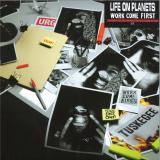
Tuskegee continues apace with ‘Work Come First’ from Life on Planets, a flawless blend of classic house, R&B, and conscious songwriting, remixed with finesse by Omar S and Soul Clap’s Charles Levine.
A modern-day hymn to hustle and stride, ‘Work Come First’ doesn’t chip away at the soul in pursuit of success. Working in collaboration with like-minded producer Seven Davis Jr., Phill Celeste applies his key alias to a triumphant, full-bodied songwriting moment. Led by beautiful organ piano, mingling with the artist’s defiant vocals and defined by the feel of a full live band, ‘Work Come First’ continues Life On Planets' beguiling, genre-crossing journey.
In ever-charismatic and minimal mode, Detroit icon Omar S breaks down ‘Work Come First’ into core elements for the floor, blowing out the system and applying Life on Planets’ vocal performance to a raw, lo-fi arrangement with a hint of street soul. In neat parallel, Charles Levine delves into the more full-bodied, rich elements of the track, tripping on the sophisticated funk long associated with the Soul Clap founder’s oeuvre.
Complimenting both takes, producer Seven Davis Jr. provides an alternate ‘Sev’s mix’, a little rougher around the edges for dancers under red lights.
A Walking Contradiction resurfaces with a new release by their friend & collaborator Katatonic Silentio, channeling a collection of tracks submerged in echoes and pressure-shaped pulses. AWC011 traces fluid architectures built from delay, decay, and deep resonance--each composition unfolding like sediment in motion. Sounds sway with tidal pull, suspended in chambers where space thickens and time refracts. Basslines emerge like sonar beneath shifting layers, while percussive elements flicker at the edges, softened by current and drag. Elastic and disorientated, these underwater constructions are tuned to the language of depth and dissolution.
Best known for his cinematic jungle excursions, Seb Uncles returns to Livity Sound for a second extended release of introspective electronics with a strong influence from mystical sources.
As Eusebeia, Uncles has developed a strong, independent presence in modern electronic music defined by a prolific run of deep-diving, breakbeat-driven albums and EPs. In 2022 he released Cosmos on Livity Sound, a mini-album that zoomed out to a more reflective strain of electronica shaped by atmospheric synth lines in the hauntological vein of Ghost Box, Pye Corner Audio et al.
The Wyrding Way finds Uncles delving even deeper into this area of his output, keeping drums to a bare minimum and focusing instead on powerful melodic lines. There are still considered soundsystem moments that connect with Livity's long-standing sonic focus, not least the subtle dub inflection of EP centrepiece 'By The Light Of The Moon'. Elsewhere Uncles leaves the melodic parts unaccompanied, letting the phrasing and emotional pull of the title track tell its own story.
Balancing light and dark elements and drawing inspiration from personal experiences and perspectives, combined with spiritual and existential observations, Uncles capitalises on the evocative streak in his studio practice to deliver a timeless, immersive experience unlike anything else in his considerable back catalogue.
Livity Sound is a label set up by Peverelist in 2011 as a vehicle for a raw and exploratory strain of UK techno, rooted in the heritage of UK dance music and sound system culture. It has since become one of the UK's foremost protagonists for cutting edge underground electronic music.
- A1: When I Sing, I Slip Into The Microphone. Into That Void, I Bring Comrade "Prayers", Then, Turning To Face The Outside, Together We Explode. Part I
- B1: When I Sing, I Slip Into The Microphone. Into That Void, I Bring Comrade "Prayers", Then, Turning To Face The Outside, Together We Explode. Part Ii
- C1: When I Sing, I Slip Into The Microphone. Into That Void, I Bring Comrade "Prayers", Then, Turning To Face The Outside, Together We Explode. Part Ii (Continued)
- D1: When I Sing, I Slip Into The Microphone. Into That Void, I Bring Comrade "Prayers", Then, Turning To Face The Outside, Together We Explode. Part Ii (Conclusion)
- D2: When I Sing, I Slip Into The Microphone. Into That Void, I Bring Comrade "Prayers", Then, Turning To Face The Outside, Together We Explode. Part Iii
Among the true Keiji Haino devotees, Nijiumu’s Era of Sad Wings (released on P.S.F. in 1993) has always held a special place in the pantheon. Operating for only a few years in the early 90s and apparently only performing a handful of shows, Nijiumu operated at the opposite end of the dynamic spectrum to Haino’s famed power trio Fushitsusha, dwelling in a hushed, meditative realm of mysterious droning sonorities and free-floating melodies that occasionally erupts into violence. Black Truffle is pleased to announce a new double-LP edition of a lesser-known 1994 Nijiumu recording, When I sing, I slip into the microphone. Into that void, I bring comrade “prayers”, then, turning to face the outside, together we explode. Here, Nijiumu is the trio of Haino, Tetuzi Akiyama and the obscure Takashi Matsuoka, the three performing on a wide variety of string, wind and percussion instruments, as well as electric guitar and bass, and Haino’s unmistakeable voice.
Like on the early solo Haino album that shares the group’s name (released on P.S.F. in 1993), the instrumentation swims in reverb (the use of which Akiyama recalls as ‘a kind of point of the band’), often obscuring the instrumental sources. On the short opening piece, a distant reed instrument arcs long buzzing melodies over a bed of cymbals and gongs, like a psychedelic take on Tibetan music. The epic second part, occupying almost 50 minutes, begins as a splayed, near-formless cloud of electric guitar and bass, shadowed by bowed and plucked strings, the three elements working through twisting atonal shapes. At various points in the recording, we hear what seems to be the sounds of musicians moving between instruments, their shuffling and bumps fitting seamlessly into this radically open music. Eventually, what sounds like electric guitar moves closer to the foreground, fixing on a repeated melodic cell around which hover mysterious clouds of long tones and a sporadic shaker. At the half-hour mark, the music begins to build to a violently emotive climax, Haino’s impassioned vocal cries punctuating a lumbering, bass-heavy murk, contrasted at points by what sounds like a tin whistle. Suddenly, the volume drops to a near-whisper, opening the way for the stunning final moments, which touch on the slow-motion balladry of Haino’s classic Affection, here given an eccentric twist by an occasional woodblock hit. The third piece opens with a hazy trio of rumbling bass, bowed strings and abstracted slide guitar, the latter calling to mind some of Akiyama’s later solo work. Eventually joined by Haino’s voice, its fragile, haunted tone might remind the listener of the man in black’s documented love of the madrigals of the murderous Count Gesualdo, before the recording abruptly breaks off mid-note. In this new edition, the Nijiumu trio recording is supplemented by a piece recorded solo by Haino in 1973, a bracing electronic blowout stretching almost half an hour. Using a homemade electronics setup to unleash a barrage of crunching distortion and shuddering harmonic fuzz, it takes its place in the canon of extreme live electronics next to Robert Ashley’s Wolfman and Walter Marchetti’s Osmanthus fragrans, looking forward to extreme noise years before Merzbow. Taken as a whole, these four sides of music are a stunning document of some of the lesser-known waystations of Haino’s singular creative path.
Biometric-Audio presents its second release: Serial Experiments Lain, a five track musical project characterized by an artistic virus in which stories unfold through minimalistic music, science fiction and industrial sounds, with very dark atmospheres at times. The album relates with a wide range of listeners. The idea was born from the inspiration of two mangas, Serial Experiments Lain and Ghost in the Shell, merging their elements into a single creative vision. A connection between mind and technology.
After an initial European release in 1976 on the Isadora label Age Of Earth was re-issued on Virgin Records in Summer 1977 and fast became a beacon for electronic music and what was becoming known as ambient - Some cite its very title as helping introduce 'new age' music - This re-issue faithfully replicates the original 1977 Virgin Records release and is pressed on 180g heavyweight vinyl.
Guitarist and synthesiser player Manuel Göttsching formed Ashra after disbanding Ash Ra Tempel, the outfit he had led since 1971. Moving away from the space rock of his previous group, Ashra was a far more electronics-based project. Recorded in Berlin, between March and June 1976, the four pieces on the album represent the very best of what became known as Kosmiche: dreamily repetitive, glancing to the stars while keeping feet firmly on the ground.
New Age Of Earth is a record full of contrasts: the throbbing, techno-predicting Sunrain opens the album; with its waves and crickets sound effects, Ocean Of Tenderness pulses gently like a space-age early Fleetwood Mac; Deep Distance brings elements of surf music into glacial electronica. At 21 minutes long, Nightdust occupies all of the album's second side, a ruminative, slowly unfolding piece that, after its crescendo, gives way to Göttsching's impressively celestial electric guitar solo.
Continuing the release series on our town of multicultural multimedia hub called Sakskøbing, which has been named after a lovely place in Denmark. This time a true veteran of electronic music DJ Honesty steps up under his moniker Honeydrop. Delivering four cuts of honest house music infused with elements of dub and break this release is guaranteed to cause the turntables feeling good and appreciated, they will be asking you for more. Hans has been producing music fanatically for long time with first official releases dating back to 1995 so it is a true honour to welcome him to the label 30 years later, now in 2025. The release is an intergalactic warm blanket with music on it that is completely ready for different moods and settings of the events/parties/listening sessions one might find itself in. Starting with “Penha de Franca” right until the last track named after the release’s title “Free at Last” a smooth ride can be felt which hopefully by the end of it will set the listener free, if it needs to do so. Free at last dear listener, free at last.
Driving, hypnotic, groove-laden techno with Detroit-inspired elements. Jeton Records proudly unveils its first-ever vinyl release, crafted by label founder and visionary Ferhat Albayrak. The Velodrome EP delivers four meticulously produced tracks that shift between peak-time energy and atmospheric depth, blending timeless influences with a modern edge. A vinyl-only exclusive rounds off the package, making this milestone release a must-have for collectors and DJs alike. With Velodrome, Ferhat redefines Jeton’s legacy and affirms his role as one of techno’s forward-looking voices.
Ben Liebrand is back with a brand-new single, Together, a masterclass in Nu-Disco groove.. This isn’t a remix; it’s a full-bodied original, featuring stunning solo work by Canadian virtuoso Anomalie (also known as Nicolas Dupuis), who is renowned for fusing jazz, classical, hip-hop, funk, and electronic styles into his unmistakable live electronic sound.
Together oozes retro charm with a modern twist. Funky slap basslines, shimmering disco strings, and soulful, uplifting vocals build with lush pads and arpeggiated elements that all go to create the track’s uplifting vibe. Disco-style string stabs and filtered synths give it that retro-modern hybrid sound, all wrapped in Liebrand’s unmistakably clean and warm production style.
Together’s soulful Nu-Disco groove hits all the right spots for dancefloors, poolside sessions, or classy warm-ups.
Call Sender is the collaborative brainchild that unites the talents of Paul Elliott, a versatile multi-instrumentalist, composer, producer, and recording engineer from Suffolk/UK and Michael Reed, a multi-talented instrumentalist, recording engineer, and drummer residing in the Bay Area/USA. Despite working together for the past four years, the pair are yet to meet in person!
After connecting on social media over their love of drum breaks and vintage reverbs Elliott and Reed fostered their creative partnership by bouncing recordings back and forth via email and this virtual collaboration resulted in their first album, the jazz-funk inspired “Lost To The Storm” (Tru Thoughts, 2023). With four singles from the album gaining radio play and becoming a favourite for tastemakers and DJs, the pair began work on the follow up “Golden Langur”. With this new record, the aim was to retain their signature Call Sender sound, a heady mix of B-movie soundtracks, classic library music and psychedelic funk and soul, but also introduce elements of lo-fi soul as well as collaborating with some of their talented friends as featured artists.
These features include fantastic instrumental contributions from the incomparable funkmaster Shawn Lee (Ping Pong Orchestra/Young Gun Silver Fox) on “Brainforests” and the legendary JJ Whitefield (Poets Of Rhythm/Whitefield Brothers) who kicks ass in two tempos on “Two Tails”. Not to mention the silky-smooth vocals from the Bay Area’s Andre Cruz, vocal duet from Lucid Paradise that is reminiscent of Gil Scott Heron and Paul Elliott’s seven year old son Buddy drops a vocal on the future B-boy classic “Rainbow”. Together Call Sender has an old-school vintage foundation with a modern perspective. Influenced by iconic acts such as Klaus Weiss, Miles Davis and Nino Nardini and with a hip and funky sonic aesthetic, Call Sender’s music is nostalgic without being pastiche, has a sense of travelling at its core, having been recorded in different parts of the globe, while never hesitating on the direction of the music.
“For Today” is a timeless album—a sonic journey that seamlessly blends electronic influences, Trip-Hop, Folk, Indie Rock,
and Psychedelia.
It unfolds like an immersive soundscape, rich in complex atmospheres, experimental textures, and a deep emotional
undercurrent. Agosta has envisioned a record that transcends trends and market conventions, crafting a cinematic, soulstirring experience that fuses the intensity of trip-hop, the purity of folk, and the swirling colours of psychedelia.
The result is music that stimulates the intellect as much as it stirs the heart. With a delicate, refined touch and melodic
depth, Agosta combines contemporary sounds with vintage warmth, pairing poetic lyrics with themes of love, introspection,
and the human experience.
A standout element of “For Today” is the presence of five tracks featuring female performers and writers. This
intergenerational collaboration brings a richness of perspective and emotional range to the album. Far from a simple gesture
of gender inclusion, it serves as an authentic integration of diverse voices, offering new layers of sensitivity and storytelling.
Where Agosta’s previous work leaned more toward instrumental composition, here the inclusion of female voices adds
lyrical nuance and depth. These contributions explore themes such as love, identity, relationships, and personal liberation—
offering a poetic yet grounded lens through which to experience the album’s contemporary sound.
In essence, “For Today” is a mature and cohesive work that defies the boundaries of traditional genres, creating a unique
and resonant sonic world.
Each track explores a different emotional and musical dimension, with meticulous attention to sound design and a clear
desire for emotional experimentation. The album balances the introspective depth of trip-hop with the lightness and
spirituality of folk, weaving in modern pop elements and touches of psychedelia and groove.
The result is a compelling, emotionally charged, and genre-blending experience—one that invites listeners not only to hear,
but to feel.
An absolute must-listen!
Oliver Dollar presents part four of his Contemporary series on Rekids. The EP precedes his upcoming album on the label, enlisting Seven ‘Sev’ Davis Jr. and Nils Ohrmann, alongside dub reinterpretations by La Boix and Sev.
Germany’s Oliver Dollar returns to Radio Slave’s Rekids with Contemporary Part Four, Parts one through three featured collaborations with Austin Ato, Brillstein, Harvard Bass, Hazmat Live, Boogs, and many more, winning support from the likes of Nightmares on Wax, Anja Schneider, Laurent Garnier, Carista, Jennifer Cardini, Dam Swindle, and others.
For this next chapter of Oliver Dollar’s ‘Contemporary’, elements of Dub serve as the unifying thread, opening part four with ‘Speakers Bleed’, a jazz-inflected House cut from Oliver and Classic Music Company and Ninja Tune artist Seven ‘Sev’ Davis Jr. Hypnotic vocals swirl through deep, groove-laden rhythms, setting the tone for the EP’s fluid, atmospheric feel before Oliver reunites with Golden Gate club resident and long-time collaborator Nils Ohrmann for the Hallelujah Dub of ‘The New Is Here’. The track features the soulful voice of Detroit songwriter and Contemporary series regular APROPOS while gospel-tinged background vocals and rich textures sit over an infectious percussive rhythm. On the flip, Oliver Dollar & Brillstein’s ‘Pill Popper’ from Contemporary Part Two is reworked by La Boix, the duo of LA”s Thee Mike B (aka Brillstein) and producer Salva, whose credits include work with RL Grime, Kurupt, E-40, and the Grammy-nominated album of ScHoolboy Q, as well as remixes for Rihanna, Boys Noize and Nelly Furtado. Their version is a late-night, low-slung trip, with echoing keys and vocals drifting through deep basslines. Closing the EP, Seven Davis Jr. returns for a dub of ‘Before You’, Oliver’s collaboration with ADMN from Contemporary Part One. Retaining APROPOS’ heartfelt vocal from the original, Sev layers bright, soul-drenched synths over rolling drums, delivering an irresistible, feel-good finale.
Mysticisms' is delighted to reissue Nail's timeless debut release, Cassiopeia. Appearing on the DiY Collective's 'Strictly 4 Groovers' compilation album for Warp Records in 1993, the original appears as a stand alone at last and is backed with a specially created 2019 Remix.
Starting in 1989 and centered around Nottingham, the collective, also known as DiY Sound System, were a focal point for the burgeoning house scene in the midlands. Promoting an alternative take on post-acid house's creeping commercialisation, DiY kept to simple ethos of good music and a good party and were at the forefront of the new Free Party movement.
Alongside parties, the collective set up a studio and label and young Neil Tolliday was introduced by in-house engineer Damian Stanley. 'Nail' was born and during studio downtime, the 18 year old wrote Cassiopeia around the S1000 sampler, Juno 106, Oberheim Matrix 1000 and Roland SH101.
Cassiopeia became the stand out inclusion on the compilation and rightly, is still highly prized. Fitting in and outside the Deep House vibe DiY were known, it fuses elements of ambient and even trance, with a beautiful arpeggio and vocal sample atop simple, but killer bass line and claps. Tolliday's 2019 Remix is a fitting accompaniment, stretching towards dub techno before house kicks back perfectly for today's heads.
Bounce the Mystery.
Continuing the percussive-driven and emotive themes from his previous EPs, CAIN reaches beyond the boundaries of experimental electronic and Celtic music from the Scottish Highlands. "Lineage" is the result of a life-long goal to combine his passion and experience in these respective worlds. The album includes Brighde Chaimbeul on Scottish small pipes, James Mackenzie on flute and vocals by Katie Mackenzie.
The common thread that connects his discography is the intense rhythmic and melodic elements that convey his love of ‘infectious rhythm, ethereal beauty, or an otherworldly strangeness’. His productions have garnered support from DJs like Ben UFO, Gilles Peterson, Peggy Gou, Hunee, Haai, Erol Alkan, Ame, Oneman, and Midland, amongst others. Balancing rhythmic precision with profound harmonic depth, CAIN weaves evocative builders that ignite dancefloors at peak time and reveal intricate sonic tapestries in the intimate confines of headphones.
CAIN's musical background is rooted in traditional Scottish bagpipe music, which evolved through his competitive performances on an international level. His experience and knowledge enhanced CAIN’s understanding of how regional folk music reflects specific environments and cultures. Through the competition circuit he met Brìghde Chaimbeul, out on the scenic games fields of Uist, Glenfinnan and many others. He also competed against James Mackenzie, an amazing piper and flautist. James is a former member of the band Breabach. His wife, Katie Mackenzie is a superb Gaelic singer.
The recordings with James and Katie were done on the island of Bernera, off the Isle of Lewis in the Outer Hebrides and recordings with Brìghde were made in Edinburgh.
Mastered by Sam at Precise, Design by Alexander Horne, Pressed and printed at Record Industry
Revolution 1988 EP is an innovative interpretation of early House and Acid House vibes. Clocking in at 125 Bpm on the A side, it sets the mood for the sonic exploration of naturally expressed, impactful and upbeat classic house piano riffs and a tight rhythm section, contaminated with a punchy bassline and rich percussive elements. To complete the journey, it’s also worth mentioning the effortless contribution of well worked out vocals and dubby kind of FXs that will lift the dancefloor to the very last beat.
The Red Pill can’t be labelled as a B side, in that it is a dancefloor filler of its own. Creating an 80s feel, it’s driven by funky, low rumbling bassline, and an articulated, snappy, sharp percussions, it infuses pure dancefloor energy with disco vibes and organic grooves. It encapsulates the listener/dancer in an immersive sonic bubble of exquisitely full range textures, emotional layers and sound stage experience. Again, meaningful vocals and piano grooves intermix with reggae/dub FXs and delays. Stick around for the finale and get ready for the unexpected ....
Shhh. The command to be quiet is not just part of the title of one of the two sprawling compositions on this pioneering album. It's also an apt metaphor for the relaxed hypnotism and spaced-out atmosphere that define In a Silent Way, a record that pushes the boundaries of studio possibilities, artist-producer relationships, and rock-jazz chasms. Recognized as Miles Davis' first full-on fusion effort and part of his "electric" era, the 1969 landmark claims a Who's Who line-up that sends the music into an ethereal stratosphere.
Mastered from the original master tapes and pressed at RTI, this unsurpassed 180g LP edition lifts the veil on the cutting-edge assembly process that created the pair of lengthy suites. Helmed by three electric instruments, the bevelled compositions melt away all preconceived notions of "jazz," ˜rock," and "ambience," following a loose theory Davis dubbed "New Directions."
Few albums are so delicately textured. And on Mobile Fidelity's meticulous reissue, such sulcate elements pour over ink-black backgrounds on a canyon-wide soundstage. In particular, Tony Williams' inventive percussive touch – he causes the cymbals to shimmer as a pieces of silver tend to do when exposed to sunlight – is broadcast with lifelike three-dimensional qualities, the panoramic view extending to Davis' nocturnal trumpet, Wayne Shorter's ribbon-unfurling saxophone, Dave Holland's extrapolative bass, and the mosaic of keys.
If the record's only accomplishment is its introduction of guitarist John McLaughlin to the world, it alone would be enough. Yet In a Silent Way continues to bedazzle, puzzle, and inspire for myriad reasons – not the least of which is the seemingly telepathic communicative methods employed by the group's members. The line-up is great on paper, but, if it's even possible, the octet sounds even better in practice, with the instruments and tonalities conjoining in avant-garde communion like hyper-sensitive tentacles exploring the stippled landscapes of an undiscovered planet.
Diverting from expectation, tubular grooves twist, turn, and spin, sometimes piling atop of each other, always shying away from structure and melody. Ellipsoidal solos provide hesitant guidance, ranging from Chick Corea's Fender Rhodes phrases to Davis' decorative spirals. And as colour is the primary unit of currency on Davis' Sketches of Spain, laid-back episodes, geometric spaces, and quiet sensuality reign here, with the set's maverick reputation attained via musings on solitude rather than explosions of noise.
Controversial for the period, the heavily edited production of In a Silent Way blew open the once-locked doors on what producer's could attempt – and how artists could assist them. Knitted together as one would construct a cross-hatched quilt, songs contain grafts of repeat passages that provide unifying structure and experimental continuity. What a statement.