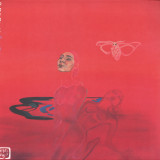
For this special release he provides 8 cuts of advanced techno, from mental and hypnotic to broken and industrial or simply arpeggiated and beatless.
WHEN THE UNCANNY ARISES starts with No Gender Role an elastic mental exercise with metallic and processed components flying over a solid kick and white noise percussive elements add some hypnotic pads and you have a powerful mind and body tool.
Blue follows in a similar approach, clean drum programming, bleepy synth lines and a progressive arrangement constantly evolving and changing Flipping the vinyl, it’s time for the broken rhythms of Feel and understand combining distorted kicks with gummy sequences again administered in a quite wise structure.
Klonger closes the B side with obsessive metallic hits repeating until madness, a powerful industrial beat for the experienced dj’s out there.
The second vinyl slice begins with Negative One, returning to the martial beat combining a precise drum workout with floaty and liquid components, followed by Anonimo coercitivo exploring the deepest side of techno using textures and drones to spice the relentless beat.
Zero opens the C side, providing a solid distorted groove with metallic details and sci fi interstellar bell like sequences, proper futuristic vibes here.
Saying goodbye, the beatless Nothing To fear, an arpeggiated synth solo reminiscent of the old Berlin School of electronics from the seventies.
A touchable proof of his craftsmanship in the studio by one of the key figures in the European techno scene.
Cerca:2 touch
Will Anderson believes in true love—as both concept and catalyst, aspiration and inspiration. During his 34 years, the Hotline TNT founder and architect has found such love perhaps half-a-dozen times. Each instance has prompted some enormous swing of commitment, like a cross-country move or simply being honest about his budding attraction. It is a hopeful and vulnerable way to exist, a way to ensure maximum bruising during the fall of the breakup. And so far for Anderson, that is how it has always ended, whether the air has slowly seeped out of some once-full balloon or whether it has simply popped, those expanded feelings expelled in an instant. This tension is the brain, blood, and beating heart of Cartwheel, Hotline TNT’s second LP and an endlessly romantic testament to reaching for something that slips forever out of grasp. The byproduct of Anderson’s decades-long quest to pin down the surging sound long in his head, Hotline TNT has come to notice in the last four years through loose association with a feverish surge of shoegaze revivalism. And Hotline TNT indeed trucks in the touchstones you might expect: skywriting guitars that bathe in fluorescent hazes of distortion, blown-out drums that pound as though they’re trying to escape a concrete box, and honeyed vocals that try to rise above the chaotic mess in true-to-life mimesis.
- A1: Across The Spider-Verse (Intro)
- A2: Spider-Woman (Gwen Stacy)
- A3: Vulture Meets Culture
- A4: Spider-Man 2099 (Miguel O'hara)
- A5: Guggenheim Assemble
- A6: The Right To Remain Silent
- A7: Across The Titles
- A8: My Name Is… Miles Morales
- B1: Back Where It All Started
- B2: Miles Sketchbook
- B3: Under The Clocktower
- B4: Spider-Man India (Pavitr Prabhakar)
- B5: Mumbattan Madness
- B6: Spider-Punk (Hobie Brown)
- B7: Spot Holes 2
- B8: Indian Teamwork
- C1: Welcome To Nueva York (Earth-928)
- C2: Spider Society
- C3: Canon Event
- C4: All Stations - Stop Spiderman
- C5: Nueva York Train Chase
- D1: The Go Home Machine
- D2: Falling Apart
- D3: The Anomaly
- D4: Five Months
- D5: Across The Spider-Verse (Start A Band)
Experience the captivating soundscape from one of 2023’s biggest blockbusters on the Spider-Man: Across the Spider-Verse (Original Score) vinyl. The sequel to 2019’s Oscar-award winning Spider-Man: Into the Spider-Verse broke the global box-office on release, and the critically acclaimed, viral hit-making score is now available on vinyl and CD for the first time.
Academy Award, Golden Globe and BAFTA-nominated composer Daniel Pemberton returns to expand upon the Spider-Verse’s iconic, multi-versal soundscape with a genre-defying score that seamlessly combines a 100-piece orchestra with DJ scratching, operatic vocals, techno beats, punk rock, acid-house-inspired Indian percussion, soaring synth solos, and even…a prominently sampled goose. From the Gwen Stacy’s fan favorite motif to Spider-Man 2099’s internet-breaking theme music, the film and its intricately-woven score is sure to transport you into some wildly unexpected parallel dimensions.
This double vinyl release comes pressed on two white and dark purple marbled LPs, featuring highlights from the score hand-selected by Daniel Pemberton. The package includes a stunning soft-touch gatefold jacket with spot gloss, a double-sided collectable poster and two printed sleeves with custom art – plus, an 8-page art booklet featuring liner notes from Daniel Pemberton and art from the film.
"Dance of Rhythms" by Fred P, the latest release on Syncrophone, is a captivating exploration of deep house music. This 12'' vinyl record, elegantly presented in a translucent deep purple format, encapsulates Fred P's distinctive style. On the A1 side, "Dance of Rhythms" invites listeners to a hypnotic journey with intricate beats and entrancing melodies. It beckons you to immerse yourself in its captivating rhythms and hypnotic grooves. Flipping to the B1 side, "The Beauty in the Sound" unveils a rich sonic landscape filled with lush textures and ethereal atmospheres. Fred P's mastery is evident as he weaves emotive chords and subtle percussion into a harmonious blend, revealing the profound beauty found in the essence of sound. Closing the experience on the B2 side, "Vibe Science" is a sonic experiment that melds innovative sound design with an unwavering groove. This track showcases Fred P's ability to fuse artistic creativity with scientific precision, making it a standout addition to the record. In summary, "Dance of Rhythms" is a captivating journey through the realm of deep house music. With three compelling tracks, it offers a profound musical experience that will resonate with both dedicated enthusiasts and newcomers to the genre. The deep purple, translucent vinyl adds an elegant touch to the presentation, making it a collector's delight and an auditory adventure worth embarking upon..
Eight decades in and Charles Hayward (This Heat, Camberwell Now) isn’t slowing down, he’s picking up the pace. Following on from a sensational string of gigs and festival performances, his latest endeavour - Abstract Concrete - is now primed to release this astounding self-titled debut via state51 Conspiracy.
The band features the luminous cast of Agathe Max (Mésange, UKAEA) on viola, Otto Willberg (Yes Indeed, Historically Fucked) on bass, Roberto Sassi (Snorkel, Glenn Branca) on guitar, Yoni Silver (Hyperion Ensemble, Steve Noble) on keyboards and, of course, Charles himself on drums and vocals. With this undeniable experimental pedigree, it’ll likely come as one hell of a surprise that this group are now responsible for one of the most persuasive and hook-laden avant pop albums of the year.
Orbiting Human Circus' new album is called Quartet Plus Two. What is Orbiting Human Circus? It is the continuing evolution of Julian Koster (Neutral Milk Hotel, The Music Tapes), whose music and storytelling under this moniker have encompassed immersive theater and a Night Vale Presents podcast, as well as more traditional albums. Central to the album are the "two" referenced in the title: North and Romika, the singing saws, whom Koster doesn't "play" so much as encourage. "I think saws sing like angels," says Koster. "I always have. Since I was a little boy. When you encourage them to sing, they do so earnestly and beautifully. It's an honest and real sound." The origins of Quartet Plus Two are as magical and seemingly unlikely as everything else in Koster's career. While walking through New York's Central Park, he stumbled upon Gauvain Gamon and Kolja Gjoni_a standup bass player and drummer, respectively_playing Gershwin and Mingus, and a musical partnership was born. Pianist Benji Miller rounds out the titular quartet, with Koster's longtime collaborators Robbie Cucchiaro (horns) and Thomas Hughes (orchestral arranging and chimes) of The Music Tapes also contributing to the record. The music they make together is at once familiar and unrecognizable, as Koster and Orbiting Human Circus interpret jazz compositions by Irving Berlin, Duke Jordan, George and Ira Gershwin, and others, alongside Koster's three originals. The use of the term "composition" is intentional and speaks to Koster's relationship with the music of Quartet Plus Two in far more evocative terms than "cover" or "standard." "To me it was always magical that there were these people called `composers' who created symphonies and popular songs for other people to breathe into life and existence all over the world and throughout time," he explains. "They traveled into our homes as sheet music, endless recorded interpretations, or were passed from hand to hand, village to village, like folk tales, changed by every hand that touched them. That music was something that came to life in our own living rooms and lives, songs that our grandmothers might have sung in a choir that we might sing just as earnestly. I just think it's nice, and I would love to share that feeling in any way we can."
- A1: Star (Ricardo Villalobos Master)
- A2: Custard Last Stand / Amo1 Ambient Version (Ricardo Villalobos Master)
- B1: Make My Love Grow (Ricardo Villalobos Mix Down)
- B2: Black Apple Pink Apple (Ricardo Villalobos Remix)
- C1: Make My Love Grow (Ricardo Villalobos Make My Love Groove Remix)
- C2: Softlanding (Ricardo Villalobos Remix)
- D1: Dealer (Ricardo Villalobos Remix)
tom Ravenscroft at 6music amongst others. And now, in true AMO1 creative fashion they are presenting an off-shoot release of that album, one completely reimagined by the man, the myth: Ricardo Villalobos.
Much has been written and talked about when it comes to producer/DJ Ricardo Villalobos over the years.
The mercurial Chilean-German artist has consistently redefined the boundaries of techno and electronica over the past 30-years as a producer, whilst also traversing the world and expanding minds as a DJ who can equally delight as he does challenge.Like a great jazz drummer (he was a percussionist before discovering mixing records), Villalobos has not so much as broken “the rules” of structure as just created his own unique approach. One that is often surprising, ever open-minded, and clearly lead by whatever happens to be inspiring him at any given moment. Watching him work or hearing him play music always feels live and free. He’s an artist. And that is exactly how this (perhaps unlikely) collaborative album has come to light – but then this is Ricardo, so maybe we should all know by now that anything is possible.
Villalobos explains, “In my scientific search for some electroacoustic musical landscapes, the offer of remixing ‘Black Apple Pink Apple’ was just perfect for me… In general, the song writing is so very good and particular, with all the instruments played into a sequencer, so it was very inspiring to strip down these pop songs into my dubby extensions, taking only the drums, bass, and vocals of the song.” Expanding further, “After delivering the first remix, Mo and myself came up with the idea of reimagining the whole album in a new way, mixed simple with other ears and my inspirations, with a new and different point of view of what instruments are important to hold the song to bare itself.”
It says a lot, and somehow captures the essence of Ricardo’s approach to music (and life), that one remix soon evolved into a whole plethora of reimagined works, driven by a creative slipstream and a clear connection to the songs created by A Mountain of One.
Mo Morris provides more insight into his own connection with Villalobos, “I lived in Berlin back in 2002-04 and used to religiously go to dance to Rici at the after (after) hours parties: little, tiny events. And he just used to blow my mind, I hadn’t heard anything like it before (or since). Ultra-modern and forward thinking.”
Mo continues, “A good friend connected to Ibiza happenings introduced me to Ricardo as it transpired that he was a fan of our early material, so I sent him some demo’s when we were in the studio creating ‘Stars Planets Dust Me’ and he loved ‘Black Apple Pink Apple’. The relationship and collaboration grew from there really, and I hope that this release is still at the start of what we can all create together.”
Focussing in on the album at hand – ‘Ricardo Villalobos reimagines: Stars Planets Dust Me’ – we are treated to a concept listen that guides us from dreamy daytime Balearic pop – staying very true to the original songs – all the way through to completely original deep dubby techno excursions. And to Villalobos fans, it will perhaps surprise (and hopefully delight) how light a touch he has provided to the opening tracks, focussing more on enhancing the sonics, and allowing the originals to shine brighter through remastering and mixing down. It’s in these moments that we see Ricardo as a pure music fan, needing not overly change or alter what’s already been created, but simply doing what he can to maximise what’s already there.
What will certainly delight Ricardo fans are the four full ‘klub’ remixes provided of ‘Black Apple Pink Apple’, ‘Make My Love Grow’, ‘Softlanding’ and ‘Dealer’ that each boldly explore the outer regions of the dancefloor in a way that only Villalobos can.
Mo rounds off, “From an electronic and sonics standpoint he’s kind of out there on his own. It’s such a unique sound. Weatherall also had this, and Harvey has that unique flavour, and also people like Nils Frahm and Max Richter have this gift. It’s not an easy thing to produce. Ricardo has his own personal cosmic trademark.”
Indeed he does. Take a trip with him around the stars and planets and see for yourself.
- Derived From The Trout Mask In A Tentative Manner 04:55
- The Dissolution Of Time 08:57
- Abdication 05:02
- The Alphabet Of Steps 06:23
- Les Cycles Extatiques 06:52
- The Geometry Of Rhythmics 05:26
- At The Margin Of Moments 06:37
- Through The Deserts Of Postmodernity 09:36
- Stereometry Of Moving Bodies 06:27
- Suspecting Metaphysical Symbols 07:28
After two years, Carl and Andreas present their second album, and once again, it opens up a wide associative space for us. What strikes us initially is the uncommon instrumentation: a church organ, harpsichord, glass tubes, and more. Like their first album (The Aporias of Futurism), it is mysterious and dark. But it also carries a strong touch of rebellion and adrenaline, sometimes quite pointedly. The pieces are now shorter and feature intricate yet irresistible rhythms. The impact is immediate, yet it maintains a sense of solemnity and ceremony. The Apollonian complexity of the rhythms and subtle melodic interweavings is transformed into a Dionysian, ecstatic, hypnotic, and at times tribal context. "Music for Unknown Rituals" oscillates between primitive instincts and avant-garde intrigues.
The process began in Döblitz, a small village on the Saale river in Germany, inside an old church that houses an organ built in 1886 by Johann Adolph Ibach. Carl and Andreas gained access and secluded themselves there for a few days, accompanied by the organ, an instrument made of glass tubes, and a set of modular synthesizers. After recording the basic tracks in Döblitz, the work continued in Munich and Berlin. Carl played electric guitars, harpsichord, bass, metallophone, xylophone, Indian harmonium, and various percussive instruments. Andreas added layers of electronic sounds, noises, and atmospheric drones. He also created percussive structures extracted and derived from recorded material of technical and industrial noises, which contrasted with the acoustic drums played by Carl. The antithetical approach continues with the dichotomous arrangement of the instruments, often panned hard left and right in the stereo field, creating an antiphonic communication. Some parts, especially the use of the electric guitar, evoke memories of the psychedelic sixties. However, this is anything but a nostalgic album—these musical references are merely remnants, set pieces, and fragments used from a contemporary, post-modern, post-youth-cultural, and post-romantic perspective.
Although Andreas and Carl continue on their chosen path of composing music with an almost literary narrative structure, this album is conceptually and formally completely different from their first effort. If “The Aporias of Futurism” was a revolutionary manifesto (in a pataphysical sense), "Music for Unknown Rituals" is more like the implementation in action; it is the practical application of the previous statement. To put it another way, if "The Aporias of Futurism” was the conceptual manifesto of a dark utopia of modernity, "Music for Unknown Rituals" is the staging of free will surrendering to the myths and catharsis of a Greek tragedy. And in response to this, the artwork features a leitmotif of histrionics with hands, the hands being the first and intuitive part of the body to express something: a ritual, a prayer, a defeat...
— Andreas Gerth is one half of Driftmachine, and Carl Osterhelt is part of F.S.K and collaborates with Hans-Joachim Irmler of Faust. Both became connected through their participation in the Tied & Tickled Trio.
Electric, their third album, came out in 1987 and really caused the band to explode to new levels of fame. It contains the massive hits "Love Removal Machine", Wild Flower" and "Lil" Devil" and was produced by Rick Rubin. Electric is a seminal work, featuring some of the band"s most iconic songs. It is a departure from the band"s previous work, with a raw, agressive and stripped-down sound. The album"s opening track, "Wild Flower," sets the tone with its pounding drums, blistering guitar riffs, and Ian Astbury"s wailing vocals. Electric was a commercial and critical success, propelling The Cult to the forefront of the hard rock scene and cementing their status as one of the most influential bands of the era. The album remains a touchstone for hard rock and heavy metal fans, a classic work that captures the spirit of rebellion and the power of rock and roll. The Cult has remained an important and enduring force in the rock music world. The band has sold millions of records worldwide and has earned critical acclaim for its powerful live performances. The Cult continues to tour and record new music, and their influence on rock music shows no sign of diminishing.
- Demons Are Real (1:39)
- Pimple Zoo (1:33)
- M Not Looking) (3:27)
- Exit Flagger (2:14)
- Sleep Over Jack (3:00)
- Girls Of Wild Strawberries (2:33)
- Navigating Flood Regions (2:46)
- Gold Star For Robot Boy (1:58)
- Window Of My World (3:08)
- Redmen And Their Wives (4:06)
- Dayton, Ohio - 19 Something And 5 (2:11)
- My Impression Now (2:23)
- Do The Earth (3:22)
- Game Of Pricks (2:23)
- Secret Star (7:31)
- My Kind Of Soldier (3:29)
- Sad If I Lost It (3:33)
- Cut Out Witch (3:33)
- Gonna Never Have To Die (2:32)
- Best Of Jill Hives (2:50)
- Watch Me Jumpstart (2:51)
- Tractor Rape Chain (2:56)
- Buzzards And Dreadful Crows (1:57)
- Pendulum (2:03)
- Murder Charge (2:53)
- Fair Touching (3:33)
- Teenage Fbi (2:57)
- Glad Girls (3:59)
- I Am A Scientist (2:48)
- Echos Myron (2:44)
The latest release from the acclaimed Live From Austin, TX series of releases from the vaults of the award-winning PBS Austin City Limits TV show. Guided By Voices are one of indie rock s most loved and prolific bands. On their 2004 farewell tour they performed one of their final concerts on Austin City Limits. Recorded on live on 24 tracks, this special 2CD set features 30 songs from their entire performance. Many of the songs were never aired on the TV broadcast.
With Call on the Old Wise Nitai Hershkovits delivers an entrancing solo album In this largely improvised solo rendering, the pianist draws from broad influences, ranging from his extensive work in jazz contexts and cutting-edge contemporary explorations to his background in classical music. This immaculate balance of idioms gives rise to an abundance of colours and timbres, explored by a pianist, who has successfully forged his very own voice as improviser and shapedesigner. With a soft touch, light action and washing harmonies, Nitai's improvisations unfold like compositions being created in real- time, making Call on the Old Wise a testimony to the pianist's unique inventiveness as well as an essential addition to ECM's celebrated line of solo piano recordings. The album, recorded in Lugano in 2022 and produced by Manfred Eicher, follows after his contributions in Oded Tzur's quartet on the acclaimed recordings Here Be Dragons (2020) and Isabela (2022).
KOU is the new project by Apolline Schöser (half of Nina Harker) & Thomas Coquelet.
Apolline & Thomas have been performing since 2022 under the KOU guise with 24 electronic harmoniums. Producing dense layers of tones & overtones. On their debut album KOU steers in another direction. The harmonium appears occasionally, but more prominent are delicate guitar pluckings, distant vocal effects, synths, flutes, piano strokes, a touch of musical magic and Apolline’s jazz not jazz vocals.
As soon as the needle drops it’s clear we are jump-cutting straight to the other side of the mirror. Cats purr, a woman sings as if asleep, drum machines stutter and warp and Alvin Lucier is not 'sitting in a room that is not different to the one you are not in now’. If you’re already confused, join the club. But, it’s the good kind of confused, a bewildering experience akin to the first time hearing the Faust Tapes or watching Inland Empire. Wait though, as pigeons coo and the tape machine clunk-clicks a gorgeous weirdo version of Roger's and Hart’s Blue Moon emerges to let you know this isn’t just dada splurge, there’s a genius pop sensibility at work here too. Side two takes us further into the murk with mournful detuned brass, stoned Joan La Barbara-esque vocalese and a droning Farfisa hymn, before ending with another too-tempting snatch of DIY pop. Some of the references are recognisable. All kinds of 70s/80s European art prog - think early Battiato, Pierot Lunaire’s Gudrun, Lucia Bosè and Gregorio Paniagua's Io Pomodoro etc etc. There’s a strong whiff of 90s us goof-off surrealism too- Bongwater, Siltbreeze, Royal Trux’s Twin infinitives, the damaged folkier side of Alastair Galbraith, Half-Japanese, early Beck even all feel relevant.
Like an oddball group of friends you might meet by chance and end up weirding-out with for days, the minds behind this deliciously odd music allow you to stay for a while in their strange subcultural world. You might not want to live here forever but a short trip, while it lasts, rewires your brain for the better.
Tin Fingers takes on a darker, melancholic direction on their second full album. Felix Machtelinckx' weeping vocals, preaching, searching, and trying to understand God, form the leitmotif. With rich melodies, haunting piano sounds, improvisations, first takes and no overdubs, Tin Fingers is searching for pureness and keeping things human and simple. The band is playing together intuitively, without a computer, without ego, just for the sake of music
The creation of the album was very fluent and spontaneous. Singer Felix wrote the backbones of the songs and the lyrics on acoustic guitar and piano. He wanted to have songs ready in order to be able to record and write arrangements fast. With an eye for details but without overthinking, keeping the ideas fresh. 'I wanted to stay in love with the music.' he explains. 'It needed to go fast, very fast, in just two weeks the entire album was recorded and ready to be mixed.'
In the studio, the band especially focused on picking the right mood rather than playing the right notes.
They were fed up with working on a computer for many hours, overthinking production choices, and adding instruments on top of each other as if they were Lego blocks. This time they decided to work in a more traditional way, going for first takes, jams, and essentially working with analog gear. No computers, no screens, no distractions. Only four humans in a studio trying to make a sound together by keeping things spontaneous and raw. They said goodbye to perfection and worked towards an unfinished product, a snapshot.
Tin Fingers also didn't want to sound like any other artist on this record. They decided not to listen to music during the sessions, and to never express ideas by referencing other bands. Just before the studio session, however, bass player Simen Wouters broke the rules and shared Bonnie 'Prince' Billy's, I See Darkness. Its dark and searching sound ended up inspiring the band unmistakably.
Once the recording was finished, the band decided to keep the volatile rhythm going and asked reputable NYC-based mixer and producer D. James Goodwin to finish the job. Goodwin, known for his analog folk productions with a real American punchy sound but a tender touch, proved the right man for the job. He opened up the songs and kept things poetic, minimal but impressive.
- A1: The Skatalites - Coconut Rock
- A2: Cedric "Im" Brooks & Sound Dimension - Mun-Dun-Go
- A3: Tommy Mccook & Richard Ace & Disco Height - Shockers Rock
- B1: The Soul Vendors - Ringo Rock
- B2: Jackie Mittoo & Ernest Ranglin - Jericho Skank
- B3: The New Establishment - The People Skanking
- B4: Karl Bryan & The Afrokats - Money Generator
- C1: Lester Sterling - Afrikaan Beat
- C2: Sound Dimension - Heavy Rock
- C3: Sugar Belly - In Cold Blood
- D1: Don Drummond - & The Skatalites Heavenless
- D2: The Soul Brothers - Bugaloo
- D3: Vin Gordon - Red Blood
- E1: Pablove Black - Push Pull
- E2: Jackie Mittoo & Brentford Rockers - Sidewalk Doctor
- E3: Liberation Group - Namibia
- F1: Brentford Road All Stars - Last Call
- F2: Soul Defenders - Still Calling
- F3: Karl Bryan & Count Ossie - Black Up
REPRESSED 2x12" now with bonus download code! Heavy, heavy tunes! Studio One instrumentals are the foundation of Reggae. These rhythm tracks became the basis for all Dancehall as countless artists and producers re-versioned these classic Studio One instrumentals.
REVIEWS: "Sheer volume of output from Studio One is astonishing, combined with the fact that the quality of the recordings never seem to diminish. These instrumentals touch on ska, rocksteady, dub, and begin to hint at the reggae sound of the late '70s. Each instrumental is perfect and has the feel that it could hardly be improved upon. Soul Jazz has once again put together a wonderfully rounded collection of music from Studio One" - All Music.
"I think if a nuclear family could have a soundtrack, ours would be the Soul Jazz comp Studio One: Scorcher. I wouldn't say it's the best record ever made, but if I heard it every single day for the rest of my life, I'd be 100% cool with it." DJ. & "Compilation of essential & rare Studio One instrumentals" - Hard Wax.
"Studio One Scorcher is the latest of these, collecting instrumental tracks spanning the years from the late 60's rocksteady vogue through the onset of dancehall and digital rhythms in the early 80's featuring The Skatalites, trombonist Don Drummond, Pablove Black and others." - Billboard.
‘Double Pink’ is the debut album by And Is Phi (Andrea Isabelle Phillips), a multidisciplinary artist from Norway and the Philippines now based in South East London. ‘Double Pink’ is a nuanced world that draws on colours and texture; with influences of Joni Mitchell and Frank Zappa, 90's R&B and Madlib’s ‘Shades Of Blue’ blending languidly to produce a base for uncovering layers of self, a deep release, and fragile new form.
Written by Andrea and co-produced with Fiona Roberts and Lorenz Okello over a nine month period; ‘Double Pink’ thematically explores the many movements of internal change, speaking from a deep inner voice inside the body. The title track is an invitation to be as unapologetically hungry as you please after a long absence of life giving passion and trust in oneself. ‘White Noise’ is a recovery song playing in your soul the first time you made it back out to the dance floor after a heart break so massive it laid rest to the person you used to be. Songs like ‘Working’ and ‘Staaar’ come from a candid and contemplative aspect. Stages of grief and resilience and wonder and wisdom are all touched upon.
“The album explores metamorphosis, liminal spaces, and the multiple faces of love”, says Andrea. “I mention love as a key ingredient, because anyone who has had to push and pull and hold and yield themselves through great loss and transformation knows it ain’t gonna happen without love. Tough times ask for double love, a stronger heart, something like a double pink”.
Andrea’s story dots between periods spent living in Norway, the Philippines and England - experiencing joy and beauty battling corruption and violence in Manila, DJing in Oslo, losing her sizable record collection in a warehouse fire before making friends and family in the jazz scene in London. Every story needs a scene, a landscape, an environment; all things Andrea visualises when writing songs.
“At my heart I am emotional and imaginative, searching for freedom for my spirit. What grounds it all is coming from a family of storytellers. My father played drums and percussion, he was a great dancer and a true collector and connoisseur of music from everywhere. My wise mother instilled in me a sense of faith and grace”.
Andrea is far from new to the scene, having performed with Steamdown, Emma Jean Thackray, Hector Plimmer, Scrimshire, William Florelle and many more as a valuable and inspiring creative force within the South London music scene. Andrea also created the album’s artwork and music videos: musicality and painting evolved from her initial creative languages of drawing and dance. All aspects are dialects of her common language: singing what can’t be painted and painting what can’t be sung.
'soft like steel’ is documenting a personal process; one of understanding, cleansing, re-learning and ultimate re-birth into a version of myself with renewed perceptions, ideas, and an openness to the new. LVRA represents an idealised version of myself - one that I feel like I can almost touch, but in reality is difficult to achieve. It follows my journey in understanding how my morality, principles and opinions have been shaped by the world and people around me - sometimes for the better, and sometimes for the worse. This on-going conversation with myself is a conversation that I hope other people have with themselves too; stepping through the mystical doors of perception, coming into a this unknown universe with me, is choosing the hard way - it is choosing to destroy the comforts of what is familiar, to seek new experiences that allow for greater empathy and understanding of the world and others. Only then do I believe the world can be a more accepting place for all kinds of individuality and differences, and I hope people find safety and acceptance in the music.
A decade after his groundbreaking debut ‘Classical Curves,’ British producer Jack Latham, aka Jam City, continues to redefine genres with his effervescent new album “Jam City Presents EFM,” delivering an immaculate fusion of rattling garage, glitzy disco, thumping house, and euphoric hooks across the album’s 10 tracks with features by Empress Of (Wild n Sweet), Clara La San (“Touch Me”), Wet (“LLTB”), Show Me The Body’s Julian Cashwan Pratt (“Redd St. Turbulence”), and more.
Xavier Boyer, the lead singer of Tahiti 80 and one of the most distinctive voices in French indie pop, returns solo with a melodic and timeless new EP entitled "Soda Coda".
After "Tutu To Tango" (2007, under the name Axe Riverboy), "Some/Any/New" (2017), and not forgetting Tahiti 80's nine studio albums, Xavier Boyer has composed five songs navigating between soft rock, folk sounds and pop experimentation. "On previous albums, I'd done everything on my own, but this time I was looking for something more lively, more organic, more collective. I also wanted to exchange ideas with other musicians.
This mini-album (the vinyl version will include five alternative versions recorded on a 4-track cassette) was created with the help of three emblematic figures from the French music scene, Mehdi Zannad (Fugu, April March, A Girl Called Eddy) on keyboards, Laurent Blot (Le Superhomard) on drums and Stéphane Laporte (Domotic, Egyptology) on mix.
Recorded between tours and studio sessions with his main band, "Soda Coda" once again confirms his talent as a melodist and his appetite for sonic adventures. The power pop of "D Day" or the lyricism of "Children Of The Sun" would not be out of place on albums by Emitt Rhodes or Richard Swift (producer of Tahiti 80's "Ballroom" in 2014). "Oh Liza" is as smooth as an Elliott Smith novelty.
The singer assumes his influences: "My aim has always been to write timeless songs without pretending it's 1975, or 1998. I want my music to remain rooted in its time." "Read The Room" blends Jamaican music and avant-garde pop with its crystalline guitars and soaring synths, while "Soda Coda" brings a touch of Soul to the EP with its distorted piano and slap-back vocals.
More than a journey or a nostalgic trip, Soda Coda is a succession of luminous songs, and as Xavier Boyer sings on the eponymous track: "I'm singing something good, I can hear this tune lighting up my path".
“A piece of music never truly comes to An end. Revisiting a theme illustrates this idea that life goes on.” These are the words of Wayne Shorter, uttered in 2018 upon the release of Emanon, his final opus. On this record, the octogenarian uses dusky hues to shade in the passions of his youth - drawing and science-fiction, as well as the causes he has defended all his life - the fight against ecological upheaval and structural racism. This sentiment did not fail to resonate with Julien Lourau, who has reached a stage in life where he has begun to look back over certain pages written by the man he has always considered one of the masters of his trade. Five years later, this Parisian native has also chosen to revisit his glory days, offering reworked versions of specific tracks composed by his titular elder throughout the 80s. “When I play this music, I find myself back in my teenage bedroom. These are my standards, and they remind me of autumn in Rambouillet.” At that time, after practising his scales, Julien would also play Dungeons & dragons, and immerse himself in SF as well as heroic fantasy - epic influences which are not without a certain connection to the dreamworlds Shorter conjured up, as another fan of landscapes beyond the grasp of reality.
This album features four themes taken from Atlantis, which came out in 1985, and two from Joy Ryder, released three years later. To these, he has added a composition penned at around the same time for Sportin’ Life, the penultimate LP by Weather Report. This is rounded off by a tune taken
from Native Dancer, the record which, ten years earlier, in 1975, brought together this saxophonist who learnt his trade alongside Art Blakey, before joining Miles’ second quintet, and Brazilian Milton Nascimento.
“Between Native Dancer and Atlantis, Shorter did not release anything under his own name, but he took the time and care to really perfect his writing. Upon his return, he injected a very Brazilian form of subtlety into his compositions, especially rhythmically. And from a harmonic point of view, these themes are extremely sophisticated, and reveal truly singular colours. In fact, he decided to display the score as if it constituted the liner notes of Atlantis.”
Julien Lourau is a fan of every Wayne Shorter era, from his Blue Note days, where Mr Gone defined the bases of a truly unique repertoire, all the way to his final quartet - a reference like no other. He decided to focus on this “highly electric” period, which is not necessarily Shorter’s best known, nor his most widely appreciated - despite being a unanimous reference, Shorter has nonetheless never had a direct descendent. In Lourau’s line of sight there lies a desire to focus on typically South American tonic accents which characterise this repertoire, twinned with the ambition to switch up their actual sound “by attempting to open up onto a production highly influenced by eighties fusion". However, he admits that modifying the structures of these most unique of worlds constituted a fresh challenge. “There’s this labyrinthine harmonic system where you’ve no idea how it holds together, but where it’s actually impossible to touch the slightest element without the whole edifice wavering. It is in fact a very difficult thing to achieve!”
In order to successfully transcribe all this creativity free of obstacles, Julien Lourau once again called upon the help of Mathieu Debordes. From January 2023 onwards, Mathieu endeavoured to break down all the musical elements, on paper, before creating any actual music. The record was therefore constructed on the faith of these scores, without necessarily transiting through a creative residency - just two live gigs, to make sure the setup worked. Besides Mathieu Debordes and his synthesisers, Julien Lourau has assembled an ad hoc team by his side. On the bass, according to the track, we can hear erstwhile companion Sylvain Daniel or a new acolyte on the fretless bass, Joan Eche Puig.
Stéphane Edouard, on percussion, even dives headfirst into an unlikely proto-rap of sorts, on Pearl On The Half Shell (where, on the original version, Bobby McFerrin adjusted his interventions in a rather madcap style). Aesthete and drummer Jim Hart as well as pianist Leo Jassef also figure on this release - both were present on previous project devoted to label
CTI. “At sixteen, I wanted to sound like Michael Brecker rather than Ben Webster - that was equated with modernity in those days”, adds Julien with a smile, as for him, all this rings out a little like a logical next step, a joyful immersion into the fountain of youth. And if, for this record, he plays the soprano more than ever, the saxophone Shorter set in his sights on, he never tries to replicate an unattainable ideal note by note. What would be the point?
“Wayne Shorter is not just a saxophonist’s saxophonist. In fact, I don’t know a single person who has risen to challenge of his solos. I have not done it myself either, but on the other hand, I have retained a lot of his phraseology. His way of approaching the instrument reveals a more evanescent language, a work on colour and shape. Keeping this in mind has allowed me to gravitate towards certain elements, that in hindsight, I find echoes of in my work, even in Groove Gang.” Shorter etches out these phrases, creating a groove within which Lourau had traced subtle punctuation, managing, from a highly written base, to create fresh apertures, promises of a great escape. Emblematic of this standpoint, his regal version of Ponte de Areia, originally a wonderful dialogue between Milton Nascimento and Wayne Shorter. Here, the Frenchman takes liberties with the original melodies, without ever growing distant from the original spirit, extending one section with delicacy, offering a rubato development and then a groove “like a little suite”. Julien Lourau also renews with an accomplice from last century, Magic Malik, who lends his high-pitched vocals to the track. Though they had not recorded together for more than twenty years, the two of them got on as if they had only ceased collaborating yesterday, everything flowed naturally. The track was wrapped up in just one take, much like other themes, such as opener Who Goes There where the flautist deploys smooth, enchanted and smoky wisps.
Fundamentally, reflecting of the sleeve which features a child playing with a ball, image that could symbolise the sun just as much as the moon, Julien Lourau manages to translate the ambiguous candour which characterizes Shorter’s work - solar and crepuscular at the same time, that of a visionary and poet definitively situated outside of all chronology, but with whom Julien shares surprising and ‘timely’ coincidences. Shorter was born August 25, 1933, the same day as Julien’s father, “if we take time zones into account”, and who died on Lourau’s birthday, March 2, 2023. Should we take this as a random fact? Or could we not see here the sign of a destiny connecting the agnostic Frenchman to the man who, as a fervent Buddhist, believed in the transmission of his spiritual flow ?