Next up on Slow Motion, Rodion and Fabrizio Mammarella are back with another precious collaboration EP since “Appennini” released in 2012 but never forgotten in the fame.
They have been like brothers for many years, and after many collaborations, these two producers are well attuned to each other in their musical soul. Rodion and Fabrizio are both very sophisticated producers and known for their dramatic melodies, mixed with synthesized funk and disco, which turns it into emotional freaky electronic music.
All tracks are recorded in Mexico City, bringing in Mexican artist Mijo as a featuring on the track ‘’Cerro Gordo’’. Moreover, italo-belgian duo Front De Cadeaux join with a remix that grabs elements from both the original tracks, reworked in one timeless piece of music.
We are proud and delighted to present to you: “Sierra Madre”.
Search:4 to the bar
Originally conceived as a medium for Chicago-based multi-media artist/activist Damon Locks's sample-based sound collage work, Black Monument Ensemble (BME) has evolved from a solo mission into a vibrant collective of artists, musicians, singers, and dancers making work with common goals of joy, compassion, and intention. A genuinely multi-generational collective, ages of BME members range from 9 to 52 years old; members include instrumentalists and fellow IARC recording artists Angel Bat Dawid and Ben LaMar Gay. Their debut album Where Future Unfolds was released in 2019 by International Anthem glowing praise; landing at #3 on Bandcamp's "Best Albums of the Year," #25 on WIRE Magazine's "Best Albums of 2019," and being repeatedly dubbed "The Best Album of 2019" by BBC/Worldwide radio titan Gilles Peterson. Locks & BME's new album NOW was created in the final throes of Summer 2020, following months of pandemic-induced fear & isolation, the explosion of social unrest, struggle & violence in the streets, and as the certain presence of a new reality had fully settled in. Set up safely in the garden behind Chicago's Experimental Sound Studio, the music was recorded in only a few takes, capturing the first times members of BME had ever played or sang the tunes. For Locks, the impetus was more about getting together to commune and make art than it was about producing an album. In his words: "It was about offering a new thought. It was about resisting the darkness. It was about expressing possibility. It was about asking the question, 'Since the future has unfolded and taken a new and dangerous shape... what happens NOW?'"
CRIMSON/BLACK COLORED
Indie Retail Exclusive Crimson & Black color vinyl Originally conceived as a medium for Chicago-based multi-media artist/activist Damon Locks's sample-based sound collage work, Black Monument Ensemble (BME) has evolved from a solo mission into a vibrant collective of artists, musicians, singers, and dancers making work with common goals of joy, compassion, and intention. A genuinely multi-generational collective, ages of BME members range from 9 to 52 years old; members include instrumentalists and fellow IARC recording artists Angel Bat Dawid and Ben LaMar Gay. Their debut album Where Future Unfolds was released in 2019 by International Anthem glowing praise; landing at #3 on Bandcamp's "Best Albums of the Year," #25 on WIRE Magazine's "Best Albums of 2019," and being repeatedly dubbed "The Best Album of 2019" by BBC/Worldwide radio titan Gilles Peterson. Locks & BME's new album NOW was created in the final throes of Summer 2020, following months of pandemic-induced fear & isolation, the explosion of social unrest, struggle & violence in the streets, and as the certain presence of a new reality had fully settled in. Set up safely in the garden behind Chicago's Experimental Sound Studio, the music was recorded in only a few takes, capturing the first times members of BME had ever played or sang the tunes. For Locks, the impetus was more about getting together to commune and make art than it was about producing an album. In his words: "It was about offering a new thought. It was about resisting the darkness. It was about expressing possibility. It was about asking the question, 'Since the future has unfolded and taken a new and dangerous shape... what happens NOW?'"
- A1: Fantas Variation For Voices (Feat Evelyn Saylor, Lyra Pramuk, Annie Garlid &Amp; Stine Janvin)
- A2: Fantas For Saxophone And Voice (Feat Bendik Giske)
- A3: Fantas For Two Organs (Feat Kali Malone)
- A4: Fantas For Electric Guitar (Feat Walter Zanetti)
- B1: Singeli Fantas (Feat Jay Mitta)
- B2: Fantas Hardcore (Feat Baseck)
- B3: Fantas Resynthesized For 808 And 202 (Feat Carlo Maria)
- B4: Fantas Morbida (Feat Kara-Lis Lis Coverdale)
Fantas is the epic opening track on Caterina Barbieri’s acclaimed 2019 release Ecstatic Computation. The original Fantas laid out a magical path of patterns leading the listener on a journey into the sound itself. Fantas Variations maps out eight new potentials sprung from this initial path as constructed by a diverse mix of artists lending to a wide spectrum of new works extrapolated from the original work. For this project Barbieri invited friends and long time collaborators from a variety of musical backgrounds to create a more sustainable and inclusive landscape in terms of stylistic, geographical, gender and generational balance. The results are a diverse array of approaches and instrumentation which blur the boundaries between the acoustic and electronic.
Fantas Variations embraces a platform for mutual exchange and support between like-minded artists, where active and collective re-imagination is prioritised over the traditional model of remixes, which is often strategic, functional and more passive.
Longtime friend and collaborator Kali Malone rearranged Fantas to a slowed-down, austere and eerie version for two Organs. Evelyn Saylor created a piece for a vocal ensemble consisting of her, Lyra Pramuk, Stine Janvin and Annie Garlid, joining forces to express the choral, psychedelic and vitalistic nature of the piece. Barbieri’s former guitar professor at the Conservatory in Bologna, Walter Zanetti, composes Fantas for electric guitar, by translating every single gesture of the original electronic piece into a personal, nuanced and detailed interpretation. Bendik Giske’s reinterpretation for Saxophone and Voice captures the atmospheric essence of Fantas and its psychic meteorology. Longtime collaborator and along with Barbieri the other half of the outfit Punctum, Carlo Maria, resynthesizes Fantas for TR808 and MC202, bringing a more club-oriented dimension of the piece to life whilst unveiling the sonic continuum between rhythm and pitch through a sensitive timbral approach. Jay Mitta’s Singeli reinterpretation of Fantas transpires with pitched-up percussion and turbo-fast polyrhythmic patterns unleashing the frenetic, shifting, transformative matter within the piece to a higher plain of euphoric dance. Baseck’s variation is a rave fantasia, where the prismatic trance of the original is channeled into fierce, uncompromising hardcore, whilst Kara-Lis Coverdale’s take is a phantasmagoria for piano that gently, yet inexorably, captures the relentlessness chimerical qualities of the original, unveiling its spectral backbone.
Evelyn Saylor (feat. Lyra Pramuk, Annie Garlid & Stine Janvin) - Fantas Variation for Voices (7’38’’)
Composed by Evelyn Saylor. Performed by Evelyn Saylor, Lyra Pramuk, Stine Janvin and Annie Garlid. Recording, mix and additional production by Bridget Ferrill at Real Surreal Studio, Berlin 2021.
Bendik Giske - Fantas for Saxophone and Voice (7'31'')
Adapted and performed by Bendik Giske. Recorded, mixed, and produced by Bendik Giske in Funkhaus, Berlin 2020.
Kali Malone - Fantas for two Organs (10'21'')
Arranged for The Utopa Baroque Organ, The Sauer Organ and tuned sine waves. Recorded by Benny Nilsen at Orgelpark, Amsterdam 2020.
Walter Zanetti - Fantas for Electric Guitar (7'27'')
Recorded by Walter Zanetti, Bologna 2020.
Jay Mitta - Singeli Fantas (12'03'')
Recorded by Jay Mitta in Sisso Studios, Dar Es Salaam 2020.
Baseck - Fantas Hardcore (4'44'')
Mixed by Anthony Baldino, Los Angeles 2020.
Carlo Maria - Fantas resynthesized for 808 and 202 (4'29'')
Recorded by Carlo Maria, Milano 2020.
Kara-Lis Coverdale - Fantas Morbida (3'04'')
Performed, recorded and mixed at The Shop in Valens, Ontario by Kara-Lis Coverdale, January 2021. Engineering assistance from Robert Coverdale and Adam Feingold.
- A1: Giovanni Lami - Stories From The Dotted Indian Whale (Part 1 Soap Wolf)
- B1: Giovanni Lami - Stories From The Dotted Indian Whale
- C1: Hannibal Chew Iii - Stories From The Dotted Indian Whale (Part 2 La Ballena Punteada)
- D1: Hannibal Chew Iii - Stories From The Dotted Indian Whale
- E1: Bardo Todol - Stories From The Dotted Indian Whale (Part 3 Mis Suenos Son Ballenas Con Un Punto Rojo En La Frente)
- F1: Bardo Todol - Stories From The Dotted Indian Whale
3xtape pack
* Three Cassette pack shrinkwrapped together therefore no returns for opened items *
Three part journey into an imaginary Indian Sub-Continent from three artists working on the fringes of Field recordings. Stories of the Dotted Indian Whale features italian artist Giovanni Lami, Hannibal Chew III aka Gonçalo F Cardoso and Argentinean noise prankster Bardo Todol.
First part from Italian sound artist Giovanni Lami, entitled Soap Wolf Giovanni presents a collection of ghost recordings from several places in India.
Second part from Hannibal Chew III is a collection of re-assembled recordings and in situ jams made in Arambol, Jaipur, Pushkar, Varanasi, Thar Desert, Pondicherry & Auroville between 2009 - 2019. Re-assembled in 2020.
The third and final part from Bardo Todol contains abrasive tape and digital field recordings manipulation made by Pablo Pico in Nepal, Kolkata, Varanasi and NewDelhi in 2012.
A new weird collection of re-interpreted field recordings from artists connecting the dots between musique concrete, naive improvisation and field recordings processing.
Artwork by Pablo Picco
Tape Crackers: An Oral History Of Jungle Pirate Radio. Rollo Jackson is a London-based filmmaker who grew up immersed in the city's dance music culture of the mid-90's. His films, whether for the likes of Hot Chip, Man Like Me, or Warp Records bare the traits of someone whose formative years were spent clad in the brash hues of a Versace print shirt and the bright white of a fresh pair of Reeboks. Whatever his subject, the spirit of too many late nights spent doing homework to the crackling sounds of pirate radio, or of weekends spent in booming, sweaty warehouses on the outskirts of London is always threaded throughout. Rollo presents a documentary DVD entitled Tape Crackers, an oral history of Jungle music and an affectionate, touching, and, at times, incredibly funny, tale of bedroom obsessiveness. Told through Michael Finch's tape collection which he recorded while growing up in Islington, North London, it's also an untold (or more accurately unheard) history of UK underground music of the last 10 years - Jungle, Garage and Grime are all knitted into the story through the MCs and DJs who manned the decks and mics. Movers of the underground today such as Riko Dan and B Live are on some of the tapes played in the film. The D90s might be dusty but this music still sounds ultra-crisp. Warning, may contain: late days of Dream FM, middle days of Kool FM/MC Ruff and DJ Uproar on Dream FM/MC Fize and DJ Swiftly/Riko Dan on Pressure FM/Evil B on Rude FM/DJ Target and Maxwell D on Rinse FM/DJ Brockie, MC Five-O and MC Moose on Kool FM in 1993/DJ SL with Strings, Koji and Flinty Badman (Ragga Twins) + Demon Rockers.
"(Don't) Hold Me Down" follows "In Conversation" as the second single from PM Warson's debut album "True Story", out on April 23 on vinyl LP, limited edition CD and digital formats.
The first version of "(Don't) Hold Me Down" with its Brit-edged Garage R'n'B and Latin Soul and a girl-group chorus that had developed as a key extension of his live sound, was released by PM Warson himself on a 7inch vinyl single and proved a winning formula for soul collectors. The independent pressing sold out within a couple of days, and it began to spin at clubs from Toronto to Barcelona, its value briefly skyrocketing on collector site Discogs. The song was later picked up by Fred Perry to underscore their 'Soul Boy' short film, further establishing his presence on the UK soul scene.
I first discovered khroniky – Ukranian folk songs – in the Highlands of Scotland. I was watching a screening of Bajka, a mesmerising documentary made by the filmmaker Lucia Nimcová and sound artist Sholto Dobie. I knew nothing about these ballads beforehand, but I was fascinated by these odd, beautiful songs, especially the easy way in which they mixed misery and levity, where gentle melodies blend with tales of dark violence. The folk songs describe hardship, murder, torture, death in gulags, heavy drinking, outsmarting men, love affairs. But they’re often very funny too – many of the songs make fun of marriage, and there’s an amazing subcategory of khroniky songs called potka (vagina) songs.
The khroniky have never been properly documented because they were considered too crude, or contained lyrics that were problematic, politically. When Ukrainian folk songs have been archived in the past, it’s normally a sanitised, more polite version of the ones that Lucia remembers from her childhood. Lucia grew up on the other side of the Ukrainian border in Slovakia. She is part of the Rusyn (Ruthenian) minority ethnic group found in the borderlands of Slovakia, Hungary, Romania, Ukraine and Poland. Rusyn is a centuries-old Slavic language, looked down upon as a poor, uneducated dialect by the neighbouring Ukraine and Slovakia. It was forbidden to talk about Rusyn culture at Nimcova’s primary school, but the khroniky stayed in her memories.
“I remember weddings when I was young,” says Lucia, who now lives in Addis Abeba, Ethiopia. “At the end of the night, when everyone was drunk and the young couple would go around their guests, people would sing in Rusyn. There was singing and dancing, and songs about being in prison or falling in love. I picked up the lyrics and sometimes my mum would make my sister and I sing them for people we met on the train. I was about five or six but the lyrics still come back when I sing to my kids.”
Determined that these rich, nuanced, unique songs shouldn’t be forgotten, she decided to record them. Over two years, Lucia, joined by experimental musician Sholto Dobie, visited Rusyn villages high in the Carpathian mountains to rediscover the songs and make the documentary. It was at the beginning of war breaking out in Ukraine in 2014.
“The Rusyn community is a very closed one,” explains Lucia. “Sometimes we’d have to wait several days to hear someone sing; we had to earn their trust before they shared something very personal to them. We’d stay up ‘til 5am at a wedding, then go straight to a morning baptism, or collect haystacks with the villagers, hoping they’d sing while they were working.”
DILO is named after an important independent Ukrainian daily newspaper that was shut down when the Red Army entered Lviv in 1939. The four long tracks on DILO blur field recordings with song; an unpolished, privileged glimpse into a private world. We hear dogs barking and insects buzzing in the summer heat, then a blast of hurdy gurdy or violin will drift in, or a plaintive song soars softly over the rural background noise, with casually harrowing lyrics about a cuckoo, “lifeless in a world of misery”, as translated in the album’s booklet.
For both Lucia and Sholto, it was important not to tamper too much with what they heard. “When you think about ethnography,” Lucia explains, “you have to have a lot of time, love and respect to document it with sensitivity.”
“The songs all have their own atmosphere and intimacy from the spaces they were recorded in and it was important to maintain these particularities and move with them,” adds Sholto, who now lives in Vilnius, Lithuania. “They guide and sometimes interrupt a journey between interiors – domestic spaces; in kitchens, by the fire – and exteriors; marketplaces, cow sheds. We used contact microphones to record metal bridges and fences, and we spent one afternoon recording a wool processing machine, the details of the rattling and tuning wheels are the ground layer for the third track.”
Lucia took rough notes and diary entries during the recording process, which are now shared in the booklet alongside a selection of lyrics, loosely translated, but revealing the depth and astonishing beauty that sometimes lies in the language of these folk songs.
The feel of the album is intimate, flipping between laughter, where a woman sings about selling her pussy to buy a cow in one track, then shifts to a raw, painful truth; an adult son asks his mother why his dad won’t be back for dinner, as he’s gone to war.
Since Lucia and Sholto began working together in 2014, they have shared the audio recordings on radio and film and shown photos in gallery spaces, making sure these special, smutty, poignant songs don’t get lost. This new record and booklet joins that same continuum, another glorious fruit from the same rare tree.
- A1: Africa Is My Root - Osayomore Joseph And The Creative Seven
- A2: Ta Gha Hunsimwen - Akaba Man The Nigie Rokets
- A3: Popular Side - Akaba Man And The African Pride
- B1: Iranm Iran - Victor Uwaifo And His Titibitis
- B2: Sakpaide No 2 - Victor Uwaifo And His Titibitis
- B3: Ta Ghi Rare - Akaba Man The Nigie Rokets
- C1: My Name Is Money - Osayomore Joseph
- C2: Ogbov Omwan - Akaba Man The Nigie Rokets
- C3: Aibalegbe - Victor Uwaifo And His Titibitis
- D1: Who Know Man - Osayomore Joseph And The Ulele Power Sound
- D2: Obviemama - Victor Uwaifo And His Titibitis
- D3: Ororo No De Fade - Osayomore Joseph And The Ulele Power Sound
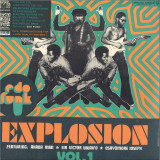
Analog Africa Presents Edo Funk Explosion Vol. 1, available on
2xLP/Gatefold LP with 20-page booklet / CD with 36-page booklet. It was
in Benin City, in the heart of Nigeria, that a new hybrid of intoxicating
highlife music known as Edo Funk was born.
It first emerged in the late 1970s when a group of musicians began to experiment with different ways of integrating elements from their native Edo culture
and fusing them with new sound effects coming from West Africa s night-clubs.
Unlike the rather polished 1980 s Nigerian disco productions coming out of the
international metropolis of Lagos Edo Funk was raw and reduced to its bare
minimum.
Someone was needed to channel this energy into a distinctive sound and Sir
Victor Uwaifo appeared like a mad professor with his Joromi studio. Uwaifo
took the skeletal structure of Edo music and relentless began fusing them with
synthesizers, electric guitars and 80 s effect racks which resulted in some of the
most outstanding Edo recordings ever made. An explosive spiced up brew with
an odd psychedelic note known as Edo Funk.
That’s the sound you’ll be discovering in the first volume of the Edo Funk Explosion series which focusses on the genre’s greatest originators; Osayomore
Joseph, Akaba Man, and Sir Victor Uwaifo: Osayomore Joseph was one of the
first musicians to bring the sound of the flute into the horn-dominated world
of highlife, and his skills as a performer made him a fixture on the Lagos scene.
When he returned to settle in Benin City in the mid 1970s - at the invitation of
the royal family - he devoted himself to the modernisation and electrification
of Edo music, using funk and Afro-beat as the building blocks for songs that
weren’t afraid to call out government corruption or confront the dark legacy of
Nigeria’s colonial past.
Akaba Man was the philosopher king of Edo funk. Less overtly political than Osayomore Joseph and less psychedelic than Victor Uwaifo, he found the perfect
medium for his message in the trance-like grooves of Edo funk. With pulsating
rhythms awash in cosmic synth-fields and lyrics that express a deep personal
vision, he found great success at the dawn of the 1980s as one of Benin City’s
most persuasive ambassadors of funky highlife.
Victor Uwaifo was already a star in Nigeria when he built the legendary Joromi
studios in his hometown of Benin City in 1978. Using his unique guitar style as
the mediating force between West-African highlife and the traditional rhythms
and melodies of Edo music, he had scored several hits in the early seventies,
but once he had his own sixteen-track facility he was able to pursue his obsession with the synesthetic possibilities of pure sound, adding squelchy synths,
swirling organs and studio effects to hypnotic basslines and raw grooves. Between his own records and his production for other musicians, he quickly established himself as the godfather of Edo funk.
What unites these diverse musicians is their ability to strip funk down to its
primal essence and use it as the foundation for their own excursions inward to
the heart of Edo culture and outward to the furthest limits of sonic alchemy.
The twelve tracks on Edo Funk Explosion Volume 1 pulse with raw inspiration,
mixing highlife horns, driving rhythms, day-glo keyboards and tripped-out guitars into a funk experience unlike any other.
We welcome another newcomer to the label, UK-badman Cartridge, who steps up with a smashing debut EP showing the world he’s not messing about. Big Things!
Stone Cold:
The aptly titled EP opener hits hard like a boulder, painting a post-apocalyptic super-metroidesque landscape, building upon the glorious ‘Flummox’ from SUBALT010. Gritty synth lines stating a simple yet catchy and evolving melody, all rounded by a fat bass exactly how we like it. A glittery rain paves the way to the breakdown and the second drop, which tells the final part of this majestic romance.
Choker:
Time to get stealthy with this one… a sinister intro erupts into a refined yet powerful barrage of bass. Solid groove, heavily panned percussion, clever wobs and synth hits, masterful reverb and delay interplays, Cartridge’s sound design really sets to impress with this superb number.
Sweet Doughs:
If the concept of ‘sinister’ was established on the previous track, ‘Sweet Doughs’ definitely takes it to the next level. Menacing car-tyre-screeching-like synths and an amusing yet slightly uncanny vocal sample set up the pace for this weighty dance-floor rattler. A saturated 808-like bass propels the track, which reveals itself as a master-class on how to blend power, bass, crafty sound design and an incredible attention to details.
- 01: The Wrestlers (With Bob Rutman)
- 02: Palmistry (With Marnie Weber And Walter Hus)
- 03: Fire Is A Mirror (With Jabir)
- 04: Sideways In Time
- 05: A Descant For El Fuego Es Un Espejo (Performed By Jabir)
- 06: No-End Street (With Walter Hus)
- 07: Edgeways In Time
- 08: Valley Of Dry Bones
- 09: When Youre Really Gone (With Walter Hus)
- 10: 8-Infinities
- 11: Palmistry (Instrumental)
8-Infinities represents Discos Transgénero’s first contemporary release after several reissues and archival projects. Stepping away from customary North-American guitar traditions, Ameel Brecht (core member of Razen) presents an utterly singular take on early European music with an album which evokes the inner conflicts of growing up and their connection to the concerns of fatherhood.
A classically trained musician, Brecht resorts once again to the use of resophonic guitars and mandolins as a way of finding a middle ground between the virtues of being a schooled musician and the ability to escape pre-established tendencies in pursuit of what he has referred to as ‘metaphysical freeform string music’.
Additionally, the album features a series of fascinating and subtly merged contributions by label associates Marnie Weber and Jabir, along with Bob Rutman’s distinguished steel cello and Walter Hus’ automated glockenspiel. Echoing the likes of Renaissance and Baroque music on plucked instruments, Brecht assembles here a collection of timeless compositions.
Die Brüder Scott und Bryan Devendorf (The National), Ben Lanz (The National, Beirut) und Multi-Instrumentalist Aaron Arntz (Beirut, Grizzly Bear) sind mit Stirnlampen und Höhlenausrüstung ausgestattet und tauchen in einen somnambulen Raum ein. LNZNDRF's II wirkt wie eine trance-induzierende Massenhypnose. Aufgenommen in ausgedehnten, schamanistischen Jam-Sessions im Public Hi-Fi Studio in Austin, Texas im September 2019 und später bearbeitet, um dem Ganzen eine Form zu geben. Der Titelsong "Ringwoodite" mit seinen flinken, geschmeidigen und präzisen Drums ist ein sommerlicher Wunderkerzen-Song, der so schnell vorbeirauscht, dass einem schwindlig wird, wenn man seinen Spuren folgt. Es folgen das computerverliebte "Gaskiers" und die langsame Motorik-Hymne "Stowaway", die zwar klanglich nicht miteinander verbunden sind, aber LNZNDRF voll in den Kanon des seltsamen und unauslöschlichen Krautrocks einreihen. "II" scheint die Dystopie der Gegenwart ebenso zu beschwören wie das große Mysterium, das uns erwartet, wenn wir endlich die Barriere durchbrechen. Es wird keine Utopie sein, aber es wird zumindest etwas anderes sein. So heißt es im lysergischen Post-Punk-Stück "You Still Rip": "We'll live like fruitless trees towards endless breeze linked as we please, the burning bridges smolder in our wake."
Classic Alligator title on vinyl for the first time in over 25 years!
“Extra wicked...hellfire slide guitar...will have you barking for joy.”
- ROLLING STONE
“When I die, they’ll say ‘He couldn’t play shit, but he sure made it sound good.”
- HOUND DOG TAYLOR
Vinyl reissue pressing of the second album by Hound Dog Taylor and his ragged
but right HouseRockers.
Features all-time fan favorites like Sadie, Take Five, Roll Your Moneymaker and
See Me In The Evening. All tracks remastered for this reissue. Download card
included.
Ad in Blues & Rhythm
'The inventive record producer and vocalist Lee 'Scratch' Perry was involved in every musical shift of note in his native Jamaica, from the rhythm and blues that pre-dated the arrival of ska in the early 1960s through the slower and more spacious rocksteady style that appeared middecade and, of course, the frenetic sound of reggae, which he helped to birth as an independent producer during the late 1960s. Operating as 'The Upsetter' from his base in a downtown Kingston record shop, Perry found his greatest success with instrumental music during this phase, the organ and saxophone re-castings of standard vocal issues proving exceptionally popular overseas.
'Scratch The Upsetter Again surfaced early in 1970 as a largely instrumental set, but with dreamy reverb a hefty feature and keyboards veering away from standard organ motifs. Dave Barker, who was soon to hit the pop charts as part of Dave & Ansel Collins, tackles The Shirelles' 'Will You Still Love Me' in soul reggae mode, only for Perry to shift things towards the emerging dub spectrum with 'Take One.'
'As Perry inched ever closer to the dub experimentation he would turn into an art form at his own Black Ark studio later in the decade, Scratch The Upsetter Again shows him moving away from the standard approaches of his competitors in his quest to test the very limits of recorded sound. And reggae was all the richer for it.'
—David Katz (excerpt from the liner notes)
Re-mastering by: Ray Staff at Air Mastering, Lyndhurst Hall, London
Morgan was one of the most active artists in the Los Angeles underground jazz scene, and a member of the late great Horace Tapscott‘s artist collective Union of God’s Musicians and Artists Ascension (UGMAA). He performed alongside Tapscott, and other Nimbus recording artists like Jesse Sharps, who he introduced to Tapscott. He also performed with Arthur Blythe, Gary Bartz, Azar Lawrence, as well as soul icons Willie Hutch (notably on the Foxy Brown soundtrack) and Rufus & Chaka Khan. Most recently he contributed to Carlos Niño’s 2016 album Flutes, Echoes, It’s All Happening!, and was a part of Niño and vocalist Dwight Trible’s soul-jazz group Build An Ark (which also featured Tribe’s Phil Ranelin).
Journey Into Nigritia was Morgan’s debut as a leader, and the first of three recordings he released for Nimbus West. The album has a strong post-Coltrane spiritual feel, with some modal-based melodies, and some fiery solos from saxophonist Dadisi Komolafe. The record also features a solid rhythm section featuring bassist Jeff Littleton and drummer Fritz Wise.
Review by T J Gorton
At the dawn of the Reagan years, LA jazz pianist Nate Morgan recorded his first album for Nimbus West. Journey Into Nigritia portrays an artist marked by the icons of his day, and striving for reinvention. Although he came from a solid jazz background, coming up through the Pan Afrikan People's Arkestra, Morgan found more exciting work with pop bands in the seventies, including glory years with Rufus w/Chaka Khan. On Journey into Nigritia, Morgan re-embraces jazz. Included in the band are Jeff Littleton on bass, Fritz Wise on drums, and Dadisi Komolafe on alto sax.
The collection opens with the Trane-ish Mrafu. Komolafe blasts off in short order, and while the modal chording recalls Tyner, Morgan shows flashes of the nimble loquacious gift that define him. While Alice Coltrane incense perfumes "Morning Prayer, Morgan's devotional sincerity and personnel expression triumph.
Suitably complex with yearning minors, Mother features the trio performing a memorable composition. Littleton's deep-note sustain contrasts Wise's shimmering cymbals, while Morgan tells heart-wrenching truth. With a somewhat solemn theme, He Left Us a Song regularly bursts through into straight-ahead fast break sprints up and down the court. The unexpected "Study in C.T. offers an homage to Cecil Taylor and Morgan's musical roots with free improvisations on a dense and spiky theme. The exhilarating result has Morgan exploring his own way, with a winking slinging of jagged bass chords halfway through.
While a quarter century's experience has nurtured Morgan's prodigious gifts beyond this ambitious debut, Journey Into Nigritia offers enjoyable insights into his artistic evolution, while adding another precious title to the discography of one of the most woefully under-recorded greats of our time.
Jamaican reggae duo Dave and Ansel Collins recorded and released their reggae debut album Double Barrel in 1971. The single “Double Barrel” topped the UK and Jamaican charts and the follow-up “Monkey Spanner” also enjoyed international success. “Double Barrel” was sampled by hip hop artist Special Ed and two of Dave Barker’s introductory exclamations (“Don’t watch that, watch this!” from “Funky Funky Reggae” and “This is the heavy, heavy monster sound!” from “Monkey Spanner”) were quoted by vocalist Chas Smash, in the introduction to the Madness single, “One Step Beyond”. All of the songs on the album were written and produced by Jamaican heavyweight Winston Riley and it was the first record that legendary drummer and percussionist Sly Dunbar played on. Shortly after the Double Barrel release Dave and Ansel split-up.
The 50th anniversary edition of Double Barrel is available as a limited edition of 750 individually numbered copies on orange coloured vinyl.
Nervous Horizon is happy to present 'Sogno EP', the new project by label co-owner Guglielmo Barzacchini, aka TSVI. Embarking on a journey inside the mind's most deep and intricate illusions and hallucinations, 'Sogno EP' is an exploration into various different types of dream states and altered states of consciousness. Characterised by intricate rhythms, slower beats inspired by techno, dancehall and little to no melodies, the record features Italian ASMR and spoken word to enhance the hazy and hypnotic mood permeating throughout. Taking a close look at his own states of unconsciousness and channelling them into his musical creation, TSVI dives into the abstract and eerie worlds of the subconscious with a project inspired by surreal dreamscapes, trance states and the concept of shadow work, in which each track explores a different aspect of the depth of the human psyche.
Vinyl kommt in blau, Klappcover und bedruckter Innenhülle! Die meisten Dinge im Leben entstehen zufällig. Die große Liebe, eine schicksalhafte Begegnung und manchmal auch eine zweite Karriere. Oliver Perau alias Juliano Rossi hätte 1996 sicherlich nicht damit gerechnet, dass er 2021 immer noch als Rossi unterwegs sein würde. Damals hatte sich gerade die alternative Rockband Terry Hoax, die Perau 1988 mit einem Freund gegründet hatte, nach acht europaweit erfolgreichen Jahren aufgelöst. Doch Perau wollte sein Versprechen, bei der ersten Ausstellung des befreundeten Fotografen Olaf Heine zu singen, halten. Also fragte er den Jazzpianisten Lutz Krajenski, ob man zusammen alte Swing-Klassiker präsentieren könnte. Schließlich war Perau seit frühster Kindheit begeistert von Sammy Davis jr., Dean Martin, Burt Bacharach, Barbra Streisand, Tom Jones und Frank Sinatra. So stand Perau im Sommer '96 mit dem eilig ironisch hinzugefügten Künstlername Juliano Rossi vor Galeriebesuchern und Terry-Hoax-Fans und sang entrückt What the world needs now von Bacharach. "So viele entsetzte Gesichter habe ich selten gesehen" sagt Perau lachend und ergänzt nach kurzer Pause "aber für mich war es wie eine Offenbarung". 25 Jahre später veröffentlicht Juliano Rossi sein fünftes Album, Terry Hoax gibt es auch wieder und zusätzlich tourt Perau seit 9 Jahren durch Pflegeheime und macht Musik für Menschen mit Demenz. Ein sehr ungewöhnliches und in dieser dreigleisigen Konsequenz sicherlich einzigartiges Sängerleben, dass offensichtlich glücklich macht. So jedenfalls wirkt Herr Rossi und sein neues Album "Drunk On Love". Aus der Zeit gefallene glamouröse Songs irgendwo zwischen The Doors, Burt Bacharach und Dean Martin.