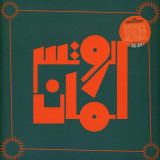
Seitō 青鞜 gathers Japanese female artists from various electronic and experimental music fields. Like the « Tokyo Flashback » series issued by P.S.F. in the early 1990s, this collection recorded between 2017 and 2019 exposes the richness of the contemporary Japanese underground music scene. The title refers to a cult feminist magazine printed in Japan in the 1910s. All tracks issued for the first time.
Iranian multi-instrumentalist Kamyar Arsani (Faraway Ghost) and Indian-born drummer/electronic music producer Ravish Momin (Sunken Cages) create their own brand of digital folk music that draws on Sufi mysticism, traditional Persian Music, street rhythms from Mumbai and contemporary electronic music at once. Momin accompanies Arsani's vocals and daf (frame-drum) with a masterful blend of electronic and acoustic percussion, including live-looping via his unique drum-loop performance system.
A surreal mosaic of eerie chant processionals, tape-rot trickery, and panicked oud madness. These are sonic forgeries of atavistic heritages, recorded by analog means using esoteric techniques."" They have been known by many names: The Givers of Illness; The Bandylegged Riders of the Ill-Promised Sun, etc_ Honed and expanded through their travels, Ak'chamel's singular sound comprising desert-scorched psychedelia, post-apocalyptic shamanism, and bizarre ritual folk is as unique as the physical theater of their otherworldly live performances.
For the first time two single records of Baksey Cham Krong - the first Cambodian guitar band - are officially being reissued in an identical version. Between surf music and ballad, these two records released in 1963 and 1964 are an invitation to rediscover the effervescent Khmer musical scene of the 1960s.
The early 1960s are often described as the “golden age” of Cambodia, with a flourishing economy and a strong cultural development. As the country had just won its independence, the King Norodom Sihanouk - who had been a singer himself (see below) - encouraged dynamism and creativity in all aspects of cultural life.
In 1959, in the midst of this artistic turmoil, Mol Kamach and his brothers created a band: the Baksey Cham Krong (also spelled Bakseis Cham Krung) named after a temple of the Angkor site. The teenagers were influenced by the latest hits they had listened on the radio. For the music, Kagnol got his inspiration from the rock n’ roll of the Ventures and the Shadows while Kamach took over the vocal techniques of crooners such as Paul Anka. The lyrics were either in French (as for the song Ne penser qu’à toi) or in Khmer. The song Pleine Lune became a hit and revealed Kagnol’s musical genius at playing guitar and Kamach’s delicate voice. From their beginnings on the capital’s high school stages to their first broadcasts on national radio, the success of the Baksey Cham Krong was very quick. At the end of the decade the band already split, the brothers getting back to activities that conformed more with their parents’ expectations.
A few years later, in April 1975, the arrival of the Khmer Rouge in Phnom Penh put an end to this musical development and started the darkest era of Cambodia’s contemporary history. A quarter of the population was killed in the Khmer Rouge genocide and the majority of artists and intellectuals were exterminated in a sordid will to wipe out any form of culture in the country. Films and music were banned, movie tapes and vinyls were destroyed. Mol Kamach and Mol Kagnol luckily managed to flee the country: one now lives in France, the other in the USA. Both still continue to make music nowadays.
Bearing witness to the past history, the reissue of these two single records of Baksey Cham Krong brings back to us the Cambodian musical scene of the 1960s.
KahruMusiqa ist eine musikalische Retrospektive der tunesischen Sängerin und Komponistin Badiâa Bouhrizi alias Neysatu. Sie ist als Autorin der Protestsongs bekannt, die zu den Hymnen der tunesischen Revolution wurden. KahruMusiqa bedeutet elektronische Musik, wird aber im Arabischen nie als solche verwendet, um das Genre zu bezeichnen. Das Album ist eine Sammlung von Klangexperimenten, die entstanden, als sie in den 2000er Jahren erstmals Musikproduktionssoftware in die Hände bekam. Die Stücke basieren auf Gedichten in klassischem Arabisch oder tunesischem Dialekt, die Badiâa selbst oder von ihr bewunderte Dichterinnen wie die palästinensischen Autorinnen Fadwa Tuqan oder Salma Al Jayusi oder den tunesischen Dichter Noureddine Werghi verfasst hat. Die meisten der Gesangsstücke sind Improvisationen, die mit einem Computermikrofon aufgenommen wurden. Eine Bearbeitung des klassischen türkischen Volkslieds Muhabbat ist fast eine moderne harmonische Neufassung, bei der nur klassische Gitarre, Gesang und Delays verwendet werden. Die Themen von KahruMusiqa entsprechen dem ideologischen Weg von Badiâa Bouhrizi. In dem Lied Transrimel ist sie eine queere Frau im sich bewegenden Sand von Tunesien. Sie hinterfragt auch den politischen Vertrag, der 1948 zu Balfour und der Vertreibung von Millionen von Palästinensern führte, und beschreibt in Fil Madinatil harima ("In The Old City") eine Reise zwischen London und Nablus. Dieses elektronische Schlafzimmer-Album im Lo-Fi-Stil enthält auch mehrere Songs, die wie Ila Selma zu Klassikern des arabischen Underground-Milieus geworden sind, und ist die erste Platte, die Badiâa Bouhrizi überhaupt zu veröffentlichen bereit war.
out of Stock
Last delivered 23 months ago available to reorder, subject to availability
« A Fantastic mixture of Brakka, Reggae & Afrobeat Recorded between 1980 and 1984 from the underground Afropean boxer Mushapata »
“Saba-Saba Fighting” or fighting for peace, is the message that Mushapata, a legend of the African reggae underground scene in Paris with an extraordinary destiny, has fought for all his life.
Born in Bukavu, a city nowadays located in the Democratic Republic of Congo at the border with Burundi, Mushapata arrived in France at the end of the 1970s to pursue his career as a boxer. A few years later, revolted by the professional sports industry, he became a personal protection agent on the advice of his manager. He escorted many celebrities among whom Bob Marley during his legendary French tour of 1980. This encounter awakened the musician hidden behind the boxing champion. Mushapata had stepped out of the ring but he kept fighting with music, lyrics and his band Saba-Saba Fighting.
Ignored by the record labels of the time, his first self-produced recordings reveal a rough mix of lo-fi reggae, afrobeat rhythms accompanied by a brass section close to Free jazz. The nonchalant sounding voices of Mushapata and Tshayi complete this explosive cocktail and carry, in Swahili language, the Pan-African ideas of Lumumba and other great figures of African-American struggles.
This maxi single, conceived as a mini-compilation tribute, includes 4 titles from the first two albums recorded between 1980 and 1984. Limited edition!
Slow paced drums with offbeats softly phased with the guitar, misty takeoffs from the synthesizer: a hazy idyll is starting off on the road to the rocket festival (bun bang fai). Answering each other on the responsive mode of the lam soeng, Sothipong engages in a flirt but Oulay Vanh is not ready to trifle with just anybody.
As a stylistic variation of a popular Lao musical genre, the lam soeng was the source of several themes among which the “bang fai” - which is part of the Lao conciliatory festivities preceding the rainy season - remains one of the most renowned.
However, the producer and composer of these songs, Sothy, created an unusual arrangement: the instrumental introduction separates from the sang canon, the synthetic mix is stripped down of the traditional organology - everything here becomes unsettling for a listener familiar with the genre.
Everything comes with a reason: the record was edited in 1981 under the title Sothy Productions yet produced in France by the Parisian label Oxygène (famously known for its unforgettable first French punk compilation 125 grammes de 33 1/3 tours). Chansons Laotiennes still remains hard to classify.
And then who’s Sothy? Along with the unverifiable identity of the seemingly Laotian singers, skepticism gains ground concerning the man behind the pseudonym. Is he an escaped musician from one of the first Cambodian rock bands of the 1960s? A surviving producer from the 1980s Paris? Or a composer in transit in one of the many places of the Laotian diaspora? Sothy eludes any researches and disappears behind his numerous homonyms.
The second track is just as enigmatic: a beat box, a lightly reverberated voice as well as a guitar solo and a small synthesizer break, “Tuei” or “Tawai” offering (as the writing on the record suggests) makes way to dancing step and a truly joyful melody. Twisted and lively steps on a romantic background tune turn this second track into a genuine paslop - a program recommended by therapists to relieve muscular pains due to seated positions: you will unlock your pelvis with some synchronized Laotian choreographies.
For their first edits, Akuphone called on a young Parisian producer. Shelter, aka Alan Briand, mingles his own mixes and electro productions with a large variety of influences and styles: krautrock, disco, traditional music, psychedelic, synth pop, ambient, bossa nova, Japanese funk. He produces both original compositions and remix.
On Maza Gusu, Mikado Koko transforms into Mother Goose, hissing Perrault's fairy tales from her native tongue in your ears. Her unsettling, regressive voice is backed up by a subtle and chilling electronic soundscape sprinkled with traditional Japanese instruments, creating a realm of sound that feels both weirdly familiar and deeply unknown. Mother Koko hurls you deep down the rabbit hole, back to your darkest childhood anguishes, before gently leading you by the hand to a joyful catharsis. As you slowly get used to its disturbing familiarity, Koko’s music feels like waking up in the pale morning light, shaky but relieved after a feverish dream.
In summer 2017 Mikado Koko started her solo career as a club music producer with the elements of Japanese traditional music. After many releases, remixes and compilations such as Seitō: In the Beginning, Woman Was the Sun (AKU1016), she now focuses on avant-garde poetry reading related to feminism and gender equality.
The title alone sums up perfectly the 8th album of French artist My Jazzy Child. Inspired by Noam Chosmky's "universal grammar", it refers to man's innate ability to develop language. It is that English, Occitan, French patois, Hindi, Pygmy or French cohabit on this record, juxtaposing on rhythms and beats that appear as a fantasized primordial tradition.
If My Jazzy Child aka Damien Mingus, questions languages about Innéisme, he also questions musical languages, mixing Asian rites and free jazz, electronic wanderings and traditional percussions. A virtuoso and experimental collage that nevertheless knows how to remain melodic and, in the end, strangely pop.
The poet, producer and visual artist Ramuntcho Matta is coming back to music with 96. 96 – as 96 hours were needed to record this new album. Ramuntcho points out that behind this dazzling recording, years of experience enabled him to achieve the mix of spontaneity and intimacy of the album.
He was the man behind the success of Eli Medeiros’ Toi mon toit. As a matter of fact, Ramuntcho Matta likes to put artists in the spotlight, as he has done with Brion Gysin, Don Cherry and many others. However this time he decided to put himself in the spotlight, with this record which sounds very 90s – with a wink to Bill Laswell for the bass – but still very contemporary. The album unveils a dark atmosphere, as if Bashung had lost himself in a Lynch film.
Alongside the album release, Ramuntcho Matta and Akuphone have decided to make the entire discography of the artist available on Bandcamp. Each Friday since the beginning of this year, an album has been put online and made available for listening and downloading.
Record sleeve designed by Ramuntcho Matta. Unpublished notes and drawings from the artist’s logbook « Desseins du jour ». Downloading code
Boîte Boîte is the latest compendium from French trumpeter Jac Berrocal. Composed of rare and previously unreleased tracks, it plunges the listener into the fascinating world of this unclassifiable and timeless avant-garde artist. Recorded between Paris, New York, Berlin and Riga, the works are received like postcards from an unknown sender and enjoyed without moderation. The selection, devised by Jac Berrocal himself, oscillates between experimental tracks such as the eponymous « Boîte Boîte » and electronic pop delusions such as « Amarena
An original instrumental music project led by composer and Oud player Aly Eissa. Featuring his diverse musical influences, Eissa’s compositions create versatile and twisted meditative atmospheres throughout the musical experience.
Aly Eissa is a composer and Oud player based in Cairo, Egypt. He was mentored by legendary composer Abdo Dagher and Oud virtuoso Hazem Shahin. Eissa’s style is deeply-rooted in the Egyptian classical and folk traditions, and influenced by various western genres. Since 2012, Eissa has been regularly performing his compositions with an ensemble for live audiences in Cairo, offering a meditative musical experience with a twist.
One of Eissa’s musical approaches is the experimenting approach through a unique trio formation including the Belgian synthesizer player Jonas Cambien and the Egyptian percussion player Ayman Mabrouk. In this trio, Eissa is trying to explore a different sound and space in the originally composed Arabic music.
Under meters of concrete in central Cairo, a relentless buzz rebels and forms a melody. A tired man tunes his machines to catch a snatch of it, and accidentally creates a playground where these abandoned sounds can flourish. They develop a sense of humor and an acid tongue. A few children with bent ears find their way to an alley with an entrance to the playground. They would later describe what they heard as a delicious hybrid: one part cream, one part bubble gum. So, bend your ears and maybe you'll hear it too.
New album of the Swiss/Lebanese experimental duo (Raed Yassin & Paed Conca). Praed is a band whose musical oeuvre can be described as a mixture of Arabic popular music, free jazz, and electronics.
Since then, the band has frequented numerous international music festivals and toured intensively world-wide, spanning Japan, Europe and Canada.
Through these endeavors, the band has created a large global network with other renowned musicians as musical collaborators.
"Akuphone is proud to present the Jerusalem-based improvisational trio Leviot and its hypnotizing debut album. Leviot (Hebrew for “Lionesses”) is a brainchild of multi-faceted musician and composer Yael Lavie, who’s joined by classically trained percussionist and music teacher Cnaan Canetti, and synth enthusiast Yishay Seroussi. The project is a result of Lavie’s ongoing explorations beyond the restraints of classical kanun playing and fascination with electronic sound and modern composition. Initially started following her experience performing and recording with Spiritczualic Enhancement Center, in Leviot, Yael gives up rehearsed pieces in favour of improvised sets, based on virtuous interpretation by Cnaan and Yishay. The three have been active since 2019, playing their immersive shows in a wide variety of settings, venues and festivals. The trio’s debut release is a live session, recorded in late 2020 at Mazkeka Studios (Jerusalem) for the lockdown edition of the annual Zikuk Festival. It’s a meditative improv piece in five parts that combines and melts boundaries between the traditional and the experimental, the primal and the futuristic. With setup as the foundation of the piece and Lavie’s graphic score as the road map, Leviot takes off on a cosmic journey between deep drones, whispering chimes, mesmerizing Arab melodies, pulsating rhythms and iridescent ambient patterns."
out of Stock
Last delivered 3 years ago available to reorder, subject to availability
Deluxe double 12'' vinyl housed in a 2 pantone sleeve Including insert with liner notes Akuphone is pleased to present the first compilation dedicated to musician John Bolloten, aka The Rootsman. As a precocious punk, he formed his first band, State Oppression, in his teens. Yet he is best known for his dub music, a genre that gave him international recognition. Largely influenced by the rhythms of North Africa and the Middle East, he built his musical identity around samples from these regional repertoires. His encounter with Bryn Jones - better known as Muslimgauze - further defined his artistic path. This selection offers an overview of his work from 1996 to 1998, a prolific period when Into The Light, 52 Days To Timbuktu, Union Of Souls (with Celtarabia) and Distant Voices (with Pachakuti) were released. A visionary production that predicted today's growing international predilection for the musical heritage of the MENA regions. The compilation is enriched with an explanatory preface by Mabrouk Hosni Ibn Aleya and illustrated with rare archival photos- all of which are contained in a superb jacket designed by the artist Ghiya Haydar.
Comes with 10'' booklet and download code. Limited 500. - "Those awaiting", the name chosen by the musicians of Sabreen, still rings true forty years after the foundation of this group in Jerusalem. Voice of the hopes as well as the anger of the Palestinian youth, this group has recorded four self-produced albums. With the weapons of poetry, they will embody the voices of resistance against the occupation but also the desire for emancipation from tradition.Emblematic of this state of mind, their second album Death Of The Prophet was released on cassette at the beginning of the first intifada. It will be the soundtrack, while providing the tuning fork of the future generations. Whether meditative beaches or collective outbursts, joyful outbursts or more serious moments, the band goes through the range of feelings, drawing its inspiration from the sources of classical Arabic music and popular folklore. The result is a unique style, irreducible to any category. All that makes that forty years later, this cult album, never released on vinyl, remains very current. Including booklet with extended liner notes by Jacques Denis and rare photos.
out of Stock
Last delivered 4 years ago available to reorder, subject to availability
Comes with printed innersleeve and download code. Limited 300. "Musician, composer and one of the most revered figures for today's younger generation of experimental and alternative Arabic music scenes, Kamilya Jubran (text, oud & vocals), collaborates with long standing musical partner, composer, accomplished trumpet player and seasoned electronic musician Werner Hasler (trumpet & electronics). In Wa (Arabic for and), their third album together as a duo, Kamilya Jubran and Werner Hasler continue to interrogate their listening and their expression, their research and their desires, to unravel a musical universe of possibilities; "a unison of timbres, cultures complementing, the complicity of verses, and modes and languages confronting each other" in the duo's own way of communicating respective origins and contemporaneity. Lyrical, within a sound full of contrast and ornamentation, they pursue an expansion of their repertoire with imaginative interpretation and improvisation." Originally released in CD and digital by Everest Records (Switzerland). Vinyl issued in collaboration with Akuphone. Vinyl mastering by Mark Gergis.
Comes with download code. Limited 300. " "Où cela commence-t-il ?_x000B_Where does cultural appropriation end and procreational fusion begin?_x000B_The answer to that depends on the perceiver. For some, applying the structures of electronic music to folkloristic samples may seem de-contextualizing. Yet when considering the similarity between dancefloor compositions and the minimalism of Steve Reich and Terry Riley, the gap to traditional music begins to fade away. They remain distinct mostly by aesthetic characteristics of sound. Nicolas Sheikholeslami's premiere solo record as Çaykh is named after the French conjunction "Où" - meaning "where" - as this was the linking element during production. We witness an attempt to re-contextualize music that travelled from analog tapes - recorded in different localities along the Indian Ocean - to a hard-drive via 192kb youtube rips. The sample-based compositions were digitally arranged before regaining their warm sonic qualities in a vintage mixing studio This EP assembles three metamorphic 4th-world disco pulsations. Expect some heavily trancy and polyrhythmic analogue-fi jams. Nicolas Sheikholeslami aka Çaykh is a Hamburg-born and Berlin-based DJ and producer. He is active as drummer & percussionist for the projects Spiritczualic Enhancement Center and Circuit Diagram. Çaykh's three earlier sound-collage cassette releases have already earned him a certain fame in the 4th-world and outsider-disco realms. His collection of pre-war Somali music called "Au revoir, Mogadishu" paved the way for the Grammy-nominated "Sweet as Broken Dates" compilation, which he co-curated.