Adult Sonics - Shuffle Master EP (SRR004)
BODJ & ROKSI in true magician style, wear their top hats & capes as they come together once more under their Adult Sonics alias, this time shuffling the deck for the inaugural vinyl release of London based record label, Stay Restless.
An original 3-track EP with the signature ADS sound - trippy and dark yet playful, created having big sound systems in mind, it’s already been in rotation from Sunwaves festival to SASH in Sydney and back.
Search:adult sonics
- 1
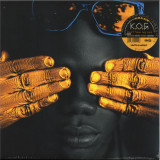
Multi-talented, Ghana-born, UK-based sonic shaman K.O.G (Kweku of Ghana - the professional name of vocalist, composer and visionary Kweku Sackey) presents his third album on Pura Vida, the imprint of respected French label Heavenly Sweetness spearheaded by much-loved French DJ and producer GUTS.
Born and raised in Ghana, but having spent much of his adult life in the UK, for K.O.G this record can be seen as the culmination of a lifetime spent absorbing, combining and refining the diverse influences that have shaped his music and his character.
Kweku explains: This album is a very personal journey. I speak about three things: the soul of my community, where I found my inspiration. The roots, highlife, soul, going to church, being around traditional ceremonial setups. Taking people to the very origin of my voice, my soul, my impulses, my community, my culture.
And the next phase is cross-culture: living half of my life in UK and half of my life in Ghana. Putting myself at this crossroads to see the effect of the sonic consciousness, how awake I am with the music from Ghana, and also how living here, having children and family here has also influenced my music.
And thirdly, it’s mirroring my personal journey. Starting in Ghana, with my band in Ghana, and my roots, then moving up to UK, Going from Zone 6 all the way to Europe. Highlife - the syncopated fusion of local music and jazz which is at the core of Ghanaian music, and which from the 1930s spread like wildfire across anglophone West Africa - is one of the core building blocks of this album. But don’t be fooled by the catchy melodies and bright sonics. K.O.G is using it to speak about some topics that are anything but bright.
Highlife is absolutely dark. Most of the places you hear real highlife music, it’s funerals! And it’s part of the culture. Death is part of life. Seeds die for life to germinate. Art is just an emotive expression, when you can cause an emotion in somebody, and it’s not always happiness.
This theme of self-expression and vulnerability is a consistent one throughout the record. With special guests Pat Thomas, Dizraeli, Fameye, Ogunskele.
Editions Mego presents Bosko, landing exactly 30 years after the initial General Magic flights into the fantastic; the legendary first Mego release, a collaboration with Pita whereby all sounds were harnessed from the buzzing, drinking, humming sounds of fridges MEGO 001 General Magic & Pita and a 12” with Elin called Die Mondlandung (The Moon Landing) MEGO 002 which embarked on a minimal techno template so austere and strange it was one of the historic progenitors of austere and wonky rhythms alongside Sakho and other European explorers.
The initial return of the playful and mystical Austrian outfit General Magic came with the 20th year anniversary vinyl reissue of their classic debut Frantz eMEGO 010. A record so audacious and playful it still baffles as much as it entertains. At some point whilst working on this reissue GM’s Ramon Bauer and Andi Pieper were spurred on to rummage around with ideas and tools once more and after more than two decades of inactivity sonic sorcery was conjured once again. Live shows in honour of Peter Rehberg were performed in Vienna and London. Softbop, a limited risograph collaboration with Tina Frank came with the first new recordings as a digital download came out discreetly online. The first full length album following Rechenkönig in 2000 MEGO 032 “Nein Aber Ja” released in 2023 on Finlay Shakespeare’s GOTO Records on CD and cassette. An ongoing series of mix tapes online further highlights their interests encapsulating a new found angle on electronic mayhem. All of these elements retain the wildly eclectic and ecstatic glow that only they can harness and hand out to an unprepared world.
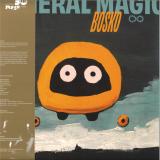
Now, we have General Magic’s second official full length comeback recording, Bosko. The new album is initially notable prior to the needle hitting the wax or the cursor identifying a track due to the artwork. Made by long term collaborator Tina Frank, this is Frank’s first analogue artwork, with a painting of a happy/nervous machine thing hovering in a landscape of no discernible identity. It’s quasi science fiction hovering amongst the potential for fun. Suited to the music? Natürlich.
Bosko sees Bauer and Pieper update and reframe their original investigations with a fresh supply of head scratching, heart racing tunes that hit the inexplicable with a wild mesh of drums, pianos, synthetic voices and all manner of immaterial sonic play. Startling sonics shock the ears on Club Duchamp which sounds like a conversation between synthetic adult ants in an environment still in development. Elfer features vocals supplied by a female-ish voice who, whilst grappling melody, has trouble executing a firm identity. Noorenhalt catapults along a mainframe of syncopation so unwieldy it feels like the voice, which is utterly alien, provides the only comfort. Seite 5 inhabits a fuzzy zone where a synthetic Horn of Jericho type ambience competes with rhythms never quite sure of who they are. Rise of the Ombré raises the spectral dread. Is this Science Fact? Absolutely nothing within Bosko is predictable.
The amount of change in the miasma of existence and the things we touch in order to make things has shifted so exponentially we are at the point where minds are starting to glaze over. All of this makes the return of the always original, always surprising, always fresh and exciting General Magic totally in tune with the artificial intelligent apocalyptic age we currently inhabit. The tools may have changed but the wonderfully warped gaze of Bosko offers a fresh new vision of perplexing funk and robotic punk.
- Big Love
- Seven Wonders
- Everywhere
- Caroline
- Tango In The Night
- Mystified
- Little Lies
- Family Man
- Welcome To The Room…Sara
- Isn’t It Midnight
- When I See You Again
- You And I, Part Ii
A Universe of Pop: Fleetwood Mac’s Tango in the Night Features Meticulous Production, Includes the Hits “Big Love,” “Everywhere,” “Seven Wonders,” and “Little Lies”
Experience the 1987 Album in Audiophile Sound for the First Time:
Mobile Fidelity’s Numbered-Edition 180g 45RPM 2LP Set Captures the Perfectionist Details
1/2" / 30 IPS analogue master to DSD 256 to analogue console to lathe
The perfectionism involved in crafting Fleetwood Mac’s Tango in the Night reached a level of intensity experienced by few artists before or since. Commercially and creatively, the painstaking efforts paid off. Recorded over the span of 18 months, the triple-platinum album spawned four hit singles and put Fleetwood Mac back at the center of mainstream conversation. Its demands also ultimately forced its primary architect, guitarist-singer Lindsey Buckingham, to leave the group shortly after its completion. Was it all worth it? A thousand times “yes.”
Sourced from the original master tapes, pressed at Fidelity Record Pressing, and housed in a Stoughton jacket, Mobile Fidelity’s numbered-edition 180g 45RPM 2LP set of Tango in the Night presents the 1987 record in audiophile sound for the first time. Everything co-producers Buckingham and Richard Dashut sought to instill in the music — the exacting tones, gauzy textures, plush atmospherics, shifted harmonics, unique pitches, pristine acoustics, biting rhythms — can now be heard with elevated accuracy, range, depth, and detail.
Made under challenging circumstances, Tango in the Night is as much a universe of sound as it is an album. This reissue conveys that sonic spectrum in exhaustive manners that go beyond prior editions by playing with a combination of transparency, imaging, openness, and dynamics that provides uncanny insight into the meticulously layered vocal and instrumental tracks. Equally important, it also amplifies your connection to the elaborate melodies, contagious hooks, and airy highs that account for the album’s ageless pop brilliance.
As for the wondrous array of percussive accents, synthesizer elements, interlaced guitars, and lush choruses — all seemingly occupying the exact right place amid the soundstages and taking on shapes and forms that lend them a living, breathing quality? If your audio system is up to the task, the realism, presence, and warmth of Mobile Fidelity’s collectible edition will have you considering Tango in the Night from a new perspective — one that puts its lavish, gorgeous creations on a par with those from Rumours and Tusk.
Unlike those records, Tango in the Night began from a more individualistic perspective in that it sprang from what originally was intended to become a Buckingham solo effort. Instead, it remains the final album credited to the peak Fleetwood Mac lineup involving Buckingham, Stevie Nicks, Christine McVie, Mick Fleetwood, and John McVie. Though the participation of all the members varies from track to track, the cohesive arrangements and alchemic production on Tango in the Night suggest a unity that remains on a par with the band’s other landmark works.
Largely constructed from laborious methods that involved recording at half speed to achieve the desired sonics and tonal nuances, piecing together verses and choruses to attain seamless synchronicity, and Buckingham using a Fairlight CMI synthesizer/workstation in visionary ways, the songs pair electronic and acoustic elements to radiant effect. Tango in the Night also possesses light dance structures that resulted in several tunes being recast as dance mixes on extended-play singles. Above all, however, this is music that appears to float and cast dreamy spells.
Surrender to the frisky interplay of the opening “Big Love,” big pop punctuated with Buckingham’s back-and-forth “oh-ah” sighs that ping the Top 5 smash with innocuous sensuality and toe-tapping momentum. Delight amid the shimmering lights of “Seven Wonders,” whose shades and shadows shift amid Nicks’ raspy vocals and a large group chorus. Wrap yourself in the warmth of the weightless “Everywhere,” a flawless slice of hummable pop that topped with Adult Contemporary charts for three weeks and towers as an ode to the love everyone desires. Stare into the mysterious landscape of the title track (and dig the synthesized harp) just before it explodes, briefly ceding to a terse riff and locked-in grooves.
Tango in the Night teems with delightful surprises and well-honed specifics, especially when Buckingham and Christine McVie team together. In addition to the aforementioned “Everywhere,” the singer born Christine Anne Perfect plays a major role on four more cuts — all highlights — from the breathy, head-over-heels emotionalism of “Mystified” to the sweet, sweeping escapism of “Little Lies,” a cover-up of romantic despair aided by Nicks’ irreplaceable background vocals.
“If I see you again/Will it be the same,” asks Buckingham on “When I See You Again,” finishing up a song a longing-sounding Nicks had started while voicing words that many likely knew would resonate far beyond the confines of the heartfelt song — a goodbye wearing a faint disguise. Though Fleetwood Mac would never again reach the heights maintained throughout Tango in the Night, and members would go their own way, the album towers as a paean to what’s possible in the fields of pop, rock, and studio wizardry.

Raymond Scott (1908-1994) was a renowned bandleader, composer and pianist from the 1930s to the 1950s. Many of his playful riffs, originally recorded from
1937 to 1939 by the Raymond Scott Quintette, are genetically encoded in every earthling, having covered by many artists while also being adapted for cartoons like Bugs Bunny, Daffy Duck, The Ren and Stimpy Show, The Simpsons and Animaniacs.
His Soothing Sounds for Baby (SSFB) trilogy showcased Scott as a pioneer of electronic music. His ambient minimalism ultimately became a source of inspiration for musicians like Terry Riley, Phillip Glass, Kraftwerk and Brian Eno. But SSFB couldn’t prepare the world for the exotic artifacts found on Manhattan Research Inc. MRI, first issued on Basta in 2000, contains 69 tracks recorded from 1956 to 1969—over two hours’ worth of Scott’s ground-breaking electronic work in adult dimensions. Forays into abstract musique concrete are heard alongside film soundtrack collaborations with a young pre-Muppet Jim Henson, and pan-galactic sonics seemingly beamed down from hovering UFOs. In addition, MRI presents some of the first TV and radio commercials to feature electronic music. MRI also features many of Scott’s instrumental inventions.
Scuba Death is Ricardo Donoso's alter ego. With more of a focus on analog sound, percussion, sampling, and location recordings, there is an organic undercurrent on Scuba Death recordings that isn't as prevalent in his solo work. This music is rich in atmosphere while still tethered to the deeper ideas that Donoso often explores in his work. Treatises on fear and deathanxiety, the underlining thematic framework for the project, run rampant throughout these claustrophobic electronic passages, and teeter on the edge of being oppressive. Nitrogen Narcosis marks the first full length and strongest statement in the Scuba Death repertoire after the privately issued, ruthless 'Demon Seed' twelve inch back in 2011. The album alternates between surprising lethargic dance inflections all nestled between 75 & 100 bpm, the normal resting heart rate for adults, and the more conceptual, numbnessinducing pieces like '50-70 Meters' and 'Nociception.' Sequencing plays an integral role on Nitrogen Narcosis as the listener is suddenly thrust into the darkest reaches of the ocean after dark alley grooves are sucked into an aquatic abyss. For a project named after Donoso's neardrowning experience in the South Atlantic when he was younger, there's an impressive amount of reflection & vulnerability present - the field recordings that permeate throughout the album were captured at the same location the undertow caught hold of him that bright Summer day 20 years prior. An inner battle between paranoia and euphoria is played out in wellconceived, precision sonics on Nitrogen Narcosis as Donoso reminds us to look back, break through the surface and go deeper.
- 1