Legendary New Zealand-born experimental composer and sound art pioneer Annea Lockwood returns to Black Truffle with On Fractured Ground / Skin Resonance, her third release for the label. Having recently celebrated her 85th birthday, Lockwood shows no sign of slowing down in her exploration of new sound sources and collaborations with an ever-growing intergenerational pool of performers – here with Vanessa Tomlinson. Her creative vibrancy is alive as ever on the two recent works presented here, which demonstrate both her engagement with the social dimensions of sound and the deeply reflective, meditative aspect of her art.
On Fractured Ground derives from material recorded with Pedro Rebelo and Georgios Varoutsos for the soundtrack of Maria Fusco and Margaret Salmon’s opera-film, History of the Present (2023). Working together in Belfast, Lockwood, Rebelo and Varoutsos made extensive recordings of the city’s ‘peace lines’, the dozens of walls erected since the beginning of the Troubles in the late 1960s to separate Catholic and Protestant areas of the city. Struck by the immensity of these barriers, ‘the brutal way they sever neighbourhoods’, Lockwood and her collaborators focused not on the sound environment of the city, but on the walls themselves, playing them as gigantic resonant instruments, using their hands and objects such as stones and leaves. Continuing to work in her studio with the material collected for the soundtrack after its completion, Lockwood composed the work presented here, occupying a space somewhere between her own extended-technique percussion music and the Cagean tradition of hyper-amplified small sounds. From deep, gong-like metallic tolling to dry scrapes and uneasy groans, the piece’s sustained attention to single sounds derived from unorthodox sources draws a line all the way back to Lockwood’s classic Glass World (1967-1970). Its spaciousness and delicacy are at odds with the dark historical background of the Troubles, creating a moving listening experience somehow haunted by the shadow of violence and conflict.
Skin Resonance is a collaboration with Australian composer and percussionist Vanessa Tomlinson. Developed through conversations in which the two discussed the idea of ‘sonic attraction’, the piece focuses on Tomlinson’s relationship to the bass drum, reflecting on the complex web of connections embodied in this seemingly simply instrument, which is at once ‘animal, wood, and metal’. Approaching the instrument in a suitably elemental fashion, Tomlinson’s performance strips away conventional technique to explore the resonance and timbral properties of skin, drum, and metal hardware, producing overlapping waves of texture that at times seem closer to wind swishing through leaves or the ocean than anything usually associated with a drum. Emphasising the symbiotic relationship between performer and instrument, Tomlinson’s voice is heard at times, exploring the field of associations and connections the bass drum suggests to her: ‘Maybe the bass drum skin is an ear as well?’
Accompanied by insightful liner notes on both pieces and photographs documenting the recording of On Fractured Ground and a performance of Skin Resonance, this LP is a moving testament to the engagement, generosity, and openness that sustain Annea Lockwood’s work, still finding new directions after more than fifty years of activity.
Cerca:annea lockwood
- 1
Over the course of a nearly 50 year romantic and creative partnership sound artist Annea Lockwood and the late pioneering electronic composer Ruth Anderson have shared space on a number of significant releases of early electronic and tape music, including Charles Amirkhanian’s trailblazing 1977 anthology of women electronic composers New Music for Electronic and Recorded Media, a 1981 split LP on Opus One, a 1997 CD for Phill Niblock’s XI imprint, and 1998’s Lesbian American Composers compilation on CRI. The couple additionally taught a course on the history of women’s music-making, at Hunter College, called Living Women, Living Music. Throughout their time together, they co-authored a number of Hearing Studies designed for people with no formal musical training, which were collected for a 2021 book publication by Open Space Music. They spent most of their private life between Crompond, NY and the house they built themselves at Flathead Lake, Montana. Although Ruth passed away in 2019, the composers’ dialogue continues today with Tête-à-tête, a collection of unreleased archival and new material spread across an LP and a single-sided 10” record.
It all began with a telephone call. In 1973, Ruth Anderson was seeking a substitute to cover a yearlong sabbatical from her position as the director of the Electronic Music Studio she had founded at Hunter College in New York City. Her friend Pauline Oliveros too was on sabbatical, but recommended Ruth call Annea Lockwood—then living in London—about the post. Already drawn to America by the work of the visionary composers with whom she would soon be labelmates on Lovely Music, Annea jumped at the opportunity and within days of meeting in person the pair were, in her words, “joyously entangled.”
Over the next nine months, while Ruth was living in Hancock, New Hampshire, the couple would speak daily by phone in between visits. Ruth recorded these phone calls and, in 1974, surprised Annea with a cassette containing “Conversations,” a private piece she composed by dexterously collaging fragments of their conversations alongside slowed and throwed snatches of old popular songs: “Yes Sir, That’s My Baby”; “Oh, You Beautiful Doll”; and “Bill Bailey.” The centerpiece of Tête-à-tête, this side of intimate musique concrète extends to its listeners a rare invitation to eavesdrop on the halcyon phenomenon of two people falling in love. Tender and playful throughout, “Conversations” comes to its zenith with a cut-up of relentless laughter of a contagious beauty that is, for once, properly convulsive.
“For Ruth” is Annea’s elegy to her life partner. In 2020, Annea returned to Hancock as well as to Ruth’s resting place at Flathead Lake to make field recordings, which she wove together with further excerpts of the couple’s 1974 conversations for a commission presented as part of the 2021 Counterflows Festival in Glasgow. A consummate field recordist, Annea imbues the simple sounds of church bells, birds, wind, and the bodies of water that permeated her time alongside Ruth with an otherworldly depth and sense of narrative akin to that of her celebrated sound maps of the Hudson, Danube, and Housatonic rivers. An oneiric, subtly tonal evocation of a meeting at the shores of existence.
The collection opens with “Resolutions,” Ruth’s last completed electronic work, from 1984. A meditation for the individual listener composed as the result of her study of Zen, it’s a rigorous, process-driven piece that charts the very slow, smooth descent of a 5th from the octave above middle C down to sub-bass frequencies. Minimalist in execution, yet powerful in effect, it glides by almost imperceptibly, with new tones arriving and hovering or levitating upwards, seemingly out of nowhere. A healing piece, it harnesses the highly focused energy of pure tones as a means to, in Ruth’s words, “further wholeness of self and unity with others.”
Tape transfers by Maggi Payne, master by Giuseppe Ielasi and lacquers cut at Dubplates & Mastering, with domestic photos and liner notes provided by Annea Lockwood.
Following on from the acclaimed Tiger Balm / Amazonia Dreaming / Immersion LP (BT028), Black Truffle is thrilled to present two major new instrumental works from legendary sound artist and experimental composer Annea Lockwood. Demonstrating the ever evolving and radically open nature of Lockwood’s practice, these two recent works were developed in close collaboration with their performers. ‘Becoming Air’ (2018), developed with and performed by trumpeter Nate Wooley, uses extended technique and electronics to interfere with Wooley’s virtuosic control over his instrument, pushing him into areas of fluctuating pitch and timbral instability. Motivated by a desire for ‘the letting go of sound to be itself’, ‘Becoming Air’ unfolds as a series of texturally distinct moments separated by pauses, each fixing on a particular approach to the instrument (long tones, upper-register whistles, breathy wooshes) and maintaining it in an essentially static fashion, focussing our attention on subtle changes and variations. Dipping into near-inaudibility in the fragile high tones of its opening section, the piece dramatically increases in volume and intensity in its final third, climaxing with a passage of roaring distortion, where the interaction between feedback and trumpet pitches calls up the shuddering interference effects of Robert Ashley’s Wolfman.
‘Into the Vanishing Point’ (2019) is a collaborative work developed with New York piano and percussion quartet Yarn/Wire, who have performed work by major contemporary composers such as Olivia Block, Catherine Lamb and Klaus Lang. Carrying on the ecological and environmental concerns of some of Lockwood’s previous works, ‘Into the Vanishing Point’ was inspired by a devastating news article on the global collapse of insect populations. Discovering that the four members of Yarn/Wire had also read this text, Lockwood mapped out a loose structure for the piece that would allow the composer and four performers to explore their ‘feelings about what is happening ecologically’. Working with a huge variety of instruments, objects and techniques of sound production, the resulting work is an alluringly lush, organically unfolding tissue of unorthodox textures and haunting tones. Though not intended to sonically represent ecological issues in any direct way, its unique sound world of rubbed piano strings, gently handled objects and chiming pitches often calls up natural images: of insects and frogs, wind rushing through trees, a bird’s wings in flight. Presented in a stunning gatefold cover with liner notes by Lockwood, Wooley and Yarn/Wire, Becoming Air/Into the Vanishing Point is a testament to the generosity and experimentation that continue to characterise the work of this extraordinary artist, active for over fifty years.
- A1: Microglass Shaken
- A2: Glass Rod Vibrating
- A3: Turning Gong
- A4: Mini Mobile
- A5: Wine Glass
- A6: Water Gong
- A7: Two Ribbed Discs
- A8: Rod Across Edge Of Pane
- A9: Glass Bulb
- A10: Glissandi
- A11: Spinning Discs
- A12: Dialogue - Bottles And Jars
- B1: Vibrating Pane
- B2: Bubbling
- B3: Breathing Machine
- B4: Water Jars
- B5: Rod Roll
- B6: Micro Grass On Goblet
- B7: Micro Glass Along Pane
- B8: Cullet - Two Glass Rocks
- B9: Medium Mobile
- B10: Bottle Tree Showered With Fragments
- B11: Deep Water Gong
Ltd. edition of 500 numbered copies on clear vinyl New Zealand-born sound artist and composer Annea Lockwood received formal training at various institutions before exploring the sonorous potential of glass in a series of performances in the late 1960s. With plates of wired glass, glass discs, chunks of green cullet glass, glass tubing, sheets of micro-glass, glass jars and other incarnations of the material, Lockwood elicited a staggering array of sounds, some subtly uncanny and others as outlandish and alien as anything emitted from the era's early synthesizers. Lockwood's glass concerts yielded a text-score published in Northern California new-music journal Source: Music of the Avant-Garde and attracted the attention of South African producer Michael Steyn, who encouraged her to record the glass pieces for his label Tangent. They worked for two years in a small, resonant church in London to document a veritable catalogue of the materials' tone and timbre; Lockwood wished to present each sound as if it were a piece of music in and of itself. Glass World originally appeared on Tangent in 1970.
"I wanted to entice people into really listening intensively," Lockwood once reflected. "Into really listening. I wanted a deep immersion in the sounds of themselves, for the audience."
First-time vinyl reissue. Limited edition of 500 numbered copies on clear vinyl.
Black Truffle is honored to present a new issue of Annea Lockwood's classic 1970 tape piece Tiger Balm, unavailable on vinyl for over thirty years, accompanied by two exquisite unreleased works for percussion and voice.
Created while Lockwood was living in the UK, the side-long Tiger Balm is a singular work within the cannon of tape music. Inspired by research into the ritual function of music, the piece explores the possibility of evoking ancient communal memories through sound. Breaking entirely with the dynamic language of the musique concrète tradition, Lockwood uses a select palette of mainly unprocessed sonic elements chosen for their mysterious and erotic characteristics (a purring cat, a heartbeat, gongs, slowed down jaw harp, a tiger, a woman's breath, a plane passing overhead), presenting at most two sounds at once. As one sound flows organically into the next, their shared characteristics are highlighted, opening a space of dream logic and mysterious associations between nature and culture, the ancient and the modern.
The B-side presents two pieces for percussion recorded here for the first time. Amazonia Dreaming (1987), performed by Dominic Donato, uses unaccompanied snare drum and voice to evoke the nocturnal soundscape of the Amazon rainforest. Unorthodox techniques and materials (marbles, chopsticks, a plastic jar lid) transform the snare into a resonant field of sensual textures.
Immersion (1998), performed by Donato and Frank Cassara, is a slow-moving exploration of gentle beating tones, performed on marimba, tam tams and gong. Like the other two works presented on this LP, it provides captivating proof of Lockwood's belief in the complexity that deep listening can reveal within seemingly simple sounds.
Francis Plagne
Presented in a stunning deluxe gatefold sleeve with archival pics and liner notes by Annea Lockwood including the score to Amazonia Dreaming.
LP design via Stephen O'Malley
Mastered and cut by Rashad Becker at D&M, Berlin February 2017
- Ratsnake
- Birth Dream
- Tail Dance
- Hello, Guston
- Secret Wish
- Twilight Zone
- The First Gift
Chloe Kim ist eine in Korea geborene, in Sydney lebende Schlagzeugerin und Improvisatorin, deren Musik Traditionen und Geografien miteinander verbindet. Bekannt für ihren unerschrockenen Improvisationsansatz und ihre ausdrucksstarke Beherrschung des erweiterten Schlagzeugs, ist sie in ganz Australien und international in den Bereichen Jazz, Experimental und Neue Musik aufgetreten. Aufgewachsen in Korea und heute in Sydney ansässig, hat sich die Perkussionistin Chloe Kim als einzigartige Stimme im zeitgenössischen Schlagzeugspiel etabliert, indem sie furchtlose Improvisation mit kompositorischer Klarheit und interkultureller Tiefe verbindet. Ratsnake markiert ihren kühnen Einstieg in den Kanon der Solo-Schlagzeugalben, indem sie viszerale Kraft mit Präzision und Fantasie verbindet. Kims internationales Ansehen stieg 2023 nach ihrer ,herkulischen" (The Guardian) 100-stündigen Solo-Drum-Performance über 10 Tage. Auf Ratsnake kanalisiert sie dieselbe Ausdauer und Vision in ein zutiefst persönliches Studioalbum, das das vollständige klangliche Potenzial des Schlagzeugs auslotet und es als melodisches und skulpturales Instrument behandelt. Der Titel des Albums stammt aus einem Traum, den Kims Mutter vor ihrer Geburt hatte und der sich auf die Rattennatter bezieht, ein koreanisches Symbol für Widerstandsfähigkeit, Verwandlung und seltenes Glück. Dieses symbolische Erbe zieht sich durch das gesamte Album, während Kim komplexe rhythmische Ideen mit Eleganz und Kraft entfaltet. ,Als ich zum ersten Mal in New York war, spürte ich, wie die Energie der Stadt neue Ideen aus mir hervorbrachte ", sagt Kim. ,Jeder Track hebt eine Facette meiner Solo-Sprache hervor - von ausgedehnten Percussion-Parts und langen rhythmischen Zyklen bis hin zu Texturen, die ich noch nie live verwendet habe ." Auf dem gesamten Album greift Kim auf jahrelange persönliche Motive zurück: eine im Laufe der Zeit verfeinerte Zwei-Takt-Phrase im Titeltrack, komplexe Strukturen in ,The First Gift" und weitläufige Arrangements in ,Birth Dream". Jedes Stück baut auf ihrer fortwährenden Auseinandersetzung mit Rhythmus, Form und verkörpertem Klang auf. Produziert und aufgenommen von Randall Dunn (SU NN O))), Annea Lockwood, Kali Malone), fängt Ratsnake Kims dynamische Phrasierung mit räumlicher Fülle und Detailtreue ein. Es ist ein kraftvolles , nuanciertes Debüt, das die Möglichkeiten der Solo-Percussion neu definiert .
- Uranian Void
- Son-Bol
- Be So
- Gregel (Pelog To Slendro)
- Epochal Cattail
Jessika Kenney ist Sängerin, Komponistin, Autorin, Klangkünstlerin und Lehrerin, deren Engagement für Improvisation, Poesie und Klangforschung eine einzigartige Perspektive hervorgebracht hat. Ihre Erkundungen von Klang, Raum und der Metaphysik des Klangs wurden in vielen Kontexten und an vielen Orten präsentiert, darunter in der Seattle Public Library, im Nottingham Contemporary und im Benton Museum. Zu ihren Kollaborationen und Projekten gehören eine umfangreiche Diskografie mit Eyvind Kang, das letzte aufgezeichnete Vokalwerk von Alvin Lucier, Auftritte mit Melati Suryodarmo, die Komposition der Vokalmusik für A24s Midsommar und die Chorleitung für SUNN O)))'s Monoliths and Dimensions. Jessika Kenney, bekannt für ihren einzigartigen Umgang mit der Stimme, hat in den letzten zwei Jahrzehnten neue Klangwelten geschaffen, die auf intensiven Studien, rituellen Praktiken und einer ungezähmten Ausdruckskraft beruhen. Von ihren gefeierten Kollaborationen mit Eyvind Kang bis zu ihrer Vokalkomposition für A24s ,Midsommar" bewegen sich Kenneys Arbeiten an der Schnittstelle zwischen dem Heiligen, dem Klangvollen und dem Unsichtbaren. Auf Uranian Void wendet sich Kenney nach innen und spürt den Konturen von Erinnerung, Resonanz und Wahrnehmung nach. Mit verschwommenen Sinuswellen, Hydrofonaufnahmen, einem Ghazal von Hafez und Originaltexten ist das Album eine Meditation über Liminalität, in der Schimmer und Schatten gleichermaßen vibrieren. Kenneys Stimme webt sich durch alles hindurch: manchmal flüsternd, manchmal strahlend , immer präzise. ,Dieses Album ist eine Übung in Transparenz innerhalb der Dunkelheit", erklärt Kenney. ,Es geht darum, offen zu bleiben für Zweifel , für Nachhall, für das, was jenseits unserer Wahrnehmung liegt." ,Uranian Void" wurde von Randall Dunn (SU NN O))), Kali Malone, Annea Lockwood) produziert und aufgenommen, dessen charakteristische räumliche Details und Tiefe dem Album seine immersive Klangarchitektur verleihen. Jeder Ton, jeder Atemzug und jede Resonanz wird mit Intimität und Dimension wiedergegeben und verstärkt Kenneys Erforschung von Präsenz und Abwesenheit. Fragmente, die während Besuchen in Spokane, ihrem Elternhaus, aufgenommen wurden, bilden die Grundlage des Albums. Im Studio transformiert, werden diese zu beschwörenden Vierzeilern - leise, aber eindringlich - die den subtilen Puls von Ort, Zeit und Körper offenbaren. Echos der Vergangenheit verschmelzen mit der Gegenwart , als ob die Wände selbst sich erinnern und mitschwingen würden. Uranian Void ist Musik für Schwellenbereiche - eine Einladung, sich mit dem Unsichtbaren und Kaum hörbar. Mit dieser kraftvollen und poetischen Aussage bestätigt sich Kenney als eine der visionärsten Vokalistinnen der Gegenwart.
The discovery of Doris Dennison's score represents a genuine musicological breakthrough—what once would have been "a tree falling in the woods" thirty years ago now holds the potential to render "a thunderous clap in our minds." While researching Anna Halprin's lesser-known collaborators, scholar Tom Welsh uncovered the archives of AA Leath, one of Halprin's principal dancers. Buried within these materials was Dennison's handwritten score for Earth Interval, dated May 1956. Born in Saskatchewan, Canada, in 1908, and raised near Seattle, Dennison (1908-2009) encountered John Cage while teaching Dalcroze eurythmics at the Cornish College of the Arts. She joined Cage's earliest percussion quartet—alongside Margaret Jansen, the composer and his wife Xenia—in the group widely regarded as having performed the first complete concert of percussion music in the United States. This historic December 1938 concert was followed by tours and the landmark May 1941 performance at the California Club, comprising Cage and Lou Harrison's Double Music, the premiere of Cage's Third Construction, and Harrison's 13th Simfony.
As Bradford Bailey observes in his extensive liner notes, Earth Interval demonstrates "an extraordinary balance of elements that imbues the piece with a sense of clarity, directness, and constraint that is both distinct and ahead of its time." The work's most remarkable innovation lies in its approach to extended techniques, particularly Dennison's notation for the central movement: "In 2nd movement, 1st player lowers + raises a gong into a tub of water while beating." This technique, absorbed from Cage's experimental vocabulary, generates what Bailey describes as "fields of acoustic abstraction that bend and warp time through sustained resonances, beat, and space." The temporal sophistication of these manipulations anticipated Karlheinz Stockhausen's Mikrophonie I (1964) and Annea Lockwood's water-based sound investigations by over a decade. After joining Mills College as dance accompanist, Dennison maintained crucial connections to the Bay Area's experimental scene, collaborating with figures like Merce Cunningham and programming Cage's music throughout the 1950s.
Comprising three movements—Land Form, Air Tide, and Earth Play—Earth Interval is scored for recorder, drums, gongs, maracas, muted gongs, and bowl gongs. In total, the piece is just under eight minutes: "a fleeting glimmer of moment in time, a life spent at the cutting edge, and a singular creative vision that packs a powerful punch." When viewed in historical context, placed in contrast to roughly contemporaneous avant-garde percussion works by Cage, Harrison, Louis Thomas Hardin (Moondog), and Harry Partch, or important precursors like Edgard Varèse's Ionisation (1931) and Henry Cowell's Ostinato Pianissimo (1934), it's clear that Dennison was following her own path. Earth Interval is not derivative. It is a precursor to what was yet to come, alluding to developments of avant-garde and experimental music that wouldn't begin to appear on the cultural landscape until the 1970s and '80s, with the emergence of Post-Minimalism and more idiosyncratic artists and ensembles like Midori Takada, Ros Bandt, Peter Giger, Frank Perry, Christopher Tree, Michael Ranta, Gamelan Son of Lion, and Niagara.
This recording by Chicago's Third Coast Percussion, captured in March 2022, represents the first complete documentation of this pioneering work. The ensemble's interpretation reveals the piece's remarkable contemporaneity while maintaining its historical specificity. Where Cage, Harrison, and Partch employed "self-consciously off-kilter polyrhythms," Dennison's rhythmic sensibility anticipates minimalist developments by nearly a decade, yet integrates "forceful rests, as well as sharp shifts in sonic character, tempo, and meter, that break the momentum and breathe a sense of life into the piece's structure." This positions her work closer to Post-Minimalism decades before its emergence. The architectural approach demonstrates Dennison's understanding that "the composer almost entirely disappears" in favor of phenomenological listening experience, creating what might be called an egoless music that places its realities and meaning entirely in the ear of the beholder. The present recording, realized by Chicago's distinguished Third Coast Percussion ensemble, represents a significant achievement in experimental music scholarship and performance practice. As specialists in the Cage tradition and contemporary percussion repertoire, Third Coast Percussion approached Earth Interval with the historical sensitivity and technical precision required to illuminate Dennison's subtle compositional innovations. The March 2022 recording sessions, engineered by Colin Campbell, capture both the work's intimate chamber music qualities and its bold exploration of extended techniques. The ensemble's interpretation reveals the piece's remarkable contemporaneity—its ability to speak directly to current musical concerns while maintaining its historical specificity.
This recording serves multiple scholarly functions: it provides the first complete documentation of Dennison's compositional voice, offers insight into the broader network of experimental music practitioners surrounding Cage and Harrison, and demonstrates the sophisticated level of compositional thinking that was occurring within the Bay Area's dance-music collaborations of the 1950s. The work's emphasis on phenomenological listening—what might be called an "egoless" approach to musical experience—places it within a lineage of American experimental music that prioritizes perceptual process over compositional personality. The work's original obscurity—limited to AA Leath's performances at venues like the 1957 Pacific Coast Arts Festival at Reed College—paradoxically allowed it to remain "entirely on its own terms," free from the constraints of historical categorization. Drawing on Jacques Derrida's Archive Fever, the argument emerges that "the archive can acknowledge, celebrate, and resurrect" overlooked voices, transforming our understanding of experimental music history. The present Blume edition, featuring Third Coast Percussion's authoritative interpretation, includes a lavishly illustrated 16-page booklet designed by Bruno Stucchi / dinamomilano, containing complete scholarly apparatus, historical photographs, and detailed production notes. This recording enables "cross-temporal intersectionality," allowing Dennison to "belong to a newly formed and more dynamic understanding of the present and past," demonstrating how forgotten voices can reshape entire historical narratives when given proper scholarly attention and performance advocacy.
Recital presents a new double album of rarely heard Robert Ashley compositions performed by baritone singer Thomas Buckner.
“(Robert Ashley) turned speech into music” - Alvin Lucier.
In the 1960s, Robert Ashley pioneered the American avant garde with the ONCE Group and festivals, before irrefutably changing the face of American opera later in the 20th century. Buckner, in addition to running the fabulous 1750 Arch record label in the 1970s and 80s, is a noted baritone who has collaborated for decades with the likes of Roscoe Mitchell, Annea Lockwood, and the late Noah Creshevsky, amongst countless others.
The title of the album, Spontaneous Musical Invention, refers to Ashley’s method of instructing the singer to do what he called “spontaneous musical invention based on the declamation of the text.” A vocal practice that Thomas Buckner perfected over the 33 years that he collaborated with Ashley. First performing in Ashley’s 1984 opera Atalanta (Acts of God), Buckner continued on as an integral performer in the ensemble until Ashley’s death in 2014.
The album is composed of two halves, the first is a new rendering of Ashley’s second opera Atalanta (Acts of God). Robert Ashley wrote about ten hours of music for the opera Atalanta, divided into three acts: ‘Max', for the surrealist artist Max Ernst; ‘Willard', for the composer’s uncle, Willard Reynolds, a great story teller; and ‘Bud', for Bud Powell, the great jazz pianist and composer. One is invited to construct a version using any material from these ten hours. Over the years they worked together, Thomas Buckner commissioned three reworkings of arias from Atalanta that he could perform in concert: the ‘Odalisque' aria from Max, 'The Mystery of the River' from ‘Willard', & 'The Producer Speaks' from ‘Bud'. So this first section of the album is one of many possible versions of Atalanta, albeit in strikingly different versions from the originals.
The second section of the album is dubbed Occasional Pieces, and holds two unpublished Ashley works. ‘When Famous Last Words Fail You' & 'World War III Just the Highlights' are not from any Ashley opera. However, each is highly dramatic and theatrical. They were written as standalone pieces for Thomas Buckner. Buckner’s distinct vocal cadence projects the sharp wit and wry storytelling of Ashley’s librettos.
A portion of the record was recorded live at Roulette in Brooklyn, NY, at an intimate memorial concert held for Robert Ashley in 2014. Spontaneous Musical Invention, in essence, functions as a tribute to both exceptional artists, and to their decades of collaboration.
Vinyl edition comes with a 24 page 12” x 8.5” booklet of Ashley librettos, scores, & program notes, with an introduction by Alvin Lucier.
crys cole returns to Black Truffle with Making Conversation, her third solo release for the label. After the intimate song-like constructions of Other Meetings (BT096), Making Conversation documents a different facet of cole’s work, presenting three rigorously conceptualised commissioned pieces, each of which extend her signature approach to highly amplified small sounds into new directions.
The side-long title piece is a stereo version of an 8-channel sound installation exhibited in 2023 at the Tabakalera Art Center in Donostia / San Sebastian, Spain. The piece uses a multitude of instrumental, vocal, concrete and electronic sounds to evoke the soundscapes cole encountered during nocturnal listening session in Bali, Indonesia in 2018 and 2019. In this world of night sounds, she explains, she ‘observed the complex interplay between amphibian, lizard, bird and insect communication, domestic animals (roosters, dogs), man-made sounds (airplanes, vehicles, conversations and evening activities) and sounds that were difficult to place’. Drawing on field recordings as memory aids (but including none in the finished piece), cole’s piece uncannily reproduces the spatiality and pacing of environmental sound without attempting strictly to replicate it. We hear insect-like twittering and birdsong fragments, resonant thuds and distant roars, furtive crunches and taps, muffled breath and metallic scrapes. While at times it can be difficult to imagine the source of these sounds, at other points they are clearly instrumental or electronic in origin; in its placement and layering, though, the whole assemblage suggests the glorious, unthinking richness of a non-musical sound environment. Suggesting at once the electronic gardens of Rolf Julius and the little instrument expanses of classic AACM, the piece is a brilliant enactment of the Cagean drive to ‘imitate nature in her manner of operation’.
‘Valid ForeverrRrrRRrrr… (pt. 1)’ began as cole’s contribution to an Issue Project Room commission to realise a score from Alison Knowles and Annea Lockwood’s Women's Work, a 1975 collection of text and conceptual scores by women artists and composers. cole’s piece begins from Beth Anderson’s Valid for Life, a complex arrangement of the letter R in various typefaces. Where the composer suggests a realisation on a trio of acoustic instruments (playing rolls with velvet beaters), cole translates the piece into her characteristic sound and object language as a trio of rolling sounds on ‘two large similar paper things and one 5-pin bowling ball’. Rolling from one side of the stereo field to the other, the bowling ball’s uneven movement is the heart of this immersive textural array, created with the simplest materials, which generates phantom sensations of pitch and phasing effects solely through amplified friction.
On ‘Valid ForeverrRrrRRrrr… (pt. 2)’, cole makes a first foray in translating her signature approach into conventional instrumental sounds, here in the form of a transcription for MIDI percussion ensemble. The result is refreshingly puzzling, comparable perhaps only to the sparsest moments of Keiji Haino’s classic “C’est parfait…” Accompanied with extensive liner notes, photographic documentation and a download code, Making Conversation is an exciting next step in cole’s work, extending her signature concerns in new sonic and conceptual directions.
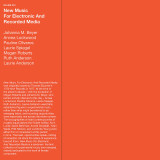
Marking its first decade of activity, Blume returns with the first ever vinyl reissue of the seminal “New Music for Electronic and Recorded Media”, from 1977, the third and final instalment in a suite of releases that includes James Tenney’s “Postal Pieces” and Ben Vida’s “Vocal Trio”. Unquestionably among the most important collections of experimental music to emerge during the 20th Century, “New Music for Electronic and Recorded Media” is the original feminist presentation in its context, releasing the work of Johanna M. Beyer, Annea Lockwood, Pauline Oliveros, Laurie Spiegel, Megan Roberts, Ruth Anderson, and Laurie Anderson under its collective banner. Includes newly commissioned liner notes by Jennifer Lucy Allen and Bradford Bailey.
Since its founding back in 2014, Blume has carved a unique place in cultural landscape, issuing free standing works, spanning the historical and contemporary, that represent singular gestures of creativity within the field of experimental sound. Joining their broad efforts in building networks of context and understanding that already includes the efforts of efforts of Werner Durand, Sarah Hennies, Bruce Nauman, John Butcher, Jocy de Oliveira, Mary Jane Leach, Valentina Magaletti, Alvin Curran, Julius Eastman, Alvin Lucier, and others, Blume delivers their third release in their first suite of releases for 2024, the fist ever vinyl reissue of the seminal “New Music for Electronic and Recorded Media” compilation, originally issued by Thomas Buckner's 1750 Arch Records in 1977. Out of print for decades on vinyl and arguably the most important feminist statement in the history of experimental music, illuminating the work of Johanna M. Beyer, Annea Lockwood, Pauline Oliveros, Laurie Spiegel, Megan Robert, Ruth Anderson, and Laurie Anderson - in a number of cases representing their recording debuts - during a crucial moment in the history of experimental music. Blume’s brand new edition - complete with newly commissioned liner notes by Jennifer Lucy Allen and Bradford Bailey, as well as reproducing Charles Amirkhanian’s original accompanying text - radically shifts perceptions of the past and present day with its truly revolutionary sounds.
Issued by Thomas Buckner's 1750 Arch Records in 1977, and out of print nearly the entire time since, “New Music for Electronic and Recorded Media” can be understood within two simple frameworks. On one hand, it is an astounding document of the landscape of experimental music toward the end of the 1970s. On the other, it is a historically significant feminist statement, being the first collection of experimental music entirely dedicated to female composers, a number of whom were grossly under-celebrated at the time, but have since gone on to be regarded as among the most important composers of their generation.
The eight pieces gathered by “New Music for Electronic and Recorded Media” - Johanna M. Beyer’s “Music of the Spheres”, Annea Lockwood’s “World Rhythms”, Pauline Oliveros’ “Bye Bye Butterfly”, Laurie Spiegel’s “Appalachian Grove I”, Megan Roberts’ “I Could Sit Here All Day”, Ruth Anderson’s “Points”, and Laurie Anderson’s “New York Social Life” and “Time To Go (For Diego)” - might be regarded as the first cohesive vision of alternate proximity or expression of experimental music to what has always been a frustratingly male dominated environment, and to the tropes, temperaments, and sensibilities that have been historically perceived to define it. It is an expanded vision of truth. While the presence of feminine sensibilities and temperaments in experimental music, however they may present themselves, were anything but new in 1977, “New Music for Electronic and Recorded Media” was the first opportunity, beyond the temporal limitations of live performance, to view them collectively, rather than as individualised expressions within a larger body of similar gestures (as was the case of Oliveros’ inclusion in Odyssey’s 1967 “New Sounds In Electronic Music” and “Extended Voices” compilations) where they might be confused for something else; to regard and celebrate a radical notion of feminine sonority for its unique characteristics and through its interrelations.
While its historical significance and groundbreaking nature can not be debated in its totality, nearly half a century on “New Music for Electronic and Recorded Media” remains compelling in both its musicality and the palpable sense of its lasting influence. Every composition across the album’s two sides is not only engrossing and deeply compelling - feeling as fresh and relevant as the day it was laid to tape - but clearly tangible in their lasting influence. Viewed in context, the album’s eight works feel like breath of fresh air when compared to much of what came before, and laid the groundwork for much of what was to come, introducing a new, often more holistic temperament and more sensitive and inclusive sensibility into the landscape of experimental music.
Particularly in the case of Annea Lockwood, Pauline Oliveros, Laurie Spiegel, Ruth Anderson, and Laurie Anderson, it's hard to throw ourselves back in time and imagine a moment when these composers rested in a fairly marginalised corner of the creative landscape. Blume’s brand new edition of “New Music for Electronic and Recorded Media” - complete with newly commissioned liner notes by Jennifer Lucy Allen and Bradford Bailey, as well as reproducing Charles Amirkhanian’s original accompanying text - brings us back to this confounding moment and points us toward a crucial moment of change set forth by these incredible composers and their sounds. Absolutely seminal and not to be missed.
Guests are Jessica Higgins and Matthew Walkerdine of Glasgow, UK, both formerly of the bands Vital Idles and Mordwaffe. They have been closely tied with DIY music, art and publishing for over a decade. Using (amateur) electronics, singing, speaking and field recording they make songs which blend the rhythms of popular music and contemporary approaches to collage, sampling, improvisation and repetition. As inspired by film and art as they are the legacies of twee underground and avant garde experimentalism, their loose, domestically twinged compositions explore feelings, atmospheres and moments which are hard to articulate and the quite literal notion of being a “guest”.
“I wish I was special” is their debut record, and with it a chance taken to explore terrain not previously covered by their other groups. The ideology of DIY practice appears integral to these eleven compositions, side-stepping virtuosity in favour of instinct and impression, unafraid to press unknown buttons and walk head first into mistake, finding inspiration where convention might not otherwise allow one to tread. The results are confoundingly fresh, sharp-of-mind, and unusually intimate. There’s an obvious intelligence at play here, and no little humour of course, but crucially there’s also a sense of the personal, a first-thought/best-thought (auto)didacticism that celebrates shared understanding and implicit trust. What, ultimately, we might view as the fearlessness in radically being yourself around another. It’s an approach that draws some comparison with the private musings of Flaming Tunes, Idea Fire Company’s domestic electronics, or perhaps even Annea Lockwood’s framing of emotional connection within avant garde structures. More so, Guests represent a compelling continuation of DIY post-punk experimentation that values intuition over prowess, and with it guides the listener into unexpected spaces that somehow comfort as much as they challenge.
d Arrangements, as in Making Them [VIDEO]
The latest in a prolific string of solo and collaborative releases by James Rushford, Turzets collects a pair of new works primarily created and recorded last year while the Australian composer-performer was in residence at La Becque, an art center on Lake Geneva in Switzerland. The side-length piece "Fallaway Whisk" explores hesitation in its many forms_reticence of speech, sonic restraint_using live, abstracted translations of text from English to German against a lush and swelling soundscape. On the flip side, "Quire" is a work in ten movements influenced by the composer's study of late medieval repertoire on portative organ, weaving the instrument's woodsy interlocking melodies with angelic Yamaha CS-80 synth sweeps and stuttering glitches. The combined effort is somewhat a departure for Rushford, working in traces of Klaus Schulze, concrete poetry, and ars subtilior into a precise and ever-unfolding tapestry. Rushford's work draws from a wide range of collagist and improvisatory musical languages, staking out an idiosyncratic stylistic space that has been variously described as "electro-acoustic experimentation with a beating heart" (Boomkat) and "haunted Jacobean ASMR" (The Wire). Investigating the creases, cracks, and folds in traditions ranging from early music to New Age, Rushford's work subtly exaggerates seemingly liminal aspects such as atmosphere and the bodily presence of the performer until these take on a weight equal to musical elements such as pitch, rhythm, and timbre. In recent years, Rushford's solo work has been guided by his theorization of sonic images, particularly the shadow, which has inspired pieces as diverse as an hour-long companion to Federico Mompou's 1959-67 piano cycle Música Callada (2016) and a sumptuous translation of the play of light across flat surfaces into synthetic sound (The Lake from the Louvers, Shelter Press, 2021). His long-standing performance practice for piano, portative organ, synthesizers, and electroacoustic devices, is constantly infused with a delicacy of touch and a harmonic sensibility in which unorthodox tunings coexist with influences from fin de siècle Impressionism, the twentieth century avant-garde, and popular musical structures. He has worked with a vast range artists including Klaus Lang, Annea Lockwood, David Behrman, Tashi Wada, Haroon Mirza, Dennis Cooper, Ora Clementi, crys cole, Oren Ambarchi, Kassel Jaeger, Will Guthrie, and Graham Lambkin. He has performed as Golden Fur (with Sam Dunscombe and Judith Hamann) and Food Court (with Joe Talia and Francis Plagne).
Students of Decay presents "Kaivajaiset" by Finnish composer Niko-Matti Ahti. Best known for his work alongside his partner Marja as Ahti & Ahti, Niko-Matti has been an active participant in the Finnish underground since the late 1990s. "Kaivajaiset" is his first solo recording and was originally conceived of as an installation. Part horspiel, part musique concrete, it is a piece of music that draws comparisons to the work of pioneering avant-garde composers such as Henning Christiansen, Annea Lockwood, Luc Ferrari, and Pierre Mariétan. Ahti weaves vivid foley and domestic recordings together with oration and classical instrumentation (violin, clarinet, bass clarinet, and flute) to arrive at an expansive, narrative, and at times thrilling composition. “Kaivajaiset" was exhibited in two Finnish galleries: B-Galleria in Turku (2019) and 3H+K in Pori (2020). The installation drew inspiration from The Diggers' 1649 pamphlet and Michel Foucault's extension of Friedrich Nietzsche’s concept of genealogy, and consisted of sounds, opinion pieces, a print copy of the pamphlet, and four cardboard collages. This record is a summary of the sounds of the installation.
The first vinyl LP release from Fluxus pioneer Alison Knowles (b. 1933). Sounds from the Book of Bean is an assemblage of noises and texts related to The Book of Bean (1982), Knowles’ 8-foot tall walk-in book constructed at Franklin Furnace in New York. This recording, the sounds of making the big book, was continually played back inside of the installation. Echoes of Yoshi Wada hammering together the circular spine of the book, other collaborators mixing ink, feeding a horse, the flowing waters of the Hudson Valley... all superimposed with texts and poems read by Knowles and her daughter Jessica Higgins.
On the second side of the album, the piece Essential Divisions features Knowles performing with red, black, and white beans. Recorded in Annea Lockwood’s underground studio, Knowles sounds the beans in glass, ceramics, wood, as well as in her mouth. Further bean histories and sound poems are recited, concluding with “Popular Bean Soup” – an ancient recipe translated by George Brecht.
Knowles’ big books are, as she describes them, transvironments: a transformationally experienced environment. The phenomenological nature of her book is distilled aurally in the case of this record. As Knowles describes the end of her book, “the reader leaves via a ladder or out the window and through a muslin panel printed with contradictory wisdom concerning beans and dreaming… one can begin again either by going on or turning back.”
Originally published as a cassette in 1982 on the New Wilderness Audiographics label, this remastered edition has been transferred from original tapes. An expansive 20-page booklet is included, holding graphics and writings from Alison Knowles, George Quasha, and Charlie Morrow.
Recorded by Alison Knowles, 1980
Produced by Alison Knowles, Sean McCann, & Charlie Morrow
Design by Alison Knowles, cover image courtesy George Quasha
Jessica Higgins adds voice to tracks 1, 3, 4, 5
- Nothing Is Safe
- He Dead (Feat. Ed Balloon)
- La Mala Ordina (With The Rita) (Feat. Elcamino & Benny The Butcher)
- Club Down (With Sarah Bernat)
- Run For Your Life (Feat. La Chat)
- The Show
- All In Your Head (Feat. Counterfeit Madison & Robyn Hood)
- Blood Of The Fang
- Story 7
- Attunement (With Pedestrian Deposit)
- Piano Burning
There Existed An Addiction To Blood" ist das insgesamt vierte Album von Clipping und ihr drittes für Sub Pop. Es ist der Nachfolger des von Kritikern und Publikum gleichermaßen gefeiertes Album ,Splendor And Misery" aus dem Jahr 2016. ,There Existed An Addiction To Blood" enthält die Singles ,Nothing Is Safe", ,Blood Of The Fang" und ,La Mala Ordina" (Feat. Benny The Butcher, Elcamino, The Rita), die von Clipping produziert, von Steve Kaplan gemischt und von Dave Cooley bei Elysium Masters in Los Angeles gemastert wurden. Das Album enthält auch Gastbeiträge von Ed Balloon, La Chat, Counterfeit Madison und Pedestrian Deposit. ,There Existed An Addiction To Blood" ist Clippings Interpretation eines neuen Rap-Splitter-Genres unter Zuhilfenahme ihrer einzigartigen Lupe. Clipping wenden sich auf dem neuen Werk intensiv dem Horrorcore zu, eines bewusst absurden und kreativ bedeutsamen Subgenres, das Mitte der 90er Jahre blühte. Einige der bemerkenswertesten Pioniere hießen Brotha Lynch Hung und Gravediggaz, aber es umfasst auch bahnbrechende Werke der Geto Boys, Bone Thugs-N-Harmony und die nahezu vollständigen Veröffentlichungen des klassischen ,Memphis cassette tape rap". Der wahrscheinlich subversivste und experimentellste Rap hat sich oft als ,Alternative" zu konventionellen Sounds präsentiert, aber Clipping verzerren das Ganze respektvoll in neue Konstellationen. ,There Existed An Addiction To Blood" absorbiert die hyper-gewaltigen Horror-Symboliken der Murder Dog-Ära, stellt sie aber in einem neuen Licht dar: immer noch dunkel getönt und düster, aber in einem seltsameren und lebendigeren Farbton. Wenn der traditionelle Horrorcore mit ,Blacula", dem populären Blaxploitationsfilm-Klassiker aus den frühen 70er Jahren, verwandt war, so ist das neue Output von Clipping analog zu ,Ganja & Hess", dem blutrünstigen Kultklassiker von 1973, der als unbesungenes Wahrzeichen des schwarzen Independent-Kinos gilt, dessen Score von Sam Waymon, Clipping als Inspiration zum Titel des Albums diente und auch Samples auf dem Track ,Blood Of The Fang" lieferte.ENG The science-fiction visionary Octavia Butler once declared that "there is nothing new under the sun, but there are new suns." The aphorism could apply to any art form where the basic contours are fixed, but the appetite for innovation remains infinite. Enter Clipping, flash fiction genre masters in a hip-hop world firmly rooted in memoir. If first person confessionals historically reign, the mid-city Los Angeles trio of rapper Daveed Diggs and producers William Hutson and Jonathan Snipes have spent the last half-decade terraforming their own patch of soil, replete with conceptual labyrinths and industrial chaos. They have conjured a mutant emanation of the future, built at odd angles atop the hallowed foundation of the past. Their third album for Sub Pop, There Existed an Addiction to Blood, finds them interpreting another rap splinter sect through their singular lens. This is Clipping's transmutation of horrorcore, a purposefully absurdist sub-genre that flourished in the mid-90s. If some of its most notable pioneers included Brotha Lynch Hung and Gravediggaz, it also encompasses seminal works from the Geto Boys, Bone Thugs-N-Harmony, and the near-entirety of classic Memphis cassette tape rap. The most subversive and experimental rap has often presented itself as an "alternative" to conventional sounds, but Clipping respectfully warp them into new constellations. There Existed an Addiction to Blood absorbs the hyper-violent horror tropes of the Murder Dog era, but re-imagines them in a new light: still darkly-tinted and somber, but in a weirder and more vivid hue. The album contains interludes with hissing recordings of demonic invasions, and guest appearances from Griselda Gang's Benny the Butcher and Hypnotize Minds horror queen La Chat. Other tracks feature contributions from noise music legends The Rita and Pedestrian Deposit. It all ends with "Piano Burning," a performance of a piece written by the avant-garde composer Annea Lockwood. Yes, it is the sound of a piano burning. There Existed an Addiction to Blood fits neatly into the broader scope of the band's career, which has seen them expand from insular experimentalists into globally recognized artists. Since the release of their first album in 2013, Diggs has won a Tony and a Grammy (both for his acting/rapping work as Thomas Jefferson and Marquis de Lafayette in Hamilton), as well as co-written and starred in 2018's critically hailed Blindspotting, while Snipes and Hutson have scored numerous films and television shows. Clipping's last album, the 2016 afro-futurist dystopian space opus Splendor & Misery was recently named one of Pitchfork's Best Industrial Albums of All-Time. Commissioned for an episode of This American Life, their 2017 single "The Deep" became the inspiration for a novel of the same name, written by Rivers Solomon and published by Saga Press. But their latest masterwork embodies what the band had been building towards - a work that finds them without peer. This is experimental hip-hop built to bang in a post-apocalyptic club bursting with radiation. It's horrorcore that soaks up past blood and replants it into a different organism, undead but dangerously alive. It is a new sun, blindingly bright and built to burn your retinas.
After the solo album Paths Of The Errant Gaze in 2016 Reinier van Houdt returns to Hallow Ground with Igitur Carbon Copies - an album based on the unfinished gothic tale Igitur, a collection of texts that eventually was abandoned by its author Stéphane Mallarmé in 1869.
Connecting with Mallarmé's obsessions about chance and destiny, Igitur Carbon Copies is the fragmentation of all the roots that ran under its predecessor Paths Of The Errant Gaze and brings these to a provisional close: guided by David Tibet's voice reading the reworked text we descend through spheres of deserted anthems, disembodied voices, morse signals, crank calls, corroded tapes, radio statics, stones, while doing counting games. Here the acoustical spaces are manifold, blended or shifted in a heartbeat, where far and near, up and down are relative, where Riemann's god is pointless and angels are enjoying their space. Here perception is a vice that constantly hallucinates realities.
Reinier van Houdt started experimenting with taperecorders, radio's and objects at a young age. Later he studied piano at the Liszt Academy in Budapest and the Royal Conservatory in The Hague. He developed a fascination for all matters that defy notation: sound, timing, space, physicality, memory, noise, environment - points beyond composition, interpretation and improvisation. He has built himself an unusual repertoire that consistently resulted from personal quests; from composing with non-musical sources, from collaborations with composers and musicians, from research in archives or from unorthodox studies of classical music. He has collaborated with artists like Francisco López, Maria de Alvear, Robert Ashley, Luc Ferrari, Annea Lockwood, Alvin Curran, John Cage, Christian Marclay, Walter Marchetti, Charlemagne Palestine and joined the legendary outsider-collective Current 93 in 2012.
- 1