repress
Bella Vista was a one off project from Michel Esteban, founder of seminal New York Disco/Electro/New Wave imprint ZE Records. Originally released in 1982 'Mister Wong' is a Pop oddity that sits between French Synth Pop and Leftfield Disco. The 12' includes the sought after Disco Dub version that lets the bassline work its magic alongside some heavy dub delays, on the flip Jura Soundsystem provide an extended version with added live percussion.
Suche:bella vista
- 1
Panamá-born, Chicago-based drummer Daniel Villarreal is known to many for his work in Dos Santos, Wild Belle, The Los Sundowns, Valebol Rudy de Anda, and many more. He's one of the busiest players on the Chicago scene. If you're in the Windy City, find him almost any night of the week at a bar, club, or venue near you, either behind the drumkit or behind the turntables, donning a beaver skin stetson hat, with his baby blue vintage Mercedes parked out front. For his lead artist debut Panamá 77 he engages a diverse array of friends and collaborators - including Bardo Martinez (Chicano Batman), Jeff Parker (Tortoise), Marta Sofia Honer (Adrian Younge), Anna Butterss (Jenny Lewis), and Aquiles Navarro (Irreversible Entanglements) - to create a vibrant and verdant suite of multi-textural psychedelic instrumental folk-funk.
Imaginative re-workings and improvisations by Andrew Tuttle of the late great Michael Chapman's unfinished instrumental album. Sonic explorations that bridge the Southern and Northern Hemisphere via the Caribbean, remote Northumberland and sub-tropical Australia. Navigating calm seas and turbulent waters of ambient corals, new-age pirates, waves of lapping banjos and drifting eroding guitars.
When Michael Chapman passed away in September of 2021, at the age of 80, he did so – as he spent much of his life – as both a pioneer and a legend. A veteran of the British blues/folk/jazz scene, Chapman emerged in 1966 and continued working throughout his life, always pushing the boundaries of his creations while collaborating with a slew of similarly heralded musicians along the way: Bert Jansch, Mick Ronson, Elton John, Thurston Moore, Steve Gunn; to name just a smattering of those he worked alongside over the years.
It's the latter of those – Brooklyn guitarist and songwriter Steve Gunn – who Chapman flourished alongside in recent years, the two collaborating on 50 and True North, two of Chapman’s final and finest records. It was through that friendship that Chapman’s music found Andrew Tuttle, the Brisbane-based multi-instrumentalist who has toured Australia several times alongside Gunn.
In the aftermath of Chapman’s passing, his partner Andru discovered Tuttle’s Fleeting Adventure LP, describing it as “one of the albums that kept me sane during that first brutal winter on my own.” The pair met in Australia shortly after, and before Andru had even made it back home to the north of England, Tuttle had begun working on the recordings she shared with him at that time. Those recordings were part of a project Chapman was working on at the time of his death, called Another Fish – what would have been a companion piece to his previously-released LP, simply called Fish.
Though Chapman had spent time in his local studio playing all the guitars, layering the different sounds and effects, he’d always intended to do much more work on the songs, however fate had its way and he never got to ribbon-bow those ideas and bring the album to its conclusion.
Though there was little intention in terms of how to finalise the project, Tuttle spent valuable time with those recordings. What materialised, eventually - with time, care, and diligent attention - is a two-disc set Another Tide, Another Fish, something both unusual and completely distinctive. The first disc, Another Tide is centred around Tuttle’s own work, which shaped all seven of Michael’s songs and ideas into new songs of their own, and the second disc which simply incorporates the recordings that Michael left behind.
“On all of the tracks I also ‘played along’ on banjo to the originals several times until I learned an approximation,” Tuttle continues. “This ended up resulting in a ‘hybrid’, where some works are easily identifiable to those who know Michael’s originals, and some took that inspiration to head altogether elsewhere. Each of the tracks, even where not obvious, does have at the very least a trace element sample of the original recordings so that it’s a true collaboration.”
What we’re left with is indeed a hybrid: part remix album, part cover album, both a solo work and a collaboration, of sorts. Inspired by Chapman’s original ideas and with new track titles directly referencing the numbered but otherwise untitled source material, Tuttle adds his own flashes of colours throughout, including editing, sampling, MIDI transposing and signal processing that twists these songs into beautiful new shapes. Perhaps Tuttle’s greatest achievement here then is that Another Tide sounds so effortlessly free of all this context.
Whether you know Michael’s, Andrew’s or even Andru’s story or not, these recordings will bristle with enchantment and intrigue, worlds are built, and while some thrive and grow, others fizzle out in a burst of light, such is the way. “It's been a long, long road but we got there and I think it's been more than worth it,” Andru says in the record’s liner notes. “I really hope you think the journey was worth it too.”
Guitars and effects by Michael Chapman recorded by Alex Warnes at Phoenix Studio, Brampton, Cumbria, 2017 Banjo, effects and edits by Andrew Tuttle at Bella Vista, Brisbane / Meanjin, 2023-2024
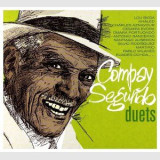
- A1: Saludo A Chango (Feat. Khaled)
- A2: Fidelidad (Feat. Silvio Rodríguez)
- A3: Lágrimas Negras (Feat. Cesária Evora)
- B1: Chan Chan (Feat. Eliades Ochoa)
- B2: Viejos Sones De Santiago (Feat. Dúo Evocación)
- B3: Virgen Del Pino (Feat. Santiago Auserón)
- B4: La Juma De Ayer (Feat. Pío Leyva)
- C1: Frutas Del Caney (Feat. Felix Valoy)
- C2: Morir De Amor (Feat. Charles Aznavour)
- C3: Linda Graciela (Feat. Basilio Repilado)
- C4: Macusa (Feat. Pablo Milanés)
- D1: La Pluma (Feat. Omara Portuondo)
- D2: Juliancito Tu Novia Te Botó (Feat. Martirio, Raimundo
- Amador)
- D3: Beautiful Maria Of My Soul (Bella Maria De Mi Alma)
- D4: Tente En Pie (Feat. Los Compadres)
Compay Segundo war der Godfather der kubanischen Musik. Im Alter von 88 Jahren erlangte er internationalen Erfolg und war der größte Künstler des Buena Vista Social Club-Phänomens.
Compays Musik ist in der Lage, einem ein Lächeln ins Gesicht zu zaubern, und einige seiner Lieder ("Chan Chan", "Sarandonga", "Yo vengo aquí") gehören zu den Klassikern des Son Cubano, des Genres, das er in der ganzen Welt verbreitet hat. Auch einige seiner Coverversionen klassischer kubanischer Lieder wie "Guantanamera", "La Negra Tomasa" oder "Lágrimas negras" gehören zu den besten der lateinamerikanischen Musik. Wir feiern sein Werk mit Vinyl-Veröffentlichungen im Jahr 2023, "Duets", "Las flores de la vida" und "Calle salud"
2 Jahre nach ihrem ersten Album "Toï Toï" (mit Gold ausgezeichnet), einem französischen Grammy Award und einer Reise über viele Bühnen in Europa, ist Suzane mit ihrem zweiten Album zurück. Die Sängerin Océane Colom alias Suzane ist eine der profiliertesten Künstlerinnen der Electro-Szene Frankreichs. hre Songs handeln - wie sie es selbst beschreibt - von wahren Szene-Geschichten. Ihre Musik regt zum Tanzen an, ihre Texte zum Nachdenken an.
Portico Quartet announce Terrain, a three-part suite drawing on American minimalism and ambient music alongside their own rich heritage as they explore new musical vistas
When Duncan Bellamy and Jack Wyllie – the driving force behind Portico Quartet got together in their East London studio in May 2020 and started work on the music that would become their new album, the world, or most of it, was in the midst of the first lockdown. The unique impact of the events of 2020 became the backdrop to their time composing and recording; causing them to take stock, re-think, and plot a new musical path.
Indian novelist Arundhati Roy expressed the sense of grief and rupture from the pandemic as "a portal, a gateway between one world and the next", and as they created the music that would become Terrainthey were drawn towards longer, slowly unfolding pieces, which are perhaps the most artistically free and also the most beautiful they have ever made.
These are compositions more in the lineage of Line and Shed Song (Isla/2009), Rubidium (Portico Quartet/2012) and Immediately Visible (Memory Streams/2019). Wyllie expands: "We've always had this side of the band in some form. The core of it is having a repeated pattern, around which other parts move in and out, and start to form a narrative. We used to do longer improvisations not dissimilar to this around the time of our second record Isla. On Terrain we've really dug into it and explored that form. I suppose there are obvious influences such as American minimalism, but I wasparticularly inspired by the work of Japanese composer Midori Takada. Her approach, particularly on 'Through the Looking Glass', where she moves through different worlds incorporating elements of minimalism with non-Western instruments and melodies were at the front of my mind when writing this music".
Terrain I, II & III are all subtly different, but a short rhythmic motif that repeats is the starting point in all three movements. There is a sense of a shared journey to all these pieces, they move throughdifferent worlds, with a sense of horizontal movement that lends the music real momentum. Terrain I was the first piece they worked on and it started with a hang drum pattern, improvised by Bellamy, who added cymbals and synthesiser. From there on it grew, Wyllie adding saxophone, another synthesiser section, strings. For Bellamy "It felt more like filmmaking than music making, a bricolage of conflicting, shifting signs, subtle tension and multiple narratives. Andrei Tarkovsky's 'Mirror' and British artist John Akomfrah's incredible 'Handsworth Songs' were pivotal points of reference for me." Wyllie expands the point. "There is a sense of conversation between us both, in that someone presents a musical idea, the other person responds to it with something else, which would then be responded to again... until it feels finished. These responses are often consonant with each other but there is also a dissonance to some of this work. The music slowly evolves through these shared conversations."
It is this sense of dialogue, both between the composers, and between tranquillity and a subtly unsettling melancholy, that makes Terrain such a powerful statement. One that speaks to both our interior and exterior worlds, to our own personal landscape, to our Terrain.
- 1