Cerca:citizen deep end ep

Generi
Tutto
  • 1
YOU CAN CAN - S/T LP

You Can Can

S/T LP

12inch36SC
SEANCE CENTRE
13.03.2023

You Can Can is an echoed affirmation, an album which traces song forms around silence, field recordings, and degraded analog memories. This is folk music transmogrified and mutated, as if recorded and reconstructed in Pierre Schaffer’s GRM studio.

Not your typical Mariposa folk duo, the group is comprised of Toronto avant-music scene stalwarts, vocalist Felicity Williams (Bernice, Bahamas) and bricolage artist and synthesist Andrew Zukerman (Fleshtone Aura, Badge Epoch). The album feels like a somnambulant conversation, fragmented and half-remembered with Williams’ vocals traveling through a landscape of field recordings and Zukerman’s saturated concrète topographies. It is an electro-acoustic assemblage, both analog and digital, comprised of air, electricity, minerals, wood, and water. Although the album nods towards traditional forms of folk and musique concrète (if at this point it can be called a traditional form), it is outwardly and inwardly contemporary; non-linear, citational, opaque, and sui generis. In a way it feels like a sonic index of the narrative experiments found on the infamous Language school-related publisher The Figures, in the work of Lyn Hejinian, Clark Coolidge, and Lydia Davis. In the musical continuum, the album picks up where Linda Perhacs left off in the early 70’s—explored by Gastr Del Sol in the ‘90s—a convergence of rural acoustic idioms and urban avant-electronics. This is country music for the discerning cosmopolitan citizen of the 21st Century.

RIYL: Luc Ferrari, Brannten Schnüre, William Basinski, Oval, Eric Chenaux, Emmanuelle Parrenin About Everything In Time and Failure Figures, Felicity Williams says:

Everything In Time is indebted to the language of Brazilian author Clarice Lispector (as translated by Alison Entrekin). Drawing on insights from psychoanalysis, we trace the roots of melancholy to render them available to consciousness; words from the ghostly realm of the transpersonal filter through dreams and shine a beam of light onto a lone trillium in a forest at night. Other influences include the experience of not knowing, of being subject to a gestation outside of one’s control. This is an ode to the power of naming to obliterate, to set free.

Failure Figures is a meditation on the radical contingency of reality and the vicissitudes of the will. With Slavoj Zizek as my guide (think: “Hegel for dummies” - I’m the dummy in this scenario), I wander through the valley of the shadow of death, and take heart. The last verse refers to an experience I had recording at a studio in Brussels. I was singing in French, with which I have some fluency, and the producer was complaining to the artist whose song it was that my delivery was not convincing. Thinking I was out of ear shot, he said in French, “c’est comme elle n'est pas là”; I was pronouncing the words correctly, but I failed to express anything. So what or whom is responsible for conveying meaning, if not the form of the word itself? And if the connection between meaning and form is broken, how do we fix it?

Gratitude to Thom Gill (guitar) and Daniel Fortin (bass) who joined us on the recording of Failure Figures. Thanks as well to my old roommate Christopher Willes, who unwittingly left behind his hand bells deep in the hall closet. We unearthed them by accident, and the bells became an important sound element. Thanks to other past roomies Robin Dann and Claire Harvie, whose childhood piano and guitar respectively still reside with us, and were used in the recording. Field recordings were made in Toronto, Canada and Celestún, Mexico in 2020.

In Stock

Disponibile in Stock e pronto per la spedizione

18,70
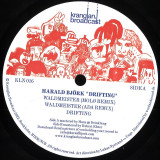
Harald Björk - Drifting feat. Molø, Ada, Throwing Snow, Skudge

In May 2020 Cocoon Recordings released the third album of Harald Björk. With the club scene on Covid-hold , tours canceled and all of our favorite DJ’s locked up at home… not the optimal conditions to release an album on a nr.1 world wide club empire as Cocoon. How ever we decided not to let a virus kill our beloved culture, as Mr. Sven Väth put it „I would like to share with you the album of Harald Björk… which has soothed me and I hope will also give you a soundtrack for these uneasy days“. It felt right to release it.

The release was shrinked from a thought of vinyl box to a digital release with future plans on vinyl. However covid decided to stay and time went. The queue at the vinyl factories didn’t make the process easier… But at one point the dream factory of Kranglan Broadcast decided, enough! , the world has to keep on dreaming. And what is a better way to embrace dreams then to release a vinyl full of of dreamers, groundbreaking in their corners of the electronic umberella. Dreamers doing their thing not even looking at the norm or what’s the recent hype.

Aditional info:
Houndtooth finest Throwing Snow who Harald met in New York 2013 during their term at RBMA brings a bassdriven rollercoaster with the arpeggios from Spektrum bouncing like rubberballs through an impressive broken drum work. The remix came delivered with a text saying „I like my drums slamming“ and so do we.

Ada takes the eteric pads of Waldmeister and place them in a auditive dreamstate, an emotional hybrid of space and vacuum. Large feelings, yet so close. It builds, stretches and builds until we are shown the enlighted truth in the end of the tunnel. Harald is a long time fan and colector of Adas music which he got to know through the lovely label of Areal and has continued to love through the Pampa era. First remix from Ada on Kranglan was the epic remake of Sabor Latino, Sabor de Ada! We are delighted to have her art on the label once again.

The pandemic 2020 took away the most fun of beeing in the club scene, sharing stages with brilliant interesting dreamers showing and exchanging visions performing music. Under these strange conditions Molø and Harald ended up sharing a physical stage at the stream festival United We Stream. One thing led to the other and Harald took a deep dive in to Molø‘s great melodic techno universe. Some times you find gold in your own hometown. Molø’s take on Waldmeister build on the mellow arpeggio from the original track and brings them to a perfect chilled out afterhours. Imagine watching the sunrise to this beauty.

Swedes are a people of high integracy but as loyal citizens we allways attend formal events by the state. Skudge and Harald met at the Swedish National Radio price anouncement, both nominated for „electronic act of the year 2011“. It was an akward event with radio interviews and canapés, not very techno, the signum of Skudge. How ever Skudge won it all leaving both Avicii and Swedish House Mafia empty handed. Landberg, the swing king of Skudge is the kind of person that will tell you why the TR-909 has to be master clock to get the right groove in a techno performance, if you ask… which you do ??! If you’re looking for techno with groove look no further, Skudge is king! In his take on Walking Path he display the power of minimalistic dirty grooves, a 909 and a 303 what else do we need?

The 12“ vinyl comes with a fresh re-master of album single Medan Du Sov and an unreleased bonus track, Drifting, a balearic sundazed love story.

In Stock

Disponibile in Stock e pronto per la spedizione

13,87
MULUKEN MELLESSE - MULUKEN MELLESSE WITH THE DAHLAK BAND (ETHIOPIQUES)

Swan Song

The vinyl LP at the heart of this éthiopiques 31 tracks 2 to 11 was one of the very last vinyl records ever released in Ethiopia. But above all it represents, we felt, the absolute masterpiece of the Ethiopian Groove – the Swan Song of Swinging Addis. The album leaves a clear idea for posterity of the level of sophistication and mastery that modern Ethiopian music had achieved, before being crushed under the Stalino-military heel of the Derg – as the bloody revolution that was unfolding came to be called.

Ethiopia1976.

The Revolution that broke out in February 1974 rolled on in a ruthless march. The whole of Ethiopian society was utterly stunned. The bouquets of flowers handed joyfully to the first tanks of the coup d'état were to wilt very rapidly. From September 1976 to February 1978, 18 months of Red Terror (the name given by the junta itself) spilled blood throughout the country. This fratricidal conflict took its heaviest toll among students and youth. The shift from feudalism to a cruel and primitive Stalinism left the country's citizens deeply traumatised, and snuffed out any pretence of activism, whatever the sector of society. This ice age was to last for seventeen long years.

ሙሉቀን፡መለሰ Mulukèn Mellèssè Muluqän Mälläsä

It was three tracks by Muluken that served as the opener for éthiopiques-1 more than 25 years ago. Seven more tracks appeared on éthiopiques-3 and 13, all accompanied by The Equators, which was soon to become the Dahlak Band.

The first track, Hédètch alu, also the very first piece that Muluken ever recorded, left audiences both unsettled and amazed. Reflecting the singer's extremely young age (he was just 17 at the time), this angelic voice mystified many, who thought they were in fact listening to a feminine voice. He was not yet 22 when he released his last vinyl record in 1976 with Kaifa Records (KF 39LP), one of the very last to be issued in Ethiopia, before the cassette tape became the dominant medium for music distribution – and before the new revolutionary regime put a stop to all independent musical life, via an unspeakable barrage of prohibitions and other persecutions.

Mulu qèn, literally, “A well filled day”. This tender maternal intention wasn't enough to ward off the cruelty of fate. His mother's premature death drove Muluken to leave his native Godjam, in northeast Ethiopia, to live with an uncle in Addis Ababa. Born Muluken Tamer, he took his uncle's last name – Mèllèssè.

The spelling Muluken appeared in his administrative records. Transcription of Amharic to the Latin alphabet, both in Ethiopia and for scholars, gives rise to controversies and quibbles that can never be neatly settled. French allows for a closer approximation of the original pronunciation, thanks to its battery of accent marks, confusing as they may be to anglophones.

Between rather accommodating administrative record-keepers and the various versions that pop up in interviews given by the artist, Muluken's year of birth oscillates between 1953 and 1955…

1954? One thing is certain: the artist's talent made itself known very early indeed, because he got his start in 1966-67, at the age of 13 or 14. Photos from the period attest to his extreme youth. It's a strange sort of initiation for a very young teenager to become a sensation in the heart of Addis's nightlife at the time, Woubé Bèrèha – the Wilds of Woubé. And what's more, in the club of the Queen of the Night, the Godjamé Assègèdètch Alamrèw herself, the very same that was portrayed by Sebhat Guèbrè-Egziabhér in his novel-memoir Les Nuits d’Addis Abeba2… The legendary female club owner who is remembered to this day by the capital's ageing boomers.

Muluken first tried his hand at the drums, before he grabbed the microphone. He emigrated briefly to the Zula Club, across the street from the old Addis Post Office, one of the ground-breaking bars of the burgeoning musical scene, before joining the Second Police Band in 1968, for around three years. He spent a few months with the short-lived Blue Nile Band founded by saxophonist Besrat Tammènè. As the musical scene grew increasingly successful, and pulled slowly but decisively away from its institutional ties, Muluken released his first 45rpm single in February 1972 (Amha Records AE 440). It was included in two LP Ethiopian Hit Parade compilation albums in September of the same year. All in all, Muluken released eight two-track 45s and the same number of original cassette tapes between February 1972 and 1984, the year that he departed for permanent exile in the USA. After converting to Pentecostalism in 1980, Muluken gradually abandoned all secular musical activity. In 1985, at the end of a concert in Philadelphia, he decided to quit concerts and recording for good. Mèlakè Gèbré, the historic bass player from the Walias band who was playing with him that night, recalls that everything appeared so irredeemably diabolical in Muluken's eyes, that it was to be the end of his contribution to Ethiopian Groove.

The end of the story, the beginning of a legend.

Dahlak Band, forgotten by History

Aside from his personal history and vocal talents, it must be remembered that Muluken Mèllèssè was one of the biggest names in the musical innovations that marked the end of the imperial period. These éthiopiques aim to convince those who are just discovering this hidden gem... As for Ethiopians themselves, they are to this day captivated by this singular and atypical figure in the Abyssinian pop landscape – even though he withdrew from public life some 40 years ago. Incorrigible devotees of poetic twists, of more or less hidden meanings, Ethiopians appreciate above all the care Muluken took in choosing his lyrics and the writers who penned them, such as Feqerte Haylou, Alemtsehay Wodajo and, here, Shewalul Mengistu (1944-1977). Love songs, written by women, a far cry from the conventional drivel that pleases sappy sentimentalists.

Muluken is equally acclaimed for his perfectionism when it came to music, the opposite of the overly casual approach that is all too common. He remained a faithful partner of musicians who came from a lineage that borrowed from several inventive and pioneering bands (Venus, Equators, Dahlak). Amongst them were certain artists who began their musical lives with Nersès Nalbandian at the Haile Sellassie Theatre and who come of age in around 1973 – at just the wrong time, you might say. Among them were the pillars Shimèlis Bèyènè (trumpet), Dawit Yifru (keyboards) and Tilayé Gèbrè (sax & flute). Most notably Tilayé Gèbrè, certainly one of the most important musicians, composers and arrangers of his generation, of the end of the imperial era, and of the early years of the Derg.

It was only in 1981 that a miraculous opportunity arose for Tilayé to escape the Stalinist paradise of the dictator Menguistou Haylè-Maryam. Once again it was Amha Eshèté (1946-2021) who provided a solution. The spirited and courageous producer, who had been in exile in Washington since 1975, succeeded, thanks to his incredible perseverence, in bringing the Walias Band to the USA. It was, in fact an extended Walias Band comprising ten musicians3, six of whom chose to slip away after a few concerts and the recording of an LP (The Best of Walias, WRS 100). Tilayé Gèbrè was one of these. He has been living in the USA ever since. There he joined the then-nascent Ethiopian diaspora, which lived largely unto itself, and was making only very modest headway in the American musical market. It seems unfair that Tilayé Gèbrè and the Dahlak Band were not able to benefit earlier from the public recognition that they do deserve.

A similar draining away of the top-rate talents would lead to the reorganization of the major groups of the “Derg Time”. The remaining artists spread themselves around between Ibex Band (renamed Roha Band), Ethio Star Band and a remodeled Walias Band. That spelled the end of the Dahlak Band.

With this record, produced by the essential Ali Abdella Kaifa a.k.a. Ali Tango, we can appreciate everything that the Derg not only destroyed, but also prevented from flourishing. This gem of Ethiopian-style afrobeat came out in 1976 (and, by way of a parenthesis, before the FESTAC 1977 in Lagos, which was attended by an impressive delegation of Ethiopian musicians — although Fela was already personna non grata in his own country). Despite everything that might distinguish this ethio-groove from Fela’s music – no colonial axe to grind, no question of political confrontation with the authorities, no claims to negritude or Africanism for the Ethiopian musicians, and less extrovertion! –, this LP fits beautifully into the saga of intense and electrified soul of the new “African” groove that Fela and Manu Dibango embodied so well from that point onwards.

In restoring this record to its place in the afrobeat epic, it can be seen that, if nothing else, the timeline bestows a legitimate pedigree and a historical primacy to works that had no international impact when they were originally released.

Warning! Masterpiece!

non in magazzino

Ordina ora e ordineremo l'articolo per te presso il nostro fornitore.

20,59

Last In: 4 months ago
John Grant - Boy from Michigan

John Grant

Boy from Michigan

2x12inchBELLA1220VX
Bella Union
25.06.2021

Produced by long-time friend Cate Le Bon, ‘Boy from Michigan’ is Grant’s most
autobiographical and melodic work to date. Grant stopped being a boy in Michigan aged
twelve, when his family moved to Denver, Colorado, shifting rust to bible belt, a further
vantage point to watch collective dreams unravel. Across 12 tracks, Grant lays out his
past for careful cross-examination.
In a decade of making records by himself, he has playfully experimented with mood,
texture and sound, all the better for actualizing the seriousness of his thoughts. At one
end of his musical rainbow he is the battle-scarred piano-man, at the other a robust
electronic auteur. ‘Boy from Michigan’ seamlessly marries both.
With Le Bon at the helm, Grant pared back his zingers, maximizing the emotional impact
of the melodies. A clarinet forms the bedrock of a song. One pre-chorus feels lifted from
vintage Human League. There is a saxophone solo.
‘Boy from Michigan’ ultimately swings between ambient and progressive, calm and livid.
The album’s narrative journey opens with Grant at his artistic prettiest, three songs drawn
from his pre-Denver life (the Michigan Trilogy, as Grant calls them): the title track, ‘The
Rusty Bull’ and ‘County Fair’. Each draws the listener in to a specific sense of place,
before untangling its significance with a rich cast-list of local characters, often symbolizing
the uncultivated faith of childhood.
Elsewhere, tracks like ‘Mike and Julie’ and ‘The Cruise Room’ offer an affecting plunge
deep into Grant’s late teenage years in Denver, while the midpoint of the album is
highlighted by ‘Best In Me’ and ‘Rhetorical Figure’, a pair of skittish, scholarly dance tunes
that build on the lineage of Grant’s electropop heroes, Devo.
Childhood as a horror narrative is the theme of ‘Dandy Star’, which observes a tiny Grant
watching the Mia Farrow horror movie ‘See No Evil’ on an old family TV set and finally, on
‘The Only Baby’, Grant removes his razor blade from a pocket to cleanly slit the throat of
Trump’s America, authoring a scathing epitaph to an era of acute national exposition.
Though he has lived in Iceland since 2011 - the same year he was also diagnosed HIVpositive - Grant spent his childhood and formative years in the US and maintains US
citizenship. Growing up, Grant was subjected to a deeply ingrained hatred of anyone
perceived as homosexual at school. Following the demise of his first band The Czars,
Grant left music entirely for over five years, only to achieve greater success as a solo
artist (his acclaimed 2015 solo LP ‘Grey Tickles, Black Pressure’ went Top Five in the
UK). Grant has sold out Royal Albert Hall, performed at Glastonbury, Latitude and more
and his song ‘Snug Snacks’ was featured on Pitchfork’s Songs That Define LGBTQ Pride.
BBC Radio 6 host Mary Anne Hobbs described Grant’s music: “Most songwriting, even if
it’s based on a true story ... is embellished in some way. But John's lyrics - they’re so true
they might as well be written in blood.”

Deluxe 2LP pressed on 140g black vinyl in inner sleeves with paintings by Gil Corral, 2
unique prints, 36-page photo booklet, pull out lyric sheet and digital download card, all
housed in a beautiful black velvet O-Card gatefold sleeve with Glitter Spark Eye.

pre-ordina ora25.06.2021

dovrebbe essere pubblicato su 25.06.2021

62,14
John Grant - Boy from Michigan

John Grant

Boy from Michigan

2x12inchBELLA1220V
Bella Union
25.06.2021

Produced by long-time friend Cate Le Bon, ‘Boy from Michigan’ is Grant’s most
autobiographical and melodic work to date. Grant stopped being a boy in Michigan aged
twelve, when his family moved to Denver, Colorado, shifting rust to bible belt, a further
vantage point to watch collective dreams unravel. Across 12 tracks, Grant lays out his
past for careful cross-examination.
In a decade of making records by himself, he has playfully experimented with mood,
texture and sound, all the better for actualizing the seriousness of his thoughts. At one
end of his musical rainbow he is the battle-scarred piano-man, at the other a robust
electronic auteur. ‘Boy from Michigan’ seamlessly marries both.
With Le Bon at the helm, Grant pared back his zingers, maximizing the emotional impact
of the melodies. A clarinet forms the bedrock of a song. One pre-chorus feels lifted from
vintage Human League. There is a saxophone solo.
‘Boy from Michigan’ ultimately swings between ambient and progressive, calm and livid.
The album’s narrative journey opens with Grant at his artistic prettiest, three songs drawn
from his pre-Denver life (the Michigan Trilogy, as Grant calls them): the title track, ‘The
Rusty Bull’ and ‘County Fair’. Each draws the listener in to a specific sense of place,
before untangling its significance with a rich cast-list of local characters, often symbolizing
the uncultivated faith of childhood.
Elsewhere, tracks like ‘Mike and Julie’ and ‘The Cruise Room’ offer an affecting plunge
deep into Grant’s late teenage years in Denver, while the midpoint of the album is
highlighted by ‘Best In Me’ and ‘Rhetorical Figure’, a pair of skittish, scholarly dance tunes
that build on the lineage of Grant’s electropop heroes, Devo.
Childhood as a horror narrative is the theme of ‘Dandy Star’, which observes a tiny Grant
watching the Mia Farrow horror movie ‘See No Evil’ on an old family TV set and finally, on
‘The Only Baby’, Grant removes his razor blade from a pocket to cleanly slit the throat of
Trump’s America, authoring a scathing epitaph to an era of acute national exposition.
Though he has lived in Iceland since 2011 - the same year he was also diagnosed HIVpositive - Grant spent his childhood and formative years in the US and maintains US
citizenship. Growing up, Grant was subjected to a deeply ingrained hatred of anyone
perceived as homosexual at school. Following the demise of his first band The Czars,
Grant left music entirely for over five years, only to achieve greater success as a solo
artist (his acclaimed 2015 solo LP ‘Grey Tickles, Black Pressure’ went Top Five in the
UK). Grant has sold out Royal Albert Hall, performed at Glastonbury, Latitude and more
and his song ‘Snug Snacks’ was featured on Pitchfork’s Songs That Define LGBTQ Pride.
BBC Radio 6 host Mary Anne Hobbs described Grant’s music: “Most songwriting, even if
it’s based on a true story ... is embellished in some way. But John's lyrics - they’re so true
they might as well be written in blood.”

Deluxe 2LP pressed on 140g black vinyl in inner sleeves with paintings by Gil Corral, 2
unique prints, 36-page photo booklet, pull out lyric sheet and digital download card, all
housed in a beautiful black velvet O-Card gatefold sleeve with Glitter Spark Eye.

pre-ordina ora25.06.2021

dovrebbe essere pubblicato su 25.06.2021

29,37
Various - Lifesaver 2 (2x12")

Dear reader,

since Ramona presented all her disciples work throughout the first Lifesaver compilation in 2013, it's now time for another episode of togetherness. Summoning all of her artists around Frankfurt and those who live around the world, Ramona is now ready to present the Lifesaver Compilation 2. 

Kicked off by one of the Frankfurt young guns, the compilation leans into a melody-driven warm-up with a slight hint of analogue soul - "Digital Revolution" by Orson Wells. Next up is the Italian-born and now Berlin-based Massimiliano Pagliara. His contribution "Phasing Down The Sea" enriches the second Lifesaver installment with some of his signature synth-lines paired with a classic chicago-driven beat. The secret weapon from Kilianstädten also known as Mr. Melody, who goes by the name of Lauer, delivers a dark-italo and wave-ish piece topped off with the famous Lauer-craziness called "Language". Roman Flügel, the man of the hour, reinvents classic UK bleep-techno with Tender Hooligan". Another member of the young-guns-club, Chinaski, brings his certain level of synthesizer-love to the table with a track called Futuresex". Portable, one of Ramona's most delicate flowers, teamed up with Lcio again - together they created a hieroglyphic and deep-driven piece of music: "Dive In". TCB, also known as the only member of The Citizen's Band, delivers "Byrdmap", a solid piece of spheric deep and broken music. "Brainwashed" by Benedikt Frey marks the end of the compilation and simultaneously shows his dimension of futuristic dark-disco acid-madness. 

The Lifesaver compilation will be released as a double 12"-vinyl. Additionally Live At Robert Johnson will release an Extension-10"-vinyl containing two brand new tracks by the infamous Hotel Lauer and Tuff City Kids end of March 2015.

Be prepared,
Ramona

non in magazzino

Ordina ora e ordineremo l'articolo per te presso il nostro fornitore.

18,03

Last In: 4 years ago
  • 1
Articoli per pagina:
N/ABPM
Vinyl