The package, posted from Inglewood in California, dropped through my letter box…
I was looking forward to seeing this, the VHS of the then relatively ‘unknown’ but now legendary live show at the Saenger Theatre in New Orleans by Maze featuring Frankie Beverly. But when I fed it into my VHS player, I was disappointed. I could not quite figure out why. The band were tight, each musician sounded great, the product of being on the road, year after year, club after club in the States, sometimes playing five shows a night, all propped up by one of the best soulful voices we had ever heard, the maestro Frankie Beverly.
It took a second play of the VHS to realise what was missing. It was ‘too comfortable’ an atmosphere. A few wealthy customers sat around coffee tables quaffing champagne. It seemed to me that this audience, somehow, did not fit the band.
Paul Fenn at Asgard promotions received the contract from the band to appear live in London and Manchester. I became more and more convinced that his UK fans were going to be a lot more responsive than those from New Orleans.
We put the word out with just a couple of exclusive ‘shout outs’ by Robbie Vincent on his Radio London Soul programme. Those two plugs were enough to sell out all four shows at London’s premier music venue, the Hammersmith Odeon. The ticket office was rammed and the queue six deep, stretched halfway down Queen Caroline Street.
“I have never seen anything like it” expressed the manager of the theatre as he rolled down the shutters and turned on the “Sorry, SOLD OUT” notice above the theatre box office.
I was curious, so I went up and stood in the wings of the Hammersmith stage on that first show. Frankie, introduced to the stage by his sound engineer, Greg Blockman, sauntered past me, strumming his rhythm guitar, dressed in a casual dark green towelling suit, a brown leather visor and flip flops…and then five seconds later, he suddenly stopped. He seemed suddenly to be aware of the thunderous ’Welcome to London Maze’ roar, circling around the theatre about to engulf him. He slapped every black and white hand offered up to him that night, with a huge smile as he circled the edge of that stage. We wanted to get next to him, even if it meant climbing over rows of seats in front of us to do so.
That was the beginning of our love affair with Maze and Frankie Beverly. It certainly wasn’t New Orleans comfort; it was more like a crazy, but friendly, London riot.
Five albums on from the “Live in New Orleans” LP, Frankie sauntered into the California recording studio, probably with the same swagger as in London, to cut the delightful A-side here, “Somebody Else’s Arms”, from his aptly named ‘Silky Soul’ album. Along with the B-side, ‘Love is’ (from the “Back To Basics” CD, 1993) both are so delicious you might want to relax and pour yourself that London glass of champagne, 1983 vintage. Tell your mates your Maze/Hammersmith story too. You deserve it.
Cerca:frankie beverly
- 1
- A1: Dee Dee Sharp - Comin' Home, Baby
- A2: Chubby Checker - (At The) Discotheque
- A3: Christine Cooper - Heartaches Away My Boy
- A4: Bobby Paris - Night Owl
- A5: Vickie Baines - Country Girl
- A6: The Tymes - Here She Comes
- A7: Orlons - Envy (In My Eyes)
- A8: Jerry Jackson - It's Rough Out There
- B1: Yvonne Baker - You Didn't Say A Word
- B2: Chubby Checker - You Just Don't Know (What You Do To Me)
- B3: Bunny Sigler - Girl Don't Make Me Wait
- B4: Frankie Beverly & The Butlers - Because Of My Heart
- B5: Damon Fox - Packing Up
- B6: Janie Grant - My Heart, Your Heart
- B7: Dee Dee Sharp - Deep Dark Secret
- B8: Evie Sands - Picture Me Gone
For the Northern Soul collector few places rival Detroit as a source for quality, rare records. But Philadelphia comes pretty close and it is the city of brotherly love that produced America's number one independent record label... the mighty Cameo-Parkway. Here, for the first time, we present the very best that that iconic company has to offer.From the Wheel to Wigan, to the Weekender and beyond, the sound of Cameo-Parkway has packed the dance floors across the UK for over 50 years. From the opening bars of Dee Dee Sharp's driving cover of Mel Tormé's Comin' Home Baby' it's easy to see why the label is so highly prized by collectors and dancers alike and why this unique vinyl tribute will touch the hearts of the faithful! All of the classics are here: Chubby Checker, Christine Cooper, Bobby Paris, Yvonne Baker, Bunny Sigler, Jerry Jackson etc etc. The difficulty has been in deciding what to leave out, not what to include, maybe a second volume later in the year One thing is for certain, 1.2 million YouTube viewers just love Cameo-Parkway!
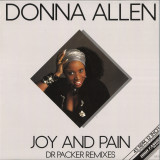
Following the huge succes of “Serious”, remixed by Michael Gray, we now dive into the enchanting world of “Joy & Pain,” a timeless masterpiece penned by the legendary Frankie Beverly of Maze-fame. The brilliant Donna Allen and expertly remixed by the maestro himself, Dr Packer. With his trademark nu disco groove, Dr Packer unleashes an irresistible sonic force, propelling you into a realm where Donna effortlessly takes the reins with her divine R&B prowess. Together, they embark on an awe-inspiring journey, catapulting you into the very heart of dance floor ecstasy. Dr Packer unveils a package of unparalleled excellence, breathing new life into this classic gem and ensuring its enduring legacy. Get ready to surrender to the irresistible allure of pure dance floor heaven!
Sublime, unique, sexy and peculiar unreleased scores by electronic and jazz pioneer Ron Geesin, made for the sublime, unique, sexy and peculiar films by maverick director Stephen Dwoskin. There. we’ve said it. And if you have not heard of one or either of these two dudes it doesn’t really matter. Geesin made great music and worked with Pink Floyd. Dwoskin made odd films, most of them are in the BFI permanent collection. They are great and a bit strange.
These superb unreleased soundtracks come from a fascinating, progressive and important period in British film history. They represent an intriguing collaboration between the lively Ron Geesin from Scotland and the American Stephen Dwoskin, who both met in London.
Musically they are minimal, charismatic and quite groundbreaking. Here is the story…
HISTORY:
Steve Dwoskin arrived in London in 1964, aged 25, with several 16mm films in his trunk, shot in the cold-water flats of Greenwich Village. He had been on the fringe of the Factory scene, and some of his films starred Beverly Grant, ‘the queen of the underground’. But they had scarcely been seen, and they didn’t have soundtracks. For almost a year they stayed in the trunk, and stayed silent. Then he met Ron Geesin, somewhere around Portobello Road.
‘Slept last night, completely dressed after working over 12 hours on sound tracks at Ron’s,’ wrote Dwoskin in his diary for 29 July 1965. ‘My films are not anywhere near being anything. I need more energy, more concise and positive ideas and less inhibition. And of course space, money and people.’ Dwoskin, who taught and practised graphic design by day, had recently decided to stay in London beyond the term of the Fulbright scholarship that had brought him there.
Ron, living with Frankie in a basement flat in Elgin Crescent – they would marry the next year, with Dwoskin as best man – was about to leave the Original Downtown Syncopators, the trad jazz band he had joined aged seventeen-and-a-half, and was trying to go solo. On stage he would make vigorous use of piano and banjo; at home Frankie had bought him a new kind of instrument – a tape recorder. ‘Soon I had one tape recorder, two tape recorders, three tape recorders.’
Ron, wrote Dwoskin in his unpublished autobiography, ‘loved to record, and to cut and splice the quarter-inch recording tape to make new sounds. This triggered in me the idea of getting back to my films and finishing them’. Soon he was living in a dank basement in Denbigh Road, a few minutes’ walk from Elgin Crescent. Ron’s soundtracks for Dwoskin’ films, recorded in the Geesins’ flat, encompassed Ron’s very eclectic range of styles – madcap piano and fretted banjo as well as tape manipulation.
Aside from Ron’s soundtracks, some of which belong to films that no longer exist (including Pot Boiler), Frankie would act in one of the films that Dwoskin either lost or never finished during these years. He was disabled, having contracted polio as a child, and Ron and Frankie were both carers and collaborators; Ron had met him when he was struggling into his car.
There was no London equivalent to the underground film scene that Dwoskin had known in New York, and his films remained unseen until such a scene began to come into being, in the autumn of 1966. Some of them made their debut at the Mercury Theatre, near Notting Hill Gate, that September. Dwoskin wrote that Alone, starring Zelda Nelson (from Ron Rice’s Chumlum), and Chinese Checkers, with Beverly Grant and Dwoskin’s friend Joan Adler, went over best.
Soon both Dwoskin and Geesin became involved in the nascent London Film-Makers’ Co-op, which put on screenings in Better Books on Charing Cross Road – ‘if you can call them screenings,’ Ron recalls; ‘I’d call it fifteen blokes in various stages of disarray, peering through the smoke’. One or more of the films had been ‘striped’ with magnetic audiotape; with others ‘we had no means of direct syncing to the picture, so he started the film and I started the tape recorder’.
In the same autumn, Dwoskin moved into a flat almost opposite the Geesins on Elgin Crescent. More collaborations followed, including Naissant, on which Gavin Bryars, whom Geesin had met during a stint on the northern club circuit with novelty act Dr Crock and His Crackpots, played double bass.
Around the end of 1967 Geesin released his first solo LP, A Raise of Eyebrows, and Dwoskin won recognition the Fourth Experimental Film Competition, aka EXPRMNTL 4, an occasional film festival staged at Knokke-le-Zoute in Belgium. By now the films had optical soundtracks.
It was only after this that Dwoskin completed his first ‘British’ films, including Me Myself and I, with Barbara Gladstone, an American dancer who had appeared in Barbara Rubin’s Christmas on Earth, and with whom Dwoskin and Geesin had at one point devised a stage show, never produced. For Moment, a single-shot film, Geesin provided his most experimental score yet. At the time of its debut in 1970, Dwoskin and the Geesins were sharing a house in Ladbroke Grove.
By then, Ron was working with Pink Floyd, and soon afterwards he and Frankie moved out to the country, to be replaced by Bryars both in the house and as Dwoskin’s principal collaborator.
Until now these scores have remained part of the Geesin Archive and have never been issued.
- 1