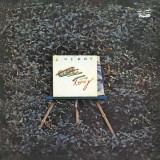
Shortly after the breakup of Flower Travellin’ Band, guitarist Hideki Ishima released his first and only solo album in 1973—a hauntingly beautiful work that stands apart in the landscape of ’70s Japanese rock. Known for his later work as a sitar player, Ishima showcases a signature floating guitar sound throughout the album, blending psychedelic rock, acid folk, and introspective singer-songwriter elements into a deeply personal and atmospheric record.
Contributing to this richly textured sound are some of the most notable names from the era: fellow Flower Travellin’ Band member George Wada (drums), future Transam collaborators Chito Kawachi (drums) and Nobuhiko Shinohara (keyboards), and Katsuo Ohno (keyboards) of PYG.
Now reissued with a bold, powerful remaster by Makoto Kubota, this overlooked gem captures a vital moment in Japan’s underground rock evolution and demands a fresh listen from those exploring the outer edges of the genre.
Cerca:hideki ishima
- 1
- 01: Hideki Ishima – Hanging By The Time
- 02: Far East Family Band – Birds Flying To The Cave Down To The Earth
- 03: Takeshi Inomata & Sound L.t.d. - Black Angel
- 04: Tetsu Yamauchi - Wiki Wiki
- 05: Flower Travellin' Band & Terumasa Hino Quintet - Dhoop
- 06: Blues Creation - Atomic Bombs Away
- 07: Kimio Mizutani & The Better - I Wanna Be Your Man
- 08: Hiroshi Segawa - White Room Where We Lived
- 09: Yuya Uchida & The Flowers – Summertime
Freiheit, Rebellion und Trotz – die Rock-/Psychedelic-Rock-Revolution, die Anfang der 1970er-Jahre durch Japan fegte!
"Diese Compilation wurde vor allem zusammengestellt, um Ihnen die freien, innovativen und zutiefst experimentellen Klänge japanischer Musiker näherzubringen, deren Leidenschaft der ihrer britischen und amerikanischen Kollegen in nichts nachstand. Auch über fünfzig Jahre später wirkt die Musik dieses Albums erstaunlich frisch und überrascht und beeindruckt noch immer wie bei ihrer Erstveröffentlichung!" – Sally Kubota
– Vollständig lizenzierte Nippon Columbia Masterbänder.
– Inklusive Track-by-Track-Liner-Notes von Sally Kubota.
– 180g Heavyweight Vinyl-Pressung, Reverse-Board-Cover.
- A1: This Is How I Feel
- A2: A Fun Sunday
- A3: Why Were We Born?
- A4: That Can't Be Good
- A5: A Long Night
- A6: Blistering Chatter
- A7: The White Room Where You Were <Bonus Track>
- B1: Pierrot
- B2: Bloom!! Old Man
- B3: Time Flows - Goodbye Baby
- B4: A Worn-Out Goldfish
Segawa Hiroshi (vocals, guitar) / Ishima Hideki (guitar) / Harada Hiroomi (drums) / Nomura Mitsuro (drums) / Kozuki Jun (drums) / Yamauchi Tetsu (bass) / Ohno Katsuo (keyboards)
Segawa Hiroshi's solo album, pursuing country rock and southern rock in Japanese
A treasure of Japanese rock, bringing together members of Flower Travellin' Band, Samurai, and PYG
After the GS boom subsided and New Rock was in full swing, Segawa Hiroshi was one of the few bands pursuing country rock and southern rock in Japanese, while most bands were aiming for British rock.
The album "Pierrot," one of the culminations of this endeavor, was produced with the help of a lineup of representative Japanese new rock artists, including Ishihama Hideki and Kozuki Jun from
Flower Travellin' Band, Yamauchi Tetsu and Harada Yushin from Samurai, and Ohno Katsuo from PYG.
The album has been reissued with the additional recording of the single "The White Room Where You Were," released the year after "Pierrot," and remastered by Kubota Makoto.
Commentary: Ogawa Shinichi
Remastering: Kubota Makoto
While most Japanese bands in the early ’70s were chasing British rock trends, Hiroshi Segawa took a bold, singular path—crafting country rock and Southern rock, sung entirely in Japanese. His masterpiece Pierrot stands as a rare and beautiful outlier, brought to life by a dream team of legendary musicians from Japan’s New Rock scene: Hideki Ishima and Jun Kozuki (Flower Travellin’ Band), Tetsu Yamauchi (Samurai), Yuushin Harada, and Katsuo Ohno (PYG).
Now lovingly reissued with a fresh remaster by Makoto Kubota, this edition also includes the haunting single “Kimi ga Ita Shiroi Heya”, originally released the year after Pierrot. A must-have for fans of Japanese rock history, obscure country rock gems, and boundary-breaking musical vision.
- 1


