
pré-commande17.01.2025
il devrait être publié sur 17.01.2025
35,08 €
il devrait être publié sur 17.01.2025

In 2015, Freestyle Records re-issued the groundbreaking 'African Party' album by the somewhat mysterious figure of Ginger (George Folunsho) Johnson. Recorded in 1967, nearly 20 years after he first arrived in post war London and immediately began performing and recording with London jazz stalwarts Ronnie Scott and Pete King.
Credited by those in the know (including Giles Peterson, Louie Vega, Fela Kuti's drummer Tony Allen & writer David Toop) as the godfather of afrobeat, Ginger and his group, The African Messengers enjoyed a varied career as the go to afro-cuban percussion group for recording sessions in the UK, working with Georgie Fame, Osibisa, Madeleine Bell and Quincy Jones - as well as acting us mentor to a young Fela Kuti and members of Cymande who cut their teeth as members of his ensemble. They also performed at The Royal Variety Performance, Ginger's music featured in the James Bond film 'Live & Let Die' and Ginger himself appears on screen drumming in the Hammer Films cult classic 'She', and famously performed with The Rolling Stones in Hyde Park in 1969.
Aside from 'African Party', and several Hi Life singles released on the Melodisc label in the 50's, it was thought that there were no further recordings by this hugely influential musician . Eventually, prompted by the attention afforded the Freestyle re-issues - Ginger's son Dennis Dee Mac Johnson was contacted by Uchenna Ikonne, a renowned African music collector, who told him he had discovered one rather battered original copy of a 45 single, released in the mid 70's on the short lived 'Afrodesia' label,
For Record Store Day 2019, Freestyle are proud to release the 2 tracks on a fresh vinyl 45. 'Witchdoctor' is not the track of the same name on African Party, but it and 'Nawa' (written by Dizzy Gillespie cohort Chano Pozo) demonstrate a musical progression as funk had stamped it's indelible footprint on Ginger's music along with afro-cuban rhythms and jazz.
Thanks to Claudio Passavanti at Doctor Mix Studios in London, who has done quite an amazing restoration and re-mastering job on this long lost music.
Commandez maintenant et nous commanderons l'article pour vous chez notre fournisseur.

New Parisian label, Disques Messager, presents its new and second release. As its name suggests, the label has a simple leitmotiv: to place itself among the best messengers for rarities and sought-after gems of the international rare groove. A mission which began like fire last year with a 7inch reissue release including two Brazilian Disco bangers by Cristina Camargo. For this second efforts, the label doesn’t deviate from the artistic and quality path taken, however also making quite a U-turn, this time presenting 2 underrated kind of musical UFO, both from the French scene.
Not many info can be found about Yoanson & Karamie, two young artists from the French African diaspora, who randomly met with Nessim Saroussi and his label Ness Music in the late 80s. Nessim himself doesn’t remind much about the 2 guys, except that he quickly offered to produce them, which resulted in their only EP release, Kalimba (1988). Part of this EP, “African Leaders” is a stunning track melting Afro-Tropical percussions, Disco bass, Early-Electro beats and Leftfield vocals in a way that could remind of Doctor L or Arthur Russel productions.
On the contrary, Philippe de Lacroix-Herpin (aka Prof Jah Pinpin) has a long musical career started in the mid-70s and became a renowned saxophonist playing and recording for many famous French acts such as Jean-Jacques Goldman, Alain Chamfort, FFF, or even rap band NTM. In 1994, he moved definitely to the Reunion Island where he quickly launched the Prof Jah Pinpin 4tet, in his own words willing to play “free/funk/jazz/rock/tropical” music… Quite a vast and large musical tag, but which immediately make sense when listening to the surprising “The Final Bird” track. Only released as CD in 1996, this instrumental production has indeed a unique sound and flavor mixing all kinds of elements together (even samples of Weather Report).
Well as you can understand, words are not the best way to describe these 2 hidden treasures, so we strongly recommend the spinning to make your own view!
Disponible en stock et prêt pour l'expédition

The latest release on Jai Alai follows the format of forgotten vinyl tracks never before released on 7” format, or previously CD only album tracks, and will raise some eyebrows in artist selection and pairing.
Donaldson Toussaint L’Ouverture Byrd II was one of the most significant jazz artists of all time having joined Art Blakey’s Jazz Messengers in the mid-50s and establishing himself as one of the best hard bop trumpeter/flugelhorn players. His progression was continuous through the 50s/60s working with John Coltrane, Gigi Gryce, Pepper Adams, Thelonius Monk, Sonny Rollins as sideman, and became one of Blue Note Records leading artists.
By the end of the 60s Byrd decided to move away from that idiom, experimenting with jazz fusion, African music and Rhythm & Blues. He worked hard to make jazz and its history part of the curriculum in US music colleges and he taught at many including Rutgers, Hampton, Howard, and Columbia, the latter from who he received his PhD in music.
Byrd took a great interest in how Miles Davis’ experimentation was resonating with a younger audience, and despite being castigated by his musical peers, his development of jazz fusion changed the jazz scene forever. His work with the Blackbyrds was a cornerstone for the progression of jazz funk in the UK.
The effect of his hook-up with brothers Larry & Fonce Mizell was immediate and his Blue Notes albums “Black Byrd” (1973), “Street Lady”, “Stepping Into Tomorrow” (1974), “Places & Spaces” (1975) and “Caricatures” (1976) became legendary on the newly evolving jazz funk scene with certain tracks such as “Change (Makes You Wanna Hustle)” normalising dance jazz on the disco floors, not to mention being a rich source for many hip-hop samples.
A slightly leaner period followed when he moved to Elektra Records and of the three albums with his new incarnation 125th Street NYC, a group of musicians he taught at North Carolina Central University, two were produced by Isaac Hayes including “Words”, “Sounds, Colors & Shapes” (1982) from which “Everyday”, a fabulous forgotten piece of mellow jazz funk derives.
By the end of the 80s he had returned to his harder straight-ahead jazz roots, but his place in history and the evolving of jazz as a dance culture in our clubs should never be forgotten.
Commandez maintenant et nous commanderons l'article pour vous chez notre fournisseur.
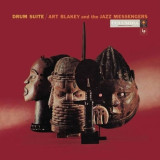
One of the inventors of the modern bebop style of drumming, Blakey is known as a powerful musician and a vital groover; his brand of bluesy, funky hard bop was and continues to be profoundly influential on mainstream jazz.
For more than 30 years his band, Art Blakey & The Jazz Messengers included many young musicians who went on to become prominent names in jazz. Recorded in 1956, Art Blakey's Drum Suite is a wonderful hybrid of African, Latin, and hard bop rhythms that prefigures the concept of Afro-beat by at least a decade. The sheer energy, not to mention its very special and fresh-sounding intimacy, make it especially astounding.
Even more amazing is that the three parts of the suite -- Blakey's "The Sacrifice," Ray Bryant's "Cubano Chant," and Oscar Pettiford's "Oscalypso" -- were recorded straight through live, and were only intended to be a pre-take run-through. As is obvious here, Blakey and company nailed the whole thing right out of the box.
Groundbreaking for its time, and still sounding vital, powerful, and visionary, the Drum Suite album is somewhat of a lost masterpiece that deserves a fresh audience.
"Art Blakey's first release for Columbia Records is essentially two records. Side one is a percussion ensemble playing what would, ten years later, be called Afro-Cuban drumming. Side two is the mid-fifties version of the Jazz Messengers featuring Jackie McLean on saxophone. Side one features Blakey, Jo Jones and Charles Wright on drums, Candido and Sabu on bongos, and Oscar Pettiford and bass and cello. The group plays three compositions, one by Blakey, one by Pettiford and one by Ray Bryant, fusing African, Cuban, and calypso percussion into a well-integrated suite.
"The group recorded a run through and it was so perfectly executed that they used the practice run for the release, unedited except to add some Swahili chants by the percussionists during a few passages. One cannot help but think of Olantunji's Drums of Passion, another Afro drumming landmark, here. Blakey's drum suite was recorded at Columbia's 30th Street studios in New York in 1957 and is in mono. The almost stereoscopic image is truly remarkable. Mastered by Kevin Gray and pressed at RTI, Drum Suite is a valuable record of one of the most important figures in jazz history. Recording: 9/10. Music 9/10." - Dennis Davis, Hifi+
"...The three-part suite was laid down in one take with no arrangements, and begins with a few tympani thwacks followed by an African chant. Soon the ensemble kicks in and the group takes off an a sweaty Afro-Cuban-bop journey that will leave you breathless, as the thing crackles with terrific energy. Side Two is more conventional hard bop, but given this group's mastery of if not invention of the style, these tracks are extremely satisfying. Kevin Gray's remastering is detailed and immediate, with plenty of bit and air, if not the widest dynamic range. For anyone interested in percussion of this genre, this is not to be missed." - Wayne Garcia, The Absolute Sound
il devrait être publié sur 14.08.2023

Art Blakey was an exceptional musician, but not only because he succeeded in recruiting the best players to join his Messengers. He also had the skill to blaze new trails through forms of jazz that continuously evolved. Beginning in the Forties with the big bands of Fletcher Henderson and Billy Eckstine, he went on to play with Charlie Parker, Thelonious Monk and Dizzy Gillespie… And then Blakey met up with Horace Silver in the mid-Fifties to found the Jazz Messengers. It was with this band that Blakey would open his arms to all the best young musicians of this generation: he nurtured the likes of Hank Mobley, Jackie McLean, Lee Morgan,
Wayne Shorter, Freddie Hubbard and many others. The first two sides of this album give an all too brief illustration of this aspect of the drummer, while sides three and four feature the inventiveness and rhythmical sense of a great percussionist who never renounced his African origins.
il devrait être publié sur 13.01.2023

clocolan is Emlyn Ellis Addison, a South African artist now living in Providence, Rhode Island. Exploring themes of ontology and psychedelia, his is a music of imaginary futures—of neglected hinterlands and unconquered vastness lost in the background noise of human endeavor.
Addison’s 2017 album, Nothing Left To Abandon, examined the experience of memory while his new album, It’s Not Too Early For Each Other, examines a more pressing experience: the ecosystemic collapse. clocolan dotes once more on dusty melancholy and electronic psychedelia in his new album, pressing into darker territory and more visceral textures.
It’s Not Too Early For Each Other examines the looming inevitability of a future shaped by mankind's destruction of natural ecosystems—and its seeming inability to alter that course. This music is dedicated to the pariahs: the messengers who confront the murder of the ecosystem.
Emlyn was introduced to Colin Morrison at Castles in Space by Strictly Kev AKA DJ Food. It's proving to be an incredibly fruitful collaboration and a third clocolan long player is already delivered and undergoing mastering for future release on Castles in Space.
Commandez maintenant et nous commanderons l'article pour vous chez notre fournisseur.

Soul Jazz Records’ Nigeria Soul Power 70 album showcases the influence of funk, rock and disco on Nigerian music during the 1970s. Originally released as a now-long-out-of-print collectors’ 7” RSD box, this fully expanded album release now also includes extra tracks from Sonny Okosuns, Wings, Chief Kollington Ayinla and more. While for many people the fusion of funk and jazz music with Nigerian rhythms and aesthetics began with Fela Kuti and his afro-beat sound, in fact this can be traced further back to the phenomena of the 1960s Nigerian artists and house bands in nightclubs and hotels who interpreted US soul and pop music with a local flavour and none more so than Geraldo Pino, the ‘African James Brown’ who features heavily in this collection. Other similarly inspired Nigerian funk and soul artists featured here included Tony Grey and his Ozimba Messengers and Don Bruce and The Angels. Nigeria Soul Power 70 includes a number of tracks from the group Wings originally known as BAF (Biafran
Air Force) Wings, an army band formed during the Biafran civil war in Nigeria. The groups’ heavy mixture of funk, rock and African styles was popular among many Nigerian groups at the time.
Beneath the shadow of the few Nigerian artists who signed international recording deals in the 1970s – Fela Kuti, King Sunny Ade, Chief Ebenezer Obey – lies of vast wealth of largely undiscovered musical transmutation and cultural cross-pollination, and included here are heavy afro-funk/rock and disco tracks
from artists such as the legendary Sonny Okosuns as well as rare cuts from little-known outside of Nigeria - groups such as Colomach and MFB. Most of these obscure artists signed to major labels in Nigeria in the commercial slipstream that opened up as Philips, Decca and EMI tried to emulate the international
success of the big three international Nigerian artists. Finally featured here is Kollington Ayinla, one of the co-founders of Nigerian Fuji music, who gives us perhaps the heaviest of all tracks on this album. Ayinla is the great moderniser of the Fuji sound and in the late 1970s began adding Bata drums and synthesizers to his authentic music to create a powerful and heavy new fusion of traditional and modernist aesthetics, embracing both new technology and experimentation while rooted firmly in Nigerian historical lineage. Nigeria Soul Power 70 is released as a heavyweight gatefold double vinyl LP (+ free download code),
deluxe slipcase CD and digital album.
Commandez maintenant et nous commanderons l'article pour vous chez notre fournisseur.
