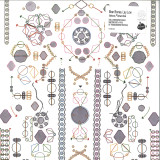
SHADOWY FIGMENTS OF UNRELENTING SONIC SEEKINGS
The magic lantern music of Razen spirals into ever more fanatic territory with the addition of turntablist Guilhem All from Brest. Vietnamese flute, oscillator, chopped-up vinyls and a range of
uncomfortable techniques bring about a series of sandblown, rock-encrusted desert mirages.
MORE INFO SOON
credits
releases October 15, 2025
Recorded by Mathieu Grillo, with assistant engineer Gaia Lufrano
Recorded at Echo Chamber in Volta, Molenbeek on March 4,5 & 6, 2025
Mixed by Mathieu Grillo, with assistant engineer Gaia Lufrano
Mastered by Frédéric Alstadt
Artwork: Aurora/ ChromaGrid drawing by Wilfried Pulinckx
Brecht Ameel: oscillator & harmonium
Kim Delcour: sáo trúc, fijfer, chalumeau, santur
Guilhem All: turntables
Thank you: Arne and Mich at Volta & AB
KRAAK Novedades
- 1
TOTEMIC MODULATIONS, UNEARTHED FROM WIND AND WORDS
“The album Chênes mainly brings together songs. These songs are narratives of scenes that unfold in the forest, or in the city but with animal and plant protagonists. One song also tells the story of a solitary walk in the mountains. They are like zoomed-in snapshots of the world of insects, amphibians, birds, and mammals. They are also celebrations of growing life, and the pleasure and joy it brings.
Composed over the course of about two or three years, it was a deliberate choice to bring them together for this album, even though they were not initially connected to one another. One of them is an exception and is more of a collection of vocalizations and cries without actual words, composed in a language incomprehensible to humans because it is nonverbal.
This collection of imitated chants and sung songs had to be illustrated by the collages of my friend Fen. Even though the stories describe real species and elements, they are indeed imagined tales. Her collages are, too. There’s also the violin that adds a wandering touch to the pieces, and other instruments that shape the environment and setting of these stories. Bells, bird calls, whistles, flutes, jaw harp, harmonica — all imitate more or less imaginary species. Each has its role and its life, down to the horsehair of the bow that rubs the strings of my violin to bring forth the sound.
Chênes is a title that pays homage to trees I love so much, though without preference over others. They have embodied several giants that I’ve often come across, greeted, and embraced” ~ Roxane Métayer
The Ghentian skyline has low peaks and hides its horrors in full view ~ walk streamside and you’ll quickly be confronted with façades that leer with their tales and secrets, the angels and demons that built this city holding up its mortar and stone in an inextricable embrace. It is within this incongruous backdrop that Benoît Monsieurs has fostered the Venediktos Tempelboom persona. Using the 12-string guitar as his main instrument, the self-taught musician creates passages that take fingerpicking Americana and Eastern transcendence into the Flanders fields, with winding compositions that distill the essence of giants like John Fahey, Robbie Basho and Jack Rose and folds them into the dark drone melancholia of Funeral Folk/KRAAK stalwarts like Silvester Anfang, Helvete and Ignatz. The results are ringing meditations of awe and terror, flamboyant and grotesque yet utterly mesmerizing in their unrooted sonic imagery.
In his debut LP, Syne Vuyle Hoeck, the Tempelboom amalgamates his influences - East, West and deep Flanders alike - into a flurry of acid-drenched tracks that spread out into a distinctive musical iconography. Each composition carries a facet, highlighting angel and demon in equal measure: the solemn opener “De woelige rit op een roze wolkje” is a threading of melodies that carry pensive heft and hopeful asides, as hints of ragtime buoyancy lead into sullen ruminations in a fully lucid change of course; “Ocharme Ochgod” is a sober penitence, slowly and almost imperceptibly building up into a tangle of lines that inexorably coil back into their brooding backbone; the echoing tape loop of “In Flock” reverberates and torments, steel sharpness and frayed magnetic disintegration finding improbable common ground; “El Contrario” swerves unforgivingly in an Eastern-infused openness reminiscent of Six Organs’ rawer days and unnervingly giving way to a forceful - dare we say upbeat - conclusion. And so one treks into the depths of the Tempelboomian universe, a place of high drama and low morals inhabited by a prankster creator who deploys euphoria and distress in equal measure. Just as the strings of his guitar are left to echo like sparkles in the dark, so his music lingers in the soil of our humanity, redolent of the kind of peace one can only make with the demons of the self.
Highly original material on a very limited EP... be quick!
POLYPHONIC WAVES OF SOULFUL MADRIGALS
The power of duality is an inscrutable thing: we’re endlessly fascinated by the interplay between light and darkness, East and West, voice and silence, our senses tingling from the compelling synergies that thrive in perceived opposites. Drawing from an urbane Antwerpian upbringing and a Moroccan family lineage, the Brussels-based multidisciplinary artist Younes Zarhoni, embraces these very dualities in all of his projects, exploring those murky areas of contrast and bringing all their ambiguous energy to crystal clear focus.
A longtime staple of the local electronic music scene with his hypnotic techno outings as YZ, Zarhoni’s latest focus is on the compositional power of pure harmony and silence: namely, his polyphonic renditions of medieval mystical poetry, sung in multiple voices and left to solemnly radiate beyond their given spatial grounds. Stripped of all instrumental accompaniments, what you get is Gregorian chant meets Boyz 2 Men, articulated by the lyrical ineffability of Arabic tongues and finding their rhythm in the silences that act as the juncture between observation and anticipation.
These sparse stanzas tread under an elusive referential threshold, conjuring visions of architecture and archaism, madrigals and MTV, the sacred and the profane ~ ostensibly disparate elements that seamlessly fold themselves into the radicality of the compositions. In these 20 minutes of verse, Zarhoni oversteps the margins of categorization to deliver an immersive story of song, flowing freely and sustaining the arc of the narrative long after it has ebbed into silence.
Sumer Is Icumen In is Quentin Thirionet's (Dhavali Giri, Pairi Daeza) debut album. Still, his musical escapades are vast and varied, based almost entirely on improvisation and live recordings, of which he occasionally distributes tapes without further information. Elusive to categorization and identification, unwilling to fix his musical activity under a stable pseudonym, his projects have ranged from gypsy jazz guitar swings, French traditional songs from Auvergne, and various experimental collaborations. Increasingly closer to electronic instrumentation, he crafted what Belgian label KRAAK presents here as Maibaum, his first ever solo output. As the title goes, this may be a maypole on which his multicolored sonic visions spring about.
Former rope access worker and currently a farmer of organic greens, Thirionet lives up to these lines of work as a musician. He assembles precisely what seems like a subtle balance between high manmade structures and soft fertilized soils; a high voltage pylon placed in a biotic landscape. It's all an even blend, spontaneous and steady, but this contraption comes from profound considerations. "I chose these tracks among many others," says Quentin, "because I heard the melodies all the time in my mind, and because I cried while playing them without really understanding why."
Armed with nothing more than a blackbox, a sequencer, a freeze pedal, and a tape player, Thirionet orchestrates a vivid rite of polished futures. At times reminiscent of Hans-Joachim Roedelius' enveloping arrangements, Maibaum's ambiances rely on mild repetitive patterns subsequently textured by prickling sprouts, mechanic dislocations and revamps that stoke and brighten the stirring motions. Jim O'Rourke's I'm Happy and I'm Singing comes to mind in terms of its detailed and prismatic nature, but Sumer Is Incumen In has its particular narrative. It's a tale of regeneration, of spring's delicate procedures and allure, a celebration of gracious and fortunate junctions between nature and machinery.
The album unfolds like a massive engine being made flesh to drift along the ether of a sultry land. The terrain turns pleasant and fertile in the title track; the colors and melodies of May start to unravel. Chromatic columns rise and define the scenery's depth of field breeding a synesthetic stream between crystal lights and warbling organisms. Grande Albero Buono Magico Uoma's brisk kaleidoscopic arpeggios sound like scanning a tree's litmus foliage. Then Ciguri takes us back to the foggy swamp of the beginning but is suddenly lit by an insect’s labyrinthine roundabout. The Jeweled Grid is a poem Quanta Qualia's lustrous metallic voice recites as a report of the album's phenomena. "Shiny revelations jump out. Pearls of thought flicker about." Images from within that distill to swirl around among us. The thicket dissolves as the album concludes calmly in Le Concept De Chien N'aboie Pas. Swaying under sieved solar light, leaves and branches tingle until the winds grow weak. All the warm creatures gathered along the way, and all those who danced around the maypole's splendid equilibrium now withdraw, folding up small to foster rebirth once again.
José Badía Berner
This is the assumption; what are the facts?
In an exhilarating convergence of sonic exploration, experimental noise guitarist Nina Garcia and danish trombone virtuoso Maria Bertel have teamed up to create a heavy-hitting, collaborative record that pushes the boundaries between extreme improvisation and harsh noise. Both renowned in their respective fields, Garcia and Bertel bring their unique styles and influences to create a masterpiece of collaborative improvisation.
Known for her fearless approach to the guitar and her ability to conjure otherworldly sounds, Nina Garcia has carved a niche for herself in the experimental music scene. With a minimal setup consisting of only guitar, pedal & amp; constantly touring, collaborating and evolving, Garcia has established herself as a trailblazer, challenging conventional norms and redefining the possibilities of the guitar beyond tonality. There‘s as much free improvisation in her playing as it is informed by no wave and the energy of free jazz, but most of all, this is kinetic music.
And this might be the intersection where Garcia and Maria Bertel meet.
Bertel, an accomplished trombonist active in the free noise rock monolith Selvhenter and in the duo Gud Er Kvinde (God Is A Woman), is no stranger to pushing the limits of her instrument. Known for her dynamic performances and innovative approach, Bertel has earned international acclaim for her ability to seamlessly blend genres and traverse musical landscapes - from delivering the low end in Selvhenter to the drone explorations of G.E.K., together with Nina, she focuses on rhythmic possibilities of her instrument. The distorted, feedbacking trombone is as controlled and precise as it is sonically explorative.
KNÆKKET SMIL (meaning „broken smile“) is a living, breathing, moving entity. It‘s a testament to the raw and emotive power of these two players. Bertel and Garcia‘s practice of mutual listening, reacting and merging is as radically tender as lovers exploring each other‘s scars.
This approach to collaboration is also reflected in every other part of that record. It‘s a joint effort of three labels, french label No Lagos, which is a home to many of Garcia‘s ventures (and the graphic work of Helene Marian), germany‘s Otomatik Muziek, where Maria previously released with G.E.K., and belgian experimental stalwarts Kraak as focal point.
The great Ernesto González with a welcome return to the LP format and firmly back in mind expansion mode for this beauty of a release. Fried, other worldly and exploratory - he really is out on his own with this stuff. HUGE TIP!
A joint release from Kraak (Belgium) & Nonlocal Research (Chile).
First LP from Donna Candy, the bass-vocal-drums trio trawled from the sub genres of experimental rock and busy pushing to the front of heavy music. Nu metal bass riffs, switch-pitched fuzz vocals and big, splashy drums layer over unsettling narratives and extreme loops to bring a bit of the pit to the dancefloor.
Begun as an off the cuff party band with the idea of finding a live sound that would fit between 4am trance sets, the trio soon found themselves addicted to the euphoric sludge they created. Swapping their usual guitar for a bass, JS Donny drives Donna Candy with simple riffs, split half clean and half shredded with Boris / Sunn O))) like distortion. Head-banging the whole way, they’ll switch speed or stop suddenly, bending and drawing out notes to ratchet things up for release. Nadja's vocals tear through the top layer - heavily processed and warped with weird imagery. Together there’s a feeling of what it might be like to see Sightings slowed by codeine but with Elvin Brandi on the mic.
Always set up facing each other, off stage and surrounded by the audience, Donna Candy encourage catharsis - reciprocally transforming energy between themselves and the crowd. They build a queer euphoria that pulls apart metal’s narrow dichotomy of nihilistic machismo vs. hyperfemininity, and begins to make the visceral faux-hybridity of nineties nu metal feel possible this time around. ‘Blooming’ brings us six offerings from the band on a four way split release that speaks for itself - once on board with the DC energy you’ll want to be a part of it.
CIRCLING RAGAS OF RESOUNDING POWER FROM THE BEATING HEART OF BELGIAN DRONEVOLK
Hailing from Geel, Jef Mertens has been researching, documenting and subtly exploring the experimental music scene in Belgium and beyond for the better part of two decades. As a filmmaker, he’s dug deep in the realm of Flemish primitive fringe (Dronevolk) and chronicled the makings of giants like Sonic Youth and Borbetomagus. After running the now-defunct free tape label Dadaist Tapes, Mertens comes with a release of his own: NO MATHEMATICS, the first record collab between KRAAK and Feeding Tube. It’s an entrancing debut, where shruti box and guitar conjoin to create circling ragas of solemn yet resounding force.
BROODING PSYCHEDELIC REVELATIONS FROM THE STAVANGERIAN OUTSIDERCORE
The uncanny is never out of bounds in the debut release by shadowy Norwegian duo Firmaet Forvoksen. Gaute Granli and Thore Warland, two archetypes of the Stavanger experimental scene long active through solo work (Gaute Granli’s recent Ultra Eczema notoriety, for one) and other collaborative projects (Thore Warland’s ongoing drum devolutions with Golden Oriole, for another), have joined forces under multiple configurations over the years in order to finally coalesce under the FF banner. Together they project an ever-unfolding vision that sonically erodes into a radiant abyss, like some serious atonement from probable jazz school fugitives.
Undone Shal is an unfurling tapestry of erratic guitar pickings, muffled percussive conjurings, barging synths, and moans that are part lamentation, part incantation. These arrangements evoke a definite psychedelia, plunging the listener into unsettling yet luminous expanses of liminality that recall only the most brooding of outsiders. Like craggly rocks piled on top of each other forming an incomprehensible, gravity-defying tower, Firmaet Forvoksen’s disjointed musical deployments forge something lucid and concrete while grazing the edges of complete inscrutability. This strange relic of a record follows the lineage of KRAAK rosterees past and present - the KRAMPs, Ignatzes, Red Bruts and Calhau!s of our hearths - through its assemblage of crude elements that incite the universe to vomit its hidden harmonies and forcibly test the boundaries between fluency and unintelligibility. No Norwegian wood wisecracking to be made here, for these two dwell in a malleable zone where chaos aligns to draw you in, hinting at all that is obfuscated like a marching band to nowhere.
The first LP by Bloedneus & de Snuitkever, MILLI MILLE. Finally on wax, it’s Lukas De Clerck’s musical vehicle for his explorations with the aulos, that ancient reed instrument that mainly satyrs and archeological enthusiasts found beguiling. Equipped with his handmade pipes and the artful sense of devotion of a true modern-day aulete, De Clerck has dug deep into the technical and cultural peculiarities of this long-silenced instrument, paying it the kind of attention and mindfulness that Marsyas the satyr so lacked when he challenged Apollo and his lyre to that ill-fated musical match. But beyond merely resuscitating an ancient cult, De Clerck as Bloedneus gives the aulos a different kind of renaissance where its penetrating qualities are expanded and expounded to effects worth every nosebleed, paving new grounds in these practices of old.
MILLI MILLE hints at mysteries universal to humans of yore, present and morrow, like a Joseph Campbellesque recounting of transcendental journeys through drones and extra reverb. Elegiac modes encounter pastoral vibes that are punctuated by sly baroque flourishes, all pointing to the timelessness of the aulos’s sound - one can easily imagine its power of enlightenment through many ages. Yet in MILLI MILLE, an insistence on the fickleness of the instrument surfaces through disorienting, perception-shifting blasts and a compulsion to push the aulos to its fullest and most destabilizing potential. This is the flavor that Bloedneus & de Snuitkever imbues into that dormant canon, one that permeates the atmosphere long after the last note puts an abrupt end to these vibrations. The satyr’s song rings on, leaving the air abuzz with a timeless pulse that holds the promise of sounds still to be unearthed.
Razen celebrate their 10 yr anniversary with “Ayîk Adhîsta Adhîsta Ayîk”, an album that takes a paragraph from CG Jung’s Memories, Dreams, Reflections as a reference point to set off a journey that goes from light to dark, from day to night, from life to death, and back.
As much a reflection of primal imagery and rituals of knowledge as a way of coming to terms with anxieties about the chaos of the night, the album concerns itself with the question: who - or what - are we in the moments before (re-)birth, before waking up, in the state inbetween darkness and light?
On “Ayîk Adhîsta Adhîsta Ayîk”, the wind instruments and organ stabs of band leaders Kim Delcour and Brecht Ameel are expanded with Pieter Lenaerts’ five string double bass and sarangi, Jean-Philippe Poncin’s bass clarinet and chalumeau, and Paul Garriau’s hurdy gurdy.
The album sees the group explore new straight-to-the-gut emotional territory, while simultaneously showcasing Razen’s intuitive, continuous investigation of the acoustic properties and resonant possibilities of churches and chapels in the countryside around Brussels; after “Remote Hologram” (2014) and “ The Xvoto Reels” (2017), this time the St Agatha Church (St.-Agatha-Berchem) functions as the conduit for Razen’s acoustic sound jolts.
With the past ten years entirely devoted to the search for archetypical timbres and connotations by improvising on Early Music instruments, it’s no wonder that the world of Razen would one day collide with the world of CG Jung and take his writing as an inspiration.
A sonic hex tour de force from this unique ensemble, “Ayîk Adhîsta Adhîsta Ayîk” is a present-day, nocturnal emitter of the Coleridge quote that opens Jung’s Memories:
‘He looked at his own soul with a Telescope. What seemed all irregular he saw and shewed to be beautiful Constellations and he added to the Consciousness hidden worlds within worlds’.
- 1