
out of Stock
Order now and we will order the item for you at our supplier.
9,20 €
Order now and we will order the item for you at our supplier.

Following the release of his third album Dans cent ans (2023), which brought to a close the pop trilogy begun with Léviathan (2015) and Contre-temps (2018), Flavien Berger returns with a now classic 'counter-album': contrebande 02. le disque de l'été
Conceived as mirror albums to the trilogy, the counter-albums tell another side of Flavien Berger's creative process. Like contrebande 01. le disque de noël (2016) and radio contre-temps (2019), Flavien navigates between sonic experimentation (gervase weatherboy type beat), encounters (magie vermeille with Pomme), previously unreleased songs (sapon, plongereuse) and interludes (music 2000 beat titi poisson skit) reflecting an alternate itinerary of the making of his latest studio album Dans cent ans.
expected to be published on 09.02.2024

Order now and we will order the item for you at our supplier.

It's hard to explain an album when one listen is enough. All the more so with MaMaMa: there's no room to stay passive. Listening to his new album, EST, means immersing yourself in an atmosphere that's softly psychedelic, comforting and organic all at once. A dreamy, electronic pop that proves this Strasbourg-at-heart, Paris-by-adoption musician, arranger, singer, songwriter and producer never stops reinventing himself. After changing his name — formerly Petit Prince — and delivering two critically acclaimed albums ("MaMaMa-gnificent." / "Hooks you carry in your head for a long time" / "sumptuous arrangements"), Elliott Diener now offers an even more sincere record. Real songs in French, after two albums where production sometimes took up all the space: "when you make heavily produced music, once you strip away the layers of sound, there's no fruit left underneath. On EST, I don't need makeup for the songs to work," he admits.
That's what this new album is about: the song and the French language first, then the pleasure of sound. An album less concerned with talking about its own making, more inhabited, more embodied, within a contemporary folklore. With this new album, don't expect to be bored: EST is his best record yet.
No pretense
Entirely conceived in his studio in Pantin — a room of his own, at last — imagined as a space free of any daydream, open to every sonic landscape, MaMaMa offers a record that's both hazy and downy soft. Often composed very early in the morning, it has become nostalgic without being dark, melancholic without being sad, with a few lineages showing through: Flavien Berger, Moodoïd, Feu! Chatterton for the taste for words and unease, Mount Kimbie for the approach to sound and rhythm. Unsurprising, given that EST was finalized with the British duo's producer. Live, MaMaMa is preparing a show in the style of Nicolas Jaar or UTO. Hypnotic and immersive.
The most liberating thing is that EST is an album without pretense. With it, we move through perseverance (in Aussi loin qu'il tiendra debout), the small arrangements we make to avoid facing reality (Tout sauf la vérité), and the fragility of bonds we thought were solid (Si bien ensemble). We also touch on lasting conflicts with the people we love (Anywhere You Are, There You Are), misunderstanding (Elle me parle une langue), and the erosion of friendships (S'envoler). EST draws an intimate and redemptive map of human relationships, in a body of work that's both lucid and sensitive — like when he also addresses social masks such as filial love (in Beau garçon, dedicated to his son) or relationships that have become impossible.
"It's really the album that sounds most like me, in terms of sonic landscape," Elliott points out. A record that rises above the noise of an imperfect, shifting world — like us — joyful in its words, liberating in its production. A true gem.
expected to be published on 16.10.2026

On Stock and ready to ship

Hologram Teen is the solo project (and anagram) of former Stereolab keyboardist Morgane Lhote. Her colourful playful songs are heavily influenced by disco and 80s French pop.
Initially from Paris, Morgane relocated to Los Angeles where she concentrated on her solo material. Captain Fluo is a disco-fuelled love letter to 1980s Paris and its underground nightlife, record store discoveries and the exhilaration of growing up as a gay teenager in a world of self-discovery.
Produced and mixed by Andrew Claristidge (Acid Washed) at Duca Sonora Studios in Brittany Captain Fluo is a vibrant fusion of propulsive beats, bouncy synths and funky basslines. Morgane’s signature keyboards weave through a constellation of guest vocalists including Sandra Zettpunkt, Maxwell Farrington, Eric D Clark and Alex Aikiu. From the euphoric pulse of ‘Lust Pill’ to the radio crooner nostalgia of ‘Fréquence Gaie’ each track is a portal to the dance floors and late-night airwaves of a bygone era.
Drawing inspiration from French pop icons like France Gall, Michel Berger and Louis Chedid alongside the sleek productions of Italo disco pioneers Kasso and the genre-defining touch of David Bowie, Nile Rogers, Quincy Jones and Depeche Mode, Captain Fluo is a heartfelt ride through an era when music was liberation.
On Stock and ready to ship
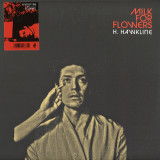
The fifth album from H. Hawkline (Huw Evans), ‘Milk For
Flowers’, is released via Heavenly Recordings.
Following the 2017 album, ‘I Romanticize’, and 2015’s ‘In
The Pink of Condition’, the album was produced and
features musical contributions from long-time collaborator
and celebrated solo artist Cate Le Bon. Artwork is
designed by H. Hawkline.
Recorded at Rockfield Studios in Monmouthshire, the
album features a host of musical collaborators - Davey
Newington (Boy Azooga) on drums, Paul Jones (Group
Listening) on piano, Tim Presley (White Fence, DRINKS,
The Fall) on guitar, Stephen Black (Sweet Baboo) and
Euan Hinshelwood (Younghusband, Cate Le Bon) on sax,
Harry Bohay (Aldous Harding) on pedal steel and John
Parish (PJ Harvey, Aldous Harding) on infrequent bongo.
The record was then engineered by Joe Jones (Aldous
Harding, Parquet Courts) and mixed, after an unlikely and
fortuitous crossing of paths, by the Grammy-nominated
Patrik Berger (Charli XCX, Robyn, Lana Del Rey), and
mastered by Heba Kadry (Deerhunter, Cass McCombs,
Cate Le Bon).
‘Milk For Flowers’ is at once visceral and enlightened, its
soundscapes verdant yet delicately rendered, and with this
latest, most intimate work, H. Hawkline bares his blood,
bones and soul beautifully. And quietly, along with the
entrails and rubble held in ‘Milk For Flowers’’ reliquary,
there hides a small, green kernel of life; hope, perhaps,
that today’s decay might nourish tomorrow’s blooms.
Available on CD and LP with rigid ‘tip-on’ sleeve with antiscratch matt lamination and digital download code.
On Stock and ready to ship

.defaultbox strikes back with their 15th release entitled "Conurbation" which will be available as double vinyl and digital release.
This wonderful various artists compilation features 10 highly effective tracks by DisX3 & Mario Berger, Slight Function, Non Reversible, Arma, Tag & Wandrach, EJA, JohannesK, 10.000 BC, Marina George and Sebastian Bayne.
No further description. Let the music speak for itself.
On Stock and ready to ship

Ever since the late 1950s bossa-nova revolution, Brazil’s influence on French music has been undeniable. Pierre Barouh, Georges Moustaki and a vast array of lesser known artists, all made the Musica Popular Brasileira (MPB) an axis of promotion at the service of a cool and metaphysical, modern and mixed Brazilian lifestyle. Some were seduced by the poetic languors of the bossa, some were looking for fun, and others just loved the American hybridization of jazz-bossa, jazz-samba.
What is bossa nova? One of its creators, Joao Gilberto said: "Its style, cadence, everything is samba. At the very start, we didn't call it bossa nova, we sang a little samba made up of a single note - Samba de uma nota so .... The discussion around the origins of bossa nova is therefore useless”. It is nevertheless useful to remember that these magnificent Brazilian songs, which the guitarist describes as samba, were shifted and balanced around improbable chords. "I like things that lean, the in-betweens that limp with grace," said Pierre Barrouh, quoting Jean Cocteau.
With emotion, arrangements for violin and supple guitar licks, bossa nova rapidly changed. A transformation that can be heard in the Tchic, tchic, French Bossa Nova 1963-1974 compilation, the result of a cultural reappropriation, which traveled through the United States and supplemented itself in France.
A musical revolution that has remained significant, bossa nova was born in Rio. From 1956 to 1961, Brazil lived through its golden years. In five years, the country had invented its modernist style. Elected president in 1956, Juscelino Kubitschek de Oliveira, an elegant man with a broad forehead, brandished a promising slogan: "Fifty years of progress in five years". He quickly got to work. Not worried about increasing debt, he launched the project for a new federal capital, Brasilia, designed by the communist architect Oscar Niemeyer. Volkswagen opened state-of-the-art factories and created the “fusquinha”, the Beetle. In Rio, the Vespa made its first appearance. The Arpoador Surf Club crew run into the “girl” from Ipanema, Helô Pinheiro - the tanned garota ("chick"), between a flower and mermaid, who at 17 walked by the Veloso bar, where the fiery author and composer, Tom Jobim and Vinicius de Moraes, were getting drunk on whiskey. From then on, bossa symbolized cool.
In 1958, Joao Gilberto recorded Chega de Saudade, which the directors of Philips denied, calling it "music for fagots". The marketing director, who believed in it, secretly pressed 3000 78-inch vinyls and distributed them at schools around Rio, creating a tidal wave.
American jazzmen then took over. In particular, trumpeter Dizzy Gillespie and guitarist Charlie Byrd. In November 1962, the Brazilian Ministry of Foreign Affairs funded a "Bossa-Nova" concert at Carnegie Hall in New York, inviting the genre’s pioneers. Unprepared, the show soon turned to disaster. But the troupe was invited to the White House by Jackie Kennedy. The first lady loved "the new beat" and in particular Maria Ninguem, a song by Carlos Lyra, later covered by Brigitte Bardot.
In Brazil, the 1964 military coup quickly ended this euphoria. The destructive atmosphere that ensued pushed many Brazilian musicians to leave, if not to exile. Thus, Tom Jobim, Sergio Mendes and Joao Gilberto arrived to the United States. In New York, Joao Gilberto met saxophonist Stan Getz. At the time, he was married to the Bahianese Astrud Weinert Gilberto, who had a German father. She had never sung before, but she knew how to speak English. Getz therefore asked her to replace her husband on The Girl From Ipanema. The Getz/Gilberto record with Tom Jobim on piano, was released in March 1964. Phil Ramone, the "pope of pop" was in charge of sound.
Bossa nova arrived in Paris through the classic “guitar-voice” channel (Pierre Barouh, Baden Powell, Moustaki…) But France loved jazz and Paris had already welcomed its American contributors. All these good people were to pass through Saint-Germain-des-Prés. The cabaret l'Escale became the Mecca of Latin American sound where one could find Pierre Barrouh and his friends, such as the Camara Trio, samba-jazz aces, whose only record was published by the Saravah label. With a band strangely called Les Masques (a band that included Nicole Croisille and Pierre Vassiliu, among others), the Camara Trio recorded an interesting Brazilian Sound, including the track Il faut tenir which is present on this tasty compilation of rarities.
Other enlightened musicians can also be found on the compilation, such as Jean-Pierre Sabar (songwriter for Hardy, Auffray, Leforestier ...) and the French pop rock organist Balthazar. In 1975, Sabar recorded Aurinkoinen Musiikkimatka on a Finnish label, which featured the crazy Vai, Vai, included on this record. We are now following the footsteps of Brazilian electronic musicians such as Sergio Mendes, Eumir Deodato or Marcos Valle who created funk and disco sounds on their keyboards and synthesizers. A style that influenced Véronique Sanson when she wrote Jusqu’à la Tombée de la nuit in 1969 for Isabelle de Funès, the niece of Louis and a great friend of Michel Berger - Sanson did end up singing this track on her 1992 Sans Regret record.
The pinnacle of exoticism and travel, Sylvia Fels’ Corto Maltese includes bongos, sea mist and ocean sounds. The title was taken from Jacky Chalard’s concept album written in 1974, Je suis vivant, mais j’ai peur (I am alive, but I am scared), based on Gilbert Deflez’s science fiction novel.
However, bossa nova extended the scope of popularity. "In the 1970s, I was a fan of Sergio Mendes, Getz / Gilberto. I fell in love with this music that I knew because I had been an orchestral singer, " explained Isabelle Aubret, who in 1971 delivered a composite record of covers by the very funky Jorge Ben, Orfeu Negro, Tom Jobim, Vinicius de Morais and Jean Ferrat. "I recorded this album for Meys Records in Paris, far from Brazil, with wonderful musicians, François Raubert, Roland Vincent, Alain Goraguer...". The latter wrote the arrangements for Casa Forte, a very percussive title borrowed from Edu Lobo, one of the initiators of the bossa who spent time in California. "Jazz and bossa came together and produced very rhythmic music. I love singing, it allows me to dream, to have fun, to feel a high on stage, and these songs brought me joy, made me swing, my singing felt like a dance.”
The world tours of French singers and their desire for the tropics, often brought them to Rio with its hills, forests, caipirinhas and tanned bodies. There are surprises though, like this Iemenja (Iemenja is the goddess of the sea in the Afro-Brazilian candomblé religion). Not unlike the composer and musician Jean-Pierre Lang, based in Sao Paulo, Claire Chevalier taught Brazil to Brazil. In 1970, the singer and painter published a 45-inch vinyl, Mon mari et mes amants (My husband and my lovers), under the improbable pseudonym of Clarinha (little Claire). She was then living in Rio, with her husband, Joël Leibovitz, who founded a band called Azimuth, and who owned a record label specialized in "sambas enredos" songs for samba school parades.
For its B side, she asked Pierre Perret to come up with lyrics for a song composed by Carlos Imperial: "Oh goddess of the sea, o goddess Iemenja, I bring a white rose to adorn your long hair ..." . "Perret came to see us, and we had fun, remembers Joël Leibovitz. We wrote Lemenja for fun, we recorded it at the Havaí studio, behind the Central do Brasil the central station. Erlon Chaves, the arranger who worked with Elis Regina, joined us" adding his share of Afro-Brazilian percussions and funky brass to the mix.
There is a common misunderstanding in Franco-Brazilian history: that bossa, admittedly hedonistic, is perceived as funny, even though the poets who wrote the texts are often philosophizing on the human condition. Its French interpreters pull it towards a carnival inspired universe, far removed from its fundamental essence. Thus, Jean Constantin covered the famous Samba da minha terra, an ode to the art of samba written by the classic Bahian composer Dorival Caymmi, renaming it with the enticing title of Pas tant de tchi tchi pompon: "On your pier there is no tchi tchi / when you arch your back, you know everything is alright ”(lyrics by Gérard Calvi). This expedited bossa aims for the absurd, but retains a certain elegance.
Indeed, Jean Constantin was not an idiot, the rather large man had a huge mustache and liked fantasy, (Les pantoufles à papa, Le pacha, inspired by cha-cha-cha-cha, salsa and jazz) but he was also the lyricist of Mon manège à moi interpreted by Edith Piaf, the composer of Mon Truc en plume by Zizi Jeanmaire and the soundtrack of François Truffaut’s 400 Blows. Le Poulpe, published in 1970, from which this bossa is extract, was arranged by Jean-Claude Vannier, an accomplice of Serge Gainsbourg’s Melody Nelson. In short: "There is enough of samba / By looking at the parasol / Because my poor cabeza / Is going to die in the sun".
Even the American actress Marpessa Down, who was at the heart of the bossa nova revolution with her role as Euridyce in Marcel Camus’ film Orfeu Negro, winner of the 1959 Cannes Palme d'or, fed the clichée with Je voudrais parler au petit cuica - "Tell me how you manage to always make people want to dance / It's true, I must admit that I cannot resist your magic" - in consequence, once can hear the cuica, a little drum inherited from the Bantu.
But bossa nova had many angles. Societal, of course, pushing actresses who were symbols of women's liberation like Brigitte Bardot, Jeanne Moreau, or Sophia Loren to engage in the exercise of accelerated bossa. In February of 1963, Sophia Loren made a record in French in Rome, Je ne t'aime plus, featuring the song De jour en jour, a bossa written by two Italians, Armando Trovajoli and Tino Fornai, which was released a little later by Barclay. Bossa accompanied the 1960s, a decade of moral liberation. Ann Sorel, who interpreted La Poupée des favellas, caused a sensation with L’amour à plusieurs, a provocative song written by Frédéric Bottom and Jean-Claude Vannier. As for the actress Andrea Parisy, she displayed her bourgeois cheekiness in Marcel Carné's Les Tricheurs before interpreting Les mains qui font du bien. And Magalie Noël, the friend of Boris Vian, who sung Johnny fais-moi mal, was hired to sing Une énorme Samba, composed by Alain Goraguer (arranger to Gainsbourg, Bobby Lapointe and Jean Ferrat) with lyrics by Frédéric Botton.
But in the end, of what wood is bossa nova made of? The answer is given by Christianne Legrand, daughter of Raymond the conductor, and sister to Michel the composer: "With me, with jà" - jà means "immediately" in Portuguese. In 1972, the singer, an expert in vocal jazz and a member of the Double Six, published Le Brésil de Christianne Legrand. Two songs included on the Tchic Tchic compilation that demonstrate how bossa, jazz, funk, rock, etc. work like a swiss army knife: the music is used to denounce broken systems, or miracles, HLM et ciné roman, Cent mille poissons dans ton filet, two songs from the O Cafona soundtrack, a successful telenovela broadcast, at the time in black and white, on TV Globo. The first was adapted in French by the fighter and friend of the Legrand tribe, Agnès Varda. The second is content with a play on words, jostling them into a summer fun.
Véronique Mortaigne
Order now and we will order the item for you at our supplier.

Creator of Le Châ, a chimera emerging from the margins, Lutèce Lockness builds worlds where dreamlike imagery and satire intertwine, inviting us to embrace the bizarre, the strange, and the intimate. With her debut album Le Châ, she crafts powerful, incantatory soundscapes. Her compositions blend psychedelic tones, medieval timbres, drifting drones, bouzouki improvisations, and digital textures, enriched through collaborations with Christoph Fink, Maxime Denuc, and Jean Rondeau.
Inspired by David Lynch, Jim Jarmusch, and Hayao Miyazaki, her practice shapes sonic material like exquisite corpses. Across disciplines, Lutèce Lockness explores new territories through projects such as the collective book Bande organisée (Seuil), born from the transport of a stone book across France during lockdown, and as part of the feminist punk group Forsissies. On stage, she has opened for Bonnie Banane at the Olympia and Flavien Berger at Le Lieu Unique in Nantes, and is also preparing for the opening of Kanal Pompidou in Brussels - continuing a trajectory where music, performance, and visual experimentation converge to create spaces of freedom.
expected to be published on 05.06.2026

repressed !
It's been a busy 3 years since Danny Berman aka Red Rack'em released on his own Bergerac imprint.
Since then he's toured relentlessly, released a whole album of live music based disco/punk funk for Sonar Kollektiv as Hot Coins, managed to completely update his biggest track 'In Love Again' to make it a hit the second time around plus released spaced out, wonky party smashers on Wolf Music, Phonica, City Fly and Telefonplan.
While all this was going on Bergerac was largely on ice but now Berman is turning his energy back to the label with a vengeance.
Wonky Bassline Disco Banger is accurately titled. An uplifting intro breaks down into a slamming disco house number and just when you think you know what's going on...
Then the trademark Red Rack'em wonky bass drops in. 150% Guaranteed party smasher... Jazzy House Extension is super vintage Red Rack'em from around 2004 - something for the jazz heads out there - cracked out piano and far too loud double bass come together to birth a euphoric yet banging snapshot of a producer learning his chops. Destined is a slightly demented leftfield house number featuring mangled, pitch shifting fretless bass and vocals samples discussing someone's destiny.
A woozy end to the EP.
Order now and we will order the item for you at our supplier.

After his EP Mission, released in 2021 and awarded “Revelation of the Year” at the Victoires du Reggae, Jahnaton returns with an ambitious second album titled I’ll Go (J’irai), in collaboration with Evidence Music. On this new opus, the artist blends reggae and dub, airy melodies and rap-dancehall flows with Caribbean influences. A rich and inspired universe that invites the listener on a true inner journey, moving between emotions, spirituality and positive energy. Once again, Jahnaton surrounds himself with prestigious collaborations, featuring major figures of the French reggae scene such as Taïro, Big Red (Raggasonic), Uman and Tiwony. I’ll Go (J’irai) is shaping up to be a must-have project on the modern Francophone reggae scene.
Francais:
Après son EP Mission, sorti en 2021 et récompensé du titre de « Révélation de l’année » aux Victoires du Reggae, Jahnaton revient avec un deuxième album ambitieux intitulé J’irai, avec Evidence Music. Sur ce nouvel opus, l’artiste entremêle reggae et dub, mélodies planantes et flows rap-dancehall aux influences caribéennes. Un univers riche et inspiré, invitant l’auditeur à un véritable voyage intérieur, entre émotions, spiritualité et énergie positive. Jahnaton s’entoure une nouvelle fois de collaborations prestigieuses, avec la participation de figures majeures du reggae français telles que Taïro, Big Red (Raggasonic), Uman ou encore Tiwony. J’irai s’annonce comme un projet incontournable de la scène reggae francophone moderne.
expected to be published on 22.05.2026

Here, Flavien departs from his usual creative process to embrace collaboration—because plouf! (Léviathan) is also the story of a dive, his first collective adventure with musicians he had always dreamed of working with: Michelle Blades (guitar), Kiala Ogawa (keys), Akemi Fujimori (bass), Cédric Laban (drums), and Thibaud Merle (winds).
Reworking these songs is a way of revisiting forgotten musical landscapes, shedding new light on them with a different perspective. It’s about transforming a solitary electronic record into a collective piece by exploring new textures and instrumental approaches.
With this album, Flavien Berger uses his early tracks as raw material—as if the 2015 Léviathan were now a kind of demo from which to extract the essence and create something entirely new. The project, like the music that drives it, is rooted in the idea of reinvention.
The result is a fresh sonic exploration where Léviathan’s tracks take on new forms—some staying true to their original versions, others completely reimagined, blending past and present.
Order now and we will order the item for you at our supplier.

"Ballad of a Small Player" ist eine der großen Veröffentlichungen von Netflix im Jahr 2025. Der Film mit Colin Farrell erzählt die Geschichte von Brendan Reilly, einem in Ungnade gefallenen irischen Finanzier, der sich als der aristokratische "Lord Doyle" ausgibt und in Macau lebt, nachdem er vor seinen Finanzverbrechen im Vereinigten Königreich geflohen ist. Reilly wechselt zwischen Hotels und Kasinos, während seine Abhängigkeit von Alkohol und Glücksspiel wächst.
Die Musik für diesen Film wurde von Volker Bertelmann komponiert, einem der bekanntesten zeitgenössischen Filmkomponisten. Nach "Conclave" und "All Quiet on the Western Front" ist dies die dritte Zusammenarbeit zwischen dem Komponisten und dem Regisseur Edward Berger. Bertelmann verleiht dem Film eine angespannte, paranoide Atmosphäre, die die Welt von Brendan Reilly perfekt einfängt.
"Ballad of a Small Player" ist auf Translucent Red Vinyl erhältlich und enthält eine Beilage.
expected to be published on 30.01.2026
![Silvestre - Fantasma [Casette Tape]](https://www.deejay.de/images/l/6/1/1165561.jpg)
Superstar Silvestre strikes strong on Studio Barnhus, bringing moronic dance music and stupendously haunting
ambient ditties to the forefront once again, following his highly reputable It's 2024!! EP, released in 2024.
On his most expansive and accomplished work yet, tensions between Silvestre’s many expressions – bass-faced rave maker,
hazy lo-fi crooner, absurdist beat poet, etc. – reach catastrophic levels, resulting in an album that shimmers and convulses
with both inviting warmth and that rare, essential hint of danger at the core of club music's spirit.
There's just never a dull moment with this Silvestre guy, whether he's out blessing club crowds with electroid techno sets or
effortlessly delivering instant classic albums like this one. Delivered via 16 digital tracks and/or cassette tape designed by
Stefan Fält, Silvestre’s Fantasma arrives on Studio Barnhus on Sept 26
expected to be published on 26.09.2025

Flutter Ridder is the duo of Norwegian multidisciplinary artists Espen Friberg and Jenny Berger Myhre, both of whom play important roles in Oslo’s contemporary art and music underground. The pair first collaborated during the production of Friberg’s debut solo record, “Sun Soon” (Hubro, 2022), quickly recognizing in one another a creative kinship rooted in a playful, intentionally naive approach towards making art. In November of 2023, the pair decamped to the coastal town of Hvisten in southeastern Norway to record what would become this debut, self-titled album in an ancient wooden church. Drawing from a palette of Friberg’s idiosyncratic Serge modular system and the church’s resident pipe organ and intoxicating acoustic reverb, they began recording and sculpting music informed by the notion that air and electricity share a common flow, a continuous current that can be directed through valves and potentiometers. The pair came to think of the Serge and pipe organ as sibling instruments, the former yielding characteristically unpredictable and complex timbres that complement the wooly, reedy drones and strange, microtonal overtones of the latter. At once sublime, liturgical, and whimsical, Flutter Ridder offers its listener a series of moving, cinematic natural landscapes, affirming the sensibilities of its makers and the indelible influence of the environment in which it was produced.
Order now and we will order the item for you at our supplier.

Boytronic was founded in the early 80’s in Hamburg by Holger Wobker (aka Bryllyant Berger) and Peter Sawatzki. At the beginning, under the moniker of Kapitän Sehnsucht, they were in charge of making the soundtrack for some seedy sex shows on Hamburg’s famous ‘Mile of Sin’. After a while, the boys found that not so satisfying and, through it was a well-paid job, they decided to leave hoping to break into the world of pop music as Boytronic. They already had some demo songs that got the attention of Mercury Records. The first single “You” was recorded highly influenced by the sound of New Order and Patrick Cowley. It didn’t go very well at the beginning. It was just a moderate club hit, but soon after they got lucky and performed “You” on a German TV Show. Just after this, sales reached 80,000 copies in the first week and had a major hit in the German charts reaching position 10. This sudden success was followed by the recordings of the debut album “The Working Model” that was finished in only fourteen days and released at the end of 1983. “The Working Model” is considered as one of the best techno-pop releases coming from Germany in the 80’s. An album more than 40 years old and still sounding so fresh and authentic.
Limited edition of 400 copies on black vinyl with gatefold sleeve, A2 poster and sticker. Includes all tracks from the original album plus some classic remixes of “You”, “Diamonds and Loving Arms”, “Trigger Track” and “Bryllyant”.
Order now and we will order the item for you at our supplier.

repressed !
It's been a busy 3 years since Danny Berman aka Red Rack'em released on his own Bergerac imprint.
Since then he's toured relentlessly, released a whole album of live music based disco/punk funk for Sonar Kollektiv as Hot Coins, managed to completely update his biggest track 'In Love Again' to make it a hit the second time around plus released spaced out, wonky party smashers on Wolf Music, Phonica, City Fly and Telefonplan.
While all this was going on Bergerac was largely on ice but now Berman is turning his energy back to the label with a vengeance.
Wonky Bassline Disco Banger is accurately titled. An uplifting intro breaks down into a slamming disco house number and just when you think you know what's going on...
Then the trademark Red Rack'em wonky bass drops in. 150% Guaranteed party smasher... Jazzy House Extension is super vintage Red Rack'em from around 2004 - something for the jazz heads out there - cracked out piano and far too loud double bass come together to birth a euphoric yet banging snapshot of a producer learning his chops. Destined is a slightly demented leftfield house number featuring mangled, pitch shifting fretless bass and vocals samples discussing someone's destiny.
A woozy end to the EP.
Order now and we will order the item for you at our supplier.

Pascal Obispo, französischer Singer-Songwriter aus Bergerac, begann 1988 ber der New-Wave-Band Senso als Bassist und übernahm später die Rolle des Leadsängers. Sein erstes Soloalbum, Le Long du Fleuve, erschien 1990 und wurde mit den Mitgliedern von Senso aufgenommen. Das Album blieb von den Kritikern weitgehend unbeachtet, aber es verhalf Pascal Obispo zu einem Plattenvertrag mit Epic, wo 1992 Plus Que Tout au Monde erschien. Mit dem Titeltrack und anderen Singles wie Tu vas me manquer" festigte er seinen Status als einer der am schnellsten aufsteigenden Stars der französischen Popmusik. Diesem Erfolg ließ er 1994 Un Jour Comme Aujourd'hui folgen, das Platz 17 der französischen Charts erreichte und mit Platin ausgezeichnet wurde. Sowohl Superflu (1996) als auch Soledad (1999) erreichten in Frankreich Platz 2, und das Live-Album Live 98 (1998) brachte ihm seine erste Nummer-1-Platte ein. In den folgenden Jahren wiederholte Pascal Obispo dieses Kunststück noch einige Male mit den Alben Studio Fan - Live Fan (2004), Les Fleurs du Bien (2006), Millésimes (2013) und Billet de Femme (2016). France, sein elftes Album, erschien 2021 und verfehlte nur knapp den Spitzenplatz der Albumcharts und landete auf Platz 2. Das neue Album L'Archipel des Séquelles besteht aus unveröffentlichten Songs von Pascal Obispo - aufgenommen und abgemischt von seinem treuen Begleiter Youri Benaïs in seinen Pariser Studios. Dieses Konzeptalbum mit intimen, akustischen, jazzbeeinflussten Liebesliedern wurde erneut von seinen beiden New-Wave-Jazz-Freunden Fred Nardin und Max Pinto produziert und basiert ausschließlich auf Begegnungen mit Künstlerinnen mit inspirierenden Stimmen: Da wären Zazie, mit der Obisipo seit ,Les meilleurs ennemis" nicht mehr gesungen hatte, mit einem Lied, das sie gemeinsam geschrieben und nie aufgenommen hatten, Carla Bruni, die zwei Songs beisteuert, Elodie Frégé, mit der er bereits auf ihrem Album ,Le grand amour" gemeinsam aufgenommen hat. Oder Nolwenn Leroy, für die er seine allererste Single ,Cassé" produziert hat. Anne Sila, die grandiose Interpretin der Maria in seinem Musical über Jesus von Nazareth. Sharon Laloum, die Interpretin der Myriam in der neuen Version der Zehn Gebote, und nicht zu vergessen sind Isabelle Boulay, die große Künstlerin aus Quebec, für die er bereits Lieder geschrieben hat, und Nawel Ben Kraïem, die junge tunesische Künstlerin, mit der er an seinem ersten Musikprojekt gearbeitet hat. Der Rest des Albums wurde gemeinsam mit Pierre-Dominique Burgaud geschrieben. Mit dem Album ,L'archipel des Séquelles" setzt Pascal Obispo seine Suche nach Schönheit und Stille fort. Als CD oder farbiges Vinyl.
expected to be published on 15.11.2024
Red Rack’em returns with a surefire summer smash ‘Italo Disco Banger’ which immediately evokes the most euphoric festival vibes ever.
The feedback has been INSANE with Gerd Janson immediately responding ‘Sounds like a hit!’ and huge support from a wide range of artists including DJ Harvey, Crazy P, Roman Flugel, Luke Una, Leon Vynehall, Avalon Emerson, Jamie 3:26 and many more.
Italo Disco Banger does what it says on the tin and more. Tailor made for Tisno and Adriatic vibes, from the first few bars of the heart tugging, eyes closed intro, you’re locked into a beautiful, sun kissed joyous ride.
Hotline is another party starter anthem. No soft B sides here. A heads down filtered disco sub bass club wrecker.
Order now and we will order the item for you at our supplier.

Typically, a band's big indie label debut doesn't come 15 albums into its career, but with Constant Smiles' Paragons, here we are. Primary songwriter and sole "constant" member Ben Jones_who considers Constant Smiles a collective_sees its impressive output as a way to document the group's evolution. Since its live debut as a noise duo on Ben's home of Martha's Vineyard in 2009, Constant Smiles has grown to include contributions from 50 other members, all of whom have personal connections to the group's extended family. And while the collective has indulged an array of musical whims along the way - including Ben's penchant for penning a new set's worth of material for each live performance - Constant Smiles' sound has tightened up considerably over their past couple of albums, in large part as a result of Ben's working relationship with Mike Mackey, who has become his main creative partner. This increased focus manifests on Paragons in the band's most cohesive batch of songs to date, ranging from shimmering psych-pop excursions to bittersweet, piano and string-accented strummers, and an execution that feels like a massive step forward for the band. Through its recent forays into dream pop and shoegaze (Control) and synth-pop (John Waters), Constant Smiles has learned how to incorporate its experimental inclinations more fluidly into the mix. Artists like Yo La Tengo, and the more recent Rat Columns, are good touchstones for Constant Smiles' musical approach - tethering to an indie-pop core while perennially mining genres, always finding new ways to intrigue listeners and pursue a unique vision. Paragons was produced and engineered by Ben Greenberg in the last two weeks of December 2020 at Gary's Electric, with additional recording done by Ben Jones at his home studio, The Void, and his Aunt Leanne's house. The album was mixed at Circular Ruin Studio and mastered by Josh Bonati. The band on Paragons consists of Jai Berger (who performed "Introduction"), Spike Currier (bass and synth), Matthew Addison (drums), Emma Conley (violin), Nicky Wetherell (cello), Adam Lipsky (piano), and Ben Greenberg (guitar and Mellotron).
expected to be published on 04.09.2024

Ali Berger has been churning out top-tier, thoughtful house music with plenty of soul and bounce for some time now. Whether he’s releasing via his own label Trackland, or dropping 12”s on labels like Spectral Sound, Clave House, Firm Tracks, and FCR, or DJing either solo or collaboratively with Davis Galvin as Hits Only, Ali’s signature feel is always palpable…there’s a genuine spirit to it all.
This 12” is four bumpers that balance sunshine and introspective, heady, thumpin’ house. A1 “Sun Rising On Harmony” has an ear-worm bass line hook driving the tune with an infectious melody on top riding shotgun. A2 “Inside” brings some acidic tendencies to a back-to-basics house sound we’re always in the mood for. Flip to the B-side and “Thoughts Like Light Snow” give us an electro reprise. B2 “Mint Leaf” brings us home with a swelling bass line and snares that dew-drop over the 4/4 with luscious pads and brain-itch scratching zoinks playing at your ear in the background. House music that’s like fine chocolate. Unpack and indulge!
Order now and we will order the item for you at our supplier.

Black Truffle is pleased to announce the first vinyl reissue of Trancedance, a wild slice of Swedish Afro-fusion from Christer Bothén, originally released in 1984. A major figure in Swedish jazz and improvised music since the 1970s, often heard on bass clarinet and tenor sax, Bothen studied doso n’koni (the large six-stringed ‘hunter’s harp’ of the Wasulu) in Mali in 1971-2 before turning to the guinbri (the three-stringed lute of the Gnawa/Gnauoua) in Marakesh later in the decade. In between, he performed extensively with Don Cherry during his Organic Music Society period and taught Cherry the doso n’koni. In the later 70s and 80s he worked with the most important figures in the distinctive Swedish jazz-rock-world fusion scene, joining Archimedes Badkar for their African-influenced Tre and participating in Bengt Berger’s legendary Bitter Funeral Beer Band. Many of the musicians who played on the Bitter Funeral Beer Band’s ECM LP (including Berger on drums, Anita Livstrand on voice and percussion and Tord Bengstsson on piano, violin and guitar) joined Bothén for one of the sessions that produced Trancedance, the first release under his own name, dedicated to his compositions. The other session introduced his seven-piece group Bolon Bata, heard on the second track of each side. The title track opens the album with the rubbery buzzing strings of the doso n’goni playing a hypnotic ten beat pattern, soon joined by bass and piano before the entire nine-piece group kicks in with a rollicking Afro-jazz workout, Berger’s drums driving an intricate, winding melodic line played by the horns with Mattias Helden’s cello throwing in pizzicato slides and smears. Bothén then takes centre stage on tenor sax, soloing with a wide, vibrating tone and moving seamlessly from soaring melodies to guttural stutters. After a return to the composed horn lines and a solo from Elsie Petrén on alto sax, the piece builds to an ecstatic conclusion of yelping voices and handclaps, gradually simmering down to return to the solo doso n’koni where it began.
The hypnotic sounds of the hunter’s harp carries over to ‘Mimouna’, where it is joined by Bothen’s overdubbed guinbri. The piece develops into a haunting whispered and sung invocation, gradually building momentum until the organic textures of strings, voices, and hand percussion are ruptured by Lennart Söderlund’s distorted guitar, which brings an unmistakable touch of 1984 to the otherwise timeless sound. Joined by chicken scratch guitar and increasingly dominated by the insistent clang of three of Bolon Bata’s members on karqab (a kind of cast-iron castanet), the grove develops frenetically.
The B side opens with the multi-part epic ‘9+10 Moving Pictures for the Ear’, at over 16 minutes the record’s longest piece. Though Bothen is heard only on horns on this piece, the hypnotic repeating bass line carries on the first side’s link to African musical traditions. Using an expanded 16-piece ensemble, the music balances untethered improvisation with carefully arranged passages of knotty ensemble playing that at points suggest Mingus, Moacir Santos or some of the ambitious post-free work being done in the same years by figures like David Murray or Henry Threadgill. The piece ends with a triumphant passage of looping unison melody reminiscent of the Scandinavian folk explorations of Arbete och Fritid (whose Kjell Westling is heard on bass clarinet and soprano sax here). The sound of Bjorn Lundqvist’s fretless bass introduces the odd left turn made by the record’s final track, a spaced-out expedition into bluesy horn lines and distant guitar atmospherics set to a semi-reggae beat, perfumed by the core Bolon Bata group and bearing the appropriate title of ‘The Horizon Stroller’. A must for fans of the Swedish scene around groups like Arbete och Fritid and Archimedes Badkar, as well as any listener who has been seduced by Louis Moholo’s Spirits Rejoice!, The Brotherhood of Breath, or, more recently, the guinbri grooves of Natural Information Society, Trancedance is a lost classic ripe for rediscovery.
Order now and we will order the item for you at our supplier.

Music is a form of world building. I love to develop sonic characters and set them into fictional ecosystems with unique textures, acoustics and atmospheres. Each song forms a different landscape, through which a vocal character guides us and tries to tell us its stories." — Ludwig Berger
Ludwig Berger's 'fictional' debut album "Garden Ediacara" unfolds as a musical eco-fiction, guiding listeners through a speculative ecosystem with synthesized vocals. Infused with storytelling techniques from sci-fi and fantasy, the album intertwines melodic songwriting with electroacoustic sound design. Inspired by hydrofeminism and eco-fiction novels, such as "A Door Into Ocean" by Joan Slonczewski, the album delves into the geological period of Ediacara around 600 million years ago — an era so remote it resonates as a glimpse into a possible future. The Ediacaran period was characterised by a peaceful and thriving ecosystem inhabited by soft-bodied creatures without eyes and bones, which were completely wiped out through the appearance of a new species. "Garden of Ediacara" alludes to this period, celebrating both the pleasures of biodiversity as well as mourning its inevitable loss. The narrative unfolds as an exploration of growth and interconnection in the shadow of a coming extinction. The track titles, written by Daisy Lafarge, reveal themselves as a cohesive poem and contribute to the album's narrative.
Informed by his practice of field recording that focusses on intimate encounters with plants, animals and geological phenomena, as well as his studies in electroacoustic composition, Berger expands his palette for his debut in 'fictional' music. The album prominently features a post-human, non-binary death metal voice synthesizer, physical modeling instruments, and microscopic field recordings of plants, insects, as well as aquatic and geological life. With impressionistic strokes, Ludwig Berger crafts vibrant worlds using glassy timbres and more-than-human voices, guiding listeners through emotionally ambiguous terrain, seamlessly oscillating between moments of intimacy and irritation, melancholy and playfulness.
Ludwig Berger is a landscape sound artist, educator and musician. In his compositions, installations and performances, he enables intimate and playful sonic encounters with plants, animals, buildings and geological entities. He is founder and curator of the label Vertical Music, which releases field recordings and experimental music. Berger holds degrees in electroacoustic composition, as well as musicology, art history and literature. As a sound researcher and teacher at the Institute for Landscape Architecture at ETH Zurich from 2015-2022, he studied the sonic dimension of Japanese gardens, alpine glaciers and urban landscapes, which among other things led to the release of the acclaimed album trilogy 'Melting Landscapes', 'Dammed Landscapes' and 'Buried Landscapes'.
expected to be published on 22.04.2024

Advitam Aeternamour, Cléa Vincent's third album, will be released on 29 March 2024 by Midnight Special.
If the 90s gave us “French touch,” then the 2010s ushered in “French pop,” and it was in the midst of this revival that Cléa began her artistic journey. As early as the music video for
“Achète-le-moi” from her debut LP Retiens mon désir (2016), we witness the singer striking selfie-like poses with her French pop comrades (La Femme, Bertrand Burgalat), appearing pell-mell on screen in the form of their vinyl records. Since then, whether singing with Philippe Katerine or co-producing (and composing) Jeanne Balibar's D'ici là tout l'été (2023), Cléa Vincent has effortlessly carved out a niche for herself in the French pop scene. The advantage of being a “jack-of-all-trades” — Cléa is a writer, composer, and producer — is that her music casts a wide net. Both highly acclaimed in the indie circuit and “as seen on TV” (on Quotidien, among others), she has also enjoyed a stint as the host for web-TV show Sooo Pop, for which she regularly interviewed a plethora of French artists. Beyond France, the singer tours extensively. After a run of concerts in Europe, Asia, North and South America, it was her visit to Latin and Central America that inspired Tropi-cléa (2017-2020-2022). The three EPs bathed in a tropicalist glow do more than just dip their toes in the water; they mark a deep desire to escape in a post-lockdown world.
In between these projects emerged Cléa’s LP Nuits sans sommeil (2019). The album quickly became an instant classic and lives up to its name, since Clea never seems to stop — writing, composing, singing, or dancing. Mixed by Stephane ALF Briat, who has lent his magic touch to records by Phoenix, Bonnie Banane, Air, and Flavien Berger, Cléa Vincent's third LP Advitam Aeternamour proves once again that her music is in perpetual renewal. The artist takes risks both in her pursuit for innovative sounds and in the themes she tackles: coming out, incest, grief...and of course, she will always be a true romantic at heart; there’s no need to be ashamed of loving love. Cléa’s songs are full of “explicit lyrics,” but not in the typical sense: rather than ringing harsh and raw, her words are tinged with sweetness and melancholy, at the risk of shocking less sentimental listeners.
Written hand-in-hand with Raphaël Léger, her creative soulmate for the last ten years who also recorded and produced the album, Advitam Aeternamour features lyrics charged with Epinal and equinox imagery. On the poignantly sober title track, sudden flashes of light are padded by tinkling synthesizers swathed in the voices of an angelic choir, as also heard on “Nuit de Yalda.” Cléa offers a modern take on 90s house music (“C'est Ok”) and 2-step garage (“Free Demain”). Particularly influenced by The Beloved, she is not above dipping pop songs into the electronic melting pot to get them through the club door (“État Second,” where we “turn up the BPM”). And whether on “Shut down ma tête,” or “Douce Chavirée,” Cléa pushes the champagne cork down even further so that the party never stops. The bass gets louder, the rhythm intensifies — the melodies of these eternal hits are an invitation onto the dance floor, lit up by her smile.
As depicted in the soothing embrace that appears on the album artwork, the bright psychedelic hues are the perfect complement to her therapeutically inclined synthetic pop. Even if they tackle themes such as breakups, Cléa's songs, which are vitamin-packed and deep on the surface, are intended to heal and repair. “Se laisser partir,” with its light vocoder echoes, emulating the vocal shadow of a loved one, is an optimistic breakup song. Advitam Æternamour gives us life, from birth to grief — and in the middle, wild, beating passion. If her songs resonate with us, it's because Cléa speaks to us in her songs, as heard on the girl power anthem “Free demain,” where she addresses the listener as a friend (“put the pedal to the metal and you’ll take off for the stars”). When she shares the microphone with Jacques on “État Second,” enveloped by the sounds of unidentified musical objects, the complementary nature of the two artists is evident. The album is as much a tribute to the healing virtues of music as it is a self-portrait of Cléa inhabited by her art. Ad vitam æternam and with love.
expected to be published on 19.04.2024

Die französische Sängerin, Multi-Instrumentalistin und Produzentin Halo Maud veröffentlicht ihr neues Album 'Celebrate'. Die zwölf Tracks bieten eine nahtlose Mischung aus Französisch und Englisch, analoger Elektronik, kratzigen Gitarren, verspielten Drums und Dream Pop-Elementen, aufgenommen zwischen Paris und Los Angeles.
expected to be published on 22.03.2024

One of New Zealand’s fastest-rising electronic producers, Sanoi aka Jonas Fischer announces the release of his new album, ‘Echoes Of Home’. Rooted in melodic house and techno, the album is a journey through electronic music, one that is as at home on the dancefloor as it is on headphones. Having previously released on labels such as Bar 25, Stil Vor Talent, Beat & Path, Magician On Duty, Sounds Of Sin and Tube & Berger’s Zehn Records, Loop are proud to present Sanoi’s second full-length. The New Zealand-based, German-born producer has crafted deeply personal electronic music that pushes the boundaries of creativity, skill and production techniques, while influenced by organic deep house and electronic techno from Berlin. Created at his home in Auckland, and road tested across countless live performances across New Zealand and Australia over the past two years, ‘Echoes Of Home’ sees Sanoi’s songwriting step up to another level. Constantly developing as an artist and finding expression through music are some of the key factors that drive him, whether it be in the studio or behind the decks. His deeply danceable, meticulous though mischievous DJ sets see him move seamlessly across warm, melodic, groove-driven techno and beyond. Featuring vocals by Beacon Bloom on ‘Silver’.
Order now and we will order the item for you at our supplier.

Contradictory accounts of Miles Davis’ creation of the soundtrack to Louis Malle’s film noir Ascenseur pour l'Échafaud have all become part of its legend. Rarely has a soundtrack been so decisive. Nearly seventy years on, beyond the myth, this taut, feverish recording, imbued with extreme dramatic tension, remains one of the Miles’ finest records. The basic outline remains: Jean-Paul Rappeneau suggested to Malle asking Miles Davis to create the film's soundtrack who agreed to record the music after attending a private screening. Davis was performing at the Club Saint-Germain in Paris in November 1957 and on December 4, he brought his four sidemen to the recording studio without having had them prepare anything. Davis only gave the musicians a few rudimentary harmonic sequences he had assembled in his hotel room, and, once the plot was explained, the band improvised without any precomposed theme, while edited loops of the musically relevant film sequences were projected in the background. Bassist Pierre Michelot recalled in 1988 that “Miles just asked us to play two chords, D minor and C7, 4 bars of each, ad lib.” Typically, Miles planned very little but know exactly what he wanted. François Leterrier, the film’s Second Assistant Director picks up the story: “The session started at around ten o’clock and went on until dawn. The screen in the auditorium was showing the scenes for which Miles had devised some harmonies, and they were edited into a loop. And that’s what makes this music unique: it was entirely improvised in conditions that went back to the days of silent films, while watching frames shot in black and white by cinematographer Henri Decaë: tracking shots of Jeanne Moreau wandering down the Champs-Elysées at night, passing in front of lit window displays or going into bars, while looking for her lover/murderer alias Maurice Ronet … All of us there in the dark auditorium were aware that something extraordinary was taking place, something that had definitely never happened before. … In the small hours we all met up again at the Pied de Cochon in Les Halles, and Louis was looking at Miles with the disbelieving eyes of a child … as if he couldn’t believe the gift he’d just received. Even in his wildest dreams he had probably never imagined what his film would be like once it had been as if illuminated by the trumpet of Miles, incisive or wrapped softly in cotton.” The music was released on 10” by Fontana and received the Grand Prix from France’s Académie Charles Cros. It was released in the USA on Columbia as the A-side of the 12” LP Jazz Track, which received a 1960 Grammy nomination for Best Jazz Performance, Solo or Small Group. This beautiful re-issue of the original recording is pressed on 180g vinyl at GZ, and packaged in a deluxe gatefold tip-on jacket with Boris Vian’s original liner notes and Jean-Pierre Leloir’s iconic studio photo of Miles and Jeanne Moreau, and an essay on the circumstances that led to this out-of-the ordinary music by Franck Bergerot.
expected to be published on 26.01.2024

tapetopia 004 The Leipzig band Neu Rot represented a singular phenomenon within the alternative music reservoir of the GDR. As with so many bands that cultivated a more sophisticated sound in the late 80s, Neu Rot’s beginnings had been in punk rock. But, with a remarkable rigour against itself, the band steadily worked its way towards post-rock. This thorough process came to fruition in 1988 with the production of the tape “Halt An”. It had been preceded by the band’s struggle for its very own means and their technical feasibility. Neu Rot’s pilgrimage to its own centre was not unimpeded. The band’s name was perceived by the GDR’s cultural watchdogs as an erratic chain of associations between the suspicious word “Neu” and the ideological signal colour red. The band was legal, but its lyrics were deemed illegal. The edition of “Halt An” was somewhere between over fifty and under one hundred copies. Jörg Stein (voc, g, casio sk-1, yamaha ps-2) Karsten Maaß (bg, voc) Anke Mehlhorn (vl, casio sk-1) Henrik Eiler (dr, voc, casio sk-1) Produced by Mike Stolle & Jörg Stein Lyrics by Jörg Stein, except „Sometimes“ and for „Die Schlange“ by Christoph Wielepp Tape artwork by Daniel Schörnig Tape cover photos by Daniel Schörnig Published by Henryk Gericke Liner notes by Henryk Gericke Remastered by Black Flag Mastering/ Friedemann Kootz © Music by Neu Rot except „Sometimes“ (traditional) recorded Oktober 1988, Leipzig Thanks to: Mike Stolle, Adrian Neumann, Nikolaus Michael, Horst Pfaff, Andreas Berger, Christoph Wielepp, Daniel Schörnig and to the unknown roommate Lachmund Christian Andersen, Michael Barthel, Sarah Baumann, Ralph Gabriel, Ronald Galenza, Jakob Geisler, Ulrike Geisler, Gerd Gericke, Elke Grabinski, Gabriele Herzog, Egmont Hesse, Sabine Jansen, Siegfried Männer, Bettina Matten-Gericke, Christian Morin, Frank Siewert, Philipp Strobel, Christoph Tannert, Stefan Widdess, Margarete Wohlan In memory of Michael Pfaff.
expected to be published on 26.01.2024

This session was originally intended to be released on Mike King's highly regarded Reel Recordings label. Sadly, Mike passed away before the project was completed and consequently the session has instead sat on a shelf of the esteemed British jazz collector and historian Philippe Renaud for the past decade. UNTIL NOW.
Album includes extensive notes by Philippe and renowned Canterbury music expert Aymeric Leroy.
Original mastering by Mike King. additional mastering by Matt Parker.
Very special thanks to: Marino Dean, Philippe Renaud, Aymeric Leroy, Ricardo Bergerone.
Produced by Matt Parker for British Progressive Jazz in association with Improjazz.
Dedicated to the memory of Mike King.
expected to be published on 18.12.2023

Black Truffle is thrilled to present a previously unheard performance by rudra veena master Ustad Zia Mohiuddin Dagar, recorded in the North Indian city of Vrindavan at the Druhpad Samaroh festival in 1982. Z.M. Dagar was a nineteenth-generation descendant of the Dagar family of musicians, famed for their profoundly meditative approach to the tradition of Hindustani court music. Perhaps the most revered members of the family were the brothers Mohinuddin and Aminuddin Dagar, who played a key role in reawakening interest in dhrupad in the mid-20th century. The great exponents of the tradition from whom Z.M. Dagar descended were all singers, and dhrupad is essentially vocal music. However, as Z.M. Dagar explained, the veena family of instruments plays an important role in the education and practice of dhrupad singers, especially as an aid to mastering the fine microtonal nuances of pitch essential to the genre. Introduced as a child by his father to the rudra veena, a large and low-pitched veena amplified by two enormous gourds, Z.M. Dagar became the first modern dhrupad musician to perform with it as an instrumental soloist, giving his first recital at the age of 16. Devoted to the instrument throughout his life, he made innovations to its design and materials, as well as introducing novel techniques (such as playing without the use of the traditional wire plectrum, resulting in the remarkable warmth of his tone). In the great Dagar family tradition, his approach to the various ragas that make up the dhrupad repertoire was stately, slow, and considered, with a great emphasis on the alap, the heavily improvised exposition section. True to form, in this recording of Dagar performing the night raga Yaman Kalyan, the alap section stretches out to more than forty minutes of slow-motion bliss, a frozen tanpura drone hovering above Dagar’s gracefully bent notes and elegantly twisting phrases. In the alap’s first half, Dagar’s figures are so intently focused on the lower reaches of the rudra veena’s range that they register more as shudders and moans than melodic patterns. As the performance continues, he slowly climbs in pitch, though continuing with the same intent focus on the articulation of single notes and subtle microtonal variations. This leads to the jod section of the performance, which, though still accompanied only by the tanpura, gradually takes on a more rhythmic character. Developing almost imperceptibly over the course of nearly thirty minutes, the jod moves from the stillness of the opening alap to a rapid pulse that announces the closing section of the piece, where Dagar is joined by Shrikant Mishra on the pakhawaj (a double headed hand drum). Where many performers use the final section of the raga as an exercise in unrestrained virtuosity, Dagar and Mishra subtly weave a web of finely shifting accents and hypnotic melodic variations, bringing the recording to a fitting conclusion while remaining within the meditative space occupied by the performance as a whole. Adorned with beautiful archival photographs of Dagar taken by Swedish percussion legend Bengt Berger and accompanied by detailed notes from Bradford Bailey, Vrindavan 1982 is a stunning document of music unmatched in its patient focus and mysterious emotional depth. .
Order now and we will order the item for you at our supplier.

"Acts of Light" ist eine Fuge, die aus neun langsamen, hypnotischen Klageliedern besteht. Auf ihrem dritten Album lehnen sich Woods' Experimentalismus und Klangforschungen an die Intimität und Zärtlichkeit dieser intuitiven Komposition an. Nach ihren Erkundungen von Gefühlen und Körperlichkeit durch Klang, die in ihrer 2021 erschienenen EP "Feral Hymns" gipfelten, ist "Acts of Light" ein beunruhigendes, persönliches Angebot an Wildnis, Verlust, Abwesenheit, Mysterien und höchste Liebe. Verletzlichkeit, Erhabenheit und Offenheit, hervorgerufen durch Drone, Noise, Synthesizer, Kontrabass, Field Recordings und sakralen Chorgesang, bilden das private Ritual. "Acts of Light" ist ein klangvolles, reichhaltiges und gewichtiges Lamento, das sowohl unterirdisch als auch abgründig ist, während gleichzeitig seine detaillierten Ranken verborgene Formen erwecken, die bei jedem Hören aus dem Schatten hervortreten. Texturaler Staub und gesprenkeltes Licht bewegen sich hier langsam und ausladend durch einen klanglichen und sensorischen Übergangsritus, bei dem Woods' bewegende Kompositionen uns das Gefühl vermitteln, mit dem ganzen Körper empfangen zu werden. Geschrieben, aufgenommen, gemischt und produziert über einen Zeitraum von zwei Jahren zwischen der Westküste Irlands und Dublin, nahm Woods die Chorsänger des Palestrina-Chores in der Pro Cathedral Dublin auf, zusammen mit den Stimmen des Galway City Chamber Choir. Die Streicher wurden von Jo Berger Myhre in Oslo aufgenommen, während die Feldaufnahmen nomadisch auf ihren Reisen durch den Nordwesten Spaniens entstanden.
Order now and we will order the item for you at our supplier.

La Bibliothèque De La Bergerie is the new all-star project from producer Emmanuel Mario (Astrobal). 11 evocative and exhilarating instrumental tracks, ranging from synthetic to acoustic, from detailed pop writing to sonic experimentation. He is accompanied here by his companions Julien Gasc, Nina Savary and Vincent Guyot (as Ulysses' companions were known). Each contributes to the composition, arrangement and instrumentation of this colourful and enchanting odyssey. Mario and Savary have been living for years in an isolated former sheepfold in the South of France and have gradually gathered around them a band of artists and musicians who have come to escape their daily lives. The compositions in La Bibliotheque De La Bergerie were born of this timeless space of freedom. Each musician's musical obsessions can be found on the album, as they travel from one track to the next: soundtracks like the ones of De Roubaix or Alessandroni (Le Fleuve De La Nuit), experimental and classy pop like Stereolab/High Llamas (Loterie Solaire) or primary and repetitive electronic music (Tous A Zanzibar tome 3). The choirs and mixed voices of Nina Savary and Julien Gasc add a sunny, melancholy touch to the whole (En Attendant L'Année Dernière). The name Bibliothèque De La Bergerie is a double nod to Library Music, a trend in musical illustration for TV and radio that had its heyday in the 60s, 70s and 80s. And to the aforementioned bergerie, a living space and creative studio. The more observant may also have noticed the titles of the tracks, taken from the novels of the golden age of science fiction. Emmanuel Mario and his friends invite you to escape to another time. The album will be released on vinyl on the Freaksville label on October 6, 2023.Tracklisting: 1. L'homme qui n'existait pas 2. En attendant l'année dernière 3. Tous à Zanzibar (Tome 1) 4. Loterie Solaire 5. Une porte sur l'été 6. Le fleuve de la nuit 7. Le manuscrit Hopkins 8. Tous à Zanzibar (Tome 2) 9. Le Voyageur de l'inconnu 10. Terminus Tel-Aviv 11. Tous à Zanzibar (Tome 3) freedom. Each musician's musical obsessions can be found on the album, as they travel from one track to the next: soundtracks like the ones of De Roubaix or Alessandroni (Le Fleuve De La Nuit), experimental and classy pop like Stereolab/High Llamas (Loterie Solaire) or primary and repetitive electronic music (Tous A Zanzibar tome 3). The choirs and mixed voices of Nina Savary and Julien Gasc add a sunny, melancholy touch to the whole (En Attendant L'Année Dernière). The name Bibliothèque De La Bergerie is a double nod to Library Music, a trend in musical illustration for TV and radio that had its heyday in the 60s, 70s and 80s. And to the aforementioned bergerie, a living space and creative studio. The more observant may also have noticed the titles of the tracks, taken from the novels of the golden age of science fiction. Emmanuel Mario and his friends invite you to escape to another time. The album will be released on vinyl on the Freaksville label on October 6, 2023
expected to be published on 06.10.2023

The album "Interstitial" is a document of a musical experiment, created in collaboration of the musicians Oh No Noh, Jenny Berger Myhre and F.S.Blumm.
The title refers to the process of the album's creation, to the letting go and filling of interstices, the temporally and spatially staggered collaborative composing, the accompanying addition and omission with the foresight to leave room for the ideas of others - without knowing how they would ultimately sound.
The three musicians layered individual elements from field recordings and improvisations into new units. The music developed in this way is a trance-like snapshot and spans wide arcs of ambient, sound art and soundscapes. Oh No Noh, Jenny Berger Myhre and F.S.Blumm each composed a piece, which served as the basis for the overlays of the other two musicians. Each of the three resulting pieces was processed, directed and shaped in its timbre and structure in different ways. The titles of the tracks describe the order of the overdubs (JBM Jenny Berger Myhre, FS Frank Schültge, MR Markus Rom).
expected to be published on 29.09.2023

Recorded Things is thrilled to present "Season Two Remixes" by Oliver Rosemann & Alexander Kowalski. This highly anticipated release features fresh interpretations of their original tracks, and is available digitally and on vinyl.
Following the success of last year's vinyl release of "Season Two," this new offering breathes new life into the already captivating compositions. The duo's collaborative efforts have attracted a stellar lineup of talented artists who have put their unique spin on the tracks. "Stinger," "Most Monkeys Live In Trees," and "Lucid Mind" have been remixed by the exceptional talents of Roll Dann, Ritzi Lee, Vil & Cravo, and Mario Berger.
This release is a testament to the versatility and artistry of Oliver Rosemann & Alexander Kowalski, as well as the immense talent of the remixing artists. "Season Two Remixes" is a must-have for electronic music enthusiasts and collectors alike. Whether you prefer the digital format or the warmth of vinyl, this release is sure to leave a lasting impression.
Order now and we will order the item for you at our supplier.

In the quiet surrounding the pandemic, Madeline Kenney made sonic sketches in the basement studio she shared with her then-partner. She arranged phrases that called her—the sharp knife of a synth cutting a path along a blooming arpeggio, drums stuttering firm and tight. Working this way, she amassed a collection of songs she had no particular aims for. Some formed her 2021 EP Summer Quarter, others languished.
But in 2022, Kenney’s partner left suddenly and without warning, plunging her into the solitary act of untangling what happened. In the wake of her ensuing depression, she revisited these songs and found in them something prescient. She’d already laid the foundation for A New Reality Mind.
That her relationship’s end came without warning is only half true, though. The warnings were in the feelings and fears that inspired Kenney’s critically-acclaimed third album, Sucker’s Lunch (2020), which was co-produced by Jenn Wasner (Flock of Dimes) and centered around the idea of flinging oneself freely into the seemingly-assured destruction of new love, come what may.
If sonically Sucker’s Lunch was letting yourself be pulled into the warm bath of a good story, A New Reality Mind reflects the harsh light of truth coming to break the spell. But as sobering as morning light can be, there’s brilliance to it, too. To see in the clarity of day is a gift. A revolution. Rather than reckoning with love lost, the songs on A New Reality Mind grapple with the self that chose to fall. “I guess I only needed to look twice / Reflected in my attitude, my constant compromise,” Kenney sings on “Red Emotion,” the musical landscape screeching and gasping around her observations of how she made herself small to keep the dream of love alive.
These notions of sight and vision pervade the record as Kenney stands before the infinity mirror of selves she’s been to preserve bonds in her life. On “I Drew a Line,” Kenney contends with the stories she’s told herself to keep plodding along, and the way those stories shape her perceived reality. She invokes John Berger’s Ways of Seeing—“Everything around the image is part of its meaning,” we hear him say. “Everything around it confirms and consolidates its meaning.” Here, Kenney isn’t interested in shaming herself for being carried away by the fantasies of the heart, but rather in investigating the unavoidably human propensity to do so. “I, like everyone else, am muddling through my most ordinary disaster of a life,” she acknowledges, a sentiment which reverberates through album opener “Plain Boring Disaster.” “I don’t need to start again,” she sings at the song’s close. “But I can change when it ends.” We may all be doomed to repetitive, ordinary heartbreaks, Kenney realizes, but at least we can cultivate a capacity to witness our missteps and build new realities for ourselves.
This is Kenney’s most expansive work, while also her most solitary. Produced and recorded alone in her basement, these songs are manifestations of what it feels like to be transformed by pain. Textures collide and collude; sonic ornaments emerge and dissipate capriciously; saxophones soar untamed, as on the 80s pop elegy to self-sacrifice, “Reality Mind”. These songs beg you to dance, then pull the rug out from under you once you’ve caught the beat, leaving you dizzy like the whiplash of love’s end.
But in the propulsive power of A New Reality Mind, there’s also acceptance, self-forgiveness, and a willingness to move forward into life, with all its ways of making a sucker of you. “That way of living, I’m over it,” Kenney declares of the habits that hold her back on “Superficial Conversation”. “I do not need to be reminded of what I did,” she assures, the song opening wide and beaming, like a smile expanding to taste a new breath of air.
expected to be published on 28.06.2023

Welcome to the "Consume Land Flea Market". This is the atmospheric setting and at the same time the luminous title of the debut album of young producer Noayama. "It centers on the contradiction between turbo-capitalist consumerism and the desire for vintage stuff in all kinds of shapes and colors to escape reality for a bit. I think it's quite a nice and suitable metaphor for the position my generation is in right now" says the 21-year-old producer, musician and interdisciplinary artist.
On about 40 minutes, Noah Berger, who grew up near Munich, spans a wide musical arc with his alter ego Noayama. He combines Hip Hop aesthetics with playful Electronica and acts skillfully in the interstices of Pop. Hints of 70s Funk hedonism, Old-School House vibes and modern J-pop sensibilities can also be found on "Consume Land Flea Market." The binding agent of the album is Noayama's "Punk Attitude" which comes through clearly on his tracks and beats and is an elementary part of his producer DNA. "I just like to drift, it's very central to the way I work" adds Noah.
Just as important for him are intergenerational collaborations, which adorn his debut work in numerous ways. An illustrious round of artists is therefore represented on CLFM. It starts with young female rap artist Maassai from the New York underground scene who can be heard on the pulsating opener "Get You Back". Also from N.Y.C is Hprizm, a member of the legendary avant-garde rap group Anti-Pop Consortium, who is featured on the dark and gritty "I Went Left" and the bouncer "War." Funkstörung is also involved here. Not too much of a coincidence as Noah has been encouraged since his teenage days by his father Michael Fakesch, one half of the Glitch-hop pioneers who became famous in the late 90s. With "The Legendary Godmother of Japanese Electronica" Coppe' on "Majesty" and the German singer-songwriter her tree on the song "Flâner", introverted pieces have also found their place on CLFM. In addition multilingual verses with Silo Inf3rnx from the townships in Gugulethu on "Ingozi" and on top "the homies from the neighborhood" Anothr and Taprikk Sweezee who give the album further facets through their contribution.
Noayama combines elements and working methods of the last five decades in a relaxed manner and bundles them into a genuine piece of work. Emblematic of this approach is the choice of features. So is the gear he uses. He incorporates old synths (Roland Jupiter 8, Nordlead) and drum machines (Roland 808, Roland 909) with playful ease with common software tools. It's also pretty convenient that he's currently studying Digital Arts at the Kunstuni Linz. In fact, his semester project is the visualization of his own album which means that every single track and every interlude gets its own video. Well, Noayama is just a gambler.
Order now and we will order the item for you at our supplier.

Woke rhythms and high-spirited grooves from the vaults of two seminal Italian jazz labels, between the 70s and 80s. Intensely curated by Khalab.
Hyperituals is a philological investigation that deeply delves into the possibilities of sound, rhythm, remix, and endless sampling. Inspiring listening, interpretation, and reinterpretation.
This volume is dedicated to the catalogue of the Italian Black Saint. Thanks to a constant, cutting-edge, and meticulous commitment, Black Saint & Soul Note established themself as two of the most important imprints for international jazz. They always placed the artists, their visions, and their music at the centre, giving them total freedom of creative expression. By combining jazz tradition with the political vanguard sentiment of the time, the two labels were able to press and produce more than five hundred records, many of which are by some of the brightest names in creative jazz or the ‘avant-garde’ of the era.
Curated by Khalab, the selection - focused on rhythms, grooves, and Afrocentric traditions - blends moments in which the rhythmic aspect is powerfully explicit, with others in which the kinetic aspect dialogues on different levels with African American cultural contexts.
Order now and we will order the item for you at our supplier.

"Dans cent ans" is not a record: it’s a talisman.
Flavien Berger doesn’t make music, he makes time machines.
In 2015, he released his first album, Leviathan, which he’d imagined like a moment suspended into the bowels of present time.
In 2018, Contre-Temps, his critically acclaimed second album, was narrated like a flashback.
Dans Cent Ans (“In 100 Years”) ends this trilogy and launches into the future with the grace of a poisonous serpent.
Flavien had just finished producing Pomme’s last album and was simultaneously scoring Céline Devaux’s feature film Tout le monde aime Jeanne, when he recorded this album, during six months of isolation.
In the garret of a Belgian house in construction, these 12 tracks were born, close to the sky, both direct and mysterious.
Because Flavien Berger knows how to make machines sound sensual (a key example is the pop song “D’ici là”) and dares to interweave electronics, chanson and art music, organic instruments and synthetic choirs, without ever falling into parodic territory.
Because his voice, more precise, unreverbed, and close-mic’d than ever, sings to our ears – using multisyllabic rhymes (“Trop ivres pour te plaire / Tropiques du cancer”) and surrealist imagery (“la neige restera rose” – “the snow will remain pink”) – stories that feel unknown yet obvious.
And like both previous albums ended with a long eponymous track like a breath of air, “Leviathan” and “Contre-temps”, so does “Dans Cent Ans”, a 15-minute long saga where vocals, wind instruments and machines converse, as if Debussy, Etienne Daho and a Sufi Dervish met in a dream.
After listening to this album, the vertigo of love and the collision of times are one and the same.
In one hundred years, music will survive us all, and its dangerous beauty will awaken other lives. In the meantime, Flavien Berger keeps stunning ours.
Order now and we will order the item for you at our supplier.