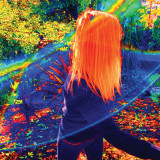
New York City has had a long history of dance music fused with confrontational performance. Whether it came from within the late 70's No Wave canon projected through venues like the Mudd Club or the downtown avant-garde galleries such as The Kitchen, the feeling that influences and infects Brooklyn-based duo Wetware's overall being as a cohesive and confrontational unit is as much enigmatic as it is familiar. Formed in 2015, Wetware eased into its performative role with their live shows around their home base of Brooklyn, NY.
Vocalist Roxy Farman, who's familiar voice was last seen on Drew McDowall's 'Unnatural Channel' album, stole audience's attention from the moment they started, using her body in tandem with her voice as a weaponised vehicle for the band's anxiety filled performance. Matthew Morandi cut his teeth in the electronic music world through his solo tech-industrial project Jahiliyya Fields and partner to Inhalants, the techno collaboration of Morandi and Max Ravitz (Patricia). The synergy that developed between Farman and Morandi has been explosive. Wetware's live antics and behaviour has caused alarm and envy amongst their local audiences, causing Wetware the group to 'not be missed' on any particular bill that they are allowed to take part in.
Wetware stepped out from their live persona and self-recorded a selection of songs that viewers had grown accustomed to and were debuted on the flawlessly curated Primitive Languages imprint. Shortly following their recorded premier was an EP collection of demo recordings on the much praised Bank NYC label. Once the band reconciled with documenting their work, they set out, with the help of engineer Kris Lapke (Alberich / Hospital Productions) to formalise their most recent output in the context of their first full length album entitled 'Automatic Drawing'.
Given Wetware's penchant for endurance, as displayed by their 3 hour long production at Koenig & Clinton Gallery in the Summer of 2017, one would expect the usual restlessness on Wetware's debut full length. All of the apprehension and unease in Wetware seems to have been channeled into a string of cohesive electronic statements found on songs 'Frequent Dreamlands' and 'Ode to Joe'. Industrial dance rhythms bounce around Farman's poetic stance on 'Where Ever You Were', causing flashbacks of an early 80's dystopia that jumps around a confusing, uncomfortable backdrop. Inter-spliced with modular electronic instrumentals like the album's opener 'Pantomime', Wetware's devastating portrait is that of a society in peril.
Search:likewise
- 1: So Much To Live For (Sadar Bahar & Marc Davis Edit) - Myrna Summers
- 2: Lifted Me Higher (Sadar Bahar & Marc Davis Edit) - The Yancy Family
Delivering the second sermon in their Disco Gospel series, Chicago’s Sadar Bahar & Marc Davis hand-pick and re-edit two more under-the-radar disco/gospel fusion tracks for the modern dancefloor.
Both revered selectors and producers, Marc and Sadar are integral parts of Chicago's underground music scene, sharing the city’s spirit with the world. Through his own label, Black Pegasus, and the Chi Talo series, Marc has become an in-demand DJ known for his raw and eclectic sets. He joins forces with good friend, DJ’s DJ and Soul In The Hole head Sadar Bahar, whose name regularly tops the bill at some of the finest clubs and festivals around the globe.
Digging deep once again, the pair serve up two certified secret weapons from their renowned collections. Finding that sweet spot that drew out the most uplifting, powerful, and danceable elements of both gospel and disco, they shine a light on two beauties from Myrna Summers and also The Yancy Family. Tweaked and re-edited with style and consideration, they re-work the tracks with DJs and dancers in mind.
As Robert M. Marovich of Journal of Gospel Music puts it, “The rise of contemporary gospel music in the 1970s and 1980s changed the style, if not the substance, of Black sacred music. Artists, including the Yancy Family and Myrna Summers, worked within the groovy new sound to attract the attention of a generation growing up on rock, jazz, pop, and soul. Bring them into the church through the music, the maxim goes, and they’ll stay for the sermon. Likewise, these two re-edited album tracks by Sadar Bahar and Marc Davis keep the gospel music heritage alive while encouraging a brand-new generation to dance through the church doors.”
Up first, Myrna Summers ‘So Much to Live For’ channels that straight from the heart passion and collective joy that gospel embodies. Bursting with uplifting lyrics, scintillating organ melodies, and an infectious sing-along spirit, Marc and Sadar give it a club-ready DJ edit, extending it for maximum dancefloor deliverance.
The B side sees the duo work their magic on, ‘Lifted Me Higher’. Written by Kevin Yancy and taken from the Yancy Family’s 1989 album From One Christian Family to Another, it features vocals from siblings Kevin, Judy, and Rev. Darryl Yancy, along with Lois Scott. The all-star team of Chicago musicians includes Sherwin (Butch) Yancy on organ, Michael Wade on piano and synthesizer, and Richard Gibbs (longtime accompanist for Aretha Franklin) on piano and bass. With a soulful boogie flavour, dripping in slap bass and ‘80s synthlines, Marc and Sadar rework the intro so it rides out on a section of delectable instrumental grooves, before letting the glorious vocals hit home.
Between flesh and silicon. “Under My Skin” (2026) is the first album by IADI, released by Neo Life. A record like few
others, highly conceptual, cover art included. Its essence lies in the folds of the increasingly ambiguous relationship
between man and machine, where the former designs the latter and, perhaps without fully realizing it, is gradually
destined to adapt and be reprogrammed by it. Each track of “Under My Skin” is, in fact, a sort of interface, connector, or
any other imaginative point of contact between two creative phases, amid emotional impulses and binary calculations.
The sonic architecture oscillates between analog warmth and algorithmic coldness, constructing landscapes in which
pulsating synthesizers and mechanical rhythms seem to question each other. There's no linear narrative, but rather a
progressive immersion in a zone of near-friction, where the comfort of technology coexists with more than a faint
musical uneasiness, like a background noise that never ceases to remind you who's truly in charge. In “Under My Skin”,
the machine is neither an enemy nor a simple instrument: it's a real presence, intimate, even tactile, amplifying desires,
fears, and dreams of dawns beyond the digital realm. Intelligent dance music. Less noise, more sensations. Electronic,
but profoundly human.
The final result, then, is a music project that speaks to the present, yet sounds like an X-ray of the future, capturing that
fragile moment when humanity and technology stop observing each other from afar and begin to merge, track after
track. It's no coincidence that IADI's album opens with “Impulse”, an immediate expression of an electrical impulse, for
both humans and machines, which is also the language of the nervous system, as fast as it is vital—pure energy and
rhythm, a track as intense as it is irregular. And after this introduction, it's the turn of the equally erratic “Axon”, whose
title describes the neuron that transmits the signal over distance, telling the listener to sit back and relax for a new
journey through the notes toward the more melodic “Cortex”. The cerebral cortex, the ultimate seat of thought and
memory, becomes the source from which the musical flow of the first part of the work is drawn.
Then, suddenly, an automatic, or instinctive, response to the constant succession of impulses: “Reflex”, or zerotemperature techno, with a fragmented pace, featuring vocal samples, breaks, and restarts. In the producer's
imagination, the subsequent, and conversely placid, “Neuron” represents the emotional core of the second part of the
work, providing a kind of respite from the seething vibrations. While the neuron is the basic unit of the nervous system,
the synapse is the functional connection point between one neuron and another effector cell, essential for the
transmission of nerve impulses and communication in the nervous system, enabling functions such as learning and
movement. Likewise, a track like “Synapse” once again illuminates the path traced by IADI. The more experimental and
streamlined “Static” instead suggests true ordered chaos. “Dreamstate” is the conclusion suspended in the void, relating
to that dreamlike state between waking and sleeping, where consciousness fades toward infinity and visions begin. Pure
fading into the subconscious. Eternal return to where it all began. Dancing is a form of consciousness. Every beat is a
question. IADI, however, holds all the answers you need.
Nicaraguan-American artist Dagmar Zuniga makes music that feels both intimate and expansive: songs drift like disrupted signals, carried by harmony, tape hiss, and a strong sense of touch. Her debut solo album in filth your mystery is kingdom / far smile peasant in yellow music — written and recorded in New York, Norway, and Athens, Georgia over a period of five years on her longtime companion, the Tascam 424 — was uploaded to Bandcamp and YouTube in January 2025, quickly garnering over two hundred thousand views and the attention of artists such as Mount Eerie, who invited her to tour with them that summer. This year, what was once a jewel of tapped-in algorithms and message boards will meet the world at large, with in filth arriving digitally on March 4, and physically on April 10, via AD 93.
in filth is an atmospheric, devotional collage where one voice multiplies into a chorus of selves, sometimes delicate, sometimes severe; an effect created by Zuniga’s masterful layering of texture and complex harmonies. Synths glitter out like spears of sunlight from beneath clouds of moody, time-distorted guitars, and songs spin about themselves like tightly-wound music boxes, making use of a kind of hypnotic repetition, before melting apart into their components or slipping into the following track.
Zuniga began recording to tape as a teenager, drawn to the physicality of the medium — how a tape recording is fragile, mutable, and alive. Though her ethereal sound may draw easy comparisons to other female pioneers of psychedelic folk, she is influenced just as much by the darker sounds of Syd Barrett and The Fall. Like Barrett, Zuniga is a painter, and she is interested not only in recording music but in creating a full, self-contained artistic universe: she creates her own artwork, merchandise, music videos, and bootleg tapes of new and unfinished music that she exclusively sells at live shows (“If something is not material, it does not exist,” she insists). Her world has not gone unvisited, garnering her a monthly show on NTS Radio ‘World of Pain’, as well as a forthcoming appearance at Rewire Festival in April 2026.
Though Zuniga’s work explores themes of solitude and suffering, the suffering in her songs is not borrowed or displayed; it is held, then opened outward through empathy — an exacting practice of attention that insists on shared ground. Solitude, in her work, is not withdrawal but a starting point for connection. Likewise, over time, her recording process has become increasingly communal, with in filth featuring musicians Hayes Hoey, Austyn Wohlers (Tomato Flower), and Zach Phillips (Fievel Is Glauque). Newer recordings widen the circle even more. For Zuniga, collaboration is a way to “find a place between worlds,” echoing Badiou’s idea of love as a vision refracted through the prism of difference. Meaning emerges there — in the space between voices, between artist and listener. “I hope my music helps people work through difficult experiences,” she says. “The same way it helps me.”
Following her debut album, I’ll Look for You in Others (Past Inside the Present), earlier this year, Patricia Wolf joins Spain’s Balmat label with See-Through, her second album. See Through finds the Portland, Oregon musician and field recordist continuing to develop her signature style of ambient, balancing radiant soundscaping with a carefully expressive sensibility. But the new album is also marked by an important difference. Where I’ll Look for You in Others was largely written in response to the death of a loved one, See-Through represents a kind of rebirth.
“After a long period of grief, I had been hoping to find my way to a place of lightness, peace, playfulness, curiosity, and sensuality again,” Wolf says. “What I was surprised and pleased to find is that for the most part, I had.”
She wrote and recorded many of the album’s songs quickly, in preparation for an August 2021 broadcast on the online radio platform 9128 Live. Excited for the opportunity to play live after more than a year of the pandemic, Wolf decided to write all new material for the event, working with a lean setup of Octatrack, Roland Synth Plus 10, Make Noise 0-Coast, and Novation Summit. (In fact, Wolf was the first sound designer invited to create patches for the Summit.) She also picked up an acoustic guitar that her brother had loaned her. “I decided to take the surrealist approach of ‘pure psychic automatism’ to see what poured out of me,” she recalls. “Woodland Encounter,” “Under a Glass Bell,” “The Grotto,” “The Mechanical Age,” “The Flaneur,” and “Psychic Sweeping” are all products of those sessions; the through line holding them together is their exploratory spirit and clarity
of vision.
Other songs, like “A Conversation With My Innocence,” “Recalibration,” and “Psychic Sweeping,” wrestle with the traumas of the preceding year. Though they may linger on the heaviness of loss, Wolf says, “What I discovered is that a stronger archetype had grown inside me to steer my emotions and thoughts to a better place.” Likewise, “Wistfulness” and “Upward Swimming Fish”—her first experiments with VST synthesizers—balance the bittersweet embrace of melancholy with the freedom to choose happiness.
“Pacific Coast Highway,” the album’s lone song with drums, might at first seem like an outlier. But it also signals Wolf’s interest in finding a fusion between the introspection of ambient and the togetherness of beat-oriented music. “Experiencing loss and isolation is what drove me into gentler territories of sound,” she says, “but I want to start making more beat-oriented music. After an extended period of loss and isolation, I’m ready to experience more joyous and social things.”
Listeners with keen ears might recognize the album’s closing song, “Springtime in Croatia”: A different mix of the song originally appeared on the 2021 digital compilation secondnature & friends Vol. II, from the Seattle label secondnature. This marks its first appearance on vinyl, however, and its spiritual home is undoubtedly here, at the close of See-Through. As the bookending answer to the opening “Woodland Encounter”—another song in which field recordings play a crucial role—it closes the circle of an album that is itself keyed to the steadily turning cycles of life.
R.i.O. welcomes a new member. Straight in full length. An album created by Dorsten,North-Rhine-Westfalia based producer Aroma Von Troisdorf - a man who refuses to be putin a box. Unlike others, who politely stay in one lane, he is a tuneful shape shifter. Alreadyhis 2021 debut on the Cologne based label Papercup Records smashed Krautrock, Synthpop,Electro, Ambient, and dub together. His 2023 and 2024 Papercup Ep's "Buttergolem"and "Rodeln am Rhein" added Italo-Disco, Synth-pop and a drop of experimental Electroto his versatility. Now eight new creations, brilliantly composed, yet - even in odd flashes -effortlessly catchy. They bring once more a stylistic melting pot, now enlarged with TheCure-ish dreamscapes, stretching over guitar riffs and bass grooves, like in the closingambient-folk star "Zeiten" or the dreamy opening track "Fog Frog Green". There is themotorik krautrock pulse of "Osmopower", that boogies heavy in drum machine hypnosisunder Aroma's entrancing new-wave vocals. Tunes like "Dreams Unfold" or "AmplifyShrooms" are likewise propulsive, each one psyching in its very own rhythmic sector. Morevoices are present too. In the two-minute manic preacher "Colas", were Togolese rapperand political activist Yao Bobby chants edgy. Or in "Closer", where singer Aprico sendsspoken-word trances echoing through the cosmic jacking. And there is "Lovers Lake", ahypnotic drift of witchy vocals, bluesy chords, and endless synthscapes, that makes youswim on your feed. Shift the shapes, "Blaumilch" opens the gates.
For our ninth offering we have ventured out of our small but fertile swamp in search of another source of magick. Meandering across boggy pastures new, we crossed paths with Steevio, who sat hovering serenely in the fern covered shade of a nearby valley. Instantly recognising the singular vision of this fabled artist, we hastily gathered our nets and cast them under Steevio’s branches, capturing four beautiful offerings as they wriggled towards us. Upon the return to our mulch, it became clear that we could not contain Steevio’s creations, so willful was their vitality. It was therefore all we could do to release them back to the universal dance from whence they came.
The dance germinates with the writhing polyrhythmic ‘Apricity’. Hearing the crunch of frost laden grass beneath our webbed toes, we look above us to search for the sun. Angular beams of light escape over the horizon, as the warmth of Steevio’s machines coalesce. A glistening hi hat breaks through the membrane to bind his creation and anchor its ever shifting arms.
‘Octopus’ glides gracefully through a sun-dappled kelp forest. Sub frequencies rumble up from the shadowy darkness below, rippling along the fronds as they ascend. As the ocean begins to churn, a wriggling melodic tentacle parts the foliage, gleaming with primordial energy. Its joyful visit to the surface realm leaves us with a brief yet powerful reminder of the mystery beneath.
The glow of the midwinter sun warms our bones on ‘Apricity (Sunrise Mix)’. Percussive elements bubble out of the depths, forming intricate cascading patterns as they grow over the perfectly formed kicks. The moog filter tames the brew with Steevio’s intuitive restraint , until he releases its mighty power upon the gleeful forest dwellers, to their rapturous gratitude.
With ‘Adref’ we return home. The sedate tempo provides oceanic space for a melody which inhales and exhales over a familiar landscape of perfectly tuned percussion. With each breath the melody seems to increase its reach, until it’s buried deep within our bones, its memory resonating on long after it’s gone.
Steevio’s music reflects the universal moments where seemingly chaotic and disparate elements are suddenly revealed to be perfectly harmonious. Of course examples of this are always universally present in nature, and have been eternally, but we have to be reminded to appreciate them. In the same way that a wave deposits a perfect line of shells on a beach, dew freezes on grass, or individual strands of mycelial hyphae bind together to form incredible patterns, Steevio’s music is likewise; effortlessly considered. For us, it has more in common with the unrelenting flow of a river than it does with dance music. It is psychedelic music in the same sense that nature is intuitively psychedelic; without ever leaning into any tried tropes of what is culturally considered ‘psychedelic’ music.
Interception, the second long player from Jensen Interceptor following 2018's Mother, is something of a state-of-the-nation that finds Melas consolidating several eras of his career, past and present, to form a distinct new sound that is the most experimental work he has produced to date.
In 2024, a freak accident at an event he was playing left him with multiple broken bones in his foot. The forced downtime became an opportunity for introspection, allowing him to revisit earlier projects and explore new musical territories. Blending his signature electro with genres such as IDM, footwork, and baile funk, Melas used this recovery period to fuse old influences with fresh global sounds. "Since I started making music I've always made music geared towards use in my DJ sets but there's always been an urge to explore the deeper side of electronic music.
That time off after the accident gave me the space to dive into genres and really experiment.
" The accident came at a time when he had already spent time, like so many others though the COVID-19 pandemic, assessing his next move. A full tour schedule had left him feeling constrained by the limitations of working in a single genre. As such, Interception is the end point of this reassessment and the start point of what Melas sees as the next stage of his musical evolution.
"I really wanted to challenge and, I guess, prove myself in other spheres, to take my music to a new place. I've never wanted to be too repetitive and found that expectations, imagined or real, were forcing me to get stuck on a specific sound both in my productions and DJ sets." This renewal is reflected in the title of the album, which eagle-eyed fans will note is the same as the first EP that was released under the Jensen Interceptor moniker, and the emotional and personal nature of the LP is likewise mirrored in the abstract impressionism of the artwork created by fellow Australian, Brodie Kaman, the artist behind the visual look of Lady Gaga's recent Mayhem LP as well as works for FKA Twigs, Nine Inch Nails, and more.
The design-resembling oil drifting across a microscope slide-uses a mix of vivid pastels and moody darks to express the album's emotional depth: a collection of distinct elements coalescing into something richer and more evocative.
A little background info….
Miss Aranivah was previously released (in 2021) on the Ska Fever vol.1 EP (OGR806). It’s had a slight re-mix / re-master and it’s proved very popular in the live set that I’ve been playing with Junior Dell at Ska and Reggae festivals in Europe.
Likewise, the B-Side has gone down very well live and we re-recorded it with Junior Dell on vocals (he did not appear on the original version which appeared on Reggae Dynamite vol.1 back in 2020).
Facta and K-LONE’s Wisdom Teeth imprint returns to the V/A format with ‘Pattern Gardening’: a new collaborative project that leans head-first into the label’s love of minimal-, micro- and tech-house, carving out the label’s distinct, contemporary take on the sound - one that swims between warm, bleepy, rolling, dubby, psychedelic and bass-heavy channels across its duration. The vinyl sampler brings together 6 highlights from the wider 22 track digital project. Wisdom Teeth heads Facta and K-LONE appear alongside longtime label associate Lurka and new signees Polygonia, rRoxymore, Sub Basics and Jichael Mackson.
By now, Wisdom Teeth and its founders are well known for their unabashed love of minimal and tech house, which - alongside ambient, UK club music, experimental electronics and a broad palette of other influences - makes up a key cornerstone of their distinctive sound. The duo’s DJ sets often see them mixing ‘00s gems from labels like Perlon, Mosaic, Minibar and a:rpia:r with more contemporary club sounds, creating a hybrid style that sits somewhere between Balearic terraces and dark UK club basements. Likewise, the label has become known as a go-to outlet for artists occupying a similar crossover space, with names like Jorg Kuning, Parris, Steevio, Duckett, Leif and LUXE all known for pushing house and techno into experimental and refreshing new territories.
‘Pattern Gardening’ follows loosely on from the label’s previous V/A releases ‘To Illustrate’ (2021) and ‘Club Moss’ (2023), which explored downtempo (100bpm) and uptempo (150-170bpm) styles respectively. Here, the focus is fixed on lush, groovy, quirky 4x4 jams, joining the dots between a global spread of producers that bring new energy and perspective to these well-explored frameworks.
As is always the case with Wisdom Teeth’s output, the results fit somewhere between the club and a more contemplative, home-listening headspace, with texture, melody and mood afforded as much significance as rhythm and functionality.
The artwork features photography by Hong Kong-based photographer Jimi Chiu, who captures seemingly ordinary corners of city life in glossy, cinematic detail.
Hard piece of stepping digital from 1989 with the masters of the era on the rhythm track, Steely & Clevie. Likewise, Conroy is one of the iconic artists of the late '80s digital era with numerous classics to his name.
“Only those who will risk going too far can possibly find out how far one can go.” a sage modernist poet previously whispered. And here we go, far out and yet so near, the third edition of “Risks Issues Opportunities” brings frontier reverberations scratching at the edges of dance, pop, downbeat, and other trance- portive sectors. Eight fast/slow propelling tracks. Adventurous, full of grandeur, gratifying the dance floor while equally winning the relaxation zones. Pure emotions crafted by newcomers. There is Milan’s Tagliabue, trancing slow and insightful. Or Cologne’s Grischerr, eloquently Tolouse-Low-Traxing. Some go down the slow burning road, where rhythms hang low, and suspense is in full show. Like London’s Frank Rodas, Garnu Depot from Iran, or Xei Ju from the islands of Micronesia, striking all ears with ghostly transcendental percussive science. An autumnally global voyage, which likewise offers industrialized districts by Italian producer Federico Cassetta, Metropolis minimal wave pop by Japanese musician Saeko Killy, or odd swamp funk by Chilean/German duo 7697 Miles. They all show, how far you can go, without losing your distinct flow.
Two And Half Records said goodbye to the A-B side and welcomes the DANCE and LISTEN side. the first of a series of Various, 6 Artists or in this case 7 with the swiss duo Quismi, Groenogen, ILyes and Venetia from France, Curios from USA and Riccardo Buccirossi with a new alias EAE. 6 Energetic tracks, some fresh Housy sound to enjoy on the dance floor, likewise to sit back, listen and get carried away by the electronic wave.
One of Drumcode's solid MVP's Wehbba comes strong with a sci-fi themed trio of tracks to kick off 2023.
The Brazilian enjoyed another stellar year in 2022, with highlights include the excellent 'Dynamo' EP on Drumcode in April, a contribution to A-Sides ‘The Next Step' and collaborating with Adam Beyer to remix the classic Planetary Assault Systems cut ‘In From The Night’.
He likewise played Drumcode's WHP, our NYC event at Avant Gardner and Drumcode São Paolo to round out the year.
His latest EP on Drumcode ‘Premonition’ is an atmosphere-rich, intergalactic-themed trip that plays out deliciously over three cuts. The title track is imagined as a kind of travel through space and time, propelled by sci-fi synths, Wehbba’s trademark full bodied basslines and a cleverly placed sample from a David Bowie interview.
‘The Message’ is a dynamic beast of a track driven by robotic synth stabs, a catchy melodic riff and memorable vocal refrain ‘Mars Needs Women’ sampled from a 1950s sci-fi film. It has all the ingredients to be another classic addition to Wehbba’s discography. ‘Inertia’ is led by a hypnotising riff that builds over six minutes.
“I love to play this track after a series of rave bangers to keep the energy levels up while taking people on a trip,” shares Wehbba.
Part 2[14,08 €]
A rare treat for Drumcode faithful: A-Sides Vol.10 is set to drop in December, the second edition of the beloved series to come in 2020.
Fuelled by the extra time and space to be creative during lockdown, Drumcode’s collective of artists have stepped up. Across 17 contributions, the producers have gone deeper into their sonic repertoire, crafting powerful, yet reflective works that capture the range of the label’s sound.
Jay Lumen leads the way with a rousing riff-driven weapon, ‘Galactic Rainbow’, while Ramon Tapia brings us the muscular gem ‘Drum Control’, mixing up ruffneck techno with a barrage of synapse-tickling synths in the second half. Both rousing highlights of the compilation.
Victor Ruiz, Drumcode’s most prolific contributor in 2020, dishes up ‘Love Story’, led by a huge vocal lead. Zimmz also returns with ‘Tension’, which deftly combines deep squelchy grooves with a silky synth interlude. Thomas Hoffknecht follows up his debut on Vol.9 with ‘Escape’, keeping listeners on their toes with dynamic, choppy shifts throughout. Veerus joins with another stirring addition ‘I Know’, reinforcing why Beyer rates him so highly.
Elsewhere a string of debutants feature: buzzy newcomer Lilly Palmer gives us ‘Amnesie’, a brilliantly pummelling and eerie cut; Alex Lentini & Stomp Boxx serve up ‘Expanders’ mixing up drone effects, trippy vocals and an unsettling melody line; and Patrik Berg’s ‘Activated’ is full-bodied techno that drops down into funky rhythms.
Long-time DC family member Bart Skils brings his A-game with the thrilling no-nonsense ‘Solid State’ that hits like a steam train. Likewise, Alan Fitzpatrick who brings a momentous slab of techno energy with ‘Rochus’, while Thomas Schumacher, now feeling like a regular on the imprint, crafts another dark techno opus, this time in collaboration with CAITLIN.
There’s even a special appearance by the chief Adam Beyer, who makes a welcome return with the progressive-tinged ‘Changes’, driven by organic tones and spacey atmospherics. The track stands as his first original contribution to A-Sides since 2017.
Conform Re-Touched Series has delivered other 5 gems to collect with the Vol.IV! The result is brilliant thanks to the contribution of great artists such as Radio Slave, Honey Dijon, Mark Broom, Adriana Lopez and Shlomi Aber.
When it comes to Radio Slave, no one can ever remain indifferent to the quality of Matt Edwards' production. Once again it has hit the mark by re-interpreting "Inside" by Gaetano Parisio in a masterly way. The track is a continuous crescendo but always well anchored to its original groove. The great British producer, Mark Broom, once again leaves no doubt about his ability to create real dace-floor killers. Seems that his edit was created to challenge the sound systems of all clubs around the world. It is the dream of all DJs to play a track of such impact during a party. His version remains faithful to the original but it has that broomish which makes it super catching.
Honey Dijon, an absolute star in the world techno firmament, makes her debut on Conform with her Re Rub interpretation of a classic like Dual Ep by C&G Southsystem, the project created by Gaetano Parisio and Marco Carola. Honey puts all of her Chicago background into this version. By adding vocal she manages perfectly to make two such different schools coexist, the Neapolitan one and the Chicago one. The result is simply sublime.
Likewise, it's a debut on the label also for Adriana Lopez absolutely respected throughout the techno scene for her extreme quality music. Her interpretation leaves no room for doubt that she doesn't like middle ways. Her remix is dark and hypnotic at the same time. Adriana gave her best and the delivery is just outstanding.
The grand finale takes place with the digital bonus track. Ben Sims "Carnival part one" re-edited by Shlomi Aber. This is definitely the icing on the cake! If you are a DJ you'll immediately desire to play this track as soon as possible. His edit it's just perfect leaving intact the original vibe of the English legend's track. Its tribal groove echoes the early 2000s sound. For those who love the genre this is unmissable.
fortunea starts their 2021 release schedule with a new 4 tracker this february. Peletronic is featured on this record and he shows again his love for detail.
‚About The Void‘ is a composition with an arc of suspense. The eerie pads and strings are in control by an imposing hypnotic groove that will guide the listener to the dancefloor.
As a guest remixer they hired none other than Stuttgart’s deep house expert Soulphiction. His take on the title track is placed on A2 and uses the elements of the original in a clever way. The groove is even more thrilling. And a female vocalist gives the track a femme fatale like character.
Peletronic delivers us his lo-fi house ‚Experience‘ on the B-side. Of course with a typical 909 kick drum, shuffled hihats and a purposely raw filtered jazz sample in loop. Intringuingly and playful likewise.
At last the record ends with the track ‚Paixão‘, which means „passion“ in portuquese. And you can clearly hear his passion for experimental latin influenced dub house in here.
The record is limited to 300 copies. There will be no repress! First come, first serve.
Mastering by Patrick Pulsinger.
- I'll Be There
- Something
- We've Only Just Begun
- Hot Pants
- Make It With You
- Luv Bugg
- Wah Wah Man
- Queen Of The Nile
- Blood In The Streets
- Save The Day
The album opens with a swinging version of "I'll Be There." The groove is up-tempo, slippery and almost gospel in intent, it's simply breathtaking.
Likewise, an extended version of George Harrison's "Something," is a blissed-out mind-bender.
Other covers, such as "We've Only Just Begun," and Bread's "Make It With You,"
The band has been sampled over 200 times, most often in the hip hop genre.
Born Again is available as a numbered limited edition of 750 copies on crystal clear vinyl and comes in a gatefold
The Alan Parsons Project / Joe Claussell
The Voice / I Wouldn’t Want To Be Like You (Joe Claussell Mixes)
Leave it to Joe Claussell to tap into our current collective artificial intelligence anxiety and render the racket divine. Alan Parson’s 1977 I Robot—the LP from which these two new edits were culled—was a harbinger for all the technological sheen and humanistic distress that was to come. Drawing from heady science fiction and even headier musicality and studio sophistication, ’The Voice’ evoked Jeremy Bentham-like omniscient surveillance, while the original ‘I Wouldn’t Want To Be Like You’ explores the ambivalent rift in perspective between the two poles of flesh and metal. For Claussell, the dichotomy leaves more unanswered questions and artistic possibilities, for the truth is always tangled and ripe for potential. Our bodies are propelled by the same electrons which accumulate in capacitors; our hearts, as Milford Graves was so enthralled, likewise transmit the same electric impulses which not only sustain our bodies but soundtrack our eternal, internal rhythm. These edits, with their strings, synthesizers and distortion-ravaged guitars, are protracted to dynamic sublimity, and seem aware of this seemingly opposing dynamic. Claussell, himself a lifelong proponent and interrogator of man’s relationship with mechanized rhythm and sound, leaves our earthly toil and unease behind for something greater, something yet unnamed, shared between us all at our finest. It's almost a feeling you can touch in the air…
Shadows Lifted from Invisible Hands is an autobiographical record, comprised of four songs that Hoff refers to as ambient media. Each track is composed from sources drawn from his own involuntary aural landscape, specifically musical earworms and tinnitus frequencies.
Neither sound nor a daydream, the earworm (or stuck song) emblematizes music as a commercial form—immediate, ubiquitous, and persistent. Likewise, tinnitus is inaudible and unscrupulous, manifesting across a spectrum of frequencies at will. The cognitive swirling of these phenomena provides an ambivalent, internal soundtrack that scores a person’s movement through the world.
Those suffering from tinnitus or those who have grown accustomed to the “Tinnitus Effect” in movies will likely recognize the buzzing pitches on the record, but will likely not recognize the songs. Distorted and distilled, Shadows Lifted from Invisible Hands features altered versions of four commercial pop songs: Blondie’s “Heart of Glass,” David Bowie’s “Space Oddity,” Madonna’s “Into the Groove,” and Lou Reed’s “Perfect Day.”
Having been haunted by these songs on and off for years, Hoff tweaks the tracks, transposing and recomposing them for orchestral instrumentation. Speaking back to these involuntary echoes, these tracks go to great lengths to obfuscate their sources; to be sure not to simply re-introduce each earworm, as though they were samples. Otherwise, what’s the point? No one needs another stream.
Besides, earworms are not music, although we perceive them as such. They are non-cochlear and exist as an affective force that is neither subjective nor objective, which is to say they are an invasive—and alien—phenomenon. Like tinnitus, they are aggravated by economic, social, and environmental forces as well as emotional states, mental health, and aging. Hoff doesn’t underplay his own struggles with mental health in discussing the record—noting a long history of depression and its acuteness over the last few years, which serve as the backdrop to the composition of this record.
Scratch any pop song hard enough and you’ll find sadness underneath it. Subdermal, the songs on this record evoke a type of ephemeral weariness and despair. By recasting the original songs through their shadowy doubles, Hoff provides a window into the dark core of pop music. At the center of which lies capitalism’s desperate attempt to replicate itself through a cheap high built on echoing refrains. Just below the surface the listener finds a hangover of shadows dancing through the mind.
Stepback Records is proud to announce the highly anticipated release of Jacksonville's new 12" vinyl, Oracle Memory EP.
Jacksonville is an electronic artist whose work spans multiple genres, creating music that’s designed for clubs and dance floors. With previous releases on labels such as Atmospheric Exsistence and Chez Damiers Balance Alliance imprint Jacksonvilles roots run deep.
With Oracle Memory EP, Jacksonville takes listeners on a journey of low end perfection, blending elements of house, electro and bass music genres.
Produced by Chris Lyth (Jacksonville), Oracle Memory EP was crafted with vinyl in mind with an analog warmth throughout each track. Likewise master and cut comes courtesy of Optimum in Bristol for the absolute best sound quality possible.
The song sets the tone of this album. A simple structure, over which a web of rhythm is woven using an instrumentation of old drum machines in dialogue with live drums and percussion. Lots of sax, tenor and baritone! A pumping bass. A frisky pizzicato violin. And some classic keyboards: the Fender Rhodes, the Hohner Clavinette D6, the L-100 Hammond organ. And lots of analogue synthesisers: a rippling Juno-106 marks the path to follow, which is crossed with phrases from other museum pieces: Crumar's Stratus, Farfisa's Synthorchestra, Sequential's Prophet-10. Or still the Casio Club M-100, which is basically a toy, but has been subtly colouring SKC's songs for years!
SKC has often dived deep into the repertoire of artists he holds in high esteem, looking for pearls, forgotten or not, to work on. Likewise on this album with versions of songs by Prince, Dez Mona, Alain Bashung…
- A1: Concierto De Aranjuez
- A2: Will O’ The Wisp
- B1: The Pan Piper
- B2: Saeta
- B3: Solea
Miles Davis' Final Collaboration with Arranger Gil Evans Yields Watershed Innovations: Flamenco-Themed Sketches of Spain Spins Graceful Webs of Sound and Emotion Mobile Fidelity's UltraDisc One-Step 180g 33RPM LP Set Brings Out the Record's Full Spectrum of Color: 65th Anniversary Edition Pressed at Fidelity Record Pressing and Strictly Limited to 5,000 Numbered Copies 1/4" / 15 IPS analogue master to DSD 64 to analogue console to lathe Miles Davis and Gil Evans bridged styles and collaborated on high-concept projects three different times during their celebrated careers. For their final act, they created Sketches of Spain, a peak moment in each luminary's legacy.
The transformative album weds Spanish themes, lush orchestrations, romantic timbres, and Davis' lyrical methods in a tender ceremony that resonates more than six decades after its original release. Part of Mobile Fidelity's Miles Davis restoration series, this 1960 landmark has been afforded the ultimate white-gloves treatment for its 65th anniversary. Sourced from the original master tapes, strictly limited to 5,000 numbered copies, and pressed at Fidelity Record Pressing, this UltraDisc One-Step 33RPM 180g LP set dramatically expands the soundstages and eradicates a dryness that many critics found inhibitive to the record's enjoyment. You can now hear the full-range responsiveness of the woodwinds, strings, and percussion, all of which come alive with superior definition and detail.
The beautiful presentation of this UD1S set befits the record's historical importance. Housed in a deluxe slipcase, it features a special foil-stamped jacket and faithful-to-the-original graphics that illuminate the splendor of the 1960 LP. This reissue is made for discerning listeners who desire to fully immerse themselves with the album. And who wouldn't want to go deep with Sketches of Spain? Whether it is the somber mood piece "Concierto de Aranjuez," renowned for Davis' flugelhorn performance, or the folktale-based "Solea," Sketches of Spain transfixes with playing, ideas, and innovations exclusive to this incomparable effort. It's one reason why Mobile Fidelity's engineers took all available measures to insert listeners into the space originally occupied by Davis, bassist Paul Chambers, drummer Jimmy Cobb, percussionist Elvin Jones, and an 18-piece orchestra. The results are as breathtaking as the music.
Multi-note motifs, brief improvisational solos, fanfare sweeps, and contrapuntal exchanges inform flamenco-spiced pieces. Davis' famous Harmon-muted trumpet is complemented by an assortment of bassoons and French horns. Heard together, they create pleasing contrasts and sounds (pp, mf, ppp) that get to what resides at the heart of Sketches of Spain: color. Seldom, if ever, did Davis ever so expressively and liberally paint with color. And in Evans, he has a likewise-minded partner to help draw out tones, shades, layers, and textures. What they achieved continues to draw praise from the global music community in the 21st century. Ranked #358 on Rolling Stone's 500 Greatest Albums of All Time, deemed "a work of unparalleled grace and lyricism" by noted scribe J.D. Considine, bestowed a five-star review from DownBeat, and noted by Q to have taken "jazz in a new direction," the Grammy Award-winning effort has never been better.Miles Davis' Final Collaboration with Arranger Gil Evans Yields Watershed Innovations: Flamenco-Themed Sketches of Spain Spins Graceful Webs of Sound and Emotion Mobile Fidelity's UltraDisc One-Step 180g 33RPM LP Set Brings Out the Record's Full Spectrum of Color: 65th Anniversary Edition Pressed at Fidelity Record Pressing and Strictly Limited to 5,000 Numbered Copies 1/4" / 15 IPS analogue master to DSD 64 to analogue console to lathe Miles Davis and Gil Evans bridged styles and collaborated on high-concept projects three different times during their celebrated careers.
For their final act, they created Sketches of Spain, a peak moment in each luminary's legacy. The transformative album weds Spanish themes, lush orchestrations, romantic timbres, and Davis' lyrical methods in a tender ceremony that resonates more than six decades after its original release. Part of Mobile Fidelity's Miles Davis restoration series, this 1960 landmark has been afforded the ultimate white-gloves treatment for its 65th anniversary. Sourced from the original master tapes, strictly limited to 5,000 numbered copies, and pressed at Fidelity Record Pressing, this UltraDisc One-Step 33RPM 180g LP set dramatically expands the soundstages and eradicates a dryness that many critics found inhibitive to the record's enjoyment. You can now hear the full-range responsiveness of the woodwinds, strings, and percussion, all of which come alive with superior definition and detail. The beautiful presentation of this UD1S set befits the record's historical importance. Housed in a deluxe slipcase, it features a special foil-stamped jacket and faithful-to-the-original graphics that illuminate the splendor of the 1960 LP.
This reissue is made for discerning listeners who desire to fully immerse themselves with the album. And who wouldn't want to go deep with Sketches of Spain? Whether it is the somber mood piece "Concierto de Aranjuez," renowned for Davis' flugelhorn performance, or the folktale-based "Solea," Sketches of Spain transfixes with playing, ideas, and innovations exclusive to this incomparable effort. It's one reason why Mobile Fidelity's engineers took all available measures to insert listeners into the space originally occupied by Davis, bassist Paul Chambers, drummer Jimmy Cobb, percussionist Elvin Jones, and an 18-piece orchestra. The results are as breathtaking as the music. Multi-note motifs, brief improvisational solos, fanfare sweeps, and contrapuntal exchanges inform flamenco-spiced pieces. Davis' famous Harmon-muted trumpet is complemented by an assortment of bassoons and French horns. Heard together, they create pleasing contrasts and sounds (pp, mf, ppp) that get to what resides at the heart of Sketches of Spain: color. Seldom, if ever, did Davis ever so expressively and liberally paint with color. And in Evans, he has a likewise-minded partner to help draw out tones, shades, layers, and textures. What they achieved continues to draw praise from the global music community in the 21st century. Ranked #358 on Rolling Stone's 500 Greatest Albums of All Time, deemed "a work of unparalleled grace and lyricism" by noted scribe J.D. Considine, bestowed a five-star review from DownBeat, and noted by Q to have taken "jazz in a new direction," the Grammy Award-winning effort has never been better.
- 1: Coyote
- 2: Amelia
- 3: Furry Sings The Blues
- 4: A Strange Boy
- 5: Hejira
- 6: Song For Sharon
- 7: Black Crow
- 8: Blue Motel Room
- 9: Refuge Of The Roads
Mobile Fidelity's UltraDisc One-Step 180g 45RPM 2LP Set Plays with Authoritative Tonality, Airiness, and Clarity:
Pressed on MoFi SuperVinyl and Strictly Limited to
3,000 Numbered Copies
1/4” / 15 IPS Dolby A analogue master to DSD 256 to analogue console to lathe
Joni Mitchell is the only artist who could’ve made Hejira. The legendary singer-songwriter said as much when discussing the album decades after its release. Yet that fact seemed obvious from the moment the gold-certified effort streeted in fall 1976. An adventurous travelogue, probing narrative, and offbeat homage to freedom, Hejira remains an inimitable entry in the catalog of recorded music — a spare, gorgeous, meditative series of sonic vignettes comprised of floating harmonic pop, cool jazz, soft rock, and sensitive vocal elements that beckon feelings of motion, discovery, and self-examination.
Sourced from the original analog master tapes, pressed at Fidelity Record Pressing on MoFi SuperVinyl, and strictly limited to 3,000 numbered copies, Mobile Fidelity's UltraDisc One-Step 180g 45RPM 2LP set presents the record ranked the 133rd Greatest of All Time by Rolling Stone with definitive detail, richness, accuracy, and directness. Marking the first time the revered LP has received audiophile treatment, it's one of six iconic 1970s Mitchell records Mobile Fidelity is reissuing on vinyl and SACD.
Playing with a virtually nonexistent noise floor, dead-quiet surfaces, and superior groove definition, this collectible reissue reproduces in enveloping fashion the tones, textures, and craftsmanship that help Hejira function as the equivalent of a liberating trip down an open road with nothing but blue sky, natural landscape, and fresh air in the immediate vicinity. Passages bloom, carry, decay as they do amid an acoustically optimized environment. Soundstages extend far, wide, and deep, with black backgrounds and pinpoint images adding to the realism.
The reference-grade immediacy, airiness, and presence put in transparent perspective Mitchell’s dense strings of words, stream-of-conscious-like phrasing, and unhurried albeit forward momentum. Likewise, the instrumental contributions of her A-list support musicians — a cast that includes L.A. Express members John Guerin, Max Bennett and Tom Scott, plus Neil Young, Victor Feldman, and Abe Most — emerges with breathtaking clarity and dimensionality.
While Mitchell, whose intimate vocals and abstract guitar parts center everything, Mobile Fidelity's restoration of Hejira further reveals the visionary breadth of guitarist Larry Carlton and bassist Jaco Pastorius. Though heard on only four tracks, Pastorius' fretless bass epitomizes the fluid, subtle, flexible, roomy, and shape-shifting characteristics of songs that often appear to transpire out of nowhere akin to the formation of a puffy cumulus cloud overhead. In sync with Mitchell’s voice, Pastorius’ fusion hovers and floats, suspended in a fog you want to deeply inhale. The "grace notes" Mitchell desired on Hejira can now be heard in full. Ditto the luxurious tapestries of alinear lines, fills, and supplements unreeled on Carlton’s six-string.
Visually, the packaging of this UD1S set complements its identity as the copy to own. Housed in a deluxe slipcase, the LPs come in foil-stamped jackets with faithful-to-the-original graphics. This version is for listeners who desire to become immersed in everything about Hejira, including the unforgettable album cover — a pastiche of 14 different photos Mitchell used a Camera Lucida to assemble into one image that’s anchored by a portrait of her in a stoic pose — and the interior shots of Mitchell skating on a frozen Wisconsin lake wearing a pair of black skates, black shirt, and fur cape.
The notion of skating, feeling an awakening wind whipping against your face, and losing yourself to the surroundings are extremely apt for Hejira, which Mitchell wrote after a sequence of trips and relationships prompted her to reflect on the complicated conflicts between independence and marriage, success and satisfaction, duty and desire — and, more specifically, “the cost of being a woman.” The Canadian native delved into such themes before. But never as she does on Hejira, whose liberating, running-away aura doubles as another of Mitchell’s rejections of tradition as well as a suggestion of a better alternative.
At once observational and personal, expansive and insular, cheerful and poignant, Hejira spans a sea of human conditions, emotions, and circumstances. It addresses drifting, isolation, pleasure, place, time, and surroundings with strikingly poetic discourse matched with music that, save for the crooned ballad “Blue Motel Room,” forgoes conventional structures and choruses.
The jazz-based arrangements, marked by scaled-down percussion and all manner of bent, rounded, and unsettled notes, hint that Mitchell has no exact destination in mind. Excursions such as the moody “Furry Sings the Blues,” funky “Coyote” and edgy “Black Crow” throw open previously locked doors to possibility and journey. They signal it’s time for a welcome departure from norms and the past, one that leads to a heightened sense of clarity and perspective. Or, as Mitchell said upon choosing the album title, it’s time for “leaving the dream, no blame.”
- Apartment Life
- The Machinist
- The Men Are Fighting
- Lakeland
- Seven And Seven
- Over & Over, Pt. 1
- Bells And Bells
Fit for Consequences: Original Recordings, 1984–1987 is the first ever archival release from Repetition Repetition, the “two-man electric minimalist band” consisting of Ruben Garcia and Steve Caton hailing from Los Angeles in the mid 1980’s. Repetition Repetition’s unique blend of cosmic art-rock minimalism / maximalism was self-released across a series of cassettes produced in micro editions, and while garnering the attention and participation of luminaries such as Harold Budd, remained under the radar during the band’s existence. Fit for Consequences: Original Recordings, 1984–1987 collects select material from across the duo’s catalog.
It was over a plate of Mexican breakfast food when Ruben Garcia and Steve Caton first told Harold Budd of Repetition Repetition and the worlds they intended to explore by respective way of synthesizers and guitars --- a rendezvous instigated by the former’s fan mail to the legendary composer. If the upstarts entered this restaurant from a one-way street of admiration, they would leave with not only Budd’s interest but, sometime later, a blessing in the wake of many hours shared by the three in Garcia’s Los Angeles home recording studio: “This is going to be difficult, but God help them, I think they’re great,” noted Budd in a USC lecture in 1985. Now several degrees removed from prior rock music aspirations, the real game was afoot.
Between 1984 and 1988, Repetition Repetition operated within something akin to the underground of the experimental underground, although even that designation perhaps overstates the case. The duo’s sparse output consisted of three cassettes self-released on Garcia’s Third Stone Music label: Repetition Repetition (1985), Lakeland (1987), and The Machinist (1987). Their songs would also be included during this period on Trance Port Tapes’ vital scene-scanning compilations assembled by A Produce. Live performances occurred with similar infrequency, but Garcia and Caton counted converts in quality over quantity, numbering among them the aforementioned Budd, a Chambers Brother, and, judging by a memorably drop-jawed reaction following a rare Repetition Repetition gig, Jackson Browne.
Likewise, critical support materialized in the form of KCRW deejays Brent Wilcox and Dean Suzuki, whose steady airplay positioned Repetition Repetition’s music amidst fearless company like Jon Hassell, Hiroshi Yoshimura, and Richard Horowitz. Yet, to hear fellow Trance Port featured players like Tom Recchion and Bruce Licher of Savage Republic tell it, Garcia and Caton moved as ghosts --- a notion more vexingly endorsed by the silence of record companies that failed to come knocking --- and therein lies an overarching truth to the work itself.
Journey to the heart of Repetition Repetition and one discovers a collective ear impossibly attuned to the hypnotic possibilities of stylistic convergence, the resulting music possessed of seamless multimodalities which beckon to a glimmering plane of the disembodied. Where Caton sought his artistic fixes at an intersection of popular genres, Garcia zoned in on the sonically spare, drawing from the same wellspring as the Enos and Rileys of his personal avant-garde pantheon, and in their coming together the two tapped into a deeper cosmic source. Synthetic walls of keyboard sound in forever states of reprise met waves of shimmering --- and at times even punishing --- guitar in reply, their soundscapes hovering convincingly between, as suggested in fittingly dualistic fashion in a press kit assembled by Garcia, such disparate sensations as bird flight in one song and oil drilling in the next.
But don’t call it a push-pull dynamic, as this was a creative partnership founded upon fluidity and organicism by way of, naturally, repetition. In contrast to, say, the Bressonian ideal of repetitive motion as a great stripping away, the concept in the hands of Garcia and Caton equated to ascendancy via continuous unfolding, a maximal route to minimalism. To be sure, their recording philosophy morphed over the course of the act’s short history, and what started as a process defined by consistent in-person interplay developed into a more isolated method formulated by Garcia, who eventually took to his own one-man bedroom-studio sessions in order to fully chart any and all potential ostinato-loaded paths which he could travel down, the Tascam-captured resonances subsequently provided to Caton as blueprints from which to take flight himself, adding layer upon layer of steel to the proceedings.
If the practice and execution changed, however, the evidence certainly didn’t rest in the results: The seamlessness remained, and, despite the brevity of their time together, so has Repetition Repetition. With this finely calibrated collection of songs in Fit for Consequences: Original Recordings, 1984–1987, Freedom To Spend sees to it that the private worlds of Garcia and Caton can now be visited by all rather than just the count-‘em-on-both-hands lucky few whose musical endeavors or collector vocations carried them into this once-distant dimension.
Repetition Repetition’s Fit for Consequences: Original Recordings, 1984–1987 will be released on Freedom To Spend in vinyl and digital editions on May 30, 2025. The collection includes extensive liner notes from Bill Perrine, and wil be offered alongside Over & Over, a supplemental collection of music available exclusively as a mail order cassette from Freedom To Spend and RVNG Intl.
- Eunice Winds
- The Memorial Service Orders Of Friends
- Instead Of A Heart
- Iron Acton
- Mattins
- Hooded Crow
- Twice Is Apology
- Pulling On A Thread
- Collodion
Collodion is the follow-up to Andrew Rumsey's 2023 solo debut Evensongs, which won widespread praise (from Mark Radcliffe on the BBC Radio 2 Folk Show, among others) as an unexpected gem of pastoral psych-folk 'An enchanting, enthralling album', according to Shindig! magazine. Next came Andrew's involvement with the Ghostwriter collective, whose September 2024 release on the Subexotic label Tremulant was described by Folking as 'hypnotically beautiful' and championed by author Sir Ian Rankin as a 'unique and spiritually enthralling listen ... with a touch of Bright Phoebus'. Collodion was (like its predecessor) recorded on a single day, in the historic setting of Rushall Church in Wiltshire, by RealWorld Studios'chief engineer Katie May. It features eight songs and a poem, with Andrew being joined by longtime collaborator David Perry on guitar and organ, plus jazz musician Cameron Saint on double bass. Collodion is a chemical used to develop images in early 'tintype' photography: these short songs, likewise, capture fleeting moods and moments before they fade.
Psycho Bummer is thrilled to present our latest release from QUAAD, a leading figure in Seattle’s emerging jungle scene and, in our opinion, one of the finest tracker enthusiasts out there.
Made on an Amiga 1200 with Octamed, QUAAD's “PAULA EP” is a nod to the Amiga's revolutionary sound chip of the same name, as well as a love letter to the primitive sampling techniques and demoscene aesthetics that the Amiga is famous for.
PAULA’s characteristic grime and grit is evident on tracks like EP opener “King Russ”, which cuts up a gorgeously degraded smooth-jazz sample across lethal amen chops and brutal subs. Likewise, the absurdly heavy drop of “Gone Postal” is offset by QUAAD’s particular sense of humor, striking a balance between caricature and dancefloor devastation. “Erb Man Dub” and “Van Nuys Crew” round out the EP, the later switching up the intensity for a more laid back R&B vibe, hinting at QUAAD’s versatility.
- A1: Yousui Inoue - Umi He Kinasai 5 29
- A2: Keiko Nosaka / George Murasaki - Oritatamu Umi 5 17
- A3: Higurashi - Natsuno Kowareru Koro 3 56
- B1: Blue - Mangrove 6 45
- B2: Rehabilual - Yaponesia Sakura 5 07
- B3: Sachiko Kanenobu - Asano Hitoshizuku 4 36
- C1: E S.island - Yumefurin 3 47
- C2: Akiko Kanazawa - Esashi Oiwake(Maeuta) (Virtual Reality Mix) 5 53
- C3: Voice From Asia - Sweet Ong Choh 4 43
- D1: Nami Hotatsu - Asa Hikari Ame Yume 1 53
- D2: Nav Katza - Heaven Electric 5 26
- D3: Naomi Akimoto - Tennessee Waltz 3 01
compiled by tsunaki kadowaki
artwork by yoshirotten
mastering by kuniyuki takahashi
Tsunaki Kadowaki, a staff member at Kyoto’s record store Meditations, the supervisor of "New Age Music Disc Guide", and the founder of Sad Disco, curates the fourth installment of "Midnight in Tokyo" themed around Ambient Kayō.
The Midnight in Tokyo series by Studio Mule focuses on Japanese music, serving as a soundtrack for Tokyo nights—whether for home listening, club play, or as a driving BGM, transcending location and space. After a six-year hiatus, the fourth volume takes "Ambient Kayō" as its new perspective, compiling genre-defying tracks released between 1977 and 1999 to explore the intersection of Japanese ambient and pop music.
For this long-awaited fourth installment, selections were made regardless of record label status (major or independent), era, format (vinyl or CD), original release price, or prior reissues. Instead, the focus was on music that deeply moves the listener, is open-minded and evocative, brims with inspiration and spiritual insight, and embodies the "utagokoro" (singing heart) of Japanese artists.
Opening the compilation is "Umi e Kinasai" by Yōsui Inoue, a legendary Japanese singer-songwriter whose works have recently gained renewed interest as hidden gems of Walearic and ambient pop
Composed and arranged by Katsu Hoshi—who is also known for his arrangements on Inoue’s masterpiece Ice World—the track features renowned players such as Masayoshi Takanaka, Hiroki Inui, and Shigeru Inoue. The song embodies a yearning for Balearic horizons, tinged with youthful vibrancy and sentimentality.
Next, "Oritatamu Umi", compiled from Keiko Nosaka, a 20-string koto player, and George Murasaki, a pioneer of Okinawan rock, is an instrumental track from their album "Niraikanai Requiem 1945". As the title suggests, it carries themes of requiem and remembrance, conveying poetic lyricism even without words. Blending Ryukyuan/Okinawan harmonies and indigenous elements, it unfolds as an intimate and nostalgic piece of progressive rock.
Also featured is "Natsu no Kowareru Koro" by Higurashi, a folk-rock band led by Seiichi Takeda, formerly a guitarist of The Remainders of The Clover, the predecessor of RC Succession. Like the opening track "Umi e Kinasai", this song was also produced by Katsu Hoshi. It stands as a folk/new music piece that takes a step into an "otherworldly" realm, recommended for fans of Twin Cosmos and Masumi Hara.
From the enigmatic Blue, the only work left by the mysterious composer S.R. Kinoshita, comes "Mangrove", a hidden treasure of Japan's ambient/new age scene from the CD era. With an oriental and enigmatic atmosphere, the track evokes a mystical world of deep, uncharted jungles, unfolding as an otherworldly New Age Kayō.
"Yaponesia Sakura", selected from Rehabilual’s sole album New Child, is a masterpiece of Japanese new age music. Produced by Swami Dhyan Akamo, a disciple of Indian meditation teacher Osho and a renowned balafon player, the track features Michio Ogawa (Chakra) and Atsuo Fujimoto (Colored Music). Their collective artistry creates an exquisite spiritual ambient pop sound.
"Asa no Hitoshizuku", the opening folk song from Sachiko Kanenobu’s album Sachiko, is also included. Known for her legendary folk album Misora, produced by Haruomi Hosono, Kanenobu’s fourth album after resuming her career was inspired by her experiences living in San Francisco and revolves around the theme of "love." This track carries the same intimate poetic world as Misora, imbued with a pure, crystalline innocence.
From the synth-pop band E.S. Island, known for the Haruomi Hosono-produced *Teku Teku Mami", comes "Yume Fūrin ", selected from their long-lost new age classic Nanpū from Hachijo. Created while the band’s core duo was living in Hachijō Island, the album aimed to sonically capture "the high and happy vibrations of everyday island life." This track offers a dynamic, tribal-infused New Age Kayō experience.
Dubbed "the world's first Min’yō House Mix" "Esashi Oiwake (Maeuta) " comes from Kanazawa Akiko HOUSE MIX Ⅰ, a collaboration between Japanese house music pioneer Soichi Terada and Akiko Kanazawa, a renowned min’yō singer. Through the prism of club music, Hokkaido's Esashi Oiwake, one of Japan’s most iconic folk songs, is transformed into a futuristic ambient pop piece with intricate sound design.
The compilation also includes "Sweet Ong Choh", a track from Voice From Asia, a group active between 1989 and 1992 featuring vocal artist Shizuru Ohtaka. Taken from their imaginative minimal work Voice From Asia, released under Aoyama Spiral’s music label Newsic, the song presents a tranquil, tribal-minimal soundscape enriched by ethnic instruments.
Hailed by Haruomi Hosono as having “a shaman residing in her voice,” singer-songwriter Nami Hōdatsu also appears in the selection. Known for her collaborations with Henry Kawahara, her debut album featured "Asa-Hikari-Ame-Yume", a track that now stands as a precursor to modern vocaloid/synthesized vocal music—a hidden gem of post-choir aesthetics that deserves rediscovery.
Likewise, "Tennessee Waltz", from Naomi Akimoto’s album One Night Stand, supported by members of Mariah, serves as another early prototype of vocaloid/synthesized vocal music. The track weaves fragmented vocal samples, pastoral yet sweetly minimal synth sounds, and mechanical beats into a strikingly unconventional piece in the history of Japanese music.
Closing the compilation is "Heaven Electric", a track from Nav Katze’s album Gentle & Elegance, which featured remixes by Autechre, Seefeel, and Sun Electric. Merging elements of IDM, ambient techno, and chillout, the song embodies an optimism reminiscent of space music while seamlessly blending a mystical Japanese aesthetic—an ambient pop masterpiece.
---
The album presents 12 exquisite pop tracks infused with an ambient feeling, resonating deeply with the evolving landscape of the mid-2020s—a time of post-hyperpop and Y2K revival.
Tsunaki Kadowaki (Compiler)
Born in 1993 in Yonago, Tottori, Tsunaki Kadowaki is a staff member and buyer at Kyoto’s Meditations record store. He is the editor of New Age Music Disc Guide (DU BOOKS) and a contributor to Music Magazine, Record Collectors' Magazine, ele-king, and more. Kadowaki has written liner notes for multiple Japanese releases (Brian Eno, Masahiro Sugaya etc.) and runs the Sad Disco music label under Disk Union. He also curates Spotify’s official New Age Music playlist and performed as a DJ at YCAM’s Audio Base Camp #3 in 2024.
We are thrilled to announce the highly anticipated re-issue of Ash Ra Tempel's legendary 5th Studio Album "Starring Rosi" in our "50th Anniversary Edition". Originally released in 1973, this seminal work remains a cornerstone of the Krautrock and "Kosmische" movement, blending psychedelic rock, ambient soundscapes, and early electronics into a transcendent auditory experience.
The Album has been recorded by Manuel Göttsching in it´s entity, with additional help to come from Producer Dieter Diercks playing bass, percussion, Drummer Harald Grosskopf and of course Rosemarie "Rosi" Müller.
"Starring Rosi" is an essential piece of their continuation of blending cosmic psychedelia, ambient textures, and avant-garde electronic experimentation. Originally released in 1973, this album marked a significant departure for the band, featuring Rosi Müller, who added a lyrical and vocal dimension to the band's typically instrumental soundscapes & Manuel Göttsching background singing.
To many technically Ash Ra Tempel last, yet most accessible, release, although there was the soundtrack to Philippe Garrel´s movie "Le Berceau de Cristal" and there might be some further previously unreleased, music to come out later.
Album Background:
*Starring Rosi* stands out in Ash Ra Tempel's discography for its lighter, more accessible sound, balancing the band's signature cosmic explorations with melodic structures and poetic lyrics.
It marks an unique chapter in Ash Ra Tempel's discography, featuring the ethereal vocals of Rosi Müller alongside Manuel Göttsching's visionary guitar work. The album is a sonic journey that takes listeners through seven distinct tracks, each showcasing Manuel Göttschings pioneering approach to music.
From the dreamy opening track "Laughter Loving" to the meditative "Day-Dream" and the atmospheric "Interplay of Forces," songs that illustrate the band's evolution from their earlier, more intense and improvisational albums, showcasing a more reflective and introspective side .
"The Fairy Dance" is delving into the mystical and meditative, transporting listeners to a dreamlike state.
While "Schizo" sounds like a continuation of the best moments of the previous Ash Ra Tempel records, is the last track "Bring Me Up" an Up-tempo Song that features Manuel as well on vocals.
"Starring Rosi" captivates with its blend of cosmic improvisation and melodic beauty.
Reissue Details:
This reissue of *Starring Rosi* has been introduced and overseen by Manuel Göttsching still, and finalised by his Family exactly to his standards, in which the meticulous approach to his work lives on.
An updated 2024 recut carefully commissioned by Schnittselle in Berlin (who also signs responsible for the previous ART Reissues, likewise, the 2016 E2 E4 Anniversary Edition ensure the warm depth sound while bringing out the rich textures and nuances, all of the original recordings. The reissue is available on 180-gram Black vinyl and a Limited Edition in transparent Pearl Sunrise Vinyl.
Both vinyl editions comes with a replica of the original Vinyl Artwork including it´s original Backside.
The Limited Edition also includes a Poster of the alternate Backside, used later on the CD Editions showing Rosi and Manuel improvising during studio sessions. Also included are prints of previously unreleased Original "The Fairy Dance" Music and "Schizo" Composition Sheets handwritten by Manuel
We are thrilled to announce the highly anticipated re-issue of Ash Ra Tempel's legendary 5th Studio Album "Starring Rosi" in our "50th Anniversary Edition". Originally released in 1973, this seminal work remains a cornerstone of the Krautrock and "Kosmische" movement, blending psychedelic rock, ambient soundscapes, and early electronics into a transcendent auditory experience.
The Album has been recorded by Manuel Göttsching in it´s entity, with additional help to come from Producer Dieter Diercks playing bass, percussion, Drummer Harald Grosskopf and of course Rosemarie "Rosi" Müller.
"Starring Rosi" is an essential piece of their continuation of blending cosmic psychedelia, ambient textures, and avant-garde electronic experimentation. Originally released in 1973, this album marked a significant departure for the band, featuring Rosi Müller, who added a lyrical and vocal dimension to the band's typically instrumental soundscapes & Manuel Göttsching background singing.
To many technically Ash Ra Tempel last, yet most accessible, release, although there was the soundtrack to Philippe Garrel´s movie "Le Berceau de Cristal" and there might be some further previously unreleased, music to come out later.
Album Background:
*Starring Rosi* stands out in Ash Ra Tempel's discography for its lighter, more accessible sound, balancing the band's signature cosmic explorations with melodic structures and poetic lyrics.
It marks an unique chapter in Ash Ra Tempel's discography, featuring the ethereal vocals of Rosi Müller alongside Manuel Göttsching's visionary guitar work. The album is a sonic journey that takes listeners through seven distinct tracks, each showcasing Manuel Göttschings pioneering approach to music.
From the dreamy opening track "Laughter Loving" to the meditative "Day-Dream" and the atmospheric "Interplay of Forces," songs that illustrate the band's evolution from their earlier, more intense and improvisational albums, showcasing a more reflective and introspective side .
"The Fairy Dance" is delving into the mystical and meditative, transporting listeners to a dreamlike state.
While "Schizo" sounds like a continuation of the best moments of the previous Ash Ra Tempel records, is the last track "Bring Me Up" an Up-tempo Song that features Manuel as well on vocals.
"Starring Rosi" captivates with its blend of cosmic improvisation and melodic beauty.
Reissue Details:
This reissue of *Starring Rosi* has been introduced and overseen by Manuel Göttsching still, and finalised by his Family exactly to his standards, in which the meticulous approach to his work lives on.
An updated 2024 recut carefully commissioned by Schnittselle in Berlin (who also signs responsible for the previous ART Reissues, likewise, the 2016 E2 E4 Anniversary Edition ensure the warm depth sound while bringing out the rich textures and nuances, all of the original recordings. The reissue is available on 180-gram Black vinyl and a Limited Edition in transparent Pearl Sunrise Vinyl.
Both vinyl editions comes with a replica of the original Vinyl Artwork including it´s original Backside.
The Limited Edition also includes a Poster of the alternate Backside, used later on the CD Editions showing Rosi and Manuel improvising during studio sessions. Also included are prints of previously unreleased Original "The Fairy Dance" Music and "Schizo" Composition Sheets handwritten by Manuel
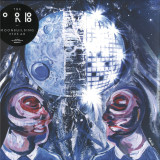
The long-awaited new full-length from legendary electronic pioneers THE ORB with cover design from iconic graphic wizards THE DESIGNERS REPUBLIC • A fascinating sonic journey over four epic tracks, constantly switching between psychedelic flourishes and beat-driven focus
Veritable pioneers of electronic music, iconic act THE ORB returns to Kompakt with the new full-length MOONBUILDING 2703 AD - another major slice of psychedelic synth bliss, obscure loops and deep ambient textures tossed in swinging breakbeats and powerful basslines. Installing a forward momentum rather unusual for a genre-defying project like this, the latest effort from masterminds Alex Paterson and Thomas Fehlmann follows their 2005 album success on Kompakt, the cheekily named "Okie Dokie It's The Orb On Kompakt" (KOMPAKT CD 45), as well as several contributions to our Speicher and Pop Ambient series - but more importantly, it finds the legendary duo at the peak of its creativity, ringing in another essential phase in what can only be called a ground-breaking career.
True to form, the new offering MOONBUILDING 2703 AD features a small track list, but turns each one of its four cuts into a mini epic in its own right. Opener GOD'S MIRRORBALL hits the ground floating, employing a handful of cozy statics to great effect before finally discharging into an intricate mosaic of atmospheric melodic sketches and gripping rhythms. With a hypnotic runtime of more than 14 minutes, it immediately establishes a blueprint for the other album tracks to follow, perfectly illustrating the vast extent of the artists' vision and their impressive skills in luring in listeners - welcome to THE ORB's sonic labyrinth, where nothing is what it seems and the unexpected waits just around the corner.
Likewise, follow-up track MOONSCAPES 2703 BC presents itself as a uniquely versatile affair sitting comfortably between ambient flourishes and beat-driven focus, holding as many twists and turns as a caper movie, but carefully grounding every single one of its cliffhangers in its impeccable flow. With a runtime of approximately 9 minutes, LUNAR CAVES is the shortest jam of the bunch - and also the most ethereal, keeping its rhythmic content to a bare, pulse-like minimum and opting for enticing, freewheeling synth textures instead. Album closer and title cut MOONBUILDING 2703 AD introduces a surprisingly jazzy vibe mingling rather well with the wealth of electronic tricks up its sleeve - even indulging in abrasive bass sweeps and a breathtaking multitude of different rhythm sections constantly switching places. It's a fitting closing act for a full-length as multifaceted as this, as idiosyncratic as possible and as muscling as needed.
• Das langerwartete neue Album der legendären Elektronikpioniere THE ORB mit einem Coverdesign der gefeierten Graphikschmiede THE DESIGNERS REBUBLIC • Eine faszinierende Klangreise über vier epische Tracks hinweg, permanent zwischen psychedelischen Schlüsselreizen und beatgetriebenem Fokus changierend
Mit THE ORB kehren echte Pioniere der elektronischen Musik zu Kompakt zurück - der Langspieler MOONBUILDING 2703 AD präsentiert erneut einen grossen Wurf in Richtung psychedelischen Synthie-Segens, obskurer Loops und porentiefer Ambient-Texturen, geschwenkt in schwungvollen Breakbeats und wirkmächtigen Basslines. Mit einem für genresprengende Projekte wie diesem hier eher unüblichen Vorwärtsdrang beerbt das neue Album von den Großmeistern Alex Paterson und Thomas Fehlmann ihren 2005er Erfolg auf Kompakt, das augenzwinkernd benannte "Okie Dokie It's The Orb On Kompakt" (KOMPAKT CD 45), sowie einige Beiträge zu unseren Speicher- und Pop-Ambient-Serien - viel wichtiger allerdings, daß wir das legendäre Duo auf der Höhe ihrer Schaffenskraft antreffen, eine neue wesentliche Phase einläutend in einer Laufbahn, die nur als bahnbrechend bezeichnet werden kann.
In bekannter Manier hat das neue Werk MOONBUILDING 2703 AD eine eher kleine Tracklist vorzuweisen, baut dafür aber jeden seiner vier Tracks zu Mini-Epen von eigenem Recht um. Der Eröffnungsakt GOD'S MIRRORBALL schwebt einem da vor Ohren, zuerst nur mit einer Handvoll gemütlichen Rauschens bewaffnet, später dann in ein feingliedriges Mosaik von atmosphärischen Melodieskizzen und mitreissenden Rhythmen explodierend. Mit einer hypnotisierenden Lauflänge von über 14 Minuten etabliert das Stück die Blaupause für die folgenden Ereignisse, perfekt die enorme Reichweite der künstlerischen Vision und ihre Fähigkeit zur massenhaften Verführung nichtsahnender Tänzer illustrierend - willkommen in THE ORB's Klanglabyrinth, wo nichts ist wie es scheint und das Unerwartete um jede Ecke lauert.
Ähnlich präsentiert sich der Folgetrack MOONSCAPES 2703 BC als einzigartig vielseitige Angelegenheit, bequem zwischen ambienten Ornamenten und beatgetriebenem Fokus sitzend und mit sovielen Drehungen und Wendungen wie ein Gaunerfilm - doch stets seine Cliffhanger im makellosen Flow erdend. Ein wenig über 9 Minuten lang, ist LUNAR CAVES der kürzeste Entwurf in der Gruppe - und auch der ätherischste, hält er doch die Rhythmusanteile auf einem puls-ähnlichem Minimum und optiert stattdessen für freilaufende Synthie-Texturen. Das letzte Kapitel des Albums schließlich ist auch der Titeltrack: MOONBUILDING 2703 AD besitzt eine überraschend jazzige Note, die sich ziemlich gut in den Reichtum an elektronischen Tricks einfügt, welche hier aus dem Ärmel geschüttelt werden - sogar in rauem Bass schwelgend und eine atemberaubende Vielfalt an Rhythmussektionen aufrufend, die ständig die Plätze tauschen. Es ist ein passender Abschluss für ein derart facettenreiches Album, so idiosynkratisch wie möglich und so anschiebend wie nötig.
- A1: Tribute
- B1: Tribute Dub
A special moment here with this one. This is one of my personal all time favorite tunes since I first heard it just about 20 years ago. Likewise, it’s been on the DKR wish list since the very first time such a list was made. This record has it all - one of the best rhythms of the entire ‘80s let alone the early digital canon, laced with lazers, killer synths, dive bombs, vocoder, screeching across the border, militant lyrics, gigantic drums, perfect claps, the list goes on and on. An absolutely perfect record for the period and for the ages. Hopeton Lindo lets loose an awesome vocal - his salute to the heroes and martyrs of the militant struggle against South African apartheid - Benjamin Moloise, Stephen Biko and of course Nelson Mandela. If you don’t know, read up on these men ASAP. This tune was made at Tubby’s on a wild mix of the original King Tubby’s tempo riddim, and was originally released on the very short lived Aqua label due to some producer runnings back in the day. Now recut from the original master tape, this is one of those joyous occasions where this new issue actually sounds better than the original, which suffered from being made at the notoriously quality plagued GG’s pressing plant. Fans of late ‘80s digital and militant reggae take note - this is your perfect storm. A long time searching for this one, finally here.
Just when you thought it was safe to go back in the water, THE ROUTES are back with their unique blend of beat-you-to-death surf music (IGGY POP). Their latest target: the music of JOY DIVISION!
Having previously surfy-fied the songs of KRAFTWERK and BUZZCOCKS, Surfin' Pleasures sees THE ROUTES take on the music of JOY DIVISION. As with their previous tributes, this is not an album of note for note cover versions. THE ROUTES have only taken subtle melodic and rhythmic hints from the original songs; rearranging them into songs of their own, respectfully and lovingly translating the music of JOY DIVSION into a different musical language.
Surfin' Pleasures sees twelve classic JOY DIVISION songs reimagined and rearranged as banging 60s surf guitar instrumentals (a la THE VENTURES, DICK DALE, SHADOWS, TRASHMEN, TERAUCHI TAKESHI, LINK WRAY, THE SURFARIS and THE ASTRONAUTS and more).
Prepare to be taken on a wild musical trip where A Means To An End and Ice Age are transformed into the background music of a 60s drag race movie, Transmission hints at the classic ASTRONAUTS sound, and Digital gets the beach party treatment... You don't have to be a fan of JOY DIVISION to enjoy these tunes, and likewise if you're a JOY DIVISION fan you don't need to be a fan of surf music to enjoy them.
The record cover comes courtesy of British design icons Peter Saville and Malcolm Garrett. It is a reworking of Peter Saville's design for JOY DIVISION's Unknown Pleasures. Reminiscent of the op art of Bridget Riley, the lines are no longer that of a pulsar, but that of the sound wave of a reverb tank. Its cover design is provided with calender embossing as well as a printed inner sleeve, just like the hit-album Unknown Pleasures.
Blasphemy or alchemy? You decide!
One thing is for sure is that THE ROUTES have provided the world with yet another future cult classic, destined to irk or jerk for eons to come.
Vision of Disorder is the first album by American hardcore/metalcore band Vision of Disorder, released on October 22, 1996.
The album showcases a band with a solid sense of songwriting, good melodic riffs, and a lot of variety in tempos and textures. Likewise, the social consciousness of the lyrics is handled in a Rage Against the Machine-reminiscent fashion. Raw, naked anger about everything wrong with American society in the 1990s. Listeners looking for just those qualities will love this album. Elements” and “Excess” are some of the highlights on the album.
Vision of Disorder is now available on black vinyl and contains an insert.
ANTON NEWCOMBE and DOT ALLISON just announcedthat they will be releasing an album together under the moniker All Seeing Dolls. ''Parallel' will be out in February 2025. Upfront they share the single 'That's Amazing Grace' (backed with "Siren's Echo iron Lung") and make available this 2-track 10" as a limited teaser. Anton Newcombe is the founder, the sole constant and the creative mastermind at the centre of one of music's most fascinating bands; Brian Jonestown Massacre. He's a frontman, songwriter, composer, studio owner, multi-instrumentalist, producer, engineer, father and force of nature. There have been 21 BJM albums over the last 30 years, each embarking on their own mind-expanding adventure and exploring the outer realms of rock'n'roll; psychedelic rock, country-blues, snarling rock'n'roll, blissed-out noise-pop and more. Newcombe has established himself as a once-in-a-lifetime talent, a revolutionary force in modern music and an underground hero. Dot Allison released her debut solo album Afterglow in 1999. Over the years she has strived to keep the listener on a journey - and herself too. She revolts against what she has done before, to evolve and not just occupy the same space. That journey has taken her from Afterglow's broad church (trip-hop, Tim Buckley-esque ballads, dance tracks, chilled psychedelia) to the sultry synth-pop of We Are Science (2002), the lush, baroque Exaltation Of Larks (2007) and the eclectic, rootsy drama of Room 7½ (2009). After a hiatus to raise her family she returned with the graceful acoustic folk record Heart-Shaped Scars (2021) and the haunting, barely there beauty of Consciousology (2023). The range of guest stars on Allison's records is equally broad: where else would you find a cast list that includes Kevin Shields, Hal David, Paul Weller, Pete Doherty and Darren Emerson. Likewise, Allison's own guest roles with the likes of Massive Attack, Scott Walker, Slam, Philip Shepard, The Babyshambles & Pete Doherty, underlining the huge respect her peers hold her in.
Isik Kural returns with Moon in Gemini, a luminous scrapbook of slow-flowing narratives couched in intuitive and symbolic storytelling. Bending a playful take on environmental music to the folk song form, Isik's vocals coo atop pastoral field notes, airy chamber instrumentation and archival recordings culled from a curious musical life. A tender pastiche coalesces across the suite of Moon in Gemini's fourteen pieces, and Isik invites the listener to daydream as-deep-as-possible. "The songs on Moon in Gemini don't mind being slower or taking their time to reach the listener," says Isik, who wanted the title to speak to the album's dreamy, liminal nature. "I enjoyed how the phrase could be used to describe an object, a time or a place simultaneously," he explains. Similarly and subsequently, these songs contain a multiplicity of sonic artifacts, moments and spaces that span Isik's rich musical career to date. With the bulk of the album realized between Amasya, Turkey and Isik's current home in Glasgow, in both domestic and studio recording environments, additional tracks unearthed from his personal recording archive lend their lush patina. The record emerged as a fertile space to reimagine a handful of previously unreleased songs and unfinished ideas spanning the past fifteen years of his life and work, including streetside sounds documented while growing up in Turkey and recordings made while studying music engineering in Miami, Helsinki and Glasgow. Looking to the more recent past, Isik found himself wanting to build upon some of the methodologies and textures explored on his 2022 album in february, seeking a newly intimate, vocal-forward sound. He points to the track "film festival" from that album as a door through which to enter Moon in Gemini, where sample-based arrangements are presented in the context of asymmetrical "build ups and progressions" and ambience and vocals intertwine. Inspired in part by listening to iconic, if not sometimes misunderstood, singers such as Nina Simone, Aldous Harding and Ed Droste of Grizzly Bear, Isik aimed to carve out a new space for his voice on Moon in Gemini, experimenting with novel recording and mixing techniques. Captured at his aunt's farmhouse in Amasya during an extended three week recording session, we find Isik's vocal high in the mix, front-and-center and on newly expressive terms. As a songwriter, Isik is an intuitive and playful lyricist who allows his deep love of literature to flow through his off-kilter texts. Here, echoes of Silvina Ocampo's poem "Dialogues of the Silence" reverberate from the margins of "Most Beautiful Imaginary Dialogues". Likewise, Elliott Smith and Virgina Astley shapeshift through "Behind the Flowerpots," some lines of which were based on misheard lyrics from Smith's "Stickman" and Astley's "Some Small Hope." Attuned to the magic of happy coincidences, other unexpected "themes and connections between tracks flourished" during the recording process, resulting in some songs being more "thematically and lyrically connected to each other compared to previous records." The duos "Prelude" and "Interlude" as well as "Grown One Iota" and "After a Rain" explore connected stories, while "Almost a Ghost" and "Behind the Flowerpots" serendipitously emerged out of a conversation with Stephanie "Spefy" Roxanne Ward, whose balmy vocals heard highlighting in february return and call out to Isik's in sweet dialogue. Plumbing these new potentials of structure and songwriting, Isik also developed a taste for an expanded sonic palette, one enriched by the lulling undertones of live woodwinds and strings. The resulting collaborations with flutist Tenzin Stephen, harpist Kirstin McCarlie and clarinet player Giulia Tamborino envelop the record in an altogether "dreamier sound," swaying pastel and awash in lunar light. Moon in Gemini, brimming with natural imagery and lullaby-inflected tones, tunes into states of being where the wonder filled sound of everyday is heard and felt, perfectly imperfect in its poetry; where the invisible steps forward; where dauntless ghosts wait around every corner and play enriches the soul; where bird song fills sun-soaked afternoons and carries us on its wings into each enchanted evening. Isik Kural's Moon in Gemini will be released on vinyl, Japanese import CD, and digital editions on September 6, 2024. On behalf of Isik and RVNG, a portion of the proceeds from this release will benefit Mor Çaty Women's Shelter Foundation, whose social work at their solidarity centers and shelters supports women building lives unhindered by gender-based discrimination and male violence under free and equal conditions.
Five years into the project, Yermande announced a thrilling new phase for this Dakar-Berlin collaboration; a giant step forward.
The group of players is boiled down to twelve for recordings, eight for shows; sessions in Dakar become steeply more focused. ‘This time around I was better able to specify what I wanted right from the initial recording sessions in Dakar,’ says Ernestus; ‘and further in the production process I took more freedom in reducing and editing audio tracks, changing MIDI data, replacing synth sounds and introducing electronic drum samples.’
Right away you hear music-making which has come startlingly into its own. Rather than submitting to the routine, discrete gradations of recording, producing and mixing, the music is tangibly permeated with deadly intent from the off. Lethally it plays a coiled, clipped, percussive venom and thumping bass against the soaring, open-throated spirituality of Mbene Seck’s singing. Plainly expert, drilled and rooted, the drumming is unpredictable, exclamatory, zinging with life. Likewise the production: intuitive and fresh but utterly attentive; limber but hefty; vividly sculpted against a backdrop of cavernous silence.
Six chunks of stunning, next-level mbalax, then, funky as anything.
French saxophonist Musina Ebobissé unveils ARMAUN, his third release under the Blendreed name. ARMAUN – Ambient Resistance Music Against Urban Noise – takes a stand against the interference of invasive irritants with sublime slow motion music. Its four pieces evoke an ecstatic peace, allowing both artist and listener to breathe deeply. As the compositions unfold, each exhalation resonates at the frequency of the human mind in repose.
Layers of treated and reverberant saxophone fuse into a hypnagogic whole, as elongated melodies interact with their own fragmented and transformed echoes. In a semi dream state, existence is experienced at a languid pace, as each phrase decays into a haze of crosscurrents.
If ARMAUN recalls the fourth world music of Jon Hassell and Eno, it equally finds oblique kinship with André 3000's "New Blue Sun". Likewise, it shares essential DNA with vaporwave and the tape-loop experiments of Terry Riley. Conceived as a confluence of acoustic and electronic elements, Blendreed explores the intersection of jazz, ambient, post-rock and experimental music.
This is work of exquisite beauty with a direct function. It provides an antidote to the bombardment of our senses. After unhooking your mind from temporal entanglements, ARMAUN will absorb your soul.
Pål Waaktaar-Savoy has explained that much of the atmosphere and the lyrical themes of Savoy’s seventh album “Under” are drawn from his move with his fellow songwriter and wife Lauren Savoy to Los Angeles, where they found themselves surrounded by loneliness.
Waaktaar-Savoy is one of the most prolific and impressive songwriters of the twentieth century and beyond, and having been working at the very top of the music industry for as long as he has, it is no surprise that the record is well-crafted. The production is good, with careful arrangements and instrumentation. Every instrument’s voice is given room and there is space in the mix. Only occasionally does this slip over into over-production, as with the treated strings on the opening track “Lonely Surfer” or the treatment of Lauren’s vocals, which sound overly processed.
It is also true that the record exhibits a fair measure of melancholy. The chords and melody lines are dark in places, and there is a hint of sadness in the lyrics, many of which have a retrospective quality, describing moments in the past. However, beyond this, the understated feel of the record is just that – understated. Many of songs feel a few RPM too slow and the delivery of the vocal lines too underplayed to give them any emotional authority. At times, it also seems like the arrangement has to step in to bolster the songwriting or lyrics, by filling space with strings or brass, or the counterpoint of the instrumentation on “Camden Palace Chronicles” which distracts from some fairly mediocre words. It is important to emphasise that this is a joint songwriting exercise for Pål and Lauren, so we should not compare the output to the work of a-ha, but still, the themes lean in the direction of suburban banality, far from Pål’s more oblique or allegorical writing.
There are other moments of real quality beyond the production and arrangement. The title track has an excellent Bowie-esque chorus (and there are echoes of his work and sound throughout, along with Beatles and Beck), “The Life and Times of a Wannabe” has some first-rate guitar work on it, edgy riffs and some good textures. Likewise, “Coming Down”, which also exemplifies Frode Unneland’s drumming on the record, which is generally prominent in the mix, and with good reason, as it carries the record along well.
- A1: All I Really Want From You Is Love 04:26
- A2: Nowhere To Go But Home 05:48
- A3: In My Time (We Don't Belong) 03:13
- A4: Tonight (I Wanna Make It Out) 05:52
- B1: (I Gotta) Get It Together Again 04:22
- B2: Stara Paris Rescued Me 06:22
- B3: Just Get It Down 02:25
- B4: Let's Throw Some Mud Against The Wall 02:42
- B5: You Know I Feel Alright Now 04:33
Remastered vinyl of the original album which came out on CD only in 2005. Limited to 200 copies on classic black vinyl. This is an album that’s as alive as any could be. Indeed, far from sounding like the last desperate set of half-baked ideas from a once vital band (hello Oasis?) Artists Cannibals Poets Thieves is more like a debut album from a bunch of teenage upstarts: free from cynicism, fired with worldly wonder and chock full of ideas. This is certainly a different outfit from that of 1998, when they first wowed us (via John Peel, naturally) with the utterly essential sprawling noise that was The Things We Make. Long since stripped down by a series of resignations from a five strong collective to a taut three piece featuring founding members Chris Olley, James Flower and Chris Davis, the music has simplified considerably. Gone are the soundscapes of old, and in their place we have a series of sharp basslines, swirling keyboards, cutting guitar lines and the passionate hollering of frontman Olley. Opener All I Really Want From You Is Love is a perfect introduction to proceedings – a truly wonderfully distorted slab of indie rock, recalling early Jesus And Mary Chain in both its fuzz and, crucially, its wonderfully crafted tune. Next, Nowhere To Go But Home sounds like New Order if they’d emerged from Detroit in 1966. Tonight (I Wanna Make It Out) follows likewise with the best bassline Peter Hook never plucked. Throughout, Six By Seven manage to sound so natural, so refreshing free of the flab and introspection that a band on its last legs would usually succumb to. And whilst the momentum is momentarily lost as the drum machine makes an appearance to fashion the Suicide-esque trawl of Stara Paris Rescued Me, it’s not long before Just Get It Down muscles things back on course with a whispered Olley diatribe perched on top of more raw cacophony, before we reach the bitter end via the Depeche Mode-on-smack You Know I Feel Alright Now. Tracklisting: