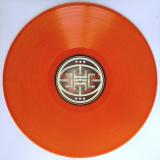
High Roller Records, insert, ltd 460, handnumbered, Picture Shape Schallplatten sind besondere Accessoires, welche einzigartig aussehen, aber sicherlich nicht die Klangqualität einer herkömmlichen Pressung darbieten werden. Vor allem sind sie als Sammlerstücke mit optischem Faktor zu betrachten. Leichte Verkrümmungen durch den Herstellungsprozess, die jedoch die Bespielbarkeit nicht beeinträchtigen, können auftreten.
“Negative Music / The Poorest! If they still know silence at all, then only as holes in the continuum of noise…” — Günther Anders, 1965
Editions Mego presents GETGETGET, a new release by Thomas Brinkmann which serves as an inquiry into silence, code, and the limits of perception.
The title GETGETGET references the trilogy of ‘Get’ lp’s made by Rehberg under his PITA moniker; Get Out, Get In and Get On. The music is based on material by Rehberg and Brinkmann morphing these two identities into a third colour, a disappearing color.
Emerging from a live performance at the label’s 30th anniversary in Berlin, the work unfolds as both sonic artifact and conceptual system: a study in what remains when sound is reduced, extracted, and reconstituted.
Taking inspiration from Günther Anders’ notion of “negative music”—composition through absence—Brinkmann’s approach aligns with Heinrich Böll’s idea of “collected silence”: silence not as void, but as a material framed against the constant pressure of noise. In GETGETGET, pauses are not gaps but structural elements, cut from a continuum and reinserted as signals.
The two side long tracks weave a dark abstract and ‘twisted’ presence where the ghosts of the machines and their operators fuse into a fantastical whole. One can hear traces of both Brinkmann and Rehberg logic which seems to fuse in a hallucinatory manner.
Brinkmann’s work reflects a broader condition: the translation of material processes into informational ones. As images detach from bodies and code separates from matter, sound too loses its fixed resonance. What remains is circulation—of signals, of data, of meaning—within systems that increasingly define perception itself.
GETGETGET is an album where absence is equal to presence, a metaphor with suggestive tones of the influence Rehberg had and continues to have in the world of the radical experimental electronic avant garde. The “zero” is not empty; it is what makes everything else work.
Cosmo Dance is the artistic alias of Cosimo Mandorino, an Italian producer and DJ who has been active in the electronic music scene for more than twenty years, as well as the founder of the label Mirella. Produced and finalized in Napoli during a series of short stays, and developed with the contribution of Raffaele Arcella and Dario di Pace, "Cosmo-logic" unfolds within a parallel, plausible, and dystopian universe where humans and machines coexist in constant tension and perpetual conflict. A musical narrative shaped by rebellious computers, wars between binary systems, and universal unified languages, the record stands as a manifesto to the early era of Italo-Disco, while remaining deeply infused with influences from cosmic disco and stripped-down electronic funk. The tracks make extensive use of mechanical rhythms, voice modulators, vocoders, and analog effects, exploring sonic territories forged through iconic instruments such as the Korg MS-20.
Flowgeist emerges from a shared inquiry into sound and aesthetics. Genre remains peripheral; meaning stays tethered to sensation. The self-titled debut, released on Evighet Records (EVIGHET007), follows that logic across a full record, moving from matter to memory and giving passing states somewhere to stay. Trip Hop, Drum and Bass, post-punk, breakbeat, EBM, Techno and modular electronics all surface within it, summoned only where a feeling demands them, with acoustic instruments retaining their grain inside the electronic frame. The A side keeps its instruments close and its focus intimate, opening on "Molecules," where Zainab J Lascandri's voice and Arthur Boudet's guitar set the album's tone before it moves through cycles that won't break: a life stuck in place, a trust already gone bu14t still being tended, an attraction whose charm thins out under repetition. That inward attention eventually turns outward, closing the side on a colder note about how influence gets performed and mistaken for substance. The B side works through broken rhythm and cinematic scale. It examines political language for the seams in its polish, follows a relationship reduced to proximity without real contact, and rises to the record's most forceful club passage before settling into "Crystal Muse," where Massimo Capobianco's guitar moves alongside an extended modular passage, luminous and unhurried. The album closes by turning its attention to composition itself, treating the act of writing music as a way of holding onto experience before it disappears. Across both sides, the record travels from immediate, bodily feeling toward something more contemplative, carrying the same emotional attention from private entanglement into wider systems and finally into the quiet work of making the record itself.
Mensch & Maschine. A concept. 13 tracks. One system. No coincidence. No compromise. Everything follows a logic. We live in a time where progress is no longer a goal, but a reflex. We accelerate without knowing the destination. We develop without questioning. We trust without understanding. We are driven by the idea that technology produces solutions. Without calculating the risks. Meanwhile, something new is emerging. A form of intelligence. Not human. Not emotional. Unstoppable. Consistent. Precise. Superior. Maybe not today. But eventually. Mensch & Maschine exists exactly there. Between what we create and what replaces us. This work does not provide answers. But it may ask the right questions. What happens when we are no longer the most intelligent entity? What remains of the human when systems begin to replace them? And who makes the decisions when we no longer decide for ourselves?
Through analog synthesizers and Eurorack modular systems, in “Axis,” Equinoxious establishes an axis between electro and minimal electronics, closely flirting with the harshness of industrial. The pieces unfold under a logic akin to the cybernetics of Norbert Wiener: feedback systems, flows of information, and voltage control intertwine with the experience of the one who operates them; the synthesizer ceases to be a mere tool and becomes an organism that reacts and communicates.
These tracks are inspired by speed, the absurdity of reality, the impossibility of things, imaginaries of dystopia, and protocols of romance, delivered with mechanical frankness and precision.
Recorded between 2023 and 2025, the pieces stand out for their FM synthesis basslines and incisive 808 derived percussion; subtractive synthesis, and 90s samplers dragging staccatos and energetic sequences.
Marking the anniversary of three decades of career, Dopplereffekt debuts on Tresor Records with Metasymmetry, arriving 12 December 2025. This latest release finds members Rudolf Klorzeiger and To-Nhan in deep inquiry in sound, contemplating structure and pattern in physics and nature resulting in a harmonious audio tessellation.
Metasymmetry itself relates to a kind of second-order reality found not in the structures of life but in the rules that govern these structures; that order exists not only in things but in the relationships among systems of order. It is a structure of structures, a logic of laws, an abstract unity embedded in the act of transformation itself.
Accordingly, the four-track EP reflects this duality. Each side opens with a piece of electronic music at its most precise and immovable: defined, kinetic, architectural. This is followed by a second composition that dissolves into a weightless, atmospheric counter-form.
The shift evokes a higher symmetry: an alignment not of parts, but of principles; a sonic model of the universe’s hidden invariance.
Metasymmetry also echoes across Dopplereffekt’s extended sonic continuum; this stands as the first offering on Tresor under the Dopplereffekt name despite an association with the label and club going back to the start. In this, it becomes the source of an echo that reverberates backwards through time; its own reflection:
Analog Fingerprints Vol. 0 is a compilation bringing together the early 2000s works of Marco Passarani under his Analog Fingerprints alias, collecting key tracks originally released on Rome’s Plasmek and Pigna labels.
For Numbers, the story starts long before the label itself. In their formative years, digging in Glasgow’s Rubadub, Passarani’s records felt like dispatches from a future city. Releases on his own Nature Records and on labels such as Generator and Interr-Ference Communications were mind blowing: rooted in Detroit techno, Chicago house and electro, yet pushing somewhere new. Much like fellow travellers Autechre, who would remix him in 2001, Passarani’s music balanced machine funk with restless experimentation.
Information was scarce, and you would hear these records first on the dancefloor or at listening stations in shops like Rubadub. Print fanzines like Ear and early web outposts such as Forcefield offered only fragments. But there was a palpable axis forming between Detroit techno and a new European wave of record labels including Skam, Rephlex, Clone, Viewlexx and Nature itself. It was the sound that defined Saturday nights at Rubadub’s ‘69’ parties in Paisley, just outside of Glasgow.
Passarani’s records, in particular, were instrumental in bringing together the future Numbers co-founders. Richard had already booked him pre-Numbers; meanwhile Calum (Spencer) and Jack (Jackmaster), then 16/17 year olds working alternate Saturdays in Rubadub, were so enamoured with the Roman sound that they travelled to Rome for the Bitz Festival in 2003 to seek out Passarani and Lory D at their source.
The first Analog Fingerprints release landed as a 12” on Plasmek in 2001, following the fractured, IDM-leaning 6 Katun material. For Passarani, the project marked a recalibration. A DJ first and foremost, he had moved into production via early computer setups, from a Commodore Amiga through primitive PC audio, Cubase and Logic, later experimenting with Ableton. The IDM scene had offered a playground for trial and error, but there was always a tension between abstraction and the dancefloor. Analog Fingerprints became the bridge: still intelligent, but with more dance than distance. After years of broken beats and complex arrangements, he wanted directness without surrendering identity.
Working closely with Francesco de Bellis and Mario Pierro in the Pigneto district, the trio formed Pigna as a vehicle for reclaiming a more accessible dance sound, deliberately steering away from the minimal wave beginning to dominate Europe. Sessions were fast, instinctive, often stretching late into the night with friends dropping by. It was a studio as social space, production as collective energy.
“In that constant search for balance, Analog Fingerprints was my way of expressing something closer to the classic dance floor. The track 'Tribute' - a tribute to my favourite early Detroit techno track of all time, 'First Bass' by Separate Minds - came after I realised I had almost lost my connection with the dance floor. The simplest step was to take inspiration from early Chicago and Detroit and twist it in our Roman ‘Pigna’ way. My goal was to create more accessible dancefloor tracks by mixing my unconscious Italo roots with my teenage love for that early US sound, ensuring the result was as far as possible from the minimal sound that was starting to dominate everywhere.” - Marco Passarani
Technically, the Analog Fingerprints tracks span a transitional era: Roland TR-909, SH-101 and Alpha Juno hardware met early software experiments. A Novation Drumstation rack stood in for the unattainable TR-808, syncing with TB-303 and TR-606. Yet the true secret weapon was Jeskola Buzz, a tracker-style modular environment that allowed step-by-step parameter control and strange melodic constructions, later exported into the audio sequencer. Even the lead on ‘Tribute’ came from an early PPG Wave-style plugin. It was hybrid thinking at a moment when digital tools still felt unstable but full of possibility for technologists like Passarani.
Behind the music sat Finalfrontier, a loose Roman collective orbiting Nature and Plasmek. Distribution and production were intertwined; importing obscure records into Italy built connections with like-minded outsiders across Europe and the US. Expensive phone bills and fax machines forged an “electronix network” that linked Rome to Clone, Viewlexx, Skam, Rephlex, Rubadub and Detroit’s Underground Resistance. There was a shared sense of survival and resistance, of operating against commercial systems.
Passarani recalls “The first time I found a sheet of paper inside an Underground Resistance 12” with info about upcoming releases... and a huge picture of Spock on the back. Imagine that: you love the music, you love Star Trek, and there’s someone on the other side of the ocean sharing those same values and sounds. It was the perfect match. We even gave our original company the suffix ‘Finalfrontier’: that says it all.”
Feedback in that era arrived physically: distributor faxes, conversations with visiting DJs, the experience of playing abroad and meeting kids who had connected with the records. Glasgow became a key node in a scattered outlier network. Passarani personally brought the first two Nature releases to Fat Cat in London, playing them in-store. Shortly after, a fax arrived from Rubadub in Glasgow requesting copies.
“I still remember that phone buzz and the fax paper slowly sliding out, with someone I didn’t know saying they wanted 75 copies of Nature 001. Or like the time we got a fax from the Rephlex crew just saying, “Hello Nature Records, Keep up the good work.” That was how we knew the message was getting through. It was a fantastic feeling; just one piece of thermal fax paper as an analog notification - the mood for the entire week would change.” - Passarani
The connection to Glasgow has since stretched across generations. As Passarani reflects, links often fracture as scenes renew themselves, but in Glasgow something different happened. New and old mixed seamlessly. There was a visible trust in what came before, and a willingness to carry it forward rather than discard it. Observed from Rome, it was deeply encouraging.
Analog Fingerprints Vol. 0 captures that moment of exchange: Rome to Glasgow, Detroit to Europe, experiment to dancefloor. It documents an artist recalibrating his sound and a network of scenes discovering one another in real time, connected by vinyl, faxes and shared intent.
"Analogue proudly welcomes UFO95 & Hadone - two of the finest talents in the new wave of techno. Their split EP features a combination of four blistering, space-infused, deep and high-energy cuts. A standout release that deserves a place in every serious collection."
Flipping rhythms from Guadeloupe, Cuba, Senegal and Puerto Rico, Time Capsule founder Kay Suzuki releases an acid-soaked collection of remixes that transcends time and space.
From the blacked-out basement of Plastic People to the psychedelic dancefloor of Beauty and the Beat, Kay Suzuki’s musical world has been shaped by some of London’s most iconic sound systems. High quality audio, he says, can open portals to new universes. Rhythm is time made plastic and beauty is the space between the beats.
Spanning over fifteen years of music from the prolific DJ, producer, Time Capsule label boss and one time Brilliant Corners sushi chef, this collection of remixes is the logical conclusion of Kay Suzuki’s musical thinking. Drawn to unique percussive or syncopated rhythms, he describes remixes as conversations between the original artist’s sense of time and his own. Weaving broken beat, house and dub influences into rhythms from across the Black Atlantic, these four tracks find each other kinship on the dance floor.
The A-side begins with a dubbed-out rework of the Gwoka celebration rhythm ‘A Ka Titine’ by Guadeloupe’s Gaoulé Mizik that was originally released by Beauty and the Beat in 2022. Layering electronic flares, dub sirens and space echo reverb across the shuffling toumblak beat, Suzuki leans into the track’s creole heritage, turning the track into a sought-after dancefloor jam, played by everyone from Colleen Cosmo Murphy and John Gomez to Yu-Su and Bradley Zero.
Skipping to Puerto Rico, Broki’s ‘Es Que Lo Es’ emerged from a collaboration between Bugz in the Attic’s Afronaut and Seiji and local musicians. Here Suzuki reworks the Afro-Latin percussion into a subtle bruk, conjuring a third space between London and San Juan that remains both of and outside the era in which it was made.
Blackbush Orchestra’s ‘Sortez, Les Filles!’ opens the B-side, taking apart the original and kneading the Senegalese percussion into a chugging Balearic house track, buoyant and full of life. Also first released by Beauty and the Beat, the track features new synth and structural elements that bring out the innate dancefloor potential beneath the surface of the original.
The final track on the collection heads back to the Caribbean and the island of Cuba, where Sunlightsquare a.k.a. Claudio Passavanti worked with vocalist Rene Alvarez and expert in Afro-Cuban percussion, Giovanni Imparato, on ‘Oyelo’. Here, Suzuki strips out the kick completely, leaving an implied rhythm which he calls an “imaginary four-to-the-floor” - a groove that is felt rather than heard, leaving the listener floating in another universe entirely.
Keroxen presents Spandauer Damm 103, a new album by Dancelwerk.
Bringing together modular systems, worn drum machines and digital synthesis, the record nods directly to the first decade of Warp Records and the early logic of bleep culture.
Dancelwerk is a Tenerife-based electronic pioneer and one of the foundational figures of the Canary Islands underground. Active for over 30 years, Spandauer Damm 103 marks both a personal milestone and a renewed point of focus, reaffirming his role in shaping the region’s electronic lineage. The album draws on 1990s electronic futurism, filtering those references through a contemporary production approach rather than nostalgia.
The music moves between places and periods: from the early rave circuits of southern Tenerife, where Dancelwerk built his reputation through DIY releases and warehouse-level experimentation, to his later relocation to Berlin, famously arriving with a shipping container of vintage synthesizers and modular equipment.
Balancing melody and impact, Spandauer Damm 103 sets custom-programmed percussion against detailed sound design. FM, spectral and wavetable synthesis shape its harmonic and textural focus, resulting in music that remains physical without sacrificing clarity.
A long-standing practitioner reconnecting with his roots while pushing the system forward.
“Man has such a predilection for systems and abstract deductions that he is ready to distort the truth intentionally, he is ready to deny the evidence of his senses only to justify his logic”
Fyodor Dostoevsky - Notes from Underground (1864)
The Intermittent Signal is the sound of resistance.
In the year since The Sick Man Of Europe’s debut album was released, the world has moved on. Steady hands have slipped from the levers of power, logic has shifted underground and the message grows more urgent with every passing day.
Repetition has been relearned and the machine rhythms repurposed, this time with increased intensity. Arrangements have moved beyond the bare bones economy of the first record and there’s a newfound melodicism in places. Clarity and conviction ring true through the static and noise, while utopian ideas to remodel a broken system gain traction. This is a rejection of the attention economy and a call to reconnect through community and organisation. Those simple acts that were once commonplace have become increasingly radical as new fractures emerge.
“Through repetition the message has gained weight and become something more urgent,” The Sick Man Of Europe explains. “The vehicle for this message needed to evolve, grow to gain the strength to carry it. We’ve landed on something more expansive, immediate and immersive. Less is more. Until it isn't.”
“Man has such a predilection for systems and abstract deductions that he is ready to distort the truth intentionally, he is ready to deny the evidence of his senses only to justify his logic”
Fyodor Dostoevsky - Notes from Underground (1864)
The Intermittent Signal is the sound of resistance.
In the year since The Sick Man Of Europe’s debut album was released, the world has moved on. Steady hands have slipped from the levers of power, logic has shifted underground and the message grows more urgent with every passing day.
Repetition has been relearned and the machine rhythms repurposed, this time with increased intensity. Arrangements have moved beyond the bare bones economy of the first record and there’s a newfound melodicism in places. Clarity and conviction ring true through the static and noise, while utopian ideas to remodel a broken system gain traction. This is a rejection of the attention economy and a call to reconnect through community and organisation. Those simple acts that were once commonplace have become increasingly radical as new fractures emerge.
“Through repetition the message has gained weight and become something more urgent,” The Sick Man Of Europe explains. “The vehicle for this message needed to evolve, grow to gain the strength to carry it. We’ve landed on something more expansive, immediate and immersive. Less is more. Until it isn't.”
»Cosmogonical Ears« is Amosphère's first album for Hallow Ground. Following her contribution to the Swiss label’s »Epiphanies« compilation and her 2021 full-length debut »More Die of Heartbreak« on 33-33, it features three expansive pieces. The Paris-based composer and multidisciplinary artist delves deeper into themes of time, space, cosmology, human perception, and psycho-physical effects, crafting profound sonic meditations. Drawing on a minimalist approach while blending electronic and acoustic elements, Amosphère’s long-form compositions are living, breathing entities whose sonic richness and evocative power unfold gradually over time, putting »Cosmogonical Ears« in direct kinship with previous Hallow Ground releases by artists such as Kali Malone and FUJI|||||||||||TA.
The album opens with its longest piece, »Land of eternal delight,« composed for the Buddha10 exhibition at the Museo d'Arte Orientale in Turin. Written during three years of isolation—a period in which Amosphère explored meditation practices and diverse belief systems—it merges mythology with personal transcendental experiences, reflecting on a challenging time for humanity. »By blending Buddhist philosophy and sculpture with my own meditation practices, I sought to explore a way for people to transcend the boundaries of space and time—not as a believer, but as an observer,« she explains. Featuring handmade ceramic instruments and recorded by Thomas Lefevre, the piece combines Amosphère’s electronic organ with Marc Lochner’s flute contributions, creating a sound that is simultaneously minimalist and expansive.
The concept of teleportation and how it challenges traditional notions of time and space serves as the foundation for the second piece. »Recent advances in quantum physics suggest that teleportation might be possible through quantum entanglement,« Amosphère notes. »What if science fiction is becoming reality—or has already existed in ancient times?« Drawing inspiration from theories proposed by physicists such as Roger Penrose, Amosphère again worked together with flutist Lochner, this time using her VCS 3 synthesizer. »Teleportation« weaves single notes into intricate, non-linear patterns that defy conventional logic, creating a complex auditory tapestry. The last piece »Black hole in, white hole out« was recorded on Corsica and features Miao Zhao’s bass clarinet drones alongside Amosphère’s church organ. It imagines the possible sound of crossing a black hole while also suggesting the study of its theoretical exit and its potential applications for large-scale time and space travel.
The questions posed by »Cosmogonical Ears« do not yield straightforward answers. Instead, Amosphère’s restrained yet intricately layered compositions require full immersion and concentration from the listener. As expressed by the album’s title—which envisions the birth of a new universe through listening—»Cosmogonical Ears« offers an experimental approach to auditory perception as a tool for seeking truth, freedom, and harmony between the outer world and the inner self.
o Standard Edition black heavyweight vinyl
o 44 tracks from the 2025 sci-fi RPG
o Each disc covers one of the game's major factions
o Art Nouveau-inspired artwork
o Widespined outer sleeve
o Printed inner sleeves
Obsidian Entertainment, Xbox, and Laced Records present the official vinyl release of The Outer Worlds 2 Original Soundtrack, a sanctioned audio record of Arcadia's most influential systems, ideologies, and approved listening experiences.
The specially mastered tracks span three LPs presented in deluxe Art Nouveau-inspired packaging. The collection captures daily life in the colony-where progress is monitored accordingly, optimism is responsibly distributed, and deviation is resolved through established channels.
Volume 001: Truth, Justice, & Dispute Resolution introduces the sound of arrival of the Earth Directorate. Sweeping orchestral themes and restrained electronic textures underscore exploration, investigation, and the reassuring sense that Arcadia's instability is both anticipated and accounted for.
Volume 002: Wireless Free Arcadia represents Auntie's Choice at peak efficiency. Bright melodies, big band swing, and relentlessly cheerful compositions promote comfort, productivity, and sustained consumer confidence. Freedom is included. Continued satisfaction indicates proper use.
Volume 003: Mental Enlightenment & Refreshment pairs the Protectorate and the Order of the Ascendant. The Protectorate asserts control through ceremonial authority, rigid rhythms, and formal arrangements devoted to discipline, doctrine, and public order. The Order of the Ascendant follows with colder, more abstract compositions focused on empirical certainty, controlled experimentation, and outcomes unburdened by sentiment.
Composed by Oleksa Lozowchuk, Antonio Gradanti, and Jim Bonney, the soundtrack of The Outer Worlds 2 blends cinematic scoring, period-inspired styles, and sanctioned cultural messaging to reflect a colony guided by ambition-and the systems entrusted to manage it.
The vinyl version of this release compiles the tracks from their two earliest EPs originally released by Ankst whilst the 22 track CD features further unreleased & unheard bonus tracks from this early era.
Super Furry Animals also recently announced additional festival dates to follow their sold out Supacabra Tour dates including stops in Llangollen, Bristol, York, Glasgow and London (their first since late 2016. See full 2026 dates below.
Holding the world record for the longest ever EP title the first EP -Llanfairpwllgwyngyllgogerychwyndrobwllantysiliogogogochynygofod (In Space), was released in 1995, followed in the same year by Moog Droog, with both EPs making up the eight-song track listing of the vinyl version of Precreation Percolation.
Later that year, with a record deal on the table and future classics such as God! Show Me Magic and Hangin’ With Howard Marks already making up the SFA’s set list, the band’s path following “two years of chaos” (including a legendary 1993 debut ‘gig’ at Bangor University’s Banana Lounge, lasting all of five minutes due to technical and chemical misadventure) was set. In the album’s liner notes, singer, Gruff Rhys writes: “It would have been the best gig ever, had we not daisy chained so many synthesizers together, that it resulted in a terminal systems failure.”
By summer they’d joined Oasis, Primal Scream and The Jesus and Mary Chain in the Creation Records family, leading to a huge London signing party that saw members of the band famously thrown out of.
The term of intriguing genre experimentation, spanning long-form electro, blissed out instrumentals and expansive prog-influenced rock, heard across much of Precreation Percolation was subsequently refined and channeled into their thrilling, 1996 debut album, Fuzzy Logic and their untamed live performances.
While consciously and frequently referring to the unheard, untold and unforeseen as a naturally nostalgia-resistant band, Super Furry Animals look ahead to reconvening with fans to celebrate their shared history as the Supercabra Tour gets underway.
(the vinyl comes with a copy of the CD in a slim card wallet)
The vinyl version of this release compiles the tracks from their two earliest EPs originally released by Ankst whilst the 22 track CD features further unreleased & unheard bonus tracks from this early era.
Super Furry Animals also recently announced additional festival dates to follow their sold out Supacabra Tour dates including stops in Llangollen, Bristol, York, Glasgow and London (their first since late 2016. See full 2026 dates below.
Holding the world record for the longest ever EP title the first EP -Llanfairpwllgwyngyllgogerychwyndrobwllantysiliogogogochynygofod (In Space), was released in 1995, followed in the same year by Moog Droog, with both EPs making up the eight-song track listing of the vinyl version of Precreation Percolation.
Later that year, with a record deal on the table and future classics such as God! Show Me Magic and Hangin’ With Howard Marks already making up the SFA’s set list, the band’s path following “two years of chaos” (including a legendary 1993 debut ‘gig’ at Bangor University’s Banana Lounge, lasting all of five minutes due to technical and chemical misadventure) was set. In the album’s liner notes, singer, Gruff Rhys writes: “It would have been the best gig ever, had we not daisy chained so many synthesizers together, that it resulted in a terminal systems failure.”
By summer they’d joined Oasis, Primal Scream and The Jesus and Mary Chain in the Creation Records family, leading to a huge London signing party that saw members of the band famously thrown out of.
The term of intriguing genre experimentation, spanning long-form electro, blissed out instrumentals and expansive prog-influenced rock, heard across much of Precreation Percolation was subsequently refined and channeled into their thrilling, 1996 debut album, Fuzzy Logic and their untamed live performances.
While consciously and frequently referring to the unheard, untold and unforeseen as a naturally nostalgia-resistant band, Super Furry Animals look ahead to reconvening with fans to celebrate their shared history as the Supercabra Tour gets underway.
(the vinyl comes with a copy of the CD in a slim card wallet)
The Story — From the Streets of Rome to the Male Productions Label
In the early 1990s, Rome lived in a kind of suspended moment. The city was still tied to its historic clubs, yet in the outskirts—inside abandoned warehouses, quarries along the coastline, and the wooded parks north of the capital—something new was beginning to stir. A nocturnal, constantly shifting movement fuelled by a hunger for freedom and a sonic curiosity that reached far beyond the mainstream.
Moving through this ferment was Francesco “Chicco” Furlotti. First an organizer of unconventional parties and underground nights, he soon became one of the driving forces behind Rome’s itinerant rave scene. Furlotti sensed that a wave of change was about to sweep across the city. It wasn’t just about parties: it was the rise of a culture, a new way of thinking about music, community, and belonging.
It was within those nights—later held with official permits, properly built sound systems, and an ever-growing crowd—that Furlotti recognized the existence of a distinctly Roman sound, and the need to capture it, preserve it, and give it tangible form.
So, in 1991, he decided to take a bolder step: to found an independent record label—small, determined, and far removed from the commercial logic that dominated at the time.
That was the birth of Male Productions.
Male was not a label like any other: it was a workshop, a gathering point, a creative hub where DJs, producers, friends, and wanderers converged. Within that environment, an artistic core took shape—Stefano Di Carlo, Leo Young, and Mauro Tannino, along with other collaborators orbiting around Furlotti. From their synergy emerged a project whose very name declared its mission:
The True Underground Sound of Rome.
The collective did not simply aim to release music; it sought to tell a story of Rome through sounds that defied categorization: house, techno, ambient, electronic mysticism, psychedelic visions… a unique blend, instantly recognizable, emotional, and experimental. The sessions unfolded using essential yet razor-sharp gear: Roland drum machines, analogue synthesizers, Akai samplers, stripped-down mixers. Few tools, endless imagination.
The first result of this work was the 12” Secret Doctrine, released in 1991 in an extremely limited run—around 500 promotional copies, according to accounts. The record captured something that until then had floated only in the air of Roman raves: enveloping atmospheres, deep rhythms, melodies built to make the mind travel far beyond the dancefloor. A sound that did not imitate what was happening in Detroit, London, or Berlin, but absorbed those influences and re-sculpted them with a distinctly Roman sensibility.
Yet, precisely because it was independent and detached from commercial circuits, Male’s output remained sparse: few EPs, few copies, irregular distribution. Over time, those records became rare artifacts—almost mythical objects within the Italian electronic scene. The legacy of Male Productions seemed destined to survive only in the memories of those early years, in the stories told after raves, and in the private archives of a handful of collectors.
Many years later, thanks to the almost accidental rediscovery of a few original copies of the first two releases issued by Male Productions, it became possible to undertake a meticulous process of recovery and restoration of the audio etched into those grooves, with the aim of preserving as fully as possible the quality and character of that unrepeatable sound.
We are therefore able today to present — at last in a complete and faithful form — the first two mixes created for Male Productions, now released on a double vinyl that brings back into the present the exact moment when it all began: the nomadic nights of the raves, Furlotti’s vision, the creativity of Di Carlo, Young and Tannino, and the sonic identity of a Rome in the midst of transformation.
This is not merely a reissue.
It is a historical document.
A fragment of a culture that changed the city.
The authentic sound of the Roman underground, finally returned to the world.
out of Stock
Last delivered 50 days ago available to reorder, subject to availability
A chance meeting in Mexico City set Points of Inaccessibility into motion. When Ibero-American composer Rafael Anton Irisarri crossed paths with Dutch media artist Jaco Schilp at MUTEK in 2024, a conversation about how technology shapes perception revealed an unexpected common ground. Schilp invited Irisarri to a spring 2025 residency at Uncloud, the Utrecht-based collective he co-founded, where Irisarri's sound began to take form amid an environment shaped by Schilp’s visual research.
The Uncloud studio was located inside the former Pieter Baan Centre, a forensic psychiatric prison where suspects of violent crimes were once confined. Its long history of silence and containment shaped the atmosphere in which the project developed. Within this setting, Irisarri coaxed long bowed-guitar tones through a network of pedals and looping systems. The raw gestures thickened into a vaporous and architectural field of sound. Schilp processed the material through a custom point-cloud software patch that produced images in continuous flux. The visuals flickered, dissolved and reformed like memories that resist coherence, functioning as a digital Rorschach that reflected the observer’s own perception.
Amid these spectral echoes, the project evolved into an examination of how the past persists within present signals. Memory endures as residue and interference, continually shaping perception even when its source has faded.
Schilp’s visual process required a continuous stream of sound in real time. Irisarri improvised throughout the residency, generating material that allowed the visuals to develop in parallel. Once back in his New York studio, he began shaping the recordings by carving pathways through the improvisations and mapping selected passages into MIDI. This process allowed him to build outward from the bowed-guitar material with minimal overdubs, adding Prophet 5 textures, Moog bass and strings that expanded the harmonic field while keeping the original performances at the center. To refine the structure, Abul Mogard provided editorial input, working with Irisarri’s stems to guide transitions and strengthen the overall pacing. The material, originally created under conditions of immediacy and constraint, evolved into a fully realized work through careful revision, patience and sustained reworking.
The title engages the geographic concept of the Poles of Inaccessibility, locations defined solely by their distance from all surrounding points. Irisarri adapts this idea to the conditions of digital life, where new forms of inaccessibility arise through the informational enclosures that structure perception. What appears to be a fully connected network often produces a deeper kind of separation, one shaped by the filtering logic of the systems that mediate experience. In this sense, the digital sphere mirrors its geographic counterpart. We inhabit spaces saturated with signals, yet the possibility of genuine contact becomes increasingly remote.
At its core, Points of Inaccessibility considers what can be understood as the new rituals of capitalist realism. Irisarri uses the term digital shamanism to describe the forms of simulated connection that organize contemporary life. These systems promise comfort through algorithms, influencers and AI interlocutors, yet they often reproduce the same conditions that generate loneliness in the first place. What appears as connection becomes the echo of connection, a sequence of gestures that imitate solidarity while withholding it. Like the geographic poles, these rituals are defined by distance. They pull us into environments where everything is illuminated, yet meaningful proximity becomes increasingly rare. In this sense, the work approaches a hauntology of the present, a reflection on futures that have stalled and intimacies that have been thinned by the algorithmic infrastructures that surround us.
This thematic tension unfolds across the album’s four movements. Faded Ghosts of Clouds introduces the work with textures that rise and dissipate in slow cycles, creating an atmosphere that resists clear definition. Breaking the Unison occupies a pivotal position in the sequence and focuses on the moment when the individual and the system fall out of alignment. Its shifting patterns trace the scattering of signals that once suggested connection, revealing the instability at the heart of contemporary perception. Signals from a Distant Afterglow forms the center of the album and features vocals by Karen Vogt, whose presence enters the sound field like a fragile transmission shaped by distance and delay. The closing piece, Memory Strands, follows motifs that appear, recede and briefly intersect before returning to quiet. Across these movements, the album outlines a landscape in which emergence and disappearance continually inform one another.
Listening to Points of Inaccessibility is an encounter with a sound field that is constantly in flux. Elements surface briefly, shift position and recede, creating a sense of motion that resists stable interpretation. The music moves between closeness and vastness, carrying traces of memory while withholding a clear point of resolution.
The album’s visual identity completes the project’s conceptual arc. In Mexico City, where Irisarri and Schilp first met, Daniel Castrejón transformed stills from Schilp’s point-cloud visuals into the cover image. The final artwork captures a single suspended frame of the digital material, a moment extracted from a field that is normally in constant motion. Its surface recalls the texture and abstraction found in the work of Catalan artist Antoni Tàpies, where material presence and erasure coexist within the same plane.
What emerges is a work that examines the tension between technological systems and human presence. Points of Inaccessibility asks whether connection is still possible within environments shaped by mediation and delay, or whether we have become isolated points within the very networks that promise proximity. What possibilities for relation persist within environments organized by algorithms and interruption? And how are we meant to understand presence when so much of it is constructed at a distance?
Points of Inaccessibility will be released on BioVinyl on February 6, 2026, with audiovisual performances planned throughout 2026.
Mastered by Stephan Mathieu
Artwork by Jaco Schilp
Design and layout by Daniel Castrejón
Artist photo by Iulia Alexandra Magheru.
out of Stock
Last delivered 7 months ago available to reorder, subject to availability
The Vibracid operation has cracked the code. With control systems collapsing, the third transmission pierces the very fabric of reality, unleashing patterns that overflow any known algorithm.
From Earth to the far reaches of the interplanetary galactic network, six architects of sound unite to chart routes beyond logic: corrosive FM sequences, blasts of mutant acid, haunting vocoders, and electromagnetic pulses engineered to infiltrate both bodies and machines.
Each track is a node in the insurgent network, an access point to the domain where matter, music, and mind can no longer be separated.
Careful sound and mastering, and exceptional design for a limited edition of 150 copies solid orange vinyl.
out of Stock
Last delivered 5 months ago available to reorder, subject to availability
“The hand knows best,” the painter Margaux Williamson says. “A shape produces itself, where I go toward what is intuitive, rather than logical.” The shapely, intuitive songs that comprise Ada Lea's third album, when i paint my masterpiece, are surprising, imagistic, tactile. They stand before us and we feel their brushstrokes. Alexandra Levy holds her guitar against the backdrop of a sea of her paintings on the album cover and it’s tempting to ask: is painting a metaphor here, for music or life? No! As ever, she resists tidy metaphors. She’s a master of this kind of thorny lowercase title that germinates and grows with time. In a real, profound way, music and painting go hand-in-hand as she unveils a new style of subversion and surrealism inspired by her transdisciplinarity.
Levy is a Renaissance woman, and Ada Lea’s albums have been swelling in scope alongside the evolution of her artistic life. Her recent turn toward pedagogy—teaching a songwriting course at Concordia University and co-facilitating a community-based group called The Songwriting Method—weaves another vivid thread into her multifaceted practice. Her debut LP, what we say in private, blurred the lines between interior and performative worlds. Her sophomore record, one hand on the steering wheel the other sewing a garden, featured vignettes centered on Montreal. On this sprawling and ambitious album, written over three years and whittled down from over 200 songs, she asks: what happens when you… pause? How can a life be held suspended in song? The album is a kaleidoscopic exploration of the transformations art can bring: the vision of an uncompromising artist dancing bravely and freely between registers and across mediums.
The album marks a reset—a quiet revolution. After years of relentless international touring, Levy felt an urgent need for community and renewal. Gruelling road schedules with very little support left her wondering: who am I really doing all this for? The system was uncaring and broken, and so it was that she came to envision a new healthy and healing mode of musical genesis. “For me, that looked like resting, extending my creative reach, going back to school, studying painting and poetry,” she explains. “Taking a step away from music as guided by industry expectations. Simplifying things. Getting a job, starting to teach. Engaging with the process rather than the product.” This need for a more deliberate creative renewal was rejected by her existing systems of support, so she began the search for an alternative.
Pawel Pruski is an electronic music producer and composer, known for blending organic elements, subtle synthetic layers, and field recordings to create immersive ambient and experimental soundscapes. In his sound creation process, he experiments with various modular systems and logical-mathematical concepts, such as the implementation of probability theory. His work spans concerts, gallery exhibitions, film soundtracks, and producer albums. He has presented his music in various parts of the world, including China, Germany, Italy, Luxembourg, and more. Additionally, Pruski creates unique sound installations based on the creative processing of various stimuli using sensors and detectors, forming interactive installations where the audience often becomes an integral part of the experience.
Taba voices a subtle yet surprising shift for the Japanese musician and producer Satomimagae. Observing and absorbing the fleeting scenes and sounds of life flowing outside of her home studio, Taba unfolds as a series of vignettes that document the personal and the universal. Satomi sings beyond herself in an orbit of souls and systems known and unknown, seen and unseen, in the present and in the strange flux of memory, leaving linear songwriting to rest for circuitous stories expanded and expansive in tone and texture. Following the logic of taba, a Japanese term for a bunch, bundle or grouping together of different things, the album is assembled as a loose collection of short stories. Shapeshifting into something like a poet-narrator, Satomi casts her writer's eye to the often perplexing shapes that form from quotidian events and exchanges defining our increasingly alienated age. Where Satomi's last full-length, 2021's Hanazono, bloomed from the lush soil of a private inner sphere, the bird's eye of Taba searches to place the artist_somewhere, somehow_within a wider, wilder world. Collaborations with other artists and musicians close to Satomi's universe further elevate the album's sweeping sonics. Synthesizer lines from Norio, who also helps define the album's visual identity through photo and video, enliven the tender ballad "Kodama." The bell-like Rhodes piano ringing in and around Satomi's guitar on "Dottsu" is played by Akhira Sano, who created the cover art for her 2021 Colloid EP. Yuya Shito's clarinet was the missing puzzle piece that completed "Spells," and it was also Yuya who mixed Taba with an ear for its organic textures and elegantly frayed edges, giving utterance to a distinctly different energy than Satomi's earlier expressions. The tonal and rhythmic play that lay the foundation of these songs also animates a colorful palette of melodic gestures, noisy resonances and pointed moments captured by Satomi's close-at-hand recorder. While Taba is still carried by the innate intimacy that has defined Satomi's music to date, these songs channel her newly spacious and inquisitive songwriting approach, unlocking unusual layers in the process. Some are subsumed in the speculative poetics of sound design, while others peer through the window of bedroom pop. Gathering imagistic reflections, tracing vast ideations and quietly lingering in humble moments, Taba connects vivid lines between the individual and the collective, the constructed and the cosmic, the articulated and the felt. Satomi's sonic tales gain an eloquent coherence by the simple fact of existing in conversation, humming a harmony of parts that buzzes with the tangled circuitry of a life in motion. Taba is the fifth album from Japanese musician, songwriter and dream traveler Satomimagae, following her 2021 album Hanazono and the 2023 reissue of her debut album Awa, both for RVNG Intl. On Taba, Satomimagae leaves linear songwriting to rest for circuitous stories expanded and expansive in tone and texture, unfolding as a series of vignettes that document both the personal and the universal. Some of the songs on Taba feature intimate moments captured on Satomi's hand recorder, poetic moments of sound design animated by tonal and rhythmic bedroom pop foundations. As with Hanazono, Taba's album artwork features a wooden block print by Satomi's sister, the artist Natsumi Magae.
Big new release by Peter Van Hoesen! Continuing his exploration of intricate techno systems, their effect and direct perimeter of action, Peter van Hoesen turns in his newest four-track piece, ‘Prime Directive’: a fascinating dive into the artist’s shape-shifting headspace and inner creative chaos.
Fuelled on a furnace-hot mix of abstract-leaning immersion and hi-octane rhythmic thrust, ‘Prime Directive’ looks at contemporary techno from the angle of experimentation and intuitive abandon. The result comes in the form of four distinct movements, each carving out their own logic and associated behaviour out an endless pool of potentialities. Here comes chaology unfolding in all its unadulterated, visceral glory.
‘Definition by Absence’ breaks the trip in to the sound of a faux-random symphony: its train-like swing and fiery bass seesaw coalesce through an elliptic fluttering of sorts, iterative and not, patterns moving in and out of synchronicity as van Hoesen applies more or less pressure on both ends. All in gusty in-your-face-ness, ‘Variables Edit 1’ whirls and swirls like an ominous vengeance of nature; Its puncturing kicks and whistling menace set against stellar winds and rabid machinery on the prowl for its next victim.
An even more unsettling piece of disjointedly arrhythmic, anti-club music for the dance floor, ‘Prime Directive’ will have you zoning out like a bad dream, flush with metronome-faced monsters and molten clocks hanging from dead trees. ‘Morphology’ could be PVH’s attempt at giving his concepts a carnal carcass to hold onto. Here, rhythm becomes somewhat less erratic, offering his 360-degree vision more melodic surface and actual room for dispersion. One to keep the boundaries pushed and status-quo challenged, this is techno at its most entrancingly bold and fearless.
*This new four-track epic from Peter van Hoesen comes draped in a fine piece of artwork courtesy of Atact, and pressed according to our standards in 180g audiophile quality so you get to experience the Belgian master's chiselled sound design in all its glory.
out of Stock
Last delivered 3 months ago available to reorder, subject to availability
As many artists before them (Gainsbourg, Snoop Dogg, Lavilliers, Sinead O'Connor…), DA BREAK embarques us to revisit their best tracks “Inna Reggae Vibe”, and invites us listeners to rediscover their repertoire with a more than ever “Roots” sound. An enchanted break that will seduce the early fans as well as reggae connoisseurs; A suspended moment with a band on their new musical quest, assuming a different side of their DNA.
The idea of an “old school reggae auto remix” had bloomed for quite a long time, with the will to dive into the 60s & 70s sound esthetics and to pay tribute to this reggae culture - this unique cultural temple they love and respect so much.
DA BREAK concerts are always rich and intense musical moments, thanks to a crew of solid musicians, so the choice to record LIVE, all in the same room, was quite obvious; with “vintage” instruments and microphones, to enjoy this warm and authentic sonic texture. The result is a “Roots & Rock Steady” album without electronics, leaning towards sweaty and rough Jazz, tropical Soul or even Gospel with sand between the toes… definitely Reggae!
DA BREAK remains DA BREAK, with its inner light, this time looking towards the Caribbean musical culture.
Given the historical influence of Jamaican Sound Systems on the American Block Parties, it seemed logical for DA BREAK to pay tribute to the artists that influenced them since day one, and still do today: Bob Marley & the Wailers, Jimmy Cliff. Culture, Toots & the Maytals, Burning Spears, The Gladiators, YellowMan, Israel Vibrations, LKJ & Mad Professor, UB40, Shaka Demus, Peter Tosh... Just to name a few.
out of Stock
Last delivered 2 years ago available to reorder, subject to availability
Biomes are little worlds of organic relationships, full of struggles, symbiosis, and sheer obsolete noise. In "De Silenti Natura," Henrique Vaz is meticulously crafting synthetic auditory biomes, sprouting from their own fuzzy logic. Unfolding across two distinct acts, the Brazilian artist interprets and replicates the complex, often ambiguous sounds of (un)natural environments, creating imaginary systems to inhabit over two sides of tape. The soundscape of the first side and title track is entirely algorithmically synthesized, with no samples used, leveraging Supercollider for real-time sound generation. The environment thus built is a flourishing one, seemingly unable to escape its own grandeur as insect-like buzzing and crackles expands into mountain ranges and forests of erupting sonorous drama. The second side introduces 'hydrophone' water synthesizers, submerged in a goldfish bowl to interface with the unfurling waves of electronic chords, creating a unique blend of damp and unwieldy sloshing movements, prismatically scattered into a luscious soundscape, and resembling everything from the bridge of a starship to the echoed drip-drip of stalactites.
Both sides of the album slowly unwrap and uncrinkle, revealing layers of hisses, distant digital choirs, warm enveloping chords, and juddering bleeps. Despite their unwieldy and strange nature, myriad elements convey a familiar sense of environment, flitting between the blossoming of new (manmade) life and the doom and destruction of the (real) world.
As the ringing of bells (fully synthetic; no samples were used) hove into view during the closing movement of side one, a simulacrum cacophony of voices is ushered in. It’s a reminder of the holy nature of sound itself, beamed into our heads intangibly. The flipside’s water ritual, frantically dunking ‘water synthesizers’ to birth swooping melodies and yawning tones, is jabbing at sleeping giants. It’s pushing and pulling the stars in the night sky into place. It’s both a simple act of beautiful creation, and a storm in a teacup.
out of Stock
Last delivered 2 years ago available to reorder, subject to availability
As the siren’s song echoes out of systems worldwide, perhaps we are (re)turning to the liquid age of dance; with natural ephemera such as moss, sentiments for ecology such as swamps, and mercurial aspects of water all absorbing the aesthetic forefront. A return to nature, a deep dive under the lily pads. Here Marijn with her debut EP guides our plunge, a trip previously taken via her podcasts on Kulture Lab, where you can also find her previously released music.
Whispers from the ethereal plane drift around the headspace, a rumble in the distance of sound traversing the water, voices to guide and to keep you from floating too far from the line. Audio hallucinations are aplenty when submerged, a serenity of space, yet distant growls assure that peace is not always 2 be found. The melancholia within the daydream, the pang of loss caught in reflections, internal and from the water, with the lily pads floating above as a guiding entity, an anchor, something to hold. Under the lily pads we rumble.
On the flip everyone’s fav casual breaks n rave hooligan Luca Lozano asks the recurring thought within dance music, a question we quest, yet rarely want the answer. Abstraction via squeaks and tweaks, you better bop your bleepin’ head to this 1.
‘Leave A Message’ leaves the tranquil waters disturbed and rippling to the outer edges, providing jumps for the lily pads to ride on the incoming tide, with the ebb and flow making way for a storm surge. Aka big beats are the best, a notion the directly honest final track ‘Made (Drums)’ follows, bringing a twisted jack attack logic to a deranged assembly of samples, a manic orchestra of tumbling drums who have conspired to freak out, albeit with cute bubbles underneath to revel in the allure of sonic mania.
out of Stock
Last delivered 2 years ago available to reorder, subject to availability
Cardinal Fuzz and Feeding Tube Records are pleased to announce ‘DATALAND’, a collaboration between Dead Sea Apes, Black Tempest and Adam Stone achieved mainly through internet data transfer during the Covid lockdown of 2020. Insistent, evolving electronic sounds encounter a variety of guitars and percussion, from the clockwork kosmische of 'Lost Hours' to the stumbling nosie dub of 'Shop Soiled', while Adam Stone's words meditate on life in the post-industrial west, our increasingly atomised and data-driven society and its logical conclusion in a corporatised dystopia.
'Dataland' is a meditation upon the average existence of a 'developed-world' human in the early 21st century. Whilst not struggling with the harsh physical demands of industrial labour as we did in the recent past, our plight continues to embody the melancholia and confusion of alienation. Under the bewildering complexity of rationalised social and economic systems, we may indeed have become unwitting prisoners within, what the sociologist Max Weber termed, "the iron cage of bureaucracy" - tripping the minutes away in a daily pantomime of data-driven surrealism. This six song collection is a fusion of electronica, monologue, 'real drums' and guitar, and was recorded at various locations in sad old England over the last two years or so. An almost psychedelic sense of puzzlement, nausea and fatigue accompanies being lost in the omnipresent number-generating machines and anti-human modelling systems that now run our world. This is the realisation that defines the essence of the album - that your life is now only as real as what is displayed on the screen of your constant technological companion.
You learned that there are genres. Everything separated into categories with their own canon and rules: Major, minor, 4/4, 6/8, highs, lows, high head, butt end. Techno here, Disco there. You learned that art and music are two different things. Visually auditory, audio-visual, optically acoustic, not to mention the surface feel. Listen to me, look at me, touch me. But everything in that order please! You have learned that understanding takes you further. Night / life, rhythm / dancing, substance / excess, water / holding out, sleep / rest, headache / not good. But what would it be if all of that wasn't just right? If all of our knowledge is based on the mistake of having to put everything in relation? To classify it, to make it responsive. What do we do with something that doesn't follow the rules of this logic? That is not based on 0 and 1 and therefore not bound to our binary systems? Is this all at once? After all, what if the whole thing has no limits?
Jens-Uwe Beyer recently released the Yellow Book with Albert Oehlen on Gagosian and on his own label Magazine. He also runs PNN and Schalen. His 4th album „Horizons“ as Popnoname is the very first long player to be released on Cologne based label Feines Tier.
out of Stock
Last delivered 5 years ago available to reorder, subject to availability
Transversales Disques presents KSHATRYA, (The Eye Of The Bird), never released before
recording by french avant-garde electronic composer Igor Wakhevitch, who composed a bunch of
major experimental albums in the 70's such as Logos, Docteur Faust, Hathor, Les Fous d'Or,
Nagual and Let's Start.
During this 10 years period, Wakhevitch was close to Jean-Michel Jarre, the Pink Floyd, the Soft
Machine, and legendary choreographer Maurice Bejart having with him many conversations around
dance and music, human body and soul, spiritual path, collective life, new society, human evolution.
As a composer Igor Wakhevitch collaborated with Salvador Dali, Carolyn Carlson, and Terry Riley to
name a few. He's considered as one of the first French composer using synthesizers like Synthi
AKS, ARP2600 or Moog modular systems.
After spending almost 30 years in India, Igor Wakhevitch dug in his archives this unreleased work
recorded in 1999 on his 'Mysterious Island 88' system. Esotheric, sacred and cosmic, KSHATRYA,
(The Eye Of The Bird) is the logical follow up of Igor's early works and a monumental piece of
electronic music. A must!
out of Stock
Last delivered 4 years ago available to reorder, subject to availability
Following our first release with Opal, which aimed at the dance and the bodies, we wanted with this second EP to reach to people's mind. As a Geneva-based techno label, it was fundamental to work with our local hero: Opuswerk. He's already been working outside of the country with artists like Fran ois X and labels such as ARTS, Semantica or Dement3d. It was time we involved him in our project. Through this EP, Opuswerk clearly shows what he knows and does best. Much like his DJ Sets, he connects dots and layers in unexpected ways, like a rhizome connecting different multiplicities. Inspiration for the original tracks came from designing systems of independent yet connected sounds, where events are triggered, un-triggered and alter other events, each behaving on their own. As one of those elements, the artist acts as a guide, directing them from one place to the next acting as and with the machines. The "mot d'ordre" is about becoming one of the machines, blending techniques with vibes and catching them like ever escaping dreams. The result is two uniquely sounding spaces, either filled with raw energy like on Extensum or with subtle and serene ever-evolving bleeps on Spatium. Those two extremes are fitting to how we want present the multiple dimensions of our artist's works to the world. The same logic went into choosing the remixers, with whom Opuswerk had a human connection with. Inland and Antigone need no introductions, having both established their sound on labels like Countercharge or Token. Each brought their own re-interpretations of the original tracks bringing them closer to the dancefloors.
Orbis X is a sublabel of Orbis Records and will be mainly focusing on softer yet often usable as DJ material for the broader mass interested in Electronic music. This sublabel is an extension of Orbis Records softer, more melodical and experimental side.
Music will be ranging from house, dub, chicago over melodic acid and even breaks. Not any track makes it to this sublabel if it can't stand on its own and stand the test of time! We warmly welcome the Dutch duo Dennis Pors & Stephan de Bruijn to OrbisX. New fresh talent, ready to conquer the world. We feel obliged to support these
fine gentlemen to get their music spread across the globe. Dennis & Stephan know each other through their musical perspectives.
They share a similar taste for music, Detroit techno. Before they worked together, Dennis experimented with deep house through digital synths and learned the ins and outs of programming music in Logic.
Stephan was well known with the detroit techno scene. His passion goes out to well balanced electronic music with hypnotizing emotional feeling to it. Add a layer of atmospheric grooves on top of that and you have the perfect blend to potential timeless music.
Soon enough they made the switch to analog gear to be able to create a cleaner and better sound. After three years of hard work, they have reached the sound they were looking for. And this is it!
Their debut on vinyl. D&S servers a full EP called Thoughts EP. A great cocktail of dreamy and diverse electronic tunes. This EP fits well in the back of any DJ bag to warm up the place or fix the atmosphere on roof-top bar in NYC. Smooth cruising, roof down car music or background music on a spring night with a summery breeze This EP is amazing and works best on a big sounds systems and major festivals! Childs play , what s in a name. Nothing like that melody. Creating a generously opening atmosphere, but actually brilliantly mixed creating the perception of simplicity. Groovy, acid touches and funky. Can t keep still when being played. A-track for sure! Thoughts might have a dark feel to it but evolves in a very uplifting track in just a few moments, making
it very bright and fun to play. Shed light to the place, should have been a great title as well, but thoughts is the best name for this track. The story in this track is definitely there to be told and listened to. Edge Of Insanity kicks of the B-side. Goosebumps, as from the start. Building up slowly to a very melodic and yet simply track, it s the perfect translation for a sunrise at the beach. Potential
Ibiza hit if you ask us. Submission is a track straight out of a movie. Clever, nice build up, dreamy, spacey and above all so amazingly subtle. This is what falling in love should sound like. We re humble. We re amazed. We re honoured to host D&S. We hope this duo gets the attention