Peter Beyls (1950) works on the intersection of computer science and the arts. He develops generative systems in music, the visual arts and hybrid formats. Beyls studied music and computer science at EMS, Stockholm, the Royal Music Conservatory, Brussels and the Slade School of Art, UC London. Initially he was active in electronic music, as a composer of tape music. Later on, he developed various analog live electronic music systems. In close partnership with Michel Waisvisz, he designed and built the early prototypes of the crackle box synthesizer at STEIM, Amsterdam (1973-1975). Around the same time, Belgian composers Karel Goeyvaerts and Lucien Goethals were his mentors at the IPEM Studio. Over the years, Beyls’ work has primarily centered on generative systems, including extensive series of machine drawings, human-machine interactive music systems using machine-learning and interactive audiovisual installations on which he has also given worldwide lectures. His work has been widely performed and exhibited at various universities and art institutions. The four previously unreleased tracks on this LP are amongst his first electronic music compositions using the Crackle Box, the Synthi 100 and the VCS3, a combination of live improvised electronics with precise tape editing and effects.
Metaphon Novedades
- 1
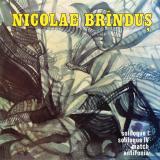
This album originally released on Electrecord’s RCM (Romanian Contemporary Music) series in 1986 provides a selection of works which belong to Nicolae Brînduş's cycle PHTORA (1968-1972). The cycle comprises five pieces which are five degrees of structuring collective improvisation, leaning towards the spectralist tradition.
It’s probably the most eccentric record in the whole RCM series, offering a mesmerizing collage of organized cacophony, as a massive but subtly layered whirlwind of abstract orchestral improvisations, Romanian picturesque folklore and free jazz with extensive use of tape manipulation and reverberation.
This reissue comes with the beautiful original sleeve artwork by Ana Golici who designed many sleeves for Electrecord.
One of Romania’s most important composers in the last half-century, Octavian Nemescu (1940-2020) is among the few that were not “part of the system”, managing to survive and compose in a world that felt more and more “empty”, fragile, confused and scarce in prophecies. The mystical approach to his art defines Octavian Nemescu as an essentialist who believed in the power of archetypes in which he found inspiration. His pieces always start from an idea that has spiritual, cosmogonic implications and often involves synthesizers, sounds from nature (buzz of bees) and the “ison” (drone). When defining “meta music” or “imaginary music”, Nemescu was an advocate of looking from above, from the top of the mountain. Silence is very important in his work in order to keep the sound flowing and to reflect on the sound from before, as a space, as a pause for thinking. Nemescu put forward another kind of music: a song that has not yet surfaced through human voice, any musical instrument, orchestra or other electro-acoustic means: an intimate, interior, introverted inner sound that focuses on the individual and the imagination. Imaginary music is a reaction, it comes in contrast to the spectacular, it is anti-show. For him, music had a ritualistic function, it served no cultural purpose.
This 3LP set collects eight pieces for variable ensemble, tape and electronics, composed between 1968 and 2015, selected together with Erica Nemescu, who also mastered the tracks. Most tracks have been previously released on different CD’s but never before on vinyl.
Composer Corneliu Cezar (1937-1997) was a distinctive personality within the Romanian post 1960 avantgarde: a visionary of music, a thinker and a prophet, a richly gifted artist also active with writing, poetry, painting and astrology. Cezar was an activist rediscovering the natural resonance of sound within a different historical context and he embraced the recovery of authenticity as a reaction against the artificialized culture of serial doctrines. When, after 1975 the spectral music trend became official in Paris, with much fuss and remarkable support from musicologists, nobody knew that this trend has already been practiced by a small group of Romanian composers lead by Corneliu Cezar for ten years. The four electro-acoustic pieces on this album (privately released on CD in Romania in 2000), recorded with little means between 1967 and 1975, display the incredibly strong ideas of a truly visionary artist. Everything Corneliu Cezar has done during his short earthly life bared the shade of authenticity.
Metaphon is thrilled to present this collection of 14 phenomenal electronic and electro-acoustic works by French composer Fernand Vandenbogaerde, realized between 1967 and 1984.
After his science studies Fernand Vandenbogaerde (1946) studied at the Conservatoire de Roubaix and did various classes and courses with a.o. Jean-Etienne Marie, Olivier Messiaen, Pierre Schaeffer, György Ligeti, Karlheinz Stockhausen and Bruno Maderna. He wrote analytical essays on mathematic music, in particular the work of Iannis Xenakis. Vandenbogaerde taught electro-acoustic music at various institutions and was director at the National School of Music and Dance in Blanc-Mesnil, near Paris. As a composer he wrote works for orchestra, instrumental and chamber ensembles, sometimes in hybrid form including tape and electro-acoustic configurations. He also recorded numerous tape compositions in Bourges, Paris, Ghent and at his home studio. His works have been presented worldwide on various leading festivals and events.
The compositions included in this edition are primarily tape works, meticulously recorded and produced, radical and most of all timbre oriented which makes his compositions focus mainly on sound while other parameters hardly change. In Vandenbogaerde’s own words: “What determines my pieces, at least all the ones in this collection, is that it’s the material that dictates me, that will predetermine the form”. This particular approach distinguishes him quite a bit from many of his contemporaries within the field of electro-acoustic music.
Another interesting aspect in Vandenbogaerde’s work is the integration of micro tonal scales (conceived by Mexican composer Julian Carrillo), on the compositions 'Modifications III' and the intriguing trilogy 'Drei Nachdenken über Hymnen an die Nacht'. All tracks are previously unreleased except the proto power electronics piece 'Anschlag' which was self-released in 1971 on his own Point Radiant label, as a compilation LP which also included a track by Tristan Murail.
First LP in the ‘Signature Series’, a small new series in the Metaphon catalog, documenting previously unreleased archive works of less known composers. Metaphon presents their ‘signature’ in the most personal and elementary way.
Raoul De Smet (1936), mainly known for his numerous instrumental and chamber music works, started composing in the early 1960’s. Between 1974 and 1989 he also recorded several electro-acoustic compositions at the IPEM in Ghent, one of the more approachable crossroads for experimental music creation at the time. His work carries different moods and contrasts, a sort of expressive eclecticism where straight forward evolution often prevails over far-fetched intemperance. However, his work is far from obvious. The four distinctive tracks on this album portray a fresh and unpretentious enthusiasm of a composer discovering new electronic tools.
Rolf Gehlhaar (1943-2019) was an instrumental and electronic music composer, and a pioneer in computer controlled interactive music. He grew up in the US where he studied philosophy and composition at Yale University. In 1967 he moved back to Germany to become Stockhausen’s personal assistant and member of his performing ensemble. In 1969 Gehlhaar co-founded, along with Johannes Fritsch (Metaphon 012) and David Johnson, the Feedback Studios in Cologne, a new-music performance center and publishing house. He later moved to England, where he became in 1979 a founding member of the Electro-Acoustic Music Association and later on senior lecturer in design and digital media. Gehlhaar's compositions include symphonies, instrumental works, experimental and electronic music, interactive computer controlled music and everything in between. The three previously unreleased tracks on this LP only show a glimpse of the versatility of his adventurous and innovative musical ideas.
Previously unreleased live recording from the Ranta archives. The creative duo of Michael Ranta and Takehisa Kosugi performed many times in the 1970’s and 1980’s. On this outstanding performance, recorded at the Japanese Culture Institute in Cologne in 1987, the application of an advanced multi delay system, independently utilized by both players, plays a central role. The smartly treated cyclic tapestry of the delay system (modulated, transformed, harmonized) injects additional dimensions to the highly coordinated improvisation with voice, percussion, violin and electronics, creating interactive ›composition-like‹ textures being »Multiple Musics«.
- Deux Angoisses 13' 00
- Yi-King 9' 04
- In Hora Conjunctionis 11' 49
- Firmament V 9' 52
- Aurora 13' 41
- Oiseaux Mécaniques 7' 38
- Et Il Créa 13' 35
- Canada 6' 02
- Het Breken Van Jef 11' 43
- Je Ne Retournerai Jamais À Tournai 8' 00
- Une Apocalypse De Jean 12' 10
- Escale 8' 25
- La Perte Du Temps 5' 00
- Missa Tenebrae 8' 27
- Co Atmosphère 5' 32
- Brouillard Face À La Mer 13' 19
- Consolation 8' 50
An anthology of the intensely arresting work of Robert Fesler (1936-2023), revealing many of his compositions (1975-1987) created with his self-built synthesizers, with as pinnacle the μP RPF78. All music composed and recorded by Robert Fesler at his home on rue Cour Boisacq in Bierges, Belgium. Except one, all tracks are previously unreleased.
With profound simplicity and devotion, Fesler paints a hermetic inner world with strong emotions of confronting solitude, sensual alienation and traumatic angst. His music was as much a therapeutic treatment as an artistic expression. Fesler quotes, »Building my synthesizers and working with them enabled me to sublimate my anxieties.« Most tracks were played and recorded real time, often with two synthesizers (the Synthese 756 and the μP RPF78), capturing the heat of the moment in one take, without multitracking. The austere and reductionist approach reinforces the overall spirit of his work, resulting in an engaging, mysterious solitary journey. It’s quite incredible how one person can put so much technical cerebral content in the development of a machine and use it in such an emotional way.
The music of Robert Fesler might be considered as very Belgian. To situate it within a close entourage, one can say it has: The endurance of Baudouin Oosterlynck The purity of Dominique Lawalree The mysticism of Arsène Souffriau
A Late Lunch’ is the soundtrack to Akiko Iimura’s eponymous movie realized in 1978. It is based on acoustic instruments and field recordings, brilliantly reconfigured and mixed by Bekaert to create a surreal, immersive soundscape. The technique used includes superposition and speed change of recordings, radical sound effects and juxtapositions of sounds. The players were prominent musicians of the 1970’s, including Maggi Payne, George Lewis, David Rosenboom and Blue Gene Tyranny.
‘A Summer Day at Stony Point’ was composed in 1969, with participation of David Behrman, Shigeko Kubota and Charlotte Warren. The piece was commissioned by English composer Hugh Davies who presented it at the Harrogate festival the same year. Stony Point is a small village in New York State where John Cage co-owned a small pseudo-commune art resort where like-minded artists gathered. ‘A Summer Day at Stony Point’ is nothing more than a page of a journal, a fragment of a notebook that utilizes a series of sound sources recorded at Stony Point on one beautiful day in the summer of 1968. Other electronic sound sources were recorded at the Brandeis University where Alvin Lucier was professor. The final realization of the piece was done at Henri Pousseur’s APELAC Studio in Brussels, 1969.
The soundtrack for Akiko Iimura’s ‘Mon Petit Album’ was composed on the basis of a simple description of the technique of the film and its time span. It includes David Behrman on alto, from an outdoor recording at Stony Point, plus excerpts from a Transition concert in London, the band Bekaert formed in 1971 with Michel Herr, Takehisa Kosugi and Ryo Koike, both members of the Taj Mahal Travelers. The atmosphere is quiet and pastoral throughout with a very dreamlike flavour.
Jacques Bekaert (1940-2020) was a man of many gifts: author, journalist, composer, photographer, visual artist, wine connoisseur, radio talk show host, diplomat and expert in Southeast Asian affairs. His whole life Bekaert has been actively involved in music but not much of his work got recorded or published. In the early 60’s Bekaert studied with Pousseur and through his frequent visits to the US he became friends with artists like John Cage, David Tudor, Charlotte Moorman and most of all David Behrman with whom he had a close friendship ever since. Bekaert helped organize the first European tour of The Sonic Arts Union (David Behrman, Robert Ashley, Gordon Mumma, Alvin Lucier) and in the early 70’s he formed the group Transition (with Belgian jazz pianist Michel Herr, Takehisa Kosugi and Ryo Koike, both members of the Taj Mahal Travelers). His meeting with Japanese experimental film-maker Akiko Iimura resulted in two film soundtracks featured on this one of a kind discreet avant garde album.
When asked in a 1979 interview about his double life as a musician and a journalist, Bekaert replied, “I suppose they’re both unsafe, unstable, questioning jobs—composing and reporting. Journalism takes me to places, shows me the world as it is. My music is my wish for the kind of world I’d want to live in. The little peaceful state I dream for everyone, where you can be yourself, and happy, and as collective as possible without giving up total privacy.”
Originally released in 1981 on the Belgian Igloo label this reissue comes with the same sleeve as originally designed by Alain Géronnez.
Toshi Ichiyanagi, Michael Ranta and Takehisa Kosugi originally got together in the summer of 1975 for an open-air concert in Sapporo. The concert felt like a great success but was unfortunately not recorded. As the desire arose to record together, they managed to arrange a studio session in the NHK Studio in Tokyo, with presence of sound engineers. What was supposed to be a soundcheck for this session became the session itself: a haunting 50-minute séance of intense avantgarde improvisation using a large instrumentation and live processing (tape echo, ring modulation, phasing). A trident travelogue of the momentum masterfully controlled by the ensemble spirit, transcending the boundaries of psychedelic underground.
Official reissue of this underground classic from 1975, originally released in a tiny edition on the small Japanese Iskra label. As the original master tapes of these recordings seem to be lost, the master had to be taken from an unplayed original LP copy. It was carefully restored and mastered by Jos Smolders with amazing result.
»Kyo Mu« and »Hochtöner« both reveal a mesmerizing symbiosis of innovative sound exploration and visionary interior music, a sublime compound of fine-drawn intricate arrangements skillfully projected in space and time, or perhaps beyond space and time.
Johannes Fritsch (1941–2010) was an award-winning composer, musician, publisher, studio owner, author and music teacher. He studied viola and composition with Bernd Alois Zimmermann and was member of the Stockhausen Ensemble from 1964 to 1970. Together with Rolf Gehlhaar and David Johnson (also from the Stockhausen Ensemble) he established the Feedback Studio Köln and the Feedback Studio Verlag, the first publishing house owned by composers in Germany.
Fritsch’s complex musical estate consists of approximately 130 works: it covers electronic music, chamber music, ballet, theatre and film music, organ compositions, an opera and pieces for large orchestras. Although Fritsch’s compositions are varied, all of them convey a strong interest in new sound combinations and sound colours.
First ever release of concrete and electronic collage works by Belgian underground sound explorer Jan Bruyndonckx. This album contains autonomous compositions, music for film and documentary; all independently recorded in his private studio between 1958 and 1965. A small collection of adventurous and mysterious sound evocations with text/poetry (Paul De Vree) recited by Julien Schoenaerts.
- 1