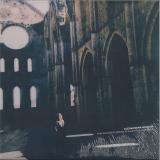
Inside Automatic Popular Music there are two people sitting in a room, their backs to each other. One plays a piano with no particular attention to detail and tuning of the instrument, and another, sitting behind him, claps his hands on his own legs. They do not see each other, they never look at each other, they can only listen to each other, look around. The room is large enough, it is daytime, there are four windows through which enough light enters to illuminate the objects and furniture with objects on them. October, the temperature is great and outside the window there are many people and all these people are dancing to the music of another record.
Automatic Popular Music was recorded and mixed by Nicola Ratti between July and December 2023. The tracks consist almost entirely of sounds generated by automatisms programmed on modular synthesisers. These are combined with tape loops on which fragments of both acoustic and digital pianos are engraved, generating tracks that are structured on repetitiveness in both their rhythmic and harmonic components. The adjective 'popular' is in this case the result of the other adjective 'automatic' since the machine has been entrusted with the task of generating the melodic patterns and harmonic structures of the tracks on the disc.
Automatic Popular Music is the first release by LL, a curatorial and editorial platform based in Milano and formed by artists and curators.
Composed, recorded and mixed by Nicola Ratti between July and December 2023. Mastered by Giuseppe Ielasi. Cover photo by Cédrick Eymenier.
Suche:nicola ratti
- 1
"Continental" is the new full length solo record by Milan-based multi-instrumentalist Nicola Ratti, following recent releases on Where to Now? and Room40. Conceived of by Ratti as a "series of big rooms or places to get lost in, full of small details and characterized each by a single flavor or perfume" it is a surprising and vibrant collection of music. Working with a palette of spare, expertly deployed percussive synthesis techniques, Ratti's work here is both labyrinthine and concise. These eight tracks are able to evoke spaces real and imagined with startling efficiency and clarity. Sprawling old world libraries, cliff caves inhabited by dripping water and rock doves, an automaton nearly slipping its axis but recovering just in time and finding a new sense of purpose in the process.
Granny13 opens with Nicola Ratti's 'Odd Doubt'. With the use of a modular system and tape loops, a broken rhythm is obtained by parallelism between single sound signals as LFO one or processed tapes.On the second side, Giovanni Lami's 'Johnny Leech' is made with a small bunch of equipment, just a chaotic hand-made synth (cacophonator) and a memoryman, working mainly on static electricity and leakage current in the synth used without any kind of power supply.
Reviews
The Wire
''Two Italian mucisians share a split single of glitchy fun and everyone goes some happy. Lami s piece uses a defective unplugged synthesizer to make huzzing chitters that have a kind of rhythm in spots. Ratti s contribution is a bit more structured it sounds like a record of accordion miniatures broken into pieces, then glued back together with little pieces of felt stuck onto it. Which would definitely be a pretty hep thing to hear.''
Textura
''Some releases qualify as art objects as much as musical collections, a case in point this recent seven-inch vinyl outing featuring material by Nicola Ratti on one side and Giovanni Lami on the other. That shouldn't be interpreted to mean that the musical content isn't worthy of one's time, as it assuredly is, but more to emphasize how striking the sleeve artwork by Opora is and how effectively it complements the musical content.Mastered by Giuseppe Ielasi and issued in an edition of 150 copies, the release opens with Odd Doubt, a concise experimental setting by the Milan-born Ratti, who's issued material on labels such as Anticipate, Preservation, Die Schachtel, and Entr'acte and who's presently working with Ielasi in the project Bellows, with Attila Faravelli as Faravelliratti, and with Enrico Malatesta and Faravelli in ~Tilde. Though Ratti started out as a guitar player, his current focus is more on beat-analog experimentation and sound installation. In Odd Doubt, Ratti's modular system and tape loops generate broken rhythms that varyingly call to mind dub-techno, even if dub-techno of an extremely wonky variety. Off-beat chords, crackle, and snare strikes add to the dubwise flavour of the material, though ultimately it registers as more of an experimental exploration than straight-up dub exercise.The flip side features Johnny Leech by Lami, a one-time photographer now known as both a field recordist and a musician focusing on soundscaping and sound-ecology. In his contribution to the seven-inch, Lami's chaotic hand-made synth (cacophonator) and memoryman give birth to blustery smears of static electricity that ultimately mutate into an Oval-like array of ripples and scratches. Johnny Leech is so removed from anything conventionally musical, it makes Odd Doubt sound like a Top 40 pop song. Like Ratti's piece, Lami's is short, so short, in fact, it gives the impression of being an excerpt from a larger sound art work. Here's a release where the abstract nature of the musical content matches its visual presentation.December 2014''
Vital Weekly 951
''Granny Records is from Greece, but the two musicians here are from Italy, of which I don't I heard from Giovanni Lami before. His piece is called 'Johnny Leech' and he uses a hand-made synth known as the cacophonator and a memory man (a delay machine), 'working mainly on static electricity and leakage current in the synth used without any kind of power supply'. It makes up for a nice piece of chaotic lo-fi sound, which is put forward through methods of improvisation. Quite a nice piece and it fits the format very well. The crackling of vinyl surely adds an extra layer. Nicola Ratti uses a modular synth and tape loops, of what seems to be percussive material, but the rhythm is broken down and the whole thing has a nice gentle feel to it, even when it bumps, clicks and glides, but the synth makes it more subtle. Here too one could say this perfect for a 7": one doesn't have the idea that this is cut from a longer part as is not unusual with this kind music. Especially Ratti seems to have worked out his music as a composition, which is very nice. (FdW)''Vital Weekly 951''Granny Records is from Greece, but the two musicians here are from Italy, of which I don't I heard from Giovanni Lami before. His piece is called 'Johnny Leech' and he uses a hand-made synth known as the cacophonator and a memory man (a delay machine), 'working mainly on static electricity and leakage current in the synth used without any kind of power supply'. It makes up for a nice piece of chaotic lo-fi sound, which is put forward through methods of improvisation. Quite a nice piece and it fits the format very well. The crackling of vinyl surely adds an extra layer. Nicola Ratti uses a modular synth and tape loops, of what seems to be percussive material, but the rhythm is broken down and the whole thing has a nice gentle feel to it, even when it bumps, clicks and glides, but the synth makes it more subtle. Here too one could say this perfect for a 7": one doesn't have the idea that this is cut from a longer part as is not unusual with this kind music. Especially Ratti seems to have worked out his music as a composition, which is very nice. (FdW)''Vital Weekly 951''Granny Records is from Greece, but the two musicians here are from Italy, of which I don't I heard from Giovanni Lami before. His piece is called 'Johnny Leech' and he uses a hand-made synth known as the cacophonator and a memory man (a delay machine), 'working mainly on static electricity and leakage current in the synth used without any kind of power supply'. It makes up for a nice piece of chaotic lo-fi sound, which is put forward through methods of improvisation. Quite a nice piece and it fits the format very well. The crackling of vinyl surely adds an extra layer. Nicola Ratti uses a modular synth and tape loops, of what seems to be percussive material, but the rhythm is broken down and the whole thing has a nice gentle feel to it, even when it bumps, clicks and glides, but the synth makes it more subtle. Here too one could say this perfect for a 7": one doesn't have the idea that this is cut from a longer part as is not unusual with this kind music. Especially Ratti seems to have worked out his music as a composition, which is very nice. (FdW)''
What We Do When in Silence is the trio of Nicola Ratti, Alessandra Novaga and Enrico Malatesta.
Imagine a series of small movements in an empty space. Imagine their shadows on the floor, there’s a natural light sliding in from the 3 windows on your right side. There’s no silence here. There are people outside waiting for others, waiting for the people since what we do is not visible, since we do it when in silence and there is no silence here. Synthesizer, piano, whistling, electric guitar and percussions.
Nicola Ratti is a versatile musician and sound designer who has long been active across diverse experimental fields. His sound production creates systems shaped by repetition and expansion, with a particular focus on building environments that resonate with the spaces and architectures we inhabit, and on balancing the emotional and perceptual orientations to which we are accustomed.
Alessandra Novaga is a guitarist who has been exploring, for years, the possible territories her instrument can lead her to. She has crossed through the most classical worlds, reaching into intangible abstractions without setting boundaries between the two. Sound, meanings, encounters, and narratives are the elements that guide her path.
Enrico Malatesta is a percussionist and independent researcher working within experimental contexts that intersect music, performance, and territorial investigation. His practice explores the relationship between sound, space, and movement, and the vitality of materials, with a particular focus on surfaces, listening modes, and the articulation of multiple layers of information through an ecological and sustainable approach to percussion instruments.
Furthering the passionate exploration of cinema that has guided her two previous LPs - 2017’s ‘Fassbinder Wunderkammer’ and 2020’s ‘I Should Have Been a Gardener’ - the Milanese guitarist/composer, Alessandra Novaga, returns to Die Schachtel with ‘The Artistic Image Is Always a Miracle’, two sides off shimmering, tense compositions – culminating as one of her most creatively ambitious and conceptually rich outings to date – freely inspired by the life and work of the Russian director Andrej Tarkovsky and the music of Johann Sebastian Bach.
Classically trained at the Musik Akademie in Basel, Switzerland, over the last decade Alessandra Novaga has emerged as one of the leading figures within northern Italy’s thriving new, experimental, and improvised music scene, rendering striking solo efforts, in addition to collaborations with Loren Connors, Stefano Pilia, Elliott Sharp, Nicola Ratti, Paula Matthusen, Sandro Mussida, Kid Millions, Travis Just, Francesco Gagliardi, and others. Remarkably ambitious and forward thinking, her approach to the guitar embarks upon a relentless deconstruction and rethinking of her instrument’s unique properties through distinct applications of structure, resonance, space, and tone, creating in a deeply personal and emotive music, seeking narrative and meaning within the abstractions of sound.
In 2017, with the LP, ‘Fassbinder Wunderkammer’, issued by Setola Di Maiale, Novaga embarked upon the exploration of her love of film. Having begun with Rainer Werner Fassbinder, this was followed in 2020 by Die Schachtel’s release of ‘I Should Have Been a Gardener’, a deeply intimate mediation on the life and work of Derek Jarman. Rather than focusing on a fixed point of inspiration or a single film to work from, these pieces achieve a form of abstract portraiture, distilling elements drawn from these filmmaker’s life and work into ambient networks of texture and tonality. ‘The Artistic Image Is Always a Miracle”’ freely inspired by the Russian director Andrej Tarkovsky and the music of Johann Sebastian Bach, finds Novaga radically expanding her sonic palette within this approach.
The seeds of ‘The Artistic Image Is Always a Miracle’ can be traced to a conversation that Novaga had with Alan Licht (contained in the highly regarded Common Tones: Selected interviews with artists and musicians 1995–2020, Blank Forms, 2021), relating to the connections between music and cinema, which led her to consider Andrej Tarkovsky’s use of Bach's music within a symbiotic framework: how the music illuminates the imagism of the films, and the film illuminates new dimensions of the music. Slowly developing over the subsequent years, the resulting album comprises six individual works, some of which draw directly upon pieces of Bach’s music that Tarkovsky used in his films – specifically 'Erbarme dich, Mein Gott', 'Das alte Jahr vergangen ist', and 'Ich ruf zu dir, Herr Jesu Christ' - while others draw upon the sensibilities and moods evoked in the imagination by the director’s films.
As a point of departure and illumination into the process and spirit that underscored the creation of the album, Novaga points toward a passage in Tarkovsky’s "Sculpting in Time”:
“Art is born and takes hold wherever there is a timeless and insatiable longing for the spiritual, for the ideal: that longing which draws people to art. Modern art has taken a wrong turn in abandoning the search for the meaning of existence in order to affirm the value of the individual for its own sake. What purports to be art begins to look like an eccentric occupation for suspect characters who maintain that any personalized action is of intrinsic value simply as a display of self-will. But in artistic creation the personality does not assert itself, it serves another, higher and communal idea.”
‘The Artistic Image Is Always a Miracle’ can be understood as a realisation of the collectivism of which Tarkovsky speaks, in the service of something far beyond the expression of self. Encountering Novaga moving into fairly uncharted waters, three of the album’s pieces incorporate the human voice we encounter the voices of others: that of the poet Arsenij Tarkovsky, the director’s father; a singer from Bach’s ‘Erbarme dich, Mein Gott’, capturing a broadcast in an underground parking lot, and Novaga’s own, rendering the melody from Bach’s “Ich ruf zu dir, Herr Jesu Christ”. Roughly alternating between solo excursions on guitar and bristling electroacoustic pieces, over the course of the album’s two sides Novaga weaves one of her most abstract and ambitious bodies of recordings to date, shifting between the complex tonal mediations generated by the six strings of her instrument, and phycological densities activated by the expanded pallet of sonority made possible by the tactics and approaches of musique concrète.
An immersive, deeply engaging meeting of beauty and melancholy within a labyrinth of voices and ideas, ‘The Artistic Image Is Always a Miracle’ transfigures the life and work of Andrej Tarkovski – one of the greatest auteurs in the history of cinema – into a singular, experimental statement of collective truth. Belonging to recent, ambitious stream of contemporary new music releases on Die Schachtel that’s already included Novaga’s ‘I Should Have Been a Gardener’, Stefano Pilia’s ‘Spiralis Aurea’, Jim O'Rourke & Giovanni Di Domenico’ ‘Immanent In Nervous Activity’, Claudio Rocchetti’s ‘Labirinto Verticale’, and Damāvand’s ‘As Long As You Come To My Garden’, among others, ‘The Artistic Image Is Always a Miracle’ is available on as a limited edition of 300 dark turquoise vinyl LPs released on June 21, 2024. The LP, designed by Bruno Stucchi / dinamomilano, comes with an 8-pages insert illuminated by Alessandra’s text as well as the lovely and intense photographs of Matilde Piazzi.
- A1: Cadux Plectere I
- A2: Lacinia Off Axis
- A3: Maris Stella Plectere Ii
- A4: Ere
- B1: Arborea Plectere Iii
- B2: Eve
- B3: Sidereus Plectere Iv
- B4: Lacinia In Axis
- C1: Veris Plectere V
- C2: Nova Pt I
- C3: Eve For String Orchestra
- C4: Nova Pt Ii
- D1: Matrix Plectere Vi
- D2: Maris Stella Plectere Vii
- D3: Lacinia Off Axis
- D4: Cycle Plectere Viii
Returning to Die Schachtel with his fourth full-length with the label, the Genoa born, Bologna based, guitarist and electroacoustic composer, Stefano Pilia, delivers “Lacinia”, a new, immersive cycle of compositions, delving deeper into the realm of metaphysical, spiritual, and divine meaning, weaving astounding arrangements of sonority from a palette of synths, strings, brass, organ, various electroacoustic instruments, and percussion. Resting at a refined intersection of the acoustic and electroacoustic, drone, and chamber music - overwhelmingly beautiful, delicate, and bold, - “Lacinia” stands as a high-water mark in Pilia’s already remarkable and forward-looking career.
Since its founding in Milan during the early years of the new millennium, Die Schachtel has occupied a singular place in the landscape of experimental music, issuing a carefully curated body of reissues and archival releases by historically significant figures and projects like Christina Kubisch, Luciano Cilio, Marino Zuccheri, Prima Materia, Claudio Rocchi, Lino Capra Vaccina, Gruppo di Improvvisazione Nuova Consonanza, Roland Kayn, and numerous others, balanced against bristling contemporary counterparts by the likes of Jim O'Rourke, Giovanni Di Domenico, Nicola Ratti, Luigi ArchettI, Valerio Tricoli, etc. Running like a spine through the label’s output is a deep dedication to the work of the Italian guitarist and electroacoustic composer Stefano Pilia. Now Die Schachtel returns with “Lacinia”, Pilia’s forth full-length with the label and their first release of 2024. Building on the ground of deeply personal engagement with metaphysical, spiritual, and divine meaning, explored within his previous LP with Die Schachtel, 2022’s “Spiralis Aurea”, “Lacinia” encounters the composer working in close calibration with various ensembles, including the Bologna based Ensemble Concordanze and Comunale di Bologna String Orchestra, weaving synths, strings, brass, organ, various electroacoustic instruments, and percussion into an astounding reconfiguration of immersive, contemporary minimalism that stands among Pilia’s most noteworthy releases to date. Issued by Die Schachtel in two special double vinyl editions and a CD edition, “Lacinia” features artwork by Bruno Stucchi/Dinamomilano, and is an absolute marvel that draws you in and doesn’t let go.
First emerging during the early 2000s, over the past two decades – via solo releases and numerous collations with artists like Oren Ambarchi, Valerio Tricoli, Alessandra Novaga, Z'EV, Andrea Belfi, David Grubbs, and numerous others - the Genoa born, Bologna based, guitarist and electroacoustic composer, Stefano Pilia has presented a singular voice within Italian experimental music, harnessing visceral energy and hands-on immediacy within delicately woven tapestries of sonority, each investigating the sculptural properties of sound and illuminating its relationship to space, memory, and the suspension of time. “Lacinia”, Pilia’s forth solo venture with Die Schachtel, encounters the composer reentering his longstanding practice of collaboration with various ensemble forms, including the Bologna based Ensemble Concordanze, for the albums central piece, “Lacinia Off Axis”, spinning stunning string confirmations by Pietro David Carami and Elena Maury on violin, Alessandro Savio on viola, and Mattia Cipolli on cello.
A new, important cycle of compositions by Pilia, “Lacinia” (meaning "lace" in Latin) builds upon the exploration of the metaphysical, spiritual, and divine dimensions through numbers, geometry, and the creation of tonal forms explored by 2022’s “Spiralis Aurea”, mirroring archetypal, immutable forms at the juncture of the abstract realm of mathematics and architectural structures in the physical world, expands the poetics and compositional ideas featured in its predecessor. Regraded by Pilia as both a series of individual compositions and a single work, “Lacinia” was conceived to “define a circular path (a sort of "rhizomatic lace") where the beginning and end touch, suggesting the concept of time not only as linear but also cyclical and ritualistic—an eternal return, a process of transformation where matter changes, its state changes, but without altering the invisible internal principle of mutation”, embarking upon a a series of “steps, degrees, and energetic quanta in a progression of archetypal whole numbers and transcendent creation.”
The resulting 16 tracks unfold as a series of complex sonic meditations. While deeply resonant with the minimalism of composers like Arvo Pärt, LaMonte Young, Pauline Oliveros, and Eliane Radigue, Pilia digs deep and moves far beyond the predictable tonal relationships and structures of that idiom, echoing the ancient liturgical and devotional music of composers like Gesualdo da Venosa, Monteverdi, and John Dowland, at a refined intersection of the acoustic and electroacoustic, drone, and chamber music.
Fascinatingly structured as a whole to include a number of motif returns, across which we encounter works like “Lacinia Off Axis” appearing in slightly different rendering, states, or evolutions three times, and compositions like “Eve” appearing twice in subtly different forms and arrangements - first for four oscillators, guitar and voice and then for string orchestra - as well “Maris Stella”, which similarly makes two appearances, first for horn trio, organ and percussion, and then for string orchestra, with “Lacinia” Pilia delves further into the world of chamber music than ever before, creating a deeply inward, mediative body of work the totality of which, guided by its rich string arrangements of arching, sorrowful tone, feels almost like a mass for some unproclaimed loss; simultaneously locked in the nuances of a moment, while managing to suspend time.
Perhaps most remarkable is Pilia's ability to create a remarkable sense of sonic cohesion while using such a varied number of ensembles and instrumentation. From the sprawling string arrangements delivered by Comunale di Bologna String Orchestra, under the direction of Paolo Mancini, and Ensemble Concordanze, and a flute trio (Cadux / Plectere) brilliantly played by Manuel Zurria, to pieces for sax, organ and percussion, violin duo and percussion, organ and percussion, Pilia manages to create a sense of singular, encompassing world that flows forward like a shifting stream.
Overwhelmingly beautiful, delicate, and bold, “Lacinia” is unquestionably a high-water mark in Stefano Pilia’s already remarkable, forward-looking career. Nothing short of a marvel of contemporary Minimalism that, through its shifting arrangements of harmonics, tonality, and texture draws flickering images of ancient forms of music into the present day, “Lacinia” is Issued by Die Schachtel in two special editions on double vinyl and a CD edition, featuring artwork by Bruno Stucchi/Dinamomilano. This is an immersive all-consuming listen that can’t be missed.
Five years after the release of ‘Pressure Loss’ the modern master of electronic minimalism Nicola Ratti returns to Where To Now? in collaboration with Japanese MC ‘MA’, for a suite of submerged, outsider Trip-Hop.
‘Shinkai’ meets at the crossroads of the gloomy sonic snapshot world of Tricky, the South London DIY avant pop bloom of Curl/Mica Levi, the outer fringes of Hip-Hop heralded by the Anticon crew, and the deep textured minimalism of Machinfabriek.
‘Shinkai’ heralds the first time Nicola Ratti has worked with a vocalist, and MA’s unique brand of ritualistic vocal methods and experimental approaches to intonation and inflexion only enhances Ratti’s otherworldly soundscapes. The depth of meaning behind MA’s lyrics further expands this sprawling sound world, revealing a twisted beauty, a deep insight into the melancholic world MA reflects upon within his abstract wordplay – on ‘Suiso’ MA laments above Ratti’s mourning electronics….
“A ship with the wind in the sails erased a path to the skies.
Gone forever,
In sandy finality,
A scene never to be repeated,
Never to be understood.
Never to hatch,
Dreams of never continuing beyond the crossroads
A painting dissipates as the allure runs dry
Without consulting the dusk, dawn never arrives.
Agonising over the silence brought on by a stumble,
Attacked from all angles until I find my ground once more.
What comes next does not matter - just as long as it comes.
A not-so-distant-future, born from certain uncertainty.
Let me face it with wavering reservations,
Bury me in it
My sins left unanswered
Cover the snow on which it falls.
An unthawing aquarium.
An unanswering aquarium.
Hiding, evolving, recollecting, transferring,
A precarious contradiction befalls.
Timeframes cut, edited and replaced with resentment
The ritual aesthetics of a secret ceremony.
The thoughts of once again,
Fills me with dread and rage.
Painted in blood.
Alas, it was fun...”
On the surface this is an unlikely (yet inspired) collaboration – MA has been a part of the Tokyo Hip-Hop underground for many years, over which time he has stylistically leapt into noisier, more experimental territories. We have Rabih Beaini to thank for shining a light on MA’s talents, with the 2019 LP ‘AMA’ being released on Morphine records, and Beaini opening new doors for experimentation and collaboration.
‘Shinkai’ was composed and recorded between January and April 2020. The pair had met a couple of times in Japan first and then in Europe, undertaking a live collaborative experiment combining sounds and words that had not been designed to be performed together, ‘Shinkai’ reflects the fluidity of this encounter and is in essence a consequence of it.
Ratti assigns the following poetic grounding to the intentions and thematic form of the album – “Shinkai means deep sea, a place most of us will never see except on the surface. The sea depths do not belong to us, they are not places for us, we do not know them and they disturb us, they are a material that we can look at without seeing. I have always thought that height, verticality in general, was not a familiar dimension except in relation to our physicality. The horizon reassures us, the depth disturbs us. The Italian language is written and read horizontally, from left to right, the Japanese language can be written vertically and read from right to left. Does the horizon still reassure us?”
The Danish label/imprint arbitrary announces the release of Framework 3 (arbitrary11) by Mads Emil Nielsen. Framework 3 is the latest instalment in Nielsen’s sequence of graphic scores and recordings. The series includes the Danish composer’s own subjective translations of visual materials and sound pieces accompanied by visual notations.
On this release he collaborates with Katja Gretzinger and Nicola Ratti. Published as a limited edition art print folder, Framework 3 consists of risographed scores and recordings on 10” vinyl and CD – with recordings by Nielsen, along with graphic scores by Gretzinger and contributions by Ratti.
Raised in a family of architects Nielsen has for several years been occupied with the question of “how do you intuitively sonify an image?” along with the complementary processes of translating sounds and music into illustrations and scores. In early 2019, he produced various drawings and sound pieces which formed the starting point for the three tracks on this 10” vinyl EP. The audio is derived from synthesizer recordings and basic electronic sound sources (sine waves, feedback, noise) and percussive loops combined with recordings made in the studios at EMS (Elektronmusikstudion, Stockholm).
The audio material was translated by graphic designer Katja Gretzinger into a series of visual notations made while listening to the music. Gretzinger developed various symbols, forms and structures, such as points, bars, 3D balls, irregular patterns / “swarms” and regular patterns (vertical hatchings). These were combined with found image materials and cut-outs from old prints and layered with large geometric forms, which define the individual character of each of the three parts. The resulting 18-page graphic score is included in the release in the form of risograph printed sheets.
Nielsen then invited musician Nicola Ratti, who is also trained as an architect, to create sonic re-interpretations of the graphic score. Ratti reinterpreted the imagery as a selection of sound elements positioned in a three-dimensional area; which he visualized as the space between the composer / artist, Ratti himself and the loudspeakers. These recordings are included on the CD.
1, 2, 3 written & produced by Mads Emil Nielsen, Copenhagen / Berlin, 2019 / 2020 (reworked and combined with a live recording from Standards, Milan, September 2019). Recording by + thanks to URSSS. CD: 1, 2, 3 written & produced by Nicola Ratti, Milan, 2020.
Scores by Katja Gretzinger. Artwork/design (packaging, discs, text) by Mads Emil Nielsen.
"Aix" is an outstanding piece of work by Italian electro-acoustic savant Giuseppe Ielasi, originally released in 2009 on Taylor Deupree's 12k label, the follow-up to 2007’s "August" (12k) and Ielasi's first collaboration with Nicola Ratti as "Bellows", also out in 2007 (Kning Disk). Originally only released on CD (12k), the album got a very limited vinyl issue on Czech label Minority Records in 2010. Keplar presents this extraordinary and timeless collection of 9 evocative minimalist soundscapes on vinyl again after 10 years.
From the original press release in 2009:
"With Aix we see Ielasi building his layered, atmospheric music around rhythmic grids. Most of the time these are quite irregular and the pulses are not neccessarily stable or clear. Where his previous work approached sound in a linear fashion Aix imposes a strong vertical development with the aforementioned grid and a production consisting of ons and offs, employing as much improvisation as Ielasi’s previous work, but in a different way.
Despite the self-imposed grid structure, Aix relies heavily on randomization. Not in the traditional sense of sound placement but instead of the spatialization of sounds, echoes, reverbs and the stereo image. As a result, Aix has an amazing sense and clarity of space as the small fragments of sound breathe and find their own place in the mix, thanks to Ielasi’s sublime skills as a mixer and engineer.
Ielasi relied heavily on numerous short samples and combining them in ways that fell into his groove; some found from others' recordings and many more recorded during the past year. We hear fragments of percussive (acoustic) objects, drums, piano, trumpet, guitar, and, of course, synthetic textures. Although there is a distinct rhythmic pulse to Aix, Ielasi manages to mold it into something wonderfully languid and warm... and strangely inviting."
Composed and recorded by Giuseppe Ielasi in Aix-en-Provence, Autumn 2008. Remaster by Giuseppe Ielasi. Cover photograph "Construction, Barcelona" by Taylor Deupree. Layout by Dan Dudarec/Marco Ciceri.
For more than 20 years Giuseppe Ielasi has been releasing his recordings on labels like Erstwhile Records, Häpna, Kning Disk, Dekorder, 12k, Entr'acte or Editions Mego, as well as on his own label Senufo Editions.
The label Keplar has been on a long hiatus and is now back with its KeplarRev series presenting vinyl re-issues of essential electronic albums from the 90's and 00's, as well as new recordings by momentous electronic and ambient artists.
- A1: Wildstyle Crew - Intro (Edit)
- A2: Bryozone - Juicy Quiddity
- A3: Ratti Nielsen Nikolaienko - M2
- A4: Mark Templeton - Soft Education
- A5: Andrew Pekler - Underwater Nocturne
- B1: Native Instrument - Thud
- B2: Nisantashi Primary School - Flaneur
- B3: Aem Rhythm Cascade - Biruza
- B4: Ol - Nutmeg
- B5: Vakula - Afromadness
Ukrainian label Muscut celebrates its anniversary - Muscut X (10) Test Pressign II - is the tenth record in a row. The first release was published in 2012 on 7 inches and was called simply Test Pressing. Like six years ago, the current vinyl is a compilation of Muscut's 'residents', as well as new friends of the label. Test Pressing II is 12 inches on which there are exactly ten tracks. Both sides are significantly different in color of mood. Party A starts with dub-drone sketches of key figures of the Odessa underground - Wildstyle Crew and Bryozone. Then we hear the mantra-like M2 - the work of the creative union of Nicola Ratti, Mads Emil Nielsen together with Nikolaenko. The Canadian sound-artist Mark Templeton continues the line of rhythmic textures crowned with unhurried percussion - it is in all senses of Soft Education at number four. The first part is completed by an exquisite curtsy from the Andrew Pekler label frequenter called Underwater Nocturne as a soundtrack for the perfect tea ceremony.
The second side confidently sets a completely different compilation rhythm from the very start - the tribal tribal dance from the Berlin project Native Instrument instantly introduces into a trance. It is followed by a warm, enveloping minimal synth track from the Ukrainian trio Nisantashi Primary School. The middle of the second side is decorated with the pensive house-ballad of St. Petersburg producer Fadeev known as AEM Rhythm Cascade. Another Russian settled next to him - Muscovite Oleg Buyanov, aka OL, with a massive broken dub Nutmeg. The final composition consists of burning afrosint motifs from luminary Odessan Vakula.
- 1