
pre-order now30.09.2023
expected to be published on 30.09.2023
10,88 €
expected to be published on 30.09.2023
Music From Memory presents ‘Sleep Machines’, a new collaborative album from UK ambient pioneers O Yuki Conjugate and German producer and DJ Philipp Otterbach.
Formed in Nottingham in 1982, O Yuki Conjugate have spent more than four decades developing a singular approach to what they now describe as ‘dirty ambient’. Emerging from the post-punk DIY scene and drawing early inspiration from artists including Cabaret Voltaire, The Durutti Column and Jon Hassell, the group gradually carved out a space between post-industrial electronics, ambient music and Fourth World experimentation. Centred today around founding members Roger Horberry and Andrew Hulme, their work has retained an outsider sensibility throughout its many periods of activity and hibernation.
Philipp Otterbach approaches music from an equally open-ended perspective. As a producer, collector and DJ, his work moves freely between drone, dub, techno, house and electronics. His sets and productions share a fascination with unexpected connections, allowing disparate sounds to drift into one another through intuition rather than fixed genre boundaries.
‘Sleep Machines’ began with a chance meeting at The Gun on Well St. in London. Otterbach asked, “Would you be interested in doing a collaboration?”
“A collaboration? Sorry, we don't do collaborations,” came the reply.
“But wouldn’t it be fun?”
“We don't do fun either.”
Despite themselves, O Yuki Conjugate tentatively sent over an initial track. An avalanche of ideas quickly came back, and what began as an unlikely proposal developed into 18 months of recording, file-swapping, mixing and repeated reworking between the UK and Germany.
Produced by Otterbach, the resulting ten tracks bring together recognisable elements of both sides while gradually dissolving the lines between them. O Yuki Conjugate’s hazy atmospheres, dubwise spaces and tactile rhythms meet Otterbach’s instinct for strange detail, low-slung electronics and shifting forms. Rather than functioning as a collection of separate pieces, the album moves without gaps, unfolding as a single continuous work in which one environment slowly slips into the next.
‘Sleep Machines’ is both O Yuki Conjugate’s first collaborative album and an unlikely meeting point between two generations of musicians whose work has consistently existed at the edges of established forms.
expected to be published on 20.11.2026
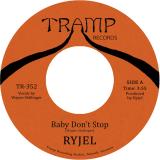
Ryjel was a band from suburban Pittsburgh, PA, that started out in the mid-1970s performing classic rock covers. The band was approached by a local entrepreneur who wanted to cut a single for the disco market, but a lack of financing scuttled the proposal. Nevertheless, the band was able to record a dozen of its original tunes in a professional studio for possible release, and among those songs were "Heart's On Fire" and "Baby Don't Stop."
Both tracks were recorded some 50 years ago having remained unreleased to this day. It needed the investigative work of the Tramp Records crew to discover them. Finally they are available on a strictly limited 45 RPM single release. In addition, the full length version of "Heart's On Fire" will soon be released on the upcoming Tramp Records compilation titled "CAN YOU FEEL IT Vol.5 - Modern Soul, Disco & Boogie 1977-88".
On Stock and ready to ship

Original release date: September 20, 1979
Along with the 3rd album, another excellent Sanullim album with the highest proportion of Kim Chang-hoon's songs. Based on a more stable and elegant performance than ever before, it is a work that attempted various experiments never before.
The guitar sound using rough fuzz tone and flanger effect, the strong rhythm and groove of the prominent bass line and dynamic drum, the keyboard expressing the rich string effect, and the stronger 'Korean' color are properly harmonized to each song. It conveys a kaleidoscopic, dramatic and refined fascination.
Mysterious and dreamy classic song Let’s Go To The Vineyard with a strong scent of progressive rock, and the Sanullim’s sounding hard rock A Portrait Of A Lady Shaman, the first song written by Kim Chang-wan, Why Are You Leaving Me? It contains songs that deliver new inspiration the more you listen to it.
On Stock and ready to ship

“Todavía No”, La Paloma’s debut album, consolidates the young band from Madrid as one of the realities of the current scene. Undoubtedly, it’s definitely a bold step forward in all senses: compositional, interpretative, and artistic. Noise-rock to combat all the noise out there.
In “Una idea, pero es triste”, their celebrated debut EP, La Paloma expounded something very serious, but they explained it only once. Five songs that instantly connected with an audience eager for new references. In “Todavía no” there is more depth; here practically each cut shows a different shade of being La Paloma. “Tiré una piedra al aire” is far from “Algo ha cambiado”, but both are unequivocally La Paloma. Surely, this is something that can be attributed to the baggage acquired during this time lapse, but it certainly speaks very well of the artistic ambition of a band to which now seems to have no ceiling.
We are not, therefore, facing a mere extension of their 2021 EP, although musically they pick it up from where they left off. “Todavía no” is an accessible and contagious work, equal qualities shared with “Una idea, pero es triste”. It’s a work that conveys discontent and liberation, ambition and boredom. In large part, it’s due to the accredited ability of its composers Nico Yubero and Lucas Sierra to observe the world with the right dose of skepticism and disappointment, avoiding tormented gesticulation.
The presentation tour that followed the publication of the EP was extensive and led La Paloma to defend their songs throughout the Spanish geography, as well as visits to Portugal, Mexico and the United States. That state of grace was transferred to the studio, where they tried to reflect their live sound and proposal. With an elegant production and without undue frills, the mission of preserving the sharp fang shown in concert halls was achieved, ensuring, in turn, that the elements, arrangements and the proposal of each instrument were heard crystal clear.
Right from the start, we notice in the sequence many of the virtues that make La Paloma one of the most advantaged groups of the current scene: gushing guitars, the solidity of its rhythm section with Rubén Almonacid on bass and Juan Rojo on drums and the color tone provided by the voices of Nico and Lucas, who share the vocal tasks on alternate tracks.
But there’s more: songs that destroy the most generic canon of noise-rock to take it to little-explored territories, frantic guitar games and a cascade of imaginative arrangements. It combines popular song constructions with unpredictable structures that prevent you from anticipating what twist is to come next, making listening experience exhilarating and addictive.
“Todavía no” is a tightly cohesive album, a remarkable fact considering the two creative inputs from which the band draws from and the artistic ambition with which they faced the building of this work. Because we are talking about a complete work, conceived as such. The first chords of “Sigo aquí” sound and the disorganization of reality… is still disorganized, but somehow it makes sense now.
expected to be published on 26.07.2024

Julian Cannonball Adderley's only Blue Note album, Somethin' Else, would likely forever be famous in music lore if just for the presence of Miles Davis. The iconic composer/trumpeter steps into the role of sideman on the 1958 set, one of just a handful of times he'd make such a move after the calendar passed the mid-1950s. Yet evaluating Somethin' Else strictly on Davis' involvement misses the big picture. Plain and simple, Adderley's jubilant work remains a jazz landmark due to the chemistry of its Hall of Fame personnel, enthusiasm of its participants, and sophistication of its arrangements – not to mention the reference-grade production and inclusion of the definitive renditions of two all-time jazz standards.
Limited to 6,000 numbered copies, pressed on dead-quiet MoFi SuperVinyl at RTI, and mastered from the original master tapes, Mobile Fidelity's ultra-hi-fi UltraDisc One-Step 180g 45RPM 2LP collector's edition pays tribute to the record's merit and includes the bonus track "Allison's Uncle." Offering reference-calibre sonics, this spectacular collector's version provides a clear, transparent, ultra-dynamic, and up-close view of a cornerstone effort that witnesses Adderley and Davis sharing horn duty alone for the only time in their fabled careers – an arrangement that occurred as a result of Adderley having joined Davis' majestic sextet a year prior.
The premium packaging and beautiful presentation of the UD1S Somethin' Else pressing befit its extremely select status. Housed in a deluxe slipcase, it features special foil-stamped jackets and faithful-to-the-original graphics that illuminate the splendour of the recording. No expense has been spared. Aurally and visually, this UD1S reissue exists as a curatorial artefact meant to be preserved, touched, and examined. It is made for discerning listeners that prize sound quality and production, and who desire to fully immerse themselves in the art – and everything involved with the album, from the iconic photos to the gorgeous finishes.
The vibrant potency reveals itself openly on an analogue set that provides full-range reproduction of an ensemble that also includes pianist Hank Jones, bassist Sam Jones, and drummer Art Blakey. Each and every snare hit, downbeat, and cymbal splash registered by the latter take on realistic proportions, blooming and decaying as they would right in front of you on a stage. Jones' foundational bass lines register with uncommon depth and palpability, the litheness of the strings and fullness of the instrument epitomizing the definition of rhythm. Stellar, too, are the surefooted 88s. Sublime in scale, tonality, and attack, with the delineation such you can practically separate the white and black keys in your mind. As for that liquid interplay between Adderley and Davis? Breathtakingly lifelike in timbre, naturalism, purity, and presence. This collector's version takes you there – there being Rudy Van Gelder's legendary New Jersey studio in March 1958 to witness it all unfold, again and again.
For reasons that extend far beyond the outstanding playing and flawless repertoire, Somethin' Else is without question a record you'll always want to watch and hear come together. As veteran critic Bob Blumenthal observed writing about the album four decades after its release, "The instant rapport achieved by the quintet is thus the product of much shared and common history, though the tensile strength that they create throughout created a totally unique feeling that can be attributed to the sensitive musicianship of all concerned, including the supposedly hard bopping leader and drummer." Such inimitable feeling, or emotion, courses throughout every passage, and no where more obviously than on "Autumn Leaves" and "Love for Sale."
Without question, the discreet interpretations of the Johnny Mercer and Cole Porter songs, respectively, found on Somethin' Else have long been considered part of jazz's alluring mystique. Adderley and Davis bring contrasting approaches to the table yet sound of a singular mind on "Autumn Leaves," with the latter's muted trumpet and the headliner's lush alto saxophone dovetailing into a performance that endures as a blueprint for expression, counterpoint, sophistication, fluidity, and linearity. Blues, melody, and romance pour from their horns. Their bandmates, picking up on the intimate vibe and calm mood here – as well as on the spry, head-over-heels spirit of "Love for Sale" – join in on the conversation with sharp economy and float-on-air roundedness.
Not to undersell the other three numbers, all deserving five-star status. Twelve measures in length, the title track offers a slow burn in swing. Written by Adderley's brother, Nat, the 12-bar "One for Daddy-O" transmits funk flavors. The closing "Dancing in the Dark" pops with lushness and temptation, its stream of bold colours and understated textures calling for a moonlight twirl, or at least fantasies suggestive of a memorable night. Somethin' else, indeed.
expected to be published on 11.08.2023

In view of the immense Black Lives Matter mobilisation in reaction to the murder of George Floyd and the comparatively meagre societal reaction to the attack in Hanau, the question arises: How come our society does not show the same empathy and solidarity towards its own fellow citizens with Kurdish, Turkish, Bulgarian, Bosnian, Afghan migrant backgrounds or members of the Roma and Sinti?
How limited is our postcolonial discourse if we are unable to address the racist exploitation of those who repair our cars, deliver our parcels or harvest our asparagus?
It’s all a sham. Shake it off like a biometric photograph. Shake off that false consciousness. The Black Diaspora is a transatlantic lie invented by music curators and journalists. Embrace this nuanced return to structures and superstructures, to articulations and historical constellations as analytical tools.
Allow me to dampen your expectations. This is not the sound of decolonisation. This is no compilation of BLM protest songs. This is no celebration of Black emancipatory struggles. You will not be able to play this at your hip post-pandemic house party. This will not go down well with your woke friends. This is music for the square in the room. For that reluctant BAME/Person of Color repelled by your fetishisation of the African-American experience.
This is music for gated communities. This is Fehler Kuti singing of class relations, not of identities and positionalities. This is Fehler Kuti resisting.
Listen to these songs of infrastructure and appraisal of the welfare state. Join me in mourning the broken promises of prosperity for all. Send that “Ausländer“ of your mind to heaven. Colonialism fucked you up. Platform Capitalism is keeping you in chains. Are we to unionise all human and non-human workers at Amazon? Will modernity always have that "forever nigger“? What about those dispossessed field hands harvesting your asparagus?
All is lost. The system is rigged. Because all histories, gestures and identities have been absorbed into this late capitalist apparatus we call diversity. It can integrate anything and anyone. It made me. It is the price of the ticket. And it is unable to challenge its own premise of an atomised society. As if you and I had so little in common.
They will try and help you. They will build a museum for your history and a scholarship program for your future. I warn you. Don‘t let them give you a name. Resist appellation. Don’t get that German passport. Don‘t eat asparagus.
Fehler Kuti, Spring 2021
All songs by Julian Warner. Produced by Markus Acher and Tobias Siegert.
Markus Acher – drums, percussion, backing vocals Micha Acher – sousaphone, trumpet Cico Beck – synthesizer Jenny Bohn – backing vocals Pacifico Boy – vocals Katja Kobolt – spoken word Theresa Loibl – bass clarinet, backing vocals Sascha Schwegeler – steeldrum, kalimba, percussion, backing vocals Tobias Siegert – bass, synthesizers, percussion, backing vocals Julian Warner – piano, memotron, vocals
recorded and mixed by Tobias Siegert at Minga Records, july – december 2020 mastered by Moritz Illner at Duophonic
Cover art and photography by Andreas Neumeister. Layout by Sascha Schwegeler.
Fehler Kuti “Professional People” is part of the same multiverse as “The History of the Federal Republic of Germany as told by Fehler Kuti und die Polizei”. A production by Julian Warner. In cooperation with Münchner Kammerspiele. Funded by the Department of Arts and Culture of the City of Munich. Released by Alien Transistor.
Order now and we will order the item for you at our supplier.

2x12" Repress
Answer Code Request returns with his sophomore album Gens on Ostgut Ton, entering darker but equally bass-heavy territory.
Answer Code Request's 2014 debut LP Code was an exciting moment for electronic music in Berlin - one that offered a break from the eternal hall and monolithic 4/4 kicks that ruled the city's club landscape. As a hybrid gesture, the album's spirit recalled an especially fruitful era in the German capital from the mid-90s to early 2000s, when dub and paddriven Detroit techno cross-pollinated with Berlin's industrial aesthetic to create one of the city's most exciting musical chapters.
Today the musical vision offered by Berghain resident Answer Code Request, real name Patrick Gräser, has proved far-sighted. While at first glance electronic music in 2018 seems increasingly balkanized, borders between genres have once again become fuzzier.
Now, on his follow up LP Gens, Gräser looks beyond the bass euphoria of Code toward darker horizons and a desolate atmosphere befitting of current global circumstances.
In a sense, Gens (Latin for tribe or lineage) reverses the notion of the hardcore continuum as proposed by music journalist Simon Reynolds: embedded in a tradition of US andcontinental European techno, Gräser seeks its disruption through hardcore outgrowths, from ambient jungle to later variations of British bass music and IDM. It's an interesting twist when seen in the larger biographical context of Gräser who, born and raised outside of Berlin in early 1980s, jumped from East German youth radio DT64 to American hip-hop, acid and early UK hardcore - a radical shift of musical interest born of a radical shift in political circumstances. On Gens, the unsettling atmosphere is established early on with the fading rave opener of the album's synonymous title track, and continues through the scrambled military communications and post dubstep rhythms of 'Sphera'. From there, sci-fi pads, heavy phasing and alien syncopation lead explorative third track 'Ab Intus' out into space. Aglimmer of otherworldly positivity arrives with the warm, distorted breakbeats and interwoven synth melodies of album standout 'knbn2', while Gräser's most dancefloororiented melds jungle and techno, Amen and 4/4 kicks, on 'Cicadae'.
Order now and we will order the item for you at our supplier.

Tobias. explores space and gasiform substances with his Helium Sessions on Ostgut Ton. Following his recent image and sound collaboration with visual artist Valentina Berthelon as Recent Arts, Tobias. now delves into the idea of music reminiscing gas leaking into space with four new tracks.
While we all agree that there can't be sound in a vacuum, Science Fiction taught us the opposite, that space can potentially sound hyperfuturistic, hostile yet exciting. And since the Chandra X-ray Observatory discovered the deepest sound in the universe near a supermassive black hole - why should analogue synth jams with the stars seem impossible
With Helium Sessions Tobias. proposes an acoustic representation of the gaseous state of matter in space. LAGEOS 1' on A1 already sets the tone with meandering drones atop a gnawing synth pad and distorted flickering percussion. The title refers to the satellite LAGEOS-1 which will continue to orbit planet earth in 5,860 kilometers altitude for another 8.4 million years (or 4,418064E+12 minutes) - we'll let you do the maths of how often the 6:03-minute LAGEOS 1' could be played until the satellite's returnal.
Nucleon' on A2 comes with a more dubby, deep and throbbing feeling, Helios' on the flip features epic noise textures with shimmering melodic synth leads and a multi-layered break beat vibe, while Spectrum V' on B2 closes this 12 with another dub cut, detailed synth explorations and alienated vocal bits.
Helium Sessions offers four new zero-g tracks from Tobias. spread out over 27 minutes on this extended EP, his third full-length album will be landing in 2017.
Order now and we will order the item for you at our supplier.

MONDO DISKO club has been, for over the past 16 years, the flagship for discerning electronic music lovers and dancers in Madrid. With a loyal and enthusiastic crowd and a booking policy that combines a selection of solid resident djs alongside a list of high quality international artists, creating a record label seemed to be the most reasonable step to follow..
MONDO DISCOS is born as an extension of the club, with the sole intention of bringing to light musical projects that excite us, projects with which we feel particularly identified.
For our first reference, which we found particularly important as it will set the tone, we have a very special and mysterious proposal called MENTHO. This is the brand-new side project of a well known house duo that wishes to remain anonymous for now, and wanted to dig deeper into their more experimental side
Teo's Sock consists basicaly on a mix of electronic, experimental music, halfway between mental electronic vibes and instropected techno. Polirithmic and intrincate patterns with an afro sounding background, deep and moody synth work and an overall endless melodic vibe.
Order now and we will order the item for you at our supplier.

Atte Elias Kantonen is a composer and sound designer based in Helsinki, Finland. “a path with a name” follows well-received releases on Mappa and Active Listeners Club, and finds Kantonen expanding the scope of his dynamic and idiosyncratic practice. Here, he places his listeners within an auditive diorama, affording them myriad views of the microscopic landscapes contained there within. An oneiric narrative is established from the opening track, in which a heavily treated voice proposes a dialogue and introduces us to the wonders of the soundscape. This speaker appears at various points throughout the record, functioning as guide, confidant, and friend. Those familiar with Kantonen’s prior output will immediately recognize the shapeshifting, 3D timbral constructions presented here, arrangements that are positively overflowing with glimmering, delicate, polyphonic detail. This is a record that invites and welcomes speculation about the nature of the quest that it sets its listeners out upon, with Kantonen offering up trail markings to provide (dis)orientation before turning them loose to explore the soil, moss, and tide pools.
Order now and we will order the item for you at our supplier.