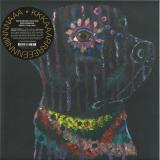
Ricochets started their career back in 1998, and quickly became a force to be reckoned with in the Norwegian rock scene. They gained a lot of attention all over Scandinavia as a solid live-band next to their Norwegian peers Madrugada & Midnight Choir. "Isolation" was their third record, first released in 2005. Now on vinyl for the first time, remastered and packed in a great looking gatefold sleeve.
"Isolation" by Ricochets includes the following tracks: "Isolation", "Written On My Grave", "I'm Gonna Eat Myself", "Blues In Bb-Minor" and more.
Cerca:ricochets
- 1
Off The Record (faitiche 39), the new album by French collagist Roméo Poirier, is an amusing romp through the discarded history of recording studios. It contains fourteen miniatures based on accidental recordings of studio talk, revealing things that were never meant for the public: we hear instructions from studio staff, scraps of talk between musicians, or just microphones being adjusted, as well as false notes, false starts: everyone stops. Start again: 1, 2, 3, 4!
Poirier’s approach recalls Accumulation, an artform practiced by Arman, Jean Tinguely and Daniel Spoerri that involved piling up everyday items into assemblages. The objects themselves often remained unaltered, the artistic gesture consisting in the careful curating of a distinctive selection. Poirier’s audio collages explore similar terrain. The fourteen pieces on Off the Record combine more than a thousand found sounds from studio archives into complex miniatures. The audio content of these outtakes is twisted, stretched, cut, reassembled, slowed down and accelerated. Voices cut into a microgroove, from a very old recording, intertwine with digital voices gleaned from YouTube. All of them in dialogue, engaging the listener with the impression of being part of a new music group.
Poirier uses the mundane routine of setting up before the actual recording gets underway to tell a universal story about working in a recording studio. And he manages something few achieve, transforming specialist knowledge into a narrative whose beauty goes far beyond its immediate subject. It speaks to everyone, because the story is told in a musical language that is open and accessible, evoking magical images reminiscent of Oz – a world consisting less of events than of camp hallucinations, captured in grainy black-and-white photographs. En passant, Poirier shows us how the notion of material accumulation can produce great art.
Written and produced by Roméo Poirier, mastered by Stephan Mathieu, photos by Roméo Poirier, graphic design by Tim Tetzner.
On ‘Animal’, Ash Fure appeals to “animal intelligence” by using sounds that are inherently physical and driven by perception, athleticism and interaction. Placing polycarbonate sheeting over an inverted subwoofer she built alongside her partner Xavi Aguirre and brother Adam, Fure isolates the physical impact of sound by focusing on psychoacoustic sub-bass pulses, semi-perceptible micro-rhythms and discomfiting white noise bursts, linking the process to her experiences in Berlin and Detroit’s techno dungeons where the sound has to adapt to the space it’s performed in. When she performed ‘Animal’ for the first time, Fure fabricated a “listening gym”, allowing the audience to interact in real-time by circuit training in response to the sound. The sweat is almost audible across the record, a run-on selection of rhythms, resonances and abstractions that sound like interlocking heartbeats on a series of treadmills. Her fascination with techno’s cavernous cathedrals is clear from the beginning, but Fure doesn’t worship at the altar: we’re hit with the feeling, not the aesthetic. The beats themselves, made from unstable vibrations and waterlogged, reverberating clicks, echo the brain’s unconscious reaction to repetition in a vast concrete box, the feeling you get when each percussive snag ricochets from every surface in the building. Coddling these whirring, criss-crossing polyrhythms with harsh, distorted low-end retches, Fure accurately recreates the energy and fatigue of the endless weekend sesh. We never once encounter techno in its expected shell, just its residue - the outline of humans figuring out their relationship with technology, architecture and each other. Fure’s use of dynamics is also deviously smart, marking out an overall rhythm that’s not tied to the strength of the sounds themselves, but just volume and physical impact. Often her most brutal sounds - ear-splitting squeals and overdriven mechanical whirrs - are reduced to an almost inaudible level, a bit like the bandy legged trip to the bathroom, or the escape to some dimly lit nook, the part of the night where you can still detect the sound on your skin without being battered by it. When the undulating rhythm returns in earnest, Fure masks acidic sequences in jet engine expulsions, still refusing to objectify anything that an AI model might be able to pick up on.
In 2016, Cliche Morph offered the aquatic textures of "Liquid Materia". "Hidden Madness" is the return and a new beginning. Four tracks of intense introspection mark a collaboration and a founding, Deep Sound Channel and Postdynamic. Atmospheric and immersive, from the needle drop the listener is immediately drawn into the subterranean chambers of this cerebral piece. A stark beat is the guide rope, a snare that echoes and ricochets into the cavernous expanse of cold currents and all too real phantoms. Feeding off that palpable paranoia, Psyk pours a thick resonating syrup over the original before pulling the switch. Darkness descends, distortion and reverb dominate with a steady kick delivering some form of solid ground. Respite? No hope. Pound and thud tell the arrival of "Exorcist". Industrial groans and a clanking larynx are cut through by haunting strings, a meagre echo of humanity in this absorbing and unsettling track. Blazej Malinowski closes. Drum patterns are amplified and concentrated in the producer's purge of "Exorcist", hi-hats hissing as the spectral refrains of the original shift in shape and form. A 12" that plumbs the physical and the psychological depths of sound.
With its name indicative of the music's boundary-testing diversity and Southwestern inspiration, On the Border finds the Eagles leaving everything on the table and embracing a harder edge that takes the band out of more relaxed territory and establishes it as a group that knows how – and wants – to rock. Glenn Frey, Don Henley, new member Don Felder, and company immediately announce their intent on the defiant album-opening hit "Already Gone" and never look back, crafting a gem of a record that from start to finish is arguably their most consistent and balanced effort.
Limited to 10,000 numbered copies, pressed on dead-quiet MoFi SuperVinyl at RTI, and mastered from the original analogue master tapes, Mobile Fidelity's ultra-hi-fi UltraDisc One-Step 180g 45RPM 2LP collector's edition pays tribute to the record's significance and enhances the experience for generations to come. Playing with reference sonics that elevate an effort revered by audiophiles, it provides a lively, dynamic, transparent, and intimate view of a release whose contemporary importance continues to grow. The opportunity to zero in on the particulars of the Eagles' golden harmonies, distinct vocal timbres, and cohesive interplay has never been better.
Visually, the premium packaging and gorgeous presentation of the UD1S On the Border pressing befit its select status. Housed in a deluxe box, it features special foil-stamped jackets and faithful-to-the-original graphics that illuminate the splendor of the recording. No expense has been spared. From every angle, this UD1S reissue exists as a curatorial artefact meant to be preserved, touched, and examined. It is made for discerning listeners that prize sound quality and production, and who desire to fully immerse themselves in the art – and everything involved with the album, from the iconic Navajo cover painting to the meticulous finishes.
And with On the Border, there's plenty to take in and soak up. Declared by famed critic Robert Christgau as "the Eagles' best album," the 1974 set claims a rich backstory. Initially recorded amid tumultuous sessions with producer Glyn Johns in London shortly after the release of the group's sophomore Desperado set, On the Border took a new turn after the band elected to scrap most of the prior work, return to its native California, and team with producer Bill Szymczyk to give the material less of a smooth, polished sheen and more toughness. Szymczyk also afforded the Eagles more input and freedom in the arrangements, and suggested adding another guitarist to play on "Good Day in Hell." Felder got the call, and so won over the Eagles with his skills, he quickly became the fifth member of the band.
While the late-arriving Felder only plays on one other album cut, "Already Gone," his mates more than prove their muster on the remainder of a double-platinum affair that established the Eagles as a force whose range transcended the calmer country-leaning style it perfected on their first two LPs. Primarily written by Jackson Browne and shelved during the Desperado sessions due to its higher-energy nature, the throttle-twisting "James Dean" ricochets with barbed riffs and rebellious swagger. Listen without limits to how Szymczyk's raw production stamps the song with a leather-and-jeans cool befitting its protagonist. Similarly rugged, the slide-guitar-fueled "Good Day in Hell" boasts its own mean streak. And the funk-laced, boot-stomping title track cautions "don't you tell me 'bout your law and order." Throughout On the Border, the Eagles are in no mood to mess around.
Not that the band skirts sentimental territory. On one of the era's finest covers, the Eagles nail the bittersweet feelings and bring high-definition detail to the vivid scenery of Tom Waits' "Ol' '55," a song the group makes its own. The rustic ballad "My Man" serves as a tribute to the recently deceased Gram Parsons, with singer-guitarist Bernie Leadon taking the lead on the microphone as he pours his heart out to his former Flying Burrito Brothers mate. And when it comes to romance, is it possible to top "Best of My Love"? Graced with Henley's honey-dipped vocals, refined wordless group harmonies, brushed drums, and the gentle strum of acoustic guitars, the Johns-produced cut soared to Number One and set the stage for what would soon be the Eagles' reality: global dominance.
More About Mobile Fidelity UltraDisc One-Step and Why It Is Superior
Instead of utilizing the industry-standard three-step lacquer process, Mobile Fidelity Sound Lab's new UltraDisc One-Step (UD1S) uses only one step, bypassing two processes of generational loss. While three-step processing is designed for optimum yield and efficiency, UD1S is created for the ultimate in sound quality. Just as Mobile Fidelity pioneered the UHQR (Ultra High-Quality Record) with JVC in the 1980s, UD1S again represents another state-of-the-art advance in the record-manufacturing process. MFSL engineers begin with the original master recordings, painstakingly transfer them to DSD 256, and meticulously cut a set of lacquers. These lacquers are used to create a very fragile, pristine UD1S stamper called a "convert." Delicate "converts" are then formed into the actual record stampers, producing a final product that literally and figuratively brings you closer to the music. By skipping the additional steps of pulling another positive and an additional negative, as done in the three-step process used in standard pressings, UD1S produces a final LP with the lowest noise floor possible today. The removal of the additional two steps of generational loss in the plating process reveals tremendous amounts of extra musical detail and dynamics, which are otherwise lost due to the standard copying process. The exclusive nature of these very limited pressings guarantees that every UD1S pressing serves as an immaculate replica of the lacquer sourced directly from the original master recording. Every conceivable aspect of vinyl production is optimized to produce the most perfect record album available today.
First thought, best thought. Until the next thought: a guiding principle for No Age in the 16ish years they've been around. Constantly responding to their own streams of consciousness with reductive flexibility, they've taken the basic duo of guitar and drums with vocals WAY farther than anyone listening in halcyon Weirdo Rippers days could have guessed. Expounding on those larval possibilities, they've zig-zagged in serpentine precision, in and out of the teeth of the wringer - ranging outside and back in again, as befits the present thought. And now, six albums into it, these principles have led them to make People Helping People. Composed in their studio of ten years in the "pre pandemic" times, then an eviction from said space, and finished deep in the midst at their new basecamp: Randy's Garage. It starts with an instrumental, too. First counter-intuition, best counter intuition! Nearly five minutes prelude Dean's debut vocal interjection - a zoom in from the upper atmosphere, Randy's guitar clouds pulsing with radiation, paced by spare, percussive accents. When the first song with singing ("Compact Flashes") bounces in on an insane synthetic beat, the only recognizable sound of No Age is a sputtering of enchanted clicks and creaks - muted guitar strings and drumkit rattlings that cycle for a full minute before voice song and snare fall into place. This is the sound of People Helping People: No Age, deep in the lab, scraping available nuclii together to see what new compound they find next. Erasing the starting points, reordering the pieces and beginning anew. It's an everyday mindset - and as the first No Age album recorded entirely by No Agee, People Helping People is a broadcast of entirely lived-in proportions. Side one ricochets expertly back and forth between magisterial instrumentals and sing-song forms cut up on the mixing desk, as with the undeniable hitness of "Plastic (You Want It)", winningly rewired to MIDI-mangled beat squelches. They don't really land on a straight up punk-style riff until it's almost time to flip the side, and even once they've got off on a run of rockers on side B, their aesthetic choices continuously reframe the norms, enhancing their inherent power. People Helping People finds their disparate desires operating in perfect sync; prolegomenic weirdness fused immaculately to classic rock propulsion, transforming the energy pouring out from their hands and feet with electronics. Dean's lyrics are like pieces taken off the belt at the factory and put together into a John Chamberlin-esque sculpture, meant to sit out in the rain. Randy's guitars, collaged into arrangements that reflect, again, boundless curiosity and exquisite restraint. This is People Helping People: unpretentious, suspicious, inviting, confident, left field. The most accurate display of the No Age ethos put to record. Yet!
- 1: Several Hands On Our Piano
- 2: Don't
- 3: Flashback Caruso
- 4: Voices And Trumpet And All
- 5: J'ai Mal Aux Dents
- 6: Beim Nächsten Ton Ist Es
- 7: Two Drums, Bass, Organ
- 8: Dr. Schwitters Intro
- 9: Several Hands On Our Piano (Continued)
- 10: Beam Me Up, Scotty
- 11: Elerimomuvid
- 12: Dr. Schwitters (Continued)
- 13: Have A Good Time, Everybody
- 14: Above And Under Our Piano
- 15: Hermanns Lament
- 16: Donnerwetter
- 17: Was Ist Hier Los?
- 18: Rudolf Der Pianist
- 19: Ricochets
- 20: I've Heard That One Before
- 21: Watch Your Step
- 22: Under Our Piano Again
- 23: Fluid Chorus
- 24: Stretch Out Time
- 25: Der Baum
- 26: Chère Chambre
There's something perversely fabulous about the thought of this warped masterwork wandering into 60,000 unsuspecting British homes in 1973. Faust's second-and-a-half album hit the shops to celebrate their signing to the nascent Virgin Records, who were looking to take advantage of the zeitgeist for German music at that time. Undeterred by the fact the band's unwillingness to engage with the commercial landscape had seen them dropped from Polydor, Branson and co cooked up a suitably spectacular marketing strategy, selling the LP for 49p, the bargain price of a single. Shoppers flocked in their thousands to grab a copy, raced home and then spent the next forty five minutes checking their tracking, banging the speakers and blowing the needle, all to no avail. Do not adjust your set - This is Faust.
Back In Stock!
The debut collaboration between techno alchemists Ben Klock and Lucy will probably provoke quivers of anticipation before a single note has been heard. After all, both producers have carved out names for themselves as scene innovators at what they do, and both have already proven that they can more than capably work in a duo format without sacrificing an iota of their unique aesthetics: in Lucy's case, there has already been the sublime Zeitgeber pairing with Speedy J., and Klock has joined forces with the likes of Marcel Dettmann to craft some of the more memorable output from the Ostgut Ton label. This new release makes good on each producer's talent for working with epically unfolding tracks, maintaining a strong command of both 'drone' and melodicism, and envisioning sound as a kind of inter-dimensional mass transit. As the record indicates, things can get very interesting when the two working methods superimpose perfectly, but can be just as interesting when the two fall slightly out of phase with one another.
Listeners familiar with the classic kosmische feel will be taken immediately by the opening gambit "Bliss," whose feeling of floating through the coldness of space is accompanied here by nicely warm production values. The bassline that introduces the subsequent track ("War Lullaby") is close to being a continuation of the opener's leitmotif sequence, although with a change in atmosphere that will keep curious ears from turning away too soon: an FX-shrouded voice delivers a monologue at once seductive and foreboding, followed by a confident kick thump with ephemeral trailing clatters in tow. This affective orientation pulses through the whole record well, building up to the second rhythmic track ("Santeria") which is the busiest and most engaging of the bunch. Here a variety of sonic flavorings are ritually thrown into the pot and allowed to simmer - fleeting snatches of conga, phasing zaps and rhythmic ricochets all make for a rich concoction that epitomizes the progress that has been made in techno music within this decade. The closing "A Ghost Love story," like the opener, is a non-'dance' piece, but is no less compelling for that fact: as a foam of white noise pans between the listener's ears, a slurred / pitch-bent refrain conjures the feeling of either entering or exiting from some erotically tinged hypnagogic state.
Speaking of which, the overall impression given off by this record is that of a special kind of reciprocity: that is, of dreams influencing reality and reality feeding back into dreams. The rhythmic intensity of these tracks, at once an indicator of a hard and immediate reality, is regularly complemented by oneiric flourishes that make the partitioning line between these two realms of consciousness less distinct. As the next chapter in the Stroboscopic Artefacts saga, and in the personal journeys of both Ben Klock and Lucy, it will contribute to the ongoing mission of all these parties: giving longtime fans what they want while expanding their consciousness and inquisitiveness.
It’s nearly a decade since William Doyle handed a CD-R demo to the Quietus co-founder John Doran at a gig, who loved it so much he set up a label to release Doyle’s debut EP (as East India Youth). Doyle’s debut album, Total Strife Forever, followed in 2014, as did a nomination for the Mercury Music Prize. A year later, he was signed to XL, touring the world and about to release his second album – all by the age of 25.
After self-releasing four ambient and instrumental albums, Doyle’s third full-length record – and the first under his own name – Your Wilderness Revisited arrived to ecstatic reviews in 2019: Line of Best Fit described it as “a dazzlingly beautiful triumph of intention” and Metro declared it an album not only of the year, but “of the century”. Just over a year later, as he turns 30, Doyle is back with Great Spans of Muddy Time.
Born from accident but driven forward by instinct, Great Spans was built from the remnants of a catastrophic hard-drive failure. With his work saved only to cassette tape, Doyle was forced to accept the recordings as they were – a sharp departure from his process on Your Wilderness Revisited, which took four long years to craft toward perfection. “Instead of feeling a loss that I could no longer craft these pieces into flawless ‘Works of Art’, I felt intensely liberated that they had been set free from my ceaseless tinkering,” Doyle says.
“The album this turned out to be – and that I’ve wanted to make for ages – is a kind of Englishman-gone-mad, scrambling around the verdancy of the country’s pastures looking for some sense,” says Doyle. “It has its seeds in Robert Wyatt, early Eno, Robyn Hitchcock, and Syd Barrett.” Doyle credits Bowie’s ever-influential Berlin trilogy, but also highlights a much less expected muse: Monty Don, presenter of the BBC programme Gardener’s World, Doyle’s lockdown addiction.
“I became obsessed with Monty Don. I like his manner and there's something about him I relate to. He once described periods of depression in his life as consisting of ‘nothing but great spans of muddy time’. When I read that quote I knew it would be the title of this record,” Doyle says. “Something about the sludgy mulch of the album’s darker moments, and its feel of perpetual autumnal evening, seemed to fit so well with those words. I would also be lying if I said it didn’t chime with my mental health experiences as well.”
Lead single “And Everything Changed (But I Feel Alright)” is representative of the album as a whole: eclectic and unpredictable, but also playful and properly danceable. On top of the gently pulsing electronics, soothing harmonies and glowing melodies, there’s a ripping guitar solo that ricochets around the song like a pinball. “I wanted to get back into the craft of writing individual songs rather than being concerned with overarching concepts,” Doyle says. Elsewhere there’s the synth pop strut of “Nothing At All”, pulsating static on “Semi-Bionic”, incandescent synths and enveloping soundscapes in “Who Cares”, and the ambient glitch groove of “New Uncertainties”.
Great Spans of Muddy Time is a beautiful ode to the power of accident, instinct and intuition. The result, however, is far from an anomaly: this celebration of the imperfect album is one that required years of honed craft and dedicated focus to achieve, “For the first time in my career, the distance between what I hear and what the listener hears is paper-thin,” Doyle says. “Perhaps therein reveals a deeper truth that the perfectionist brain can often dissolve.”
m 13. [a sea of thoughts behind it]
Sheffield’s Tommy Vicari Jnr delivers a study in contrasts for his first release on Drone. ‘Kept In’ is a concordant, synthetic techno pop excursion that bursts into your head like a thought and ricochets throughout. The static and reverb harnessed by Vicari to create ‘Closing In’ is a dub/techno assault, and inverse to the propulsive and glitchy rhythm of the A side.
Brotherhood Sound System Records is back with its third 12" offering and the first in a series of compilations entitled 'Percussive Parameters', delivering percussion heavy sonics focused directly at the dance floor.The lead track of the EP, Callahan's 'Kudzu', opens with a chopped, atmospheric vocal layered intelligently over rolling percussion and a hypnotic flute. A pounding 808 kick drum is teased underneath until the track switches into a relentless, chugging club tool.
This one's destined to tear up dance floors for a long time...
Next up are label bosses Silas & Snare with 'Eastern Shores'. An unassuming and innocuous introduction with lush pads and clean percussion that ricochets neatly off vocal cuts dramatically shifts pace and turns into a weighted, rolling cut of UK Techno. On the flip, A:Tonal leads the charge through an acid tinged stomper entitled 'Perfect Imbalance'.With driven percussion and firing synths in equal measure, this is unquestionably a peak time weapon in any DJs arsenal. Finally, Bristol locals SYZ & LKY deliver 'Turbulence', a groove and sub laden roller that's meditative and hypnotic whilst maintaining an assertively club ready focus.We're very excited about the start of this new project and chapter for the label, and would like to thank you for all your on-going support. Enjoy the music!
- 1