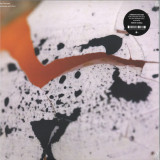
Black Truffle is pleased to present Landscape and Voice, a radical new work (and rare vinyl release) from major Japanese sound artist Toshiya Tsunoda. Undoubtedly one of the most influential artists working with location recordings since the 1990s, Tsunoda’s work possesses a rigorously searching quality that sets him apart from his contemporaries. Tsunoda is known to many listeners for the subtle atmospheric poetry of his early Extract from Field Recording Archive series, which focussed on vibrations recorded in various indoor and outdoor environments in his native Miura Peninsula, often inside pipes, bottles and other vessels. In more recent years, his work has explored the implications of his claim that field recording should be seen as ‘depiction’ rather than ‘documentation’. He has explored disorienting editing and processing in his works with Taku Unami, and, perhaps most radically, represented Maguchi Bay as a kind of kinetic sculpture for shaking speakers by removing all but the inaudible low frequencies from a field recording (Low Frequency Observed at Maguchi Bay).
One of the recurrent concerns of Tsunoda’s recent work, as he explains in the crystalline liner notes accompanying this release, is ‘exploring how I can establish a subjective relationship with an environment, rather than seeing it merely as an object to be recorded’. This has taken various forms, from documenting simultaneously an outdoor environment and the blood flowing through the listener/recorder’s body (captured with a stethoscope) on The Temple Recordings, to representing his own experience of the landscape as made up of ‘grains of space and time’ by inserting looped fragments into field recordings in Grains of Spring.
On Landscape and Voice, this meeting between subject and object becomes an almost mystical union between the natural and the human. As with all of Tsunoda’s work, a relatively simple concept leads to compelling, thought-provoking results. Landscape and Voice combines vowel sounds spoken by six voices with short, looped fragments of field recordings, their noise character suggesting consonants: voice and landscape thus join together in something like words. The record consists of three pieces, each using a different, richly evocative field recording, which periodically freezes, catching on a looped fragment to which is synchronised an abruptly looped spoken vowel sound. The lengths between these interruptions vary, as do the tempi of the loops. The interruption of these lushly immersive recordings of the world – bristling with bird song, rushing water, distant traffic, and clinking metal – only serves to intensify them, as if the depicted environment itself had been returned to the listener each time it abruptly reappears. At the same time, the constant interruption creates an uncannily frozen effect, as if the recorded environment were an object rather than a stretch of recorded time. When combined with the bare human presence of the vowel sounds, the result is both austere and magical. Pressed on 45RPM for maximum fidelity, in a gorgeous sleeve designed by Lasse Marhaug with liner notes from the composer, Landscape and Voice is a radical proposition from one of the deepest thinkers in contemporary sound.
Buscar:toshiya tsunoda
- 1
After a collage tape collab with Bardo Todol back in 2022 (SUC52, Magnetic Road to Hell) Robert Millis finally gets his Discrepant debut proper, a much overdue entryin our random catalogue of lost musical oddities.
The not so self explanatory title Interior Music explores Millis obsession with hidden sounds and its anomalies. An hermetic rearrangement of emptiness could be another more big headed title. But I leave the man to talk about his thing:
‘’The phrase interior music occurred to me a few years ago as a way to describe some recent work. It’s about the resonances inside of hollow wooden chambers (and hollow heads) like gramophones and talking machines, music boxes, instruments, metal containers, and resonant rooms. It’s about exploring tiny audio fragments—single notes, vinyl and shellac surface noise, recording mishaps and anomalies—and arranging them into something meaningful. It is about my own interior mishaps and anomalies and attempts to arrange THEM into something meaningful. It also references “interior design” with the placement of sounds in specific locations, layers or in juxtapositions.
Inspirations include Steve Roden’s lowercase work, Toshiya Tsunoda’s field recordings, Eliane Radique’s slowly shifting ambiances, and the musique concrete of Pierre Schaeffer, as well as the dhrupad and kayal traditions of Indian classical music—especially Kesarbai Kerkar and the Dagar family who have a sublime way of stretching out individual notes and exploring their endless permutations, combinations and connotations.’’
Robert Millis is a sound artist known for his work with Climax Golden Twins, the Helen Scarsdale Agency, the soundtrack to cult horror film Session 9, the Victrola Favorites book and cassette series, and many releases on Sublime Frequencies including Indian Talking Machine, Paris to Calcutta: Men and Music on the Desert Road, compilations of the earliest music recorded in Korea, Japan and Myanmar, and the documentaries This World is Unreal Like a Snake in a Rope and Phi Ta Khon: Ghosts of Isan. Somehow he is a Fulbright scholar (to India 2012-13) and the recipient of a Guggenheim Fellowship (2020). He has or currently does play with AFCGT, Idol Ko Si, and/or Telescoping.
From the cacophonous surrounds of London to the sea stacks of Orkney, via the abandoned military facilities of the Suffolk coast and the watery expanses of the Blackwater Estuary in Essex, from the quarries and neolithic sites of Snowdonia and the wide open skies of Norfolk to the hubbub of Nairobi and Berlin, the streets of Kyiv and the windblown wilds of Antarctica – music is everywhere. You just need to know or learn how to listen.
Ears To The Ground: Adventures in Field Recording and Electronic Music explores how electronic music producers and sound artists use field recordings and samples to document their environments. Author Ben Murphy takes you on a journey to discover how field recordings can create context, emotion, atmosphere, humour and meaning – and examine the most pressing topics of our times.
Composed of extensive interviews with music producers, the book will show how field recordings have become a vital way of understanding, celebrating and interrogating the landscape and the places we live. The book features interviews with Leafcutter John, KMRU, Ultramarine, Kate Carr, Erland Cooper, Proc Fiskal, Flora Yin-Wong, Langham Research Centre, Claire Guerin, Toshiya Tsunoda, Lawrence English, Heinali, Oliver Ho, Matthew Herbert, Matmos, Scanner, Felicia Atkinson and many more.
On its journey, the book takes in abandoned military test sites, remote bird colonies, estuaries, cities, coastlines, old quarries, neolithic burial grounds, scientific research centres and docklands, and ventures between Orkney, Edinburgh and Cork to Norfolk, Kent and Snowdonia, before heading to Kenya, Ukraine, Japan and Antarctica
- 1


