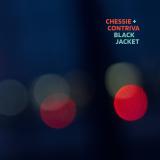
“Black Jacket” is a love letter between two bands separated by continents but united by mutual admiration. Contriva, of Berlin, and Chessie of Washington, DC, first came together in 2001 when sharing a stage, sparking a deep connection over their respective takes on textural, emotive, and mostly instrumental music that merges post-rock, ambient, and experimental elements into unique visions. Fast forward two decades and many trips to their respective studios and we now have “Black Jacket”, a double LP of musical alchemy that builds upon the expressionistic, idiosyncratic sounds of these two groups. A new classic that proves far greater than the sum of its parts.
Begun in the mid 1990's, Washington DC's Chessie is Stephen Gardner (also of noisy shoegaze pioneers, Lorelei) and Ben Bailes, whose various LP's for Slumberland's Dropbeat imprint and Plug Research pair abstract electronics and melancholy post-rock in search of the sounds and feelings of railways and train travel.
Berlin's Contriva, (Monika Enterprises, Lok Musik, and Morr Music) features Masha Qrella (known for her solo works for Morr Music), Max Punktezahl (also of Munich indie legends the Notwist and Berlin's Jersey and Saroos), Hannes Lehmann and Rike Schuberty. For over a decade beginning in the mid-1990's, Contriva crafted compelling instrumentals, grafting experimental textures onto beautiful and complex indie songs.
Together, the six of them have created “Black Jacket.”
Watusi Novedades
- 1
- Annunciation 06:12
- Riel 04:52
- Stone Leaf And Pond 04:11
- Katwijk 04:01
- Dongen 05:20
- Tilburg 03:09
- Maryam 04:51
- Two Wings 04:53
Originally released on Ben Chasny's own Pavilion imprint in 2011.
"I was invited by the Incubate Festival and the city of Tilburg to participate in an artist residency where I would explore the region’s unique chapels built for the Virgin Mary. After writing the music for about six months by drawing on memories of the encounters with the chapels and using techniques inspired by Gaston Bachelard’s Poetics Of Reverie, I flew back to Tilburg to perform the music at the Incubate Festival. We recorded the evening and I released the result on my Pavilion label. Each cover was hand painted white on white in the old Pavilion style. I created a stencil and used graphite powder to make the design that is inspired by the sun imagery in Athanasius Kircher diagrams."
Roadside chapels express the identity of the inhabitants of North Brabant, a Dutch province, bordering on Belgium. Roman Catholicism has been the dominant religion in this southern part of the Netherlands since the eighth century. For about a century and a half this religion was strongly suppressed. Only when the French revolutionaries preached freedom of belief around 1800 could the people of North Brabant exercise their faith again. This was the start of a very strong emancipatory development from which a special form of the Roman Catholic faith arose that fully determined everyday life of the people here. This faith was the determining factor in life and the measure of all things. After the second Vatican Council (1962-1965) the reins of the catholic faith in Brabant were loosened as well. This was the start of a revolutionary process of secularisation. Within a decade hardly anything was left of the almighty influence of the Roman Catholic Church and this situation has lasted up to the present day.
In spite of the almightiness of the official, Vatican ruled, Roman Catholic faith, North Brabant has always and perhaps notoriously fostered an undercurrent of popular belief as well. This is a kind of belief in which elements of the official faith and age-old pre-Christian traditions are combined. Worshipping relics, holding pilgrimages and processions, the use of water from holy wells, popular art, recitations and songs, festivals, rituals, folk traditions, superstition and the like are all examples of popular devotion. These matters have strongly influenced and formed the identity of the present-day population of North Brabant. It is part of their immaterial heritage.
An obvious and still very much visible form of popular devotion are the roadside chapels. In Brabant some 400 can be found, most of which have been devoted to Mary. Chapels are small buildings in which Mary or other saints are worshipped. They can be found within villages or towns or in natural surroundings. Always at the finest spots! The beauty of the environment adds a primary religious or mystical feeling to the visitor. Local people attach great value to their chapels. In spite of the overall secularisation in society they are still at the centre of cultural and social life. Where people in North Brabant can hardly be found in the churches nowadays, this doesn’t mean at all they are no longer religious. On the contrary, religious feelings are perhaps stronger than ever, but now people have to find their own expression of them. That’s why they fall back on the age-old popular belief in which chapels play an important role. We can even witness new forms of popular belief with chapels as their focal point. An example of this is the scattering of ashes of people who have been cremated. Chapels clearly also play a role in the lives of young people. On an average five new chapels are added every year.
I have studied the popular culture and belief and the identity of the inhabitants of North Brabant for over thirty years. I have published over forty books on these subjects. In 2010 I was approached by the organisation of the Incubate Festival in the North Brabant town of Tilburg. Their request was for me to lead the American composer and guitarist Ben Chasny around a number of chapels in the province devoted to Mary. He had been invited to North Brabant to write some new compositions. Ben Chasny then chose to be inspired by these chapels and that’s how we met. I was especially curious how an American would react to something as specific and small as a roadside chapel in North Brabant, since we tend to think here of (people in) America in terms of ‘big-bigger-biggest’. Would an inhabitant of this enormous country with this prevailing culture be able to grasp and respect the identity of some 2.5 million people in North Brabant with their chapels? The answer to this question lies hidden in the compositions he made and that can be listened to on this album. Yes, Ben Chasny has been able to convert the phenomenon of a simple chapel devoted to Mary into music. The physical and the spiritual have found each other. What a beautiful world…just listen! - Paul Spapens
Bursting forth from the darkness of this pre-apocalyptic winter comes 'The Cabanists', the first release of an improvisational project of the same name, comprising three members of the UK's seminal avant-rock band, Nøught. Garnering a cult following since their initial self-titled debut, Nøught became known in the London experimental underground for their tightly orchestrated yet highly complex compositions, ranging from heavy atonal riffage to mesmerizing and hypnotic meditations. 'The Cabanists' builds on Nøught's musical language and are a boundary-pushing trio fusing intricate guitar riffs, dynamic keyboard textures and explosive percussion into a sound that defies convention. Featuring James Sedwards on guitar (most recently known for his involvement with the Thurston Moore Group and This Is Not This Heat), Luke Barlow on keyboards (who co-runs Copepod Records with musician Alex Ward) and Bo Mapper on drums, the band recorded their groundbreaking material during an extended session at London's Lonely Man Studio, marking a defining moment in their musical journey.
With influences spanning progressive rock, experimental jazz and post-punk energy, The Cabanists weave a sonic tapestry that is as cerebral as it is visceral. They challenge standard rock and jazz norms while crafting deeply resonant soundscapes, inviting listeners into a thrilling journey of sound and intense emotion.
Prepare to lose yourself in the intricate chaos and undeniable groove of 'The Cabanists' - where every note is a revelation.
Brigid Mae Power’s latest release, Songs for You, is a heartfelt collection of cover songs dedicated to her father. This album features her unique interpretations of tracks written by legendary artists like Roy Orbison, Tom Verlaine, Neil Young, and Cass McCombs, among others.
With a minimalist yet emotionally resonant sound, Songs for You offers a fresh take on these timeless songs while remaining deeply personal. Brigid Mae Power’s ethereal vocals and atmospheric arrangements bring a sense of nostalgia, reflection, and heartfelt tribute, making this album a powerful bridge between memory and music.
While many of the songs are performed solo, Brigid is joined by Ryan Jewell on drums and Shahzad Ismaily on bass, with Brigid herself playing vocals, guitar, electric guitar, organ, and accordion. Tracks 1, 3, 4, 7, and 8 were recorded at Analogue Catalogue by Julie McLarnon, while tracks 2, 5, 6, and 9 were recorded at home. The album was expertly mixed by Sean McErlaine and mastered by Brian Pyle.
William Tyler is a Nashville guitarist and composer. He spent years woodshedding and touring with Nashville groups like Lambchop and Silver Jews before breaking away to focus on his own version of instrumental guitar music. In the summer of 2022 he was fortunate to have an artist residency at Epicenter in Green River, Utah, a tiny high desert town three hours from anything, One of the other non-profit friends of Epicenter was The Tank is Rangely, Colorado. The Tank itself is a giant and tall disused water tower from the high days of train travel and used to store water to cool train engines and such. Empty for decades, it is now an internationally recognized destination for sound art and almost unparalleled echo/acoustics. William Tyler decided to book recording time there and chose to re-interpret all of the songs of hie 2019 album "Goes West" in a sparse yet cavernous solo acoustic setting: "Something about the frailty and space I wanted the songs to imply was lost in the over-production of the studio record, This felt like a reclamation of the songs and also a symbolic tribute to the stunning, haunted and vast possibilities of the American West, especially at the twilight of American Empire.’
da Googie is the solo project of Deb Googe, bass player with My Bloody Valentine, Thurston Moore Group and Brix Smith. Taking a bass IV, a looper and a pile of FX pedals, da Googie blends traditonal basslines with more abstract noises to make intricate, layered soundscapes.
Too Many Things are duo Marion Andrau (The Wharves/ Underground Railroad/Throw Down Bones) & Jem Doulton (Thurston Moore Group/The Oscillation). Marion & Jem play each other’s songs best described as gloomy noise, politico-romantic psych; expect well oiled electronics, guitar, keys and vocals leading you to an underworld reminiscent of the red room of Twin Peaks.
Steve Gunn has always had one foot in indie rock and the other in an expansive improvisational scene. His songwriter albums alternate with freewheeling jams, most notably in his Gunn-Truscinski Duo, but are not confined to that. So when Gunn decided to revisit Other You, it made sense that he brought in some guests from the far side of the commercial/experimental spectrum to reimagine his songs. Nakama presents five tracks from that last album, reshaped by artists that Gunn admires. The process loosens the songs up considerably.
To start, he calls in Mdou Moctar’s backing band (the American bassist Mikey Coltun and the other guitarist Ahmoudou Madassane) for “Protection.” The song already had a bit of blues-y swagger to it, with sharper-edged guitar rhythms also heard on the ultra-smooth Other You, but here the heat has an otherworldly desert sheen. Its caravan-traveling rhythm sways from side to side, digging in to to the upbeats in a way that is both kinetic and also hypnotically still. There’s some crowd noise in the background, the knot of people that regularly forms when Mdou and his compatriots plug in from Agadez, and a few mournful afro-blues licks arcing off the vamp. But mostly it’s a cut that reminds you how much African guitar music Gunn has absorbed (listen to “Tommy’s Congo” from Way Out Weather for proof), and how well it fits with what he does.
Gunn also brings in Circuit Des Yeux’s Haley Fohr to reconfigure “Ever Feel That Way,” and she sets the song’s drifting melancholy amid pensive minor-key piano chords. She strips back the ambient whoosh that surrounds the original, slows down the pace and presents the song in startling, unadorned clarity. Her version removes some of the sticky, over-prettiness that I found so distracting in Other You. The melody is better, purer and more focused without the frills. There is also an electronic remake of “Reflection” from David Moore’s ambient ensemble Bing and Ruth, which traps Gunn’s fragile vocals in a shivering palace of synthetic tones. It’s enjoyable in its way, but the two sensibilities never quite meld together.
The best part comes when Gunn joins forces with Joshua Abrams’ Natural Information Society in remakes of “Good Wind” and “On the Way.” The former is a matter of subtle differences: the gentle pitch and roll under Gunn’s voice, the intermittent liquid runs of bass between widely spaced phrases. Abrams and his crew open up the jazz-leaning, reiterative possibilities under Gunn’s song, but they don’t change it fundamentally. “On the Way” is even stronger, a glowing drone and a pattern of hand drums enveloping the melody. It makes the music seem more spiritual, more resonant, more deep and full of mysteries. It was striking enough that I had to go back to Other You to hear again an album that had left me cold. This new version of “On the Way” didn’t change that chill, but it gave me an idea of how strong the songs might have sounded in another setting. (by Jennifer Kelly)
- 1


