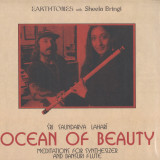
Multi Culti World Records venture deeper into the new new age with the release of 'Ocean of Beauty - Meditations for Synthesizer and Bansuri Flute,' a collaboration between California-based artist/DJ Earthtones and Indian classical musician Sheela Bringi. Earthtones, fresh off his genre-defying debut album on Wonderwheel, here dives into the deep end of the ocean of ambient. With music that traverses cultures,he’s known for bridging influences from Cumbia to hip hop and house music. Here he presents his most consciousness-expanding work yet, no doubt influenced by his involvement in Ojai new age culture,years living in ashrams, practicing Shaktism,+ spending as much time curating sounds suitable foraural healing and meditation as for dance-floors. He’s found a perfect muse in Boulder-based Sheela Bringi, whose virtuosity in Indian classical music sets the tone of the record with her bansuri (Indianbamboo flute) & harp, blending traditional instrumentation with more contemporary influences. Bringi was a direct disciple of bansuri master GSSachdev, and represents a devotional musical lineage. She has released two solo albums, 'Shakti Sutra' and 'Incantations,' and her work has been featured on over 50 world and ambient records, plus publicly on outlets from NPR to NBC News, & more. 'Ocean of Beauty' is the English translation of an ancient Sanskrit text devoted to the divine mother, the Sri Saundarya Lahari, The song titles are taken from verses in that text, and the album is in fact a dedication to the goddess Lalita Devi. It creates a serene, meditative space which seamlessly blends traditions; synth-driven ragas with a spirit of tranquility that nurtures Multi Culti’s philosophical bent towards ‘music without borders.’
Поиск:a drive
Все
The Boysnoize Records catalogue contains more than a decade of milestones in the life of Angeleno DJ and producer PILO. His signatures—a focus on sound design, and a digital crunch evocative of hardware rather than software—are present from the very beginning, but the evolution of Pilo’s skill and sophistication is clear as he stretches from electro to experimental to techno and back again in a slowly oscillating gradient. Yet despite his dozen or so releases in just as many years, G.L.A.M. (dropping November 8th, 2024 from BNR) is Pilo’s first proper album. That the record embraces the cyclical nature of time is apropos; the artist’s journey towards self-actualized mastery always ends with a new beginning.
Over the eight tracks of G.L.A.M., Pilo reaches deep into the dream that first ignited the passion that has driven him since. For a chosen few internet-connected American teens in the aughts, the sounds of European electro (and electroclash) trickled down their ethernet cables and instilled a fantasy of exotic, sartorial, sexually-fluid hedonism that felt a world away from the hard-edged masculinity of the hip-hop and skate cultures dominant at home. Pilo opens G.L.A.M. expressing this idealized fantasy with the track “Superstar DJ,” channeling the tongue-in-cheek self-celebritizing of Miss Kitten and The Hacker’s seminal work. “I’m a superstar, come meet me at the bar,” hiss Pilo’s heavily effected vocals, over a bassline of chopped mentasm synths driven by a swift, club-ready rhythm. The fingerprint of 2000’s electro a la International Deejay Gigolo Records is recognizably present, yet Pilo is too adept, too confident in his studio abilities to let his tracks rely on the retro. A great joy of this album is the future-facing richness of its production, always nodding to its spiritual guide of the past, while constantly breaking new sonic ground.
G.L.A.M. continues with “Girls Rule The World,” its vicious, droning bassline and sticky, titular hook making it the perfect electroclash soundtrack for a revenge plot on an ex-boyfriend. “What you Want” offers an instrumental exercise in “synthesizers are the new guitars,” and Pilo’s FX chops really shine as he warps and distorts his sounds into an undiscovered dimension existing somewhere between both. “Loverboy” enters the more melodic, Legowelt-inspired realm of electro, pushing above and beyond the foundation of analogue minimalism with flourishes of impressive sound design to construct something both climactic and cathartic. Scopa lends her perfect coldwave sprechgesang to titular track “G.L.A.M.,” with Pilo’s vocal processing offering surprises throughout and his FX chains wielded as instruments unto themselves.
On the track “A Slow Thinning Halo,” Pilo might be conjuring the haunting vocal chops and chiptune simplicity of early Crystal Castles, but the whiplash snap of his drums and sizzling production are all his own. “Spend the Night” is G.L.A.M.’s least nostalgic—and most unashamedly pop—offering, with the mic being passed between Sana and DEEVIOUS (previously featured on Pilo and Boys Noize’s 2023 track “Pvssy.”) DEEVIOUS’ sultry singing rides atop the bassline as it hypnotically struts across the floor, while Pilo’s skillful arrangement, deft rhythm programming, and atmospheric control elevate the songcraft into full-spectrum worldbuilding.
As the penultimate track, the contemporaneity of “Spend the Night” serves as transition away from the album’s previous, past-leaning exercises, allowing Pilo to step fully into the future with “One Last Embrace.” The closing track still references aughts sounds, but it borrows so widely and prolifically that Pilo’s reassemblage can only be described as singular. Here, Pilo pushes his engineering into psychoacoustic territory, as the eerie, beautiful melancholy of “One Last Embrace” explodes into a thrashing bassline that warbles like a drowning memory, struggling against the sinking weight of time. Pilo allows it to survive for 16 electrifying, gut-wrenching bars before letting go. In G.L.A.M., as in Pilo’s career, as in life, every ending can only be a new beginning.
Recorded at the Studio Acousti, Paris, September 23, 1965.
Original LP issue: International Polydor Production – 46.871.
This self-titled album is a testimony of the short lived-band led by New-York drummer Ron Jefferson during his stay in Paris in the mid-60s. After a first album under his name on Pacific Jazz in 1962, the founding member of The Jazz Modes and the Les McCann trio made the trip overseas.
Here, he made his living by playing with the popular pianists Errol Parker or Hazel Scott but his main drive was this trio that he formed with two other US expats, bassist Roland Haynes (the same musician who recorded an album on Black Jazz as a pianist, as confirmed by Kirk Lightsey) and guitarist Buz Saviano. After a highly successful show at ‘Palais de Chaillot’ in 1965, they were invited for a series of concerts in Dakar Sénégal. On their return, Polydor International proposed them this session. You can hear the deep impact their stay in the Motherland had on their music on the stand-out track ‘Africa the Beautiful’. On pair with the best of Yusef Lateef’s afro-eastern explorations from the time, it showcases Ron on flute and Senegalese percussion. The album release nonetheless was a commercial failure that prompted the band’s separation and Ron’s return to New-York where he performed until his passing in 2007.
Only a few copies of this record ever made it to the shops at the time and very few have had the chance to listen to it before this legit reissue remastered from the original MONO master tapes.
– Antoine Rajon –
Ron Jefferson (Drums & Flute)
Buz Saviano (Guitar)
Roland Haynes (Bass)
Jackie Robinson (Vocal on The Speaker)
The Rills haben sicherlich ein oder zwei Häute abgestreift, um diesen Punkt am Vorabend ihres spritzigen Debütalbums zu erreichen. Produziert von Dave McCracken (Indie-Mastermind hinter Ian Brown, dEUS, The Rifles), nehmen diese drei jungen Freunde auf "Don't Be A Stranger" die ungenutzte Energie, die sie zu viralen Sensationen und Lieblingen der Grassroots-Szene gemacht hat, und verwandeln sie in etwas Überlegteres, Vollständigeres und Herzlicheres.
- "The Rills sind eine Mischung aus einer Northern Oasis inspirierten und einer trendy Post-Punk-Band aus London. Damit schafften sie es nicht nur mit ihrer Musik, sondern auch über Tiktok zu begeistern." - Budde Talent Agency (Tourveranstalter)
Area Silenzio is eat-girls" debut record and it is both haunted and haunting. For the past four years, the French trio have been crafting their songs into little self-contained worlds with the patience of entomologists, taking them out all over the country and Europe to confront them with the wilderness of a live audience. The ten resulting tracks are a collection of electronic madrigals, groove-driven songs played on a mischievous multi-speed Victrola, ranging from languid dub drips to full-on drum machine cavalcades. Their live performances have that same ghostly, ephemeral quality. There is something other-worldy about the three of them, a suggestion of telepathy, their three voices blending together or going their separate ways like a flock of starlings. They secured opening slots with artists as different as Thalia Zedek, Exek and The Young Gods, just to name a few. It is the elusive essence of their music that allows them to feel at ease pretty much anywhere they find themselves: part no-wave disco rhythms, part post-punk throbbing basses, folk tunes and synthesizers in equal measures, with a perpetual attention to hooks and melodies. The album was self-recorded, a necessary measure to protect the delicate nature of the inner landscapes painted by the band. In this case "delicate" does not mean "soft" by any means: the industrial disco inferno of "A Kin", the ritualistic kraut stampede of "Para Los Pies Cansados" and the bubbly post-funk rhythms of "Trauschaft" will leave you gasping for air once you come out on the other side. "On a Crooked Swing", the opener, is all arpeggiated bass and stumbling kicks. "Unison" will dip you into a hallucinatory river where nothing is what it seems to be and rescue you at the very last second. "Canine", the first single off the record, will gently but firmly reach for your jugular with its vulpine Farfisa and deceptively nonchalant drum beat. The vocal polyphonies on "3 Omens" sound like a field recording of traditional music from a tiny country that has yet to be discovered. eat-girls exist on a slightly different plane from ours, where everything is teeming with secrets and hidden life. Area Silenzio is a precious polaroid shot from that world, or, as Tom Verlaine would have it, "a souvenir from a dream".
Unbound by place or genre, mercurial, experimental pop duo Soft as Snow find freedom to intuitively reflect the disarray of human connection with their intricate, shape-shifting pop production. With each successive release, the duo evolves, unfurling into their own poetic sound, now fully realized on their intimate, third full-length, Metal.wet.
The oft-present trappings of male-female duos are eschewed here as the Berlin-based Oda Starheim and Øystein Monsen contribute equally across a canvas of analogue synthesizers, samplers, live drums, and processed guitars. At once a part of and yet apart from the zeitgeist, their forward-thinking modernity stretches the limits of expectations across Metal.wet's ten insouciant tracks. Fans of Tirzah, Hype Williams, and even Angelo Badalamenti will find much to love in this haunting work peppered with ASMR moments and rough sampling wrapped in high production –– twinkling glasses and sirens in the distance, rhythms and voices up front. The result is synth-driven, noisy, and dripping with laidback, confident sensuality.
Although Starheim's voice begins the album in a whisper, it quickly becomes apparent that the group has jettisoned their previous tendency to bury and distort her vocals. Nested in a bed of thorny electronics and broken rhythms, her multifaceted vocals might bring to mind Kazu Makino of Blonde Redhead or Hope Sandoval fronting Massive Attack. London MC Brother May (Mica Levi, CURL) makes an appearance on the driving and ethereal “Whip,” while Øystein’s own voice appears for the first time in a state of languid background haze.
Soft as Snow create and record across Europe. Defiantly averse to genre, the pair become vessels for their “electronic music pushed to the brink of collapse” (The Wire), previously released by Infinite Machine and Houndstooth. Informed by backgrounds in film and performance art, “there’s a surrealism that comes with watching Soft as Snow in the flesh,” (Vice) as seen at L.E.V. and Lunchmeat Festivals. Collaborations with visual artist Guynoid, designer AGF Hydra, and sculptor Camilla Steinum add depth to the corporeality of their “strange, mesmerising and utterly unforgettable” electronic experimentations. (DJ Mag).
La Dispute is a ve-piece from Grand Rapids, Michigan responsible for some of the most uncompromising, experimental post-hardcore music of the last two decades. Vancouver is the bands rst EP from 2006, featuring one of the band’s most popular songs, „Future Wars“. After nearly two full decades crafting inventive post-hardcore, La Dispute remains driven by their passion for art, live performance, and for the community that surrounds it.
Inhaler is the third studio album by American rock band TAD, originally released on October 19, 1993. It was the band's major label debut after two albums and an EP released by Sub Pop, and it was also their first album with drummer Josh Sinder, formerly of The Accüsed. Producer J. Mascis (Dinosaur Jr.) gave TAD a more focused and driven sound on this record. He can be heard playing the piano on ""Luminol"". The song ""Grease Box"" was played during the end credits of the 1994 movie Brainscan. Inhaler is easily their best and most consistent album to date and obtained positive critical reception upon release. Fortunately, the group has lost none of the grit that marked them as the grungiest of the Seattle scene. In promotion of Inhaler, TAD toured with Soundgarden. Inhaler is available on black vinyl and includes an insert.
One Way Trip to Gaia, Alberta Balsam's debut album, propels listeners into uncharted territory, delivering a futuristic fairytale--a utopian world that serves as a sonic refuge from reality. Building on the electro-IDM foundations of her earlier releases , this record evolves into an odyssey of bass-driven beats, breakbeat rhythms, and dub-infused atmospheres. As her most vocal project to date, the album showcases her ability to merge pop sensibility with otherworldly sound design, all while maintaining that club-ready energy. Limited edition: pressed on a black and silver marbled vinyl. Sleeve design by Timaeus
Black Vinyl[27,69 €]
LP Ltd vinyl picture disc version w/ DL card, 500 pressed. Vanishing Twin furthers their exploration of decidedly experimental territories with Afternoon X. Crafted with a playful balance of humour and rigour, with each member embracing the role of the multi-instrumentalist and process, over outcome. Following a series of line-up changes, Vanishing Twin is now the tightly honed collective of singer and multi-instrumentalist Cathy Lucas, drummer Valentina Magaletti (Holy Tongue, Tomaga, Moin) and bassist Susumu Mukai (Zongamin). Harnessing the diverse touchstones of its members; Lucas' left-field song-craft, Magaletti's singular approaches to experimental percussion, and Mukai's long history in the production of electronic music, the band has refined a hypnotic sound at the juncture of minimalism, kosmische, post-punk, and dream-laden, psychedelic pop. These eight fluttering abstractions, culled, collaged, and built upon from a vast constellation of instruments, samples, and unclaimed sources. Lucas employs her voice as an instrument and a generator of raw sound, weaving surreal imagery and uncanny juxtapositions amongst the dance and propellant drive. From infectious grooves of the album's title track and the constrained minimalism of "Subito", to the ambitious heights of pieces like 'The Down Below' and Lazy Garden, which unfurl a psychedelic avant-gardism on the scope and scale of David Axelrod and Scott Walker. Vanishing Twin embark upon a new multifaceted journey that collectively culminates as the bands most forward-thinking and groundbreaking release to date.
This 1986 album by The Primates remain as the only recording ever released by these four 60s r&b and garage fans. Originally published on Greg Shaw's very own Voxx (Bomp! sublabel focused on revival garage/psychedelia) and produced by Shaw himself, this valuable musical document that portraits the essence of the L.A. 80s garage scene, has been out of print for more than 20 years! So we thought it would be a perfect record to reissue as part of our Bomp! reissue series. The Primates were formed in 1984 and cut their teeth at L.A. spots such as the Cavern Club, as part of a growing scene of devoted Nuggets/Pebbles fans, fascinated with 1960s garage punk classics. The core of the band were Brett Miller and Ted Edlefsen, sporting Vox guitars, and Erik Bluhm as front man, with different drummers, mostly Brian Corrigan but then also Eric from Threw the Looking Glass and Gene from The Miracle Workers. The opener 'I Ain't Like You', 'Bad Luck' or the fun cover of Neil Sedaka's 'I Go Ape' reflect the wild, party-driven mood of the entire album, making you wonder how crazy their shows were in the golden era of the L.A. 80s garage scene. Combining originals and versions (check their great take on Q65's 'I Got Nightmares'), "We Are The Primates" remains as a wild, raw, party album that every fan of garage music should own. Munster is thrilled to reissue this essential '80s garage gem as part of a series of releases celebrating Bomp! 50th anniversary. Our issue includes a booklet with liner notes and rare photos and ephemera.
The Zeros is a pioneer punk rock band formed in 1976 in Chula Vista, California. Comparisons with The Ramones are often made when describing the energetic and fierce guitar driven sound of the group. The first singles recorded by the band instantly catapulted The Zeros into a top draw on the local scene and have become legendary. Unfortunately, the band never cut an album during these days. Their debut single was released in 1977 on Greg Shaw's very own Bomp! Records. It included 'Don't Push Me Around' and 'Wimp', two of the greatest punk rock songs of all time, both written by Javier Escovedo. It was followed by another single in 1978, "Wild Weekend" and a third one in 1980, "They Say That (Everything's Alright)". This release compiles all their early singles, some rare tracks (including the previously unreleased 'Left to Right') and songs taken from a 1978 live show. Munste is thrilled to reissue this essential '80s power pop gem as part of a series of releases celebrating Bomp! 50th anniversary.
After winning three leading Belgian music awards with Humo's Rock Rally, De Nieuwe Lichting and Sound Track, girl band BLUAI is expanding its horizons. On their debut album Save It For Later, the trio leaves for a road trip through the sonorous areas populated by the likes of Big Thief, Pinegrove, Haim, and Alabama Shakes.
Save It For Later is a record not unlike a Polaroid picture. Belgian songwriter Catherine Smet captures the memories of her youth in lyrics with a perfume of Americana, country pop, and indie folk. The stories areset in her native Flanders, but close your eyes, and galloping horses on a ranch in Mississippi form the backdrop of BLUAI's debut album.
Catherine Smet (vocals, guitar), Mo Govaerts (drums), and Caitlin Talbut (bass) joined forces with producer Willem Ardui (blackwave.) for this record. BLUAI's instrumentation was expanded with banjo, twelve-string guitar, and lap steel. Engineer Tobie Speleman received 'Nashville tuning' as a briefing. BLUAI thus shifts the focus from indie rock to Americana and breaks open the band's frame of reference, with influences ranging from Maggie Rogers to Alabama Shakes to The Japanese House.
Save It For Later is the creation of a group that came together two years after the formation of BLUAI, found a common drive, and is now cruising at full speed. BLUAI is here to stay.
Matter-of-factly, Lycox exclaims "Yaaahh" right at the beginning. That's an affirmation but in times of distress it can also mean resignation, something like "Yeah, whatever". Lycox says he was only freestyling though. Then the bassline appears. Elastic, expressive, full-bodied. And it's not even present the whole time. He was "trying to develop a new formula for the Kuduro beat."
Songs for the club? Most certainly. Different sensibilities, one same focused mind. Lycox evolves within tradition, he has mastered the groove, the ambience, the right tones. Simply called "Energia", the last track circles above wistfully, menacing but maybe just promising some sort of action. With a few drops one could almost switch over to a parallel universe of old school Trance, a reference that feels as alien here as maybe this track feels to someone for whom the standard Afro House sound represents modern African music.
These songs pile up in a threshold balanced between styles, sensations, maybe in the middle of life itself. Such a concentration of energy is bound to need release and that comes figuratively through details in the music reaching out to receptive ears. "To Bem Loko" explicitly tries to "literally drive everyone crazy on the dancefloor." Once again Lycox provides vocals, as in "Edson no Uige", about a friend who embarked on a trip to the Angolan province of Uige and came back speaking only the local dialect known as lingala. A nod to tradition, very emotional, without compromising complex arrangements. Consequently, we the listeners are kept believing there is still enough space for a bright future. To ears accustomed to Lycox productions the title "Contemporaneo" (opening of side B) reads like a redundancy, then.
Maybe this music can never be quite as massive as other Afro styles. Without sounding pretentious, it avoids simplistic patterns, it demands a bit more mental processing while it certainly aims to loosen the limbs. Universal in vocation, underground at the core, Lycox definitely calls it Batida but for some it is still Ghetto Music. Like DJ Veiga said when describing a previous release for Príncipe, Ghetto is home, though. Lycox adds it is a foundation of personality. "Few in our community will recognize your work when you come from the same environment, but once you establish your reputation outside of the neighbourhood and even outside of the country, people will look at you differently, as if you were a star."
- 1: Dick Rabbit "You Come On Like A Train" 968 - Bay City, Michigan
- 2: Blizzard "Be Myself" 1974 - Oklahoma City, Oklahoma
- 3: Fox "Sun City - Part Ii" 1969 - San Francisco, California
- 4: Sweet Wine "Bringing Me Back Home" 1970 - Virginia, Minnesota
- 5: Enoch Smoky "Roll Over Beethoven" 1969 - Iowa City, Iowa
- 1: Flight "Get You" 974 - Elyria, Ohio
- 2: Quick Fox "Indian" 1978 - Berkshire, Massachusetts
- 3: Bonjour Aviators "The Fury In Your Eyes" 1976 - Boston, Massachusetts
- 4: Cedric "I'm Leavin'" 1970 - Tulsa, Oklahoma
- 5: Zane "Step Aside" 1976 - Malm?, Sweden
There is NO LIGHT at the end of this tunnel! BROWN ACID: The Nineteenth Trip fires ten more savage nails deep into the coffin of ‘60s psychedelic idealism. This series is THE premier top dog journey into the rarest and most wasted early local eruptions of heavy rock, unleashed at a time when harsh reality, human nature and disillusionment drove prevailing underground rock glimpses of a ‘better’ world into ever darker selfabsorbed comedowns. Mind expanding ’60s love energies transform into toxic aggression right before your ears! The great thing is that these moves are totally justified, ‘we are all one’ is cosmically good in theory but ‘get it while you can’ ends up perhaps better advice in the light of human history. Both of those angles of awareness can coexist, some of these bands deliver unrelenting sideways positive energy but they aren’t over-thinking it, they are youthfully driven by hunger for life and satisfying the undeniable urges their DNA thrusts upon them. Sonically, the results in the BROWN ACID series never fail to breathe hot and heavy, the guitars kill it every time, the variety of approaches these tracks take keep the scenery shifting into new places. The key element that makes this stuff so potent is that THEY (the bands) are in control. Captured genuinely with no compromise, right out of the gate. No doubt they had ambition with high hopes for the future when they laid down these primal efforts, the fact that they captured their energy so vividly at a moment in time when the only direction imaginable was UP creates a hard hitting life affirming subtext to the proceedings. That is the core energy of blues and rock and roll, dealing with the struggles of existence by flipping a gigantic ‘what the fuck’ high energy bird right in the face of the moronic defective reality these bands were born into. If you take this stuff too ‘seriously’ you are utterly missing the point, it is beyond analysis, it is life itself! No amount of thinking will get you there quicker! BROWN ACID: The Nineteenth Trip is scary... the bottomless pit of deranged vintage heavy rock the series presents continually expands over time... one deadly dose too many and you might be trapped in the bad trip loop forever... enjoy it or lose your mind!
IOTUNN means Giant! IOTUNN's Metal Blade Records debut "Access All Worlds" is an epic; a cosmic and contemplative journey of energetic beauty and ferocity that reflects on human existence set in a story line following daring space travelers. The music is grounded in roaring, colorful drumming and crushing bass, while the sonic horizon is painted with a vast spectrum of guitar-driven expression, all over arched by narration through diverse vocals.
Pique is the sensational debut solo album from Dora Morelenbaum, one of the key talents spearheading Brazil’s new musical wave. A member of the Latin Grammy award-winning band, Bala Desejo, Dora showcases a new side to her solo productions on this special LP. Whereas Dora’s first solo EP, Vento de Beirada, was a leap of faith, Pique sees her soaring as one of Brazil’s standout stars, emboldened, emphatic but ever elegant. Building bridges between past and present, it’s a funkier, more groove-based affair, weaved together with those signature, slower, celestial tracks. Touching on disco, MPB, soul, R&B and jazz, the album is enriched with an indie pop aesthetic courtesy of fellow Brazilian star and co-producer, Ana Frango Elétrico.
With an ethereal, enveloping air few can match, Dora’s gift shines through both the serene and the spirited songs contained within. The blissful, sun-soaked ‘Não Vou Te Esquecer’ opens, before the funk-fuelled, feel-good ‘Venha Comigo’ and ‘Sim, Não.’ give a glimpse of the creativity bursting from the production partnership between Dora and Ana Frango Elétrico. Elsewhere, the album reclines into hazy lean-back realms via ‘A Melhor Saída’ and ‘Petricor’, virtuoso jazz funk in the form of ‘VW Blue’ and radiant MPB through the album’s title track ‘Pique’.
The drumming is tight, fresh and swung, the horns and strings deftly arranged, as funk-driven basslines and strutting guitars mesh with playful production touches that give an added vibrancy to the record. It is an album that exhibits every side of Dora and one she has been involved in from the ground up, from the songwriting, singing, arrangement and production to booking the studio time and sourcing the artwork designer, Maria Cau Levy.
An exchange of musical ideas powers every great scene and Rio’s contemporary landscape is no different - a family of interconnected musicians and friends that collaborate on each other’s productions. Pique is graced by a wealth of these leading Brazilian lights including her Bala Desejo bandmates Lucas Nunes, Julia Mestre and Zé Ibarra, as well as Guilherme Lirio, Alberto Continentino and Tom Veloso to name just a handful. This exchange crosses generations merging tradition with modernity. In a full circle moment, Dora’s parents Paula and Jaques Morelenbaum, who featured in countless recordings from Tom Jobim's Nova Banda and Ryuichi Sakamoto to Gal Costa and Gilberto Gil, join on the album through backing vocals and arrangement.
Pique sees Dora embrace a freedom through fresh forms, showcasing the depth and diversity of her creative artistry. An infinitely listenable release that nods to Brazilian greats like Gal Costa, Banda Black Rio and Lincoln Olivetti, fused with the indie pop edge of Ana’s production. The result is truly unique and sure to be a future Brazilian classic.
Now on our sixth release & going strong, Brooklyn Sway returns with a heady combination of local producers, further-afield figures and scene-setting interludes to get that real Bucktown mood, accompanied by bold new artwork from NYC "Grafstract" muralist Fumero.
After words of wisdom from originator David Morales, St. Xose, patron saint of afterhours, re-rubs his own entry from BKS-01 into an electro flip with a forceful but smooth strut, Nathan Nothing's ephemeral vocals vanishing in spaces between steady bass pulses and broken beats. Those looking for late-night addresses check Noha's 'Madison Street 932', where the PanickPanick! label head proves his local cred with a funky, vocal sample-driven house jam equally at home on its eponymous street corner or somewhere later, darker, and preferably inside.
Label regulars DeWinter & Emma return with 'Unity', the spoken word Spanish vocals interweaving with choppy snare patterns and a room-filling reverberating bass roar that hits paydirt when English vox and a kick hit late in its second half. C&K are local legends Connie & Karina, and while that may not be some punters' first guess for their moniker's meaning, the track is an exercise in restraint and class, jaunty house swathed in dub echoes and hand drums that positively sways when the trombone lead swings in to carry the tune.
P3RF3CT STRANG3RS is a collaboration between Mexican DJ/producer PAURRO and NY vocalist STEVEN KLAVIER. Featuring remixes from TAMA SUMO & LAKUTI, and MIDLAND, "RUN AWAY!" is inspired by 90s house classics & club divas, driven by a passion for melodic rhythms, organic beats, and silky smooth flow. From Brooklyn’s TOUCAN SOUNDS.