Fusing hypnotic rhythms with cutting-edge sound design, the French producer carves out a space where melancholy meets euphoria, and violence dances with beauty.
This record is not just a collection of tracks; it’s a cohesive narrative, each piece unraveling like a thread from the same ribbon—twisting, pulling, and ultimately tying together a story of tension and release. Known for his ability to merge hard-hitting club energy with emotional depth, Hadone pushes his sonic identity further than ever before.
Ribbon is a testament to Hadone’s evolution as an artist—a finely tuned balance between chaos and control, structure and freedom. A soundtrack for the dancefloor and the introspective mind alike.
Buscar:a produce
Two previously unreleased gems from a Chain Reaction studio session recorded in London, in 1977 - now available back-to-back on this 7” single. ‘You Gave Me The Reason’ is a lovely modern soul uptempo dance-floor burner coupled with ‘Let’s Be Lovers’, a mellow and funky instrumental adaptation of the Holland-Dozier hit, ‘Why Can’t We Be Lovers’. By the mid-70s, former Techniques singers Bruce Ruffin, Bobby Davis and Dave Collins had established individual recording careers with The Upsetters, The Sensations, Byron Lee & The Dragonaires, and Dave & Ansel Collins amongst others, reuniting in 1975 to form Chain Reaction, a fine-tuned, first-class soul trio performing ‘inna soul style’. Produced here by industry veteran Stanley Pemberton of Congress Productions, Chain Reaction's blend of sweet vocal harmonies, funk-inflected grooves and Motownesque arrangements has long been favoured by soul collectors and beat-fiends alike.
Island disco-soul... modern soul... tropical boogie... plus killer break-beats: Recorded in the Bahamas in 1980, Portia’’s ‘I Wanna Thank You’ Club Mix by Sean P. is exclusive to this single. Two versions, vocal and Instrumental both mixed from the original multi-track session tape. Sung by vocalist Portia and backed by Naussau’s High Voltage Band, led by guitarist and producer Patrick Carey of 5th Degree.
The faultless Scruniversal has sent certified digger, Los Protos, deep into Brazil on a mission to unearth rare gems and connect with local talent. The result? A fresh discovery in the form of DJ EL OHIM, a native digger and producer with a sharp ear for a serious edit. For this latest in the SCRULSD (Scruniversal Local Sugar Diggers) series, he collides vintage Brazilian grooves with some contemporary edge and flair. 'Mentiu Pra Mim (Re-Percussao edit)' is a snappy, breaks-driven funk workout with soulful MPB vocal hook up top. 'Vamos Juntos Nesse Funk' (Re-Percussao edit)' is harder and more edgy with booming drums and Latin percussion sprinkled over the mix. Steamy tackle for summer fun.
French producer Fièvre drops his new EP *"Party Again"*, a bold fusion of dubstep and dub techno, featuring iconic grime MC Killa P. The project kicks off with an original mix laced with yardie vibes, followed by a deep, hard-hitting 2-step version. Special guest Hyas—one of the most exciting names in France’s breakbeat scene—jumps in with a razor-sharp, irresistibly catchy drum & bass remix. With *"Party Again"*, Fièvre delivers a UK-flavored EP built for sound systems!
- A1: The Sermon
- A2: You Are Blessed
- A3: The Van
- A4: The Whisper
- A5: Areverend At The Bus Stop
- A6: Friends (Alternative)
- A7: Michigan Basement
- A8: The Nightmare (Extended)
- A9: Goodbye Autumn (Extended)
- A10: The Photo (Alternate)
- A11: The Beggar
- B1: Blackmail
- B2: And So Fades The Light
- B3: Reverends Theme (Extended)
- B4: Regression (Extended)
- B5: A Collected History
- B6: Reverend Walk With Me
- B7: The Cuckhold (Alternate)
- B8: The Fan
- B9: Imposter Syndrome
- B10: Gift Of God Child
Gold Vinyl[28,36 €]
So Fades the Light is an eerie horror thriller that makes for unsettling watching. That is no small part thanks to the equally haunting score from composers Blair French (an ambient and Balearic producer from the Detroit area) and Dave Graw (a fellow Motor City musician and visual artist), who forgo melody in place of atmosphere. It means their soundtrack is a living, breathing presence that's less about music a more of a sort of ghost that refuses to leave. Graw and French sculpt a world of distortion, static and whispered tones that feel dug out of crumbling ruins. It’s bleak, patient and unrelenting, always pulling you deeper into the lead character Sun’s fractured memories and the menace of her past. As a standalone release, it’s equally gripping: a record that blurs ambient, horror and noise into one oppressive atmosphere.
- A1: The Sermon
- A2: You Are Blessed
- A3: The Van
- A4: The Whisper
- A5: Areverend At The Bus Stop
- A6: Friends (Alternative)
- A7: Michigan Basement
- A8: The Nightmare (Extended)
- A9: Goodbye Autumn (Extended)
- A10: The Photo (Alternate)
- A11: The Beggar
- B1: Blackmail
- B2: And So Fades The Light
- B3: Reverends Theme (Extended)
- B4: Regression (Extended)
- B5: A Collected History
- B6: Reverend Walk With Me
- B7: The Cuckhold (Alternate)
- B8: The Fan
- B9: Imposter Syndrome
- B10: Gift Of God Child
Black Vinyl[26,85 €]
So Fades the Light is an eerie horror thriller that makes for unsettling watching. That is no small part thanks to the equally haunting score from composers Blair French (an ambient and Balearic producer from the Detroit area) and Dave Graw (a fellow Motor City musician and visual artist), who forgo melody in place of atmosphere. It means their soundtrack is a living, breathing presence that's less about music a more of a sort of ghost that refuses to leave. Graw and French sculpt a world of distortion, static and whispered tones that feel dug out of crumbling ruins. It’s bleak, patient and unrelenting, always pulling you deeper into the lead character Sun’s fractured memories and the menace of her past. As a standalone release, it’s equally gripping: a record that blurs ambient, horror and noise into one oppressive atmosphere.
Where we welcome you to the Fourth installment of 'Divine Harmonics" Featuring Kuniyuki Takahashi. Music produced in collaboration with friends
Here we present Part one of a Two Part Series.
Recorded in a full-fledged Recording Studio in Brooklyn New York, the idea behind this current project was to assemble a few admires of Kuniyuki's music and invite them to participate in the composition.
The musicians on this project include master percussionist composer Lekan Babalola on African Drums and Percussion, Lead Guitarist James Bergeau , Joaquin Joe Claussell Main Voice and Percussions; And of course, the artist himself Kuniyuki Takahashi and Acoustic Piano, Keyboards and Drum Programming.
Artwork Created by the one and only artist Akemi Shimada.
Debut album by Cindy is aptly called I'm Cindy. Produced by Kai Hugo a.k.a. Palmbomen II. Vinyl comes with a 20-page handmade booklet, an individually signed and kissed handkerchief of Cindy (some of them even have her teardrops on them) and a huge fold-out poster! Who exactly is Cindy? If producer Kai Hugo used oblique strategies it would be this question that's been central to his past four years of musical output. First appearing on his 2015 LP Palmbomen II as the titular subject of the track Cindy Savalas, her life has become intertwined with the producer's. "Following that release, I made a music video for Cindy Savalas, where Cindy came to life through the portrayal by Blue LoLan,' Hugo explains. 'I really felt a connection with this character and went deeper into developing who she was and the world she lived in. The result was the creation of the LP Memories Of Cindy, where my goal was to reveal more about Carmel Vista, the town Cindy lived in. Afterwards, I imagined Cindy having her own 'lost' album, as if she had once released a record that was kind of forgotten.' I'm Cindy is altogether different though. It sits at an uncommonly explored intersection between Italo disco and shoegaze - Cocteau Twins and Slowdive are mentioned as influences and you can hear that in the blurred textures and hazy synths of the 13 tracks here. But Hugo also revels in a chance to use his self-created character as a conduit to explore his love of both mainstream pop and its more skewed forms. In many ways the record is as much LoL?n's. It was she who gave the character her voice - initially across 27 tracks recorded with the producer - but her own connection to Cindy runs deeper than that. 'It makes me really nostalgic thinking about everything Cindy went through, she and I have similar feelings' says the vocalist. 'Cindy is a mix of me and Kai so when I listen to the album I feel like I'm half entering Kai's head and half in mine, with a whole bunch of deep emotions, purity and loneliness that just makes me want to dance and cuddle with all my cats in a disco forest somewhere outside of Carmel Vista.'
- A1: Beach Girl
- B1: Beach Girl Instrumental
Singer/DJ Natsu Summer's new single, due for release on Wednesday, July 30th, is already available as a 7-inch!
"Beach Girl" a new track themed around the ocean and summer, was written and arranged by her main producer, Kunimondo Takiguchi (Ryusenkei),
a trusted figure in the city pop boom!
"Beach Girl" is a lovers' reggae track that draws on the city pop reggae tradition, but is perfect for a beachside summer.
The mellow sound, Natsu Summer's ocean-worthy vocals, and the exquisitely soothing dub mix by e-mura create a truly exquisite finish!
■Natsu Summer continues to release original albums, dub albums, mix CDs, and more. Be sure to listen to this summer's best lovers' reggae.
Debut album by Cindy is aptly called I'm Cindy. Produced by Kai Hugo a.k.a. Palmbomen II. Who exactly is Cindy? If producer Kai Hugo used oblique strategies it would be this question that's been central to his past four years of musical output. First appearing on his 2015 LP Palmbomen II as the titular subject of the track Cindy Savalas, her life has become intertwined with the producer's. "Following that release, I made a music video for Cindy Savalas, where Cindy came to life through the portrayal by Blue LoLan,' Hugo explains. 'I really felt a connection with this character and went deeper into developing who she was and the world she lived in. The result was the creation of the LP Memories Of Cindy, where my goal was to reveal more about Carmel Vista, the town Cindy lived in. Afterwards, I imagined Cindy having her own 'lost' album, as if she had once released a record that was kind of forgotten.' I'm Cindy is altogether different though. It sits at an uncommonly explored intersection between Italo disco and shoegaze - Cocteau Twins and Slowdive are mentioned as influences and you can hear that in the blurred textures and hazy synths of the 13 tracks here. But Hugo also revels in a chance to use his self-created character as a conduit to explore his love of both mainstream pop and its more skewed forms. In many ways the record is as much LoL?n's. It was she who gave the character her voice - initially across 27 tracks recorded with the producer - but her own connection to Cindy runs deeper than that. 'It makes me really nostalgic thinking about everything Cindy went through, she and I have similar feelings' says the vocalist. 'Cindy is a mix of me and Kai so when I listen to the album I feel like I'm half entering Kai's head and half in mine, with a whole bunch of deep emotions, purity and loneliness that just makes me want to dance and cuddle with all my cats in a disco forest somewhere outside of Carmel Vista.'
- A1: That Musician Thats Dead
- A2: Preference Is A Good Friend, Mind
- A3: No One Can Sing That Well
- B1: Last Herald
- B2: Mo**Real
- B3: Things Keep Happening
OOOOH! by Alex Bad Baby Lukashevsky with Cocoa Corner (2025)
Celebrated veteran of Toronto’s music scene, known for his boundary-pushing approach to folk and avant-garde music, twists rock music into strange and brilliant new shapes with the help of young jazz players, U.S. Girls, and his own immensely talented son.
OOOOH! is hard on the outside and soft on the inside. Made in the spirit of unity,
humanity, and poetry — disobediently renouncing the glory of personal triumph for the
generosity of an honest experiment. On the last track of the album you’ll hear “Or do you only ever never want to make a single enemy? / That’s not freedom or humility / It’s nothing, honestly.” Oooh, that's a bad baby!
A celebrated Toronto songwriter and performer, Alex Lukashevsky has always been disobedient. Which simply means, nothing is off the table when he’s looking for his
poetic voice; when trying to find the realest I of the teller. As he sings on the lead track “that musician that’s dead” The musician is radical/ it’s the world that’s demented/ listening with their eyes, the music looks dented/ they’re over-represented.
OOOOH! was recorded in January 2024 at Sound Department in Toronto, engineered by Patrick Lefler (ROY), mixed by Grammy-nominated producer Matt Smith. All the songs were tracked live off the floor in two days, with one extra day for recording vocals, to keep the recording fully alive and breathing. As leader of Deep Dark United, as a solo performer, and a sideman in Brodie Wests’ Eucalyptus and Luka Kuplowsky’s Ryokan Band, Alex has been an outsized influence on the Toronto music scene that spawned acts like Broken Social Scene and Owen Pallett. (Pallett, who has toured with Lukashevsky, went so far as to record an entire album’s worth of Alex’s songs, backed
by a full orchestra.)
Lukashevsky has approached each of his albums and projects as something completely new, using only the musical boundaries he creates with each song. Even when he
has recorded songs with nothing but his voice and his own acoustic guitar accompaniment, the results are never “stripped down” or “back to basics,”
Gong! How do you get to heaven / have fun! have fun!
It’s cool to approach music as a game of “spot the influence”; Burt Bacharach-meets-Black Flag; Lana Del Rey-meets-LCD Soundsystem etc. Glorified mash-ups are promising because of their conversational nature. But they can turn us into hyperboreans; blowing cold air beyond ourselves while doing what we can to remain warm. To devise a game or a narrative is to have a winner and a loser, but we all know that just as you win/ so you lose. And does anything really change? Alex Lukashevsky and Cocoa Corner are more at ease drawing blind contours or playing an old game like consequences. They let things add up without knowing particularly how. Cognition is recognition.
Lukashevsky, in addition to writing all the songs, plays guitar and sings on OOOOH!, doing both in ways that are soulful and spikey at the same time. Joining him on guitar and vocals is his oldest child, Charlie Lukashevsky, who, at 23, is already a talented performer and songwriter in his own right. Cocoa Corner also includes Aidan McConnell, an in-demand drummer and composer, Jack Johnston, a jazz bassist and Barry Harris acolyte, and percussionist Evan Cartwright (The Weather Station, U.S. Girls, Cola, Tasseomancy), who plays steel pan and marching drum.
Working with his son and with other younger musicians is central to the album’s
unpredictable aesthetic. It reinvigorated the sound in unexpected ways. Lukashevsky says, “I had to reconsider my own instincts. I had to deal with being 99 years old.”
In addition to these performers, the album includes a tasty contribution from Meg
Remy, the visionary musician and producer who is the leader of the critically acclaimed
project U.S. Girls. Remy duets with Lukashevsky on the imagistic and sprawling album
closer “things keep happening.”
About that album title: OOOOH! is taken straight from “that musician that’s dead” an
arch and unhinged comment on the exertion required to navigate a lifetime of music making.
Lukashevsky’s delivery of that one emotive word is a kind of cultural posture, but also a
hundred percent primitive expression. The impact is never less than visceral. His vocal
delivery ranges through rich baritone blues to keening falsettos to a kind of sprechstimme that periodically steps out from the music to grab the listener’s shirt. He
doesn’t sound too nice, but he is sincere. When life gives you lemons lament.
For OOOOH! his first official full-length album since 2012’s Too Late Blues, (a collection of knotty-yet-effervescent tunes built upon the enchantingly serpentine harmonies of Lukashevsky and his vocal collaborators, Felicity Williams (Bahamas, Bernice) and Daniela Gesundheit (Snowblink, HYDRA)), Alex has once again broken apart and rebuilt his own approach to music. Or rather (because that sounds too over-determined), he
has allowed his music to build itself into strange new shapes that only fleetingly and
coincidentally, but happily, resemble anything that might be called rock and roll. There is some editorializing within the song’s lyrics— Lukashevsky even cheekily contributes to the “spot the influence” game with the line “Muddy Waters, Rite of Spring!” a funny preemptive strike against anyone already reaching for some variation of avant-blues to describe what the song is up to here. In fact there are many names checked on this record (literally and in spirit); they are the lily pads that trace the path of this expression! Palestrina, Peter Pears and Benjamin Brittain, Andrés Segovia, Stravinsky, Lotte Lenya, Alice Coltrane, Skip James, Chuck Berry, D’Gary, Betty Carter, Mukhtiyar Ali, Chuck D, Yoko Ono, Hailu Mergia, David Bowie, Jane Siberry. rhythm is a skeleton mansion / haunted by melody / feckless prodigy / the world is under a spell / cast by some demon angel / Practice day and night / Try as hard as hell / no one can sing that well Musicians are often worried by the way in which they are prepared to fail rather
than how they would like to succeed; it’s such a deep concern that it tempers their creativity and shackles their process. Current cultural proclivities, tend to comfort a certain kind of artistic failure and abnegate another kind. How many testimonials, full of heartfelt care and investment, have you heard for Taylor Swift, and yet a craftsman like Chris Weisman is often dismissed easily as though he’s doing something anti-social. what’s throwing itself in my ears and my eyes / arrogant devil ad hominem christ.
The music you will hear on this recording veers off in multiple directions at once,
and features a rock and roll spirit with a divergent heart. This is no sclerotic clomp of the Average Rock Song, but in fact a flood of humanity in all its darkness and moodiness and unpredictability. If most performers make songs that are like sports cars or pickup trucks to drive around, Lukashevsky has built something more akin to a rowboat in a tree: it’s weird and beautiful.
- A1: Natty Dub Source: Natty Dread In A Greenwich Farm / Cornell Campbell
- A2: Lee's Dub Source: Lee's Dream / Derrick Morgan
- A3: Wonder Why Dub Source: Wonder Why / Cornell Campbell
- A4: I'm Gone Dub Source: I'm Gone / Derrick Morgan
- A5: Country Boy Dub Source: Country Boy / Cornell Campbell
- A6: True Believer Dub Source: True Believer / Johnny Clarke
- A7: Care Free Dub Source: Care Free / Mighty Diamonds
- A8: Rasta Train Dub Source: Mule Train / Johnny Clarke
- B1: Move Out Of Babylon Dub Source: Move Out Of Babylon / Johnny Clark
- B2: Give A Little Man A Great Big Hand Dub Source: Give A Little Man A Great Big Hand / Cornell Campbell
- B3: Feel So Good Dub Source: Feel So Good / Derrick Morgan & Paulette
- B4: For The Rest Of My Life Dub Source: Wonder Why / Cornell Campbell
- B5: When Will I Find My Way Dub Source: When Will I Find My Way / Owen Grey
- B6: I'm Leaving Dub Source: I'm Leaving / Derrick Morgan & Hortense Ellis
- B7: Feel Lost Dub Source: Feel Lost / Bb Seaton
- B8: Dawn Dub Source: Dear Dawn / Barrington Spence
2024 Reissue
“Tubby did three original dub albums, ‘Dub From The Roots’. ‘The Roots of Dub’ and the third is ‘Brass Rockers’ with Tommy McCook ‘pon the flying cymbals. Where he mixed it with the horn going in and out in a dub way and one named ‘Shalom Dub’ you can call Tubby’s too because he mixed the versions as they were off forty fives’’
Bunny ‘Striker‘ Lee
King Tubby and Producer Bunny ‘Striker’ Lee are intertwined in the birth of Dub Music. After discovering a mistake that made a ‘serious joke’ ( more of which later...) they went on to release the first pressings of this new musical genre namely ‘Dub Music’. Tubby’s vast knowledge of electronics and Bunny’s vast catalogue of rhythms would lay the foundations of what today is taken as a standard... the Remix / Version cuts to an existing vocal tune.
Osbourne ‘King Tubby’ Ruddock was born in Kingston, Jamaica on 28th January 1941 and grew up in the High Holborn Street area of downtown Kingston. He studied electronics at Kingston’s National Technical College and also on two correspondence courses from the U.S.A... When he had qualified Tubby began repairing radios and other electrical appliances in a shack in the back yard of his mother’s home. His work in the early days included winding transformers and building amplifiers for Kingston’s Sound Systems. Tubby built his first Sound System in 1957 playing jazz and Rhythm & Blues at local weddings and birthday parties. His reputation as a man who knew and understood both electronics and music grew steadily and as the sixties drew to a close. Tubby purchased his own basic two track equipment. He installed this alongside his dub cutting machine, a home made mixing console and his impressive collection of Jazz albums in the back bedroom of his home at 18 Dromilly Avenue which he christened his music room.
Tubby and Striker were at Treasure Isle Studio’s one day while Ruddy from Spanish Town was working with the engineer Byron Smith....
“Tubby and myself was talking when Ruddy was cutting some dub but Smithy (engineer) made a mistake through we were talking and forgot to put in the voice. It was two track recording in those days. Ruddy said ‘No Man! Make it stay! and so they cut the rhythm. When I went over to Ruddy’s that Saturday night a dance was in progress and when they played the vocal to the tune... then he said we’re going to play ‘Part Two’. They never called it ‘Version’..and then he played the rhythm track. The song was a catchy song and everybody started to sing along and the deejay started to toast so everything went down well. On Monday morning I went up and I said ‘Tubbs the mistake we made was a serious joke.It mash up Spanish Town! The people went wild. So you have to start to do that now ‘cause when the man put on the ‘Part Two’ everyone start singing this song. It played about twenty times. I said you try Tubbs!’...Well the next Saturday night now when Tubby strung up down the farm U Roy said he’s going to play ‘Part Two’ but Tubby did it different now. He started with the voice then dropped it out and let the rhythm run and then he brought in the voice in the middle and from there Tubby started to get really popular.’’
Bunny ‘Striker’ Lee
Dynamic Sounds upgraded to sixteen track recording in 1972 and Tubby purchased, again with the help of a deal brokered by Bunny Lee. The old four track equipment and the MCI console from their Studio B. The four tracks now gave him far wider scope to work with and he began to create a new musical form where the bass and drum parts were brought up while the faders allowed Tubby to ease the vocal and rhythm in and out of the mix. It was only a matter of time before Tubby’s dub plate experiments began to make it on to vinyl and the first ever long playing King Tubby releases would feature a collection of his mixes to a selection of Strikers rhythms. So please sit back and enjoy this historic set of sounds. Lovingly restored and with a few extra gems added to the CD Editions. These releases were the first to carry the name of King Tubby and the first to credit the great musicians that contributed so much to the rhythms that made these albums possible.
" Goldie presents Rufige Kru "Alpha Omega" album.
" Rufige Kru was Goldie's collective with around him no fix members and including various drum & bass producers.
" This is the comeback & first new album of Goldie's iconic alias Rufige Kru since 2009's "Memoirs of an afterlife".
" This new album 'Alpha Omega' produced with James Davidson (Subjective)
" Rufige Kru now also features longtime collaborator Submotive alongside Goldie.
" First track collaboration with Casisdead (Best UK Hip Hope artist at Brit Awards 2024) announced & released February 26. Video for track featuring both artists.
" Goldie touring Europe & US to support album as DJ and with live band : US DJ tour in May , teaser (before the album release) dates in the UK & US + summer festivals in Europe
" 2025 will also mark 30 years of the album "Timeless" .
- 1: Seeds
- 2: Friendzone
- 3: Growing Apart
- 4: Big Mouth
- 5: Lilly
- 6: Plans
- 7: Got You Here
- 8: Your Secrets
- 9: Knees
- 10: Red
- 11: Videogame
One of the most exciting voices in modern soul returns with Lilly - a deeply personal new album from Amsterdam-born singer, songwriter, and producer Danny Kuttner.
Blending 90s neo-soul, ECM-inspired jazz, and leftfield electronics, Lilly will resonate with fans of Hiatus Kaiyote, James Blake, and Billie Holiday – which Kuttner cites as some of the album’s key influences.
An emotional tour-de-force, the album is shaped by raw introspection and inspired by the passing of her grandmother. A stunning record that invites listeners into a world of vulnerability and sonic depth, and a must-have for vinyl lovers seeking soul, story, and standout production.
- A 1: It’s My Thing (Pt 1)
- A 2: It’s My Thing (Pt 2)
- A3: Things Got To Get Better (Get Together)
- A 4: What Kind Of Man
- A5: If You Love Me
- A6: In The Middle
- B 1: Unwind Yourself
- B2: You Got To Have A Job
- B 3: I’ll Work It Out
- B4: Get Out Of My Life
- B 5: I’m Tired, I’m Tired, I’m Tired
- B6: Shades Of Brown
Among the most revered voices in funk, Marva Whitney holds a special place thanks to her fierce energy and unmistakable style on tracks like the classic 'Unwind Yourself,' a long-time favorite for DJs and dance floors alike. Emerging from the dynamic world of the James Brown Revue in the late 1960s--alongside iconic names like Lyn Collins and Vicki Anderson--Marva quickly carved out a name for herself. In 1969, she began recording as a solo artist under James Brown's King label, scoring a Top 20 R&B hit with 'It's My Thing.' While mainstream hits were few, her music resonated deeply with funk lovers and crate diggers around the world. Songs like 'You Got to Have a Job' and the endlessly sampled 'Unwind Yourself' have only grown in stature over the decades. Her album, "It's My Thing", dropped that same year and has since become a touchstone of the genre. Backed by the legendary JB's and produced by James Brown himself--who also contributed to most of the songwriting--the album captures a raw, unapologetic funk sound with a distinctly female voice at the forefront. From the explosive opening of 'It's My Thing'--a bold response to the Isley Brothers' 'It's Your Thing'--Marva channels sheer intensity, backed by a band that doesn't let up. The pace briefly softens with 'If You Love Me,' a soul soaked ballad in the spirit of Otis Redding, before diving back into the rhythmic grit of tracks like 'Unwind Yourself.' Decades later, "It's My Thing" continues to inspire, sampled by producers and treasured by collectors--a powerful snapshot of funk at its most uncompromising. Reissue on 180g vinyl.
- A 1: Woman Of The Ghetto
- A 2: Call It Stormy Monday
- A 3: Where Can I Go
- A4: I'm Satisfied
- A5: I Wish I Knew (How It Would Feel To Be Free)
- B1: Liberation Conversation
- B2: California Soul
- B3: Go Away Little Boy
- B4: Looking Thru The Eyes Of Love
- B 5: Anyone Can Move A Mountain
The Spice of Life, released in November 1969, stands as Marlena Shaw's second--and final--studio album for Cadet Records, produced and arranged by the renowned Richard Evans and Charles Stepney. From the opening, Shaw's voice--both playful and powerful--cuts through the lush yet tight-knit arrangements, weaving together a vibrant tapestry of soul, proto-funk, jazz, gospel, and blues. The album features two defining classics: her deeply resonant original of 'Woman of the Ghetto' and a signature take on Ashford & Simpson's 'California Soul', both staples in sampling culture (you'll probably find that you're more familiar with Shaw's material than you thought.) Evans and Stepney's arrangements are far from mere support--they're panoramic and inventive. You'll hear kalimba flourishes, psych-tinged guitar accents, and bongo-fueled organ textures that elevate each track, keeping the atmosphere rich but never overwhelming. Moments like the Bacharach-styled 'Looking Through the Eyes of Love' or the dramatic flair of 'Stormy Monday' showcase their widescreen sensibility and Shaw's versatility. Beneath its musical elegance, "The Spice of Life" carries a weighty current of social commentary. Tracks such as 'Woman of the Ghetto' and the succinct, fierce 'Liberation Conversation' bring political and feminist themes into a soulful, expressive framework--adding unexpected depth to the sophisticated sonic palette. This album offers an immersive journey through soul-jazz mastery, one that rewarded listeners with sampling gold for decades to come. Reissue on 180g vinyl.
Irish techno producer, Kerrie, returns to Tresor Records on the 24th of October 2025 with her second EP for the label. Entitled Echoes Of The Live Wire, this collection captures the beauty and essence of live performance; a moment in time never to be repeated.
This fixing of time is also given a different meaning as the EP explores the ways in which intense moments in our lives, both joyful and painful, are crystallised into memory, both beautiful and haunting, lingering long after they've passed.
Layered meanings are employed throughout as Kerrie explores this idea: Live Wire draws connections between circuit boards and the human nervous system, whilst also toying with multiple meanings of the word “live”.
Echoes Of channels classic Detroit techno influences, resonating with the distant hum of memories that refuse to fade, while Moment To Memory is a beatless, floating piece which slowly builds to an ecstatic crescendo.
Digital bonus tracks Recircuit and Reclaim add further depth to the core metaphor: the former a driving, minimal yet building techno work-out, and the latter a cathartic and emotionally open track that delivers intensity with vulnerability.
Echoes Of The Live Wire reflects on memory as a complex, dual-sided force where joy and pain coexist with equal weight. Her creative process becomes a form of meditation and emotional processing, using machines to process, reflect, and let go. The result is a body of work that loops back on itself, telling a story of fleeting moments and their lasting emotional imprints.
Phylipe Nunes Araújo's songs are as rich and varied as the diverse landscapes they were written in. The hills of Pernambuco, the lagoons of Alagoas, and the beaches of Bahia are all woven into his stripped-back, folk-inspired Brazilian songwriting. As part of a wider movement of musicians originating from Brazil's Northeast, Phylipe sees the process of music-making as the search for beauty itself.
Collaborating with fellow Northeastern artists Bruno Berle, Batata Boy and Nyron Higor among others, Phylipe's debut album represents the latest flowering of this exceptionally talented community's creative search.
The Northeast holds an almost sacred importance in Brazil's collective cultural imagination. The region bore witness to the brutal histories of Portuguese colonization and the African slave trade, while simultaneously amalgamating the diverse cultures, religions and traditions of those who have called it home. Countless Brazilian music greats - Gilberto Gil, Caetano Veloso, Hermeto Pascoal, Djavan and Luiz Gonzaga - have emerged from this vast cultural melting pot.
Born in Caruaru, Pernambuco state, and raised in the city of Santa Cruz do Capibaribe (famed for its textiles industry), Phylipe describes his music simply as "Brazilian music from the Agreste of Pernambuco". His masterful compositions thread together regional rhythm, folk poetry and sophisticated harmony.
Phylipe's musical foundations were laid in youth, listening to the local elders rehearsing their forrós, attending São João street parties in front of his house and watching the Junina Quadrilhas dance through his neighborhood. At street fairs he would read the Literatura de Cordel (handcrafted pamphlets of Brazilian folk literature), and watch the rhyme battles between cantadores, violeiros, and repentistas, who improvise verses on daily life, social commentary and philosophy. This tradition of Northeastern folk poetry proved particularly formative for Phylipe as a lyricist. "I always try to write things as simply as possible. I believe that beauty must be easily understood. If I can facilitate the path to the message, there's no reason not to. It's something I learned from the traditional poetry here: it's more beautiful if everyone understands."
At the age of 11, Phylipe first got access to the internet. As he explains: "Still in adolescence I was also able to discover things like The Beatles and Nick Drake - I started to get to know music from the rest of the world and later to correlate that with my local musical experiences." Rich with extended chords and artful dissonances, it's clear from his compositions that jazz and bossa nova also took hold, but he's quick to eschew stereotypes. "Inevitably, people associate a Brazilian musician playing a nylon-string guitar with bossa nova..." "But the foundation is another story," he asserts, "It's the Northeast."
On the guitar Phylipe experiments with the binary rhythms inherent in traditional Northeastern music. Coco, frevo, maracatu and baião are recontextualised, placed alongside Brazilian popular music (MPB), gentle lullabies and stunning ballads. "In these 10 songs, I am experimenting with making pop music on a nylon-string guitar with my foundation in the Northeastern songbook."
The contemporary musical community which Phylipe belongs to developed initially in Pernambuco's neighbouring state Alagoas. Phylipe lived in its capital Maceió for three years, where he built friendships and musical bonds with Bruno Berle and Batata Boy who together produced his album. Bruno also sings in unison with Phylipe on the duet "Valise", a song Phylipe wrote aged just 15.
In recent years, Phylipe, Bruno and Batata have migrated south to São Paulo, where the majority of the album was recorded. Other collaborators on the album include Alici, who provides vocals for the ebb and flow of "Temperim", Nyron Higor who plays drums on lead single "Asa" and the sweet indie moment "Ziz"", bassist Meno Del Picchia who plays on the mystical baião "Bixin" and the propulsive "Subindo a Ladeira", and Raphael Coelho who joins Bruno and Batata on percussion for "Santa Cruz", Phylipe's hypnotically powerful portrait of his hometown.
- A1-: Mirror House
- A2-: Djinn Dance
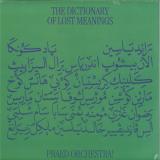
- B1-: The Dictionary Of Lost Meanings
- B2-: The Spell
- C1-: Fragmented Realities
- C2-: Three Dimensional Spirits
- D1-: Ila3Sab
PRAED return to Discrepant, after their 2017’s entry Fabrication of Silver Dreams (CREP44)
Known for their signature blend of Egyptian Shaabi, free jazz and improvisation, the Lebanese duo behind PRAED - Raed Yassin and Paed Conca - now assemble a full orchestra for the second time taking the music to a deeper, rooted level.
Following their 2020 release Live in Sharjah, also under the PRAED Orchestra! moniker, the duo now revisit their unique blend of Arabic heritage and free jazz sensibilities with an album that keeps pushing further into strange and unexpected directions.
The Dictionary of Lost Meanings is just that, seven fully composed pieces and large-scale improvisations, performed by an expanded ensemble of musicians from across the globe. The result is dense and playful, unpredictable but familiar, a record where Arabic rhythms and microtonal melodies collide playfully against electronics, warped vocals and orchestral textures.
It’s less about genre than about memory — like tuning into a radio station broadcasting from somewhere between the past and the future.
PRAED continue to blur the line between popular culture and experimental music in ways that feel both grounded and completely their own.
PRAED ORCHESTRA! are
Raed Yassin: Synthesisers, Vocals, Beats
Paed Conca: Clarinet, Electric bass
Alan Bishop: Alto saxophone, Electric bass, Vocals
Andreas Bral: Harmonium, Electronics
Elisabeth Klinck: Violin
Christian Kobi: Soprano and Tenor Saxophones
Hans Koch: Bass Clarinet
Martin Küchen: Alto and Sopranino Saxophones
Maurice Louca: Synthesizer, electronics
Stan Maris: Accordion
Radwan Ghazi Moumneh: Buzuk, Vocals, Modular Synth
Youmna Saba: Electric Oud, Vocals
Sam Shalabi: Oud, Electric Guitar
Els Vandeweyer: Vibraphone
Khaled Yassine: Drums, Percussion
Michael Zerang: Drums, Percussion
Recorded by Jasper Jan Peeters at the Summer Bummer Festival, DE Studio,
Antwerp August 26, 2022
Mixed by Adham Zidan
Mastered by Mark Gergis
Produced by PRAED
Photos by Geert Vandepoele