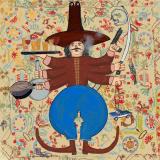
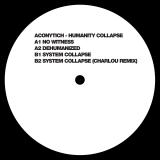
In 2018, Rian Treanor left his home in Rotherham, UK, and headed to Kampala for a residency at Nyege Nyege's villa studio. The mind-expanding experience inspired his critically acclaimed 2020 full-length "File Under UK Metaplasm", but that wasn't the end of the story. Treanor also spent time working alongside Acholi fiddle player Ocen James, developing an improvisation-heavy collaboration that would push both musicians' idiosyncrasies into completely new places. Treanor wanted this collaboration to be as tactile and reactive as a live performance with traditional instruments, so he set about working on a digital process that would synchronize with James' approach. Using physical modeling techniques, Treanor created an instrument that explored the tunings and sounds of the a'dungu, an arched harp, and the nah or nag. With Ocen playing his rigi rigi, a single string violin, they intuitively experimented with the spectral properties of sound, using texture and acoustic contours as their structural framework. They were able to develop a sound together that was unconventionally rooted in traditional Ugandan culture, but shuttled into different dimensions of noise, computer music and radical UK rave. "Saccades" is the buffer between two vastly different sonic universes, united in respect and sprightly curiosity. Treanor's hyperactive computer-controlled rhythms are immediately identifiable on opening track 'Bunga Bule', but the sound palette is distinct: it's more flexible and less digital. James' expressionistic fiddle strokes are a revelation, contorted into hoarse squeals and rough vibrations that rub and flex off Treanor's tin can shuffle.
Cerca:about 2
„Cloudy Eyes (Dance Tonight)“ marks Reznik’s and Jesse Boykins III’s second collaboration. Remember Rez’ remix for Tiga & Hudson Mohawke’s „Silence Of Love“ from last year? Working with Jesse’s vocals struck quite a few chords, so the next obvious move was to produce an original track together. And that one just hits all the sweet spots. Those piano chords. Those string pads and synth arpeggios. This driving rhythmic footing. Quite the ideal sonic environment for Jesse’s soulful croon to thrive on. „Cloudy Eyes (DanceTonight)“ has become a set-highlight of all the Keinemusik members throughout the summer season and the triggered feedback and ID requests have been no less than overwhelming. Safe to say, this is one of the most anticipated tunes of the year and its unmistakable imperative to dance tonight is about to wreak a lot more of the sweetest emotional havoc on dancefloors worldwide.
- D4: Black Smoke (They Never Got Started) (Remastered
- D5: Concrete Concentration (Remastered
- A2: What Did They Asked
- A1: Hex Collapse (Remastered) 5 44
- A3: Porn Shop (Remastered) 7 58
- A4: Crashed Core (Remastered) 5 47
- B1: Black Smoke (Remastered) 4 09
- B2: A Small Book Of Truth
- B3: Like A Coastal Shelf
- B4: Slung (Remastered) 3 03
- B5: Emp 1951 (Remastered) 3:24
- B6: Dust In The Wind
- B7: No Juju (Remastered) 2 42
- B8: Ghiahead (Remastered) 3 03
- C1: Soyo Solitude (Remastered) 3 31
- C2: Cup Noodle (Remastered) 3 30
- C3: Constructivist (Remastered) 5 19
- C4: She Said It Would Happen
- C5: Amberly House (Remastered) 4 36
- D1: Yes Hello
- D2: No Juju (Man Power Version - Remastered
- D3: Cup Noodle (Unemployed Youth Version - Remastered
- D6: They All Live In The Past
Fragments was a completely new way of working for us. We’ve always worked with an internal brief, creating documents, pictures and videos, simply because keeping an idea on track with three individuals can be difficult. It's easy for someone to be edged out of the creative process when the focus is not clearly defined.
It’s a formula we’ve used since the early 2000s, but things have changed a lot since then, particularly when we decided to dip our collective toes into supporter memberships with Patreon. It made us think about what we could do directly for our support- ers rather than just the next album or project. At first, the whole thing felt odd and uncomfortable, but we decided that we’d try a few things and ask for feedback.
"Fragments" was initially a way for us to see how we could include others in an ongoing creative process. There was no over-arching concept, no defined characteristics or purpose, just the promise that there would be at least one new track for members to download every month. Consequently, we never knew what was coming next, so the old, very focused working method was irrelevant. It was difficult for us to let individual tracks go without knowing what was coming next, but this also made the project more interesting.
And then C19 hit and we were forced to continue the project remotely from our home studios. As difficult as the disruption was, it was during this period that we realised we could re-organise and remaster the individual tracks into a coherent album, captur- ing a specific moment in time and drawing a line under the first phase of the project.
Like our "Allegory" EPs, we’ve tried to keep everything stripped back. We used to hide many subtle elements within the layers, but not so much this time.
Fragments is our journey through many changes, both self-im- posed and those imposed upon us, and it ultimately led us to create things differently. We hope you like it.
b A2
r D1 b Yes Hello (Remastered BONUS) 1:53
s D2 No JuJu (Man Power Version - Remastered BONUS) 4:27
t D3 Cup Noodle (Unemployed Youth Version - Remastered [BONUS]) 5:43
[u] D4 Black Smoke (They Never Got Started) (Remastered [BONUS]) 2:18
[v] D5 Concrete Concentration (Remastered [BONUS]) 3:21
[b] They All Live In The Past (Remastered [BONUS]) 1:06
Dot / Stephan Bazbaz - Split EP Vol. 2 (Depthful002)
Depthful returns with its second release, following the success of the first release by label owner and artist Dotan Bibi aka Dot.
In the second release, Dot returns to collaborate with his close friend and artist Stephan Bazbaz for their second split EP, following the great success of the first one released back in 2017 on Stephan's label, "No waves"
A1. opening With Dot's track 'Hoag’s Object'. is an intriguing fusion of house and dub influences, balancing the pulsating energy of house with the relaxed, spatial vibes of dub. From the start, listeners are greeted with a deep, groovy bassline and lovely acid line, that immediately establishes a rich foundation for the track.The rhythm section and congas is tight and persistent, with the signature rolling beats of Dot's sound laying the perfect backdrop for the track's sonic landscape.
A2. 'Fading Fast' isn't just a track; it's an experience. If Hoag’s Object laid down the groove with subtlety, 'Fading Fast' fully submerges you in its rich, atmospheric depths. From the very beginning, there’s a sense of movement - like something slowly emerging from the mist, with deep, resonating bass frequencies that pull you into the track.The rhythm section feels almost submerged, like you’re hearing it from underwater. The inclusion of short, scattered vocal samples in 'Fading Fast' adds an extra layer of intrigue and emotional depth, without pulling focus from the track's atmospheric core. Rather than traditional, lyrical verses, these vocals appear like fleeting whispers - fragments of a larger story, almost like half remembered phrases.
B1. opening with Stephan's track 'Overload' and it feels like an immediate shift in energy, where the vibe ramps up with pure house power. This track is all about the rhythm, the groove, and, most importantly, that bassline that keeps you locked in.
From the first beat, it’s clear 'Overload' isn’t messing around. The drums hit with a sharp, punchy attack, but it’s the bassline that truly makes this track shine. Deep, low, and relentless, the bassline pulses in a way that feels almost like it’s driving the entire track forward. There’s something about the way the low end sits in this track that makes it feel alive especially with the warmth of the lovely deep pad Holding the whole track underneath.
B2.'Better in Space' is the closing track of the record, it feels like a natural continuation of the vibe that’s been built, but also a final statement that allows the listener to fully sink into the deep, spacious world Stephan is known for. With this track, we’re stepping into a place where dub and deep house collide seamlessly, creating an atmosphere that's both expansive and intimate - taking us out there but also pulling us inward. From the very first moment, 'Better in Space' sets the stage with a warm, enveloping bassline that instantly grounds you.
Mastered By Pheek
Designed By Idan Am-Shalem
Deep Logics is the new imprint from Amsterdam´s Techno & House veteran David Labeij.
A long-lost track, never forgotten. Over 20 years ago, during the early 2000s, Swalmloop was created by two of
David’s close friends, Frodo & Pep, during a time when they briefly shared a studio. Though the track hadn’t
been heard since, it always lingered in David’s memory. Every few years, he would ask about it—and finally,
buried deep on an old, forgotten hard drive in storage, Frodo & Pep found the original file earlier this year.
And just as David remembered, the track was every bit as beautiful to him. Now, after two decades,
Swalmloop is finally being released—accompanied by two amazing remixes from Rotterdam’s own Tapirus and
Deep Logics own David Labeij.
The Wire: his most satisfying collection to date Resident Advisor: return to minimalist roots on a noise rock-influenced new live record Support from: Barnt, Ben UFO, Vladimir Ivkovic, Boris, OPTIMO 180 gr. colored vinyl pressing incl. art poster and sleeve - limited edition of 50 copies available via distribution Philipp Gorbachev is back at it with a new conceptual album. KGC Radio is all about returning to music-making roots - choices are raw, minimalist and different from the sonic industry environment. The flow is kept simple but deadly, using only the bare essentials to blow up the rave and festival scenes: analog synths, drum machines, a mic, and some sick percussion. The whole album was recorded in one take, like some kinda secret radio wave you stumble on in the middle of the night. Catch it, and you're diving headfirst into a maze of vibes and meanings you ain't seen coming. On the visual side, KGC Radio is a collab with Zhanna Maliti, this dope Moscow-based artist and photographer. Her one-of-a-kind style and imagery are a perfect match for the music, bringing the whole vibe to life. Sounds Like: Underground Resistance, Daniel Maloso, NIN, Broken English Club Mastering by: Beau Thomas
- A1: Sir Benni Miles
- A2: Roaches Don’t Fly
- A3: Black Sunlight Featuring Kayana
- A4: Indian Summer
- A5: Aubergine Featuring Fielded
- A6: God’s Feet
- A7: Peppertree
- B1: Scaffolds
- B2: Falling Out The Sky Featuring Earl Sweatshirt
- B3: Wishing Bad Featuring Curly Castro & Amani
- B4: Chicharrones Featuring Quelle Chris
- B5: Squeegee
- B6: Robert Moses
- B7: Stonefruit
Looking back more than four years later at Haram, it is easier to see the forest for the trees. At the time, much of the attention fell on how this outsider duo would fare under the bright lights- which was fair, Armand Hammer had never done a single producer record before- and here they were working with a living legend. Now, with a little distance, it’s easier to see how Alchemist stepped out of his comfort zone to meet them where they were, and how all three artists then absconded for parts unknown. The flashbulb energy of “Bring The Stars Out”, asymmetric drone of “Chicharrones”, fugue-bounce of “God’s Feet”, and good luck finding analogues for “Peppertree” or “Stonefruit”. Haram doesn’t sound like anything else in the ALC discography, nor in Armand Hammer’s, for that matter. Haram was a one-shot kill that somehow contained some of the most accessible work ELUCID and billy woods had ever done, as well as some of their most experimental, and it all sounded cohesive.
Needless to say, they didn’t do this alone; KAYANA’s golden voice upps the wattage on “Black Sunlight,” while Fielded’s sultry alto gets chopped and screwed on “Aubergine”. Earl Sweatshirt’s cameo on the sun-soaked “Falling Out the Sky” is already a classic. Curly Castro, Amani, and Quelle Chris all turn up the heat when called upon.
But since we are talking about retrospect here, the thing about Haram isn’t that it still sounds as good as it did when it came out. The amazing thing is that it actually sounds even better than it did then. You don’t have to take our word for it either, run it up one time, with the lights low and something on ice, see if it doesn’t take you somewhere new, again.
- A1: Ulrika Spacek - 'Interesting Corners
- A2: Empty Country - 'D3Sp4Ir
- A3: The Reds, Pinks & Purples - 'New Market Space (Down The Stairs Ver )
- A4: Cindy - 'The Thousand First
- A5: April Magazine - 'U Bop
- B1: Index For Working Musik - 'Going To Heaven On The End Of A String
- B2: Midding - 'Do As You Would
- B3: Luft - 'My Third Eye
- B4: Hospital - '25 Jade Place
- B5: William Doyle - 'The Sun Ain't Doing It For Me Lately
- B6: Daily Toll - 'Begin Again
LTD BLUE VINYL[26,68 €]
After so long it becomes harder to say new things about older things you now just do. Some things you've become. Some things you simply (never simply) are. The thing becomes a slippery notion. The self slides along with it. After this long, the story is whatever are the songs. A Self-portrait at two decades. Here are 11 new ones, from the current constellation, and a future still to come. The cement is still wet on that one. From the forest near where I now live you can hear a chorus of different birds in voice at once, competing but each defined, in defence of a territory or to attract a mate. There's an app that tells you so. I wonder, too, what that app doesn't reveal, if their nature need not share those same purposes. This is simply (never simply) how it exists. If we can't speak to the mysteries of these strategies, they at least persist, regardless of who picks up the frequency. Singing to itself, and there will always be these kinds of songs. 1. Ulrika Spacek - 'Interesting Corners' 2. Empty Country - 'D3SP4IR' 3. The Reds, Pinks & Purples - 'New Market Space (Down the Stairs Ver.) 4. Cindy - 'The Thousand First' 5. April Magazine - 'U Bop' 6. Index For Working Musik - 'Going to Heaven On the End of A String' 7. Midding - 'Do As You Would' 8. Luft - 'My Third Eye' 9. Hospital - '25 Jade Place' 10. William Doyle - 'The Sun Ain't Doing It For Me Lately' 11. Daily Toll - 'Begin Again'
Chicago's premier boogie purveyors STAR CREATURE dig deep with 4 extremely rare cuts, 3 of them being white whale level impossible to find & the 4th commanding big bucks online! Includes songs by TIGER JACK, SOUL INVADERS, MOTHERFOX, and PYRAMID PLUS. Heavyweight vinyl and heavyweight reverse board jacket. Due out Nov. 10.
“Let’s Bounce” was originally issued on Ajana as one of their only 2 releases, the first being earlier from Central Power System on Numero Group’s The Chicago Party compilation. Tiger Jack remained elusive, both Jack and a copy of his record until we stumbled upon a contact and were able to get in touch and stitch together the fully extended mix of this Punk Funk Boogie Bopper. Speaking of Numero Group, The 2nd track of Side 1 comes from an assist from the reissue Gods themselves as they blessed us with this never-sold-on-discogs soulful side of Boogie Slap issued on one-and-done label Magikal. When asked about the track, songwriter CA Williams said they recorded it for a restaurant jingle. Probably the best one we’ve ever heard.
Side 2 starts off with an absolute Modern Soul Monster with Motherfox’s Hot Shot. John Harris came by Star Creature’s South Side of Chicago HQ to chop it up and share some stories on Motherfox and his other passion project most deep funkers would known as Carver High. This record has reached insane demand the past few years as it’s a certified floor filler for all scenes - peak big budget sound packed into a small DIY package, total package. Track 2 delivers the full version of the ever mysterious Pyramid Plus providing the Titular Tune “Comin’ At Ya’” as vocoded talkboxed low slung, spaced out Boogie Banger.
Brown Angel descends upon Dark Entries with Pure Brown Energy, an EP featuring 6 tracks of gloom-laced electro-funk and retro house. Pure Brown Energy was born when San Francisco-based producer and Hard French collective member Brown Angel was faced with a gift and a loss: an original Roland TR-808 was given to them around the same time that their father passed away. To process their grief, they set about making an album that showcased the many facets of their being, in their words: “my gay tío side, my Latin goth side, my cruising down the boulevard side, and most of all my soft vulnerable side.” From slamming vogue/ballroom house to cumbia-inflected freestyle, Pure Brown Energy channels club sounds both contemporary and timeless, while centering the most eternal electronic instrument of all: the TR-808. Opener “Miel” grooves with the effortlessness of peak-era Masters at Work or vintage Kevin Saunderson, while “Dame Más” dials up the energy even further. The influences of Miami bass and West Coast electro shine through on “Maya” and “Love Me Right,” which pair razor-sharp beats with a flurry of samples culled from Brown Angel’s record collection. “PBE” and “En Movimiento” take the Planet Rock vibes to another level, combining influences from contemporary cumbia and reggaeton sounds with Brown Angel’s Latin goth flair. Each copy comes in a sleeve designed by Ricardo Diseño featuring illustrations inspired by Teen Angels, a popular 1980’s Chicano magazine. Pure Brown Energy brings a sense of urgency to the dancefloor, unreluctantly examining the crossover between creation and loss, between celebration and sorrow. But don’t forget: these cuts also slap.
For their first album as Gilla Band (formerly Girl Band), the
foursome have redrawn their own paradigm. ‘Most Normal’ is like
little you’ve heard before, a kaleidoscopic spectrum of noise put in
service of broken pop songs, FX-strafed Avant-punk rollercoaster
rides and passages of futurist dancefloor nihilism.
Lockdown robbed Gilla Band of any opportunity to try the new
material out live, but the pandemic also incinerated any idea of a
deadline for the new album. They were free to tinker at leisure, to
rewrite and restructure and reinvent tracks they’d cut, to, as
drummer Adam Faulkner puts it, “pull things apart and be like,
‘Let’s try this. We could try out every wild idea.’”
The group also fell under the spell of modern hip-hop, “where
there’s really heavy-handed production and they’re messing with
the track the whole time,” says Fox. “That felt like a fun route to go
down, it was a definite influence.”
‘Most Normal’ opens with an absolute industrial-noise banger that
sounds like a manic house party throbbing through the walls of the
next room as a downed jetliner brings death from above. What
follows is unpredictable, leading the listener through a sonic house
of mirrors, where the unexpected awaits around every corner.
The common thread holding ‘Most Normal’’s ambitious Avant-pop
shapes together is frontman Dara Kiely. Throughout, he’s an antic,
antagonistic presence, barking wild, hilarious, unsettling spiels,
babbling about smearing fish with lubricant or dressing up in binliners or having to wear hand-me-down bootcut jeans (“It was a
big, shameful thing, growing up, not being able to afford the look I
wanted and having to wear all my brother’s old clothes,” says
Kiely).
‘Most Normal’, then, is a triumph, the bold work of a group who’ve
taken the time to evolve their ideas, to deconstruct and reconstruct
their music and rebuild it into something new, something
challenging and infinitely rewarding. It’s a headphone masterpiece.
It’s a majestic exploration of the infinite possibilities of noise. It’s a
bold riposte to your parochial beliefs on whatever a pop song can
or should be. It’s the best work these musicians have put to
(mangled) tape.
Bringing together the elder statesman of the Zulu guitar Madala Kunene and internationally acclaimed Sibusile Xaba, kwaNTU pulls two generations of South African guitar mastery into a single point of focus. Under-represented on recordings outside of South Africa, Madala Kunene (b. 1951), the ‘King of the Zulu Guitar’, is revered as the greatest living master of the Zulu guitar tradition. Sibusile Xaba, whose collaboration with Mushroom Hour Half Hour reaches back to his first recording in 2017 (Open Letter To Adoniah/Unlearning), has garnered international acclaim for his unique voice and virtuoso guitar stylings, which bring together multiple South African guitar lineages in an original, spiritualised fusion. Collaborating with Mushroom Hour and New Soil for kwaNTU, the two players come together to weave a filigree sonic fabric which reaches down to the heartwood of Zulu guitar music but moves resolutely outward, building on the past to create a deeply rooted statement about present conditions and future travels. kwaNTU – which can be roughly translated ‘the place of the life-spirit’ – is also conclave of teacher and student, as Xaba has been taught by Kunene for the last decade. Meditative, rich and sonically sui generis, kwaNTU finds these two musicians linking up within the inimitable space of sound and spirit that they share through Kunene’s teaching.
The great masters of South African music have not all had equal exposure. For many years the generation of musicians who were exiled during apartheid took centre stage, as the regime made it very difficult for those at home to be heard. More recently, a new cohort of important voices, especially in jazz, has broken through to international consciousness. But for the generation of musicians in between – those who shone like beacons in the most difficult final years of apartheid and immediately afterward – international recognition has been slow in coming.
Madala Kunene, ‘the King of the Zulu Guitar’, is among this number. A revered figure for current generations of South African musicians, Kunene began his recording career in 1990, at the bitter end of apartheid, with a now classic self-titled LP for David Marks’ storied Third Ear imprint. Born in 1951 in Cato Manor, near Durban, he had determined to be a musician from early childhood, and by the time he first entered a recording studio he had already had a long career as a popular performer. His virtuoso absorption and transformation of the venerable Zulu maskanda guitar tradition and his richly spiritualised approach to music immediately marked him out as someone special, and in the years that followed, Kunene cemented his position as one of South Africa’s musical elders. He is without doubt the grand master of the Zulu guitar tradition, but his sound and sensibility ranges far beyond it into varied sonic terrain, and he has collaborated with a wide range of musicians both at home and abroad. Now in his mid-seventies, he remains a shining light for those that are making music in contemporary South Africa.
‘He is really an amazing person,’ says the guitarist Sibusile Xaba, who has been mentored by Kunene for over a decade, and now invites a collaboration with him on kwaNTU. ‘As a mentor, he's really powerful in showing us the way. For us to have this opportunity to make music together and have a project together is really a blessing to me.’
Xaba himself grew up in Newcastle, KwaZulu-Natal, where his mother had been in a band and his father sang in a church choir, and from early childhood Xaba played homemade tin guitars. He only later realised that music was his calling. ‘I just loved music. I was fortunate. My parents loved music. And when it was time for me to leave home and go to study outside Newcastle, I knew that music was what I wanted to do. There was no second option. It was just music.’ Moving to Pretoria to study music formally, Xaba committed himself to his craft, developing a unique style that draws on both US jazz masters such as Wes Montgomery and Jim Hall, and the rich and varied heritage of the South African guitar, from inspirational jazz players such as Allen Kwela and Enoch Mthalane, to the music of the Malombo groups and Dr. Philip Tabane (Xaba has previously collaborated with Dr. Tabane’s late son, Thabang), and the Zulu guitar tradition embodied by Kunene.
‘I was really in love with the jazz guitar, I really admired it, and I was digging a lot in that direction,’ says Xaba, recalling his first encounter with Kunene’s music, over a decade ago. ‘And then one day on my timeline, Kunene popped up, and I was like – “What's this sound?” I was so connected to it. It really touched me deep. I started checking out his records, and then I found out he's from the same region as I am, which is Zululand.’ After Kunene played a show at the Afrikan Freedom Station in Johannesburg, Xaba make contact with him, and visited him at home in Durban. They struck up a friendship, and Xaba became the elder’s student, as Kunene began to pass on his knowledge and his inimitable way of playing.
kwaNTU is a tribute to this relationship and the deep learning that has defined it. The album was recorded in Zululand in the town of Utrecht, at a cultural centre called Kwantu Village, which gives its name to the album. ‘It's such a broad word,’ Xaba says, ‘but the elders teach us that Ntu is basically an energy, almost chi, an energy, a force that all living beings have within them. It's a living energy, so kwaNTU is like, almost the place of this energy.’ The two men sequestered themselves for five days of jamming, improvising and planning, and then the session was recorded in one take over a single night, with Gontse Makhene joining on percussion and backing vocals and Fakazile on vocals. Other voices and overdubs were later added in the studio in Johannesburg.
The result is a rich and meditative recording that finds two generations in a deeply engaged dialogue. Teaching and passing on his knowledge, the elder Kunene has brought Xaba into a space of sound and knowledge that they now share; Xaba’s own practice of deep communion with nature and his dedication to his musical craft make him the perfect interlocutor for Kunene. The result is an album that foregrounds the two musicians engaged at the highest levels of responsive listening, sympathetic unity, and collaborative concentration. Bringing an elder statesman of South African music to an international listening audience for the first time in decades by pairing him with one of South Africa’s most important new voices, kwaNTU is a meeting of generations and a powerful demonstration of musical lineage and continuity.
‘Before music, there is sound,’ Xaba observes, speaking of Kunene’s unique approach to music. ‘And sound is like a common compartment…it's not restricted to particular people or particular geographic places, you know what I mean? It's sound. Everybody can hear it. So when he constructs that sound into music, I think everybody resonates with the energy behind his construction of sound into song. Here at home, we really love him for preserving our history through the guitar, through his stories as well the music, the songs that he writes. We really, really admire him.’
Arriving two years after the first chapter, Absurd Matter 2 isn’t just a sequel, it’s an evolution, redrawing the boundaries established by its acclaimed predecessor. The Berlin-based Italian producer tempers his confrontational sonics with rare moments of introspection, shifting seamlessly between blown-out noise, warped hip-hop, mutant club experimentation, and weightless ambience. Textures disintegrate and reassemble, rhythms flex and crumble, and every detail balances on the edge of fantasy. It’s a poetic, layered response to Nino Pedone’s changing physical reality: the gradual hearing loss and perceptual renegotiation triggered by Ménière’s disease, which struck him in 2022. At first, the experience felt like betrayal, a brutal disconnection from the very sense that had shaped his life. But over time, the disorientation turned into a strange kind of focus. The silence between sounds became as expressive as the sounds themselves.
The first Absurd Matter was a visceral reaction to trauma; the second is more reflective – an ambiguous chronicle of sensory recalibration. Pedone doesn’t represent his altered inner reality through extremes, but through depth, zooming in on illusory distortions, tense rhythmic fluctuations, and fragmented sonics. Dense, immersive, and mystical, the album mirrors Pedone’s evolving relationship with perception itself.
Tinnitus-like feedback wails and noir-ish strings introduce “Repeater”, making it immediately clear that Pedone is painting a more delicately finessed image this time around. Fleshed out by raps from cult MCs billy woods and E L U C I D, the track is marked by subtle, sophisticated contrasts: the blurred, inverted rhythms that couch Armand Hammer’s haunted back-and-forth, and the glitchy interference that offsets the lavish orchestral phrases. Backwoodz associate Fatboi Sharif lends his Lynchian drawl to “Bandage Chipped Wings”, grounding Pedone’s lysergic rhythmic distortions with syrupy, horror-inspired couplets. Pedone also invites discomfort into “Crash Landing”, with droning, metallic tones that contradict South Central rapper ICECOLDBISHOP’s elastic flow. “Bitch, I don't give a fuck about anybody,” he squawks over Pedone’s incongruous rasping textures and time-warped beats, “cash out at any party.” Working alongside London’s Loraine James on production, Pedone reunites with Moor Mother on “I Saw The Light”, blending James’ soft-focus atmospherics with soundsystem-damaging, overdriven bass hits and rusted percussive snips. Moor Mother’s assertive words hover over the wreckage, tightening Pedone’s themes of overstimulation and altered awareness as they stutter and veer off course, vanishing into the backdrop.
Contrasting his more pensive experiments, Pedone’s dancefloor deviations are more concentrated on Absurd Matter 2 than ever before. He torches a stuttering dembow structure on “X”, obfuscating the rhythm’s familiar energy with disturbing audio hallucinations. On “Splintered”, he reunites with Kenyan prodigy Slikback, mangling neon-lit trance arpeggios with dissociated trap rhythms. He sharpens his skills to a fine point on “Oblivion Step”, observing 2- step through a lens of distortion and personal abstraction, shaking blipping synth leads over neck-snapping drums and counteracting the momentum with airless sci-fi soundscapes.
Perhaps the album’s most surprising moment arrives with “Viel”, which features vocals from Los Angeles-based composer Kaitlyn Aurelia Smith. Together, Pedone and Smith chance upon their notion of dub techno, fogging synth stabs and ghostly vocal traces into eerie harmonic distortions. On some level, it’s almost pop music, a far cry from the bleak dissonance of Absurd Matter and a hopeful way to reframe turbulence as transformation. Absurd Matter 2 doesn’t simply document a process; it enacts one. It doesn’t offer clarity; it invites disorientation. It’s not a map of the labyrinth, but a foghorn piercing the darkness.
Utter presents Marshall Jefferson's previously unreleased meditation opus 'Yellow Meditation For The Dance Generation' alongside two remixes from French production maestro Joakim.
Marshall Jefferson: Chicago House music pioneer, creator of the anthemic ‘Move My Body’, an original collaborator of Adonis, Ce Ce Rogers and Roy Davis Jr., production mastermind of countless dancefloor classics such as Phuture’s ‘Acid Tracks’, Sterling Void’s ’It’s All Right’, Hercules’ ‘7 Ways’… and the soothing voice behind a 36 minute healing meditation guide. Yes, really.
But let’s rewind, slightly.
In 2017, Marshall was approached and encouraged by Ian ‘Snowy’ Snowball to write his autobiography and the pair set about putting Marshall’s account of the history of House music together. The book, ‘Marshall Jefferson: Diary of a DJ’ was published in 2019.
Following the book’s release, Ian and Marshall's collaboration continued and during the pandemic an outlandish idea arose to create a piece of music combining Ian's interest in meditation (he runs Club Chi specialising in Shibashi Qigong - a form of Tai Chi Qigong - which is a gentle form of movement therapy/exercise) and Marshall's willingness to experiment musically to see what might be possible.
The result is ‘Yellow Meditation For The Dance Generation’, where Marshall vocalises Ian’s lyrics in his instantly recognisable voice. The keen-eared out there may also recognise aspects of the music itself as a stripped back, lengthened and far mellower version of Marshall’s 1985 obscurity ‘Vibe’:
“I would take tapes to the Music Box and Ron Hardy would play my music. ‘Vibe’ was one of those tracks. I recorded ‘Vibe’ in 1985, but it became one of my tracks that I just forgot about until some guy on Facebook sent me a recording of it that was taken from a club. The only person who I ever gave a recording of ‘Vibe’ to was Ron Hardy. The other people I know who had copies of the track were Gene Hunt and Emanuel Pippin (DJ Spookie).
"The original version of ‘Vibe’ was made using a Roland 707, Roland JX-8P keyboard and a Roland 727 drum machine. I was still working at the Post Office at the time, and this was pre-‘Move Your Body (The House Music Anthem)’. ‘Vibe’ has the building blocks for ‘Move Your Body’ because it was using the instruments on the track that I discovered what I could do with the bass sound, to make a track like ‘Move Your Body’.”
Still, Ian’s initial intention for ‘Yellow Meditation’ was function and it was designed to be a ‘Sequential Relaxation Exercise’ focusing on the Solar Plexus. Bearing this in mind, Marshall took a bare-bones and hypnotic approach to this particular re-recording of ‘Vibe’ so that the voice takes centre stage and listeners (hopefully) find themselves on a meditative journey. In fact, this long-form track was always intended as a private tool purely for meditation at Club Chi rather than released to the public - after all, Marshall had also created and released a more drum heavy, ’traditional’ club-focused 'Vibe Three' instrumental version for that very purpose - but a chance airing of the full 36 minute version changed its path.
Much like those 1985 ‘Vibe’ cassettes, Marshall had sent the track to a few close contacts, one of whom was Kieran at Phonica Records who aired it over the shop’s basement soundsystem. Its unorthodox nature caught the ear of colleague Alex (of Utter) and the seeds of a physical release were planted.
Eventually, with the full-version carefully whittled down to a vinyl friendly length of 24 minutes, full track parts in hand and a b-side to fill, Alex sought out one of his favourite producers to take up the remix reigns: Joakim. The Tigersushi co-founder and Crowdspacer boss has a long history of boundary-pushing remixes that straddle both dancefloor functionality and experimentation. This time the original material resulted in Joakim coming up with a number of ideas and he finally delivered two versions - one club focused (‘Vertical’), the other more introspective and meditative (‘Horizontal’), both of which appear on the final 12”.
The limited edition 12” also includes a download code giving buyers access to all of the vinyl tracks plus an 18 minute extended version of Joakim’s ‘Horizontal’ remix, its instrumental counterpart (for those who can live without Marshall's voice) and full 12 minute acapella (for those who can't!)
Alex
a A1. Yellow Meditation For The Dance Generation (Edit) 24:00
b B1. Yellow Meditation For The Dance Generation (Joakim's Vertical Remix) 9:09
9:05
Back from ‘96 — Abacus’ legendary The Abacus EP returns, now reissued as Erotic Illusions. Deep, soulful and hypnotic house at its finest, straight from the Guidance era. Pure timeless heat — grab it before it vanishes again.
DJ Feedbacks :
Laurent Garnier : Classic <3 <3
Nick Hoppner : OOOOOH YES
Dan Beaumont (Chapter 10 / NTS) : Decadent dub for me! lovely
Louise Chen (NTS) : Huge fan, this is a wonderfully sexy reissue!
Joel Martin (Quiet Village) : Timeless Classic from one of the masters - Essential!
Kölsch (IPSO / Kompakt) : Still sounds so fresh
Sven von Thuelen (SVT / Work Them) : Sublime!
Josh Wink (Ovum) : Sounds just as great as when it first came out!
Satoshi Tomiie (Abstract Architecture) : Soooo good! Every details tuned precisely
Carista : sickkkk
Crackazat (Freerange / Local Talk) : yes. of course
Anthony Collins (Frank & Tony / Scissor & Thread) : fantastic record
Hunee (Rush Hour) : classic!
Call Super (Houndstooth) : lovely thxxx
Erol Alkan (Phantasy Sound) : Downloading Thanks!
Radio Slave (Rekids) : Such a big fan !!! Full support and congrats on the re-release. Peeps need to know about "Abacus".
Ben Sims : Now downloading... will check asap!
nd_baumecker (Ostgut Ton) : YAAAAAS! Finally I have this in a better quality than my vinyl rip from the original 12". Vinyl is preordered. Thanks!
Jonnie Wilkes (Optimo) : SEMINAL.
Lawrence (Dial) : OMG Fave Classic!
Fouk (House of Disco / Razor N Tape / Room With A View / Heist) : Ooooh yes! <3
Hector Romero (Def Mix) : Love it. H
Aleqs Notal : Lovely repress
Alinka (Twirl / Classic / Crosstown Rebels / Batty Bass) : Beautiful tracks
Terry Farley : fantastic reissue for those that missed the golden era
Ian Pooley (Pooledmusic) : Sooooooooo good !
Marcia Carr : The Dub without a lot less of the sleazy vocal is cool.
Nick Holder : FIRE
DJ Bone (FURTHER) : Poetic Illusions and Decadent Dub both work for me.
Nat Wendell (Depth of My Soul / Courtesy of Balance / Love & Loops) : classy!!
Luke Solomon (Classic / Freaks / Music For Freaks) : absolute classic Kenny Hawkes special xxx
ROD / Benny Rodrigues : !!!!
Domenic Cappello (Subclub) : still sounds fresh
Alexkid (Rawax / FUSE / NG Trax) : Total Dopeness
Jimpster (Freerange) : An absolute classic from the golden era! Got the vinyl but I'm sure these new masters will sound better than my well worn vinyl rip! Will keep on banging this beauty.
Bake (All Caps / Rinse FM) : the best! thank you for reissuing :)
Dj Deep (Deeply Rooted) : Nice to see this beautiful release available again
Kai Alce (Real Soon) : CLASSIK!!
Mr. V (Sole Channel / Strictly Rhythm / Salter / Defected) : Solid work on this classic Thanks
Baby Rollen (Holding Hands / Slump / Futureboogie) : timeless
DJ Gregory (Point G / Faya Combo) : Alwayes loved that classic
Tom Esselle (YAM / Rhythm Section / WOLF Music) : Killer reissue!
Harri (Sub Club) : nice, will play and support
Hifi Sean (Defected / Plastique) : Diggin' this dub big time
Jenifa Mayanja (Bumako Recordings) : This reissue sounds just as good second time around. Straight dance floor magic. Moody and dubby perfect to zone out to in a dark corner somewhere.
Demuja (MUJA / Let's Play House / Madhouse / Freerange) : nice!!
Marcel Dettmann : thx
Kosh (Syncrophone) : doesnt get any better than this
Dj Hutch (Ambers / Rinse FM) : Lovely deep business! Thank you!
Geir Aspenes (G-Ha / Sunkissed) : Kool, thanks
D'Julz (Bass Culture) : classic alert!
Despite immense challenges, SOYUZ have delivered a career-defining album in KROK.
“Krok” means “step” in Belarusian - and for Alex Chumak and his band this word comes with a lot of meaning. It’s the title and theme that ran throughout СОЮЗ (SOYUZ)'s fourth album, reflecting the journeys the band has navigated in recent years, having moved to Warsaw due to political unrest in their homeland of Belarus and the outbreak of war in Ukraine. Embracing the uncertainty became both the inspiration and main lyrical theme for Alex Chumak, SOYUZ’ composer and arranger, who also decided to go a step further and change the language in which he writes songs from Russian, which is used as lingua franca in many post-Soviet countries, to his native Belarusian. The result is nine songs about dreams and outer space, ordinary miracles, things very close and very distant at the same time.
In early 2022, Chumak and original members, Mikita Arlou and Anton Nemahai, joined tens of thousands of Belarusians seeking safety abroad. Resettling in Warsaw, the band released Force of the Wind in October 2022, garnering widespread acclaim, a string of major European gigs, and led to Polish musicians Albert Karch and Igor Wiśniewski joining the band.
Deeper and more melancholic than previous works, KROK is quintessentially SOYUZ, laced with hope, dreams and a celebration of life. Given the difficulties with finding rehearsal and recording spaces in Warsaw and the departure of the drummer Anton Nemahai from the band, Chumak explored alternative options. He reached out to friend and fellow musical collaborator, Sessa, about the possibility of recording the new album in his recently finished studio in São Paulo, with Sessa and Biel Basile coming onboard as recording engineers.
At the tail end of 2024, Chumak and SOYUZ’ new drummer, Albert Karch, made the trip to São Paulo to record the first sessions for KROK. Laid down directly to tape, these sessions featured prominent Brazilian musicians Sessa, Biel Basile, and Marcelo Cabral, with a guest vocal feature by Tim Bernardes recorded at a later date. The final touches were then added back in Europe. Lush string and woodwind arrangements written by Chumak and Karch were recorded at the Polish Radio studio in Warsaw, and Rhodes parts were added by Chumak at Sven Wunder’s studio in Stockholm.
Though primarily recorded in Brazil, KROK is not a Brazilian or MPB album. It blends the band’s Eastern European roots with jazz, folk and global influences. The genre of the music is hardly identifiable: there are folk ballads and jazz-driven pop compositions covered in lush and often dissonant string and woodwind arrangements where each note is placed with care and meaning behind it.
The title track was the first song Chumak wrote in Belarusian as an adult, making for a fitting opener and one of the band’s finest tracks. Darker than most of SOYUZ’ songs, the tensions lift and lighten as the track progresses. The cinematic library jazz of 'Voo Livre', with ghostly vocals sung by Ciça Góes and Ina, feels like a modern twist on the Italian library composer Alessandro Alessandroni through its sublime choir and woodwind orchestration. Elsewhere, the heartfelt 'Lingua Do Mundo', composed, written, and sung by Chumak and the incredible Tim Bernardes, features one of the standout string arrangements from Chumak and Karch. 'Cichi Karahod' is an instant SOYUZ classic, almost Pat Metheny-esque as it opens, with the acoustic guitar and bass riff transitioning into jazzy AOR / pop-folk territory. The record closes with 'Smak žyćcia', a gentle, dreamy spoken-word poetry piece in Japanese by singer-songwriter Manami Kakudo.
- A1: Herbert - Got To Be Movin' (On The Dancefloor)
- A2: Chris Nazuka - Somewhere Between Distance And The Impossible
- B1: Blaze - Lovelee Dae (Beloved Vocal Rmx)
- B2: Gemini - In My Head (Freaks Move This Way Vocal Dubby)
- C1: Seven Davis Jr. - One (Live Edit)
- C2: Red Rack'em - Wonky Bassline Disco Banger
- D1: Eli Escobar - Happiness Pt. 2
- D2: Kenny Hawkes & Louise Carver - Play The Game (Space Children Love Mix)
To mark three decades of Classic, this special edition double vinyl comes housed in a raw reverse board sleeve, calling back to the very first ‘Season’s’ release on the label. The inner sleeves feature stunning orange and pink GMUND card stock, complete with embossed detailing—a tactile nod to Classic’s design-led legacy and attention to craft.
Volume 1 of the 3-part compilation series dives into Classic’s most cherished moments—spanning both foundational tracks from the label’s early years and key highlights from its post-2011 rebirth.
Record One celebrates some of the first outings of Classic's original era.
It opens with Matthew Herbert’s sought-after 1996 cut ‘Got To Be Movin’—a raw, Chicago-inspired groover that captures the sound of Classic’s roots.
Also featured is the monumental ‘Somewhere Between Distance and the Impossible’ by Chris Nazuka (of Rednail Kidz with Derrick Carter), a 1997 masterpiece steeped in atmosphere and widely regarded as one of the label's most transcendental releases.
Flip to Side B for Blaze’s legendary ‘Lovelee Dae’, remixed into a club ready, ethereal dreamscape by Jon Marsh of The Beloved.
To finish we have Gemini’s hypnotic ‘In My Head’, transformed by prolific remixers on Classic - Freaks (Luke Solomon & Justin Harris) into a dubbed-out vocal trip that oozes character.
Record Two picks up the story with Classic’s reawakening in 2011.
Seven Davis Jr’s ‘The One’ (Live Edit) was the track that caught Luke Solomon’s ear, paving the way for his Friends EP and long-standing connection with the label.
Red Rack’em’s infectious and eccentric ‘Wonky Bassline Disco Banger’ found its perfect home on Classic in 2016, quickly becoming one of the most talked-about records of the year.
Then there’s Eli Escobar’s ‘Happiness Pt. 2’—a rich, emotive standout from his Classic album work, showcasing his skill at blending deep grooves with raw soul.
Rounding out the release is the iconic ‘Play the Game’ by Kenny Hawkes & Louise Carver. A pillar of UK house history, this essential track was reissued in 2019 with a powerful remix from his best buddy’s The Space Children (Luke Solomon, Jonny Rock & Leon Oakey), honouring Kenny’s lasting influence.
The long-awaited debut album from Panic Shack featuring the singles 'Gok Wan' and 'Girl Band Starter Pack', available digitally, on CD and on Latex Red vinyl.
- A1: I Borrowed My Dad's Car But We Had Nowhere To Go So We Drove Around Listening To Music All Night
- A2: The House Party Went On So Long We Talked And Drank And Played Music Til The Morning
- A3: I Used To See Her On The Way Home From School And She Lit Up The Sky With Her Beauty
- A4: We Ditched School And Climbed Over The Neighbour's Fence To Swim In Their Pool All Day
- B1: We Were Dancing In Her Bedroom And Then We Made Out
- B2: We Walked All The Way To The Lake And The Water Was So Still We Jumped In Naked
- B3: She Broke Up With Me Before Our Last Class So I Walked To The Beach On My Own
- B4: Her Parents Were Out So We Shared A Joint And Floated Around In Her Pool Under The Starlight
Enigmatic UK producer Dylan Henner announces new album of deeply considered and choral-laced experimental ambient music Star Dream FM, said to be taped from a mysterious radio broadcast that plays his favourite memories from adolescence.
Though (clearly) fictional, the backdrop to new album Star Dream FM represents a tactile canvas on which the record’s true meaning is painted. It is, through Henner’s now-characteristic employment of ambient-textured synthesis, marimba, digital choir, and processed voice, a study of late adolescence and the experience of being seventeen.
Little is known about Dylan Henner, who landed on the ambient scene in 2020 with cassette releases for Phantom Limb, Belgian label Dauw, and cult tastemakers AD93. He barely promotes himself publicly, instead choosing to communicate through disarmingly poetic song titles. His debut album “The Invention of the Human” (AD93, 2020 - a recipient of BBC 6Music’s Album of the Year honours) responds to a set of philosophical questions - what exactly makes us human? What good is civilisation when there’s so much misery attached to it? How will technology affect humanity in the long run? In 2022, he released follow-up You Always Will Be on AD93, which traced the course of a single life from birth, to childhood, to adolescence, adulthood, parenthood, middle-age, old-age, and demise. He has also covered Raymond Scott, Terry Riley, Aphex Twin, Ryuichi Sakamoto, and Su Tissue among numerous further projects.