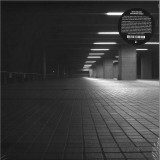
Editions Mego is proud to welcome Powell to its roster with a bizarre and strangely emotive new LP of synthetic computer works entitled Piano Music 1-7.
Via his own Diagonal Records imprint, his work on XL Recordings and, most recently, the opening of audio/film platform A Folder afolder.studio, Powell has firm footing in the contemporary electronic landscape. During a wry and obstinate musical life he has twisted myriad synthetic forms into shapes that explore and expand upon the districts of post-punk, techno, noise + computer music, and in the the last year alone he has released four albums of hi-def abstractions, each inspired by a formalisation of music proposed by Iannis Xenakis.
As an extension of this intense period of work/research/play with stochastic functions using probabilities to compose music, various processes emerged that Powell then began to apply to more traditional musical events. Where ordinarily in his work the probabilities and relationships are used to define parameters such as wave-shape, folding, FM, filter modes etc., he now began to use them to create musical formations and visual scores that could be played back using any software/MIDI instrument one of these can be seen on the rear cover of the LP release. While mapping out this cartography of relations, he used a basic Grand Steinway sampler as a placeholder instrument; the longer the process went on, though, the more he began to embrace the acoustic properties of the synthetic piano and make it the bedrock for this new constellation of work.
Piano Music 1-7, subtitled 'Music for Synthetic Piano and Assorted Electronics', consists of seven different synthetic islands strung together into a single composition. All were composed using the aforementioned processes that allowed Powell to play a piano, even if he never learned to do so with his hands. After all, 'In writing electronic music,' Robin Mackay once wrote, 'you also have to direct the invention of new tools.'
At times the piano skips gleefully over shadowing synthesis, whilst at others the synthetic sheets swarm and envelope the keys. The interplay between the two create a fantastical alternate reality, a cosmic machine in which time is eroded, shrunk and expanded, like a wax upon which operations and relations are inscribed or engraved. Many of the pieces express a playfulness or optimism verging on vitalism, as bundles of piano notes dance and interpolate with a never-repeating range of electronic gestures. The feel is of a brightly coloured flower-bed in various stage of bloom. This interplay of the artifical acoustic and the electronic builds on the pioneering processes developed by David Behrman in works such as Leapday Night, and Piano Music 1-7 could also be posited as a modern take on Conlon Nancarrow's investigations for player piano. Similarly, the razor-sharp sonic properties and unfolding of non-human events recall the computer works of Xenakis and the surgical precision of Mego mainstay Florian Hecker.
Recorded in late 2020, these new Powell works propose not just a bold and bright vision of electronic music but serve also as a map with which, for 35 minutes at least, we can navigate our way out of the current milieu. As the artist himself remarks in the sleeve-notes, '. . . What emerged from this fog or soup for me were ideas and processes that felt affirmative and life giving — sensations I had always hoped to convey in my music. Perhaps the optimism or positivity I felt at these musical events unfolding, these clusters and knots tumbling in different directions across time, can also be felt by you.'
Cerca:abstract vision
- A1: Noah Gibson – Returning
- A2: The Pelican Company – Temple Bells
- A3: Varg2Tm Vtss – Vargtss1 (Do The Roar)
- B1: Anthony Linell – Hallucinations
- B2: Exploited Body – She Blames The River
- B3: The Empire Line – Traet Av Lagen, Traet Av Systembolaget
- C1: Puce Mary Ft Varg2Tm - Violent And Delusional
- C2: Fatal – Indolent
- C3: Tusagi – Swetti
- D1: E-Saggila – Blue Amps
- D2: Js Aurelius – Crime Is The Highest Form Of Sensuality
- D3: Mischa Pavlovski – Fra Midt Til Slutning Ii
- E1: Free The Id – Red Fall Foliage
- E2: Evigt Morker – Stege
- E3: Ulwhednar – Dimman Runt Borgen
- F1: Bhmf – Morkertal
- F2: Ca+ – Taki Patch-Out
- F3: Age Coin – No Corner, No Devil
3x12" Repress
Some serious hot tracks on this fourth instalment of the Scandinavian Swords series. It breaks with its predecessors' forms. Deviating from the austere brevity that marks Northern Electronics out, Scandinavian Swords IIII: Atlas of Visions completes a survey of the label's confidants and components in the same breath as it introduces a swarm of new artists and genre-collisions. With the swell of the last 12 months behind them, Anthony Linell and Jonas Ronnberg have forged the compilation with a paradoxical formula: Atlas of Visions stakes itself as a milestone release that retains the sure-footed programming of its proprietors yet cuts a new silhouette for what the platform of a Northern Electronics release consists of. Presented across two volumes, Atlas of Visions courses through the hyper-pigmented and infectious fallout zone between club-focused works and the abstract territories of experimental modes. The release compiles egression and intensification into a pandemoniac whole, a refracting design for fractured times. Recommended!!!
Binding a deep social and political conscious with rigorous musical experimentation, the Brussels based, Italian pianist, performer, composer, Giovanni Di Domenico, delivers Downtown Ethnic Music, the 4th instalment of Die Schachtel’s Decay Music series, focused on inspired contemporary experimental efforts in the ambient, ethereal, and emotively abstract music.
Over the last decade or so, Giovanni Di Domenico has carved a deep path through a diverse number of discrete fields within experimental music, working in various ensembles - Abschattungen, AufHeben, Bonjintan, Cement Shoes, Delivery Health, Going, etc. - as well as producing a discography of critically heralded solo efforts, and intimate collaborations with Jim O'Rourke, Tatsuhisa Yamamoto, Akira Sakata, Arve Henriksen, Tatsuhisa Yamamoto, Alexandra Grimal, Nate Wooley, Chris Corsano, and others.
Downtown Ethnic Music encounters Di Domenico reimagining the future of urban music, pluming the mysterious and emotive depths of self, to arrive at vision of sonorous utopia, radically divergent from those of the past. Hybridizing numerous forms of musical practice, while making a conceptual nod to Jon Hassell’s notion of the "fourth world”, as well as the cross-temporal transnationalism of Roberto Musci, Aktuala, Futuro Antico, and the Third Ear Band, Di Domenico’s vision of democracy - rendered through the creative metaphors of sound - is a true to life, bristling conflict, as open-ended as it is ordered, and as dramatic and tense as it is beautiful, playful, and refined.
A colorful tapestry of ideas, experiences, histories, and reference points, woven from a pallet of electronics, synthesis, and various acoustic sources - the intervening rhythms of drummer João Lobo, vocals by Pak Yan Lau and Patshiva CIE women choir, the horns of Ananta Roosens and Jordi Grognard etc. - across the length of Downtown Ethnic Music, the boundaries between idiom, expressive concept, collective, and individual blur, giving way to a visionary, forward-thinking rendering of electroacoustic music, that subtly reminds us of the social and political potential of art.
Seamlessly incorporating bubbling electronic abstraction, sprawling ambience and long tones, throbbing kosmische, acoustic free improvisation, and the human voice, Giovanni Di Domenico’s Downtown Ethnic Music represents a high-water mark in an already astounding career. Issued by Die Schachtel in a one-time edition of 250 copies, pressed to 180g marble vinyl and housed in a pro-printed inner sleeve and jacket, contained in a silk-screen PVC sleeve.
Tape
It might be easy to assume that the distinctly focused compositional voice unveiled on Rose Bolton's The Lost Clock is the product of its creator's rigorous, almost hermetic dedication to her own particular aesthetic universe. A quick survey of Bolton's artistic career, however, reveals that her carefully sculpted approach to abstract electronica has been forged through a longstanding engagement with a wide range of intertwining creative activities.
This album—coming out on Important Records' cassette imprint, Cassauna—demonstrates both the Toronto-based composer's unique mastery of colour and her gift for breathing a tactile, organic quality into synthetic landscapes. Bolton's distinctive sensibility is akin to that of a painter—every hue has been carefully mixed so as to imbue its accompanying gesture with its own life and personality. This tangible dimensionality her electronic work assumes, however, can be traced back to the work Bolton has been doing since the 1990's. She has produced a large and varied catalogue of work that includes pieces for solo performers, chamber ensembles, orchestra, electronics, voice, and to accompany installations and films. A number of her works reside in several of these zones simultaneously, such as Song of Extinction, an ambitious collaboration between herself, filmmaker Marc de Guerre, poet Don McKay, and multiple live ensembles, that was mounted in an abandoned power station for Toronto's Luminato Festival.
This quasi-instrumental vitality isn't the only feature of The Lost Clock that reflects Bolton's diverse artistic practice. It can also be heard within the structural realm. Each of the collection's four tracks trace a patient unfolding and favour a certain roundness of timbre, even as finer details begin to fidget along the perimeter of the music. As with her writing for the concert hall, Bolton doesn't shy away from the evocative here, yet she doesn't pursue this poignancy through conventional, direct or quasi-narrative means. Her compositions lead the listener gradually through their impressionistic sonic scenery, but neither the path they take nor their ultimate destination are at all predictable. The ostensible gentleness each piece exudes dissolves as dissonances slowly insinuate themselves, obscure textures writhe just out of earshot, percussive lattice work materializes, or as the overall blend begins to exert a heavier weight. Her lucid-dream vision of form functions in tandem with her acute micro-level attentiveness to engender a vivid and elusive soundworld that resists classification.
Over more than two decades Rose Bolton has been garnering acclaim and enthusiasm from audiences and major collaborators alike. Last year, her brooding string quartet The Coming Of Sobs was nominated for Classical Composition of the Year at the JUNO Awards, following earlier accolades such as SOCAN Awards for Young Composers, and the Canadian Music Centre's Norman Burgess Fund. Her music has been commissioned by the likes of the CBC, stalwart experimental music festival the Sound Symposium, as well as key interpreters and ensembles such as percussionist David Schotzko, accordionist Joseph Petric the Esprit Orchestra, Continuum, Arraymusic, the Kitchener-Waterloo Symphony, and guitar quartet Instruments of Happiness (led by Tim Brady). Together with Marc de Guerre, she produced an 8-speaker sound and video installation for Toronto's Nuit Blanche Festival. She's also been featured by the likes of revered pianist Eve Egoyan, The Vancouver Symphony, L'ensemble contemporain de Montréal, The Music Gallery, and AKOUSMA, while appearing in concert alongside the likes of Jerusalem in My Heart (Constellation Records), Tanya Tagaq, and Francis Dhomont. Bolton is also a respected film composer, notably contributing music to the highly regarded documentary Anthropocene: The Human Epoch (co-directed by Jennifer Baichwal, Nicholas de Pencier and Edward Burtynsky).
As a performer, she variously employs electronics, violin, and viola. Parallel to her engagement with exploratory approaches, she's invested in the fiddle traditions of the British Isles, and various Canadian regions. She teaches this repertoire at the Royal Conservatory of Music. Bolton has also performed with Rhys Chatham, Owen Pallett, opened for Charlemagne Palestine, and appears on recordings by the likes of Chatham and Aidan Baker. In 1999 she joined the Canadian Electronic Ensemble, whose fifty-years together make them the world's longest-running live-electronic music group. In February 2020, the CEE held a residency and provided guest lectures at Carnegie Mellon University's music department. Bolton has also led workshops at the Banff Centre, also founded the SOCAN/ Moog Audio-sponsored program EQ: Women in Electronic Music, which worked to foster community and mentorship among (trans/cis) women and non-binary individuals.
‘Several Others’ marks Whispering Sons’ first full-length release
since their 2018 debut ‘Image’, which has notched up over
20,000 sales locally in Belgium as well as tallying up millions of
streams for their dark and unique blend of experimental and
frenetic post-punk.
Similarly, prior to lockdown, their ferocious live shows had also
seen them begin to firmly cement themselves as a must-see
live band, playing alongside the likes of The Murder Capital,
Patti Smith, The Soft Moon and Croatian Amor, as well as
touring across the UK and Europe with Editors in 2019 and
2020.
The new album sees the band distil the ferocious post-punk
aesthetics from which their sound first emerged and pushes
them to the absolute limit. The tracks toy with the delicate
balance between moments of fragility and their capability for
relentless and driving intensity, experimenting at the point in
which no wave, industrial and avant-punk converge.
The anxious and propulsive instrumentation is eerily abstracted,
whilst Fenne Kuppens’ words, sung in a dramatic and utterly
distinctive low register, inject that extra central tension and
darkness.
What the critics said about first single ‘Surface’:
“The first sign that they're fast outstripping the genre-trappings
of their post-punk roots, and an ample showcase for Fenne
Kuppens’ magnetic presence on lead vocals.” - The Quietus
“Bold, dark, and immersive” - CLASH
“A confounding, confusing and continually climaxing song of
dead-ends, narrowing avenues and night-time awareness” - The
Line Of Best Fit
Having already made a big splash on labels like Rush Hour, Ghostly, Spectral Sound and Werkdiscs, the London based producer Moirétees up his third full length player for Hypercolour. ‘Good Times’ goes someway to pulling back a positive energy to recent global events and finds Moirécollaborating with fellow artist Demigosh on a good chunk of the album cuts. Hazy agit house and drowsy beats anchor an album filled with smooth ambience and soulful sampling.
Low frequencies and foggy tones make tracks like ‘Magdan’ and ‘Vertigo’ strike a chord between lo-fi electronica and abstract ambient noise, whilst the collaborations with Demigosh add an ethereal soulful touch that’s both stirring and emotive in equal measures. Exotic beat science is deployed on cuts like ‘R1’ and ‘Telefunk’, whilst the jazzy licks and lumpy rhythms of ‘Lost In Pacific’ seal off an extraordinary album that exemplifies the advancing maturity of Moiré’s sound and vision.
Label Text "Dekmantel once again teams up with RE:VIVE, the cultural initiative setup by the The Netherlands Institute for Sound and Vision, to pair modern electronic talent with Dutch archival footage. The third EP in the Scores series sees Interstellar Funk and Italian producer Guenter Råler create innovative, modular soundscapes to the graceful visual arts unearthed from the EYE Filmmuseum archives.
As Interstellar Funk, Olf van Elden uses his production competency to craft a heavenly arpeggiated, synth composition to the amateur aquarium movies by J.L. Clement which are edited for this project by Sjoerd Martens. Filmed in the 1940’s, the video’s turn-of-the-century black-and-white style aquatic footage is reanimated through van Elden’s tacit polyphonic, modular sonic soundtrack. Layering together multiple sequences, van Elden pieces together the music as a whole, to mimic the way in which the film was created.
On the B-Side, Italian abstract artist and Dutch native Guenter Raler concocts a deeply introspective, and perfectly choreographed, ambient soundtrack to a select series of pieced together clips from the Collectie Natuurbeelden, the Institute’s Collection of Natural Images. The music plays against the depiction of multiple biological communities in transition; what is referred to as an ecotone. The title itself not only recalls that of a musical tone, but represents the ever-evolving aspect of life and nature as similar colours, along with movements of animals and plants pass on from one image to the next.
Within their own right, the new scores not only give the age-old films new context and sonic character, but exist as creative works as their own, full of resonance and individualism that highlight the retrospective artists’ voices to their fullest."
11001 Records is a Berlin-based record label focused on techno, ambient, experimental and other forms of abstract visions. Co-founder of Teufelsberg Domecast, a sound installation podcast series with ambient experimental live performances using the dome at the top of Teufelsberg as a natural parabolic reverb. In ‘Dimensional Perception’, each song revolves around an object in outer space: A1 RYUGU Ryugu is the name of an asteroid. In June 2018, a Japanese spacecraft called ‘Hayabusa2’ landed on it, took some measurements and samples. After a long journey it landed successfully in the desert of Australia early December 2020. The goal is to discover what asteroids carry with them across the universe. If they carry water this could explain how life is spreading in the cosmos. A2 QUASAR A Quasar also known as a quasi-stellar object, is an extremely luminous active galactic nucleus, in which a supermassive black hole with mass ranging from millions to billions of times the mass of the Sun is surrounded by a gaseous accretion disk. They are capable of emitting hundreds or even thousands of times the entire energy output of our galaxy, making them some of the most luminous and energetic objects in the entire universe. B1 SEDNA Sedna is a large planetoid and possible dwarf planet in the outer reaches of our solar system. Its surface is one of the reddest among Solar System objects. It is a possible dwarf planet. It has an exceptionally long and elongated orbit, taking approximately 11,400 years to complete and a distant point of closest approach to the Sun at 76 AU. Understanding its unusual orbit is likely to yield valuable information regarding the origin and early evolution of the Solar System. Scientists continue speculations on its origins of this trans-Neptunian object. B2 NAMAKA Namaka is the smaller, inner moon of the dwarf planet Haumea at a distance of 25,600 kilometres. It takes 18 Earth-days for the moon to complete one orbit around the dwarf planet. Discovered on 30 June 2005 it was named after Nāmaka, the goddess of the sea in Hawaiian mythology and one of the daughters of Haumea. Photometric observations indicate that its surface is made of water ice.
La Morte Viene Dallo Spazio (Death Comes From Space)’s name is taken from an a late 50s Italian sci-fi b-movie, and this ensemble’s cinematic odyssey of sound is like Argento, Fulci and Bava taking acid with Magma and Jodorowsky. A solid departure from anything you will be listening to right now, La Morte Viene Dallo Spazio’s free-form journeys leave you in unknown astral territory and bake your brain. Composed of an open gathering of players, the Italian quintet combines flavours of Middle Eastern scales, droning theremin and guitars. Their flute-player’s frantic, progressive and abstract elements tear open the cosmic gates like Jethro Tull in a Giallo nightmare. The first album, ‘Sky Over Giza’, released in 2018, was a synth laden soundscape full of ancient mysticism and alien apparitions which gained them a rabid following in their home country of Italy and beyond. La Morte Viene Dallo Spazio’s second album on Svart Records; ‘Trivial Visions’, is a wholly unique experience. An enthralling listen in a confluence of sound and ritual atmospheres that craft a both vibrant and hypnotic effect with nods to black metal and extreme ends of the sound spectrum. This vivid, dreamy and cosmic material will transfer the listener to vast sonic dimensions where one could easily lose the way back to reality. Is this Jazz, Stoner-Rock, Psych-Rock or Progressive Rock? This is La Morte DalloS pazio and they’re in a universe of their own. Start receiving your deathly visions when the new album drops via Svart Records on the 26th of March 2021.
An unlikely meeting of two like-minded spirits, »First Man in the Moon« sees the former Swans guitarist and Hallow Ground regular Norman Westberg and the prolific double bass player Jacek Mazurkiewicz collaborate for five evocative tracks. The pair finds common ground beyond the boundaries of atmospheric drone, abstract jazz and experimental music and blurs the lines between the acoustic and the electronic.The two first met when the composer Mazurkiewicz supported Swans with his solo project 3FoNIA on their 2014 European tour. »I really enjoyed his approach,« says Westberg about the Polish musician’s blending of the acoustic qualities of his instrument with electronically generated sounds. A decision to collaborate was made and when the US-American musician returned to Eastern Europe to support Michael Gira on his solo tour in late 2019, Mazurkiewicz reached out to him with the idea of booking some studio time before Gira’s two concerts in Warsaw. »Recording was very fun and easy,« remembers Westberg. »It was just two people enjoying hearing and reacting to what the other is doing.« »First Man in the Moon« is not however a plain document of these improvised sessions, but also shaped by Mazurkiewicz’s approach as a composer. Once the recordings were finished, he selected and edited the recorded material, refining the peculiar dialogue between the guitarist’s meditative drones and bright chords and his own rhythmic yet subtle approach to playing the double bass, sometimes plucking the strings and occasionally using his bow to underscore
Westberg’s fleeting melodies, but also using the instrument in unconventional ways to generate sound. A feeling of weightlessness prevails throughout the aptly-titled »First Man in the Moon.« Even at their most abstract however, these five improvisations-turned-compositions remain tangible, lively, and joyfully explorative. It is a record that you wouldn’t expect from either of these musicians, but
the logical result of two idiosyncratic minds sharing not only space and time, but also their respective visions with each other. Credits:
Recorded at Studio Diamentowy Pies/ Damian Pielka, engineering/Piotr Mazurek, engineering assistance/Jacek Mazurkiewicz, mix/
Lawrence English, mastering/John Fell, photographs.
Purgate is the solo work of Frederic Arbour, one half of Industrial Techno duo Stärker and also works under the name Visions, creating Deep Ambient Atmospherics. As Purgate, Arbour explores purely analog circuitry through dense layers of treated modular systems and sparse, pulsing rhythmic structures. Monolithic, abrasive and atmospheric, he exerts the elemental properties of sound and the textural possibilities of signal processing as an exploration of the inherent forces, and physicality, of sound. His live A/V performance has been created with long time friend and experimental film maker Karl Lemieux (Live film projectionist for God Speed You Black Emperor), keeping a focus on all analog mediums with live projections of abstract layers of decomposed 16mm film experiments. Arbour is also the founder of the Cyclic Law and Aesthetical labels.
TWR72 opens the EP with 'Ultraviolet', an energetic, club-like cut based in a closed and looped rhythm, with a vibrant, minimalist and industrial vision. The sequencing of his bass - giving him futuristic feelings - and the subtle sound of bells adds attraction to a cut intended to blow up the toughest dance floors.
What Alderaan proposes with 'Lino' is an insider techno journey, introspective by nature, textured and exciting. From a dystopian environment and in loop, all of it has one main idea: moving and touching the listener's mind.
Tuber through 'Second Choice' bets on a predominantly techno cut, as floor-friendly as abstract. Here is a sign of his love for the anabolic and the fierce and for that mentaloid touch that sometimes becomes schizoid.
Albert Van Abbe closes the EP with 'Inguma One', a cut that is an extract from the 'Broken Cymbals' set he recorded for Semantica. It's a dub passage in which he uses granular synthesis to create deep and icy atmospheres, giving rise to complex and escapist textures.
The Oystercatcher is the first collaborative LP from Cucina Povera (Maria Rossi) and ELS (Edward Simpson)
Recorded in London over two days, hours' worth of improvisations have been edited down to form these six tracks.
A fragile interplay is at work between Maria's drifting vocals and the ominous churn of Edward's modular synth. Each sonic element takes a turn at leading the way.
The opening track 'Mantle' is formed from sparse, monolithic electronics, woven gently with a thread of vocals. In the closing track 'Eon' Maria's voice shepherds spontaneous bursts of sounds, almost Rave-like if order were imposed, through 15 minutes of turmoil and resplendent until the end.
Maria's vocals make their own trails amongst the noise, bringing to mind the the exploratory language from Ursula K. Le Guin's album 'Music and Poetry from the Kesh', recalling the same understated mystery.
The overall effect of this collaboration is a completely unique creation albeit within a recognisable lineage of predecessors.
The artwork reflects the vision of these two artists, collaged together. Both images are from a trip to Helsinki. Edward's photograph of Tulips caught after dark are reviled by a flash. Maria's seemingly abstract drawing is a graphite rubbing taken from a granite slab of a pavement somewhere in Kallio. Together the two images represent two different methods for capturing a city's haptic landscape.
The album moves with a feeling of transience, which is no surprise given that the idea to collaborate was formed in Helsinki, realised in London and edited together in Rotterdam.
The Oystercatcher tells a fragile tale, one that spins out into the unknown. A cold union of voice and machine, still tentative and probing, learning to co-exist. A kind of fundamental shift whereby shared moments have been turned to sound.
The Oystercatcher is a bird that can freely travel between the earth, sea and sky. The motif is taken from a Tove Jansson short story. A dead bird washes ashore, two different versions of events are presented to how the bird came to die. The album feels like two different stories being presented on top of one another but ultimately coming to the same tragic conclusion.
Cucina Povera is Maria Rossi - Vocals
ELS is Edward Simpson - Synthesisers
Recorded in London across two days during the Summer of 2019
Mastered by Russell Haswell
Repress
Leading lights of the neo ambient rhizome alongside Huerco S’ West Mineral label, Experiences Ltd has already amassed a cult following after just one release - ULLA’s ‘Tumbling Towards A Wall’, now returning to relay a sublime, probing debut of crackling, cross-continental communications from mdo, Ultrafog, and Nikolay Kozlov, aka Folder.
Weft from dematerialised ambient tropes spooled between their respective bases in Kansas City, Tokyo, and Samara in Russia, ‘New Path’ slots fuzzily into an expanding prism of contemporary ambient music which echoes the purpose and effect of the original thing via traces of ‘90s/‘00s experimental techno and minimalist rhythms. Their sound effectively recalls K. Leimer’s systems music as much as the Pole’s eerie dub malfunctions; running a lushly frayed and decentralised style that embraces a gently psychedelic sort of chaos and lysergic, hallucinatory vision in an up-to-the-moment way shared by the likes of Huerco. S and uon.
If original ambient was analogous to THC and LSD, and in the ‘90s MDMA, then the effect of Folder’s music, and that of their peers, adds the putative, lushly dissociative effect and non-linearity of Ketamine and psilocybin to that formula. As such ‘New Path’ attempts to follow new routes through your neurons, sparking at new junctures of style and form that better reflect and counter a current psychic state of stasis and anxious anticipation.
Coming from the label behind those cult ‘bblisss’ volumes of 2016-2018, listeners can trust their needs for relaxation and otherworldly curiosity will be sated by ’New Path’, as it courses from iridescent ambient noise in the titular opener, to the laminal diffractions of ‘Plasma’, and soothing textural abstraction of ‘Reset’, shoring up in ‘Node’ as though oceanic ambient currents have individually lead them to this bobbing buoy inthe middle of a noumenal ocean.
James Ruskin & Mark Broom are back as The Fear Ratio with their third album ‘They Can’t Be Saved’.
180G 2x12"
The duo, who are long-term collaborators have created their own signature style with abstract synths, heavy basslines and experimental soundscapes that fit somewhere in between IDM, electronica and ambient.
Their acclaimed debut album ‘Lightbox’ was initially released in 2011 on Ruskin’s Blueprint Records, featuring remixes from Warp aficionados Plaid and Deadhand. Soon after they formed a long-lasting relationship with cult Manchester based label Skam, with the follow-up album in 2015 ‘Refuge of a Twisted Soul’.
2018 saw a four track ‘Live EP’ release made up of exclusive versions of their Autechre supporting slot at the Great Northern Warehouse in Manchester, Several years and various solo productions later, The Fear Ratio return with an album that solidifies their reputation as experimental producers.
From the ethereal opening bars of ‘Sender’ slowly twisting into a brooding dub breakbeat, to the staccato, bugged out atmospherics of ‘Grey Code’, ghostly electronics of ‘Small World’, tripped out, schizophrenic hip hop haunting bass of ‘Game Plan’ and sun-dappled keys of ‘The Final Vision’ Broom & Ruskin flex their techno muscles ever further beyond the floor.
“The combined forces of Frederik Valentin & Loke Rahbek first found a way into the world in 2017 with the album 'Buy Corals Online'. Together they now present 'Elephant', an eight-track album that composes an inquisitive space with it's parts.
The economy of movement across Rahbek and Valentin's new collaborative album makes for a gentle transmission of its abstract intimacies. This presence, which we caught glimpses of on their previous work 'Buy Corals Online', is shaped by the delicate interplay between acoustic instrumentation and synthetically rendered sounds. Hauntingly melodic at times, the album feels like a suite of uncanny lullabies that grant access to realities that can only be found in dreams.
Rahbek and Valentin are always leading us somewhere and showing us something—one piece of the scene at a time, coming and going with different parts of a puzzle that eventually settles into a complete form. And through all this we perceive an inviting restlessness on their behalf, encouraging us to stray further and further into the private space of 'Elephant'. Valentin is perhaps best known for his work in the exquisite atypical pop group Kyo, though his widereaching music and videography practices covertly underpin his flagship projects.
Most recently, Valentin has been working with Yung Lean as both producer on his 'Nectar' album as Jonatan Leandoer127 as well as on their commission for Sweden's Cullberg Ballet. As Croatian Amor, Rahbek has made similar forays into unworldly pop and his work with Christian Stadsgaard as Damien Dubrovnik has been as critical as their cofounding of Posh Isolation.
Modest interventions from processed field-recordings and semi-erupting synths invite you to zoom in enough to hear the human hand. An attention to listening, to how sounds cradle the small movements and gestures that naturally accompany the playing of guitar, piano, and viola, is acutely developed by Rahbek and Valentin.
It's in this way that 'Elephant' persuades us that even small stories unfurl into the most intricate and tremendous of sagas"
"1995" is a reissue of three tracks extracted from the Album "Rage Of Age", released in 1995 on the famous record label ACV Records. The CD version of the album contained more tracks than the album's LP version. These three tracks were never released on vinyl and it is impossible to find on the net.
Three different aspects of Freddy K really on fire at only 24 years old. Three tracks with an original style that made Freddy special at that time. Unusual from what today is called '90s style'. The title of "Mac-Beth" wants to remind the famous damned opera called "Macbeth", the track is hard, abstract and psychedelic at the same time. "Electro K" is a personal vision of something electro, funky and crazy. "Love trax" is a representation of what a love story can be.
Welcome to this rare Freddy K's world picture from 1995...
Expect the unexpected!
Klein's offbeat singular vision continues to defy classification. Her acclaimed, self-released records – Lagata, Only and CC – along with Tommy for Hyperdub and her theatre musical Care, have allowed glimpses into Klein's uniquely spirally perspective on vocal abstraction, disarming experimentalism and pop culture wonderment. Yet these chapters have also served as masks to conceal the artist's own personal crises of self-belief, misrepresentation and belonging.
An 18-month writing process led to her new album Lifetime. It's an unexpectedly literal body of work which Klein compares to "giving someone your diary." Lifetime embraces the inevitable cycles of existence, phasing through moments of brutality, vulnerability, estrangement and unexpected fortitude. Lifetime embraces the inevitable cycles of existence, phasing through moments of brutality, vulnerability, estrangement and unexpected fortitude. Every sound in Lifetime is intentional, every influence—from 'King of Gospel Music' composer James Cleveland, to early 18th century tonalities in the b side, the work of 'race film' pioneer Spencer Williams, the residue of the religious experience is deeply personal. The 12 songs of the album are pieced together like a puzzle; seamless transitions connect each of its compositions in a reverse chronology, while every chord from every song is echoed someplace else.
What's been hinted at in Klein's live performances is now realised in full for Lifetime. Less vocal work allows her to be even more expressive, and in eschewing a tendency towards brief, truncated sketches, each song serves as its own long conversational piece, committed to realities of a lived experience. The artist who once grappled with self-doubt has set about breaking the cycle of insecurity for others like her, while mindfully chipping away at the conventions of classical music.
Like its artwork, Lifetime addresses intersecting life cycles: the inner and outer selves, hypermodernity versus history, living nightmares and dream states, while seeking the light and darkness in both. Part 1 opens with unmistakable Klein flourishes on the title track. Gusty pads, anxious, frayed-edge static arcs, and craters of deep negative space, all of which melt down to the clean slate of "Claim It," which is a tribute to embracing one's own blessings. "Listen And See As They Take" and "Silent" form their own microcosm, as the sound of crackling kindling burns backwards into imposing structures of distorted strings and disembodied marching drums, before returning to heat and ash again. "For What Worth", in collaboration with sound artist and saxophonist Matana Roberts, explores the kinship between two artists whose shared exploration of lineage leads them both toward uncharacteristically sweet clarity.
Part 2 is further steeped in black expressive styles of the past. "Enough is enough" links the Lifetime narrative to the broader diasporic black experience, inhabiting every chamber of a harmonica with ghostly notes of the present and past, as fragmented gospel chords reflect spiritual bonds between self and the divine. "We Are Almost There" begins the journey with nothing but the looped structures of multitude of voices. The drums and dischord of "Never Will I Disobey" wordlessly create the conditions for "Honour," a near 10-minute composition where crossed boundaries and crossed wires are exposed in real time, and sharp expressions of hurtfulness, accountability and corrupted expectations are rendered beautiful in representational form, via sustained synth tones which hum, jab and flit in natural disharmony. The interlude "Camelot Is Coming" draws on the choir tradition to prelude the spoken word recounts the cycles of trauma and death that form "99." Lifetime closes with the dystopian swirl of "Protect My Blood" a composition which details an excruciating rift, before blooming into serenity as it draws to a close.
Klein's Lifetime is laid bare, from the end to the beginning, and cycled over again. From her place within her family, to their place within her, to viewing the fragility of culture through the lens of memory. It's a lifetime, an embodiment of young livelihood, and an end as much it is a beginning.
‘Synth Expressionism/Rhythmic Cubism’ LP from Chicago’s Jamal Moss aka Hieroglyphic Being is a collection of idioms that have no past and no future, his jarring use of polyrhythmic polyphony imbues a sense of timelessness.
The prolific catalog of Moss’ covers many musical dialects from his hometown and beyond. Never standing in one artistic sphere for too long, this adventure for On the Corner Records sees Hieroglyphic Being exploring a multitude of expressions of the American Avant-garde.
Abstractions Of The Future Past — Afro-Cubism: The Designation, conceived by an African With A Mainframe — An Etude Of Effigy — A Hieroglyphic Being.
Rhythmic Cubism: In this ‘Dissertation Of Disorientation’ Neal Andrew Emil Gustafson temporal considerations are put aside as polyrhythmic propulsion is the current flowing through the work. As prelude the fastidious ‘Rhythmic Cubism’, Moss enacts a flurry of white noise and musical coda as it phases in-and-out of synchronicity.
The disjointed dance of an alternative Black Music, ‘The Spiritual Or ‘Electromagnetic Worlds’ takes the meter down a fraction to exonerate a granular groove of visceral refracted complexity. Sonorus static sits alongside spastic shards of synthesis to reveal a melancholic medley before its conclusion.
‘Apocrypha’ collages distinct rhythmic source materials in an entrancing abstraction of ‘Hypersonic Hemiola’. An assertion of Art Blakey proportions. Perpetually pushed forward through the building of distorted percussion, Moss precludes into syncopated synapsis before and end of reductive symmetry.
Evolving into a studdered off-kilter groove, ‘The Redemption Project’ flows as a dissipating organ medley dissolves into a deluge of layered sonic textures, creating an indiscernible metric center before fading to a distant vanishing point.
Departing with a common-time ‘Timbuk2’ takes off like a classic Chicago Acid track, then makes a left turn towards the center as it drives the rhythmic motion into a dystopian dreamland, as the sax line surges forcing the track to break free from it’s charted course.
The Fragmented Fantasy of The Synth Expressionism/Rhythmic Cubism LP is a conclusive work that has no end, a conundrum of conceptual calculated improvisation. Drifting through time, this fragmented abstraction of Afro-Cubism leaves room for posterity, as each listen summons a new perspective on the suite. Something ever so common in the work of Jamal Moss. Charting new sonic directions, the very nature of its precedent makes it a truly Hieroglyphic affair.
Words By Neal Andrew Emil Gustafson
Destiny is made. Realised. Driven by the acts of vision. Hireroglyphic Being is a seer. Atomic resonance echoing from the big bang defies the conceptual reality of purity. The nuclear static of ‘white noise’ is HBs canvas. Channeling poly rhythms into the universe. Experience, repetition and eternal decay. From purity back to the absolute by way of a deluge of slurry across time. Infinite layers of distortion and refracted complexity. This is HBs canvas. Sound of eternity channelled through a bass bin, represented by its own impure reflection and fragments. Always more than it's whole but never as was before.
This album seeks to reach beyond ideas and emotions, beyond the comprehension of a human archetype. Beyond ultimate history, forwards and back. To ends and a singular beginnings. Timbuk2 is the frenetic intersection where the call and response of these ideas lock and dissipate back into the void.
Philippe Cam is the Thomas Pynchon of the electronic music world. Little is known about him and only a couple of pictures have been put online since he emerged on this planet to write his first and only album18 years ago. We know he worked as a sailor and that’s it. If you dig deeper you might find out that he worked as a DJ in the beginning of the 90ies in Brussels and began to study electronic music there and also began to write music for theaters and ballets.
The American distributor Forced Exposure once wrote that about him: „Philipe Cam is a star in his own field. He is among the few people who have succeeded to write hypnotic dance music without a conventional beat still conveying a thrilling, dramatic feel. Cam has developed an accurate, intense and complex formula of modulation-techno. Starting with music similar to Pan Sonic in 1996, his music turned towards a more elegant form of minimal music. Abstract soundtracks lead to an organic form of music, which was equally influenced by modern techno as Wolfgang Voigt's Studio 1/Gas or Basic Channel/Maurizio. Cam's music corresponds heavily to the Cologne scene, where his music is appreciated and played throughout the clubs by the likes of Michael Mayer, Tobias Thomas and various other DJs as well as experimental djs from the A-musik corner.“
So what’s new with his music? Basically the art of filtering is still his passion. Maybe he can be less associated with techno and the themes of his new tracks emerge in a more distinctive pattern? Well that’s hard to say, we would comment the energy of his early techno days in Brussels have returned here in a fierce way with some oft he tracks. The rhythmic movements are classy and stick with you. Whereas other tracks look for a distinctive relaxation of some kind.
We are releasing the album as a double clear vinyl with cover art by Yvette Klein who also designed the cover for his Philippe Cam’s album 18 years ago. Graphics for "Rotterdam" come from Cologne designer Daniela Thiel. We also would like to thank the cultural department of Cologne for supporting us to finance the album and to see the artistic value in this piece of minimalism.
The album kicks off with the mellow and soothing "Cocoa Beach". A Gentle beat that moves like bodies swaying in the hot summer sun. The clock moves a step forward and then a step backward as evolution takes a rest.
"Manga" feels like an acceleration to the moon, the contemplative moments come in spurts and hide in the intervals of the chords which are on the loose. Philippe Cam is the most energetic person in the world when it comes to core activity, this is head banging stuff for the ambient lounge.
"Short Summer" is a heavy and violent recognition. As intensive as it is it knows when to stop and disappear. In the ear and brain of the listeners it leaves an indisputable echo which lingers on for minutes. We suggest not to make a pause but jump directly into "Vermillions Sands".
What can be said about into "Vermillions Sands"? Be prepared some Terry Riley might lure around the corner to offer you some oranges on a silver plate, but don’t eat them. This is luring and beautiful at the same time. Maybe the best ambient track ever written and yet who can ever venture to say that without making a fool of himself. "Vermillions Sands" comes in waves and they could be longer we think.
"Rotterdam" the home of Philippe Cam for a long time but not anymore. He moved away. So that changes the perspective. But when was the track written? "Rotterdam" seems mechanical and rusty and spooky and divided. This arrangement is very different to all the other tracks so far and is almost dub in style but way more fractured. A steady stop and go emerges. But the longer it runs the better it gets. At minute 6 the brain resets itself and tries to grasp what has happened so far, reconstruction as a result of its own phantasmic imagination and hardly true at all, wonderful. Applause included!
Here comes "Bis", a short episode of a track and before we can comment on it, it is already over.
"The Game" is a mule of a track. It has a quiet stubborn sequence that bites and kicks you in the back without any change in near sight. We can hear a voice whispering, which sounds like a miniature vocoder featuring the voice of a child calling out - never stopping. This is treadmill to some extend but starts to breathe towards the middle of the track and slowly changes perspective. In fact there are some changes taking place here which go beyond a sound design that works heavily on the stereo image. Stick with it and the experience will be a great one.
"Ultimate Fly For Halloway" somehow orchestrates how you might feel after you climbed a 8000 meter high mountain and reached the top. A rejoicing off a special kind. Lava for the ears. No cheerleader murder plot sorry.
"Last Track" is a perfect example of a true minimalistic pice of music that manages to make contact with other genres and does this with elegance, determination and a lot of soul.
key selling points: The key selling point is the fact that Philippe Cam once was referred to as one of the main protagonists of the minimal music scene along with Wolfgang Voigt's Studio 1/Gas and Basic Channel/Maurizio. A true artist with a vision which is very rare.
Philippe Cam has picked up the sound he was famous for but has developed it further without selling out to any genre and expectation that rules our daily business.
Exactly this is the strength of the album to create a vivid world of impressions by using instruments in a whole different way than all software developers would suggest.
"Rotterdam" is a piece of art that can set off a firework when you listen to it and it owes nothing to anyone.
Get on board 5 new space alchemists for the next level of “The Orbitants”!
The “Panic Side” (Side A) refers to a synthetic melody transition from the beatless Heinrich Dressel’s intro, to the mystical drama “Source Reality”, a utopistic abstract-composition by Galaxian, who serving his anarchic vision of electronic music.
Falling into the wicked flash born from Foreign Sequence’s Oberheim.
Entering to the “Black Side” (Sibe B), the virus infected the system: it’s the Lake Haze electro hit! Spooky pads triggering the edgy arpeggio, body of the track.
Jensen Interceptor provides yet another one of his tipycal alien incursion with a cruel-core on a beat techno influenced. 5 ruthless tools — Be brave!
Part of the Atøms √ë¢tœrs Pix£ls Gh©sts™ series with The Designers Republic™.
-
Info:
Valance Drakes and Kero team up for their first collaborative endeavor. The EP, Abstract Thought is an evident fusion of both artist’s unique styles, bringing together elements of glitch, Hip hop, Detroit techno, and a whole lot of space vibes.
-
My hands float before my face, drifting in defiance of gravity, willfulness brought on by forces beyond my own. Things stop very abruptly with a crash the shakes my eyes in their very sockets, rattling reverberation pushing painfully through my skull.
One thousand days in space feels like nothing and everything all at once. Children grow, faces fill with wrinkles and I stay still.
Until my eyes begin to shake and everything turns to television static flashing somewhere inches behind vision. Is someone stepping on my throat?
I’ve crashed into something hard and barren. Is that electricity I see, clinging to my hands?
I spring across an earth or planet or meteorite that crumbles beneath my boots and sways in the air moving so swiftly about my body, dust flying up into the visor of the helmet that saves me, threatening cracks, ruckus.
I can hear my heartbeat in here. I wonder if this is what it sounds like in the womb. The rope connecting me to the ship is something like an umbilical cord. Is it not? Maybe it’s a vacuum. Maybe I’m not born yet after all.
Audiophile reissue, lacquered directly from Axelrod's original EQ'ed master tapes at Capitol Records by Ron McMaster, housed in a deluxe gatefold jacket. 'Songs of Experience was supposed to have a different feel than Song of Innocence. You see, music is a great outlet. And regardless of what the titles say, and as close as I wanted it to be to William Blake, what was going on in my life took precedence.' - David Axelrod. Songs of Experience is visionary composer/arranger/producer David Axelrod's second album; it was recorded after the death of his beloved son Scott. Experience is an ominous affair, an album concerned with mortality and spirituality - the solitary, pastoral musings of William Blake set to the urban bombast of a full Los Angeles orchestra, with Wrecking Crew vets grounding the proceedings with dark funk. This is the next Now-Again issue in a series of reissues centered around Axelrod's Capitol Trilogy - Song of Innocence, Songs of Experience and Earth Rot - which will see release through 2018. LP Contains oversized, 28 page booklet that delves into Axelrod's incredible life and music, replete with never before published photos and an interview with Axelrod by Eothen Alapatt and Wax Poetics' Brian Digenti. (CD 32 page booklet) 'There are very few people who see the Grand Picture of the Universe and understand the Nothingness that it all comes from. There are even fewer who can express these ideas through music - David could do it all.' - T-Ray.
Chemistry between individuals is an amorphous and elusive notion. It is usually seen as something that occurs between two people who are sharing a physical space, with access to each other's body language and energy. However, modern technology has provided many other opportunities for chemistry to blossom and be explored and this record is just one example of that: Vent is proud to present Kina, a double LP of musical collaborations between MAYa and Tolga Baklacioglu.
Tolga Baklacioglu is an associate professor in aeronautical engineering. He is also a musician. For several years, he has been steadily building a body of work that explores the outer boundaries where techno and abstract textures merge and blur. In 2014, Tolga created a label, VENT, as a platform for his explorations and those of likeminded travelers within this sonic realm.
MAYa Hardinge works in film. She is also a musician. She has collaborated with numerous artists. Beginning in 2008, She released 4 EPs under her solo guise MAYa. Considering her background in film, it comes as no surprise that her work has a strong visual element. Pre- dating Beyonce´'s Lemonade by many years, her last two EPs were visual albums made in
collaboration with various directors.
It makes total sense that MAYa and Tolga should have made an album together. Their interests and backgrounds overlap and diverge meaningfully in a way that has all the hallmarks of good musical chemistry. There is however one unusual element to their collaboration: they have never met. Tolga lives in Eskisehir (Turkey) and MAYa lives in New York City.
Always on the look out for inspiration and new collaborators, Tolga stumbled across MAYa's videos online. What he saw and heard inspired him to reach out and contact her. After some correspondence they decided to experiment with the prospect of making music together. Perhaps deprived of the traditional notions of chemistry defined by proximity, they found inspiration across time and space in the name of exploration and discovery. Tolga began by sending MAYa files of beats and ambiance. Upon finding the ones that spoke to her, MAYa went to work disassembling, adding, subtracting and rearranging. MAYa's work would then go back to Tolga, a world away, for further input and then back again. In this way each track was painstakingly constructed and a true chemistry was born. One built on sensitivity, support and honest artistic communication. In a word: LISTENING.
The songs cover a broad spectrum of topics, from the deeply personal feelings and experiences, to world events, and the fundamental aspects of life and death. Kina is a document of two artists from different backgrounds and their shared visions of the interplay
between one's private microcosm and the global macrocosm of our time; a testament to the fact that, for all its vastness and diversity, this world offers inspiration and potential collaboration around every corner. The music contained within has traveled around the world many times before reaching your ears. As MAYa and Tolga have done before, it is now your turn to LISTEN.
Bastet is the second album of LCC (Ana Quiroga and Uge Pañeda).
Bastet is a ritual study gliding the path from the rites of the ancient to the realm of the modern.
Bastet is the name of the ancient Egyptian goddess closely linked to music and female power who coerced humans to entertain her in order to keep her untamed animalistic side in check. Whilst absorbing this legend the second LCC release presents itself as a vast canvas of ritual, restraint and spacious sonorities. Stark and unnerving Bastet is not reliant on pure electronics as abstract theatre but rather utilises these tools to conjure a world circling the spheres and planes of symbolic human activity.
Recorded throughout 2016 among residencies at the legendary studios EMS of Stockholm, the Inter Arts Center of Malmö and their own studio in Gijón, Bastet is a rich experience: cryptic, visionary and utterly compelling. 8 tracks laying forth a deep listening journey into the netherworlds of human experience, movement, ritual and space.
- A1: Suck - The Whip
- A2: The Invaders - Astral Iii
- A3: Otis Waygood - Straight Ahead
- A4: Abstract Truth - My Back Feels Light/What Can You Say
- A5: Dickie Loader With Freedom's Children - The Eagle Has Landed
- A6: Buzzard - Blurry Visions
- A7: The Fireflies - Cathy Come Home
- B1: Hawk - Predictions
- B2: Freedom's Children - Kafkasque
- B3: Bryan Miller's Destruction - Blue Machines And Dreams
- B4: John & Philipa Cooper - The Mad Professor
- B5: Tidal Wave - Morning Light
- B6: The Idiots - Magic Dragon
- B7: Mccully Workshop - Birds Flying High
This collection brings together rarities from well-known artists like Abstract Truth, Suck, Otis Waygood, Freedom's Children, John & Philipa Cooper, McCully Workshop and Hawk, as well as lesser known acts like Buzzard, The Fireflies, The Idiots, Tidal Wave, and The Invaders. Although the South African rock movement of the late sixties and early seventies was not a major commercial success, its participants heralded an exciting new age in South African rock and started a movement aimed at changing the musical tastes of fans in a spectacular way. Stadium concerts became the vehicle for feeding the youth with heavier rock sounds, and behind studio glass were producers like Clive Calder, Billy Forrest, Graham Beggs and Selwyn Miller who acted as change agents to transform conventional pop into heavier 4 to 5 minute songs. The movement's struggle for recognition through airplay remained unanswered and only the true fans of rock knew about their existence. Licensed by the Fresh Music label in South Africa and available on vinyl for the first time, complete with insert and liner notes.
Freedom To Spend's first catalog wide deep dive into an artist's career focuses on four albums from Rimarimba, beginning with 1983's Below The Horizon, followed by 1984's On Dry Land, 1985's In The Woods, and finally, the once-imagined, now-realized assembly of 1988's Light Metabolism Number Prague.
Somewhere out there around the turn of the 1980s, to the left of the post-punk crew, to the right of the minimalists, and surfacing with a friendlier face than the dour industrialists of the time - there existed, seemingly unbidden, an entire, networked, tape-trading community; a community that crossed continents and oceans, that relied on the postal service to do its bidding; a community full of humble visionaries and lost, misunderstood, or just plain ignored home steeped genius.
Exploring that thicket of weirdness in the UK wild, you'd likely stumble across labels like Cordelia, Hamster, and Unlikely; compilations like the should-be-legendary Obscure Independent Classics series, or the Real Time cassettes; and inexplicable one-offs like The Deep Freeze Mice, Jody & The Creams, R. Stevie Moore, Leven Signs, Jung Analysts, and Rimarimba.
Rimarimba was the project of Robert Cox, based in Felixstowe, on the seaside in Suffolk, UK. Rimarimba was not Cox's first entry into the world of recorded music, but was the first time he explored, most perceptively, the parameters of a particular musical mode: one where minimalism is removed from its 'high-art' mantle, Cox inveigling its practices in amongst the doit-yourself creativity of a burgeoning and beguiling underground, letting the music breathe - and most importantly, letting it play, gifting it with imagination.
The first in the Rimarimba series, 1983's Below The Horizon, feature Cox in exploratory mode, figuring out exactly how to make his music. There's a pleasure in hearing how he feels out the parameters of his aesthetic, here - there's a boxy minimalism, slightly clunky and charming with it, that reflects the home-spun, improvisatory tenor of the compositions. It's ambitious music, though, wanting to do the most and the best it can with its limited resources. Cox himself admits to not being 'pre-wired' to making this music, but that only makes it more compelling: 'Were I to be properly musical, it wouldn't actually work as well in some ways; it'd be just another album of contemporary clattery music.'
On October 5, Freedom To Spend will offer Below the Horizon in a one-time edition of 750 copies, followed On Dry Land and In The Woods on January 8, 2019 and February 22, respectively. Each album features artwork reinterpreted from its original edition by Will Work For Good, and accompanying abstracts by Jon Dale.
If you check the credits of The Rolling Stones' Goats Head Soup LP from 1973 you'll find a certain "Pascal" listed on the percussion section. That is none other than Los Angeles based artist Nicolas Pascal Raicevik (1933-1994), aka 107-34-8933, aka Head, aka Nik Pascal, aka Nik Raicevic. Besides his hitting the bongoes on the Stones album, Nik was a great artist on his own, both as a painter and as a musician. As a musician, he was a pioneer in the use of synthesizers, preceeding the Berlin school by some years when his Head LP was released on on Buddah in 1970. Buddah probably saw in Head the opportunity to cash in some money from the remains of the psychedelic scene - the three tracks on the LP are named after drugs used in the late sixties. The sounds, however, are accomplished works that show Raicevic as one of the most interesting pioneers in the use of synths. The album probably didn't do too well, since Buddah didn't renew the contract with Raicevic, who instead took his own way releasing his works on his very own Narco Records and Tapes label. Between 1968 and 1975 Narco would issue 4 LPs credited either to Nik Raicevic (Beyond The End... Eternity) or Nik Pascal (The Sixth Ear, Magnetic Web and Zero Gravity) plus one credited to 107-34-8933 (Numbers, which is in fact the same LP as Buddah's Head, albeit with different cover art). Copies of these LPs came with an ironic sticker over the shrinkwrap that read "Do not listen to this LP if you are stoned".
1972 saw the release of The Sixth Ear (Narco NR666), this time credited to Nik Pascal. A more complex work than Beyond The End..., it adds consistent rhythmic patterns to the mix with the addition of bongoes and also explores some interesting chord progressions.
Besides his musical explorations, Nik was also an interesting painter. His paintings are auctioned from time to time, and are consciousness expanding works influenced by abstract cubism and surrealism, some kind of Salvador Dalí on drugs exploring the outter and inner space. All the artwork on the sleeves of his LPs is done by himself. Spacey landscapes and psychedelic colours that fit perfectly to the music they contain.
"Nik Raicevic's music is at the intersection of radical psycho-electronic weirdness and kraut kosmische music (in particular the scifi-hypno-minimal modules of Conrad Schnitzler in Grun, Rot and Blau). It presents mega epic & tripped out electronic improvisations.
"This is an absolute must for collectors and fans of visceral, neurotic soundscapes." (progarchives)
"As far as late-60s / early-70s American Bedroom' Electronic Music goes, these LPS have to be among the first transmissions from this sector, made all the more attractive when coupled with Raicevic's alien topographIes - the covers are high-color portrayals of Venusian lanes, knotted growths, & future-past architecture in a style you might equate with Vintage' sci-fi pulp-novel covers - & copious Downer' sentiment. This music is imbued with a sort of lonely, anti-social sensibility that's about as far as you can get from the Academic' Early Electronic vector. I will say that if the Steve Birchall, Cellutron & the Invisible, and/or Pythagoron™ seed your garden, this will likely do the same." (twoheadeddog)
Never reissued before on vinyl format, the Wah Wah reissue features original sleeve artwork made of paintings and drawings by Nik himself and reproduction of the famous ironic "Do not listen if you are stoned" sticker. Limited edition, 500 copies only.
"it Sounded All Right Through Two Walls, So What's The Problem" The Final Words Of 'two Walls', The Fast And Very Catchy Leading Track Of Dj Marcelle's New Record, Sum Up An Aesthetic Almost Lost In Today's Musical Climate, Where Often A Pleasing Attitude And Overproduced Music Sadly Rule, Even In So-called 'alternative' Circles.The Quote Comes From The Late Mark E. Smith (1957 - 2018), Legendary Frontman Of The Fall, And Is Taken From Some Of The Conversations Marcelle Had With Smith Over The Years. Smith Is Referring To A Recording Process But For Marcelle His Words Stand For Something Bigger.Although The Fall Have Been With Marcelle During Her Whole Musical Life (which More Or Less Started In 1977 During The Punk Wars) And She Has A Deep Love For Their Music, It Was Especially Smith's Attitude That Inspired Marcelle.Smith Was An Iconoclast, A Surrealist Dadaist Breaker Of Conventions In Music And Art More Generally. A Magically Creative Individual, A Brain-twisting Wordsmith. An Attacker Of The Pretentious And Dishonest Elements In Society And Music Scenes. An Autodidact Whose Singular Vision, Fired By Both Humour And Sharp Observation, Found A Voice In A Body Of Work Unlike Anything Else.The Day After Marcelle Heard Of Smith's Passing She Created A New Track, Lauding Smith, Whose Name Was An Institution In Itself: Mark E. Smith! Therefore, The Repetitious Use Of A John Peel Sample Pronouncing Smith's Name Celebrates The Life Of This Totally Unique Artist.This Track Opens With Another Smith Quote: "you're Probably Right, Marcelle". And Indeed, The Dutch Producer / Dj Shares Many Of Smith's Attitudes In That She Tries To Stay True To Herself, Doesn't Think Too Much About Audience Expectations And Always Tries To Stay Ahead Of The Public. 'punky' Energy Combined With The Avant-garde And Always Going Forward With Fresh Productions And Dj Sets. To Make And Play Music Which Reflects The Present And Doesn't Rest In The Comfort Zone Of One Dimensional Party Music.There Are Five More Versions Of 'two Walls' On This Ep, But They Differ So Much From The Original That You Can Count Them As Different Tracks. 'dubai Muezzin Dub' Was Partly Recorded In The United Emirates When Marcelle Played There Earlier In 2018. 'problematic Dub' Is Pure Industrial Techno Torn Apart By The Wildest Dub Effects, Its Coming And Going Of Sounds Equals A Ride In A Calypso. 'studio Door Dub' Celebrates The Repetition Of The Fall And The 'emerson, Lake & Palmer Symphony Dub' Is Both Pure Avant-garde And Hilarious Fun. And Belp, Who Owns The Jahmoni Label, Comes With A Wicked Abstract Noise Remix. The 'for' Ep Is The Fourth (get It) Vinyl Release Of Marcelle On The Munich Label Jahmoni Since 2016. As Always, Sleeve And Label Are Very Colourful. Both Labels Show Special Photos: On One Side We See An Old Picture Of Smith Embracing Marcelle, The Other Side Depicts The Label Of A 1985 The Fall Test Pressing That Once Belonged To John Peel But Which Was Stolen Out Of His Car In Amsterdam. Later Marcelle Found The Record On A Flea Market, Recognising Peel's Handwriting. "when I'm Dead And Gone" Smith Sang In The 1979 Song 'psychik Dancehall', "my Vibrations Will Live On, In Vibes On Vinyl Through The Years. People Will Dance To My Waves."Now We Can Listen And Dance To A Vinyl 'for' The Incomparable Mes, Made With Total Commitment And Which - Like The Fall - Defies Comparison.
Shunter, the new album by the Berlin-based duo Driftmachine, is their most ambitious work to date. Although instantly recognizable, featuring their trademark Kosmische and Avant-garde sounds, it also presents a new journey into abstract and hallucinatory worlds. Filled with eerie textures, their electronic visions are darker and more vaporous than ever.
Driftmachine's fourth album (also the fourth one for Umor Rex) offers a new perspective on their ample sound spectrum and systemic narratives. Shunter overlaps and mutates their post-industrial-dub motives. It was conceived and produced in search of a very different kind of imagery, with sections of noise and field recordings intersecting with analogue sounds, a mixture of contrasted fragments, where the usual creative process of modular-synthesis leads Gerth and Zimmer to the discovery of a dark, hazy and diffused experience. There is a protean quality to the rhythmic elements, with tempos constantly contracting and expanding, a departure from the mono-beat-rhythms of "Nocturnes" and "Colliding Contours". The first half of Shunter is made of four pieces named "Shift", although individually separated, they are conceptually linked and can be understood as a sort of score. Imagine a late stage of the industrial revolution, with the interaction between heavy machinery and human beings. The second half of the album is not completely separated, but it has three other substantial melodic moments. Somewhere between the hauntological and the realms of archive-music, a huge range of subterranean beats and distinct patterns dotting the landscape of early electronic and post dub music.
All songs written & produced by Driftmachine (Andreas Gerth & Florian Zimmer), Berlin.
Mastered by Rafael Anton Irisarri. Design by Daniel Castrejón.
Next to the entire All is an astonishing work by Danish experimental sound quartet We like We, consisting of Katrine Grarup Elbo (violin), Josefine Opsahl (cello), Sara Nigard Rosendal (percussion) and Katinka Fogh Vindelev (voice).
Although classically trained, all four share a desire for exploring, experimenting and shaping a sound of their own, something which is truly present on this album. Both instrumentation and composition feel glued together with an abundant sense of playfulness and vision. The record starts with the beautiful I'm not for More which sets the tone for the 10 pieces, hurling you back and forth in a whirlwind of sound and musical intuitivity.
Genre bending as the record can be, it can be seen as somewhat of a contrasting work - as much of northern folk traditions as of an avant-classical work in the spirit of György Ligeti and Meredith Monk. Forest Sketches, as an example, starts with minimal woodblocks and percussive rattling while slow building violins, cello and vocals pull themselves in through the unknown before bursting into a Pagan sounding wormhole of screams and looped cellos. The piece ends with minimal vocal sound scapes fading away into almost pure silence. It could be mirrored with a merger of both the opening and closing scene of Kubrick's classic movie 2001 - creating the sense of beginning of humanity versus the far future, with abstractation and the unknown.
Next to the entire All is both a mind bending and grounded piece of work fitting naturally next to other Sonic Pieces releases such as Hauschka & Hildur Gudnadottir's Pan Tone or Christoph Berg's Conversations, while adding a northern minimalism. A record as hard to shake off as it is to describe.
- A1: Get Wid It Feat. Tyna (Visioneers Version)
- A2: Happy Days Feat. Bagi & Sarah Ann (Peter Kruder Remix)
- A3: Code Of The Snake Feat. Blabbwona (Pulsinger & Irl Codeine Shake Dub)
- A4: Why We Feat. Ward 21 (Jstar Remix)
- B1: Holdin´ Back Feat. Wordsworth (Flip Remix)
- B2: Concussion Feat. Blurum13 (Trishes Remix)
- B3: Get Wid It Feat. Tyna (Visioneers Version Instrumental)
- B4: Holdin´ Back Feat. Wordsworth (Flip Remix Instrumental)
- B5: Concussion Feat. Blurum13 (Trishes Remix Instrumental)
Die zweite Runde von Remixen zu dem selbst betitelten Album von Urbs ist eine fesselnde Zusammenstellung von zeitlosen HipHop sowie Downtempo Nummern.
Marc Mac: Gibt es zu dieser Person etwa noch was zu sagen Als Teil des UK Duos 4Hero hat er Musikgeschichte geschrieben und sein Visioneers Projekt setzte neue Standards in Sachen organischem HipHop. Sein Remix zu - Get Wid It featuring Tyna aus Neuseeland, besitzt alles, was man sich von diesem Musikgenie erwartet. Ein souliges, harmonisches Meisterwerk, welches auch auf einem seiner legendären Visioneers Alben hätte veröffentlicht werden können.
Peter Kruder hat als Teil von Kruder & Dorfmeister sowie mit seinem Projekt Peace Orchestra Musikgeschichte geschrieben. Sein Remix zu - Happy Days feat. Bagi und Sarah Ann ist eine Reise zurück zu seinen musikalischen Wurzeln, welche ihn berühmt gemacht haben - eine relaxte Downtempo-Nummer. Der Remix weckt Erinnerungen an die Zeit, als seine Musik Millionen von Menschen berührte.
Patrick Pulsinger ist der dritte im Bunde aus der Riege der Helden der 90s. Gemeinsam mit Sam Irl, seinem derzeitigen Komplizen, zeigen die beiden was herauskommen kann, wenn ein Studio-Zauberer mit Techno Wurzeln auf ein Musikgenie mit HipHop Wurzeln trifft. Ihr Remix zu - Code Of The Snake feat. Blabbwona ist eine trippige HipHop-Tech-Dub Nummer mit viel Bass und als solches absolut einzigartig.
Jstar aus London hat sich bereits einen Namen gemacht als Produzent von unzähligen Remixen und Edits auf seinem eigenem Label Jstar. Seine Spezialität sind Dub und Reggae Remixe von HipHop Classics. Er ist ein Großmeister des Digital Dancehall und transformierte den Golden Era Sound von - Why We feat Ward 21 (aus Kingston Jamaica) in etwas absolut Futuristisches.
Flip: Rapveteran von Texta aus Linz, der zuletzt durch sein Soloalbum auf dem New Yorker Raplabel Ill Adrenaline Records aufgefallen ist, bringt einen Remix zu - Holdin' Back feat Wordsworth. Mit einem genialem Chuck D Sample und einem funky Beat setzt dieser Remix Tanzflächen von Alaska bis Auckland in brannt.
Trishes: Last but not least: Moderator der legendären HipHop Radioshow Tribe Vibes auf FM4 und integraler Bestandteil der Wiener HipHop Szene. Für seinen Remix zu - Concussion feat BluRum13 von Oneself, setzte er auf einen heftigen Groove mit lauten Becken um einen Underwater-Funk-Beat zu kreieren und somit einen neuen Hintergrund für diese echt verrückte Geschichte zu gestalten.
Über das Album 'Urbs':
Ganze elf Jahre sind seit - Toujours Le Meme Film', dem letzten Album von Urbs vergangen. Auf Kruder & Dorfmeisters G-Stone Label lieferte der Wiener Musiker, DJ und Producer damals den Soundtrack zu einem fiktiven Film Noir, zog sich aber nach einer Europa-Tournee fast gänzlich aus der Öffentlichkeit zurück. Er sieht sein Schaffen nicht als Karriere, sondern als Teil seines Lebens, welches in den seltensten Fällen einer konkreten Planung unterliegt, und deshalb hat Urbs sich auch bewusst viel Zeit gelassen für sein aktuelles -unbetiteltes - Album.
Urbs: - Der Vorgänger "Toujours Le Meme Film" kam bei sehr vielen Leuten extrem gut an, und über die Jahre habe ich mitbekommen, daß es manchen Leuten richtig viel bedeutet. Das war eine gewisse Belastung, weil man diese Leute natürlich nicht enttäuschen will. Mittlerweile denke ich, daß genug Wasser die Donau runtergeflossen ist, um vielleicht den einen oder anderen mit etwas ganz Neuem zu überraschen. Die Leute, die mich kennen, wissen ja, daß ich im Grunde immer dopen HipHop produziert habe.'
Konsequenterweise handelt es sich diesmal nicht um ein Instrumental-Album sondern um eine Sammlung von 12 souligen HipHop Nummern, die mit handverlesenen Vokalisten der internationalen Rap-, Dancehall- und Soul-Szene aufwarten. Neben den New Yorkern Wordsworth von EMC sowie R.A. The Rugged Man, finden sich unter anderem Ward 21 aus Kingston, Jamaica, Voice Monet aus New Orleans, Blu Rum 13 von One Self aus Washington DC, als auch alte Weggefährten wie dem Wiener Skero oder dem Wahl-Münchner Blabbwona von Abstract Art auf dem Album.
Auf die Frage, wie es sich anfühlt, nach mehreren Instrumental-LPs erstmals ein Album mit Vokalisten aufzunehmen, erwidert Urbs mit einem Augenzwingern: - Generell war es für mich schwierig die Songs loszulassen und mich den MCs auszuliefern. Man verbringt viel Zeit mit einem Stück und baut eine gewisse Beziehung auf. Die Musik erzeugt Bilder im Kopf und hat oft eine schwer fassbare Bedeutung für den Producer. Dann geht ein MC drüber und es ist ein bisschen als würden die brutalen Freunde deines älteren Bruders dein Kinderzimmer verwüsten- in deiner Anwesenheit.'
Wieso das Album keinen Titel trägt, ist auch schnell beantwortet: - Dieses Album ist nun sozusagen meine Leistungsschau auf diesem Gebiet und durch den unendlich langen Reifeprozess, ist es auch schön intensiv eingekocht und auf dem Punkt. Deshalb auch keine Intros, keine Interludes, kein Titel, no Gimmicks, einfach 12 gute Songs - Punkt.'
Neben dem Album werden auch zwei EPs mit Remixes von Retrogott, Brenk Sinatra, Visoneers (Marc Mac von 4 Hero), Peter Kruder, Cookin' Soul, J*Star, Flip (Texta) und anderen veröffentlicht. Für das Artwork zeichnet DJ DSL verantwortlich.
This 12' begins with Collocutor ripping into Miles Davis' 'Black Satin', from the benchmark On The Corner LP, and owning it from the off. A respectful homage is paid to the original with sensational improvised parts being added with a hip groove from the percussive wonders of Magnus Mehta (Magnus P.I.), Maurizio Ravalico and bassist Suman Joshi. The sparks fly as guitarist Marco Piccioni channels the spirits of late '60s psychedelic fires. The melodic riff of Miles' classic is stripped down by Simon 'Shwaa' Finch and Mike Lesirge who subtly encapsulate the original's atmosphere.
The A-side is completed with the label's latest signing, DJ Khalab delivering a sharp, warped assault on Collocutor's 'The Search', just in time for the LP's repress.
On the flip is a live version of 'The Search' recorded during the 'Live at the Fish Factory' Session in 2016 which, have so far resulted in two collector's edition dubplates that are as rare as hen's teeth. The invigorated far out sound has been mixed on this recording by producer Sam Jones who has entrenched himself with the On the Corner approach and brought his 'Sam Jones Construct' vision to the label. Marco Piccioni sold his soul at a highway crossroads on the way to the recording. There are spirits riding on the backs of the ensemble guiding this version of 'The Search' out into cosmic oceans.
The 12' ends with bassist Ruth Goller (Melt Yourself Down, Let Spin, Gufo and Bug Prentice) stewarding her virtuosic groove sensibilities into the twilight zone with this brooding off -kilter abstraction of 'Everywhere'. The stripped backbones of the tracks rhythm are punctuated by a dialogue and mantra summoned by Goller that moves menacingly over a synth bass augmented b-line.
As label founder Pete OntheCorner describes the release: 'This EP ushers in a string of releases that embody the label's vision. The futuristic concept first realised by Miles Davis with On The Corner and more generally during his electric period is at the heart of our collaborative, genre-less burning chalice. Analogue genius being mutated with a charge into something other, a vanishing point of ethereal musical feeling where the space for fresh narratives can be formed beyond genre and out On the Corner.
Victoria's artwork is always stunning and for this series of works she has already conquered the sublime with the sleeve for Black Satin".
Celebrating the immortal legacy of the late director Finders Keepers Records compile a detailed and comprehensive music cabinet of some of the finest musical moments from his initial directorial decade between 1968-1979, which provided a m much needed platform for the freak rock and free jazz that mirrored the distorted erotic visions in his own mind's eye. Imagine Gong-gone-wrong meeting the Art Ensembles Of Châteauroux...
.Rising out of the smokey Parisian Mai 68 shrapnel and claiming his stake as the first French vampire movie director, the inimitable father of European Horrortica, Jean Rollin (1938-2010) has smudged the painted face of surrealist cinema for over five decades. Dragging his roots from beneath the Letterist/Situationist movements, avant-garde theatre and Belgian fine art groups and entwining them around the minds of sexual revolutionaries, the European comic book cognoscenti and the Parisian free jazz and rock scenes, Rollin stopped at nothing to bring his macabre phantasies of zygotic vampyrism and backwoods blood cults to Gallic cinematheques and beyond.
[A] A1 | Blind Songbird - Sung by Nicole Romain (Viol Du Vampire)
The visionary from Detroit, Terrence Dixon, is back to 30D Records with an exquisite pack of vanguard tastefully built on Techno. This fifth chapter of the ExoPlanets series is powered with two original cuts and a pair of remixes.
The homonymous title track, 'Digital Ladder', sinks us to a hypnotic state conducted by a dreamy and evocative sequence. The big Dasha Rush takes over the message and reframes it getting percussive expressiveness and savoir faire on her remix.
B side starts with the second Dixon's proposal, 'This Is A Test'. Same artistic tools, different discourse, shape and result. On this track, experimentalism gets us higher with a fanciful cyclic pattern, garnished with sporadic ascensions, that streams on a subtile bassdrum. 30drop takes the relay to carry up the message to his own stylistic universe constructing a fine solid remix.
'Digital Ladder' is an abstract and immersive trip to some place beyond the consciousness that relies into the core of the vanguard dancefloor. You can't miss it!
Distant Images is D.K.'s fourth release on Antinote and we can say quite safely that Dang Khoa Chau fueled a few identifiable obsessions over the years - for those familiar with his work, it probably won't feel like uncharted territory when they'll hear a somehow well-known guitar in the background of the title-track.
.
What time spent collaborating with D.K. also showed us is how much his sound magnified itself and its textures sharpened for the past three years. We now know for sure that his music only seems versatile on the surface as Distant Images confirms that the Paris-based musician has been, in fact, digging deeper in the same direction, each new record working like a diaphragm, always more precisely adjusted to capture his inner vision. It feels, for instance, like D.K.'s music is constantly trying to reach a higher level of evanescence from one record to an other, a process which possibly accelerated after a visit from Suzanne Kraft - who he recorded an album with, earlier this year (coming out on Melody As Truth).
With Distant Images, D.K.'s sound also took a step further into reality - the most attentive ears will hear seagulls on Distant Images while rain is softly falling on Leaving - and slightly departed from the digital universes that his previous records seemed to set in motion. From the most abstract songs - like the Steve Reich-ian Shaker Loops
- to the most evocative ones, the five compositions on Distant Images are like stained glass, gently filtering natural light. It is therefore no coincidence if, of all the senses, the titles of the songs mostly refer to Sight: close your eyes while listening to the cinematographic Days Of Steam and visions of an industrious city might appearbefore you.
The beauty that emanates from Distant Images is of a diaphanous kind and the record a collection of kaleidoscopic moments.
Sometimes amongst all the music that we hear every day, something comes along so unique and brilliant that its captivates your mind and soul and refuses to let go.
That was exactly what happened when we first heard DOKTA - the ex-studio engineer with the freshest take on electronic music we have heard for a long time. Fusing a fully analog working method & live instrumentation with a breathtakingly unique arrangement style, DOKTA combines all his experience working with some of the best in the business and transcends it into one hypnotic stream of genre defying mastery.
For his first EP on 20/20 we are fortunate enough to have remixes from fabric resident Jay Clarke, and a collaborative contribution from Seth Troxler and Bas Ibellini. It is a major milestone for 20/20 to finally have a Seth Troxler production on the label. He has been a great inspiration for us and hugely supportive of our output over the years. Seth went into the studio with good friend Bas and came out with a remix worthy of DOKTA's long abstract arrangements.
We hope you enjoy, and with an album in the pipeline for later this year we promise there is a lot more to come...
Rising Amsterdam-based star Esther Duijn leads the charge with a hypnotic, understated slice of dub techno that grooves in all the right places. Label boss Brothers' Vibe then steps up with a sharp-edged, percussion led workout that blooms into a fulsome, acidic jam laced with techno futurism and pure machine soul. German production duo youANDme are regular collaborators with Brothers' Vibe, and here they join forces for the tough, drum-pounding Playing With Toys. Rodriguez also takes the opportunity to unveil the Silent Rodgerz alias, championing the Toad Red vision with a daring, experimental trip through abstractmodular-synthesizer processes that build towards a jacking rhythmic throw-down.
Jam Money is the shared musical vision of Kevin Cormack and Mathew Fowler. Mathew (Bons) and Kevin (Half Cousin, Harry Deerness) first began collaborating as part of the Blank Tape Spillage Fete, an ongoing collective project of art and music which focuses on the creation and perpetuation of small DIY exhibitions, related events and limited releases that celebrates the hobbyist nature of home recording.
Jam Money revolves around a passion for the simple and sometimes restrictive nature of four-track cassette recording. Using old half-broken guitars, clarinets, charity shop keyboards, toys, family heirlooms, zithers, home-made percussion, and household objects a shared dialogue appears, involving both mark making and musical mishaps, allowing the makers to be carried along as the music finds its own way.
Genre definitions melt away in Jam Money's music as ambient dissolves into lo-fi rock, noise into fragile naive classroom melodies. Creativity beyond easy categorisation.The first recordings titled 'Blowing Stones' were self-released in 2014. The cover and insert artwork for this record featured abstract paintings by the artist Aimée Henderson whose work and process is a great influence on their music. Having played gigs alongside kindred spirits National Bedtime and Plinth, the tail end of 2015 saw the the band travel to Germany to play with the Notwist and Le Millipede for a series of 'Alien Disko' nights organised by Alien Transistor, a label with a shared kinship of both the weird and wonderful.
'A Gathering Kind' is the second album by Jam Money: a journey of sound and colour, subliminal images and narrative. The roots of this collection found Fowler and Cormack using an earthier, more instinctive language, making it a rougher-edged sibling to their other recordings, with parallels to the home-spun worlds of Flaming Tunes, Pumice, Maher Shalal Hash Baz and World Standard. Aimée's artwork features again, both paintings and music forming a collective language of dream-like adventure.
"Poignant and exploratory. Melting together acoustic and electronic elements, the narrative throughout is one of a ghostly world heading for winter. A firm fan favourite Stephen Pastel (The Pastels & Monorail Music) on Blowing Stones.
"Created in question and answer form, their songs exist like little sculptures - wayward and peaceful, sometimes whirring into automatic life under the pair's combined attention."
THE ASSISTENZ is the culmination of a four year creative hot streak as vivid as any part of CRISTAN VOGEL's long career. The trio of dance oor-oriented records formed by 2012's The Inertials, 2014's Polyphonic Beings and now THE ASSISTENZ are sensual pleasures rst and foremost: a lifetime of study of frequencies and rhythms on the frontline of the world's clubs has been put into the creation of sounds that interface with the nervous system and emotional re- sponses with extraordinary immediacy. But there's much more too: together with the more ab- stracted album Eselsbru¨cke, these form an enticing sonic narrative, encoded themes running through them, each part revealing more about the whole. THE ASSISTENZ, then, is many things: a personal document, a tribute to Copenhagen where it was recorded and after whose famous cemetery it is named - but also the nal piece in this bigger puzzle, which unlocks untold secrets from the previous three records.
There's a deeper history, of course. CRISTIAN's productions going back to the start of the 1990s have woven their way into the fabric of underground culture. His own recent remasters of his early albums, and the Sub Rosa Classics 1993-1998 collections have shown just how potent his early work remains. But his new work exists in a very different world to those past works, and is far removed from the recent electronic generations who he has in uenced too. In fact, as you listen to THE ASSISTENZ, you realise that there's no point making comparisons with other elec- tronic producers at all. While you will certainly hear some of the most fundamental and enduring vectors of underground music - dub, electro, acid, funk - owing through the tracks, even those things are rebuilt from the molecular level, created completely afresh with new, precise, but some- what skewed vision.
CRISTIAN's understanding of music now is spectral. That is to say, with every step through his exploration of sound over the years, he has made more and more detailed analyses of the specif- ic frequencies that make up speci c sounds and produce speci c effects on the human mind and body. And as a result, his own sound synthesis - increasingly done via the Kyma programming platform - is more and more able to reach beyond the 'synthetic' and impact in uncanny and wonderful ways. The most obvious sense of this is the way his sounds touch on the human voice: not just in the chattering, shimmering, singing tones of THE ASSISTENZ's ghostly centrepiece 'Barefoot Agnete', in the alien radio signals of 'The Merman's Dream' or even in the subliminal 'aaah's hiding in the background of the noisy 'Vessels', but in the way any sound, anywhere in any track can sound peculiarly vocal, heard from the right angle.
And it's not just the boundary between human and non-human, or that between acoustic and synthetic, that get blurred to the point of non-existence. CRISTAN's creative methodology now is all about leaving you so uncertain about where anything came from, or what scale the sounds are operating on, that you have no choice but to let go of preconceptions and standardised criti- cal faculties and go with it. Sometimes that can take you to places where darkness and physical- ity close in on you as on 'Vessels' or 'Telemorphosis', or into haunted spaces on the edge of the void like those of 'Snowcrunch' and 'Barefoot Agnete', but even in those, there is euphoria. And in the voluptuousness of 'Hold' or the body-rocking funk of 'Cubic Haze', all the abstraction is grounded in the sheer pleasure of your own bodily responses to the sound.
So many of the science ction dreams of the 1990s are now (virtual) reality. We live in a time when social networks consciously manipulate our emotions, where data is money, where ma- chines learn, where images can't be trusted, and where the synthetic can feel more real than real. Over some 25 years, CRISTIAN's experiments have traced much of this weirdness and evolved with it, and his understanding of synthesis and algorithmic processes to create structure makes him one of the most important composers working today. But THE ASSISTENZ doesn't just ex- periment with the interfaces between mind, body and machine: it expresses those relationships in ways that are beautiful, troubling, moving and scary, and which even make you want to dance. Together with the preceding three albums it enacts a glorious, endlessly-explorable mapping of just what electronic music can do.