
pré-commande08.11.2024
il devrait être publié sur 08.11.2024
20,59 €
il devrait être publié sur 08.11.2024

Materia Obscura, launches with witchcraft themed three-part techno series entitled "Trilogia Del Aquelarre", inaugurating with Abstract Division, Cadans, NX1 and Lucindo. Based on Francisco de Goya's black paintings "El Aquelarre", which is exhibited at the Museo del Prado in Madrid.
"Parte 1" is a high-octane and thunderous techno package that includes contributions from Dynamic Reflection duo Abstract Division, Neighbourhood and Clone's Cadans, Nexe Records bosses NX1 and 3TH Records co- founder Lucindo. Kicking things off, Dutch duo Abstract Division's "Blue Void" delivers winding transcendental polyphonics balanced over synthetic techno drums. Cadanss "Don't Tell Me" employs tough heads down percussion and pulsating, metallic drone-like sonics. Then Spanish pair NX1's "MO1" offers heavy duty, machine-like crunches layered over resilient twisted modulations before Berlin's Lucindo concludes matters, supplying thunderous kick drums in "Atto 170" as unearthly type bleeps join vigorous swells.
Commandez maintenant et nous commanderons l'article pour vous chez notre fournisseur.
4/5 REVIEW IN MOJO: “HEARTBEAT TONES DISSOLVE INTO BEAUTEOUS SHIMMER AND STELLAR SYNTH MEDITATIONS GIVE WAY TO CAREFULLY ORCHESTRATED ELECTRONICA.”
4/5 REVIEW IN UNCUT: “IT'S MASTERFUL, THOUGH IT WILL LEAVE YOU FEELING LIKE A SPECK OF GRAVEL IN A SELF-DESTRUCTING WORLD.”
NME - 8/10 review (w/c 14 October) "He’s mastered this stylistic skittishness and you’ll do well to find much dispute about his talent."
NARC - 5/5 review (October issue) "An immersive soundtrack to your own personal psychodrama."
WIRE - ONE PAGE REVIEW (October issue) "The sentiments it stirs to life are shadowed and ambiguous, simultaneously personal and impersonal. It is also fantastically immersive, dragging the listener into its turbulent undertows, then washing them back on dry land, intact but changed.’’
Virgins was recorded during three periods in 2012, mostly in Reykjavik, Montreal and Seattle, using ensembles in live performance.
While this album remains committed to a painterly form of musical abstraction, it is also a record of restrained composition recorded live primarily in intimate studio rooms. This record employs woodwinds, piano and synthesizers towards an effort at doing what digital music does not do naturally—making music that is out of time, out of tune and out of phase.
Some pieces go off the rails before forming into anything, others eschew crescendo
compositional structures or bombastic density while going sideways instead. It points to the ongoing development of Hecker's work. It suggests illusory memories of drug- hazed jams or communal music performance that may have never been performed or been heard.
It is an offering of music into the void, a gift of digital filler between distractions. Yet hopefully it also stands as a document of the enduring faith in the narcotic, enigmatic function of music as long-form expression.
Mixed by Valgeir Sigurðsson and Tim Hecker. Additional assistance by Randall Dunn and Ben Frost. Mastered by Mandy Parnell at Black Saloon Studios in London, UK.
il devrait être publié sur 02.10.2026

Since the release of DAMAGED in 2024, Michael Fiedler aka GHOST DUBS has been surfing intensifying waves of adulation, earning praise from such diverse underground legends as Justin Broadrick (Godflesh/Jesu), Regis, Stefan Betke (Pole) and Steve Von Till (Neurosis). With second album Oblique, his mastery of sculpting sound waves results in a spellbinding set of alien soundscapes: larger in scale, richer in tone and considerably more cinematic than its predecessor. Lower, deeper and moodier, its cloudy abstractions, shadowy pulsations and submerged rhythms find Fiedler reaching further into his own sonic void, crafting blurred melodies and addictive narco loops into something simultaneously heavyweight and hypnotic.
Lead single and album opener “Low Times” sets the atmospheric pressure to maximum, resembling a dream date between prime dirt-house era Andy Stott and Berlin dub-tech pioneers Basic Channel. From there, Oblique descends into a series of enchanting mood scenes: the furtive, balletic gyrations of “After All”, the haunting ambience and buried heartbeat throb of “Soft Collapse”, and the noirish atmospherics of “Blackout Dust”, which worms its way into the mind like some forgotten David Lynch scene. The spirit of reggae is more distanced here than on DAMAGED, but the ghost of Jamaican dub still permeates these foggy soundscapes, particularly on “Bombed Suburbs”, where Augustus Pablo-style melodicism is chopped, screwed and slowed into a magnetic lock groove.
Superficially minimal but maximal in its minute detail, Oblique is a record of contorted reflections, mesmeric echoes and tantalising audio mirages. By the vaporous mist of closing track “Almost a Structure”, obvious rhythm has been craftily filtered away, leaving a blurred and blunted residue full of mystery and implied narrative. Dense in the best possible sense and crushing when played loud yet equally potent played quiet, Oblique imagines dub techno burning its own rigid rulebook: sensual, funky and concussive rather than dry or alienating. Following Fiedler’s recent work scoring Sound of Falling, recognised at Cannes in 2025, Oblique finds Ghost Dubs shedding his influences and making it clear he has arrived at a sound entirely his own — essential deep listening and a bewitching dose of future shock.
il devrait être publié sur 09.10.2026
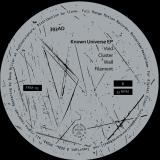
Full Range Motion co-founder 393AD returns to his own label with 'Known Universe EP', providing four more introspective modular-based jams using Perkons as the main rhythm box. The Amsterdam-based DJ, producer, and nightlife devotee opens the EP with 'Void' a percussive, rolling, and fluttering cut. 'Cluster', on the same side, is a devious tool in the right hands with its abstract groundwork and overwhelming single stab 3D sound design. Over on the flip, 'Wall' is straitjacket paranoia-techno in stripped form. Closing this EP is 'Filament', the name itself providing a vivid cosmic image for the track: intertwining, spiralling melodies connecting filmic scenes of interstellar dust.
il devrait être publié sur 12.10.2026
“Negative Music / The Poorest! If they still know silence at all, then only as holes in the continuum of noise…” — Günther Anders, 1965
Editions Mego presents GETGETGET, a new release by Thomas Brinkmann which serves as an inquiry into silence, code, and the limits of perception.
The title GETGETGET references the trilogy of ‘Get’ lp’s made by Rehberg under his PITA moniker; Get Out, Get In and Get On. The music is based on material by Rehberg and Brinkmann morphing these two identities into a third colour, a disappearing color.
Emerging from a live performance at the label’s 30th anniversary in Berlin, the work unfolds as both sonic artifact and conceptual system: a study in what remains when sound is reduced, extracted, and reconstituted.
Taking inspiration from Günther Anders’ notion of “negative music”—composition through absence—Brinkmann’s approach aligns with Heinrich Böll’s idea of “collected silence”: silence not as void, but as a material framed against the constant pressure of noise. In GETGETGET, pauses are not gaps but structural elements, cut from a continuum and reinserted as signals.
The two side long tracks weave a dark abstract and ‘twisted’ presence where the ghosts of the machines and their operators fuse into a fantastical whole. One can hear traces of both Brinkmann and Rehberg logic which seems to fuse in a hallucinatory manner.
Brinkmann’s work reflects a broader condition: the translation of material processes into informational ones. As images detach from bodies and code separates from matter, sound too loses its fixed resonance. What remains is circulation—of signals, of data, of meaning—within systems that increasingly define perception itself.
GETGETGET is an album where absence is equal to presence, a metaphor with suggestive tones of the influence Rehberg had and continues to have in the world of the radical experimental electronic avant garde. The “zero” is not empty; it is what makes everything else work.
il devrait être publié sur 23.10.2026
Since the release of DAMAGED in 2024, Michael Fiedler aka GHOST DUBS has been surfing intensifying waves of adulation, earning praise from such diverse underground legends as Justin Broadrick (Godflesh/Jesu), Regis, Stefan Betke (Pole) and Steve Von Till (Neurosis). With second album Oblique, his mastery of sculpting sound waves results in a spellbinding set of alien soundscapes: larger in scale, richer in tone and considerably more cinematic than its predecessor. Lower, deeper and moodier, its cloudy abstractions, shadowy pulsations and submerged rhythms find Fiedler reaching further into his own sonic void, crafting blurred melodies and addictive narco loops into something simultaneously heavyweight and hypnotic. Album opener "Low Times" sets the atmospheric pressure to maximum, resembling a dream date between prime dirt-house era Andy Stott and Berlin dub-tech pioneers Basic Channel. From there, Oblique descends into a series of enchanting mood scenes: the furtive, balletic gyrations of "After All", the haunting ambience and buried heartbeat throb of "Soft Collapse", and the noirish atmospherics of "Blackout Dust", which worms its way into the mind like some forgotten David Lynch scene. The spirit of reggae is more distanced here than on DAMAGED, but the ghost of Jamaican dub still permeates these foggy soundscapes, particularly on "Bombed Suburbs", where Augustus Pablo-style melodicism is chopped, screwed and slowed into a magnetic lock groove. Superficially minimal but maximal in its minute detail, Oblique is a record of contorted reflections, mesmeric echoes and tantalising audio mirages. By the vaporous mist of closing track "Almost a Structure", obvious rhythm has been craftily filtered away, leaving a blurred and blunted residue full of mystery and implied narrative. Dense in the best possible sense and crushing when played loud yet equally potent played quiet, Oblique imagines dub techno burning its own rigid rulebook: sensual, funky and concussive rather than dry or alienating. "Second album from electronic producer Michael Fiedler's GHOST DUBS project. "Follows up from the highly-acclaimed 'Implosion' album with The Bug from 2025. "Debut album 'Damaged' sold out its three initial pressings and has just been repressed "Michael Fiedler recently scored 'Sound of Falling' which won a Cannes award in 2025 and made the shortlist for an Oscar, too.
Cet article n'a pas encore été publié. Vous pouvez pré-commander le produit maintenant.

Listen!
Klara Lewis’ distinctive talent for disfiguring sound into forms that remain recognisably song-like reaches a new peak here. Her new album Opening is a deceptive recording with veiled melodies and clandestine bangers.
Lewis, creator of worlds, treats music as a mirror that reflects a perspective misaligned with the real image. Her music moves in unusual and often startling ways. Acoustic instruments such as ukulele and piano are subjected to processes of deconstruction and reconstruction, their original forms continually reshaped.
The tracks within Opening offer an array of disorientating tactics; damaged field recordings are suddenly sliced into ominous rhythmical patterns whilst deceptively simple tactics provide foreboding dread. Often alien on entry, the progression of a piece can land in a surprising tenderness, or the other way around. The momentum grows as a physical state but also one which is questioning, desiring, encapsulating a feeling, to explore a further way of expression and ultimately connecting: A new closeness, a new perspective.
Opening is an album in which the protagonist’s manipulation of sonic matter seems to extend beyond the music itself, resulting in a corresponding manipulation of the active listener. Sounds shift, dissolve, and re-emerge in altered forms, creating an experience that feels both intimate and disorienting. Lewis maintains a delicate balance between abstraction and emotional immediacy, drawing the listener into a world where familiar musical gestures are constantly reconfigured in surprising ways.
The works on Opening are refracted through an exploratory and transformative lens, suggesting an artist continuing to redefine the possibilities of musical language as a space where the instantaneous and the eternal come together.
Music by Klara Lewis. Mastered by Stephan Mathieu. Cut by Andreas Kauffelt at Schnittstelle, Berlin. Artwork by Klara Lewis. Design by Klara Lewis & Nik Colk Void. Images from ”En Masse” by Circa, directed by Yaron Lifschitz. Dancer Holly-Rose Boyer.
Published by Mute Song. Released by Editions Mego© 2026
”Tide” commissioned for compilation album "Dissolving Strawberry" (2020), released by Irrlicht. ”Drip” and ”Feel” originally composed for the film ”Failed Emptiness” (2024) by Mika Taanila.
Partner in crime: Hampus Högberg.
il devrait être publié sur 04.09.2026

Editions Mego welcomes KMRU back to the fold. Kin is Kenyan born, Berlin based, sonic wizard Joseph Kamaru’s second release on Editions Mego, following on from the classic 2020 release Peel. Since the release and subsequent praise for Peel, the artist has been a staple on the electronic scene performing on numerous stages and festivals worldwide in tandem with a flood of media recognition. Kin could be construed as the second child following Peel. The project came out of initial discussions with Peter Rehberg about what a Peel sequel would sound like. Kamaru is quick to clarify that Kin is not that record; “I'll know when that record will come and when I'll make it. It's already happening... or maybe it lives within both of these Mego records”.
It is this deft ambiguity and vague tiptoeing around the concrete that encapsulates the ambiguous sound world of Kamaru’s vision.
Kin was started early 2021 in Nairobi with Kamaru exploring his noisier palette of sounds encompassing distortions reminiscent of the sounds he would muster from in his youth when playing guitar. He paused making this record for a year as soon as Peter died, then slowly returned to it through 2022 resulting in the immense new work we have here.
The charms within Kin lay as Easter eggs revealing the true identity behind the colourful sonics only after multiple deep listens. With Trees Where We Can See sets the tone by way of a warm swaying melody inviting the listener in for further investigation. In 2022 KMRU and Mego stalwart Fennesz toured the USA together resulting in a strong friendship and also, the second track here, Blurred. A neat Mego/Editions Mego loop as such. Blurred arranges twangy guitar strums alongside glistening glaciers of shimmering drones. They Are Here represents a darker hue as melancholic clouds of shadowy noir tap directly into the listener's nerve stream. Maybe takes a detour into a bristling euphoric electronic storm whilst We Are screeches in a pattern formation not unlike a highly abstracted Aphex Twin forcing its way out of a hard drive. By Absence concludes proceedings, operating as both exit music and a portal to further sonic investigation with acoustic bellowing residing amongst a kaleidoscopic backdrop.
Kin is a trip that rewards close repeated listens as all the colours and textures, nuance and narratives unveil themselves. This isn’t a record to be glossed over, magic rewards concentration.
Kin is a record to be Played slow and LOUD.
For Pita.
All tracks written, produced, mixed by Joseph Kamaru
Blurred co-written & produced with Christian Fennesz
Mastered by Stephan Mathieu at Schwebung Mastering
Photography: Joseph Kamaru
Layout & Design: Nik Void
Cut by Andreas Kauffelt at Schnittstelle, Berlin
Commandez maintenant et nous commanderons l'article pour vous chez notre fournisseur.

NPVR is the avant garde duo made up of the late Peter Rehberg and Nik Void. Editions Mego is proud to present their second and final release. No this is not some kind of Beatles synthetic AI that raises the dead reconstructed recordings but rather a new album made by the humans and their machines.
The initial meeting of Rehberg and Void was in London in 2016 and despite or due to their mutual awkwardness found solace and compatibility in the fact that they both had a similar electronic modular set up, along with matching cases to transport all. The idea to collaborate was an obvious and organic process as a means to connect their individual gear together and observe the outcome. The fruits of these initial experiments, recorded in London, resulted in the playful experimentation of their acclaimed 2017 release 33 33 (eMego 251).
Now in 2024 Editions Mego presents the logically titled follow up, 33 34. These sessions were recorded six months after the initial recordings at Peter’s home in Vienna. This was planned out as a mirror city release to the original London recordings. With Peter having access to his full studio set up this time around we encounter a rich audio landscape which organically folds together a variety of musical genres blurring any distinction between these forms so the resulting music hovers as a new cloud of sound. Any musical form, be it industrial, electro-acoustic, ambient, drone and techno all coexist and melt into the other as the ensuing result unveils a hypnotic swarm of divergent sounds (music). When active there were no lines or contexts with NPVR, either between sound or genre within these recordings or live where NPVR were at home playing at a techno club one night and an avant garde venue the next.
The initial session of these recordings was edited by Rehberg and sent to Void to further develop. Over time the final versions were agreed on and then shelved as other outside projects took over. The awkwardness had been surmounted and the two had become close friends. NPVR performed at a range of venues such as Tresor, Sutton House, Corsica, Blitz, Paris GRM #Focus2, LEV Festival and Rigas Skanumezs Festival. Following Rehberg’s untimely passing Void had difficulty listening back to the sessions but eventually thought it fit to complete and release this album, of which even the artwork (like 33 33, an image from Zurich photographer, Georg Gatsas) had been decided upon prior to Rehberg parting ways.
There is an unmistakable joy to these recordings. One encounters an enthralling exploration of their chosen machines which conveys the excitement of what can be randomly conjured when people speak through such devices. There is no grand statement or argument here, just the sheer thrill of creation and the recorded results of random encounters. The art of collaboration was always a mainstay of Rehberg’s practice from the advent of the MEGO adventure. Rehberg & Bauer was an initial collaboration with former business partner Ramon Bauer. Even at this stage one can hear a relaxed sense of delight in the sheer discovery of sound.
A mix made for the Wire magazine following the release of 33 33 hints at the freedom that comes with endless urge for exploration and discovery. Abstract tracks from Z'EV. Jérôme Noetinger and Jung An Tagen are included alongside British stalwarts The Fall and New Order. There were no lines between pop / academic / underground or mainstream in Rehberg’s world. All of it sat at the same table. It is just matter in the atmosphere, like the diverse exploration found in these recordings that comprise 33 34.
Towards the end of his life Rehberg was obsessing over the immense output of the German ambient musician Pete Namlook. An artist renowned for not only his sprawling catalogue of ambient masterpieces but one who often said his main inspiration was nature. This is apt with regards to the work of NPVR which also aligns with such thought as the intertwining of the two individual artists and their machines results in a natural symbiotic flow, as it happens, just like in the world around us.
Commandez maintenant et nous commanderons l'article pour vous chez notre fournisseur.
Among the true Keiji Haino devotees, Nijiumu’s Era of Sad Wings (released on P.S.F. in 1993) has always held a special place in the pantheon. Operating for only a few years in the early 90s and apparently only performing a handful of shows, Nijiumu operated at the opposite end of the dynamic spectrum to Haino’s famed power trio Fushitsusha, dwelling in a hushed, meditative realm of mysterious droning sonorities and free-floating melodies that occasionally erupts into violence. Black Truffle is pleased to announce a new double-LP edition of a lesser-known 1994 Nijiumu recording, When I sing, I slip into the microphone. Into that void, I bring comrade “prayers”, then, turning to face the outside, together we explode. Here, Nijiumu is the trio of Haino, Tetuzi Akiyama and the obscure Takashi Matsuoka, the three performing on a wide variety of string, wind and percussion instruments, as well as electric guitar and bass, and Haino’s unmistakeable voice.
Like on the early solo Haino album that shares the group’s name (released on P.S.F. in 1993), the instrumentation swims in reverb (the use of which Akiyama recalls as ‘a kind of point of the band’), often obscuring the instrumental sources. On the short opening piece, a distant reed instrument arcs long buzzing melodies over a bed of cymbals and gongs, like a psychedelic take on Tibetan music. The epic second part, occupying almost 50 minutes, begins as a splayed, near-formless cloud of electric guitar and bass, shadowed by bowed and plucked strings, the three elements working through twisting atonal shapes. At various points in the recording, we hear what seems to be the sounds of musicians moving between instruments, their shuffling and bumps fitting seamlessly into this radically open music. Eventually, what sounds like electric guitar moves closer to the foreground, fixing on a repeated melodic cell around which hover mysterious clouds of long tones and a sporadic shaker. At the half-hour mark, the music begins to build to a violently emotive climax, Haino’s impassioned vocal cries punctuating a lumbering, bass-heavy murk, contrasted at points by what sounds like a tin whistle. Suddenly, the volume drops to a near-whisper, opening the way for the stunning final moments, which touch on the slow-motion balladry of Haino’s classic Affection, here given an eccentric twist by an occasional woodblock hit. The third piece opens with a hazy trio of rumbling bass, bowed strings and abstracted slide guitar, the latter calling to mind some of Akiyama’s later solo work. Eventually joined by Haino’s voice, its fragile, haunted tone might remind the listener of the man in black’s documented love of the madrigals of the murderous Count Gesualdo, before the recording abruptly breaks off mid-note. In this new edition, the Nijiumu trio recording is supplemented by a piece recorded solo by Haino in 1973, a bracing electronic blowout stretching almost half an hour. Using a homemade electronics setup to unleash a barrage of crunching distortion and shuddering harmonic fuzz, it takes its place in the canon of extreme live electronics next to Robert Ashley’s Wolfman and Walter Marchetti’s Osmanthus fragrans, looking forward to extreme noise years before Merzbow. Taken as a whole, these four sides of music are a stunning document of some of the lesser-known waystations of Haino’s singular creative path.
Commandez maintenant et nous commanderons l'article pour vous chez notre fournisseur.

Rivet’s new album for Editions Mego is an uplifting and joyous affair coming in the wake of tragedy and disenchantment. It is yet another rebirth from an artist willing to take a step back and reprise the current situation he is in. Mika Hallbäck has a long credible history in the Swedish underground. First recognised for his industrial techno works under the Grovskopa moniker he worked privately on more experimental works that eventually came out as On Feather and Wire, an album released on Editions Mego in 2020. After much acclaim for this bold new direction that blended electronic abstraction, pop and industrial forms into a heavy synthetic trip two tragedies struck. One was the passing of label boss Peter Rehberg and then the passing of his dog Lilo, who was as close as a companion one could have. These events led to the release of the more unsettling follow up L+P-2 (Lilo and Pita minus two) on Midnight Shift Records in 2023. Peck Glamour sees Rivet return to the reawakened Editions Mego with an album of optimism inspired by reconciliation with loss and further explorations of new mental/sonic realms.
Hallbäck defines his approach as not being married to any particular machine, instrument, process or genre. However he holds a particular affinity to sampling, of which, he says, provides the dirt and grit amongst what would otherwise be pristine, generic machine music. The contemporary crate digging method of scouring obscure download music bogs for unique sounds was his preferred research practice.
Peck Glamour is an album full of tracks brimming with the excitement of exploration. It's the results of a mind informed by punk, industrial, techno, dancefloor, disappointment, trauma and rebirth. Here the synthetic and authentic is viewed simply as the same means of human rationale and expression.
The opening, ‘Catch Up to Light’, sets the scene with ecstatic and odd fluorescent vocals sliding amongst crystalline likembe whilst synths swirl amongst the external festivities. ‘Orbiting Empty Cocoon’ is somewhat a homage to the alien sound worlds of The Orb, one which takes the listener deeper into a mind melting array of teased potential as visual elements are executed in a mask of audio wizardry and euphoric staccato rhythms, the later being a nod to Singeli music. ‘Patitur Butcher’ is more dance frontal utilising the Ghatam drum and a YouTube rip of a Chinese language lesson. ‘Plastic Bag Putain’ was made during the beginning of Russia's invasion of Ukraine and should be clear of its intent. ‘All that Heaven Allows’ is a marimba cover of an imaginary Love Parade anthem. 'Kyrie Geire’ potentially briefly fills the void left by the demise of Coil. The entire trip of Peck Glamour is sewn up with ‘We left before we came’ whereby extraneous recordings of double bass player Gregory Vartian-Foss (tuning/strumming/moving the bass) are superimposed with local field recordings to create a gorgeous bed of sounds acting as an exciting exit music to this sharp collection of cinematic ear excursions.
Commandez maintenant et nous commanderons l'article pour vous chez notre fournisseur.

‘Absurd Matter’ is a labyrinthine sonic conundrum that spirals around the two poles of extreme noise and hiphop. It's Berlin-based Italian producer Shapednoise's first album in four years and confidently advances his narrative into the next chapter, building on the groundwork of his prior abstractions to emerge with a coherent genre-warped fusion of urgent rap, crushing bass weight and idiosyncratic sound design. After spending years scrupulously deconstructing club music, Nino Pedone has rebuilt it brick by brick in his image.
The album is the first release on Pedone's brand new imprint WEIGHT LOOMING, a multidisciplinary label platform that's set to explore the depths of bass music, textured noise and abrasive transcendence. It follows a slew of acclaimed releases for Numbers,
Opal Tapes, Type and his own Cosmo Rhythmatic label, and forward thinking collaborations with Kenyan beat alchemist Slikback and Hyperdub-signed Angolan producer Nazar. Pedone's most ambitious project to date, ‘Absurd Matter’ taps into kinetic energy from a hand-picked selection of collaborators, including New York rap duo Armand
Hammer, French DJ/producer Brodinski, Bruiser Brigade's ZelooperZ and vanguard Philly poet, musician, and activist Moor Mother.
On ‘Family’, Billy Woods and Elucid weave a dismal, apocalyptic landscape with their razor-sharp anecdotes. The duo’s macabre imagery is given artificial life by Pedone's industrial scrapes and rattles that curl around their worlds like thick smoke. It's still rap, just about, but lodges itself in the back room of a factory, machines running themselves to an early death. Pairing with techno-rap trailblazer Brodinski, Pedone edges further towards the sound system, spatializing rhythms in four dimensions around Detroit rapper
ZelooperZ's playful expressions. This is the Italian producer's sci-fi tinged liquefaction of radio echoes, a way to fire familiarity into the void and sublime the human voice into weightless mist. When Moor Mother arrives shouting "me me me" on the aptly-titled 'Poetry', it sounds as if all of Pedone's loose threads are being tightened into a knot. His misshapen neo-grime beats sound like a broken jet engine, but smartly cede power to Moor Mother's resonant rhymes. "You can't cancel me" she assures. ‘Absurd Matter’ is a defining personal development for Pedone that not only appraises his career so far, but diverts its logic into frighteningly new sonic territory. From great loss, the producer has determined his work's cardinal themes, and sounds more strident and far heavier than ever before.
Commandez maintenant et nous commanderons l'article pour vous chez notre fournisseur.

Cross Record's new album, Crush Me, is steeped in the pressures and wonders of existence—a profound statement, especially coming from artist and death doula Emily Cross. A two-and-a-half-year gestation period offered challenges, disappointments, and joys reflected in the cramped space of the album, which explores how we handle the weights we carry. Emily Cross had held hundreds of Living Funerals and was as many episodes deep into her podcast, What I’m Looking At. She was five years into serving clients as a death doula and fresh off a tour with Loma, her band with Jonathan Meiburg (Shearwater) and Dan Duszynski, when she began work on her fourth album. After moving from Austin, TX to Dorset, UK, she established the Steady Waves Center for Contemplation (named after a track from her second record, Wabi-Sabi ), where she hosted Living Funerals, met clients, scheduled mindful tea sessions, and showcased experimental music nights. All the while, she was scribbling down song ideas. Cross’s Tascam four-track demos finally reached readiness, and she sent them to an interested major independent label. She was encouraged to push her imagination to the limits of what a record could be. So, unlike her usual process of recording as inexpensively as possible, she prepared a two-week recording session in Germany with a group of skilled musicians from around the world. True to her previous work, Cross left plenty of room in her demos for experimentation, collaboration, chance, improvisation, and complete obliteration, then resurrection when necessary. Comfort and traditional structure were eschewed in favor of unaccountable magic, prayers whispered into The Void. Cross is comfortable with the chaotic and unpredictable, a perspective demanded by her work and writing style. The Berlin Airbnb was packed with people, instruments and luggage. During a ride down in a tiny elevator to the studio, Cross realized how central the sense of being crushed was to the album. “I thought of it later and it dawned on me that ‘Crush Me’ perfectly embodied the record,” says Cross. Yes, the weight of a body laying limply atop yours, or the tight squeeze of a hug, can be pleasant. Go too far, and you’re in the hands of a cruel, adolescent god. Upon leaving Germany, the record was unfinished, and without a roadmap. As passages were recorded as isolated parts, Cross and musician Marcin Sulewski collaborated, facing a haphazard brick pile, waiting to be assembled. Work dipped in and out of view like a buoy bobbing in a violent sea over many months. During that time, the aforementioned interested label went radio silent, suddenly not seeming so sure of a thing. Collaborators disappeared, continuing the themes of abandonment, surrender, and disarray that followed the project. Cross physically felt her entire body go numb: In a twist of fate, the record was rescued by long-time friend and supporter Ben Goldberg at Ba Da Bing Records who was eager to help realize the project. Cross worked for months on the album, all the while nursing a pregnancy and continuing her full-time funeral work. The last minute participation of Seth Manchester of Machines with Magnets, who mixed and mastered, was an essential liferaft. He gave true final form to the abstracted songs. Crush Me has the effect of a spell being cast, with songs balancing heaviness and levity. Vocals, guitars, and keyboards float above, as drums and upright bass (often bowed) lurch beneath. On “Rolling Backwards” percussion wanders about while feedback squeals and persists in the distance. “Dorset Area Of Natural Beauty” starts with a thick, unhinged church organ progression punctuated by the disquieting sounds of laughter reaching the point of hysteria. “God Fax” is a slow-moving panic attack, with shallow breaths in and out framing a guttural cacophony like a wooden freighter encountering increasingly turbulent waters and vocals struck emotionless by autotune. The album ends with “Twisted Up Fence,” a reflection on life from outside the wall--wistful, warm, and comforting. Cross, likely with a smile on her face, sings: “You say it’s an endless abyss” “And I say the abyss is the best”
il devrait être publié sur 21.03.2025

A new artist appears on the streets of City HC Records, he is Andrey Orenstein
multidisciplinary artist, part of the alternative Rock band ‘Tequilajazz’, with several solo musical incarnations such as: Amor Entrave, for electronic Indie beats with tocuhes of IDM of broken beats, Do you like trains? for Acid House, and 50DIX, dedicated to street beats such as jungle, drum n bass, ghetto house, Juke and Footwork, and the pseudonym he uses for Go Ahead! EP, the new and multifaceted 22nd release from the Valencian label.
IF U WANT 2 is the elegant track that takes us into the bustling avenues of the 2st century megapolis, where the urban rhythms of the dance battles in Chicago, Footwork and Juke, along with brief Jungle passages alternate in a brilliant composition with funk and jazz nuances accompanying tight percussion and distorted kicks at 160 BPM.
Tough and Ghetto House and rugged acid define FOOLZ, second track of the A-side in which the demonic power of the 303 sounds embrace the thick and husky voice that together with infectious laughter set a rhythm as pugnacious as it is playful.
FETTA DI LIMONE, Juke, Footwork and Jungle, a perfect combination of American influences, legacy of Dj Rashad together with the English tradition around bass music, are fused by 50DIX with the unexpected and playful Italian lyrics of Tomasso Girardi, in perfect conjunction with the pianos, ethereal pads and mutant synths, that forge the development of the track. Already anthemic before the first beat sounds.
Juke, IDM, Halftime and abstract broken beats combine for the ultimate dance elixir, in the last track of the vinyl titled ICE FEELS KEEN, reaching 170 BPM in a catharsis of braindance, soul and acid exaltation in a dreamy harmony, where the syncopated notes of Oleg Egorov's bass and the velvety voice of Julia Garnits (Ice Hokku) commune.
Bonus digital track - 50Dix ICE FEELS KEEN (DZA REFLIP). Hypnotic, sharp and minimalistic, DZA's remix transforms the original track into an intimate and evocative experience, in which every sonic element acquires more prominence and presence.
Bonus digital track 2 - Fetta di limone (Kaxtelian remix) Inspired by the classic hardtrance sounds of the 90s, from Valencian dance temples such as Chocolate, Kaxtelian reinterprets the track with distorted drums, catchy melodies and Rave spirit at 165 bpm.
Mastering by Steve Voidloss at Black Monolith Studios in London (UK), except for the Bonus track 2 mastered by Raszia.
Once again, artwork and design by Dani Requeni, giving artistic coherence to the label's aesthetic.
Commandez maintenant et nous commanderons l'article pour vous chez notre fournisseur.

Watkins Group returns to Frequency Consortium for its second release, pushing further into the murky depths of dubbed-out desolation. Dubh Dubs (Dark Dubs) takes its name literally—seven tracks of cavernous low-end pressure, submerged echoes, and spectral atmospheres, drawing inspiration from the voids between worlds, the unseen corners of deep space, and the eerie stillness of unknown places.
Where Beanntan a’ Bhròin charted a course through the bleak grandeur of the Highlands, Dubh Dubs plunges headfirst into the abyss, embracing the weight of isolation and the slow decay of time. Watkins Group crafts a sound that feels at once infinite and suffocating—pulsing, restrained, and heavy with the dread of something just beyond reach. Tape-warped textures and submerged percussive mutations unfold in glacial movements, calling to mind the nocturnal dub abstractions of Porter Ricks, the blackened ambience of Thomas Köner, and the sub-heavy spirals of Rhythm & Sound at their most ghostly.
A study in tension and negative space, Dubh Dubs marks another compelling entry in the Frequency Consortium catalog—an offering for those drawn to the darker recesses of sound, where every echo leads deeper into the unknown.
In loving memory of my brother and kindred spirit - Marcus Rafferty
il devrait être publié sur 03.03.2025

On alene et, Michaela Turcerová, a Copenhagen-based, Slovakia born musician, takes minutiae — the tiniest scrapes and breathiest hums — and distorts them into sprawling, collaged webs that barely resemble the instrument in its natural state. Each shard, when pieced together, makes a rhythmic, undulating sound born from the subtlest motions.
Alene et marks Turcerová’s debut as a soloist, putting a spotlight on the exploratory approach she has developed on her own and across a variety of collaborations. She has long studied the quiet excavation of her instrument, pulling it apart to find a new vocabulary. To develop this language, she unearths shards of sound from the instrument, muting it or bringing out its scratchiness and grittiness. Primarily working with open-ended scores and improvisation, she is inspired by various percussive music, looking to deep sonic awareness to guide her. As a soloist, her music harkens to the abstracted electronics present across the Editions Mego catalog or the distorted ruminations of Nyege Nyege tapes. And no matter where she goes, she is constantly in the pursuit of the unknown — the hidden elements of music that come to life through experimentation and listening.
With alene et, Turcerová presents her singular language on the saxophone to the fullest. To make this music, she placed many microphones close to her instrument, zeroing in to each sound and examining it from multiple different angles. She emphasizes the percussive possibilities of her instrument, puzzle-piecing each note into pulsating webs. Each track highlights a different side of the saxophone — the bristling distortion and amplification of a column of air as it blows through her saxophone’s body, the trickling tapping of the keys as she places her fingers onto them.
At its core, alene et presents Turcerová’s curiosity. The saxophone lives many different lives within her hands, shapeshifting through the uncovering of its possibilities. She shows us how the instrument is an ever-changing entity, a distorted and blown out drone with a thousand shards poking out from inside of it. But more than just a showcase of an individual instrument, alene et feels like a statement of the act of exploration. Turcerová is an excavator, always looking for new worlds hidden within her saxophone, and leaving room for more to come alive with each listen.
il devrait être publié sur 18.11.2024

Blake Lee has always been fascinated by the unknown, and space, in its isolating, mysterious vastness, embodies this theme immaculately. The open void, captured so memorably by Stanley Kubrick in '2001: A Space Odyssey', is Blake's far-reaching canvas on 'No Sound In Space', a cinematic meditation on the cosmos that's painted in nuanced, emotionally sincere colors. The Los Angeles-based composer has been contemplating his full-length debut since 2021, using his guitar as a sonic paintbrush rather than find himself snared in its traditional aesthetic constraints. Transforming its characteristics with effects and subtle processes, he layers sustained tones and intimate improvisations, creating richly visual polychromatic utopias teeming with unknown life.
Since 2011, Blake has been most known for being the guitarist and a music director for Lana Del Rey, notching up three songwriting credits on her acclaimed ‘Ultraviolence’ full length. He sees his solo work is a form of escapism, a place where he can experiment and find comfort and catharsis outside of expectations and formal structure. The album was written instinctively, and Blake made sure he didn't force anything, letting go and getting out of his own way, listening intently as sounds and textures materialized organically. "I didn't want to ruin it by being a perfectionist," he laughs. And his collaboration with Kenyan sound artist KMRU, who runs the OFNOT label and contributes to two of the tracks on the album, occurred similarly organically.
Blake was moved to reach out to KMRU when he caught a performance of 'Natur' at Los Angeles' Zebulon in 2022, leading to a prolonged back-and-forth. They didn't meet in person until earlier this year, by which time they'd become firm friends, continuously sharing music and conversation. KMRU had lent a valuable ear to Blake, who sent early playlists of 'NSIS' that, over the months, slowly evolved into the finished album. It's the first release on OFNOT that's not by KMRU himself; the label emerged last year with the release of KMRU's own 'Dissolution Grip', and Blake's debut immediately expands its sonic universe. Alongside the playlists, Blake also provided KMRU with the tracks' raw stems, which KMRU began to edit and expand in his Berlin studio. 'Miura' and 'Waiting' are the result of this process, two sublime abstractions that augment Blake's dreamlike, euphoric tones with KMRU's pebbly distortions and booming low-end rumbles. And this same playful sense of freeness seeps into Blake's other compositions.
On the misty 'In A Cloud', he surrounds cascading string tones with soft-focus pads that swell until they're like crashing waves, and on the two 'Echoplexx' pieces, he uses delay and reverb to smudge his sounds until they're viscous residue, the harmonies obscured by whooshes of white noise and distant chimes. The mood is quieted somewhat on 'Moving Air', as Blake's swirling tones form half-heard lullabies, coalescing into a dense, melancholy crescendo, and he fills out the sound with reverberant airport recordings on 'Pan Am', letting pitchy My Bloody Valentine-esque drones warble beneath the transitory chatter. Each track melts into the next, forming a billowing, cryptic narrative that leaves more questions than answers. Blake is constantly searching, and fills his unoccupied space with warmth, perception and sensitivity.
il devrait être publié sur 15.11.2024
Blake Lee has always been fascinated by the unknown, and space, in its isolating, mysterious vastness, embodies this theme immaculately. The open void, captured so memorably by Stanley Kubrick in '2001: A Space Odyssey', is Blake's far-reaching canvas on 'No Sound In Space', a cinematic meditation on the cosmos that's painted in nuanced, emotionally sincere colors. The Los Angeles-based composer has been contemplating his full-length debut since 2021, using his guitar as a sonic paintbrush rather than find himself snared in its traditional aesthetic constraints. Transforming its characteristics with effects and subtle processes, he layers sustained tones and intimate improvisations, creating richly visual polychromatic utopias teeming with unknown life.
Since 2011, Blake has been most known for being the guitarist and a music director for Lana Del Rey, notching up three songwriting credits on her acclaimed ‘Ultraviolence’ full length. He sees his solo work is a form of escapism, a place where he can experiment and find comfort and catharsis outside of expectations and formal structure. The album was written instinctively, and Blake made sure he didn't force anything, letting go and getting out of his own way, listening intently as sounds and textures materialized organically. "I didn't want to ruin it by being a perfectionist," he laughs. And his collaboration with Kenyan sound artist KMRU, who runs the OFNOT label and contributes to two of the tracks on the album, occurred similarly organically.
Blake was moved to reach out to KMRU when he caught a performance of 'Natur' at Los Angeles' Zebulon in 2022, leading to a prolonged back-and-forth. They didn't meet in person until earlier this year, by which time they'd become firm friends, continuously sharing music and conversation. KMRU had lent a valuable ear to Blake, who sent early playlists of 'NSIS' that, over the months, slowly evolved into the finished album. It's the first release on OFNOT that's not by KMRU himself; the label emerged last year with the release of KMRU's own 'Dissolution Grip', and Blake's debut immediately expands its sonic universe. Alongside the playlists, Blake also provided KMRU with the tracks' raw stems, which KMRU began to edit and expand in his Berlin studio. 'Miura' and 'Waiting' are the result of this process, two sublime abstractions that augment Blake's dreamlike, euphoric tones with KMRU's pebbly distortions and booming low-end rumbles. And this same playful sense of freeness seeps into Blake's other compositions.
On the misty 'In A Cloud', he surrounds cascading string tones with soft-focus pads that swell until they're like crashing waves, and on the two 'Echoplexx' pieces, he uses delay and reverb to smudge his sounds until they're viscous residue, the harmonies obscured by whooshes of white noise and distant chimes. The mood is quieted somewhat on 'Moving Air', as Blake's swirling tones form half-heard lullabies, coalescing into a dense, melancholy crescendo, and he fills out the sound with reverberant airport recordings on 'Pan Am', letting pitchy My Bloody Valentine-esque drones warble beneath the transitory chatter. Each track melts into the next, forming a billowing, cryptic narrative that leaves more questions than answers. Blake is constantly searching, and fills his unoccupied space with warmth, perception and sensitivity.
il devrait être publié sur 15.11.2024

Black[27,31 €]
The album was created in two versions - a limited "color in color", of which 100 numbered pieces were produced, and a classic version with black wax, of which 200 pieces were produced.
After 10 years, Kixnare returns to U Know Me Records with his fourth original album. "Asteria" is a step towards even more experimental and abstract corners of electronic music. Each of the seven songs on the album reveals a fascination with completely different musical areas - from dark ambient ("Plaga"), through oriental ("Mystic Journeyman") / dubbing downtempo ("Impass") to stronger acid ("Mutacja") and techno ( "Omnis"). What connects everything is a constant atmosphere of anxiety - a reflection of the times we live in. Despite a completely different musical climate, "Asteria" refers in its character to Kixnare's last album "Rotations" from 2014, continuing the concept of inter-genre collage. All this comes together in the weekly radio show "Rotations", in which Kixnare presents his recommendations from the world of underground and experimental electronics on Radio Kraków.
"Asteria" is an album consisting of seven songs - almost 38 minutes of an amazing journey, the sound of which was worked on by the legendary Stefan Betke from Berlin (mastering author). The cover is the work of the flawless Animisiewasz.
Commandez maintenant et nous commanderons l'article pour vous chez notre fournisseur.

ACxDC—full name Antichrist Demoncore—are anything but subtle. So to make sure that their message is heard loud and clear, they take things a step further, smashing these ambiguous, sophisticated, and abstract notions into a pulp and shoving them down throats. What’s left are sharp, caustic, and unabashedly vicious bits of truth and poisonous tongue-in-cheek propelled by bursts of powerviolence, metallized hardcore, and grindcore. Over the seventeen short songs, the music closely follows these themes.
il devrait être publié sur 26.04.2024

On For Annette, singer-songwriter ronja summons forth a certain unbridgeable void within our existence and the acceptance of the deafening silence that comes with it. Weaving the strands of her previous release something about us with multiple openings towards more abstract territory, this 5-track EP marks her debut under the forward-thinking Unguarded label, astutely situating her music well beyond the confines of the genre.
The opening track “Nothing Makes Me Feel” beckons the listener into a discreet moment amid the early light of dawn, commencing with an up-close acoustic guitar, soon to be graced by ronja’s hushed voice, softly whispering, as if to avoid waking someone near. “Just Once”, with its weeping waltz, is about losing one’s place in the world, about choosing the imaginary over the real. Behind the strummed chords hides a soft dither of sine tones that attempts to fill the gap that cannot be filled, only to transform into quavering distortion ever after. Where language may falter, ronja turns to choral-like instrumental pieces (“Light” & “Grass from Below”), characterized by her distinctive and multi-layered flute arrangements. The absence of words here allows for a sensible stage of introspection, a fleeting and diaphanous pause, forging a passage to a more hopeful outlook. Yet, these pieces are not isolated; hints of fluttering air and cavernous depths are subtly alluded to in the earlier, more song-based tracks. In just under 18 minutes running time, the theme of loss, or the anticipation of its arrival, lingers solemnly before transcending intermediate states in “Almost There”.
Admirers of the dreamgaze band Roomer, which made waves in and around the Berlin music scene this past year, might detect faint resemblances. Nonetheless, ronja—a pivotal presence in said band—unveils a distinct effort here, striking subdued but enticing tones, a foreshadowing of what is yet to come from this luminary artist. – Luka Aron
Commandez maintenant et nous commanderons l'article pour vous chez notre fournisseur.

Balmat is a new label with a cloudy outline.
Jointly shepherded by Philip Sherburne and Albert Salinas, two friends living in Cardedeu, Catalonia, and on the Balearic island of Menorca, Balmat grew out of Lapsus Radio, a weekly show on Spain’s Radio 3. Balmat’s mission is simple: to foster new ideas, expand upon personal obsessions, and put enveloping sounds out into the world.
“Balmat” means “empty” or “void” in Catalan. But quite apart from any negative connotations, we prefer to think of it in terms of possibility: a space waiting to be filled.
Balmat’s first release comes from Luke Sanger, a Norwich, UK-based artist whose two decades of electronic music making have encompassed a range of tools and techniques, from MaxMSP to modular synthesis. Along the way he has built an extensive catalog encompassing ambient atmospheres, abstract soundscaping, and more. With Languid Gongue, he puts multiple approaches into play. Experiments in microtonal composition balance out pieces in standard tunings, while esoteric electronic machines merge with familiar acoustic treatments and microphone techniques.
The result is a constellation of his signature sounds: freeform new-age fantasia; spring-loaded toytronic arpeggios; quartz-driven braindance clockworks. Drifting between consonant, almost lyrical compositions and shape-shifting textural sketches, the album drifts with the nonchalance of a sky-high cirrus cloud, and it glows as if illuminated from within. When we heard the material, we knew that it was the perfect choice to launch the label. To us, it sounds like a roadmap for points unknown.
Commandez maintenant et nous commanderons l'article pour vous chez notre fournisseur.

The collaboration between Klara Lewis and Nik Colk Void somehow seemed inevitable. Both artists having seen their releases published by Editions Mego, individually carving out idiosyncratic voices in the worlds of extreme, abstract electronic music. With Full-On, Lewis and Void explore and assimilate the very edge of their individual practice where a unique collaborative interface allows two voices to combine and morph into a third voice.
Lewis and Void play ping pong with the conversation of sounds, generating ideas and bouncing them off each other, simultaneously encouraging the other to go further with their ideas opening up an opportunity to engage with previously unexplored terrain. Guitars, synths, euro rack modular systems, voice, sampling and outboard processing are folded in a playful unification with a propensity to tease, explore and extract new ideas and shapes, sometimes brutal, sometimes playful.
Trust was also a compositional tool allowing instinct to freely move on any aspect of the sound and space. This sound/feeling/instinct/association let this wild and wonderful material grow organically into something new.
The result of this exploratory interplay are 17 intense miniatures reveling in the process of unadulterated experimentation and whimsical interplay, not just between the humans, but the machines themselves. United in an endless series of sonic U-turns, this daring duo intertwine pop and noise whilst also bringing together visions of tender techno and forthright ambient.
The various zones which manifest from all this reveals vocals shifting in mysterious ways, dust drenched beats churning limpidly and devilish string loops navigating a disorientating domain. The experience of listening to Full-On is to be confronted with a range of ideas resulting in a platter of emotions. A place where beauty and the beast collide with the impulsive and outright weird. What a wonderful world.
Commandez maintenant et nous commanderons l'article pour vous chez notre fournisseur.

Summer’s here with Limbic Resonance ‘s first vinyl release giving a strong impression of our exploration into the darker sides of electronic music & ambient soundfields.
Spread over 13 tracks by pioneering artists, established current acts, upcoming new faces and under the radar mavericks, LDRR is a sound canvas representing LR ongoing interest in unpredictable & undertow sounds & atmospheres.
Compiled by Alexandra Ismalone
Limbic Resonance is a platform set up by Jeroen Lauwers (Red Stars Over Tokyo, Hot Hair Records, Testtoon), Alexandra Ismalone (Alekzandra/CPR) & Tobias Lisius (Liziuz, CPR) bringing together their solo and cooperative output.
LR conjures a sound that paradoxically traverses dark & light, a wave of dark ambient music punctured by rays of light sculpted w/ lush loops, heartbeat pulses & psychedelic electronics. Their vision is abstract primitivism and modern romanticism bypassing the artificial modern day present, a soothing meditative space w/ indefinable mysterious undertones.
Creating a “beyond logic” world & vision that melts smothered spectral ghostlike dreampop soundfields with unbound dark occult ceremony exercises. A cross pollination of two universes where space and time confront themselves and will be burned down within the ritualistic circle, the remaining void filled with warmth and sparkles, detached from their original source, a rebirth of natural primitivism.
RITUAL MUSIC AND URBAN SURVIVAL STRATEGIES
Commandez maintenant et nous commanderons l'article pour vous chez notre fournisseur.

Catorce reflexiones sobre el fin (Fourteen Reflections on the End) originated from an installation exhibited at the Museo de Arte Contemporáneo de Oaxaca, Mexico, in 2019. Fourteen magnetic bodies of tape that dialogued with the fourteen pieces of electroacoustic music now contained in this album composed from the sound anthology of Angélica Castelló. Thus, Catorce reflexiones sobre el fin is a complex piece consisting of multiple parts that, although articulated with each other, hold a life of their own.
Like every body, these have a unique history made up of mixed fragments spun by Angélica, ranging from field recordings, references, and self-references to previous pieces, experiences, and voice recordings made specifically for these compositions re-recorded in various formats, from lo to high fidelity, analog and digital, composed, decomposed and recomposed (Castelló, A., 2019). Likewise, as any body, they also reflect on their end, whether absolute or temporal, of the many ways of being finite and of saying goodbye.
During the Catorce reflexiones sobre el fin, Castelló takes you on a journey that is difficult to locate. An ethereal space between shattered glass, stridulation of cicadas, war drums, murmurs in French, Italian maledictions, and soft recitations in Spanish. From uproar to solace, all wrapped in a soft abstraction that only allows access to the subtle whisper of these expressions. A gesture between invitation and sharing because who does not recognize oneself in this emotional storm?
First, the approach of the winds, the first breeze that caresses the body. Then the bewilderment announced by the scent of uncertainty condensed in the air’s humidity. The prelude to the storm, to something that will shake you from head to toe, something from which there will be no return.
To the acceleration of the winds comes the percussions, the tremor of the storm with its lightning. la Ira (1). A vibration running through the whole body, unstoppable. This reverberating sound, resulting from its re-percussion with our body acoustics, owes its tones and echoes to the cavities and organs of different masses. From what is hollow and what is full; what is void and what is matter. There is no turning back. It is a dive into the void; to fight and resist because there is no other way to go. It is a matter of survival.
Ma fin est mon commencement Et mon commencement ma fin (2)
After this, the cicada resumes at the crack of dawn, a gentle breeze, and solitude, that temporarily musical silence of embraces (3) with hints of harpsichord and bells.
The breaking of the waves in Sicily is accompanied by the antenna that picks up radio transmissions that already invite other tastes. The Mediterranean and its currents mingle and divide tense routes of escape, exchange, and struggle between Blutorangen, tides, and birdsongs.
An immersion into deep waters.
And in the end, we all commit sins! Queste maledette! (4)
Lorena Moreno Vera, 2023
il devrait être publié sur 07.07.2023

Dark Green Vinyl[24,33 €]
American singer-songwriter, poet, and photographer Thomas Meluch, known musically as Benoît Pioulard, returns with his most structured and vocal release to date. Titled »Eidetic,« a word denoting the ability to recall mental images with extraordinarily rich precision, the album presents unprecedented clarity and vitality for Benoît Pioulard. To access its thematic ground, Meluch looked inward with an affinity towards the people he loves during a period marked by his move from Seattle to Brooklyn in 2019. The resulting work engages with the universe's unflinching mortality and, as he says, »the ways it has modified and improved my relationships, especially with family.« Embodied by the creek, leaves, and ferns of the cover photography — taken in Michigan’s Burchfield Park, where he and his dad used to hike and »muse on existence« — the music glistens and unfurls with the flow of life he’s come to know. »Eidetic« is the culmination of Meluch's craft both as a producer and writer. An evocative sonic vocabulary meets deft lyrical introspection, articulated with the nuance, vulnerability, and confidence of a longtime artist hitting a stride.
Meluch has continually refined, redefined, and adjusted the focus of his gentle pop project over the last 20 years. Recorded primarily with guitar, tapes, and voice — and spanning labels with albums for Kranky, Morr Music, Beacon Sound, and Past Inside the Present — his catalog flows seamlessly between ambient improvisation and pop composition. Much like the analog photos that often accompany his releases, songs can feel dreamily softened and distant, and others beautifully vivid and detailed. 2021 full-length »Bloodless« found Meluch deep in droning decay, expressive yet wordless. With »Eidetic,« he swings back to sharpened forms. Lush banks of treated guitar and synth brush against hushed percussion; there is mist in the distance, but everything up close is intricately constructed and radiant. Meluch's voice is notably forward in the mix — a warm and calming tenor, a harmonic coo more than a whisper — ever-observant and actively processing.
To record much of the album, Meluch filled a cabin in rural Maine with his usual setup of simple percussion, a couple of Fender electrics, and a parlor guitar made by his friend who does bespoke luthier work. The modest utility is what he knows best, and here he pushes the output to its most pristine potential.
»Eidetic« opens in a swirl of familiar haze; »Margaret Murie« eases listeners in, as lush and verdant as the landscapes conserved by its famed namesake. With the setting established, Meluch, the narrator, enters the foreground with »Crux,« a tender piece written about finding new motivations in a new city. »We covet this rare green hue / Here at the farthest point from home,« he sings above a reassuring pattern of strums and percussion. Meluch's prose shines on the swiftly-moving »Nameless,« inspired by the neurological effects that came with the antiquated practice of manufacturing mercury mirrors; »folks would slowly go insane while looking into their own reflections every day,« he adds. The idea informs a series of surreal abstractions before everything drops out in the final minute, and we are left free-floating in eerie nothingness.
Across the album, labyrinthine lyrical ponderings scatter with dazzling imagery, artfully blurring scenes from world history with Meluch's more personal, present-day. The propulsive and earnest »Thursday Night« catches his mind overly active and too stoned, riffing on black holes and songwriting itself. »Halve« references the splitting of the atom, what he considers »the beginning of man's downfall,« and the unrealized initiative proposed by the US government that would have created 'nuclear refuges' in its national parks. Meluch's loved ones weave throughout; »Tet« holds his father's experience in Vietnam and its lasting effects. »Lillian Isola« touches on his maternal grandmother's spinal curvature, and »Pastel Dust« navigates the wake of his cat, who died on New Year's Eve 2020.
At first blush, Meluch's atmospheric and melodic sensibilities resonate purely in their own right. Upon closer meditation, his ability to render stories — many of which surround human tragedy, misfortune, and understanding — through the prism of his poetry makes »Eidetic« even more rewarding.
il devrait être publié sur 03.03.2023

Black Vinyl[24,33 €]
Dark Green Vinyl
American singer-songwriter, poet, and photographer Thomas Meluch, known musically as Benoît Pioulard, returns with his most structured and vocal release to date. Titled »Eidetic,« a word denoting the ability to recall mental images with extraordinarily rich precision, the album presents unprecedented clarity and vitality for Benoît Pioulard. To access its thematic ground, Meluch looked inward with an affinity towards the people he loves during a period marked by his move from Seattle to Brooklyn in 2019. The resulting work engages with the universe's unflinching mortality and, as he says, »the ways it has modified and improved my relationships, especially with family.« Embodied by the creek, leaves, and ferns of the cover photography — taken in Michigan’s Burchfield Park, where he and his dad used to hike and »muse on existence« — the music glistens and unfurls with the flow of life he’s come to know. »Eidetic« is the culmination of Meluch's craft both as a producer and writer. An evocative sonic vocabulary meets deft lyrical introspection, articulated with the nuance, vulnerability, and confidence of a longtime artist hitting a stride.
Meluch has continually refined, redefined, and adjusted the focus of his gentle pop project over the last 20 years. Recorded primarily with guitar, tapes, and voice — and spanning labels with albums for Kranky, Morr Music, Beacon Sound, and Past Inside the Present — his catalog flows seamlessly between ambient improvisation and pop composition. Much like the analog photos that often accompany his releases, songs can feel dreamily softened and distant, and others beautifully vivid and detailed. 2021 full-length »Bloodless« found Meluch deep in droning decay, expressive yet wordless. With »Eidetic,« he swings back to sharpened forms. Lush banks of treated guitar and synth brush against hushed percussion; there is mist in the distance, but everything up close is intricately constructed and radiant. Meluch's voice is notably forward in the mix — a warm and calming tenor, a harmonic coo more than a whisper — ever-observant and actively processing.
To record much of the album, Meluch filled a cabin in rural Maine with his usual setup of simple percussion, a couple of Fender electrics, and a parlor guitar made by his friend who does bespoke luthier work. The modest utility is what he knows best, and here he pushes the output to its most pristine potential.
»Eidetic« opens in a swirl of familiar haze; »Margaret Murie« eases listeners in, as lush and verdant as the landscapes conserved by its famed namesake. With the setting established, Meluch, the narrator, enters the foreground with »Crux,« a tender piece written about finding new motivations in a new city. »We covet this rare green hue / Here at the farthest point from home,« he sings above a reassuring pattern of strums and percussion. Meluch's prose shines on the swiftly-moving »Nameless,« inspired by the neurological effects that came with the antiquated practice of manufacturing mercury mirrors; »folks would slowly go insane while looking into their own reflections every day,« he adds. The idea informs a series of surreal abstractions before everything drops out in the final minute, and we are left free-floating in eerie nothingness.
Across the album, labyrinthine lyrical ponderings scatter with dazzling imagery, artfully blurring scenes from world history with Meluch's more personal, present-day. The propulsive and earnest »Thursday Night« catches his mind overly active and too stoned, riffing on black holes and songwriting itself. »Halve« references the splitting of the atom, what he considers »the beginning of man's downfall,« and the unrealized initiative proposed by the US government that would have created 'nuclear refuges' in its national parks. Meluch's loved ones weave throughout; »Tet« holds his father's experience in Vietnam and its lasting effects. »Lillian Isola« touches on his maternal grandmother's spinal curvature, and »Pastel Dust« navigates the wake of his cat, who died on New Year's Eve 2020.
At first blush, Meluch's atmospheric and melodic sensibilities resonate purely in their own right. Upon closer meditation, his ability to render stories — many of which surround human tragedy, misfortune, and understanding — through the prism of his poetry makes »Eidetic« even more rewarding.
il devrait être publié sur 03.03.2023

Experimental black metal from Brooklyn featuring the conductor of the Glenn Branca Ensemble. For fans of Krallice, Mizmor, Liturgy. Also featuring member of Pyrrhon, Weeping Sores, Glorious Depravity, and Seputus. There’s a real sense of loss on Brooklyn experimental black metalists Scarcity’s debut album Aveilut, an inescapable presence of the realities of death. Multi-instrumentalist Brendon Randall-Myers (conductor of the Glenn Branca Ensemble since Branca’s passing) wrote Aveilut while processing the sudden deaths of two people close to him, tracked it while caught in Beijing’s first lockdown of 2020, and finished it while surrounded by the overwhelming plague visuals of New York’s early COVID peak. Back in Brooklyn, vocalist Doug Moore (of Pyrrhon, Weeping Sores, Glorious Depravity, and Seputus) soon found himself in the midst of an equally bleak lockdown experience—living next to a funeral home when New York City was America’s COVID epicenter. From conception through development, tangible death surrounded Aveilut. The result of such a profound closeness with death is this grief-stricken release, which takes its name from the Hebrew word for mourning. 72-note octaves, alternate tunings, psychoacoustic phenomena and macro-phrases embody the hugeness of loss, the inexplicable space of death’s void that Randall-Myers faced both on a personal and existential scale. Together with Moore’s gripping vocal delivery and stark lyrics, the album takes the form of a hyperobject, an entity with such vastness and reach that it’s difficult for the human mind to comprehend. Consisting of one 45-minute composition, the music is black metal roughly in the vein of Jute Gyte, Krallice, Mare Cognitum, and Enhare—with hefty doses of post-Branca microtonal guitar abuse, and a cinematic scope that draws on Randall-Myers’ work with orchestras. Aveilut’s mathematical abstraction and lyrical focus on the greatness of the void breed raw emotion, attempting to represent a catastrophe, the vastness and inevitability of things outside one’s control, as well as a direct expression of grief, a kind of requiem. Though born of Randall-Myers and Moore’s intense intimacy with absence, Aveilut is an attempt to present a harrowing universal representation of death’s true form. Tracklist: 1 I 2 II 3 III 4 IV 5 V
il devrait être publié sur 30.10.2022
When words trail off at the beginning of claire rousay’s »everything perfect is already here«, ornate instrumentation is waiting to fill a void left by the breakdown of language. Yet it becomes clear as we trace rousay’s collaged sonic pathway that breakdown, of meaning and also of melody, is also a place to rest. everything perfect… is made up of two extended compositions that cycle between familiarity and unknowing. There are seemingly infinite ways to feel in response to these pieces of music, which shift tone across their languid duration, earnest like a familiar song but unbound from the emotional didacticisms of lyrical voice and pop form.
rousay builds a fluid landscape around the acoustic contributions of Alex Cunningham (violin), Mari Maurice (electronics and violin), Marilu Donovan (harp), and Theodore Cale Schafer (piano), whose respective melodies weave gently in and out, sometimes steady, sometimes aching, sometimes receding altogether in deference to less overtly musical sounds. That is, percussive texture in the form of unvarnished samples and field recordings: the rattle and rustle and the stops and starts of life unfurling, voices sharing memories nearly out of reach, doors closing, wind against a microphone. Everything comes from somewhere in particular, possessing the veneer of the diaristic, but sound’s provenance is secondary here and so these details become tangled and fused. On this release I hear such details not as individual ornaments or stories but the collective architecture of the greater composition. It’s an architecture that is not quite formed and thus full of openings out to the world unfolding.
“The world unfolding,” that’s a kind way of saying change, movement, loss, transformation. Things rousay here indexes, not without shards of desire or pain, still somehow what I hear is coarse peace in the in-between. These two pieces sweep you away and then bring you to earth, but which is which, anyway? Where am I now? What is different outside of me? What is different inside of me? Um. I think. everything is perfect is already here, like the answers to these questions, is loose and beautiful in surprising ways.
The music guides a certain experience of the world around. In claire’s music there is this marriage—not just a pairing or juxtaposition but an interrelationship, an eventual confusion—of song/texture, narrative/abstraction, figure/ground. Everything comes from somewhere in particular but not just the voices, the field recordings, the what is being said or meant, what matters is the where you are now. There are so many ways of anchoring oneself in the present, some have to do with fantasy or storytelling and some with accepting what is.
These two compositions find peace between these modes. They sweep you away and then bring you to earth, but which is which, anyway? Their mode of feeling is inquisitive. Where am I now? What has changed outside of me? What has changed inside of me? The music, like the answers to these questions, is loose and beautiful in surprising ways.
Commandez maintenant et nous commanderons l'article pour vous chez notre fournisseur.

Micheal “Eyedea” Larsen and Gregory “DJ Abilities” Keltgen first met in the mid-90s and soon began a working relationship that would play a prominent role in the burgeoning Indie-Rap movement of the time. After numerous successes across nearly every notable MC or DJ battle of the late ‘90s and early ‘00s, including HBO’s Blaze Battle, the Rocksteady Anniversary, Scribble Jam, the DMC’s and more, they had already cemented their legacies both as individuals in the battle scene and as the dynamic duo, Eyedea & Abilities, for their live performances and showmanship. However, determined not to be dismissed as one-dimensional, they set out to prove they were to be taken just as seriously at writing and recording. Together, they developed a near symbiotic creative union that produced three albums—First Born; E&A; and By The Throat—before Eyedea tragically passed away in 2010, at the age of 28.
The release of their debut album, First Born, had revealed their talents to be much more versatile and expansive than previously expected. The boastful arrogance and punchlines that had become synonymous with battling were notably scarce on the album. Eyedea chose to tackle subjects that were more conceptual and philosophical in nature, focusing on matters of reality and altered states of perception while pushing his urgent, dense delivery into darker, more abstract terrain. Meanwhile, DJ Abilities was able to craft worlds of depth and emotion, pairing hauntingly suspenseful beats with meticulous turntablism. The resulting album was rich in ambition, ideas and humanity. First Born came at the forefront of an exciting new era of underground hip-hop, delivering messages that emphasized questions over answers, ambiguity over certainty, and self-expression over exploitation, to an audience that was eager to expand their horizons beyond the commercial programming and clichés of the time.
il devrait être publié sur 22.04.2022

2023 Repress
"banging piece of sound art" - The Observer
"...a fascinating piece of Brutalist techno that pivots between crisp machine-like minimalism and granulated noise." - Clash
"A piece of immediately engaging techno it reveals more of itself with each listen." - CMU Daily
Nik Colk Void is well established with her work as one half of Factory Floor, one third of Carter Tutti Void (alongside Chris Carter and Cosey Fanni Tutti) and with the late Peter Rehberg as NPVR, but perhaps surprisingly, "Bucked up Space" is her first solo album release.
Void explains, "When Peter Rehberg initially asked me to produce a record for Editions Mego, I didn't feel quite ready and asked if we could make a record together instead. Collaboration is so ingrained into what I do, I only felt ready to make this album after working through ideas live, using the audience in place of the collaborator."
Bucked Up Space combines Void's love of improvisation with the driving force of beat-driven music absorbed from performing in galleries, residencies and clubs across the UK and Europe. She goes on to say, "You find out more about yourself when you explain your ideas to others, and that's how I felt the live performance worked for me."
The process steadily teased out a language and Void employed a variety of tactics in the recording process including a methodical approach of collecting data at her home studio in a manner not dissimilar to keeping a diary. Her microscopic focus on raw instrumental noise, layered and reformulated, resulted in a sound catalogue that Void divided into groups for their tone, density and texture.
These initial pieces were taken to a studio in Margate to put them into a more cohesive compositional context. Something that pragmatically started as cold and detached was given warmth, unity and emotion in the studio. Via improvised repetition co-existing alongside organised production, Void conjures new sonic muscle with tracks such as 'Interruption Is Good' and 'FlatTime'. Initial recordings are rendered into sequences initiating the organic rhythms, triggering awkward jerks of high hats and percussion, or used to activate the margins of post effects detectable in the tracks like 'Demna', 'Big Breather' and 'Oversized'.
Void explains: "It was important to me that the simplicity in the work disguised a lot of complexity, I want this work to be absorbed instinctively."
The sleeve image, a still from We Are City by Brazilian artist Maria de Lima, was chosen to illustrate Bucked Up Space, which Void describes as "a distorted reality, the space that lives at start of an idea, then floats in public view, before returning to inform my understanding of the idea. Once the idea is out in the world, it moves and morphs into something else entirely."
Written, performed and produced by Nik Colk Void, the album was engineered by James Greenwood, mastered by Rashad Becker and tracks 1, 4, 5, 7 and 9 were mixed by Marta Salogni.
Bucked up Space is the result of the ideas and resulting sounds of free exploration morphing into a personal structured album that fearlessly moulds patience, listening and restraint. It's a sharp focussed work embracing collective action through the lens of the self. All this, and also one of the best abstract dance records you will hear in some time!
Commandez maintenant et nous commanderons l'article pour vous chez notre fournisseur.

Wretched, bleak, hopeless and incredibly dark. Canadian dark hardcore crust bruisers Dark Circles and American black sludge destroyers Abstracter bring forth waves upon waves of utter misery and horror on this crushing 12" split. Dark Circles' stark, rabid and virulently embittered dark hardcore is a firestorm of crust punk, grindcore and black metal that marvelously brings together the best and most confrontational elements of bands like Catharsis, Gehenna, Cursed, The Secret, etc. On the other hand Abstracter's bleak and hallucinatory side fuses doom, crust, drone and black metal to incarnate a staggering twenty minutes of total and horrific devastation, yielding a similar sonic hell as seen in dark and miserable slower bands like Triptykon, Primitive Man, Coffinworm, Indian, etc
il devrait être publié sur 01.04.2022

LP pressed exclusively for National Album Day 2021 on gold vinyl in
single-pocket jacket with custom dust sleeve and digital download
coupon.
Through ‘Titanic Rising’, Weyes Blood, aka Natalie Mering, has
designed her own universe to soulfully navigate life’s mysteries.
Manoeuvring through a space time continuum, she plays the role of
melodic, sometimes melancholic, anthropologist.
Tellingly, Mering classifies ‘Titanic Rising’ - written and recorded during
the first half of 2018, after three albums and years of touring - as The
Kinks meeting WWII or Bob Seger meets Enya. The latter captures the
album’s wilful expansiveness (“You can tell there’s not a guy pulling the
strings in Enya’s studio,” she notes, admiringly). The former relays her
imperative to connect with listeners. “The clarity of Bob Seger is
unmistakable. I’m a big fan of conversational songwriting,” she adds. “I
just try to do that in a way that uses abstract imagery as well.”
The Weyes Blood frontwoman grew up singing in gospel and madrigal
choirs. (Listen closely to ‘Titanic Rising’ and you’ll also hear the jazz of
Hoagy Carmichael mingle with the artful mysticism of Alejandro
Jodorowsky and the monomyth of scholar Joseph Campbell.)
‘Something To Believe’, a confessional that makes judicious use of the
slide guitar, touches on that cosmological upbringing. “Belief is
something all humans need. Shared myths are part of our psychology
and survival,” she says. “Now we have a weird mishmash of capitalism
and movies and science. There have been moments where I felt very
existential and lost.”
As a kid, she filled that void with ‘Titanic’. (Yes, the movie.) “It was
engineered for little girls and had its own mythology,” she explains.
Mering also noticed that the blockbuster romance actually offered a story
about loss born of man’s hubris. “It’s so symbolic that The Titanic would
crash into an iceberg, and now that iceberg is melting, sinking
civilization.” Today, this hubris also extends to the relentless adoption of
technology, at the expense of both happiness and attention spans.
But Weyes Blood isn’t one to stew. Her observations play out in an
ethereal saunter: far more meditative than cynical. To Mering, listening
and thinking are concurrent experiences. “There are complicated
influences mixed in with more relatable nostalgic melodies,” she says.
“In my mind my music feels so big, a true production. I’m not a huge,
popular artist, but I feel like one when I’m in the studio. But it’s never
taking away from the music. I’m just making a bigger space for myself.”
il devrait être publié sur 15.10.2021

Introducing a brand new label of mutant, fusioneering styles from the pulsating brain that rules from the centre of the Firecracker constellation.
The maiden voyage by Healing Force Project traverses further and deeper into the wormhole that was first explored in his Gravitational Lensing EP on Firecracker.
A full panoply of bubbling, semi-submerged, electro-acoustic abstraction, lysergic drones and oblique, polymetric time signatures recalling the work of Italian avant-jazz outfit Gruppo d’Improvvisazione while simultaneously picking up distant echoes from 'Pangaea' era Miles Davis, 23 Skidoo, Source Direct, Squarepusher, The Heliocentrics, This Heat and Mosquitoes.
'Fizz-cracking drum machines and sparring breakbeats knitted with eyes-shut chord progressions and a seemingly mystic sampler that spits pure magick vibes'.
This is electrified, psychozoic jazz fusion for tomorrow's unlocked vortices!
Commandez maintenant et nous commanderons l'article pour vous chez notre fournisseur.

81355 (pronounced `bless') is a meeting of the minds between three pillars of the Indianapolis music scene; Sirius Blvck, Oreo Jones, and Sedcairn Archives. While the three have worked together in the past, this is their first start-to-finish collaboration, and the result is the stunning and distinctive debut Time I'll Be of Use. Simultaneously mystical and stark, somber and danceable, the project grapples with hard-wired truths and imagines alternate realities with better futures. These lucid wanderings amongst the street fires sound like a cross between the ghost of progressive electronic music of the 70s with its innovative eccentricities, and acrobatic wordplay delivered with sharp resolve. While surrealist in its metaphors and abstraction, it doesn't betray a present awareness. Reflecting on Black struggle in the pandemicridden and democracy faltering landscape of 2020, each member arrived from a synchronistic space, and the recording process ended up being largely intuitive. On "Capstone," the opening track on the album, Sirius Blvck offers a look from inside his space, "This is what we've come to. Generational curses I still can't undo. Just taught my lil girl to tie her shoes now she running to. Holy smokes lungs made of leather like it's comfortable. Climbing up this infinite ladder to get a better view." These three musical vagabonds have met up to find even themselves surprised with the results. Drawing inspiration from the likes of biting poetic commentary of the late Naptown residents, Etheridge Knight and Kurt Vonnegut, OJ summons a golden-era flow and paints a picture of the group's influences, surroundings, and trajectory in one fell swoop in "Thumbs Up." "Alright, in my feelings tonight, Honda Civic overturned as it burns through the night. Bone Thugs in these streets no Surender in sight. I'm writing poems from a jail cell, Etheridge Knight. I throw a fit when I flip it, it's all vintage. A pearl white Bronco like OJ you done did it. The sunshine shatters the rock painted so vivid. Two-hundred fifty pounds of gifted we so lifted_ wassup?" Sirius, with poetry present even in his speaking voice, adds, "It's a way to carve our story in the sky before we're gone. This is us choosing to believe that this time, things will be different. It is an affirmation to the universe. This time I'll see the whole blessing. This time I'll be of use."
il devrait être publié sur 28.05.2021

Statistique Synthétique draws as much from the history of computer sound synthesis as from its latest developments. But well beyond developing simply as a proof of concept, this piece aims to transcend the abstract status of synthetic sound objects and lead them to a properly hallucinatory state, that is to say to a meeting point where the object and perception dissolve into each other, in a sort of transcendental field. Beyond, also, hylomorphism, to reach the world of matter-form fusions, where perception knows how to see "shoulders of hills", as Cézanne wrote.
Teum (the Silvery Slit) is, as the title suggests, an overture, an opening to the game of multiplications, fragmentations, duplications. But it is also the opening understood as the void that blossoms between two borders, a break from which escapes a double tension, both the pulling force of these two edges which move apart and the opposite force of reconciliation, of compression. Okkyung Lee invites us to a truly telluric moment, a rare moment of expression where tectonic movements and shear stresses become music. If the earthquakes were, as we thought in the 18th century, due to underground thunderstorms, there is no doubt that this piece of music, both celestial and continental, could have been their audible manifestation.
Text by François Bonnet
HeckerStatistique Synthétique2020 / 25'15Computer-generated sound with resynthesized situated texture recordingsWritten and produced by Florian Hecker, 2019 - 2020Texture analysis and resynthesis algorithm: Axel Röbel, Analysis/Synthesis Team, IRCAM, ParisMastered by Rashad BeckerPhoto by Mauricio Guillén, 2019
Thanks to Axel Röbel for his commitment to the project and special appreciation to GRM, Luke Fowler, Mauricio Guillén, Dirk Mayer and Porta33
Location Texture Recordings, using DPA 4060, DPA 4017B, DPA 4021 and DPA 4060 microphones to Sound Devices 702 recorder; except segment 04:31 - 05:37, recorded by Luke Fowler, April 2019 using Sony M10.
00:00 - 02:00 Lopud, Croatia, June 200802:00 - 03:12 Ponta do Sol, Madeira, ER 101, April 201903:12 - 04:14 Prentiss St, Cambridge, MA, February 201504:14 - 04:31 Anjos, Ponta do Sol, Madeira, ER 101, April 201904:31 - 05:37 Atelier Cézanne, Aix-en-Provence, April 201905:37 - 08:31 Anjos, Ponta do Sol, Madeira, ER 101, April 201908:31 - 09:46 Praia dos Anjos, Ponta do Sol, Madeira, ER 101, April 201909:46 - 10:39 Private garden, Kissing, September 200910:39 - 11:15 Praia dos Anjos, Ponta do Sol, Madeira, ER 101, April 201911:15 - 15:11 Porto do Paul do Mar, Calheta, Madeira, April 201915:11 - 16:53 Prinz Eugen Strasse, Vienna, June 200816:53 - 24:27 Risco, Rabaçal, Madeira, April 201924:27 - 25:15 Bois de Boulogne, Avenue du Mahatma Gandhi, Paris, September 2015
:::::::::::::::::::::::::::::
Okkyung LeeTeum (the Silvery Slit)2019 / 20'03Performed, recorded and composed by Okkyung Lee (ASCAP)Mixed by Lasse MarhaugMastered by Guuseppe IelasiPhoto by Lasse MarhaugPart of Re-Imagine Europe, co-funded by the Creative Europe Programme of the European Union.
Cut by Andreas Kauffelt at Schnittstelle, Berlin, September 2020Sleeve design by Stephen O'Malley
il devrait être publié sur 12.03.2021

Bristol-based trip hop trio Jabu this week announced details of their second album. ‘Sweet Company’ will be released on November 20th via the group’s own do you have peace? imprint.
Sweet Company is the second album by Jabu. Where their first LP, Sleep Heavy, was an unflinching exploration of grief, dark and disembodied, Sweet Company’s deep, sedative soul feels like more of a lovers’ outing: optimistic, becalmed, looking outwards as well as inwards, and longing for the kind of human connections where ego and self-consciousness might dissolve. It is perhaps also an exhortation to love and accept yourself, to recover a lost innocence and peace – that paradise which has always been lost. Released via their own do you have peace? label, Sweet Company is on the one hand a very intimate and private-sounding work - the sound of life played out in a room, a bubble, a home, a head. The rhythms of everyday domesticity: listening to the plants, cars in the street, voices through the wall…. going to work, not going to work, sleeping heavy or not sleeping at all. Wavering on the brink of a revelation, of something just beyond the material world, while you wait for the kettle to boil. The core Jabu trio of producer Amos Childs and vocalists Jasmine Butt and Alex Rendall is present and correct. Sweet Company has theexhilarating sweep and confidence of a collaboration between people who trust and understand each other implicitly, and, secure in that knowledge, are able to give the absolute best of themselves to us. As before, Jasmine’s voice is a textural, painterly instrument, layered and blurred into abstraction, resisting the limits of language; the songs she sings on are portals into vast internal landscapes where the normal rules of gravity are suspended, every sound is smothered in a cathedral-like resonance, and you're both fearful and hopeful that you might never find your way back out again. Alex takes a more narrative, confessional and no less engaging pop tack: as on the gauzy, decelerated 2-step of ‘Lately’, with his masochistic, self-mocking entreaties to “be cruel to me … I like it when you make a fool of me”. Childs has a true hip-hop fiend's ear for a striking sample, and how to loop it to most hypnotic and rapturous effect, but here takes things to ever more powerfully uncanny and auteurish places, drawing inspiration from the voidal bliss-outs of shoegaze (AR Kane’s amniotic dream-pop epic 69 is one influence cited) and the space-time disturbances of dub, commanding both a raindrops-on-cobwebs delicacy and an immense, oceanic pressure. His productions seem to resist linear progression - instead they move by a kind of unstoppable diffusion, like weeds reclaiming an unkempt garden, or alien flora patterning the sea-floor and coral-caves of the subaquatic level of a computer game which may exist only in your, or his, imagination. Perhaps it's Daniela Dyson, the British-Afro-Colombian artist who contributes her vivid, energising poetic mysticism to two tracks, who best sums up Sweet Company's ambition and effect: “Me quiero perder en los momentos tan puros en su esencia que Las Horas mismas se detienen para ser testigo de nuestro amor” (I want to lose myself in the moments so pure in their essence / that The Hours themselves stop to bear witness to our love…). For a precious half an hour, we're invited to celebrate the smallness of our lives - and the limitless grandeur which that smallness contains. When it ends, we step back from the brink but things aren’t quite the same anymore: we’re haunted by what we briefly almost knew.
Commandez maintenant et nous commanderons l'article pour vous chez notre fournisseur.

Metal is a collaborative endeavor between Bristol and London artists Jamie Paton and Mike Bourne of Cage & Aviary and Teeth Of The Sea, respectively. A shared love for modular synthesis brought the two together in 2018 for a series of improvised live performances and the tracks featured on this EP were born from rehearsals for those sessions. What draws ESP to this music is its paradigmatic nature. The tracks are exercises in improvisation yet there is a level of control in which the performance slowly comes alive. Jam sessions allow for artistic gratification, a freedom of form often at the expense of the listener, but when artists set forth exacting parameters, there grows an opportunity for alternate forms of fulfillment on both sides of the experience. As is typical among stylistic prototypes, a reduction of tools frees the artist to narrow their focus and explore more singular modes of performance.
Jamie and Mike chose texture as a concept, namely Metal, and following the aforementioned methods, minimized their instrumentation toward the aesthetic representation of that element. Operating in a void without the convenience and advantages of the infinite tools we’re now accustomed to, they exhausted a short list of granular details, honing their concept to a fine point. Throughout these three iterations on the theme, we hear timbres that depict metal literally, but moreover we gain a view into the duo’s visceral attachment to its materiality, abstractions of its surfaces, and an overall transgression from conventional constructs of beauty. The idea is simple, designed with discipline to romanticize both the crudeness and elegance in one of Earth’s most industrious and enigmatic elements. Metal.
Commandez maintenant et nous commanderons l'article pour vous chez notre fournisseur.

Heinrich Dressel was an archaeologist, epigraphist and numismatist, creator of a table, still in use, for the cataloging of Roman amphorae. For over ten years, one of the founders of MinimalRome, Valerio Lombardozzi, has embraced the name of the German scholar, becoming both the guardian of a dense collection of sounds from the past and the creator of new brilliant electronic ones. “Completion Of The Amphoras Table”, originally released on cd by Legowelt's Strange Life Records, was the final chapter of the so-called 'Studium Amphorae Trilogy', a triptych of albums which tried to 'evoke' in notes not only the discoveries and the studies of Monte Testaccio's fragments made by the former pupil of Theodor Mommsen.
The first vinyl release of “Completion Of The Amphoras Table”, curated by Souterraine.org and Envlp_Imprint, fills not only a recording void, but also gives posterity a remarkable album to rediscover, worthy successor of “Mons Testaceum” (2007 ) and “Escape From The Hill” (2008),
which reconstructs one more time the ghostly atmosphere of a Rome at the dawn of the 20th century. Heinrich Dressel adopts the stylistic features of gloomy soundtracks and, above all, relies on a set of polyphonic synthesizers that, starting from the rare Elka Syntex, favor the composition of abstract textures, punctuated by some appropriate variations, and harmonies which, net of the
deep bass, make every single track even more magnetic.
Commandez maintenant et nous commanderons l'article pour vous chez notre fournisseur.
